Modern Warship Defence (CIWS) Discussion

At least one Russian corvette in black sea (with two ciws) was directly saturated(all ammo in ak-630 used out).
CIWS and RCWS have almost polar opposite priorities.
So you’re saying that 2 CIWSes isn’t enough based on real world examples, wow! Almost like the people calling for more are right!

Not really. Both prioritize defending the ship from threats that get uncomfortably close.

Phalanx is already in the SOPs for small boat swarm attacks in the USN.
Just replace phalanx and mk38s with something that is both less wasteful of ammo than phalanx, and higher ROF that mk38, and you have a gun that can do both jobs.
 
So you’re saying that 2 CIWSes isn’t enough based on real world examples, wow! Almost like the people calling for more are right!
It was one, per exposed side/sector;ship was cornered and fought as is.
That's the point though - COIN rcws assumes (since Cole) it has to be able to defend even in a random harbor, when main ship systems are offline.

Much like IDEALLY CIWS (WW2 experience) can work from internal power, even if onboard power failed.
The problem of course is that such fully independent system will cost you.
Phalanx is already in the SOPs for small boat swarm attacks in the USN.
Just replace phalanx and mk38s with something that is both less wasteful of ammo than phalanx, and higher ROF that mk38, and you have a gun that can do both jobs.
This is 57mm; it was understood since 2000s, this is why it's primary gun on LCS, FFGX/FFX and type 31. The problem is, it isn't a real CIWS, and it's also a big, deck penetrating boi.
Mk38 can be installed relatively freely.
 
In there there is nothing stopping the Navy from using the Army XM913 with a New Radar System to make a Phalanx Replacement.

Cause no matter how you slice the Phalanx.
It radar and fire control is ancient even with its upgrades. You can likely save a whole lotta of weight with a modern clean sheet design. That will fix most of it issues cause we have learnt a lot about this type of shit that the Phalanx doesn't and in some ways can't have.

The 50mm has settings for 500 shots a minute, twice as fast as the 57 with similar per shell throw weight. With there being guided shells on order for control by the mount as well as other thing mention here. And is design for a stand alone none penetration mount on military vehicles.

As is the Army mount is looking to be half the empty CIWS weight and size fully load 2.5 ton compare to the Phalanx full 6.5 tons.

Heck you probably could replace the 30mms on the Burkes waist with them, leaving the bow and stern Spots for Things like RAM or HELIOS. All three of those together will give you a very solid defense zone.

Never going to help cause Icky Army Guns but well...

It is an option for a stand alone system that can replace the Phalanx.
 
Mk38 can be installed relatively freely.
A Mk38 is okay for shooting at dudes in speedboats but not much else.
 

Attachments

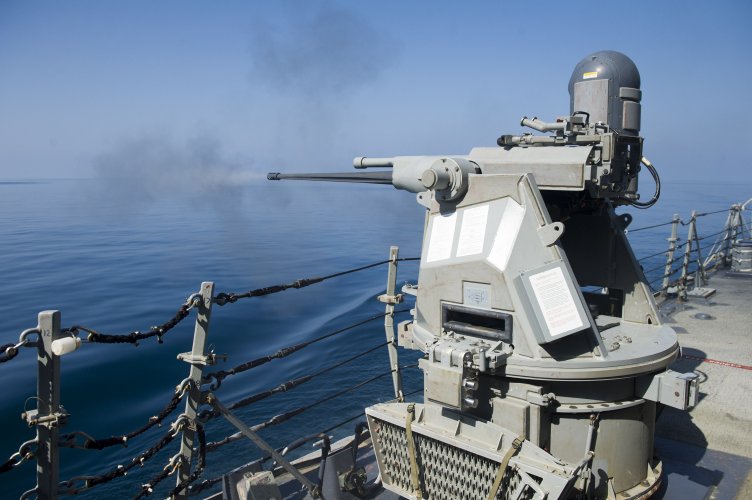
  • Firing_a_Mk_38_25mm_autocannon_by_remote_control_-160301-N-VE959-131_(25434908752).jpg
    Firing_a_Mk_38_25mm_autocannon_by_remote_control_-160301-N-VE959-131_(25434908752).jpg
    924.2 KB · Views: 30
A Mk38 is okay for shooting at dudes in speedboats but not much else.
The older mods were never even particularly good at that.
The mod4 with airburting ammo is a completely different system, and will be a reasonable choice for drone defense.

Still not quite a CIWS though
 
Good luck with 50mm and 60mm projectiles. My statement was about layered defence so the coice of weapons on the inner "last ditch" layer is not relevant to guided projectiles, which are relevant to the next layer. A 35mm CIWS is supposed to pick up what gets through, so that means it may be a multipurpose gun but its CIWS role is dealing with stuff thats already gone wrong. At this point we are trying to turn a sinking or massive fire into superficial damage.
You could’ve used google to very easily find out about 50mm EAPS or the new 50mm guided round for the XM913 or the guided projectile for the Navy’s 60mm ETC gun program.

If you’re spending money, weight, etc to achieve a close kill that damages you, would it not be better to spend that so you can achieve a more distant kill? You are not considering opportunity cost.
Again, your esteemed leaders do seem to have a knack for it.

I think your enemy will catch you out if you think you have planned perfectly. They have planned pretty well too, and sometimes they get lucky.
You cannot engineer your way out of bad leadership. If you try to make something idiot proof God will send a better idiot.

“Don’t send single unsupported ships close to the enemy’s shore while they have high capability.” is not a tall ask. There is little point in discussing scenarios where everyone involved in the planning demonstrates rank incompetence when you want to derive performance requirements.
What? How do you expect to win a naval war against a peer navy if you don’t sail forth, assert sea control, or at the very least sea denial?
Do you expect to win a naval war while sitting in port?
That’s why I’ve specified about support options. If you want to operate in that environment you’re going to need a task force with air cover at a minimum. Sending single ships in, as is presupposed in a couple of these comments, would be disastrous and foolhardy.
 
You could’ve used google to very easily find out about 50mm EAPS or the new 50mm guided round for the XM913 or the guided projectile for the Navy’s 60mm ETC gun program.

If you’re spending money, weight, etc to achieve a close kill that damages you, would it not be better to spend that so you can achieve a more distant kill? You are not considering opportunity cost.

You cannot engineer your way out of bad leadership. If you try to make something idiot proof God will send a better idiot.

“Don’t send single unsupported ships close to the enemy’s shore while they have high capability.” is not a tall ask. There is little point in discussing scenarios where everyone involved in the planning demonstrates rank incompetence when you want to derive performance requirements.

That’s why I’ve specified about support options. If you want to operate in that environment you’re going to need a task force with air cover at a minimum. Sending single ships in, as is presupposed in a couple of these comments, would be disastrous and foolhardy.
No one said single ships, however if China wants to start a fight with us they’ll likely drop a sucker punch or two on ships already in the area operating independently.

It’s like you have absolutely no imagination.
 
No one said single ships, however if China wants to start a fight with us they’ll likely drop a sucker punch or two on ships already in the area operating independently.

It’s like you have absolutely no imagination.
You’re searching for a problem for your solution.

In optimizing for one narrow range of scenarios you are reducing the budget that can go to more multirole solutions like say more missiles and VLS cells which can help out in said scenarios but are markedly superior in other possibilities (where the guns are limited/useless).

If you cannot internalize that tradeoff is an inherent part of design and procurement your understanding of these systems and the thinking behind them will remain limited.
 
You’re searching for a problem for your solution.

In optimizing for one narrow range of scenarios you are reducing the budget that can go to more multirole solutions like say more missiles and VLS cells which can help out in said scenarios but are markedly superior in other possibilities (where the guns are limited/useless).

If you cannot internalize that tradeoff is an inherent part of design and procurement your understanding of these systems and the thinking behind them will remain limited.
No I’m seeing threat scenarios and countering them in reasonable ways
 
Sometimes you simply do not have room on a hull to fit more missile canisters but do have the space you can put a CIWS of some kind. There are a great many low-cost threats which you'd do better to eliminate with a gun saving the missiles for higher threat targets.

If a bunch of shaheds are sent at your ship downing them with proximity-fuzed cannon fire is infinite better than expending missiles to do so. Your surface combatant could be dealing with many of these low-threat targets sent with the intention of depleting the expensive missiles that are needed to take out the real ship-killer AShMs.
 
Sometimes you simply do not have room on a hull to fit more missile canisters but do have the space you can put a CIWS of some kind. There are a great many low-cost threats which you'd do better to eliminate with a gun saving the missiles for higher threat targets.

If a bunch of shaheds are sent at your ship downing them with proximity-fuzed cannon fire is infinite better than expending missiles to do so. Your surface combatant could be dealing with many of these low-threat targets sent with the intention of depleting the expensive missiles that are needed to take out the real ship-killer AShMs.
My position has never been that CIWS, guns, and RWS’ are useless. It is that after a few mounts to cover arcs of fire, the marginal benefit from additional mounts is unlikely to justify the costs. Treating them as the primary method to deal with Shahed swarms is dangerous and excessively costly for the force as a whole. At those ranges you have the smallest margin for error and a more complex target environment

The best method to deal with UAS saturation is with aircraft (manned or unmanned) armed with guided weapons like APKWS. Air power has been, and for the foreseeable future will remain, the best means of countering air threats because of its mobility, sensor awareness, and simple intercept kinematics. Its advantages should be leveraged in this regard. Diverting funds from this and other longer range C-UAS tools to focus excessively on close-in defense would be a severe misallocation.

Is it possible that a ship could be overwhelmed by sheer weight of numbers? Of course but there are reasonable precautions that can be taken in the planning and execution of operations to mitigate this risk through use of the whole force instead of trying to push that capability onto every single combatant.
 
My position has never been that CIWS, guns, and RWS’ are useless. It is that after a few mounts to cover arcs of fire, the marginal benefit from additional mounts is unlikely to justify the costs. Treating them as the primary method to deal with Shahed swarms is dangerous and excessively costly for the force as a whole. At those ranges you have the smallest margin for error and a more complex target environment

The best method to deal with UAS saturation is with aircraft (manned or unmanned) armed with guided weapons like APKWS. Air power has been, and for the foreseeable future will remain, the best means of countering air threats because of its mobility, sensor awareness, and simple intercept kinematics. Its advantages should be leveraged in this regard. Diverting funds from this and other longer range C-UAS tools to focus excessively on close-in defense would be a severe misallocation.

Is it possible that a ship could be overwhelmed by sheer weight of numbers? Of course but there are reasonable precautions that can be taken in the planning and execution of operations to mitigate this risk through use of the whole force instead of trying to push that capability onto every single combatant.
I agree aircraft with low cost guided rockets engaging beyond visual range is better than the ship using shorter range guns.

However, most surface combatants only carry 1-2 helicopters, and for the USN, it’s still a pretty limited depth of magazine to engage with, and engaging with door gunners puts the helicopter in a very bad position.

Then you begin thinning things out at range with cheaper missiles like ESSM, and RAM, but it should still be guns doing the heavy lifting in terms of the ship’s onboard weapons.
 
I agree aircraft with low cost guided rockets engaging beyond visual range is better than the ship using shorter range guns.

However, most surface combatants only carry 1-2 helicopters, and for the USN, it’s still a pretty limited depth of magazine to engage with, and engaging with door gunners puts the helicopter in a very bad position.

Then you begin thinning things out at range with cheaper missiles like ESSM, and RAM, but it should still be guns doing the heavy lifting in terms of the ship’s onboard weapons.
This is why we operate the largest carrier fleet in the world. The carrier aircraft support the surface combatants with strike, CAP, ISR, and counter-ISR missions while the surface ships provide BMD and Area Air Defense for the carrier among other missions and with plenty of overlap in some. In this way platforms play to their relative strengths rather than try to do everything.
 
This is why we operate the largest carrier fleet in the world. The carrier aircraft support the surface combatants with strike, CAP, ISR, and counter-ISR missions while the surface ships provide BMD and Area Air Defense for the carrier among other missions and with plenty of overlap in some. In this way platforms play to their relative strengths rather than try to do everything.
…we can’t even relieve the Lincoln in the current war against Iran…and you think we’ll have carriers available all over the place in a conflict with China that will most likely span from the Barents Sea, to the straits of malacca at the very least.

There will be SAGs operating completely independently of the CSGs in a war with China.

Even in the current conflict we’ve had destroyers operating independently and going in harm’s way on their own. Likely the only thing that kept them from having to fend off actual drone swarms being iran’s own restraint to avoid escalating the conflict at the time.

I deployed twice with the bush CSG, yet my ship transited SoH a bunch on its own, and transited the Suez escorting subs more than a dozen times, and broke off before reaching the Middle East to putz around the Black Sea and keep an eye on what was happening there in 2014.

In a 9 month deployment as part of a CSG we spent probably 1/3 of that deployment very far away from the carrier.
 
“Don’t send single unsupported ships close to the enemy’s shore while they have high capability.” is not a tall ask. There is little point in discussing scenarios where everyone involved in the planning demonstrates rank incompetence when you want to derive performance requirements.

That’s why I’ve specified about support options. If you want to operate in that environment you’re going to need a task force with air cover at a minimum. Sending single ships in, as is presupposed in a couple of these comments, would be disastrous and foolhardy.
Normal peacetime operations usually mean sending single ships close to the enemy's shoreline.

Especially if you're talking Hormuz or Red Sea. Or the South China Sea.
 
If you’re spending money, weight, etc to achieve a close kill that damages you, would it not be better to spend that so you can achieve a more distant kill? You are not considering opportunity cost.
You spend money designing a ship with beam and displacement margins for a given VLS capacity long before you even allocate deck space for the CIWS. And perhaps spending all that money to design the ship could be done efficiently enough to produce a realistic warship in one go without having variations every other week.
You cannot engineer your way out of bad leadership. If you try to make something idiot proof God will send a better idiot.
Bad leadership and battleships... well said!
 
…we can’t even relieve the Lincoln in the current war against Iran…and you think we’ll have carriers available all over the place in a conflict with China that will most likely span from the Barents Sea, to the straits of malacca at the very least.

There will be SAGs operating completely independently of the CSGs in a war with China.

Even in the current conflict we’ve had destroyers operating independently and going in harm’s way on their own. Likely the only thing that kept them from having to fend off actual drone swarms being iran’s own restraint to avoid escalating the conflict at the time.

I deployed twice with the bush CSG, yet my ship transited SoH a bunch on its own, and transited the Suez escorting subs more than a dozen times, and broke off before reaching the Middle East to putz around the Black Sea and keep an eye on what was happening there in 2014.

In a 9 month deployment as part of a CSG we spent probably 1/3 of that deployment very far away from the carrier.
Given China's large aircraft based anti-shipping capabilities, in my opinion concerns about drones are a distant second place as to why any operation against them need air support either from land based facilities or from carriers. Failure to include it will allow them to attack relative leisure which means a far more complex and dangerous threat, setting aside attrition inflicted by one's own fighters. If you're going to include fighters you may as well use them for C-UAS since they're well suited to the task.

Normal peacetime operations usually mean sending single ships close to the enemy's shoreline.

Especially if you're talking Hormuz or Red Sea. Or the South China Sea.
This is what various forms of military intelligence are for. The threats present and poltical atmosphere needs to be considered even during peacetime. Withrawal of the singular ship could be used as a means of descalation or bringing up further support could be a means of applying additional pressure. Either may be appropriate during a political crisis. But of course intelligence failures happen, however at that point whether it can stay on station because of magazine expenditure is a distant secondary concern because it will need air cover anyways for further operations.

This is an addendum to my earlier thoughts (and possibly a result of becoming jaded over the years) but it has struck me that a putting tons of CIWS on your warship might actually put it in more danger because of a perception from elements of leadership that it is invincible [insert title card joke] even though it might not be well suited to other threats present and thus they keep it in the threat zone right up until a Mach 3 penetrator rips through it.

You spend money designing a ship with beam and displacement margins for a given VLS capacity long before you even allocate deck space for the CIWS. And perhaps spending all that money to design the ship could be done efficiently enough to produce a realistic warship in one go without having variations every other week.
There are some non-deck penetrating V(?)LS systems like Mk 56 or the Adaptable Deck launcher (among other systems like that for JAGM or Coyote launchers) but I have ammended my position that the tradeoff is largely that of funding.
 
FF/FFG: 2-3 CIWS guns, 1-2 SeaRAM, 1-2x 76 mm, ESSM (FFG)
DDG: 3-4 CIWS guns, 2-3 SeaRAM, 1-2x 5" main gun, 1x DEW, SM-x
CGN: 4-6 CIWS guns, 3-5 SeaRAM, 1-2x 6.1", 2x DEW, SM-x, CPS
BBGN: 6-8 CIWS guns, 5-8 SeaRAM, 2-4x 6.1", 4x DEW, SM-x, CPS
FFG: x4 CIWS guns, 2 RAM, 1 deck gun, 76mm preferred 5 inch
DDG: x4 CIWS with larger caliber or improved ammo capacity., x2 RAM, 5 inch deck gun
CG/CGN: really what's difference anymore in terms of tonnage. x2 main guns, or high caliber bombardment gun.
BBG/BBGN: 8-10 CIWS dual pairs. x6 RAM, x2-4 secondary 155mm guns. High caliber/high velocity bombardment gun.

Lasers well leave whether not practical testing in austere conditions.
 
Given China's large aircraft based anti-shipping capabilities, in my opinion concerns about drones are a distant second place as to why any operation against them need air support either from land based facilities or from carriers. Failure to include it will allow them to attack relative leisure which means a far more complex and dangerous threat, setting aside attrition inflicted by one's own fighters. If you're going to include fighters you may as well use them for C-UAS since they're well suited to the task.


This is what various forms of military intelligence are for. The threats present and poltical atmosphere needs to be considered even during peacetime. Withrawal of the singular ship could be used as a means of descalation or bringing up further support could be a means of applying additional pressure. Either may be appropriate during a political crisis. But of course intelligence failures happen, however at that point whether it can stay on station because of magazine expenditure is a distant secondary concern because it will need air cover anyways for further operations.

This is an addendum to my earlier thoughts (and possibly a result of becoming jaded over the years) but it has struck me that a putting tons of CIWS on your warship might actually put it in more danger because of a perception from elements of leadership that it is invincible [insert title card joke] even though it might not be well suited to other threats present and thus they keep it in the threat zone right up until a Mach 3 penetrator rips through it.


There are some non-deck penetrating V(?)LS systems like Mk 56 or the Adaptable Deck launcher (among other systems like that for JAGM or Coyote launchers) but I have ammended my position that the tradeoff is largely that of funding.
China’s strike aircraft will probably be more worried about hunting down CSGs and ARGs, than finding lone DDGs or even SAGs.

But even with aircraft included, you’re just hurting your own argument. If aircraft carrying high end missiles are a threat why in the world would you expend a major portion of your missiles on shooting down drones?

There’s a reason Ukraine has dudes with M2s in the back of pick ups shooting down drones.

1. Cost
2. Limited stock of high end interceptors.

The US has already eaten through most of its high end interceptors fighting Iran, largely shooting down drones that cost a fraction of the missiles and can be much more easily mass produced.

…and you want to waste missiles on drones in a potential fight against a nation whose missile stockpiles dwarf iran’s and whose drone production capabilities already dwarf iran’s?

You are stuck in the 2000s maybe the 2010s at best.
 
At least one Russian corvette in black sea (with two ciws and no proper RCWS) was directly saturated(all ammo in ak-630 used out) by USVs. And more or less a major reason BSF is stuck is complete lack of COIN RCWS; they thought it's someone else's problem.
CIWS and RCWS have almost polar opposite priorities.
Russian CIWS might not be suitable for shooting at USVs. Also remember the Ukrainians had 3 "wolf packs" in that fight. Two groups had been harassing the corvette to deplete ammo, while the last group engaged directly. Maybe radar or other sensors had problems feeding accurate coordinates to the most appropriate weapons. Or their longer range guns couldnt fire at manoeuvring targets.
Just replace phalanx and mk38s with something that is both less wasteful of ammo than phalanx, and higher ROF that mk38, and you have a gun that can do both jobs.
Yes theres a few off the shelf options.
In there there is nothing stopping the Navy from using the Army XM913 with a New Radar System to make a Phalanx Replacement.
The fact that its not a Navy system and therefore not marinised or integrated with Navy fire control, or tested against potential scenarios. In time maybe, but there are other systems already available for the CIWS job.
It is an option for a stand alone system that can replace the Phalanx.
No, but it might replace current Mk38 mounts where a 35mm wont fit.
If you're going to include fighters you may as well use them for C-UAS since they're well suited to the task.
Fighters are terrible at CUAS unless fitted with something like APKWS, so you might have some fighters pre-loaded for that role but a fast fighter struggles to go slow enough for guns against slow targets. If you are caught out then you are back to ship weapons.
CG/CGN: really what's difference anymore in terms of tonnage. x2 main guns, or high caliber bombardment gun.
BBG/BBGN: 8-10 CIWS dual pairs. x6 RAM, x2-4 secondary 155mm guns. High caliber/high velocity bombardment gun.
Well BBGNX I'm just going to say spend a few billion more so its unsinkable, and send it close to shore for a bombardment.

CG (or the next one might follow the new trend and be CCG) I'm pretty sure has a command element, which is focussed on AAW these days, so it certainly needs self defence but area defence involves commanding the group. It might not even have an especially high VLS load if enough "missile barges", but lets leave that can of worms. Just saying its the position in the command and sensor ecosystem, not the size of the old school guns.
 
Russian CIWS might not be suitable for shooting at USVs. Also remember the Ukrainians had 3 "wolf packs" in that fight. Two groups had been harassing the corvette to deplete ammo, while the last group engaged directly. Maybe radar or other sensors had problems feeding accurate coordinates to the most appropriate weapons. Or their longer range guns couldnt fire at manoeuvring targets.

Yes theres a few off the shelf options.

The fact that its not a Navy system and therefore not marinised or integrated with Navy fire control, or tested against potential scenarios. In time maybe, but there are other systems already available for the CIWS job.

No, but it might replace current Mk38 mounts where a 35mm wont fit.

Fighters are terrible at CUAS unless fitted with something like APKWS, so you might have some fighters pre-loaded for that role but a fast fighter struggles to go slow enough for guns against slow targets. If you are caught out then you are back to ship weapons.

Well BBGNX I'm just going to say spend a few billion more so its unsinkable, and send it close to shore for a bombardment.

CG (or the next one might follow the new trend and be CCG) I'm pretty sure has a command element, which is focussed on AAW these days, so it certainly needs self defence but area defence involves commanding the group. It might not even have an especially high VLS load if enough "missile barges", but lets leave that can of worms. Just saying its the position in the command and sensor ecosystem, not the size of the old school guns.
I mean tbh if we’re not going to arm cruisers with mk110 to act as CIWS and millennium guns for smaller ships, then we need millennium guns on everything, but for ships tipping the scales over 11k tons or so we should have a mk110 or 40mk4 as CIWS. If we can fit smaller gun systems on in one or two other spots, then sure
 
Last edited:
We now have guided ammo but imho throw mass or number of shots still matter to ensure kills especially with "hardened" threats like bombshells etc. So rate of fire and projectile mass matters. That aside muzzle velocity is key to range and KE kill effect.
But despite of over 20 years of work in guided and new ammo concepts we haven't seen much work on new cardrige sizes.
I would like to raise muzzle velocity to ~4270fps/~1300m/s that would raise range to about 2km on the low and critical end.
For example using 35 mm to shoot a sub 30mm AHEAD round. This reduces development time and cost since we only need to put both existing products together. And with the Mk3's 1100 RoF the throw weight remains almost the same, too. Though 1200 rpm would be desireable.

I'll put something together later as an overview since it seems to me we've been going in circles due to lack of data presence and some realization of fundamental issues..
 
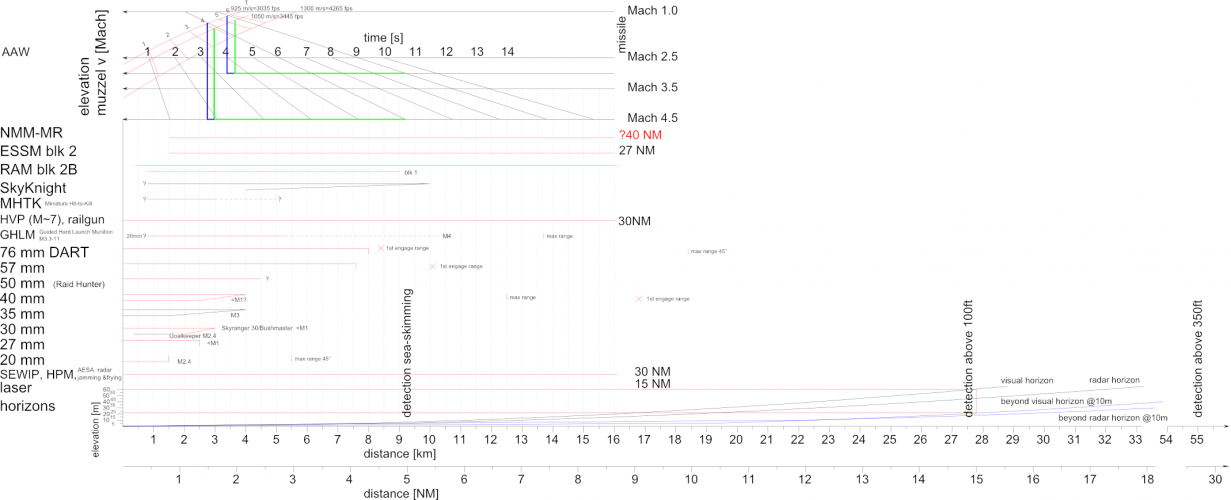
So here's a quick and dirty overview I've put together. Took me a bit of effort to adjust the plots from other sources.
In any case, a lot of information are missing. Take it with a pint of salt.
 

Attachments

  • AAW-ranges.png
    AAW-ranges.png
    265.3 KB · Views: 17
The 35mm Millennium gun is good weapon but lacks own improvements.
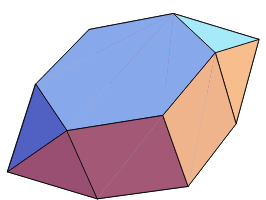
1000043670.png

Hexagonal turret support own radar. And a recess to house more ammunition. The Millennium gun 220 rounds isnt much and since doesn't utilize deck penetration. Flexible ammunition chute permit growth design more so deck sustenance to be reloaded in use.

Ammo consumption is issue, Phalanx carries 1500 rounds.
 
Hexagonal turret support own radar. And a recess to house more ammunition. The Millennium gun 220 rounds isnt much and since doesn't utilize deck penetration. Flexible ammunition chute permit growth design more so deck sustenance to be reloaded in use.

Ammo consumption is issue, Phalanx carries 1500 rounds.
Apparently, the Mk3 has a magazine with 280 rounds now. But I agree they should have given it at least the same amount as the Gepard with 320 rounds. In the end what matters is number of stored kills.
The math for this gun with AHEAD ammo seems to be 5 shots for a tight swarm, 10 shots for aircraft and a max 26 round burst for the tough ones. They originally claimed 10-20 stored kills which tracks.

Phalanx with 1500 rounds also claims 20 stored kills which doesn't track with records. I'm guessing this is for aircraft and not missiles.

In today's environment 30-40 kills would be best. Also dual feed should be standard. This would allow one magazine to be loaded while the 2nd one is being used. Regardless, loading tools must make reloading within 5-10 min possible these days.
 
I mean tbh if we’re not going to arm cruisers with mk110 to act as CIWS and millennium guns for smaller ships, then we need millennium guns on everything, but for ships tipping the scales over 11k tons or so we should have a mk110 or 40mk4 as CIWS. If we can fit smaller gun systems on in one or two other spots, then sure
Seems like all smaller ships also get Mk110 as their main gun these days, so thats an outer layer CIWS for everything. I think 35mm is a useful multipurpose innet layer CIWS for everything too, so they could function as a complementary pair. If 40mm still makes sense, its as a surface weapon to conserve 35mm ammo (like the Mk38), although only 100 ready rounds.
So here's a quick and dirty overview I've put together. Took me a bit of effort to adjust the plots from other sources.
In any case, a lot of information are missing. Take it with a pint of salt.
I noticed 8km effective range for 57mm, which I assumed was for surface craft but then it produces a much bigger cloud of tungsten so maybe thats about right. With anti-missile guided ammo, could be improved.

Bofors 40mk4 does 300rpm but allegedly not accurate enough to be CIWS beyond 2.5km, so it looks like primarily a surface weapon that only gets used as CIWS in a saturation attack.

https://www.navylookout.com/in-focus-the-bofors-40mm-mk-4-gun-that-will-equip-the-type-31-frigates/
Hexagonal turret support own radar. And a recess to house more ammunition. The Millennium gun 220 rounds isnt much and since doesn't utilize deck penetration. Flexible ammunition chute permit growth design more so deck sustenance to be reloaded in use.
I agree theres room to improve. As always. There is an E/O system available for it, but i would also like to see auto reloads from the magazine. That would involve an elevator from either a below deck magazine or an above deck system. Not sure if dual feed required, but could be if reloads take time.
They originally claimed 10-20 stored kills which tracks.
Rheinmetal website still claims 10 engagement before reload.
Regardless, loading tools must make reloading within 5-10 min possible these days.
Apparently current 228 ready rounds take 2 guys 10mjn to reload on current turret.
 
Seems like all smaller ships also get Mk110 as their main gun these days, so thats an outer layer CIWS for everything. I think 35mm is a useful multipurpose innet layer CIWS for everything too, so they could function as a complementary pair. If 40mm still makes sense, its as a surface weapon to conserve 35mm ammo (like the Mk38), although only 100 ready rounds.

I noticed 8km effective range for 57mm, which I assumed was for surface craft but then it produces a much bigger cloud of tungsten so maybe thats about right. With anti-missile guided ammo, could be improved.

Bofors 40mk4 does 300rpm but allegedly not accurate enough to be CIWS beyond 2.5km, so it looks like primarily a surface weapon that only gets used as CIWS in a saturation attack.

https://www.navylookout.com/in-focus-the-bofors-40mm-mk-4-gun-that-will-equip-the-type-31-frigates/

I agree theres room to improve. As always. There is an E/O system available for it, but i would also like to see auto reloads from the magazine. That would involve an elevator from either a below deck magazine or an above deck system. Not sure if dual feed required, but could be if reloads take time.

Rheinmetal website still claims 10 engagement before reload.

Apparently current 228 ready rounds take 2 guys 10mjn to reload on current turret.

So about 1000 meters farther than phalanx can fire, and with much better chances of actually hitting, but still with the capability to reach out beyond that 2.5km range to hope for a lucky hit well beyond that and keep on firing until the target reaches that 2.5km range if they hadn’t scored a hit before that.
 
So about 1000 meters farther than phalanx can fire, and with much better chances of actually hitting, but still with the capability to reach out beyond that 2.5km range to hope for a lucky hit well beyond that and keep on firing until the target reaches that 2.5km range if they hadn’t scored a hit before that.
There were some questions iirc whether it could elevate high enough to get those shots against some modern missiles.
 
So about 1000 meters farther than phalanx can fire, and with much better chances of actually hitting, but still with the capability to reach out beyond that 2.5km range to hope for a lucky hit well beyond that and keep on firing until the target reaches that 2.5km range if they hadn’t scored a hit before that.
Most information don't come with target details.
In this case I took the information for 3P. Looking at museum informations for 40mm L/70 (same data from the British and German) and extrapolate it looks to me 2.5 km is for subsonic (aircraft). This makes sense if you take muzzle velocity into account being similar to 35mm among others. Only the 35mm implies HARM as the target (AQM-88A has replaced AQM-37 drone as target for Navy AAW system), hence Mach 3 qualified.
 
There were some questions iirc whether it could elevate high enough to get those shots against some modern missiles.
Hard to imagine the people who have been making 40mm AA guns for 80+ years created a 40mm AA gun with insufficient elevation
 
I searched for "CIGS" and it seems to be a term used by NAVSEA to refer to the Mk.110 and Mk.38 in the context of defwnce against small boats. You could argue it just means a CIWS thats not missile based.
So about 1000 meters farther than phalanx can fire, and with much better chances of actually hitting, but still with the capability to reach out beyond that 2.5km range to hope for a lucky hit well beyond that and keep on firing until the target reaches that 2.5km range if they hadn’t scored a hit before that.
So 40mk4 can be used in the CIWS role but its a compromise. Probably oriented to surface defence if it has below deck magazine, but with only 100 ready rounds and 300rpm its got 20s of firing time so you probably aren't wasting them.
40mm AA guns aren't CIGS.
Looks like they are but somewhat limited, so not the primary AA defence if you have another gun.
 
I was being a bit sarcastic. CIWS, CIGS, and ILDS are all overlapped terms but they are used to accent roles. CIWS implies the ability to articulate enough to handle high angles. CIGS implies counter boat and slow air defenses. ILDS is Europe not being American lol. But honestly there is not definitive meaning between any one term.
 
Bofors Mk4 max elevation is 80 degrees, Phalanx is 85.
 
Bofors Mk4 max elevation is 80 degrees, Phalanx is 85.
Bofors 57 mm elevation is similar per the wikipedia:
Mark 1: −10°/+78° (40°/s)
Mark 2: −10°/+75° (40°/s)
Mark 3: −10°/+77° (44°/s)
 
MeRoKa was interesting. Spanish Navy used groups of six paired 20mm guns as a defensive weapon array. Probably less interesting than Phalanx in practicality with a combined 1,440 rpm. But if they did use Oerlikon rounds (20 mm × 139 mm) which gave them salvo kills at 550 meters. They should have upgraded from twins to single French M693, as it had 900 rpm per barrel to give it 5x the total mass flow rate and used a dual feed.
 
Maybe, but what if you had an extra SeaRAM instead of a Phalanx, and that incoming weapon never got close enough to damage your ship?
You gonna shoot a dude in a boat with that? You could with Phalanx.
 
I mean tbh if we’re not going to arm cruisers with mk110 to act as CIWS and millennium guns for smaller ships, then we need millennium guns on everything, but for ships tipping the scales over 11k tons or so we should have a mk110 or 40mk4 as CIWS. If we can fit smaller gun systems on in one or two other spots, then sure.
Maybe an overview, we covered various angles and almost have a consensus of some aspects.

There is now a greater chance of multiple incoming weapons penetrating outer defensive layers, and potentially being combined with cheap/subsonic drones (air and surface, maybe submersible) in a way intended to deplete ammunition. CIWS may engage at the longer range but will consume more ammo than at their optimum engagement range.

Ballistic attacks are especially difficult to defend against because they are fast and tend to retain their trajectory despite aerodynamic damage.

So inside the outer missile interceptor layers we have:
  • Future pulsed laser weapons, and smaller dazzlers like HELIOS.
  • RAM launchers and other VSHORAD missile based CIWS, primarily against supersonic AShMs. RAM is effective out to 4km to 8km depending on target difficulty. Some other VSHORAD systems might have more range.
  • STRALES type 76mm guns, including guided rounds for both air and surface targets.
  • Mk110 type Bofors 57mm guns, including guided rounds for surface targets but guided AA rounds in perpetual development may become useful against ballistic & hypersonic. Unguided 3P rounds effective 4km to 8km for air targets, dual feed 220rpm. Very useful against small boat swarms.
  • Bofors 40mm with 3P rounds effective to 2.5km against air targets, so primarily a surface gun. 100 ready rounds on mount, plus any below-deck magazine.
  • Oerlikon 35mm gun available on various mounts, generally 200 to 300 ready rounds (average 10 air targets), 1000rpm for Millennium Gun or dual guns 500rpm each for some others. Effective 3.5km to 5km with AHEAD rounds, primarily air defence but could be multi-purpose on small vessels. Appears to be current most effective short range CIWS calibre available.
  • 20mm to 30mm guns still common, useful against boat swarms but not enough range as CIWS against supersonic or swarm threats.
I dont know if its useful to suggest gun mount numbers for hypothetical ships, but with threats multiplying maybe worth a go.

57mm and 76mm guns can be used as multipurpose guns and CIWS but slower rate of fire so more filtering threats to prevent saturation. VSHORAD missile systems complement the guns, ideal against different targets. Various combinations possible with fore and aft centreline mounts, eg an A and D position.

35mm CIWS could alao be on the centreline in a "budget" frigate eg Wicher class looks to have a 35mm fore and aft. A more substantial ship (FFG equivalent) might have a 35mm with overlapping arcs covering each quadrant. May or may not be any point to have further CIWS amidships on destryer sized vessels, but those positions might be more oriented at surface fights so maybe ideal for 40mm if that role is worth having a separate calibre.
 

Similar threads

Back
Top Bottom