Modern Warship Defence (CIWS) Discussion

The 5inch can work for sub/high supersonic ASM if it has saboted rounds with terminal seekers.
But then you're limited to 5" rates of fire, 16-20 rpm for a maximum of about a minute (at which point the auto-loading drum is empty and someone needs to refill it). Even if you can guarantee a kill, 1 round per 3-4 seconds is going to be problematical if you have a swarm attack, especially if it's spread over a wide arc which is going to dilute your RoF.

A problem for the 5" in general is no one really mounts more than 1, so you're stuck to prioritizing one bearing, whereas multiple mountings of smaller MCG/CIWS systems are normal giving you at least two sided fire.

Yes, an incoming AShM can potentially generate a significant change in position between a round being fired and the same round arriving at the intercept range, even with guided rounds, but you're still going to be closer with the guided rounds than without, and that miss distance is going to narrow quickly as the AShM closes and time of flight drops. Given which I'd definitely prefer a high RoF CIWS with four times the slew rate of a 5" turret for engaging multiple targets.
 
In 10s a M3 high supersonic ASM can close 10km and your 76mm round with a 1100 m/s muzzle velocity has moved 7km with a stated effective range of 8km. That says everything about why 76mm systems won't work.
So you fire the 76mm when the missile is at ~17km.


The super rapide 76mm guns also require deck penetration.
The Sovraponte does not. It's a super rapide gun with only the 76 rounds in the ready drums.

Plus, I'd honestly only have a single Sovraponte (on top of the hangar) while the other mounts were traditional super rapides.


5" guided rounds have been in development and are supposed to undergo testing next year.
The USN has been developing CLGPs since before I was born, and hasn't deployed any of them.

I don't expect the new guided round to be deployed either.


A problem for the 5" in general is no one really mounts more than 1, so you're stuck to prioritizing one bearing, whereas multiple mountings of smaller MCG/CIWS systems are normal giving you at least two sided fire.
Which is why Italy has been mounting a 5" and usually 3x 76mm.

So that they can cover multiple bearings.
 
With command guidance you need to constantly provide updates to the round as the round doesn't know where it is.
Correct. If the ships sensors are insufficient, these guns usually have a matching sensor system either on-mount or separately.
Which is why Italy has been mounting a 5" and usually 3x 76mm.
Slew rates etc must limit the size of swarm you can deal with. If anything gets inside 3km, you should have an actual 35mm CIWS for those leakers.
 
Thinking about the changing nature of air defence with AShM and drone swarms now becoming an expected feature. Mogami seems to be optimised for the occasional high performance antiship missile but no CIWS optimused for cheap or multi vector threats.

Is there any space to fit something like a couple of 35mm turrets?
 
Last edited:
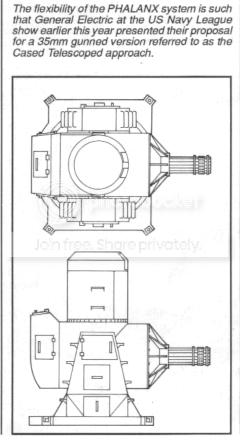
Rheinmetal's Millennium CIWS is the naval version of Skyshield using a single 35 mm Oerlikon cannon. Its the revolver cannon using programmable AHEAD 35 mm x 228 mm airburst ammunition at 1,000 rpm. The turret hold about 250 rounds. The ammunition is about 50% better range than Phalanx against incoming supersonic targets. Lockheed Martin is the American partner.

Neither 35 mm nor 76 mm is appropriate against hypersonics. What 76 mm lacks in rate it makes up in range Both can use similar technology against supersonics. The 76 mm can keep boats further away and is a good land attack option. The 5 inch is appropriate versus subsonics. The 5 inch is better against land targets but not as nimble against ships.
 
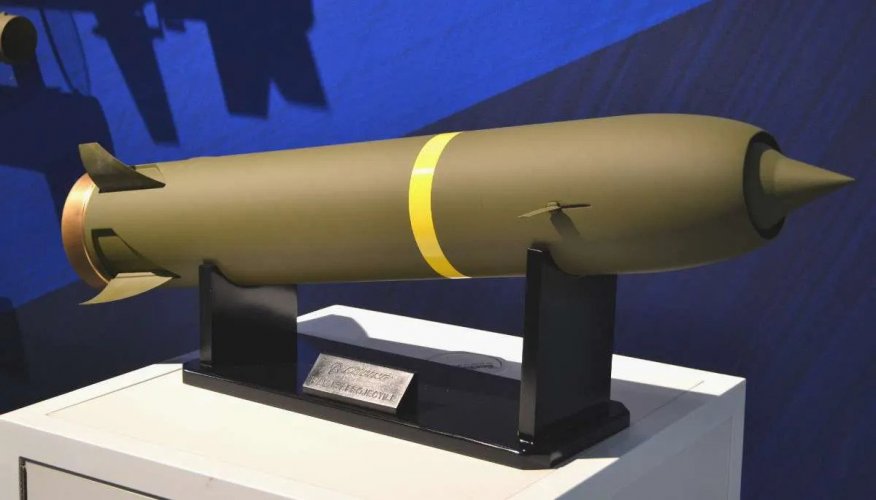
The development RamJet artillery definitely possible contribution to interception of enemy missiles. But which round? 5 inch.
Challenges would likely include upgrade mechanics to improve the guns speed of rotation and directing.
It'd also probably need improved tracking and fire director. Given potential velocity and size warhead if any, the round most likely be guided direct kinetic impact. Hypersonic weapons actually do slow down lower atmosphere. And has been shot down by missiles slower than it's own ballistics.


With smallest ramjet developed by hobbyists to 2 inches in diameter.
1000043098.jpg
 
Slew rates etc must limit the size of swarm you can deal with. If anything gets inside 3km, you should have an actual 35mm CIWS for those leakers.
And I have been insisting on 4x ~30mm CIWS guns on top of 4x C-UxV guns.
 
Correct, and it is not expected to. You have missiles for that.


At 16-18km range (depending on which mile you're talking in), you're still in ESSM range.

At 8km you're in RAM and 76mm DART/Strales range. DART is command-guided instead of terminally-guided, but that saves you from having to acceleration-harden terminal seekers.


Correct, kamikazes are basically subsonic cruise missiles. So if a whole mess of 40mm can't stop a subsonic cruise missile, what makes you think anything smaller is going to work?
…ummm much better fire control and airbursting ammo, that’s what would make me think something smaller than 40mm could stop it…
You’re talking about WWII, where even with guns being tied into FC systems were largely just relying on a single lucky hit.
Airbursting ammo whether its proximity fuzed, or electronically set timed fuze 3 rounds of 30 or 35mm bursting 9” away is going to shred the control surfaces of the missile as well as its fuselage which may not necessarily stop it, but will likely result in a miss.
 
Even if each 76mm gun can only shoot-look-shoot, that's why I am talking about 4 RAM and 4-6 76mm turrets. Each turret has its own command-link antenna attached, so you should be able to put 3x RAM and 3-4x 76mm to either quarter.

76mm DART time of flight to 5km is 5sec, even being somewhat pessimistic about the DART round's ballistic coefficient time of flight to 10km it should be less than 15sec to 10km.


Except we'd have to develop said guided round for the 5", while the rounds already exist and are in series production for the 76mm. Crud, the 76mm probably has missile/drone kills in the Red Sea.
5” has drone drone kills in the Red Sea.

https://news.usni.org/2025/01/30/cr...wn-houthi-drones-with-5-inch-gun-says-admiral

https://news.usni.org/2023/12/06/guided-missile-destroyer-uss-mason-shoots-downs-drone-in-red-sea
 
Last edited:
Aren't you confusing command guidance with semi-active guidance? The command link is probably being updated from electro-optical sensor on the ship or turret, and the on-mount radar just adds to that. Compared to the radar on a Millennium Gun just measures projectile velocity so it can update the timed airburst for the next round, targeting normally comes from ship systems or separate off-mount sensors.

I also just looked up the ORKA round. Its intended to target swarms of surface FAC, its not an anti-air projectile. USN decided it was overkill and went with the cheaper ALAMO. So there's still no guided 57mm anti-missile round, just the 3P. So theres currently less range advantage for 57mm in the AA role because 3P is unguided and loses accuracy at longer range. At least it could filter missiles that get past the RAM, probably effective 3P range less than 4km against manoeuvring ASMs. As the main air defence gun in VSHORAD range, it still shouldn't replace the last ditch CIWS role.

GOKDENIZ carries a variant of Oerlikon 35 mm twin cannon, manufactured under licence by MKEK. I think its dual feed and seems to have sensors on the mount. If Aselsan can do it, why is it so hard for America to replace the Phalanx...
57mm will not be filtering out missiles that leak through RAM coverage. for LCSes the RAM is the secondary choice.

RAM holds fire for the highest kill probability so it doesn’t fire at targets toward its max range generally, and generally fires around half its maximum range.
 
The Sovraponte does not. It's a super rapide gun with only the 76 rounds in the ready drums.
Apparently Mk110 can also lose the below deck magazine, but then few rounds in the turret.
turret hold about 250 rounds.
228 i think.
Airbursting ammo whether its proximity fuzed, or electronically set timed fuze
Just had a thought (i know dangerous). Proximity fuze would detonate at roughly same distance from target, regardless of target speed. With a wide variation of possible subsonic to hypersonic targets, timed airburst allows automatically adjusting it to get optimum spread of tungsten.
RAM holds fire for the highest kill probability so it doesn’t fire at targets toward its max range generally, and generally fires around half its maximum range.
So unguided 57mm would pretty much get fired at same time as RAM...
 
Thinking about the changing nature of air defence with AShM and drone swarms now becoming an expected feature. Mogami seems to be optimised for the occasional high performance antiship missile but no CIWS optimused for cheap or multi vector threats.

Is there any space to fit something like a couple of 35mm turrets?
For cheap drone and low velocity targets the MK 45 127mm gun should take care of it effectively and there is two remote weapons stations one on each side for asymmetric threats.
 
For cheap drone and low velocity targets the MK 45 127mm gun should take care of it effectively and there is two remote weapons stations one on each side for asymmetric threats.
Mk45 is a slow loader with limited ready rounds, so theres manpower needed to keep loading it and the rate of fire isn't ideal for air threats especially against a swarm or decoys. Anyway 76mm and 57mm have their own issues. Remote weapon stations are really an addon for the easy targets but cant handle multiple AShMs that suddenly appear over the horizon.
 
Mk45 is a slow loader with limited ready rounds, so theres manpower needed to keep loading it and the rate of fire isn't ideal for air threats especially against a swarm or decoys. Anyway 76mm and 57mm have their own issues. Remote weapon stations are really an addon for the easy targets but cant handle multiple AShMs that suddenly appear over the horizon.

That's what the RAM is for.

The current RWS on those ships is a .50cal, which does seem a little undersized for countering USVs. I'd rather see something in the 30mm range, but that will take some rearrangement of the topsides.
 
Mk45 is a slow loader with limited ready rounds, so theres manpower needed to keep loading it and the rate of fire isn't ideal for air threats especially against a swarm or decoys. Anyway 76mm and 57mm have their own issues. Remote weapon stations are really an addon for the easy targets but cant handle multiple AShMs that suddenly appear over the horizon.
I see your point.
Mk45 is best you can have for a gun in a frigate, it can fire 20 rounds before needing manual reloading you have to hope you take care of the drones before that if you use long range guided ammunitions, US navy recent has engaged drone using mk45 in houthi conflict so it is feasible, But i get your point- https://news.usni.org/2025/01/30/cr...wn-houthi-drones-with-5-inch-gun-says-admiral
Remote weapon stations are for close asymmetric threats, personally i do not believe any CIWS can deal with AShMs especially modern once. you have to use SAM missiles for that.
It would certainly have been better if mogami has atleast two CIWS.
I hope Mogami get Laser or Microwave weapon. ASEV will be equiped with laser weapon lets hope they can put it mogami future.
 
But then you're limited to 5" rates of fire, 16-20 rpm for a maximum of about a minute (at which point the auto-loading drum is empty and someone needs to refill it). Even if you can guarantee a kill, 1 round per 3-4 seconds is going to be problematical if you have a swarm attack, especially if it's spread over a wide arc which is going to dilute your RoF.

A problem for the 5" in general is no one really mounts more than 1, so you're stuck to prioritizing one bearing, whereas multiple mountings of smaller MCG/CIWS systems are normal giving you at least two sided fire.

Yes, an incoming AShM can potentially generate a significant change in position between a round being fired and the same round arriving at the intercept range, even with guided rounds, but you're still going to be closer with the guided rounds than without, and that miss distance is going to narrow quickly as the AShM closes and time of flight drops. Given which I'd definitely prefer a high RoF CIWS with four times the slew rate of a 5" turret for engaging multiple targets.
You can engage at much longer ranges, have much higher pK per shot, and might be able to do something about hypersonics and ABSM. Out of a 5inch you can functionally have a small missile with the first stage being the gun. With a 5 inch saboted round you can likely intercept at at 30km or more which is also well before ASM start evasive manuevers making intercepts much easier. If they change to doing evasive manuevers that far out, they've just reduced their range.
So you fire the 76mm when the missile is at ~17km.


The Sovraponte does not. It's a super rapide gun with only the 76 rounds in the ready drums.

Plus, I'd honestly only have a single Sovraponte (on top of the hangar) while the other mounts were traditional super rapides.


The USN has been developing CLGPs since before I was born, and hasn't deployed any of them.

I don't expect the new guided round to be deployed either.


Which is why Italy has been mounting a 5" and usually 3x 76mm.

So that they can cover multiple bearings.
The 76mm doesn't have enough divert, and the missile has allot. 5 inch will have much more divert. The situation is very different now regarding guided rounds, it went from a difficult engineering problem to a solved one.
 
The Japan Maritime Self-Defense Force is not expected to introduce a new CIWS system.
It is thought that...
 
Last edited:
They use the Mk.45 partly because they are mindful of the need for land-attack capabilities. In this era of multi-domain warfare, there has been a concerted focus on land-attack capabilities—an emphasis that goes beyond what might strictly be necessary. They have conducted naval gunfire training directed by JTACs and have even begun using Oki-Daito Island for exercises under an agreement with the U.S. military.

This stands in contrast to the past, when land-attack training consisted merely of firing at buoys floating in the open sea.

However, it remains unclear whether they genuinely intend to deploy frigates or destroyers to positions just 10 kilometers offshore.


The Mogami ships dispensed with the CIWS because it was realized that the system had limitations when dealing with supersonic missiles.

If drones become a primary asset in naval warfare, it wouldn't be surprising to see a replacement for the CIWS added, would it?

If the mounting base for the RWS(水上艦艇用機関銃架(遠隔操作型))were reinforced, it might even be possible to accommodate 20mm-class weaponry.
 
…ummm much better fire control and airbursting ammo, that’s what would make me think something smaller than 40mm could stop it…
No, I'm saying that every video of Phalanx firing at an incoming missile has fragments hitting the ship. Every subsonic missile at that.

Supersonic missiles are carrying more energy so the defending ship catches a whole lot more fragments.


Airbursting ammo whether its proximity fuzed, or electronically set timed fuze 3 rounds of 30 or 35mm bursting 9” away is going to shred the control surfaces of the missile as well as its fuselage which may not necessarily stop it, but will likely result in a miss.
IIRC, the AHEAD type ammunition pops significantly farther forward of the incoming, like 3ft or even 3m, but it's still trying to cause the warhead to detonate.
 
The 76mm doesn't have enough divert, and the missile has allot. 5 inch will have much more divert. The situation is very different now regarding guided rounds, it went from a difficult engineering problem to a solved one.
The 76mm has wings. Not a DACS.
 
No, I'm saying that every video of Phalanx firing at an incoming missile has fragments hitting the ship. Every subsonic missile at that.

Supersonic missiles are carrying more energy so the defending ship catches a whole lot more fragments.


IIRC, the AHEAD type ammunition pops significantly farther forward of the incoming, like 3ft or even 3m, but it's still trying to cause the warhead to detonate.
Some of the Russian ASMs had ti armor/heavy steel/ti caps which prevented easy CIWS kills and helped hull penetration which is partly why the US used APDS. You'll have more of an issue with airburst and direct hit at killing/detonating those warheads.

The 76mm has wings. Not a DACS.
It's the same things. Divert measures how much it can devieat off its inital trajectory. In this case it bleeds more airspeed to divert and is less manueverable vs ASM performing evasive actions or unfavorable intercept geometeries.
 
I wonder if they couldn't detonate fuel air bombs as a ship shield to keep debris off
 
I wonder if they couldn't detonate fuel air bombs as a ship shield to keep debris off
Now you're talking about massive shock loads for a close-aboard explosion. Which tends to rupture fuel and hydraulic lines and now you have flammable liquids spraying out under high pressure, plus potential ignition sources.
 
No, I'm saying that every video of Phalanx firing at an incoming missile has fragments hitting the ship. Every subsonic missile at that.

Supersonic missiles are carrying more energy so the defending ship catches a whole lot more fragments.


IIRC, the AHEAD type ammunition pops significantly farther forward of the incoming, like 3ft or even 3m, but it's still trying to cause the warhead to detonate.
And I’d 100% rather catch fragments than a warhead, but what videos show CIWS intercepting a missile on a ship?
 
I wonder if they couldn't detonate fuel air bombs as a ship shield to keep debris off
Or just add a little bit of actual armor.
1” of armored steel, exterior hull, Kevlar sheet, then the standard 1/4” interior hull. That should be enough to stop fragments.

Don’t necessarily need to do the whole ship that way, just around the above water citadel.
Main passage ways in the middle third of the ship area, which would also likely include CIC, any spaces in the superstructure that would be manned during GQ, etc.
 
I made a mistake on 35mm fusing. Heres the update.
"The initial muzzle velocity of each round is measured after firing but prior to leaving the barrel. This information is fed back into the gun’s data processing system prior to programming the round..."

Theres also an onboard ballistics computer so doesnt have special integration problems. Apparently effective range for AHEAD could be 3.5km to 5km, probably depends how much ammunition you are prepared to waste (more for faster targets I guess). The round gets detonated 1m to 3m or more in front of the target with spin-stabilised tungsten cylinders. If you use it against surface targets its basically a frangible penetrator.

Allegedly 40mm not accurate enough to engage missiles beyond 2.5km so I'm thinking its more of a CUAS and surface gun, maybe a very reliable one.

https://www.navylookout.com/in-focus-the-bofors-40mm-mk-4-gun-that-will-equip-the-type-31-frigates/

Phalanx is inside 1km. That leaves 35mm as the most reliable CIWS inside the 57mm range. In the end 57mm would be nice fore and aft, combined with 360° overlapping 35mm coverage for average 10 engagements per gun.
 
Last edited:
No, hydraulic ruptures are not normal.
Every ship has sea trials to check for shock characteristics, so its not like every detonation would break things. You probably equate all fuel-air mixtures to expand like C4. I can assure you there is a wide spectrum of effects. The goal isn't to break stuff on your ship. The goal is to create a pressure bubble in the atmosphere to redirect debris. It doesn't exactly have to be on the ship, it can be 400 meters away in the path of debris. Basically a large scale TROPHY system for ships.
 
However the fact that there have been multiple ships that have had phalanx installed had munitions used against them, and phalanx has only ever once successfully defeated a munition in real life afaik…I’d say yeah they are pretty ineffective.
Not sure your history is correct. C-RAM had a lot of repeat success.
 

Attachments

  • 35mm_ciws_1991_1.png
    35mm_ciws_1991_1.png
    75 KB · Views: 22
Not sure your history is correct. C-RAM had a lot of repeat success.
C-RAM is its name when used ashore, and sure it worked well against mortars and shit, but there are very few examples of phalanx successfully defeating a missile aimed a ship.
 
And I have been insisting on 4x ~30mm CIWS guns on top of 4x C-UxV guns.
CIWS is a costly component that draws from the primary mission payload but offers limited value beyond serving as a goalkeeper against part of the threat spectrum.

4 modern CIWS on their own can cost you as much as a cheap surface combatant. And you need them to be modern, as threat profiles evolve.
And a non-modern one...what's the point? It will still be expensive, but it won't do its work.

Among modern combatants, only Italians buy 3 CIWS per normal ship, and that, at least to a degree, is industrial policy.
One-of-a-kind exception is Nakhimov, but that's a capital ship effectively.
 
Last edited:
CIWS is a costly component that draws from the primary mission payload but offers limited value beyond serving as a goalkeeper against part of the threat spectrum.

4 modern CIWS on their own can cost you as much as a cheap surface combatant. And you need them to be modern, as threat profiles evolve.
And a non-modern one...what's the point? It will still be expensive, but it won't do its work.

Among modern combatants, only Italians buy 3 CIWS per normal ship, and that, at least to a degree, is industrial policy.
One-of-a-kind exception is Nakhimov, but that's a capital ship effectively.
And yet everybody has them and has no plan to ditch them.
 
And yet everybody has them and has no plan to ditch them.
CIWS is still essential part ship self defense. Will it handle Hypersonics? Probably not..... Possibly.
With companies developing their own production ready versions.
As whether not handle hypersonics, question accuracy/caliber Assuming shred/distort aerodynamics a hypersonic can be rendered unsustainable drag, rips to pieces.

Can ETC guns propel hypersonic flachettes, Could coil/rail guns? Still iffy, testing is more essential.
1786559634810.png
 
And yet everybody has them and has no plan to ditch them.
I can't think of a non-American ship in build which is intending to use Phalanx. Most navies seem to be going for a mix of Italian guns with guided rounds, RAM and 20-30mm RWSs.
 
The development RamJet artillery definitely possible contribution to interception of enemy missiles. But which round? 5 inch.
Challenges would likely include upgrade mechanics to improve the guns speed of rotation and directing.
It'd also probably need improved tracking and fire director. Given potential velocity and size warhead if any, the round most likely be guided direct kinetic impact. Hypersonic weapons actually do slow down lower atmosphere. And has been shot down by missiles slower than it's own ballistics.


With smallest ramjet developed by hobbyists to 2 inches in diameter.
View attachment 820724
Love it design) Almost like tiny Talos missile)
 
The issue with mounting tons of RWS' as anti Boghammer/USV duty is that there are better solutions. Sending a helicopter with guided weapons (JAGM or APKWS) gives you good standoff in case they have unguided rockets or ATGMs and for saturation attacks light VLS with JAGM or incorporating guided weapons onto the RWS mounts will provide better defense (in addition RAM does have an anti-surface mode).

This doesn't mean you shouldn't have a couple but it does mean that there are significant diminishing returns after the first couple mounts.

It's important to distinguish between additional capabilities against categories of threats and marginal improvements.

For another example it can be a given that a ship will have a 5" gun for shore bombardment/anti ship/general utility. If we give that guided rounds like HVP, how much additional utility would adding a 57 or 76mm gun with capabilities that heavily overlap bring? Can the command guidance systems effetively employ the additional rate of fire of these smaller weapons? How do the mounts integrate into the ship's overall IAMDS? Would they interfere with each other or duplicate efforts against threats leading to overkill and letting another threat slip through?

Finally what are you giving up? CIWS and gun systems are expensive, manpower intensive, and deck hungry. Would you benefit more from 32x more VLS cells or some other aspect you had to cut for the sake of their addition?

There aren't any inherent "right" answers because they fundamentally depend on air defense doctrine and expected threats but there are strong drivers as to why ships don't bristle with weapon mounts as they did in WW2.
 

Similar threads

Back
Top Bottom