How the Bf 109 E could out-turn the Spitfire Mk I

AndersJ

ACCESS: Secret
Joined
7 November 2023
Messages
354
Reaction score
900
Could the Bf 109 E really out-turn the Spifire Mk I?

Many people would probably say no: The Spitfire has both a larger wingspan and a lower wing loading. So the physics speak against the Bf 109.

In addition, lore and legend is very clear on this point, saying that while the Bf 109 certainly was fast and climbed well, it had no chance at all in a turn fight with a Spitfire.

However, this video argues that the Bf 109 E could actually out-turn the Spifire Mk I at lower altitudes by lowering its flaps in certain conditions.

But is this really true?

Well, this video aims to answer these question with the aid of a validated simulation model, more about which is covered in the video.

Also, while the video covers low level performance, the question is what happens at higher altitudes? Could the Bf 109 still stay competitive by dropping more flaps?

In addition, what happens if we assume that the Spitfire Mk I is capable of higher engine boost using 100 octane fuel? How would that affect the outcome?


A couple of questions about the model:

- Sustained turn involves having sufficient power to counteract the induced and parasitic drag. How is this taken into account? An aircraft can turn sharply for short period of time, but be unable to sustain the turn (e.g. Mirage III). I see that you mention both instantaneous and sustained turns - but what about intermediates between these two (e.g. turns which compromise to allow some altitude/energy loss, while still retaining energy).

- Also how is the maximum lift/drag ratio calculated? This will depend on the airfoil (not just the wing-loading) and different airfoils have different performance at different angles of attack.

- Does the model take into account additional drag from control surface deflections required to maintain the turn rate? Also, how parasitic drag is impacted at that angle of attack etc.

Thank you!
 
A couple of questions about the model:

- Sustained turn involves having sufficient power to counteract the induced and parasitic drag. How is this taken into account? An aircraft can turn sharply for short period of time, but be unable to sustain the turn (e.g. Mirage III). I see that you mention both instantaneous and sustained turns - but what about intermediates between these two (e.g. turns which compromise to allow some altitude/energy loss, while still retaining energy).

- Also how is the maximum lift/drag ratio calculated? This will depend on the airfoil (not just the wing-loading) and different airfoils have different performance at different angles of attack.

- Does the model take into account additional drag from control surface deflections required to maintain the turn rate? Also, how parasitic drag is impacted at that angle of attack etc.

Thank you!

This video only covers sustained turns, so the speed stays constant. But in the longer 40-minute video I will also cover instantaneous turns and you can see an example I already posted in this forum here. So in this case the speed bleeds off rapidly, but less so for the Spitfire just as expected.

And yes, the added drag due to both the profile drag going up and the added induced drag from the flaps is taken into account. In fact this is visible in the video here because as you can see, at higher speeds, the dashed blue line is below the solid blue line showing that the flaps result in more induced drag.

The maximum lift coefficient of 1.41 for the Bf 109, and 1.36 for the Spitfire without flaps on aircraft level, is very well documented, and is of course substantially lower the the circa 1.5 to 1.6 in Clmax the profiles have in 2D conditions as you would measure in a wind tunnel.

The negative effects of control surface deflections is included implicitly for both aircraft, since this effect was captured when they (the British RAE) did the Clmax tests on aircraft level using trailing pitot systems.
 
Hi Anders,

In addition, lore and legend is very clear on this point, saying that while the Bf 109 certainly was fast and climbed well, it had no chance at all in a turn fight with a Spitfire.

I totally love your analysis, but I'd also like to point out that the concept of a "turn fight" is a bit unrealistic, though of course it's very useful to know about the relative turning capabilities for any pair of fighters that might meet each other in combat.

In my opinion, the "turn fight" is only one phase in combat, which might not even occur in many actual fights. The WW2-era RAF opinion on this can be found in their 1943 manual on air combat, published by Wing Commander "Teddy" Donaldson (quoted from "Spitfire Manual 1940" edited by Dilip Sarkar, p. 201f):

"Altitude and speed are the only important points in air combat. Of course altitude can always be converted into speed merely by depressing the nose of your aircraft. I am convinced that it is suicidal to place any importance on maneuverability. Maneuverability is only a form of defense which is not required if you have sufficient speed to get out of trouble. You do not require any kind of exceptional maneuverability to attack and if you have not got the speed, the enemy can always avoid combat without relying on his powers of maneuverability to do so.

[...]

For instance, if you have an enemy pursuit ship on your tail, you don't need any advice from me on how to get rid of him (just one big kicking scrambling turn will take care of that and the enemy would be stupid, in my opinion, to attempt to stay behind you). [...] You cannot win a dog fight on maneuverability, because it is not a form of attack but merely a method of giving momentarily respite which will only last while the maneuver is being carried out.

[...]

You can [when protected by top cover] allow yourself a bit more latitude for 'ham fisted' maneuvering and you may be more successful in 'sitting' on some enemy fighter's tail until he is destroyed. Frankly, I am against even this."

This manual also contains a section authored by Wing Commander A. G. Malan:

"How many times have we been asked the same question-- 'Please sir, what do I do to get a 109 off my tail?' As if we knew. The answer really is: 'Why did you let it get there, anyway?'"

Relating the doctrine expressed in this RAF document to the later, Korean War era "No Guts, No Glory" by "Boots" Blesse, turning was about the RAF's equivalent to what Blesse considered a last ditch maneuver ("No Guts, No Glory": http://www.simhq.com/_air/PDF/NGNG.pdf ).

Again, I totally appreciate your analysis and am definitely looking forward to the more detailed video as well. I just wanted to add a bit of perspective on the tactical context to guard against the possible misunderstanding that turning capability was a dominant characteristic in fighter performance :)

Regards,

Henning (HoHun)
 
Hi Henning

Interesting quotes there from Donaldson and Malan. I had not read those before so thanks for posting.

And I absolutely agree with your point about turn fighting not being the preferred method of combat. Especially in a Bf 109. And AFAIk very few Luftwaffe pilots used it for this purpose. But there were exceptions:

And in the longer video, I will refer both to Hans-Joachim Marseille and Helmut Lipfert as examples of pilots who did (I also mention them as examples in my book). But I’m not sure if Lipfert used his flaps that often, although based on his memoirs, he does seem to have fought Russian fighters in turn fights quite often. Marseille on the other, does seem to not only have done turn fighting, but also used flaps when fighting Allied fighters in North Africa.

In addition, the video should not to be interpreted as me advocating for turn fighting, but rather as highlighting that the Bf 109 had this item in the “tool box” should it ever be needed. And as I wrote in another forum: It’s a bit like the 4-wheel drive on a SUV: You seldom need it, but when you do, you’re glad it’s there. ;)

Then about the RAF: Yes, IIRC then British pilots are said to have retorted that “turning does not win any battles” when the higher ups tried to smooth over the fact that the Fw 190 A was so much better than the Spitfire Mk V by pointing out that the Spitfire turned so much better.

But there is only so much information you can squeeze into one short video, and the longer one will have more space for nuance, and be even more clear on the fact that the Bf 109 turning better was very much the exception to the rule.

But even so, with all of that having been said, I still think it’s an interesting fact the the Bf 109 actually COULD out-turn the Spitfire by dropping flaps in certain conditions, because if you’d asked med before I did the simulations, then I would have said no, of course it can’t!
 
Hi Anders,

Then about the RAF: Yes, IIRC then British pilots are said to have retorted that “turning does not win any battles” when the higher ups tried to smooth over the fact that the Fw 190 A was so much better than the Spitfire Mk V by pointing out that the Spitfire turned so much better.

I think that's a "Johnny" Johnson quote, but if I remember correctly, Eric Brown fully agreed with this in his dicussion of the Fw 190.

Alfred Price in his "Spitfire - The Complete History" quotes an August 1942 memorandum of the Air Tactics department at the Air Ministry:

"1. This memorandum ... is intended to bring to the notice of all concerned the necessity of making full use of the power available in our Spitfire aircraft. It applies equally, in principle, to all our fighter aircraft operating against an enemy whose performance is equal or superior to our own.

2. At the present stage of the war, the enemy in France is equipped with the FW 190, a fighter with an excellent rate of climb and good acceleration. To defeat this aircraft and to avoid casualties on our side, our aircraft must fly as fast as possible whenever they are in the combat zone."

The memorandum goes on to describe the techniques for high-speed cruise in formation while in contested airspace, along with guidance for economic cruise outside contested to compensate for the necessarily increased fuel consumption during the former.

The mention of formation flying also highlights that while turning might be a viable tactic in a one-on-one encounter, the reality of air combat consisted or formations fighting each other, and turn-fighting in formation wasn't necessarily a good idea (though admittedly, the RAF tactics document I quoted above does mention defensive circles).

Regards,

Henning (HoHun)
 
Good points Henning. But I'm AFK for a few days so a longer reply will have to wait until I'm back.
 
Hi Anders,


I think that's a "Johnny" Johnson quote, but if I remember correctly, Eric Brown fully agreed with this in his dicussion of the Fw 190.

Alfred Price in his "Spitfire - The Complete History" quotes an August 1942 memorandum of the Air Tactics department at the Air Ministry:

"1. This memorandum ... is intended to bring to the notice of all concerned the necessity of making full use of the power available in our Spitfire aircraft. It applies equally, in principle, to all our fighter aircraft operating against an enemy whose performance is equal or superior to our own.

2. At the present stage of the war, the enemy in France is equipped with the FW 190, a fighter with an excellent rate of climb and good acceleration. To defeat this aircraft and to avoid casualties on our side, our aircraft must fly as fast as possible whenever they are in the combat zone."

The memorandum goes on to describe the techniques for high-speed cruise in formation while in contested airspace, along with guidance for economic cruise outside contested to compensate for the necessarily increased fuel consumption during the former.

The mention of formation flying also highlights that while turning might be a viable tactic in a one-on-one encounter, the reality of air combat consisted or formations fighting each other, and turn-fighting in formation wasn't necessarily a good idea (though admittedly, the RAF tactics document I quoted above does mention defensive circles).

Regards,

Henning (HoHun)

Hi Henning,

Yes, many pilots seem to have had the tactic to fly as fast as possible, arguing that this lessened the chance of being shot down. IIRC then Lipfert said this was Heinrich Sachsenberg’s tactic. And certainly, not only are you harder to catch, but you will also have a high energy state if bounced which makes sense. So the old adage that speed is life is probably not far off the mark.

And again, I’m not saying that any of the aircraft we saw in great numbers in WW2 were designed with turning in mind: In fact both the specification for the Spitfire and Bf 109 had two main requirements at the top of the list: Namely speed and climb. And as I write in my book, I’m sure Reginald Mitchell would have designed the Spitfire with a smaller wing if he had been given the chance.

So it seems nearly everyone agreed that speed and climb was the most important thing. Sure, the specifications were written with bomber intercepts in mind, but it turned out to be just as important for fighter versus fighter combat as well.

And yes, turning battles was probably not part of the plan generally. But as the examples I’ve brought up with Marseille, Lipfert and Godfrey show, it did still happen. Another example I can think of is Willy Reschke’s maneuvering kill of a Tempest while flying a Ta 152 H. After going round in a turn fight, the Tempest pilot eventually stalled in at low altitude due to Reschke pressuring him.

In addition, different pilots seem to have developed different tactics, and Lipfert says in his memoirs that he never got that hang of BnZ fighting and seems to have done decently even so using the Bf 109 as a turn fighter.

IRL, turning to avoid getting shot down was probably quite effective. I doubt very few back then mastered the art of pulling so much lead that the target aircraft disappeared under your nose and fire by feel. And this is what’s needed to hit a really tight turning target. I know that Marseille is said to have mastered this art, but TBH, I think it was very rare that this happened back then. Today people in simulators probably spent hundreds if not thousands of hours honing deflection shooting skills. Back then most pilots probably flew mostly uneventful missions spiced by a few seconds of firing time now and then. Hardly the environment to learn how to shoot an opponent hidden under your engine cowl.

So in summary, while certainly not winning battles, turning probably saved a lot of pilots back then, since I think most pilots attacking would simply not pull enough lead to hit you in a tight turn.
 
Hi Anders,

And yes, turning battles was probably not part of the plan generally. But as the examples I’ve brought up with Marseille, Lipfert and Godfrey show, it did still happen. Another example I can think of is Willy Reschke’s maneuvering kill of a Tempest while flying a Ta 152 H.

Absolutely, but I think one should distinguish between instantaneous and sustained turning for a better tactical appreciation, and unfortunately, the available combat descriptions are often too vague to allow this distinction. In the case of Reschke, I would say it was indeed sustained turning, but at the same time, it was a bit of "no other choice due to being low on altitude and airspeed" situation.

IRL, turning to avoid getting shot down was probably quite effective.

Fully agreed, and the WW2 RAF tactical manual I quoted above gives an interesting perspective on that as well: Regardless of whether the attacker can actually turn better than the defender, merely comitting to a turn places him in a very vulnerable situation as he might be attacked by an unseen enemy while circling with the defender. The defender on the other hand is already under attack, so his situtation doesn't deteriorate much, and the risk of being shot down by the recognized attacker outweighs the threat an unseen enemy might pose.

In short, it's always the more desparate pilot who has most to gain from circling, while the pilot in a superior position doesn't have much motivation to follow desparate manoeuvres if a quick kill doesn't seem to be assured.

I doubt very few back then mastered the art of pulling so much lead that the target aircraft disappeared under your nose and fire by feel. And this is what’s needed to hit a really tight turning target. I know that Marseille is said to have mastered this art, but TBH, I think it was very rare that this happened back then.

I agree - simulation players to day probably have more pure trigger time than some pilots during the Battle of Britain had flight hours. Deflection shooting is a trainable skill, and even in WW2, some attempts were made. The most simulator-like approach was, I believe, so so-called Jam Handy trainer, which was a cinematic simulator in which bomber gunners fired simulated guns at movie projections of attacking fighters. (I learned about his from "Operation Pinball - The USAAF's Secret Aerial Gunnery Program of WWII" by Ivan Hickman).

With regard to gunnery attacks, I think there was an alternative to tracking shots though, and that was firing from a position of intersecting flight paths, avoiding the need for stationary tracking. That could result in shorter engagement distances and allowed a clearer aim, either by letting the enemy fly through the sight horizontally, or by a technique described post-war by John Boyd in his "Aerial Attack Study": Track an imaginary target flying at a lower speed than the actual target, and let it fly through a burst with a moving impact pattern.

(Boyd actually developed this to deal with the limitations of the analogue lead-computing optical gunsights of the early jet era, but it's sort of an universal technique that I'm sure was intuitively used by many fighter pilots before he formalized it.)

This kind of non-tracking firing is where cannon outperform machine guns, as the firing windows involved necessarily are quite limited in duration. In my opinion, the cannon-armed Me 109E had a clearly superior armament to the Spitfire I's eight rifle-calibre machine gun battery even for fighter-vs.-fighter combat.

Regards,

Henning (HoHun)
 
Hi Henning,

Sure, while instantaneous turns (or high speed turns for that matter) probably were much more frequent, sustained turning was probably quite rare. In addition, I believe Marseille mostly also worked in the vertical while turning with an enemy. But key here is that he is said to have used flaps sometimes. And given how long it takes to wind them in and out, I believe he must have been at a rather stabilized speed in those cases, i.e. more or less in a sustained turn.

But again, and at the risk of repeating myself, the video is about an EXCEPTION to the rule, and I never suggested that turning with flaps was frequent IRL. But I nonetheless find it quite interesting that the Bf 109 E actually COULD out-turn a Spitfire Mk I under ANY conditions. TBH, I never expected that myself, and while I certainly would have said it lowered the stall speed and allowed a shorter turn radius before doing the simulations, that winding them out to about 20-30 degrees meant that you would at low level be able to out-turn a legend like the Spitfire under any conditions was news to me.

I would really love to see some sort of a meta analysis of representative archived gun camera film: Because I would guess that those we so often see repeated again and again on YouTube, of fighters shooting down other fighters while in tight turns and allowing just the right amount of lead, is more of an exception than the rule. That is why we see them. They are interesting to watch. But I would not be surprised if most footage in the archives are of fighters shooting far off the mark, at far to long ranges, and/or allowing too little lead and shooting behind the target aircraft in a turn, while the successes, are most likely poor blighters flying strait and level, never knowing what hit them.

Then about the amount of practice time we have today in simulators: Funnily enough, in another forum, there was a post just yesterday about this linking to a video where Christoph Bergs (Military Aviation History channel) makes the comment that ardent gamers today probably have more trigger time in simulators than IRL pilots had flight time, and thus painting a rather false picture of how easy it was for an actual WW2 pilot to shoot down an enemy plane. And I think that is a point well made.

Regarding the cannon being better even for fighter versus fighter combat at the time of the Battle of Britain? For simmers and the really good pilots IRL of the time then yes. And for downing bombers and for surprise attacks on fighters from the rear? Then yes again. But for average shots in a twisting dogfight? I’m not so sure. I would not be surprised if the 8 MG shotgun pattern sprinkling a basically un-armoured 109 in a deflection shot really was that bad at the time. In addition, 7 s of firing time is quickly over, and then its suddenly only 2 versus 8 MG’s.

Best wishes

Anders
 
Hi Anders,

And given how long it takes to wind them in and out, I believe he must have been at a rather stabilized speed in those cases, i.e. more or less in a sustained turn.

I'd tend to agree, but do we have any information at which angle the flaps were deployed?

But I nonetheless find it quite interesting that the Bf 109 E actually COULD out-turn a Spitfire Mk I under ANY conditions. TBH, I never expected that myself, and while I certainly would have said it lowered the stall speed and allowed a shorter turn radius before doing the simulations, that winding them out to about 20-30 degrees meant that you would at low level be able to out-turn a legend like the Spitfire under any conditions was news to me.

Absolutely. As you know, I've done some calculations too, but I never considered flaps. Without the use of flaps, I thought that a Me 109F-4 would probably stand a chance against one of the heavier Spitfire V variants in a pure turning fight, but that this was just the best case for the Me 109, with the Spitfire being clearly superior in all other subtype pairings.

Because I would guess that those we so often see repeated again and again on YouTube, of fighters shooting down other fighters while in tight turns and allowing just the right amount of lead, is more of an exception than the rule. That is why we see them. They are interesting to watch.

Good point. There's actually a US report (I believe by Herbert K. Weiss/Aberdeen Proving Ground) on systematic evaluation of Luftwaffe gun camera films (though these showed attacks against bombers), and they include a discussion of the shortcomings of the available data. Sure enough, these include the exact mirror image of what you're pointing out! :)

Some of the gun camera films were removed from the dataset because they were considered "interesting to watch" and thus of propaganda value for the news reels, biasing the statistics towards, as you put it, "fighters shooting far off the mark, at far to long ranges, and/or allowing too little lead and shooting behind the target aircraft".

(This report seens to be the source of the misleading statement that average Luftwaffe pilots only scored like 2% hits against bombers ... only 2% hits were visible on film, but the report states clearly that there must have been many invisible hits, and some bombers even were considered destroyed without receiving any visible hit at all.)

Then about the amount of practice time we have today in simulators: Funnily enough, in another forum, there was a post just yesterday about this linking to a video where Christoph Bergs (Military Aviation History channel) makes the comment that ardent gamers today probably have more trigger time in simulators than IRL pilots had flight time

Damn, I thought I came up with that statement myself, but I know I watched that video when it was new, so probably I simply internalized it from that source! :-D

I'd tend to think that simulator gunnery probably is easier than real-life gunnery on top of the training advantage simulator pilots have, partially because in real life, controlling slip seems to have been really difficult, but I admit that I've not tried the most current simulation games. The WW2 Luftwaffe found in 1944 that providing an autopilot to relieve the pilots from the task of coordinating rudder on shooting runs greatly increased the number of hits, leading to the introduction of the "Jägerkurssteuerung" autopilot even on clear-weather dayfighters - as far as future production was concerned, I am not sure this had any real effects on installed hardware in WW2. (This was documented in files available on the Bundesarchiv site, I'd have to look up the signature if anyone is interested.)

Then yes again. But for average shots in a twisting dogfight? I’m not so sure. I would not be surprised if the 8 MG shotgun pattern sprinkling a basically un-armoured 109 in a deflection shot really was that bad at the time. In addition, 7 s of firing time is quickly over, and then its suddenly only 2 versus 8 MG’s.

I guess it depends a bit on the definition of "twisting dogfight" ;-) The idea that a shotgun pattern was advantageous seems to have died pretty early in the war. Ritchie's "Fighter Squadron" on the efforts of No. 1 Squadron in the Battle of France points out that once in France, his unit quickly changed to a shorter-range and, if I remember correctly, point-harmonization instead of the RAF-prescribed extensive pattern, as they found it to be a lot more effective.

The firing time really doesn't matter all that much, what's interesting is the integral of the product of rate of fire, probability of a kill per round fired (Pk), and probability of a hit per round fired (Ph). Being able to achieve a high Pk in the brief window where Ph is high makes a gun lethal even with a small ammunition supply, as with a weak battery, you will end up firing even outside the optimum firing window to achieve a kill despite your low Pk.

Also, I am not sure that it takes more skill to fire at a crossing target than it takes to fly your aircraft into a stable tracking position against a generally superior turning opponent. Firing from a position of crossing flightpaths enables the fire to keep up the speed to zoom up and to avoid the turning fight, which also help with unit cohesion, which was an important element for the effectiveness and survivability of novice pilots, so I don't see the skill question as all that one-sided here.

Regards,

Henning (HoHun)

 
Hi Henning,

AFAIK, there is no good info on how far Marseille wound out his flaps.

And as you say, the Bf 109 F-4 probably had quite a good chance against the Spitfire Mk V, especially if the Bf 109 pilot was aggressive and the Spitfire more vary of stalling. And we must not forget about Leykauf: I think there is every chance his anecdotes are quite correct: After all, much depends on the pilot.

Interesting that you and Bergs had been thinking along similar lines about “trigger time hours”. And TBH, I think most WW2 pilots who ended the war with only a handful of kills were nowhere close to being as good as some on-line “pilots” today are at deflection shooting. After all, practice makes perfect, and most WW2 pilots probably only got the chance to press the trigger every blue moon. In addition, many of them probably spent most of their career’s flying wing man, watching their boss get all the kills.

Interesting info about the "Jägerkurssteuerung". Did not know about that and does sound interesting. But I suppose it makes sense: Since in-game you quickly learn to center the ball when trying to shoot from behind at longer ranges. On a tangent to this, I find it quite amusing that Il-2, CloD and many others coded their AI to fly wings level with quite a bit of rudder deflection while being chased. TBH, I would not be surprised if this was done originally because otherwise it would have been “unrealistically easy” in-game to shoot down an unaware opponent.

In fact, this is also my theory why so many “state of the art” flight simulators have flight models which oscillate, are wobbly and have lag: Because one famous flight sim introduced this at the time when most early FM’s flew (realistically actually) like they were on rails, and this was widely lauded as bring in a new level of “realism” in flight sims. Because, as we know, in the flight sim community, more difficult must be more realistic right?

But now that I’ve flown both the Spitfire Mk IX and P-51D Mustang IRL at Sywell, I can testify that these do not feel anywhere near being rubber band suspended, exhibit lag, oscillate or wobble, but have clean crisp responses. It’s almost like they fly on rails! ;)

Cheers

Anders
 
Hi Anders,

And TBH, I think most WW2 pilots who ended the war with only a handful of kills were nowhere close to being as good as some on-line “pilots” today are at deflection shooting.

The US Navy aviators have a claim to fame in being supposedly the only fighter pilots being thoroughly trained in deflection shooting, and that's a very popular claim you'll find all over the internet. However, as the standard way of training aerial gunnery was to shoot at towed drogues, and you couldn't perform a no-deflection shot at a towed drogue without endangering the towing plane, I doubt there really was anything special about the US Navy. Lundstrom's "The First Team" contains a description of the "high side attack", in which "full deflection" shooting was supposed to be performed, and if you follow that description, the instant in which "full" (which I presume means 90 degrees) deflection in used is fleeting and at fairly long range, and the attack then develops into a chasing pursuit curve with the attacker closing to much shorter ranges. As the hit probability follows the inverse square law, I doubt the "full deflection" part of the attack made much of a difference even when executed correctly.

"The Battle of Britain" by Richard Townsend Bickles has an interesting anecdote on deflection shooting that indicates that dogue shooting could even be counter productive: Colin Falkland Grey, who scored 15.5 victories during the Battle, describes his first kill. He had 140 flight hours on Spitfire at the time, considering himself "reasonably experienced", when on July 24, 1940 he fired all his ammunition on a bomber with no effect, and in a second mission that day, fired a burst at a Me 109 similarly unsuccessfully. Continuing after that failure, he came upon another Me 109 which he mistook for a friendly Spitfire at first, and despite finding himself in a firing position suddenly, the element of surprise caused him to accidentally apply twice the deflection he intended to. "To my astonishment my first burst caught him smack amidships, and the pilot immediately baled out into the sea. From then on I always allowed twice the deflection I thought necessary and maybe even a bit more for good luck". His drogue shooting training had been against targets towed at "not much more than 100 mph", and I'd tend to think that had systematically trained pilots to underestimate the lead required.

Interesting info about the "Jägerkurssteuerung". Did not know about that and does sound interesting.

Dan Sharp posted a technical description here:

https://www.secretprojects.co.uk/th...52-projects-variants.3603/page-13#post-807936

In fact, this is also my theory why so many “state of the art” flight simulators have flight models which oscillate, are wobbly and have lag: Because one famous flight sim introduced this at the time when most early FM’s flew (realistically actually) like they were on rails, and this was widely lauded as bring in a new level of “realism” in flight sims. Because, as we know, in the flight sim community, more difficult must be more realistic right?

I didn't follow simulators so closely, but I know that the question of damping was always discussed controversely. And in parallel to your experience, one of the first guys back then to chime in with actual Spitfire stick time also pointed to the excellent damping characteristics of the real aircraft! :) In the context of what we'd nowadays would consider very crude simulations! :-D

Regards,

Henning (HoHun)
 
Hi Anders,

I would not be surprised if the 8 MG shotgun pattern sprinkling a basically un-armoured 109 in a deflection shot really was that bad at the time.

Coincedentally, I just came across this post on ww2aircraft.net:

https://ww2aircraft.net/forum/threa...he-bob.58893/page-7?post=2120306#post-2120306

It quotes Hurricane Combat: The Nine Lives of a Fighter Pilot, by K. W. Mackenzie:

The general lack of experience in shooting, using the guns, using the aircraft as a weapon and the inadequacy of the .303, except at close range, was to be the greatest shortcoming in Fighter Command during the Battle of Britain.

Now one might argue that deflection shooting was only effective at close range anyway, but unless both aircraft were in a stabilized turn, the shooting windows would likely be quite short, which favours high-firepower weapons.

The higher-firepower weapon, if provided with the same total ammunition supply, will always run out of ammunition before the lower-firepower weapon, so a lower-firepower weapon will almost always able to "redeem" itself by the metric of "duration of fire". Accordingly, I don't think the latter is terribly useful as a metric ...

Regards,

Henning (HoHun)
 
Hi Anders,


Coincedentally, I just came across this post on ww2aircraft.net:

https://ww2aircraft.net/forum/threa...he-bob.58893/page-7?post=2120306#post-2120306

It quotes Hurricane Combat: The Nine Lives of a Fighter Pilot, by K. W. Mackenzie:


Now one might argue that deflection shooting was only effective at close range anyway, but unless both aircraft were in a stabilized turn, the shooting windows would likely be quite short, which favours high-firepower weapons.

The higher-firepower weapon, if provided with the same total ammunition supply, will always run out of ammunition before the lower-firepower weapon, so a lower-firepower weapon will almost always able to "redeem" itself by the metric of "duration of fire". Accordingly, I don't think the latter is terribly useful as a metric ...

Regards,

Henning (HoHun)

Well TBH, I find it difficult to take a firm stand on which was the better armament at THIS stage in the war. Later, for sure, no argument. And cannons was the way of the future. And everyone seems to have agreed on this.

But at this stage of the war? I’m not sure all Bf 109’s even had armoured windscreens at the time? And did all have effective back- and head armour? And on the German bombers, what protected the crew on a He-111 from frontal attack?: Plexiglass. Sure, the pilots had some sort of back armour, but what about the rest of the crew? How many sat behind any sort of armour? And Stuka and Bf 110 gunners and crew? And the British did down a lot of aircraft with their 8-gun armament. We know this from the statistics. And how many returned with dead or badly wounded crew? I have seen German aircraft from the time that made it back over the channel but looked like sieves.

In the movies, you see Cops taking cover behind their squad cars, while IRL this is what happens when you shoot an AK-47 or AR-15 against a car: Straight through, and still enough oomph left to ruin anyone’s day on the other side. And the 7.92 mm and .303 “rifle” rounds used by the Bf 109 E and Spitfire Mk I are way more powerful than that. And sure, the engagement distances would have been more than the 50 m in that video, but the .303 will still pack a punch at 300 m, and aircraft grade aluminium will hardly protect you any better.

Then about the handling parts of the anecdote: Yes, the Hurricane is lauded for its handling and being a “stable gun platform”, but note that he does not say anything bad about the Spitfire. Yes, he does not say it’s stable, but he does not say it’s unstable either. That would make it OK in my book. And when I flew the Grace Spitfire myself, I did not perceive any instability. Yes, it responded immediately, so if you are ham-fisted with it then yes, that would probably throw off your aim. But unstable and wobbly like in video games? No.

Another thing that was interesting in that anecdote, was that we yet again have another pilot saying that the Hurricane Mk I turned better than the Spitfire Mk I. But given they had the same engine, and the Hurricane was heavier (i.e. a higher power loading), and had a slightly higher wing- and span loading this seems strange. Granted, it had a very thick wing profile, but this was the recurved Clark YH. So on profile level poorer than the Spitfire’s NACA 22-series. So I’m not sure the Clmax was any better? But sure, I haven’t seen any reliable data on the Hurricane’s Clmax, so that may be it.

In fact, since you also do performance simulations Henning, what is your take on this? How did the Hurricane Mk I and Spitfire Mk I compare in turns? Have you looked into this?

Best wishes

Anders
 
Last edited:
Hi Anders,

But at this stage of the war?

It's of course hard to quantify - you'd need very solid data on gunnery results, and most of the time, the results weren't known with any kind of certainty.

However, Priller in JG 26 noted some Messerschmitt came back with a lot of bullets holes all over them, one even showing a total of 90 holes. I think the USAAF later recorded hits to their four-engined bombers very carefully, using statistical analysis to estimate their vulnerability aginst enemy fire from it, so these data points might have been a basis for a more thorough analysis.

The German conclusion from their early war experience certainly was that rifle calibre machine guns were insufficiently powerful as they too often only damaged the targets, which then were able to land safely despite the damage or the wounded crews. Luftfahrt International featured a contemporary article on the protection of airframes documenting this.

One thought experiment I ran was to assign arbitrary probabilities for a kill to rounds of various calibres against the main target areas of an aircraft, along with a coarse estimation of which area proportion of the target would be vulnerable for the respective rounds at all, and then see what values one has to assume to generate at least vaguely plausible results, which would be aligned with the general trends in the armament of fighters in WW2 and afterwards. The RAF certainly considered two 12.7 mm machine guns an improvement over four 7.7 mm guns, and two 20 mm cannon an improvement over four 12.7 mm machine guns, for example.

And the British did down a lot of aircraft with their 8-gun armament. We know this from the statistics. And how many returned with dead or badly wounded crew? I have seen German aircraft from the time that made it back over the channel but looked like sieves.

True, but we don't know how many aircraft the British would have shot down with cannon armament. As pointed out above, the Germans, having been on the receiving end, concluded that rifle calibre machine guns weren't effective enough.

And sure, the engagement distances would have been more than the 50 m in that video, but the .303 will still pack a punch at 300 m, and aircraft grade aluminium will hardly protect you any better.

"Knights of the Skies" by Michael C. Fox reports on British firing tests against a Bristol Blenheim, in which 1200 rounds were fired at the bomber from 500 yards. The dummy pilot was unharmed, the dummy navigator possibly hit in the arm, and the dummy gunner killed twice over. The aircraft was a sieve but would probably have been able to land, though the trials were conducted with water in the tank and (I believe) without incendiary ammunition. The trial was repeated with a 20 mm Hispano gun, which achieved 14 hits with much more decisive results: "The tail plane and the elevators were so badly damaged that it was believed that the aircraft would have been uncontrollable after the fourth hit." Both fuel tanks were drained by the hits, and the dummy gunner was dead once more, pilot and navigator escaping unharmed.

(The Blenheim had modest amounts of 4 mm armour plating.)

Then about the handling parts of the anecdote: Yes, the Hurricane is lauded for its handling and being a “stable gun platform”, but note that he does not say anything bad about the Spitfire.

My point was that here a contemporary RAF pilot commented on the "inadequacy of the .303". I believe the Spitfire was a good gun platform too, though probably not as stable in pitch, which might affect gunnery. As I understand it, the Hurricane is often praised as good gun platform because its guns were mounted close to each other and closer to the centreline than the Spitfire's guns. Maybe the thick Hurricane wing also made it less prone to flexing under load, which would be an advantage when pulling Gs while firing.

In fact, since you also do performance simulations Henning, what is your take on this? How did the Hurricane Mk I and Spitfire Mk I compare in turns? Have you looked into this?

Yes, but it was long ago, and I don't have really solid data on the Hurricane's Clmax, so it's nothing definitive. You know how difficult it is to nail down the critical parameters ! :) But I agree with you that on the same engine, the heavier Hurricane should come out with a slower turn rate than the Spitfire, even if it could still be considered a pretty good turner.

I recently saw a Hurricane fly in formation with a Me 109, and the British fighter was really looking like the mothership the little Messerschmitt had been launched from! ;-) The advantage the Hurricane enjoys in terms of wing area is very visible for sure!

Regards,

Henning (HoHun)
 
That was interesting info about the Blenheim test Henning. TBH, and of the bat, I would have expected 1200 rounds .303 to not only “kill” a large part of the dummy crew, but also probably to be enough to disable the plane.

But then since the .303 (I assume it was mostly ball?) almost exclusively relies on kinetic energy, doing the trial at 500 yards is not very much to the .303’s advantage, and a trial at 2-300 yards would probably have been more representative.

As I recall it, Williams & Gustin set the “value” of a 20 mm Oerlikon hit to 15 rifle caliber rounds, and the 20 mm Hispano shell to 20.

So in this case the 14 Hispano hits equal only 280, which on paper then is not even 25% of the “hitting power” of the 1200 .303 rounds.

Also interesting with the “90-holed” Bf 109. That pilot seems to have been exceptionally lucky. However, we have to consider that just like Leykauf’s claim to out-turn Spitfires, is this Bf 109 that survived 90 .303 representative or an outlier? One can also give another outlier a thought: The not so lucky Bf 109 pilot who got a couple of .303 rounds through his radiators and is now resting at the bottom of the English Channel.

So the outcome is very much dependent on what is hit, and these weighted comparisons can only get us so far, since for example an AP round that goes in through the upper, and out of the lower wing skin without connecting to spars or control rods is not very well spent, just as a Mine shell that finds itself confronted by an armoured plate.

In summary, working out the optimal armament seems like a complex affair to me. And again, I have never contested that the cannon was the best long term solution. But I sometimes feel that the Battle of Britain had its fair share of myths, and I’m still not totally convinced that the 8 gun .303 armament was as bad during the BoB as they have historically been portrayed, just as I’m not totally on board with the theory that had the Bf 109 had just a little more range and endurance, then the Luftwaffe would have won the BoB.

Sure, radar was a big plus for the RAF, and the Bf 109’s range certainly hampered the Luftwaffe (although as I say in my book, maybe it was not as bad as legend has it), but I still think that what really decided the BoB was that Fighter Command was such a professional force, present in sufficient numbers, and with just as high a fighting morale, and equipped with equipment that was just as good (Spitfire) and good enough (Hurricane) that the Luftwaffe finally met its match and simply did not possess the critical mass to take out Fighter Command.

Finally, yes the Hurricane is big: Last year I visited Duxford, and the Hurricane there when seen up close appears more like a Draft Horse when compared to the Thoroughbreds the Spitfire and Bf 109. Probably stepped on some toes right there ;), but I still have to say I still stand by that statement : The former just seems a generations behind the two latter, even with the knowledge that the Hurricane bore the the brunt of the Battle of Britain.
 
Hi Anders,

But then since the .303 (I assume it was mostly ball?) almost exclusively relies on kinetic energy, doing the trial at 500 yards is not very much to the .303’s advantage, and a trial at 2-300 yards would probably have been more representative.

The ammunition was descrived as 0.303 Mk VII, which I believe was ball ammunition.

So in this case the 14 Hispano hits equal only 280, which on paper then is not even 25% of the “hitting power” of the 1200 .303 rounds.

I would think that the "hitting power" concept, or even the total energy approach I'd favour, understimates the advantage of larger projectiles as they apply concentrated damage, while the damage is more and more spread out the smaller the projectiles are. At least to the point where a projectile "overkills", that is.

Also interesting with the “90-holed” Bf 109. That pilot seems to have been exceptionally lucky. However, we have to consider that just like Leykauf’s claim to out-turn Spitfires, is this Bf 109 that survived 90 .303 representative or an outlier? One can also give another outlier a thought: The not so lucky Bf 109 pilot who got a couple of .303 rounds through his radiators and is now resting at the bottom of the English Channel.

Survivor bias is definitely something to guard against, but the fascinating thing about the USAAF method is that it compensates for that by looking at the total distribution of the hits that the survivors survived. If we'd have more data on the surviving Messerschmitt's hit counts, we'd might be able to quantify the type's vulnerability against enemy fire. The thing about Priller's anecdotal record is that the 90 holes weren't described as a freak occurrence, but as the high score in a more or less continuous distribution. At least, that's what I get in terms of vibes, as so often we are short on data to draw precise conclusions.

But I sometimes feel that the Battle of Britain had its fair share of myths, and I’m still not totally convinced that the 8 gun .303 armament was as bad during the BoB as they have historically been portrayed, just as I’m not totally on board with the theory that had the Bf 109 had just a little more range and endurance, then the Luftwaffe would have won the BoB.

I admit that I have no clear picture of what the RAF pilots thought about the 8-gun armament. The example I linked above was from a pilot who was pessimistic about the armament, and Greg of "Greg's Airplanes and Automobiles" just published a mostly boring video on the Spitfire I vs. Me 109E-3 in which he quoted Stanford Tuck as being very critical of the RAF fighters' armament, too. However, I readily concede that there might be RAF pilots that were enthusiastic about their armament whom I am not aware of.

Sure, radar was a big plus for the RAF, and the Bf 109’s range certainly hampered the Luftwaffe (although as I say in my book, maybe it was not as bad as legend has it), but I still think that what really decided the BoB was that Fighter Command was such a professional force, present in sufficient numbers, and with just as high a fighting morale, and equipped with equipment that was just as good (Spitfire) and good enough (Hurricane) that the Luftwaffe finally met its match and simply did not possess the critical mass to take out Fighter Command.

Good points. I think the Battle of Britain was fought by the Germans based on the very optimistic pre-war theories of air power that, retrospectively, expected "major" (measured at the moderate scale of pre-war air forces) bomb raids to be highly devestating and capable of bringing a nation to the brink of surrender very quickly. With the much more limited effect bombers actually had, I don't believe the defeat of Fighter Command would not have caused Britain to surrender, so in my opinion, the Battle of Britain was impossible to win for the Luftwaffe.

With regard to a calibre comparison, here's a post with a graph from a 1946 USAAF report by Herbert K Weiss and Arthur Stein (full report is linked from the post):

https://www.secretprojects.co.uk/threads/usaaf-0-60-caliber-machine-gun.14481/page-3#post-889980

It's based on pretty thorough firing trials that provided a solid statistical basis, albeit limited to a low-frontal attack angle against the (P-47) fighter target.

The smallest calibre included in the 12.7 mm Browning machine gun, and its single-hit probability for a kill that brings down the target within 5 minutes is less than 2%. The frontal attack angle probably sees the pilot better protected than a rear attack would, but 12.7 mm is quite a step up from 7.7 mm, too.

Regards,

Henning (HoHun)
 
The longer video mentioned in the opening post is now finished and released on YouTube.

This video aims to answer the question as asked in the title: Namely, how close were they in terms of turn rate and radius during the Battle of Britain time period?

Which is an issue often hotly debated in aviation forums, and which even knowledgeable persons sometimes have very different ideas about.

And while there certainly is some historical data on this subject, this is often spotty and usually limited to sustained turns at just one altitude, meaning such data can only provide a snap-shot.

But how did they really compare at other altitudes, and with different flap and power settings?

And what about instantaneous turns? I.e. turns in which the pilot trades a speed loss for a better turn rate? How do they compare under such conditions?

Added to this we have ample anecdotal evidence on how the Spitfire Mk I and Bf 109 E compared in turns. But as this video shows, such anecdotal evidence often needs to be approached with caution, since it’s not only affected by pilot skills, but can also be tainted by unrepresentative outliers.

Then there are a lot of myths surrounding the Bf 109’s leading edge slats. Such as did they really come out “with a bang”? Or smoothly and gradually? And how much drag did they cause? And did they provide any advantage in turns? And if so, how large was this?

In addition, how do different general aircraft characteristics like wing and span loading, aspect ratio, maximum lift coefficient and power loading affect an aircraft’s turn performance?

And all of these questions and more, are addressed in this longer video, which expands on the video linked in the opening post.

But there are probably other opinions on this, and perhaps even data, and it would be interesting to hear other takes on this subject.

As in is there any solid anecdotal evidence, or other data supporting or contradicting the conclusions drawn in this video?

 
Hi Anders,

The longer video mentioned in the opening post is now finished and released on YouTube.

Highly interesting, thanks a lot! :)

Regarding the sustained turn at 18000 ft, you're suggesting a course of action for the Spitfire pilot to defeat the Me 109 ... where would that region of superior excess power be in your diagram (which only shows graphs for zero excess power, I believe)?

View: https://youtu.be/0h-F1-RK7ns?t=1649


My thinking is, after a prolonged turn fight the Spitfire would probably be closely behind the Me 109, which would outturn the Spitfire at slow speed, so to employ the advantage you mentioned, the Spitfire would have to go faster ... which would make it overshoot, which the Me 109 could then use to switch to scissors to get behind the Spitfire. Did your book point out the slow-speed roll rates of both types, by the way? That might be interesting data in such a situation.

Regards,

Henning (HoHun)
 
Hi Henning,

Sure, dropping flaps in a scissors fight sounds like a plausible way to get down to these low speeds . And the scenario that I mention in the video, i.e. that both are at low speed and co-altitude is quite academic since neither pilot would probably IRL fly his plane like this.

But the idea here was to compare what the airframes as such are capable of, and in this case, to answer your question about if there are figures in the video in which you can read off the resulting climb rate I’m talking about, then no, you can’t read that off directly in any of them since as you point out, they are for zero vertical speed.

However, in the figure you refer to (about 24 min into the video), say that the Bf 109 pilot flies slow with the flaps out at 200 km/h and at a turn radius of 200 m and circa 11 deg/s turn rate, then then Spitfire can’t match that. However, if the Spitfire aims to keep in station with the Bf 109, i.e. at 11 deg/s, then if it flies at 225 km/h it can match that turn rate, but with a radius of around 330 m in lag pursuit.

So in order not to get in front of or “lap” the Bf 109, then the Spitfire pilot as I see it can either (as per the figure about 14 s into the video) reduce throttle and lower the right hand part of the doghouse chart to match the Bf 109’s 11 deg/s turn rate leading to a stalemate, or keep the throttle wide open and instead maintain the 11 deg/s turn rate and while maintaining 225 km/h TAS instead use the excess power thus made available to climb slowly in the turn. As to exactly what climb rate this would result in, I can’t extract that without modifying the code, but it should result in a gradual gain of altitude while keeping station with the Bf 109 as I see it.

Then about the roll rate: The Bf 109’s aileron gearing is optimized for higher speeds, so according to my data then the Spitfire should at these lower speeds actually have a bit better roll rate (see page 306 in my book). And this is even with the early fabric covered type ailerons that the Spitfire still had at this early stage in the war.

Best wishes

Anders
 
Last edited:
I grew up hearing the stories and seeing the film of the time. We used to go to the Odeon on a Saturday morning to see whatever was going the rounds, lots of films cheap as chips for distracting rug rats and giving our mums peace.
Now I am seeing research and testing of the old theories we were spoon fed, mostly because what we would often see was reruns of wartime Pathe news clips, propaganda and including including one "Cat's eyes Cunningham".
As kids we lapped up all sorts and questioned nothing, having grown in more ways than one, I am considering myself fortunate to benefit from folk who dig through the dross to find the facts, "We who benefit from your hard labour, salute you all". Thanks folks, for more than an overdue education.
Now, how would the Hurricane fair in the same conditions.
Sorry but I go down the Rabbit hole on a regular basis and one day, I might get out of it but I really do love it.
 
Calum E Douglas posted some contemporary documentation regarding this very topic today over in Twitter.
Added below.

View: https://x.com/CalumDouglas1/status/2093960064709042373
Sounds like @Calum Douglas has much better drinking company than I do, since none of my friends would be very interested in debating the Spitfire versus Bf 109 turn performance over beers at the local pub. ;)

But on a more serious note: First of all, I completely agree about the pilot’s importance when it comes to turns: In fact I have two slides on the subject in the longer 40 min video I posted a few weeks ago (about 7 m 15 s and 8 m 40 s into the video).

But even if the variation in pilots skills has a larger variation that the aircrafts relative performance, I still think it's an interesting exercise to work out just how big was the difference between the airframes as such, and which is what the video covers: How would they compare if we assume equally skilled pilots in both aircraft?

Also, I have absolutely no objection to the observation that turn performance was not that important in WW2, and that speed and climb was what everyone, from the procurement organizations to the pilots themselves, wanted. But still, and just like Calum Douglas points out himself, how they actually compared when in turns has always been hotly debated, and hence the reason for the video.

Finally, I don’t know if I find it perplexing that the the German aces “managed to survive and profit in the Battle of Britain when facing aircraft which could out dogfight them” because I suspect they avoided exactly that: I mean to dogfight Spitfires. They probably did more of hit and run attacks, zooming back up to their pals after each attack, and avoided turning battles with Spitfires. In addition, if you were an ace in the Luftwaffe, you could probably rely not only on your wingman, but also the other two in your “Schwarm” to cover you rear.
 
I grew up hearing the stories and seeing the film of the time. We used to go to the Odeon on a Saturday morning to see whatever was going the rounds, lots of films cheap as chips for distracting rug rats and giving our mums peace.
Now I am seeing research and testing of the old theories we were spoon fed, mostly because what we would often see was reruns of wartime Pathe news clips, propaganda and including including one "Cat's eyes Cunningham".
As kids we lapped up all sorts and questioned nothing, having grown in more ways than one, I am considering myself fortunate to benefit from folk who dig through the dross to find the facts, "We who benefit from your hard labour, salute you all". Thanks folks, for more than an overdue education.
Now, how would the Hurricane fair in the same conditions.
Sorry but I go down the Rabbit hole on a regular basis and one day, I might get out of it but I really do love it.
Well, the Hurricane is the object of another myth in my opinion: Because as far as I know, many would say that while the Spitfire was faster, the Hurricane could turn better. But the numbers and physics simply don’t support that.

But here again maybe the point @Calum Douglas brought up in his X-post is the explanation, i.e. that it was pilot skills, or maybe in this case that the Hurricane was easier to fly that is the explanation, since the hard numbers like wing- and power loading simply do not favour the Hurricane. Because on paper, the Spitfire should outperform the Hurricane across the board:

Not only should it be faster and climb better, but it should also turn and dive better. So looking at the performance numbers, then the Hurricane had nothing over the Spitfire.

But was it more rugged and easier to fly? Probably. But again, if one looks at the pure physics of how they compare, like the wing-, span- and power loading, then the Hurricane should not out-turn the Spitfire.
 
But was it more rugged and easier to fly? Probably. But again, if one looks at the pure physics of how they compare, like the wing-, span- and power loading, then the Hurricane should not out-turn the Spitfire.
I thank you, Sir.
 
Hi Anders,

Well, the Hurricane is the object of another myth in my opinion: Because as far as I know, many would say that while the Spitfire was faster, the Hurricane could turn better. But the numbers and physics simply don’t support that.

But here again maybe the point @Calum Douglas brought up in his X-post is the explanation, i.e. that it was pilot skills, or maybe in this case that the Hurricane was easier to fly that is the explanation, since the hard numbers like wing- and power loading simply do not favour the Hurricane. Because on paper, the Spitfire should outperform the Hurricane across the board:

I fully agree with you, and while Calum might have a point, I'd suggest a slightly different explanation: For pilots who know their aircraft is clearly inferior in performance, but superior in manoeuvrability, it might be more evident that they have to know how to exploit the manoevurability of the type to the fullest, and to develop tactics for using manoevrability as a regular technique in an air combat.

Pilots who can rely on performance might not give manoeuvrability the same kind of attention, but consider it mostly as a last-ditch technique.

Just my speculation, kind of "if your only tool is a hammer, you should better be a real expert in hammering" ;-)

Regards,

Henning (HoHun)
 
Hi Anders,


I fully agree with you, and while Calum might have a point, I'd suggest a slightly different explanation: For pilots who know their aircraft is clearly inferior in performance, but superior in manoeuvrability, it might be more evident that they have to know how to exploit the manoevurability of the type to the fullest, and to develop tactics for using manoevrability as a regular technique in an air combat.

Pilots who can rely on performance might not give manoeuvrability the same kind of attention, but consider it mostly as a last-ditch technique.

Just my speculation, kind of "if your only tool is a hammer, you should better be a real expert in hammering" ;-)

Regards,

Henning (HoHun)

Agreed: If your encounters with other fighters tends to be them coming down at high speed to take a pot shot at you and then zoom back up, then you obviously get a lot of practice turning. ;)

But added to this, if the aircraft you fly has a benign stall and gives clear warning (and IIRC then this was true for the Hurricane) then you are probably more comfortable taking you plane to the edge. I believe the reverse was true for the Fw 190: As I recall it, it had quite good and benign stall properties at lower speeds, but the g-stall were nasty. And in that case, even good pilots may be wary of going close to the stall in a combat turn.

In fact, I think RAE R & M 2361, Messerschmitt Me. 109 Handling and Manoeverability Tests, M. B. Morgan and D. E. Morris, September 1940 captures the pilot problem perfectly: This report states that Bf 109s managed to stay on the tails of British fighters “merely because our pilots would not tighten up the turn sufficiently from fear of stalling and spinning.”
 
Hi Anders,

But added to this, if the aircraft you fly has a benign stall and gives clear warning (and IIRC then this was true for the Hurricane) then you are probably more comfortable taking you plane to the edge.

I found this NACA report, "Measurements of the Flying Qualities of a Hawker Hurricane Airplane" ... I hope the NACA links don't break again:

https://ntrs.nasa.gov/api/citations/19930092603/downloads/19930092603.pdf

Also of interest: "Comparison of Aileron Control Characteristics as Determined in Flight Tests of P-36, P-40, Spitfire, and Hurricane Pursuit Airplanes":

https://ntrs.nasa.gov/api/citations/20150015694/downloads/20150015694.pdf

Regards,

Henning (HoHun)
 
Hi banie01,

Calum E Douglas posted some contemporary documentation regarding this very topic today over in Twitter.

Quoting Calum from there:

Its always been a bit perplexing how German aces managed to survive and profit in the Battle of Britain when facing aircraft which could out dogfight them

This report ...

http://www.wwiiaircraftperformance.org/ ... ne-109.pdf

... which was prepared by Patrick Halahan, Squadron Leader of No. 1 Squadron during the Battle of France might shed some light on this.

His conclusions were based on trials against a Me 109E captured by the French:

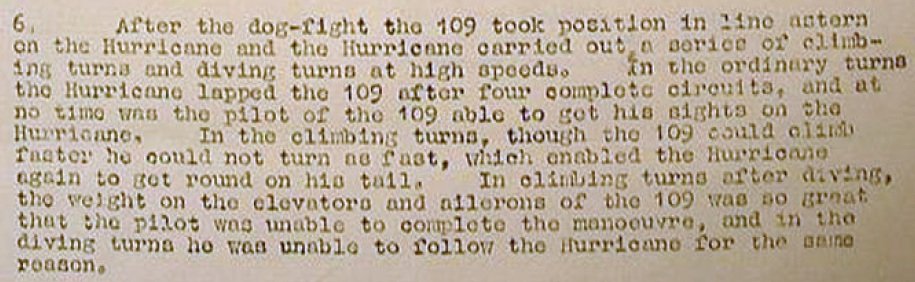
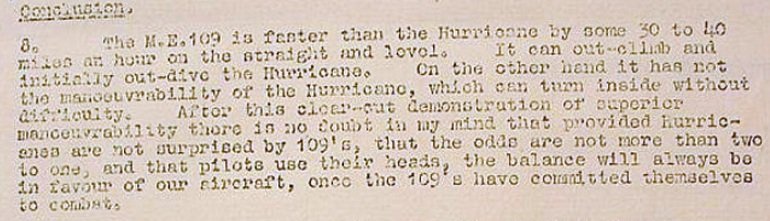
"After this clear-cut demonstration in my mind that provided Hurricanes are not surprised by 109's, that the odds are not more than two in one, and that pilots use their heads, the balance will always be in favour of our aircraft, once the 109's have committed themselves to combat."

"In this connection, judging from the tactics at present being employed by the 109's, namely sitting above us and only coming down when they can surprise a straggler, and then only completing one dive attack and climb away, I am fairly certain that the conclusion of the Gemran pilots is the same as our own, and I cannot help feeling that until all Hurricane aircraft have Constant Speed airscrews to enable them to get up to the height at present adopted by the 109's, we shall have few further chances of combat with this particular type of German aircraft."

Ironically, two days after signing the report, Halahan seems to have been shot down by a Me 109.

I would conclude that dogfighting until one aircraft has out-turned the other was not the main way in which victories were scored in WW2, as it is clear from the subsequent history of the Hurricane, even when equipped with the constant speed airscrews Halahan wished for, it was never able to achieve parity with the Me 109, which combined inferior manoeuvrability with superior performance.

Regards,

Henning (HoHun)
 
Hi Anders,


I found this NACA report, "Measurements of the Flying Qualities of a Hawker Hurricane Airplane" ... I hope the NACA links don't break again:

https://ntrs.nasa.gov/api/citations/19930092603/downloads/19930092603.pdf

Also of interest: "Comparison of Aileron Control Characteristics as Determined in Flight Tests of P-36, P-40, Spitfire, and Hurricane Pursuit Airplanes":

https://ntrs.nasa.gov/api/citations/20150015694/downloads/20150015694.pdf

Regards,

Henning (HoHun)
Yes, and as the report on the flying qualities says, the Hurricane's stall characteristics were excellent. And those NACA flying qualities reports are all very good reading I think.

For example, I deduced from the one NACA did on the Spitfire, that the problem oft said about the Spitfire that it was so sensitive in pitch since only a small deflection of the stick would result in such a large response in pitch, was in reality not such a big problem after all because the stick force gradient is such that while the stick movement itself may be small, you still need to apply force to move it, meaning it's a bit like a modern F-16: The aircraft is essentially force controlled while the stick top only moves about 1/16 of an inch.

And now having had the privilege to have flown a Spitfire myself, I can conclude that this was indeed the case. So in summary, I believe you can extract quite a lot of info from those NACA flying reports if you set your mind to it, giving me confidence that I can get a fair understanding of how it would be to fly another one of these Warbirds, just as long as there is a NACA flying qualities report on it similar to the one on the Spitfire, i.e. NACA report L 334 by Phillips and Vensel.
 
Hi banie01,


Quoting Calum from there:


This report ...

http://www.wwiiaircraftperformance.org/ ... ne-109.pdf

... which was prepared by Patrick Halahan, Squadron Leader of No. 1 Squadron during the Battle of France might shed some light on this.

His conclusions were based on trials against a Me 109E captured by the French:

"After this clear-cut demonstration in my mind that provided Hurricanes are not surprised by 109's, that the odds are not more than two in one, and that pilots use their heads, the balance will always be in favour of our aircraft, once the 109's have committed themselves to combat."

"In this connection, judging from the tactics at present being employed by the 109's, namely sitting above us and only coming down when they can surprise a straggler, and then only completing one dive attack and climb away, I am fairly certain that the conclusion of the Gemran pilots is the same as our own, and I cannot help feeling that until all Hurricane aircraft have Constant Speed airscrews to enable them to get up to the height at present adopted by the 109's, we shall have few further chances of combat with this particular type of German aircraft."

Ironically, two days after signing the report, Halahan seems to have been shot down by a Me 109.

I would conclude that dogfighting until one aircraft has out-turned the other was not the main way in which victories were scored in WW2, as it is clear from the subsequent history of the Hurricane, even when equipped with the constant speed airscrews Halahan wished for, it was never able to achieve parity with the Me 109, which combined inferior manoeuvrability with superior performance.

Regards,

Henning (HoHun)

Yes, this report is interesting reading, and while the trial was done with a Hurricane with the fixed two-position pitch system, and the report pointed out the importance of transitioning to the constant speed control, there are still some other interesting things written in it connected to turn performance, showing that the British (or at least some of them) still found comparisons of how aircraft compared in turns interesting and worthwhile to do.

And interestingly, the report concludes that as long as the Hurricanes are not surprised by 109s and have to face superior numbers, "and that pilots use their heads, that the balance will always be in favour of our aircraft, once the 109's have committed themselves to combat" ;)

Hurricane turn superiority 1.jpg Hurricane turn superiority 2.jpg
 
Hi Anders,

For example, I deduced from the one NACA did on the Spitfire, that the problem oft said about the Spitfire that it was so sensitive in pitch since only a small deflection of the stick would result in such a large response in pitch, was in reality not such a big problem after all because the stick force gradient is such that while the stick movement itself may be small, you still need to apply force to move it, meaning it's a bit like a modern F-16: The aircraft is essentially force controlled while the stick top only moves about 1/16 of an inch.

That's in fact very good to keep in mind, as there are quite a few aircraft around on which the pilots commented with phrases like "the stick felt like it was set in concrete" or "controls were practically immovable", where one might get a wrong impression about the effectiveness of these controls.

However, wasn't there a period in which the Spitfire did in fact have some problems with elevator controls being too light for safety? I seem to remember a document listing cases of in-flight failure, with what was known about the airframes and the accident details, and from Mike Crosley's books, either "They gave me a Seafire" or "Into Harm's Way", it seems at least some Spitfire variants at some point in their service lives were fitted with a bob-weight in the elevator circuit to artificially increase elevator forces under Gs. That's just from memory though, I might be misremembering ...

Regards,

Henning (HoHun)
 
Hi banie01,


Quoting Calum from there:


This report ...

http://www.wwiiaircraftperformance.org/ ... ne-109.pdf

... which was prepared by Patrick Halahan, Squadron Leader of No. 1 Squadron during the Battle of France might shed some light on this.

His conclusions were based on trials against a Me 109E captured by the French:

"After this clear-cut demonstration in my mind that provided Hurricanes are not surprised by 109's, that the odds are not more than two in one, and that pilots use their heads, the balance will always be in favour of our aircraft, once the 109's have committed themselves to combat."

"In this connection, judging from the tactics at present being employed by the 109's, namely sitting above us and only coming down when they can surprise a straggler, and then only completing one dive attack and climb away, I am fairly certain that the conclusion of the Gemran pilots is the same as our own, and I cannot help feeling that until all Hurricane aircraft have Constant Speed airscrews to enable them to get up to the height at present adopted by the 109's, we shall have few further chances of combat with this particular type of German aircraft."

Ironically, two days after signing the report, Halahan seems to have been shot down by a Me 109.

I would conclude that dogfighting until one aircraft has out-turned the other was not the main way in which victories were scored in WW2, as it is clear from the subsequent history of the Hurricane, even when equipped with the constant speed airscrews Halahan wished for, it was never able to achieve parity with the Me 109, which combined inferior manoeuvrability with superior performance.

Regards,

Henning (HoHun)
I'll dig out the actual books for the quotes later but IIRC when the Luftwaffe assess captured Spitfires & Hurricanes (aswell as Moranes & Dewoitines) Rechlin.
The general opinion given was that they were poor fighting machines and inferior to the Me109.
Similarly, when BF109s were assessed by the AFU the opinion from the pilots their mirrored the Luftwaffe.
That the BF109 was inferior to the Spitfire.
The issue being of course that each Air Force tested the aircraft with their own current operational tactics and doctrine, rather than flying the aircraft as the enemy did.

A cognitive bias on either side that missed the simple truth that pilots with time and experience on an airframe will seek to exploit their knowledge of performance and flight envelope to the maximum.
The BF109 in particular is an example of an aircraft that as an interceptor and boom and zoom fighter maintained quite a respectful capability throughout the war.

In the early war period though, I'd argue that the Luftwaffe's operational experience from Spain particularly in enabling them to fight effectively against more maneuverbile opponents.
That and the implementation of the rotte & finger four versus the RAF's Vic gave a big tactical advantage albeit one that was massively offset by the nature of pilot losses during the Battle of Britain.
 
Last edited:
I think this is a good point @banie01 : Both sides tended to think that their own equipment was superior to the oppositions. And it’s quite often myths like the Bf 109’s slats coming out with a bang and spoiling the pilots aim, and the Bf 109 lawn darting because it was impossible to recover form a dives etc. are repeated, because that was what the victors of WW2 wrote about it and what is propagated in aviation circles today.

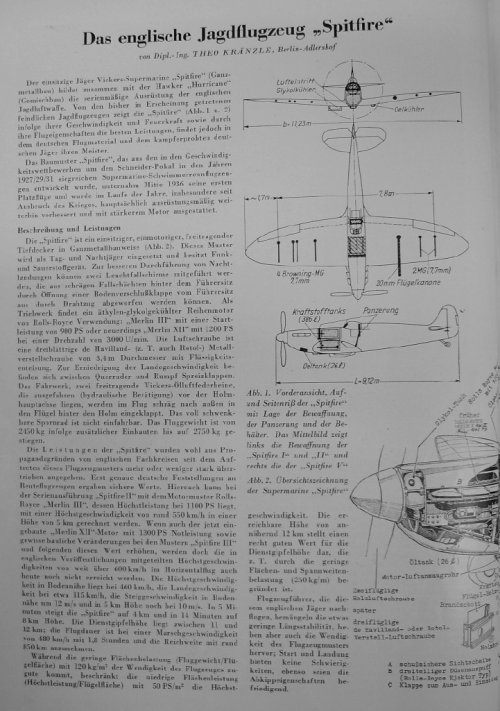
Then if you look at what the Germans thought of the Spitfire, you can see things like the snippet below from an article in Luftwissen. In addition, IIRC then many German pilots who flew captured Allied aircraft in the touring Rosarius Circus were not always so impressed with them.

Finally, I think the old saying about familiarity breeding comfort hold a grain of truth in it as well. And while my flight experience of Warbirds is limited to a couple or short hops in the Spitfire and Mustang, this certainly holds true for other aircraft I have more experience in:

Whatever quirks they may have, when you’ve flown them for a while it all feels perfectly normal and the way thing should be. Then we you return to another aircraft you flew before and remember as rather pleasant, it still takes a while before you get re-dialed back in to that one, and in a similar fashion, that this aircraft now feel like very natural to fly.

Some quotes from the attached Spitfire Luftwissen article: “The performance of the Spitfire has been greatly overrated in English technical circles. Only through thorough German measurements have the true numbers been obtained." And ”Pilots who have flown the aircraft lament its poor pitch stability”


Page 1 Lufwissen 1942 article on Spitfire.jpg
 
Hi Anders,

Interesting article, I hadn't come across this one yet! :)

I think it was the style of the time to cast doubt on the quality of enemy equipment, you see the same in the contemporary "Flight" articles.

Some quotes from the attached Spitfire Luftwissen article: “The performance of the Spitfire has been greatly overrated in English technical circles. Only through thorough German measurements have the true numbers been obtained."

The basis for the claims on exaggerated claim seem to be figures for "far beyond 600 km/h" for the Spitfire, which I think we can agree to be unrealistic for the Spitfire I, II and even V, the latter of which in the test reproduced on spitfireperformance.com averaged about 600 km/h over the various (and varying) examples tested :)

And ”Pilots who have flown the aircraft lament its poor pitch stability”

I'd read that statement actually as a bit weaker in tone, I'd translate it as "criticize the somewhat weak pitch stability".

Regards,

Henning (HoHun)
 
Back
Top Bottom