Dilandu
I'm dissatisfied, which means, I exist.
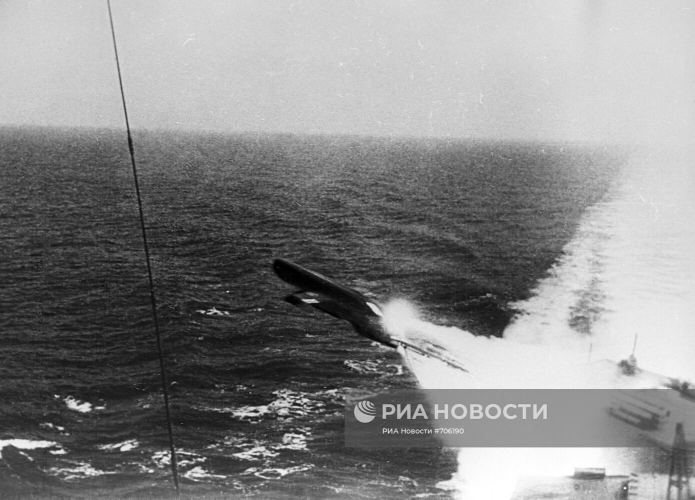
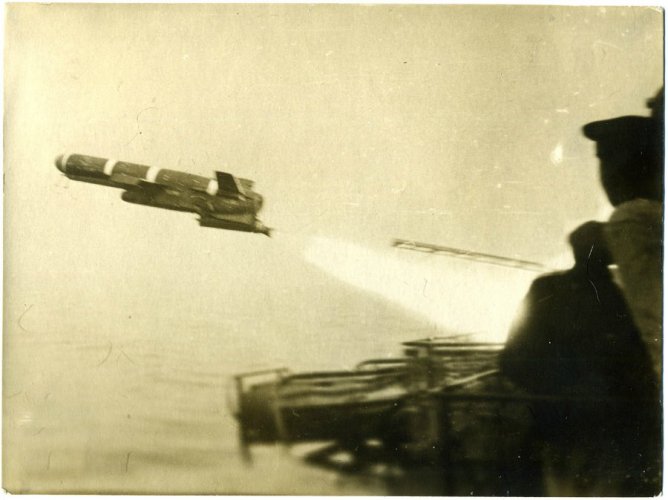
Just noticed, that forum lacked a thread about the very first shipborne anti-ship missile in service - the Soviet P-1 "Shyuka" (rus. Pike), also known as KsSH (rus. Korabelny Snaryad Shyuka - Shipborne Pike Projectile), or 4K-32, or SS-N-1 Scrubber (NATO). And this missile is pretty interesting thing)

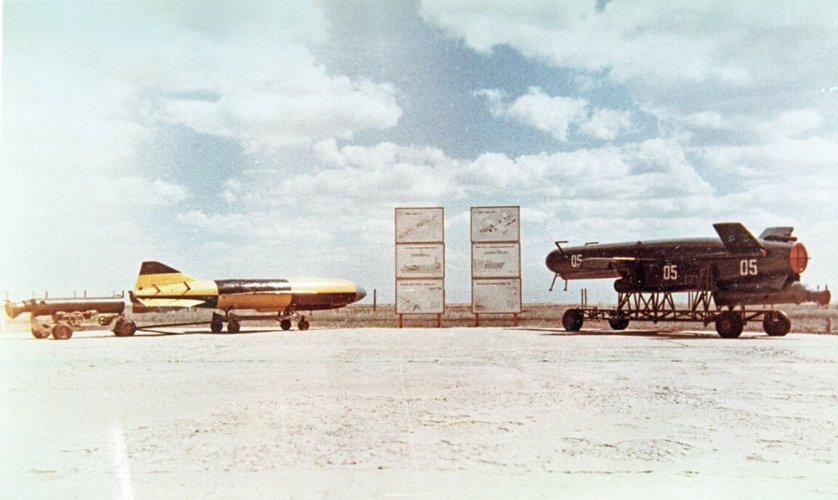
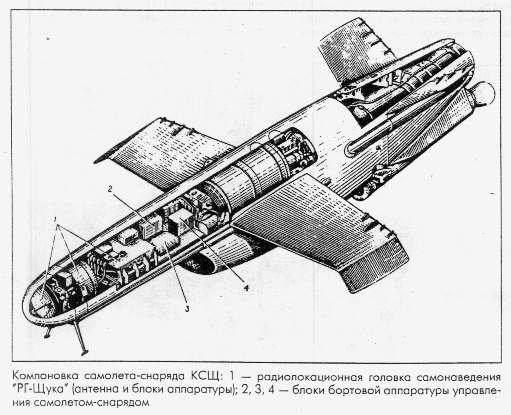
The KsSH early development history is quite a bit unclear. Officially, the missile was initially developed as air-launched missile, RAMT-1400 "Shyuka", based on German Hs.293 project. Personally, I always considered this story highly dubious - the RAMT-1400 and Hs.293 have literally zero in common:

On the other hand - and this is quite interesting - RAMT-1400 "Shyuka" looks very similar to AUM-N-6 "Puffin" missile. Essentially the only major difference is the use of liquid rocket motor on RAMT-1400 (the "Puffin" was fitted with pulsejet). But - in original plans for AUM-N-6 "Puffin", the missile was supposed to carry a liquid rocket motor!

So my personal opinion is, that origins of "Shyuka" missile actually are American (spy-delivered), and not German. Not very important, but very interesting)
Anyway, the air launched RAMT-1400 "Shyuka" was not a sucsess. Her active radar seeker (first such device, tested in USSR) was unreliable, her liquid-fuel motor was too short-legged, and generally "Shyuka" have few advantages over already-used KS-1 "Kometa" missile. So despite eventually sucsessfull test program, the air-launched version was dropped by 1955.
But Soviet Navy decided, that the active radar seeker technology have potential - for the shipborne launched missiles. Soviet Navy already tried to adopt KS-1 "Kometa" to shipborne use, but the results were unsatisfactory. The KS-1 "Kometa" used combined beam-riding (for midcourse)/semi-active homing (for terminal stage) guidance, which means that it required target to be constantly tracked by external radar beam. It was not a problem for air-launched missile, but for ship-launched one it means that targets could only be engaged within the radar horizon of launcher ship. So KS-1 "Kometa" (KSS "Strela" version) was adopted only for coastal defenses, and not warships.
Instead, Soviet Navy decided to salvage the abortive "Shyuka" program and re-work it into shipborne guided missile, capable of over-the-horizon flight.
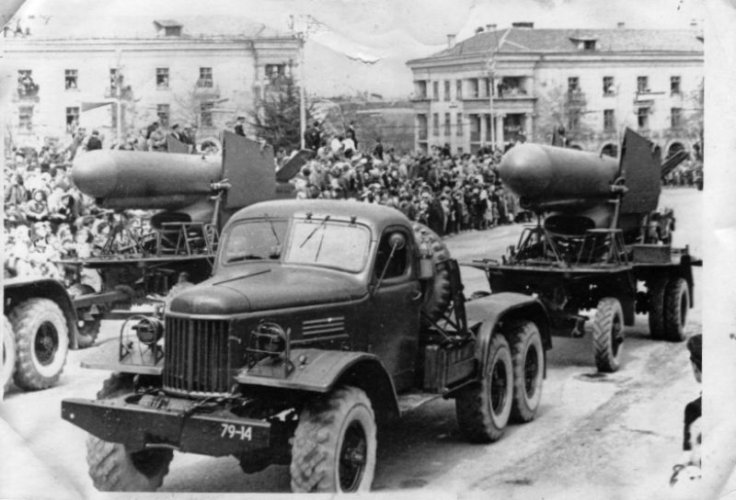
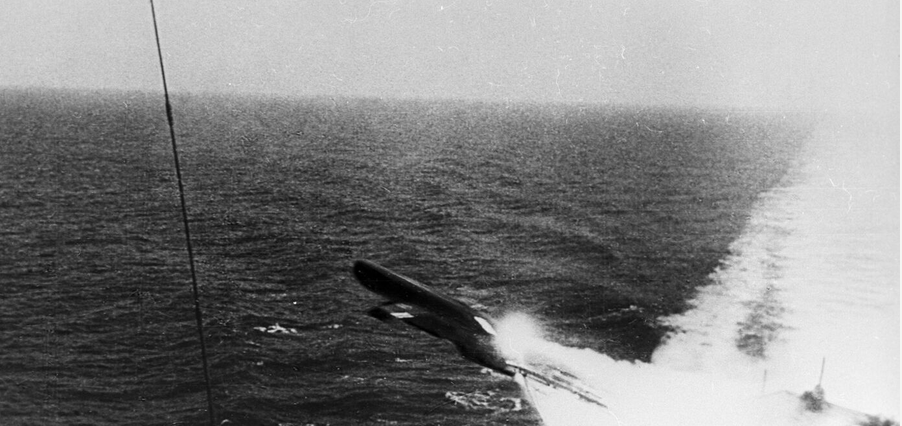
The missile was significantly re-worked to adapt it to new function, but the general shape and size retained. The liquid-rocket motor was replaced with jet engine, with under-hull air intake (the AM-5A turbojet, used on Yak-25 and some other fighters was used - mainly to reduce cost, by utilizing worn-out fighter engines for missiles). The solid-fuel rocket booster was installed. The characteristic downward-pointing wingtips were installed. As a result of such major changes, the missile appearance was... unorthodox, and universally considered to be very clumsy. The Tupolev himself, after viewing the missile mockup quipped: "It is aerodynamical abomination... but it would fly".

The shipborne missile was named "Korabelny Snaryad Shuyka" (rus. Shipborne Projectile Pike), or KsSH. It was designed as over-the-horizon weapon against enemy heavy units, cruisers and battleships mainly.
To summarize main data about KsSH missile:
* The missile was turbojet-powered, subsonic, with a max range about 100 km, and max speed of 1000 km/h (0.9 Mach). It followed about 60 meters cruising altitude, and made terminal pop-up maneuver near the target (both to confuse AA fire, and to set the correct dynamic for detachable warhead attack);
* The control system was of "bang-bang" type, i.e. V-shaped rudders were moved from "off" to "on" position & back only. The proportional guidance was achieved by rudder deflection time. As a result, the missile constantly zig-zagged along its flight path (which complicated the terminal approach, but also made missile pretty hard target for AA guns);
* The missile was equipped with active radar seeker of range-and-azimuth-only, horizontal-sweep sector scan. It have scan arc about 150 degrees wide and max detection range about 25 km. There were background noise filter (which automatically reduced clutter from ocean surface), and target signal filter (which set the minimal return signal that missile should lock on). The seeker did not have any specific anti-jamming measure, besides background noise filter. It was generally assumed that the short terminal flight time of the missile simply would not left the enemy enough time to implement sophisticated ECM's (which in 1950s were mostly manually set);
(due to limited anti-clutter ability, the missile could not be used in sea state above 4 by WMO Sea State Scale. If the waves were more than 2 meters high, the seeker would not be able to discriminate them)
* The midcourse guidance was simple bearing-following autopilot and seeker activation timer. Since the autopilot was inherited from air-launched missile - which was supposed to be launched directly at the direction of the target! - the autopilot have no capability of any pre-set bearing changes. So the missile needed to be launched directly at the direction of the target (which required trainable launcher) with distance to the target (i.e. flight time) known to correctly set the seeker activation timer;
(the notion that missile have some kind of midcourse command guidance is a common mistake, likely caused by RAMT-1400 "Shyuka" testing - early models have command guidance, because seeker was not ready yet)
* The missile was equipped with detachable "diving" warhead (about 600 kg, of which half was explosive filler), cone-shaped, placed below the missile body. Such warhead was chosen as more efficient against heavy-armored battleships with thick anti-torpedo defenses. The idea was, that the missile would dive into water about 50 meters from enemy ship hull, the warhead would detach at the entry, move underwater at curved upward trajectory, and hit the enemy battleship right into its bottom:
(the nuclear warhead was considered at some point but eventually rejected due to size restrictions)

(that's scheme for original RAMT-1400 missile, but you got the picture)
* The targeting was done by "Kiparis-56M" semi-automatic fire control system, which used data from onboard "Rif-Sh" radar to determine target bearing, heading and distance, and calculate interception point to aim missile into. Since the shipboard radar could provide only within-the-horizon targeting, the "Kiparis-56M" system was also designed from the beginning to receive targeting data from other sources - other ships or coastal radars - to provide over-the-horizon targeting (the main idea was, that destroyers with KsSH missiles would be moving behind main fleet, and use targeting from the ships close to enemy). Later models of the system allowed targeting from aerial spotters and patrol planes;
* Onboard the ship, missiles were stored with empty fuel tanks (to reduce the fire hazard in case missile magazine would be hit), wings folded. Before the launch, the missile would need to be fueled, its wings unfolded, its electronic warmed up and its gyros set. The full preparation took about 8-10 minutes; to reduce the time, one missile was usually stored inside the launcher, fully equipped (but not fueled);
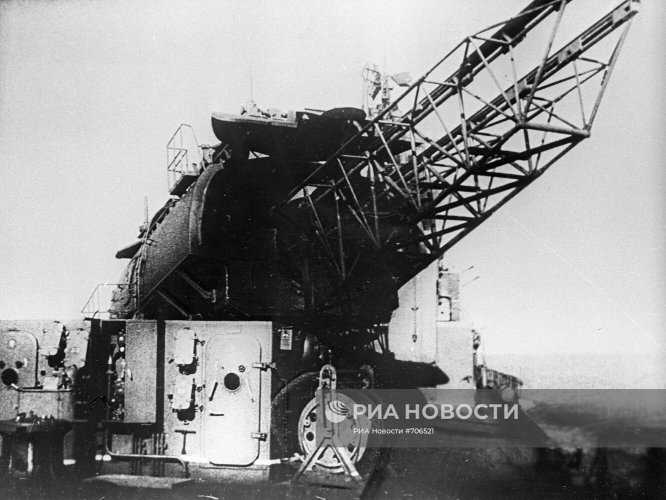
* The massive SM-59 launcher was a specially-designed, fully-stabilized trainable mount with 16-meters long launch rails. The armored "hut" of the launcher was an armored (against fragments and bullets) storage hangar for launch-ready missile. The missile was stored inside the mount fully ready to launch, but with its fuel tanks empty. The tanks were automatically fueled when the missile was ordered to be prepared for immediate launch;

* The launcher was fed from the above-deck magazine, where six missiles were stored on side racks three tiers high. The central elevator moved the chosen missile to the preparation room, from which the missile (wings unfolded and systems checked) were delivered to launcher. Total ammo supply per system was eight missiles; six in magazine, one in preparation room, and one in launcher;
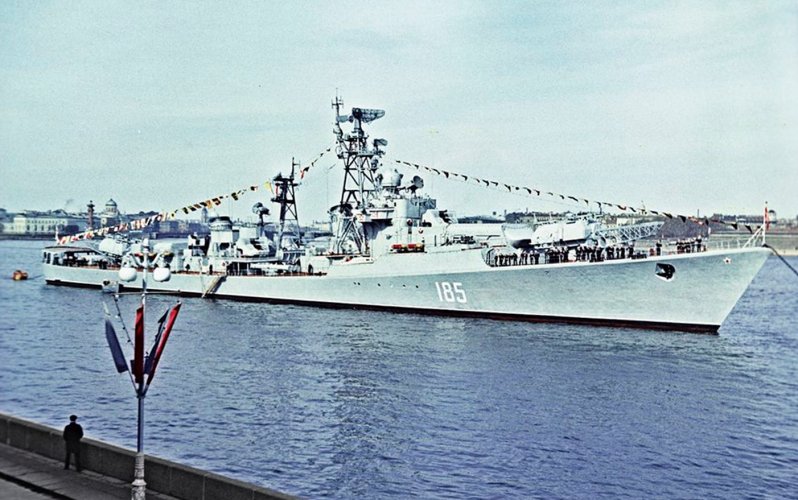
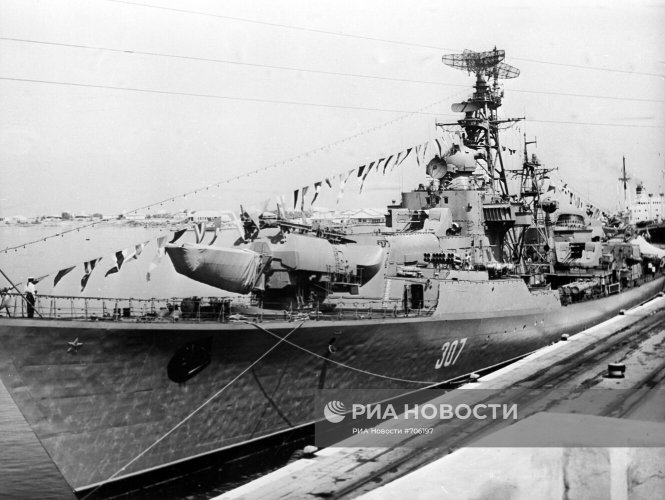
* The Project 56M destroyers have one KsSH system (eight missiles, magazine, SM-59-1 launcher, "Kiparis-56M" FCS, ect.) on the stern. The Project 57bis destroyers have two KsSH systems (with modified SM-59-1A launchers) at the bow and stern both;
* It was assumed that about 2-4 missiles (counting for possible misses) are required to guarantee a mission kill on destroyer. 6-8 missiles were required to ensure mission kill on 15.000-ton cruiser. And 16 missiles - a full supply of Project 57bis destroyer - were required to dealt with "Iowa"-class battleship;
Four Project 56M destroyers were build, the first one re-ordered from Project 56 destroyer hull, the rest were ordered separatedly (a fifth ship was planned, but cancelled). Eight more of more capable Project 57bis destroyers were build (the nine was planned, but the last one construction was delayed, and eventually it was deemed obsolete, so she was left incomplete and later rebuild into power supply vessel).

Despite major efforts, long testing program and big construction program, KsSH missile served only for about a decade. In late 1960s, they were already considered generally obsolete, due to a number of reasons:
A) The whole missile system was very bulky and clumsy, only suitable for destroyer-sized warships;
B) The seeker was very primitive, capable of working only in relatively calm weather, and easily fooled by late 1960s ECM's. While improving the seeker was possible, the missile itself was viewed as too obsolete to justify efforts;
C) The "diving" warhead never worked fully satisfactory, and significantly reduced the overall efficiency of the missile;
D) Much better systems, like P-15 "Termit" (subsonic, container-launched, much more compact) and P-35 (supersonic, twice as longer range, man-in-the-loop guidance capability) became available already in early 1960s;
So in early 1970s the KsSH missiles were decommissioned, and their carrier ships rebuild into either large missile ships (project 56U, with P-15M missiles) or anti-submarine ships (project 57A, with helicopter pad and M-1 Volna SAM).
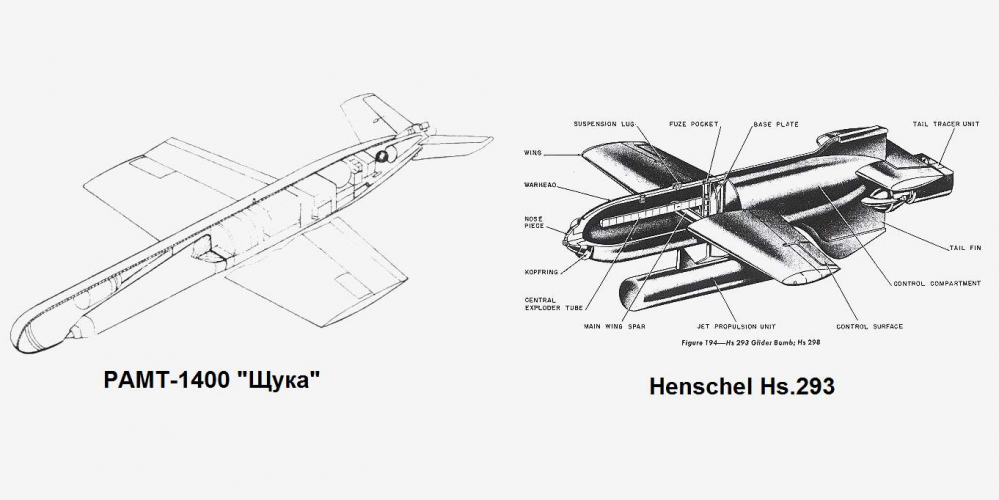
The KsSH early development history is quite a bit unclear. Officially, the missile was initially developed as air-launched missile, RAMT-1400 "Shyuka", based on German Hs.293 project. Personally, I always considered this story highly dubious - the RAMT-1400 and Hs.293 have literally zero in common:
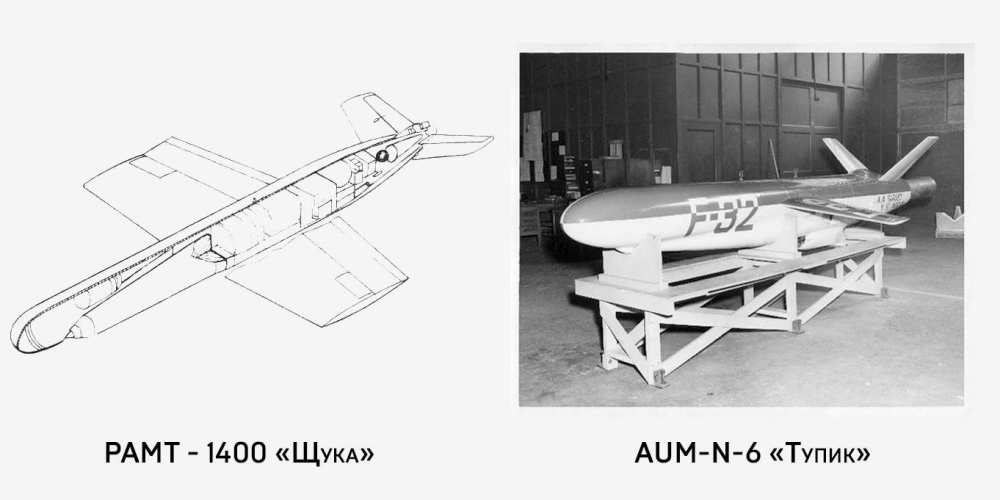
On the other hand - and this is quite interesting - RAMT-1400 "Shyuka" looks very similar to AUM-N-6 "Puffin" missile. Essentially the only major difference is the use of liquid rocket motor on RAMT-1400 (the "Puffin" was fitted with pulsejet). But - in original plans for AUM-N-6 "Puffin", the missile was supposed to carry a liquid rocket motor!
So my personal opinion is, that origins of "Shyuka" missile actually are American (spy-delivered), and not German. Not very important, but very interesting)
Anyway, the air launched RAMT-1400 "Shyuka" was not a sucsess. Her active radar seeker (first such device, tested in USSR) was unreliable, her liquid-fuel motor was too short-legged, and generally "Shyuka" have few advantages over already-used KS-1 "Kometa" missile. So despite eventually sucsessfull test program, the air-launched version was dropped by 1955.
But Soviet Navy decided, that the active radar seeker technology have potential - for the shipborne launched missiles. Soviet Navy already tried to adopt KS-1 "Kometa" to shipborne use, but the results were unsatisfactory. The KS-1 "Kometa" used combined beam-riding (for midcourse)/semi-active homing (for terminal stage) guidance, which means that it required target to be constantly tracked by external radar beam. It was not a problem for air-launched missile, but for ship-launched one it means that targets could only be engaged within the radar horizon of launcher ship. So KS-1 "Kometa" (KSS "Strela" version) was adopted only for coastal defenses, and not warships.
Instead, Soviet Navy decided to salvage the abortive "Shyuka" program and re-work it into shipborne guided missile, capable of over-the-horizon flight.
The missile was significantly re-worked to adapt it to new function, but the general shape and size retained. The liquid-rocket motor was replaced with jet engine, with under-hull air intake (the AM-5A turbojet, used on Yak-25 and some other fighters was used - mainly to reduce cost, by utilizing worn-out fighter engines for missiles). The solid-fuel rocket booster was installed. The characteristic downward-pointing wingtips were installed. As a result of such major changes, the missile appearance was... unorthodox, and universally considered to be very clumsy. The Tupolev himself, after viewing the missile mockup quipped: "It is aerodynamical abomination... but it would fly".
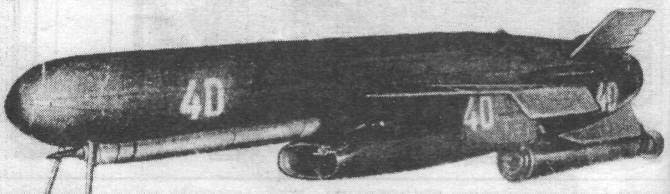
The shipborne missile was named "Korabelny Snaryad Shuyka" (rus. Shipborne Projectile Pike), or KsSH. It was designed as over-the-horizon weapon against enemy heavy units, cruisers and battleships mainly.
To summarize main data about KsSH missile:
* The missile was turbojet-powered, subsonic, with a max range about 100 km, and max speed of 1000 km/h (0.9 Mach). It followed about 60 meters cruising altitude, and made terminal pop-up maneuver near the target (both to confuse AA fire, and to set the correct dynamic for detachable warhead attack);
* The control system was of "bang-bang" type, i.e. V-shaped rudders were moved from "off" to "on" position & back only. The proportional guidance was achieved by rudder deflection time. As a result, the missile constantly zig-zagged along its flight path (which complicated the terminal approach, but also made missile pretty hard target for AA guns);
* The missile was equipped with active radar seeker of range-and-azimuth-only, horizontal-sweep sector scan. It have scan arc about 150 degrees wide and max detection range about 25 km. There were background noise filter (which automatically reduced clutter from ocean surface), and target signal filter (which set the minimal return signal that missile should lock on). The seeker did not have any specific anti-jamming measure, besides background noise filter. It was generally assumed that the short terminal flight time of the missile simply would not left the enemy enough time to implement sophisticated ECM's (which in 1950s were mostly manually set);
(due to limited anti-clutter ability, the missile could not be used in sea state above 4 by WMO Sea State Scale. If the waves were more than 2 meters high, the seeker would not be able to discriminate them)
* The midcourse guidance was simple bearing-following autopilot and seeker activation timer. Since the autopilot was inherited from air-launched missile - which was supposed to be launched directly at the direction of the target! - the autopilot have no capability of any pre-set bearing changes. So the missile needed to be launched directly at the direction of the target (which required trainable launcher) with distance to the target (i.e. flight time) known to correctly set the seeker activation timer;
(the notion that missile have some kind of midcourse command guidance is a common mistake, likely caused by RAMT-1400 "Shyuka" testing - early models have command guidance, because seeker was not ready yet)
* The missile was equipped with detachable "diving" warhead (about 600 kg, of which half was explosive filler), cone-shaped, placed below the missile body. Such warhead was chosen as more efficient against heavy-armored battleships with thick anti-torpedo defenses. The idea was, that the missile would dive into water about 50 meters from enemy ship hull, the warhead would detach at the entry, move underwater at curved upward trajectory, and hit the enemy battleship right into its bottom:
(the nuclear warhead was considered at some point but eventually rejected due to size restrictions)
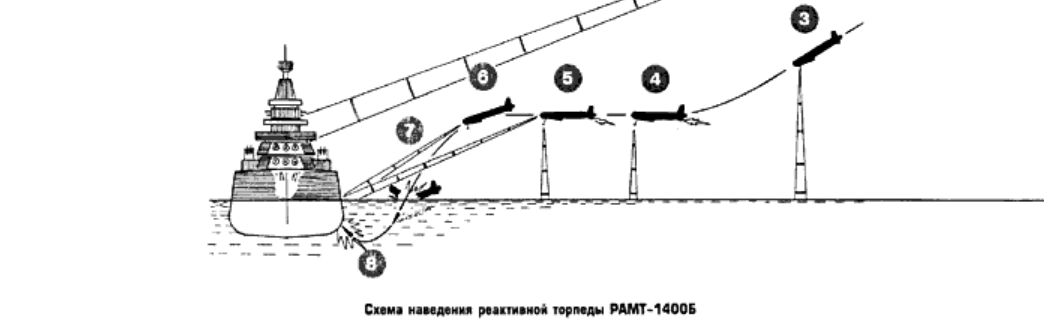
(that's scheme for original RAMT-1400 missile, but you got the picture)
* The targeting was done by "Kiparis-56M" semi-automatic fire control system, which used data from onboard "Rif-Sh" radar to determine target bearing, heading and distance, and calculate interception point to aim missile into. Since the shipboard radar could provide only within-the-horizon targeting, the "Kiparis-56M" system was also designed from the beginning to receive targeting data from other sources - other ships or coastal radars - to provide over-the-horizon targeting (the main idea was, that destroyers with KsSH missiles would be moving behind main fleet, and use targeting from the ships close to enemy). Later models of the system allowed targeting from aerial spotters and patrol planes;
* Onboard the ship, missiles were stored with empty fuel tanks (to reduce the fire hazard in case missile magazine would be hit), wings folded. Before the launch, the missile would need to be fueled, its wings unfolded, its electronic warmed up and its gyros set. The full preparation took about 8-10 minutes; to reduce the time, one missile was usually stored inside the launcher, fully equipped (but not fueled);
* The massive SM-59 launcher was a specially-designed, fully-stabilized trainable mount with 16-meters long launch rails. The armored "hut" of the launcher was an armored (against fragments and bullets) storage hangar for launch-ready missile. The missile was stored inside the mount fully ready to launch, but with its fuel tanks empty. The tanks were automatically fueled when the missile was ordered to be prepared for immediate launch;
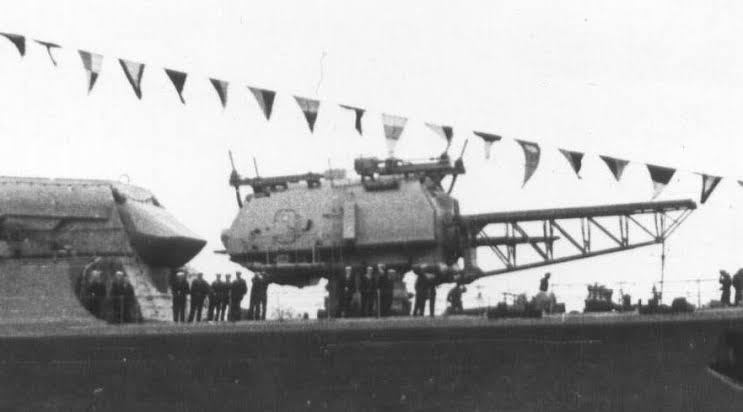
* The launcher was fed from the above-deck magazine, where six missiles were stored on side racks three tiers high. The central elevator moved the chosen missile to the preparation room, from which the missile (wings unfolded and systems checked) were delivered to launcher. Total ammo supply per system was eight missiles; six in magazine, one in preparation room, and one in launcher;
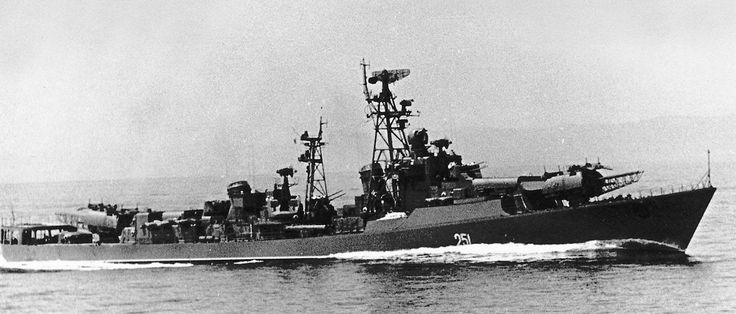
* The Project 56M destroyers have one KsSH system (eight missiles, magazine, SM-59-1 launcher, "Kiparis-56M" FCS, ect.) on the stern. The Project 57bis destroyers have two KsSH systems (with modified SM-59-1A launchers) at the bow and stern both;
* It was assumed that about 2-4 missiles (counting for possible misses) are required to guarantee a mission kill on destroyer. 6-8 missiles were required to ensure mission kill on 15.000-ton cruiser. And 16 missiles - a full supply of Project 57bis destroyer - were required to dealt with "Iowa"-class battleship;
Four Project 56M destroyers were build, the first one re-ordered from Project 56 destroyer hull, the rest were ordered separatedly (a fifth ship was planned, but cancelled). Eight more of more capable Project 57bis destroyers were build (the nine was planned, but the last one construction was delayed, and eventually it was deemed obsolete, so she was left incomplete and later rebuild into power supply vessel).
Despite major efforts, long testing program and big construction program, KsSH missile served only for about a decade. In late 1960s, they were already considered generally obsolete, due to a number of reasons:
A) The whole missile system was very bulky and clumsy, only suitable for destroyer-sized warships;
B) The seeker was very primitive, capable of working only in relatively calm weather, and easily fooled by late 1960s ECM's. While improving the seeker was possible, the missile itself was viewed as too obsolete to justify efforts;
C) The "diving" warhead never worked fully satisfactory, and significantly reduced the overall efficiency of the missile;
D) Much better systems, like P-15 "Termit" (subsonic, container-launched, much more compact) and P-35 (supersonic, twice as longer range, man-in-the-loop guidance capability) became available already in early 1960s;
So in early 1970s the KsSH missiles were decommissioned, and their carrier ships rebuild into either large missile ships (project 56U, with P-15M missiles) or anti-submarine ships (project 57A, with helicopter pad and M-1 Volna SAM).