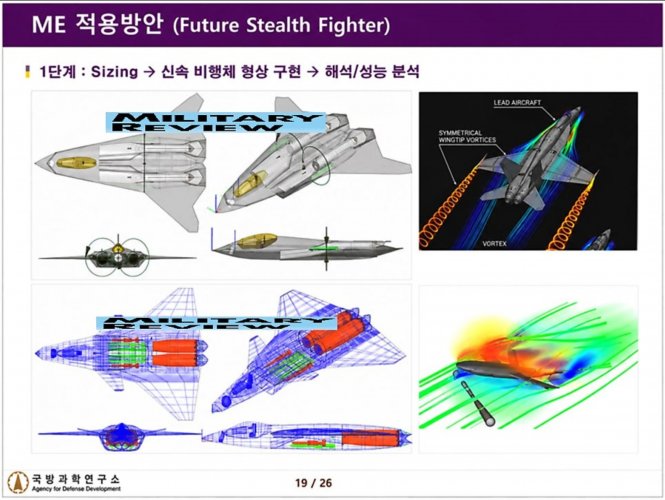
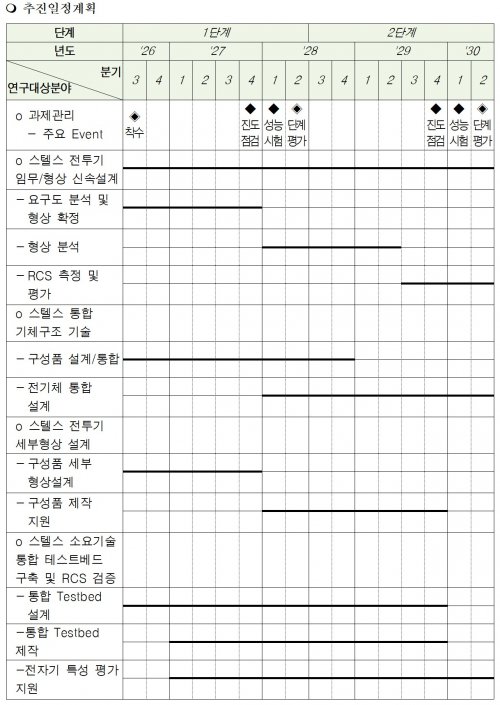
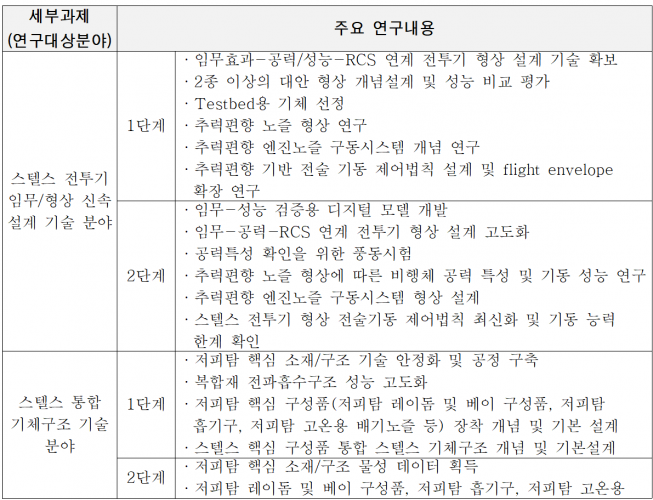
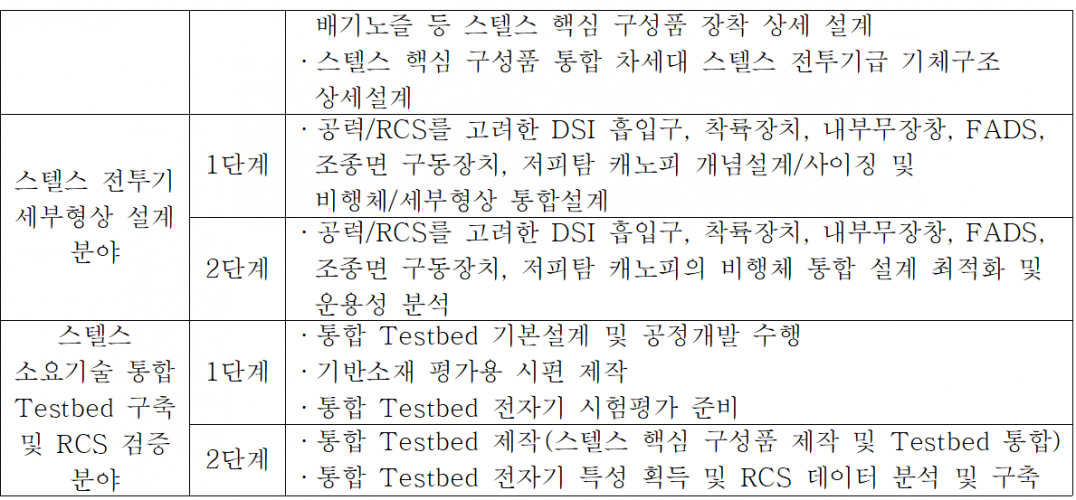
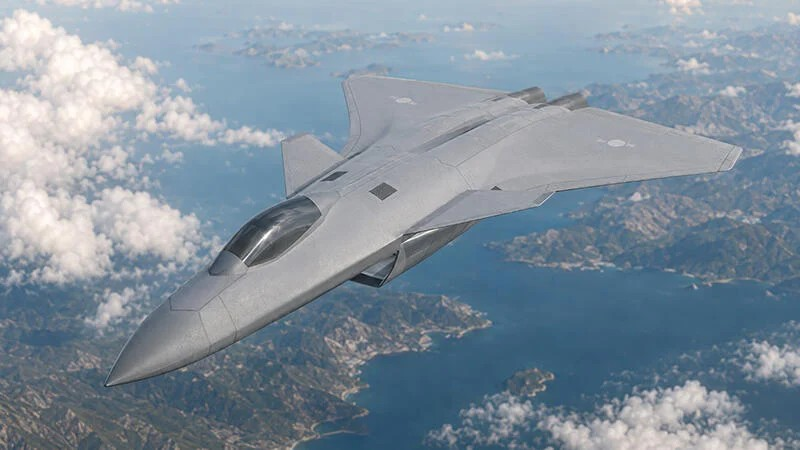
Future Stealth Fighter Configuration Study of Stealth Bridge Program is being conducted by ADD until '30 Q4. Decision of airframe configuration for the demonstrator is scheduled for '27 Q4
So if they went for the stealth configuration shown above it would be basically a completely new airframe with a substantial financial commitment required ? Not to mention a much longer development timeline.
So if they went for the stealth configuration shown above it would be basically a completely new airframe with a substantial financial commitment required ? Not to mention a much longer development timeline.
They already field a substantial F-35 fleet capable of taking over the A2A/A2G penetrator role. More stealth fighters would certainly be nice, but they're hardly an absolute necessity unless Seoul abandons its American-aligned yet still neutral policy course and ends up in a shooting war with either Japan or China.
As for the North, their existing F-35 fleet can open corridors for KF-21s/KF-16s/F-15Ks to penetrate adversary airspace if the KF-21 never evolves into a stealth aircraft.
All in all, redirecting those existing funds away from a 5th-generation evolution of the KF-21 and toward a clean-sheet 6th-generation design while entering the 6th-gen. race relatively early, still makes complete sense...
So if they went for the stealth configuration shown above it would be basically a completely new airframe with a substantial financial commitment required ? Not to mention a much longer development timeline.
I spent a while tracking down source material based on the image posted by @Frogfigther . The original caption on the blog from where it's from reads "This is a concept drawing of a 6th-generation next-generation fighter jet unveiled by the Agency for Defense Development at the Aerospace Weapons Systems Technology Development Conference 2026. It features a shape of a tailless fighter jet." (Google translate)
I found some information on the conference itself but sadly not the original presentation.
Then for more adjacent information, searching in Korean for said conference on YouTube I found a channel for "ROKAF live". There's indeed some unedited conference footage but it's from June 23rd, "2026 Air Force Artificial Intelligence Development Conference" so not the same event. Because of the proximity (if anyone wants to trawl through six hours plus of it) there might be some overlapping (or otherwise interesting information) there:
For good (or other) measure I also prompted an LLM AI about @Frogfigther 's post, asking for leads on the image. Here's what that netted me:
LLM AI said:
The image and forum discussion you found are highly accurate reflections of South Korea's fast-evolving defense pipeline. The "Stealth Bridge Program" (스텔스 브릿지 프로그램) is an official initiative led by South Korea’s Agency for Defense Development (ADD). It serves as the transitional framework guiding South Korea from its current 4.5-generation capabilities into the realm of 6th-generation air superiority.
Purpose of the Stealth Bridge Program
Historically, South Korea’s defense procurement suffered from a gap where core technologies were developed in isolated projects, often becoming obsolete or failing to match immediate military requirements by the time a full aircraft went into production.
The Stealth Bridge Program fixes this by creating a continuous "bridge" testbed. Instead of treating components separately, ADD integrates next-generation airframe design, structural materials, radar, and advanced sensors onto a full-scale testbed to prove their maturity in real-time.
The Move toward "KF-XX" (Skipping Block III)
Recent tracking of the program indicates a major shift in the Republic of Korea Air Force (ROKAF) strategy:
The Original Plan: Upgrade the baseline KF-21 Boramae incrementally from Block I/II into a 5th-generation Block III equipped with internal weapons bays.
The New Direction: Current data shows South Korea is leaning toward skipping the KF-21 Block III modifications entirely. Instead, they intend to jump directly into the development of a brand-new, dedicated platform tentatively called KF-XX.
The Tailless Design: The airframe configurations you saw without vertical tails correspond exactly to ROKAF’s updated requirements. The Air Force has formally requested all-spectrum, all-azimuth stealth capabilities. Eliminating the vertical stabilizers radically lowers the aircraft’s radar cross-section from the sides and rear, a classic hallmark of true 6th-generation designs like the U.S. Next Generation Air Dominance (NGAD) concepts.
Timeline & Next Steps
The numbers and data cited by the forum member align perfectly with ADD's acquisition timelines for the project:
Airframe Configuration Decision (Q4 2027): ADD is testing several tailless variables. They will freeze the definitive aerodynamic shape for the technology demonstrator by the end of 2027.
Demonstrator Timeline: The initial construction phase of the actual physical test aircraft is projected to span 48 months at a starting budget of roughly 63.6 billion won (~$46 million USD).
Technology Scope (Through Q4 2030): The program runs through 2030 to validate advanced technologies on the airframe. These include 3D thrust-vectoring engine nozzles (to compensate for the loss of maneuverability caused by removing the tail fins), broadband next-generation composite materials, massive conformal multi-band radars, and a deep internal weapons bay.
The presentation you surfaced is effectively the foundational roadmap proving that South Korea intends to be a primary architect of sovereign 6th-generation tech rather than relying indefinitely on iterative upgrades of the baseline KF-21 structure.
Treat this response to my prompt with caution since it seems to draw only from two sources. One is an "X" account "mason_8178" whom I did encounter already when the platform was still Twitter. The account is, if not a prolific, then at least a steady and enthusiastic poster about (South Korean defense technology) whose credentials I know little about. "mason_8178" 's material has been featured here in other discussions as well and not to universal acclaim. The other Is a blog, "Sheldon's Military" and I don't know anything about it. In any case here's the post the AI refers to:
Their Future Stealth Fighter is on exploration stage now. Planning can be started only after the compeletion of the Stealth Bridge Program.
According to the program's publicly released RFI, main schedule is divided into Phase 1('26 Q3 ~ '28 Q2) and Phase 2('28 Q3 ~ '30 Q2).
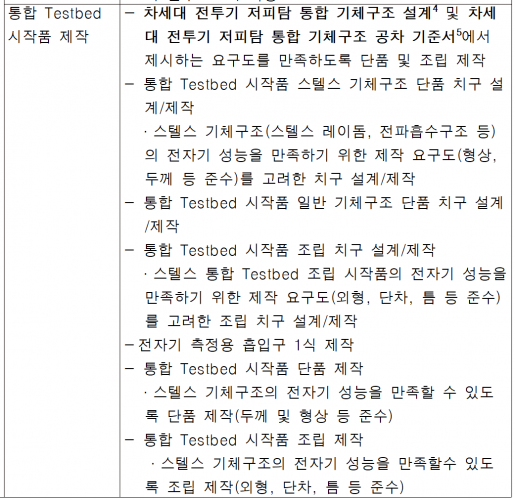
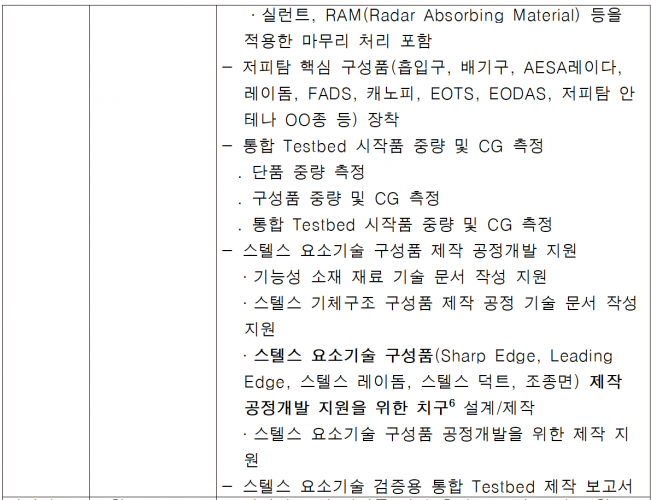
The phase 1 aims to develop airframe, DSI, landig gears, IWB, FADS, actuator, canopy design considering mission effectiveness, RCS, aerodynamic perfromance, thrust verctoring nozzle system, and basic control law.
The phase 2 aims to optimize the airframe, sensor pairings and develop digital model, full scale ground demonstrator and check their performances.
The demonstrator will be have its core element prototypes (Inlet, exhaust, AESA radar, radome, FADS, canopy, EOTS, DAS, conformal antenna, etc) to check its overall wieght, RCS performance.
the next generation fighter jet programme succeeding KF-21 that will most likely replace the KF-16s and F-15Ks is being pushed back according to the ROKAF presentation
All in all, redirecting those existing funds away from a 5th-generation evolution of the KF-21 and toward a clean-sheet 6th-generation design while entering the 6th-gen. race relatively early, still makes complete sense...
That was the initial plan. Now they're pursuing both, as I've clarified on the KF-21 thread, whilst pushing back the next generation fighter programme.
It will be interesting to see what the final design KAI comes up with for their next fighter beyond the Boramae, considering that the KF-21 has just entered service.
Future Stealth Fighter Configuration Study of Stealth Bridge Program is being conducted by ADD until '30 Q4. Decision of airframe configuration for the demonstrator is scheduled for '27 Q4
Future Stealth Fighter Configuration Study of Stealth Bridge Program is being conducted by ADD until '30 Q4. Decision of airframe configuration for the demonstrator is scheduled for '27 Q4
It’s just a ground testbed without an engine, so it should probably be fine. If the tests go well and they decide to move forward with an actual sixth-generation aircraft, they’ll likely need to select an engine first and then spend quite a bit of time doing further research and development.
That said, considering South Korea’s track record in weapons development, it’s pretty interesting to see such a large budget being allocated at such an early stage, and on such a fast timeline...
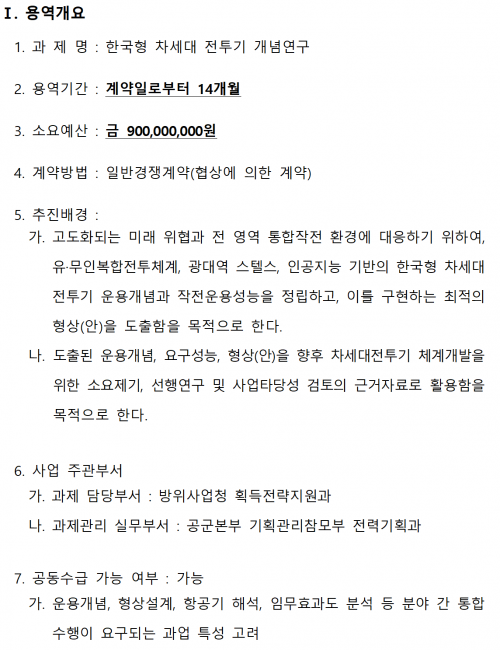
Citation from Korean Next Generation Fighter Conceptual Study Public RFP from DAPA/ROKAF.
3. Project Objectives
The objective of this conceptual study is to concretize and verify — on a configuration- and analysis-based footing — the operational concept and required performance of the "Korean Next-Generation Fighter," a principal element of the manned-unmanned teaming combat system built on broadband stealth and AI technology; to establish an optimal configuration design and system through combat effectiveness analysis; and to present a defense technology acquisition roadmap and a development direction for future air power. Details are as follows.
a. Concretization and verification of the operational concept and required performance: Derive and analyze potential threats through analysis of the future battlefield environment; derive the operational concept and core required performance for conducting operations in a high-threat environment; and verify, supplement, and optimize the derived operational concept and required performance (draft) through configuration design and analysis, mission effectiveness analysis, and the like.
b. Optimal configuration design and system concretization: Perform configuration design for high-performance broadband stealth, aircraft analysis, and mission effectiveness analysis to concretize the next-generation fighter concept into an actual configuration and performance; and produce and deliver a system-analysis-based mock-up and rendered/visualization imagery.
c. Presentation of a defense technology acquisition direction: Identify and evaluate the technologies required for next-generation fighter development, and present a phased acquisition roadmap that accounts for technology readiness.
d. Presentation of a development direction for future air power: Reflecting the transition to manned-unmanned teaming and AI-based combat systems and the paradigm shift from platform-centric to network-centric operations, present a development direction for a future air power force structure with the next-generation fighter as its core axis, thereby presenting a development direction that lays the foundation for building future-oriented air power that improves pilot survivability and enhances the ability to conduct all-domain integrated operations.
4. Project Scope and Content
The scope of this conceptual study is to concretize and verify the operational concept and required performance of a next-generation fighter on a configuration- and analysis-based footing, extending through a defense technology acquisition roadmap and a development direction for future air power. Details are as follows.
a. Study of operational concept and required performance
1) Establishment of the next-generation fighter concept of operations (CONOPS) and presentation of an operational concept diagram
2) Establishment of mission scenarios by mission type and detailed mission profiles
3) Identification of Operational Required Capability items
4) Derivation of Required Operational Capability (ROC) and feasibility verification based on configuration, analysis, and M&S
b. Configuration conceptual study and mock-up fabrication
1) Aircraft sizing and design of two candidate configurations based on the operational concept and required performance
2) Construction of databases for aircraft performance analysis and mission effectiveness analysis
3) Verification of aircraft performance analysis and mission effectiveness
4) Aircraft exterior rendering and visualization
5) 3D mock-up fabrication (size: within 1.5 m)
c. Defense technology acquisition plan
1) Identification and evaluation of defense technologies for next-generation fighter development
2) Presentation of a defense technology acquisition roadmap for next-generation fighter development
d. Presentation of a development direction for future air power
1) Analysis of changes in the future battlefield environment and force structure (platform-centric → network-centric)
2) Derivation of development directions for manned-unmanned teaming and AI-based combat systems
3) Identification of associated force employment and additional requirements linked to the next-generation fighter
4) Policy recommendations for follow-on system development and fielding
5. Configuration Concept Study
a. Analysis of required technologies
1) Establishment of a traceability mapping scheme among required capabilities – required performance – technologies
2) Identification of required technologies by discipline and selection of core technology candidates
3) Assessment of the domestic technology level and classification of acquisition strategy (domestic development / technology cooperation / procurement)
4) Derivation of a technology roadmap aligned with the target fielding date, and of requirement feedback items
b. Aircraft sizing
1) Perform aircraft sizing based on the operational concept and required operational capabilities
2) Because classical statistics-based sizing techniques are expected to be inadequate for deriving the innovative configuration of a next-generation fighter, establish a systematic sizing methodology and perform sizing using it
c. Configuration design
1) Establish a systematic design process for deriving the aircraft exterior based on the sizing data
2) Define the principal design parameters for realizing a low-observable configuration
3) Apply low-observable configuration design guidelines
4) Develop two candidate configurations reflecting the required performance, and evolve them into improved configurations reflecting the analysis results
– Stealth configuration implementation: reflection-angle alignment, S-shaped duct, tail removal or simplification, internal weapons bay, etc.
– Achievement of high maneuverability, twin engines (supercruise, high-efficiency variable cycle), modular equipment replacement, single-seat
5) Establish an approach for configuration modeling of the airframe exterior
6) Establish an approach for the arrangement of principal components and implementation of the integrated configuration
7) Airframe exterior modeling using CAD
d. Aircraft analysis: Analyze and quantify the aerodynamic characteristics and radar low observability of the designed next-generation fighter configuration.
1) Inlet analysis: A next-generation fighter must have an inlet that simultaneously satisfies all-aspect low observability and propulsion performance, yet this is a technology in which both are difficult to satisfy at once. Develop an inlet configuration appropriate to the operational concept and engine thrust of the next-generation fighter and review the influence on inlet performance at design conditions.
– Determine notional engine mass-flow conditions and inlet type
– Inlet sizing based on theoretical sizing techniques
– Derive inlet performance data
– Inlet performance data at design conditions
2) Control stability analysis: Analyze the static control stability of the designed next-generation fighter configuration. Present compensating measures for tail simplification or tail removal undertaken for all-aspect low observability.
– Static longitudinal stability analysis, essential to securing basic cruise capability
– Roll control-surface sizing and roll performance analysis for high-maneuverability roll capability
– Static directional stability analysis results and yaw control-surface sizing appropriate to directional control capability
– CG limit range
– Results of the adequacy analysis of directional stability characteristics
3) Low-observability analysis: In performing next-generation fighter configuration design based on the operational concept, establish low-observable design guidelines to derive RCS-inducing factors, formulate reduction measures for them, and reflect these together with the low-observable design guidelines in the configuration design.
– Where multiple candidate configuration designs are derived, perform an RCS analysis for each
– Generate an electromagnetic mesh model from each configuration's surface model
– Select frequency and azimuth conditions taking the operational concept and mission scenarios into account
• Perform RCS analysis for L-band, S-band, and X-band center frequencies (the electromagnetic modeling required for RCS analysis shall be performed separately for each frequency)
• Perform RCS analysis for the forward, left/right, and aft azimuth sectors
– Perform RCS analysis to generate RCS data
4) Aerodynamic analysis: Predict the aerodynamic forces acting on the aircraft to support sizing and to provide the aerodynamic data required for performance analysis, control stability analysis, load analysis, and the like.
– Aircraft sizing support
• Predict minimum drag and lift characteristics from configuration information
• Derive sizing improvement proposals to meet required performance
– Whole-aircraft aerodynamic data prediction
• Predict whole-aircraft six-component forces/moments and surface pressure distribution
• Generate aerodynamic load data for structural weight prediction
Inferior to the U.S. F-47, but Potentially Comparable to GCAP
If a Korean 6th-generation fighter were actually developed according to ADD’s current design, it is estimated that it could have a cruising speed similar to the Global Combat Air Programme (GCAP) being jointly developed by the United Kingdom, Japan, and Italy, though with a shorter combat range. Its stealth performance could be similar to, or slightly better than, that of GCAP.
Combining the design features mentioned above with developments in Korea’s ongoing “Stealth Bridge Technology” program allows us to sketch a rough picture of what a Korean 6th-generation fighter might eventually look like.
First, in the area of radar—which is a central component of modern combat aircraft—the fighter could employ a wideband AESA radar operating across a far broader range of frequencies than existing systems.
Using a broader frequency range would make it more difficult for an enemy to determine whether the fighter is operating its radar, while also enabling more precise tracking. It could even become possible to use electronic warfare to suppress enemy radars while allowing friendly aircraft to operate their own radars relatively freely.
The stealth configuration itself is also highly ambitious.
China’s J-36 and J-50 use diamond- or lambda-shaped delta wings with no tail surfaces at all. The U.S. F-47 has ear-like canards positioned ahead of its delta wing. GCAP, meanwhile, uses a very large delta wing combined with two vertical tail fins.
Of these designs, ADD’s concept is closest to the F-47. Because it eliminates vertical tail surfaces altogether, it may potentially offer better stealth performance than GCAP.
The most distinctive feature of ADD’s 6th-generation fighter design is its size.
GCAP, the F-47, J-36, and J-50 are all extremely large fighters approaching 20 meters in length, whereas Korea’s 6th-generation concept is considerably smaller, falling somewhere between the KF-21 and F-22 in overall size.
As a result, it may have shorter range and lower weapons capacity than other countries’ 6th-generation fighters. On the other hand, it could gain a significant advantage in cost-effectiveness.
The Engine Is the “Achilles’ Heel”
The main problem is the propulsion system.
DAPA’s request for proposals explicitly specifies two adaptive-cycle engines capable of supercruise.
An adaptive-cycle engine changes its bypass ratio and combustion characteristics during flight, allowing it to switch between fuel-efficient cruising and high-thrust supersonic cruising.
Put simply, it is similar to a car that can switch between Eco Mode and Sport Mode in real time while driving.
However, adaptive-cycle engines require extremely advanced technology, and they remain beyond Korea’s current technological capabilities.
For a country that has only recently begun developing its own indigenous fighter-class jet engine, this may simply be too ambitious a target.
Moreover, the U.S. F/A-XX, GCAP, and China’s J-36 and J-50 have reportedly either abandoned adaptive-cycle engines or are considering doing so. Korea should therefore carefully consider whether such an engine is truly necessary for its 6th-generation fighter.
Simply using the engine currently under development also poses problems.
The domestically developed KTF16000, which is being pursued as a government-funded program for installation on the KF-21, is targeting initial flight release approval in 2041.
However, it is expected to produce only approximately 16,000 pounds of dry thrust and 24,000 pounds with afterburner.
Installing this engine in a 16-meter-class tailless stealth fighter would make it difficult to achieve the supercruise capability required by DAPA.
Korea’s thrust-vectoring nozzle technology is also still at an early stage. Although thrust vectoring has been applied to rockets, Korea has not yet applied the technology to a jet engine.
In the author’s personal view, Korea should first use the KTF16000 as its baseline engine, but rather than pursuing excessively ambitious and risky goals, it should develop an improved version focused on practical capabilities.
For example, it could incorporate an integrated generator similar to that of the HAF4500 engine, providing several hundred kilowatts or more of electrical power, while concentrating development efforts on thrust-vectoring nozzles.
Rather than focusing excessively on increasing maximum thrust by improving afterburner output, Korea should first secure practical operational capabilities. It could then cooperate with an overseas partner in the future to develop a variable-cycle engine based on the KTF16000.
Balancing Priorities Between the KF-21EX-T and the 6th-Generation Fighter
Another concern is how development priorities should be divided between the 6th-generation fighter and the KF-21EX-T.
Korea Aerospace Industries (KAI) is currently conducting internal research into upgrading the KF-21 into a 5.5-generation fighter. Once the Republic of Korea Air Force finalizes its requirements, this concept is expected to evolve into the KF-21 Block 3.
The problem is that there are differing opinions among those involved over exactly which capabilities should ultimately be incorporated into the KF-21 Block 3.
The central issue is the stealth performance of the KF-21EX-T.
The current plan calls for the addition of an internal weapons bay and stealth coatings and materials.
However, developing an internal weapons bay would require substantial time and money. Some argue that long-range missiles and remote-strike capabilities provided by Collaborative Combat Aircraft (CCA) would already be sufficient.
Some even argue that further KF-21 development should be brought to an early conclusion so that Korea can instead accelerate development of a full-fledged 6th-generation fighter.
Both positions have merit.
However, Korea must be particularly careful that the debate between advocates of “early 6th-generation fighter development” and supporters of “maximum KF-21 development” does not repeat the old “F-50 versus KF-X” debate, which could have highly negative consequences for the Korean aerospace industry.
Between 2002 and 2014, similarly unproductive debates were repeated far too often.
Development strategies for the two platforms therefore need to be established on the basis of efficient decision-making and parallel investment.
For example, the internal weapons bay beneath the KF-21EX fuselage could be developed using the same design approach intended for the 6th-generation fighter, reducing both time and costs.
Likewise, the tailless and canard configuration being considered for the 6th-generation fighter could be applied to Collaborative Combat Aircraft, maximizing the reuse of newly developed technologies.
1. The RFP does not speak of a "6th-generation fighter" (only a "new generation").
2. Tail surfaces are permitted in the RFP, albeit simplified ones (hunting OWA and similar unmanned pests—a current and future operational reality—requires excellent directional stability).
This site uses cookies to help personalise content, tailor your experience and to keep you logged in if you register.
By continuing to use this site, you are consenting to our use of cookies.