VLS timeline

zen

ACCESS: Above Top Secret
Top Contributor
Senior Member
Joined
15 July 2007
Messages
5,737
Reaction score
6,321
Qustion when would it have been possible to pioneer VLS?

Could this have been achieved by the 60's?

It seems to me that this is possible. Frankly from even earlier.
Though for SAMs beam riders and early SARH tended to keep director radars close to the launchers to ensure the missile picked up the signal.
However once you move to Command Guidance or INS autopilot for the bulk of the missile's flight. Then this need ceases and VLS becomes plausible.
 
You could probably get some form of VLS around the same time as the Sea Sparrow. That took the idea of using an ASROC launcher for AAMs. From there it's not too big of a leap to VLS. The biggest challenge is getting the missile seeker head to see the target after a vertical launch.
 
Well I think certainly with Sea Wolf the arguments for VLS actually led to some firings to test the idea.

But ...for the USN at the time, it was heavily invested into launchers.
And the advanced Point Defense System callec Mauler had been cancelled. Not that I think this could achieve VLS into that system easily.
Sea Sparrow BPDMS is just that, basic.

However while PT.428 the British rival to Mauler has the option of a booster, the use of beam riding guidance rather makes VLS harder.

It seems more institutional inertia that saddles Sea Dart with a launcher.....
 
Qustion when would it have been possible to pioneer VLS?

Could this have been achieved by the 60's?

It seems to me that this is possible. Frankly from even earlier.
Though for SAMs beam riders and early SARH tended to keep director radars close to the launchers to ensure the missile picked up the signal.
However once you move to Command Guidance or INS autopilot for the bulk of the missile's flight. Then this need ceases and VLS becomes plausible.


Wasn't the use of launchers dictated by the use of beam-riders? I'm asking because I don't know, but it would seem a vertical launch would be far out of the targeting beam before it started to head toward the target....

Regards,
 
Qustion when would it have been possible to pioneer VLS?

Could this have been achieved by the 60's?

It seems to me that this is possible. Frankly from even earlier.
Though for SAMs beam riders and early SARH tended to keep director radars close to the launchers to ensure the missile picked up the signal.
However once you move to Command Guidance or INS autopilot for the bulk of the missile's flight. Then this need ceases and VLS becomes plausible.


Wasn't the use of launchers dictated by the use of beam-riders? I'm asking because I don't know, but it would seem a vertical launch would be far out of the targeting beam before it started to head toward the target....

Regards,
That's partly my contention too. Only if the guidance beam was separate from target tracking could it be done.

Plus for SARH you'd want to be sure the missile is receiving the reflected signal.
 
One thing that has to be remembered is that even in the 1980s, especially during the first half of the decade, VLS systems were still considered immature when compared to rail and box launcher systems. Not only that, but the Mk 26 launcher in particular was considered to be a quite more flexible system than the Mk 41 VLS, both in terms of compatiable munitions and in response times & coverage.
 
And yet....
And yet various missiles for attack had used vertical launch since the V-2.
Including several solid fuel systems.

And as if that wasn't enough, work on long range SAM systems had included vertical launch such as BOMARC and this would reach the extreme Sprint ABM system.

So really beyond the guidance solution, it seems more like institutional inertia.
 
Last edited:
One thing that has to be remembered is that even in the 1980s, especially during the first half of the decade, VLS systems were still considered immature when compared to rail and box launcher systems. Not only that, but the Mk 26 launcher in particular was considered to be a quite more flexible system than the Mk 41 VLS, both in terms of compatiable munitions and in response times & coverage.


Mark 26 was extremely fast compared to other twin armed systems It could fire every 10 seconds (9 second reload, with one second salve delay), or 12 rounds per minute.

Mk 10 in comparison could fire every 30 seconds (4 rounds per minute).

https://www.alternatewars.com/BBOW/Weapons/US_GMLS.htm
Regards,
 
I thought I had read in one of Friedman's books that VL was considered for Sea Slug but I can't for the life of me find it again.
 
The main headache with VLS, is that missile itself needed to be smart enough to orient itself toward the target in flight (or into the guidance radar beam). In 1960s, this generally means unreasonably big programmable autopilot, which would increase cost & weight of the missile. Also, rocket engines of 1960s were not as advanced as modern ones, and vertically-launched missile might require too much engine power to remain stable and controllable immediately after boosting out of the cell.
 
USSR experimented with idea of vertically-launched SAM's as early as in 1959-1960s:

1595189915824.png


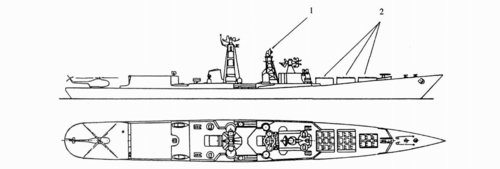
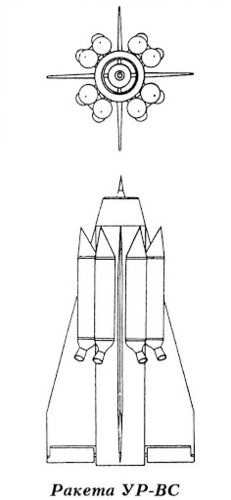
This is multi-purpose warship, designed in 1960 by NII-20/OKB-82. This ship was supposed to carry UR-VS (Upravlayemaya Raketa - Vertikalnyy Start; Guided Missile - Vertical Launch) long-range multi-purpose missile in 24 vertical cells:

1595189727514.png

Not exactly the best-looking missile, I must admit. It was supposed to carry heavy 300-kg warhead, to be useful both against aircraft (60-80 km range) and surface ships (up to 120 km range).
 
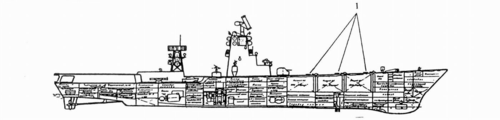
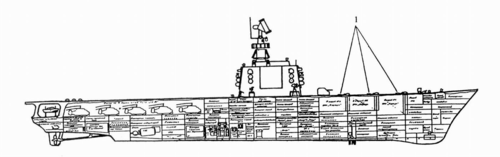
Later (1965) projects of ocean air defense (top) and anti-submarine (bottom) cruisers with "Korshun" VLS-capable SAM:

1595190045253.png
1595190079451.png
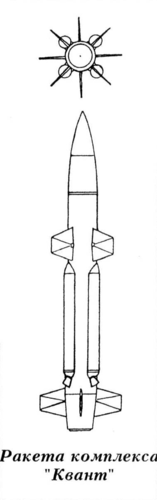
The "Kvant" missile (derivative of "Korshun") was supposed to be another "universal" missile:
1595190172610.png
It was supposed, that on the same base would be designed the multi-purpose missile with SAM/ASM functions, and anti-submarine missile with the same engine and guidance system. Those missiles were supposed to be launched from semi-VLS launchers (they were cell-based design, but "Kvant" cells were angled at roughly 15 degrees). In late 1960s, "Kvant" project was proposed for the 1134-B and 1144 missile cruisers, but since it was only in design stage, Party decided to use naval version of S-300 instead.
 
There are various photographs on the internet of HMS Penelope when she was used as Seawolf trials vessel, but it was with the 'standard' sextuple mount on her helicopter flight deck.
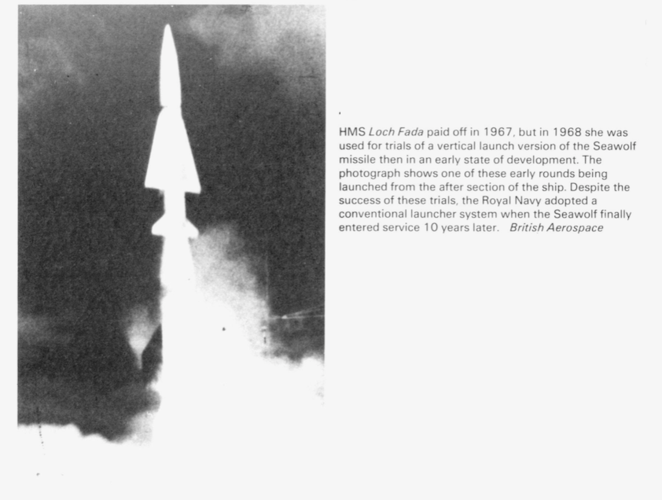
HMS Loch Fada an old WW2 Loch class frigate was used for early Seawolf trials and I believe that at one time during the trials some form of VLS was tested.
Unfortunately I have not been able to find any pictures of the ship in her trials configuration at all, let alone any showing the experimental VLS.
IF, given the timescale, the VLS system had proved to be workable, this could put the (British) Royal Navy ahead of the field...

Does anyone have any images of Loch Fada from her Seawolf trials day??
 
Last edited:
The main headache with VLS, is that missile itself needed to be smart enough to orient itself toward the target in flight (or into the guidance radar beam). In 1960s, this generally means unreasonably big programmable autopilot, which would increase cost & weight of the missile. Also, rocket engines of 1960s were not as advanced as modern ones, and vertically-launched missile might require too much engine power to remain stable and controllable immediately after boosting out of the cell.
I don't think it does as such. Rather we're talking either datalink command guidance or separating beam guidance from target tracking.
Both are do-able with 60's technology.
 
The main headache with VLS, is that missile itself needed to be smart enough to orient itself toward the target in flight (or into the guidance radar beam). In 1960s, this generally means unreasonably big programmable autopilot, which would increase cost & weight of the missile. Also, rocket engines of 1960s were not as advanced as modern ones, and vertically-launched missile might require too much engine power to remain stable and controllable immediately after boosting out of the cell.
I don't think it does as such. Rather we're talking either datalink command guidance or separating beam guidance from target tracking.
Both are do-able with 60's technology.
Doable, yes. But at what cost and how much of a penalty in weight and performance?
 
Isn't it the opposite case?
Less cost through no complex and expensive launcher, that demands more power from the ship, constant maintenance due to exposure to maritime environment.

Less cost as missile kept in neutral atmosphere container.
Less cost in no complex magazine system....
 
Isn't it the opposite case?
Less cost through no complex and expensive launcher, that demands more power from the ship, constant maintenance due to exposure to maritime environment.

Less cost as missile kept in neutral atmosphere container.
Less cost in no complex magazine system....

No, that's the problem. Launcher and magazine system do not affect the missile performance. But complex autopilot, additional engine power, more complex trajectories - actually do, on 1960s tech. Essentially you would be using more complex, less reliable, and less capable missiles, which main function - to destroy enemy targets - would be servery impaired.
 
Last edited:
In short, the choice was:

* Rail launcher - heavier, more bulky launch system and magazines, BUT much simpler, more reliable, more high-performance missile.
* Vertical cells - more compact launch system, BUT heavier, less reliable, much more complex missile with quite probably impaired performance.

In 1960s, it was hard enough to design reliable SAM, added complexity was the last thing any navy wanted.

Also:

Less cost as missile kept in neutral atmosphere container.

Many missiles of 1960s actually required regular servicing while on ship.
 
I get the simple aspect here, and that through direct connections the ships systems can interrogate the missile on the rail, checking the signal it's receiving, the direction the launcher is pointing compared to the tracking radar etc...

But I think once you disconnect the missile flight from directly towards the target, all of this paraphernalia has to be questioned.

As we have covered, even NIGS considered VL but the method envisioned put more constraints on the ships design.
And as we know Sea Wolf was tested in VL. But institutional inertia stuck with a launcher.
 
HMS Loch Fada and old WW2 Loch class frigate was used for early Seawolf trials and I believe that at one time during the trials some form of VLS was tested.
I have a clear memory of seeing a photo, decades ago, of a Sea Wolf vertical launch from a test platform, dated to the 1960s I believe. I also recall that the missile had quite a long booster added to it.
 
There are various photographs on the internet of HMS Penelope when she was used as Seawolf trials vessel, but it was with the 'standard' sextuple mount on her helicopter flight deck.
HMS Loch Fada an old WW2 Loch class frigate was used for early Seawolf trials and I believe that at one time during the trials some form of VLS was tested.
Unfortunately I have not been able to find any pictures of the ship in her trials configuration at all, let alone any showing the experimental VLS.
IF, given the timescale, the VLS system had proved to be workable, this could put the (British) Royal Navy ahead of the field...

Does anyone have any images of Loch Fada from her Seawolf trials day??
I've (partly at least) managed to answer my own question.
The attached image is from Leo Marriotts "British Frigates"...
It is, unfortunately, not the best image, and my original question still stands - Does anyone have any additional/clearer images of Loch Fada and her Seawolf installation?
 

Attachments

  • VLS Loch Fada.png
    VLS Loch Fada.png
    289.5 KB · Views: 126
And yet....
And yet various missiles for attack had used vertical launch since the V-2.
Why on earth would anybody try to rail-launch a V-2? Ballistic missiles aren't really what's being discussed here. (Not an apples-to-apples comparison.)
 
HMS Loch Fada and old WW2 Loch class frigate was used for early Seawolf trials and I believe that at one time during the trials some form of VLS was tested.
I have a clear memory of seeing a photo, decades ago, of a Sea Wolf vertical launch from a test platform, dated to the 1960s I believe. I also recall that the missile had quite a long booster added to it.
I have a reference to it in a book somewhere, but which book and where it is I don't know. But yes I definitely recall the initial Sea Wolf tests were VLS.
 
To quote JC Fuller

The date I have for INSWING is 1964.

Swingfire emerged from experience with Fairey Project 6 (Orange William), with a Anglo-German test vehicle called AATW, which eventually became Fairey Project 12 to examine low-speed launch / vectored-thrust techniques. BAC took this over to produce Swingfire.
Which shows the concept of a vectoring thrust missile with potential for VLS was being researched by 1964.

Quote from Zoo Tycoon

I'm not sure if it was the same book but I also remember a comment that the early Sea Dart and Sea Wolf system design work by both BAE (HSD) and RAE had questioned the reliability/availability of load/point/shoot type launchers. This lead to a Sea Wolf vertical launch/TVC demonstration in the very early part of the program (as early as 1969?). However the RN insisted on load/point/shoot launchers launchers for little more reason than that was what the USN had! But the experience in the Falklands (HMS Glasgow) really showed the the original concerns to be correct. Quite a lot of study work was done into vertical launch Sea Dart, but I don't believe anything flew. Does anyone have any information?
Attempt to meet GAST.1210 had various booster sizes added to Sea Wolf for VL. This requirement starts 1969.
 
Last edited:
Certainly vertical launch for tactical missiles was being researched in the 1960s, but practicality is a different matter. It's likely that these 1960s efforts did not translate directly into service because the technology was not quite feasible yet.

You see design proposals for surface ship VLS in the USN starting in the early 1970s. I can confirm 1974, but I'm pretty sure I've seen one a few years earlier. In-service dates would roughly coincide with SM2MR (1979), which had a digital autopilot and inertial reference unit. These features were needed both to fly a more energy-efficient path to the target and (secondarily) to manage the tip-over from vertical launch to intercept trajectory. I doubt that the technology really existed to do this affordably and within a small enough envelope before the early 1970s. Obviously, strategic missiles launched vertically more or less from the outset, but they were much larger and more expensive, so the size and cost of early inertial platforms was acceptable.
 
And yet....
And yet various missiles for attack had used vertical launch since the V-2.
Including several solid fuel systems.

I think an interesting example are British anti-tank missile programs (I believe they started experimenting with missiles that would turn after launch as early as the 1950s?), so there was a desire and research program there.
 
The earliest RN VLS I think that we've seen are the single topside PX.430 tubes either side of a helicopter hangar on the Design Study 919 patrol vessel as part of the Destroyer and Frigate studies of 1966.
Judging by the drawing in Rebuilding the Royal Navy the tubes look nearly two-decks in length. Perhaps they weren't intended for internal hull fitting - they might have vented outboard for example - but its not easy to tell with a sample size of only one drawing.
 
It certainly would have altered a number of things in the long run, had Sea Dart and Sea Wolf entered service with VLS a lot earlier.
Arguably it could have been implemented on Type 42, Type 22 and the Invincibles.
Had VLS been developed from 1964 even HMS Bristol could have had it worked into the design.

This would have strengthened the case for Sea Dart mkII, and allowed a focus on new shipside elements. As the missile could be upgraded to mkII as long as it fits the silo.

We might have seen the Type 44 which was based on the Type 22.

It would also have shifted the arguments about Land Dart and Land Wolf.
While Sea Wolf even with boosters doesn't meet GAST.1210 or the Naval Tripartite requirements demanded by the French for local area defence. It would certainly set things in the right direction. It seems to me that elements of the system could have achieved those requirements with a new larger missile.
 
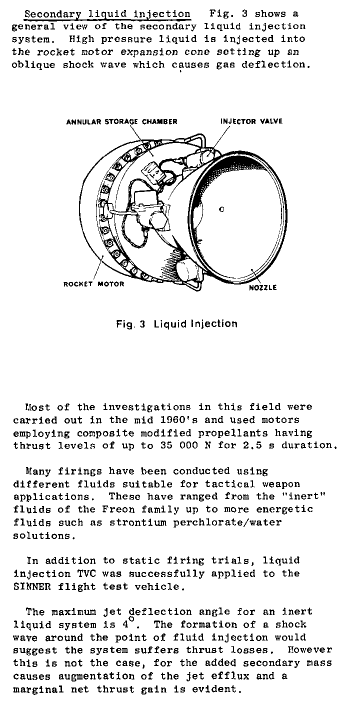
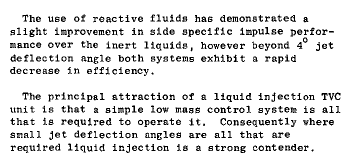
The Sinner test vehicle used a method called secondary injection, for TVC. This had been identified as the preferred approach, if vertical launch was to be used, in study work in 1965. It involved injecting freon into the motor expansion cone. The attached images are from A Review of Thrust Vector Control Systems for Tactical Missiles by R. Lloyd of the Summerfield Research station, published in 1978, and describes the secondary injection method used for TVC in the Sinner Test Vehicle.

The Vertical Launch Landpax configurations studied in 1968, heavily based on PX.430, considered three forms of TVC for the booster:

1. Plane Spoilers with hot gas actuation
2. Axle jet defectors with hot gas actuation
3. Bellows nozzle with hydraulic actuation

The favoured solution was was plane spoilers on the basis of cost and weight.

The attraction of vertical launch for PX.430/Confessor was outlined in the 1965 study work. It would have allowed for a much higher performance missile within the other confines of the staff requirement. The objective was for a system with a relatively small impact on the ship (and thus overall cost), this meant that a Sea Dart style under-deck magazine and reloading apparatus was out of the question, so the missile had to be man handled, limiting it to 90kg. Combined with the requirement for missiles to be stowed vertically, for shock reasons, length was therefore constrained by standard deck heights. Vertical launch offered a way out, a much longer (potentially up to 3m) missile could be stored in a tube, ready to fire. There would be no requirement for handling once loaded onto the ship so the weight constraint would be removed too.

At least based on published sources, Sinner seems to have been successful as a test vehicle, and I have yet to discover why the trainable launcher solution was ultimately taken forward for Sea Wolf, though one document implies cost was the reason. Had vertical launch have been chosen it's unlikely the result would have been a universal launcher akin to Mk.41. It would probably have been much closer to the Mk-48 and Mk-56 used for Sea Sparrow and ESSM respectively.
 

Attachments

  • R. Lloyd_Secondary Injection 1of2.png
    R. Lloyd_Secondary Injection 1of2.png
    56.9 KB · Views: 83
  • R. Lloyd_Secondary Injection 2of2.png
    R. Lloyd_Secondary Injection 2of2.png
    20.8 KB · Views: 54
It would certainly not surprise me if the costs of the VLS missile were being compared to a trainable launcher and yet equally believable that both unit price per missile and 'through life' costs did not cover the savings VLS has over the trainable launcher. In terms of maintenance and staff....and the need for magazine, clear 'safe' paths from magazine to the launcher etc...
 
Really I think also a major part of why VLS took so long was that many missiles needed constant illumination. (Think SM-1 in all forms, early Sea Dart, Triple T, M-11 ect ect) Which effectively renders one of the huge advantages of VLS, its ability to fire off way, way more missiles in a shorter period essentially useless. It's not like you could guide more than however many illuminators you had anyways.
 
Really I think also a major part of why VLS took so long was that many missiles needed constant illumination. (Think SM-1 in all forms, early Sea Dart, Triple T, M-11 ect ect) Which effectively renders one of the huge advantages of VLS, its ability to fire off way, way more missiles in a shorter period essentially useless. It's not like you could guide more than however many illuminators you had anyways.
That was part of the problem, yes.
 
VLS main advantage isn't rate of fire(as if inclined boxes fire slower than vertical boxes), it's simplicity. Launching missiles upwards per se is very simple.

To exploit simplicity, you need missiles that can be usefully stored assembled and ready to launch for extended period of time.

Without 1970s electronics, it doesn't work.
 
VLS main advantage isn't rate of fire(as if inclined boxes fire slower than vertical boxes), it's simplicity. Launching missiles upwards per se is very simple.

To exploit simplicity, you need missiles that can be usefully stored assembled and ready to launch for extended period of time.

Without 1970s electronics, it doesn't work.
This isn't generally true, and mostly ignores what (most) VLS systems replace. Most of those systems were arm launchers for primary air defense. Even in the box-held SAMs like Sea Sparrow they were harshly limited by the illumination channels. With box launchers, yes, the rate of fire advantage isn't there, but it is very strongly there with arm launchers. The fastest Arm Launchers were Mk.13 (roughly 8s time between launches) and Mk.26 (9-10 seconds). VLS is a missile per second.

Related, but not to this specific post, and about VLS on the other side of the curtain, does anyone have any information about the Soviet's weird and wonderful rotating vertical cold-launched systems for S-300 and Tor? I've always seen them and been confused. My best concept for why is that they just put the cold launching cells in essentially an arm launcher's carousel magazine?
 
Really I think also a major part of why VLS took so long was that many missiles needed constant illumination. (Think SM-1 in all forms, early Sea Dart, Triple T, M-11 ect ect) Which effectively renders one of the huge advantages of VLS, its ability to fire off way, way more missiles in a shorter period essentially useless. It's not like you could guide more than however many illuminators you had anyways.
Not just rate of fire, but also gathering the missile. Off a rail launcher, the missile and illuminator are both pointing more-or-less at the target, and it's relatively easy (not trivial, of course) for the missile to pick up the guidance signal before it starts trying to seek the target.

From a vertical launcher, that problem is much greater. Starting with the fact that at some point the missile has to pitch over from the vertical - and there's no obvious reason why it should prefer one direction to another. It then needs enough control before being guided in order to find the guidance signal.

Systems like Wasserfall, S-25, and Nike avoid this problem by being command guided, but that's not without its problems. Especially for a seaborne system, where separate target-tracking and missile-tracking radars are undesirable.
 
Related, but not to this specific post, and about VLS on the other side of the curtain, does anyone have any information about the Soviet's weird and wonderful rotating vertical cold-launched systems for S-300 and Tor? I've always seen them and been confused. My best concept for why is that they just put the cold launching cells in essentially an arm launcher's carousel magazine?
IRRC the idea was to have just one launching/loading hatch per drum, reducing deck perforation and simplifying construction. The concept of fixed cells was rejected because it would require multiple hatches, each equipped with its own opening device, which would seriously affect the deck integrity. Instead, each drum have only a single launching position with a single hatch over it and single opening device (a boxy things with "arms" sitting on top of the drum).

So each drum have just one opening hatch. The round "hatches" on top of each drum cell are merely gas vents - to vent the gases safely in case some missile ignite in cell.
 
To summarize the early VLS problems and challenges:

1) Most 1960s missiles are rather heavy, and their rocket boosters aren't very powerful. Launching the missile vertically - without the aid from wings lifting force - would require significantly more massive booster;

2) Stabilization of 1960s missiles during subsonic flight stage was generally achieved passively, with the help of large booster fins. Putting such fins into vertical cell would require cells of totally impractical diameter. So some kind of very fast opening folding fins must be developed, which was a significant design challenge then;

(It might be cirumvented a bit by using packet scheme with boosters wrapped around missile body, nozzles slightly inclined aside to induce spin stabilization - like on Seaslug SAM - but again, it would require very large cell to fit)

3) Most of 1960s missile required either to be pointed toward the target before launch (the 1960s seekers weren't exactly fast to lock on...) or been gathered by guidance radar beam immediately after launch and aimed toward the target - while missile is still boosting. With arm launchers it was simple; the missile was pointed in required direction by launcher. But for vertical system, it would basically require a separate control system just for boosting. And in 1960s, such control system would be bulky, heavy and costly;

4) Missiles in 1960s weren't still fully reliable, so vertical launch presented rather nasty problem; what if the missile motor failed to ignite, and the missile came crashing down on the ship? This problem could be partially solved by having launchers inclined to sides, but this would create "danger area" for other ships nearby;

(same problem with spent boosters)

5) Finally - what's the point of having fast-working vertical launcher, if fire control system could not fully exploit its advantages? Most of 1960s fire control systems have no more than 1-2 target channels, which meant that even if you could fire missiles very fast, you could only fire then against 1-2 targets already tracked. After they would be dealt with, your launcher would sit idle, while fire control radars are seeking and aquiring new targets.

Yes, you could fire more missiles against the same targets in less time, but frankly, it isn't exactly big advantage. And, for example, Soviet SAM's were mostly command-guided, i.e. limited by number of missile control channels also - so there were no point in launching more missiles that could be tracked & guided;

To suumarize, for 1960s the VLS systems were deeply impractical. Designing them would cause enormous numbers of engineering & practical applications, while advantages were not fully clear due to fire control systems limitations. It was MUCH more simple to circumvent all those headaches by just using rail launcher and mechanized ammo magazine; while heavier they were just a simpe and reliable mechanics.

P.S. Should point out that interest toward VLS become practical in 1970s due to same reason for USSR and USA: major improvements in fire control capabilities. The USSR developed multi-channel S-300F system, which could guide up to 12 missiles against several targets. The USA developed SM-2 missiles and Aegis system. In both cases rail launchers weren't sufficient anymore, and much faster rate of fire become practical.

 
Last edited:

Similar threads

Back
Top Bottom