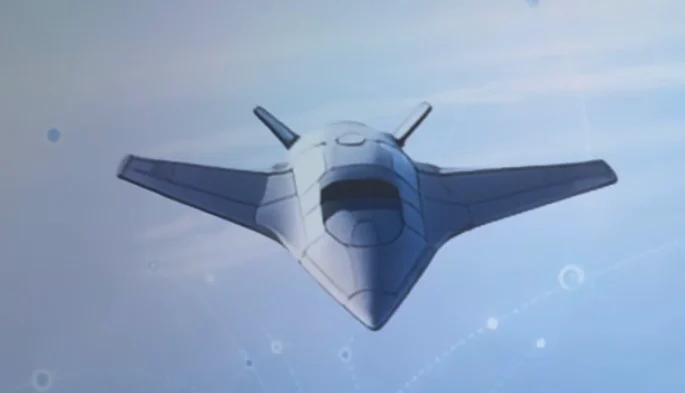
French 6th generation fighter

Rafale and Eurofighter lacked the key feature of stealth to be called a 5th generation fighter but the avionics and kinematics were up to the standard of a 5th gen fighter.
5th gen was defined by Lockeed Martin itself as : Stealthy / supercruising / with data fusion / as agile as a early F16 / Affordable.

so F-35 is not a real 5th gen jet (because not supercruising and not affordable). So.....
 
ASN4G will be carried by Rafale. Entry date is 2035, far too early for a new jet.
A shorter version than the one intended for SCAF/6gen, one with about the same range as the existing ASMP. While SCAF's ASN4G will have the full range required.
 
A shorter version than the one intended for SCAF/6gen, one with about the same range as the existing ASMP. While SCAF's ASN4G will have the full range required.
This point is unclear. It is possible, maybe probable but not sure.
 
The F-47 has proven that a stealth aircraft can have canards. Maybe Europe's lack of stealth knowledge means they are still believing that canards aren't stealthy. Those were just lies over the last 15 years to discredit the J-20.
Given Europe was working on front-aspect stealthiness of canard deltas 35 years ago, what makes you think Europe isn't at least as far ahead on stealthy canards as the US? Remember, the MD/BAE Systems/Northrop CALF/JSF design was a canard for a chunk of its design life.
 
Given Europe was working on front-aspect stealthiness of canard deltas 35 years ago, what makes you think Europe isn't at least as far ahead on stealthy canards as the US? Remember, the MD/BAE Systems/Northrop CALF/JSF design was a canard for a chunk of its design life.
AFAIK the thing about canards is that they don’t necessarily need to be deflected during standard cruise maneuvers, only during combat when you’ve already been detected. (They’re also very useful for low speed controlability and lift generation during which stealth is irrelevant).

So even if canards have a temporary signature penalty it should be possible to schedule the flight control system to have a zero deflection stealth mode to reduce initial detectability…

And I would imagine that blending the canard into the wing (LEVCONs) further reduces the RCS when not deflected, which is why that was being studied by Onera and DLR for FCAS.
 
Last edited:
AFAIK the thing about canards is that they don’t necessarily need to be deflected during standard cruise maneuvers, only during combat
If you have an aerodynamically unstable design with a constant desire to pitch up, then your canards need to constantly work to prevent that. Even in theoretically stable cruise you're likely to see constantly varying demand just because the atmosphere isn't a uniform fluid.
 
If you have an aerodynamically unstable design with a constant desire to pitch up, then your canards need to constantly work to prevent that. Even in theoretically stable cruise you're likely to see constantly varying demand just because the atmosphere isn't a uniform fluid.
If you're doing it right, they're deflecting very little.

Where was that paper that showed canards had almost no effect on RCS until deflected more than 15deg?
 
AFAIK the thing about canards is that they don’t necessarily need to be deflected during standard cruise maneuvers, only during combat when you’ve already been detected. (They’re also very useful for low speed controlability and lift generation during which stealth is irrelevant).

So even if canards have a temporary signature penalty it should be possible to schedule the flight control system to have a zero deflection stealth mode to reduce initial detectability…

And I would imagine that blending the canard into the wing (LEVCONs) further reduces the RCS when not deflected, which is why that was being studied by Onera and DLR for FCAS.
RCS is not only driven by deflection, but also by material, shape, size, interferences.
 
5th gen was defined by Lockeed Martin itself as : Stealthy / supercruising / with data fusion / as agile as a early F16 / Affordable.

so F-35 is not a real 5th gen jet (because not supercruising and not affordable). So.....
It honestly would be much easier to everyone, if "5th gen" was just left to 2000s jets.
2010s jets, coming from ~2000 views on future air combat, readily sacrificed supercruise and some stealth performance without much issue.


Affordability is always relative, but attacking F-35 from this angle is wrong. Rafale costs almost x2, despite being a smaller non-LO jet.
 
In some export couples (Romania, India) it's as close as it gets to x2.

F-35A by itself as is is ~9x million ish, Rafale is ~14x. Even cheaper deals with second hand rafales tend to be more.

Plus, french weapon package is more expensive as well. Granted it's more complete, but number is number. You don't buy eurocanards to save direct procurement costs, not even the gripen E.
 
In some export couples (Romania, India) it's as close as it gets to x2.

F-35A by itself as is is ~9x million ish, Rafale is ~14x. Even cheaper deals with second hand rafales tend to be more.
That's apples and oranges because the India contract included lots of additional items not typically included in contract prices, so you can't compare.

A much better comparison would be what Greece paid for its 20 F-35s vs. 18-24 Rafales. Same contract scope (aircraft + simulators + training + initial support for 3-4 years, excluding weapons packages), same currency, same taxes etc.
  • 20 F-35A: €3.47B (€174M per aircraft)
  • 20 Rafale: €2.035B for first 18 Rafale + ~€270M for 2 extra Rafale (€808M for 6 options) + €500-750M estimated discount since 12 Rafales were used with 60% of service life remaining = €2.8 - 3.1B (€140-155M per aircraft)
So Greece paid 10-20% less for Rafales vs. F-35s under almost identical conditions.
 
It honestly would be much easier to everyone, if "5th gen" was just left to 2000s jets.
2010s jets, coming from ~2000 views on future air combat, readily sacrificed supercruise and some stealth performance without much issue.


Affordability is always relative, but attacking F-35 from this angle is wrong. Rafale costs almost x2, despite being a smaller non-LO jet.
No. Rafale cost is not twice than the F-35 price.

Ask Switzerland : they expected to purchase 36 F-35 for 6 swiss francs billions. Finally they only are able to purchase 30 unit, for 6 billions plus a new budget of 394 swiss francs millions !
6.394 billions swiss francs = 8.05 $ billions for 30 units => 1 F-35 costs 268 $ millions.

Show me a inked deal for Rafale at a 500 $ millions my dear.
 
https://aviationweek.com/defense/aircraft-propulsion/french-startup-aura-aero-reveals-cca-ambitions

French Startup Aura Aero Reveals CCA Ambitions​


PARIS—Toulouse-based Aura Aero is close to launching a new collaborative combat aircraft (CCA) project, aiming to reach first flight with a demonstrator in 2028, CEO Jérémy Caussade said on June 17.

The CCA project follows plans to launch flight testing of Aura’s Enbata medium-altitude, long-endurance (MALE) uncrewed aircraft system by the end of the year, and stands to reuse the avionics and missions systems architecture developed for the latter.

“The idea is to have one core system: same control station, the same connectivity, the same architecture,” Caussade told Aviation Week at the Eurosatory trade show here.

Aura is designing the CCA with a maximum takeoff weight of 3-5 metric tons (6,600-11,000 lb.), or roughly 50% to 250% more than the 2-metric-ton, diesel-engine-powered Enbata.

The Aura CCA also would be designed with internal bays for weapons and a small turbofan engine, Caussade said. Safran and Rolls-Royce are working independently on small turbofans for the CCA market that could work, he added.

The project adds to a long list of aircraft developments by the nearly eight-year-old company. Aura’s Integral R two-seat trainer received European Union Aviation Safety Agency certification in December 2024. The Era, a hybrid-electric, 19-seat regional airliner, also is in development, with scheduled entry into service in 2030.

The company launched the Aero M division for the military aircraft market. The focus initially was on an electric-powered high-altitude pseudo-satellite (HAPS) aircraft. But the technical challenge of designing a solar-powered aircraft to operate in the high European latitudes proved complex—and Aura’s contacts in the French military asked them to change focus.

“The customer said to us that the CCA and the MALE were more urgent than the HAPS,” Caussade said.

Aura launched the Enbata to fill the role of a sovereign French MALE UAS. Initial interest for the aircraft from the French military is focused on the maritime patrol mission, Caussade said.

Enbata will be equipped with a nose-mounted Thales AirMaster-C radar, which will be integrated shortly after the aircraft completes first flight. Thales also is working on electronic intelligence and jammer payloads for Enbata.

Aura revealed the final configuration of Enbata at Eurosatory. The company dropped the canards from the original design revealed at the Paris Air Showlast year. The engine nacelle and inlet are also enlarged to accommodate an intercooler and oil cooler, Caussade said.

 

Attachments

  • image.png
    image.png
    121 KB · Views: 91
Last edited by a moderator:
5th gen was defined by Lockeed Martin itself as : Stealthy / supercruising / with data fusion / as agile as a early F16 / Affordable.

so F-35 is not a real 5th gen jet (because not supercruising and not affordable). So.....
Maybe the "generation" is more about the trends that reflect changing priorities. Looks like 6th gen is going to be more about range and networking than speed and agility.
 
Is a 2018 start up of 250 persons able to deal with such a project ?
I believe so. With the right people involved, it' be a Skunkworks type organization.

They are currently working on a Predator-type aircraft, and they are aiming for a 3-5 tonne CCA with internal weapons bays (Too small, IMO, but that's a separate argument. I'd say they should be aiming for 5-9 tonnes). The first hardest part will be getting some stealth designers.
 
F-47, GCAP and F/A-XX will all have conventional engines. They’ve abandoned adaptive engines… so now none of them are 6th generation??
GCAP does not have a conventional engine, it's just not adaptive. It's can be boosted by electrical generation, similar to kers on an F1 car.
 
Last edited:
Is a 2018 start up of 250 persons able to deal with such a project ?
Start-Up's lend themselves for drones, because ultimately these are less complex and cheaper to develop than manned high performance aircraft. Same applies for the USV and to a degree to the UUV space as well. Such drones like proposed by these French guys and gals are currently all the rage for fresh companies looking to breach into the defence sector. And fresh talent is definitely needed in an industry that has become somewhat stale over the last decades. These systems are software heavy and light on physical manufacturing. They also usually don't run on high performance engines which bring a whole load of mechanical complexity with them as well as the need for far more advanced flight controls. In short, the bar for a decent "CCA-Type" drone or loyal wingman is quite a bit lower, which makes the playing field between new companies and established ones far more even. And usually Start-Up's are far more flexible with regards to pricing as well as being more willing to bend over backwards for a contract, legacy manufacturers aren't.

So yeah, such a small company could end up being competitive. Established aerospace manufacturers and suppliers obviously have their own advantages, especially with regards to resources and expertise.
 
Last edited:
"Seeking unprecedented levels of electrical power generation and thermal management, the GCAP engine team has ditched an adaptive-cycle concept"

Source: Aviation Week article from April 2025
Global Combat Air Program Engine Focuses On Thermal-Electrical Management
https://aviationweek.com/defense/ai...-engine-focuses-thermal-electrical-management
The french air force top brass are, in the same way, not very keen with adaptative cycle engine. They are afraid it is costly (to built and to maintain) with too small benefit...
 
It will be interesting to see what type of engine that will be put into the new french 6th gen fighter BonPlan2, obviously they are right to stay away from adaptive cycle engines.
 
It will be interesting to see what type of engine that will be put into the new french 6th gen fighter BonPlan2, obviously they are right to stay away from adaptive cycle engines.
The prototyp will rely on M88, for sure.
Or a 80% size frame with actual M88, or 100% frame with boosted M88 with lower span life.

For the serialy produce 6th gen fighter, it may be well to share the engine with the indian AMCA one : 12 tons thrust is something convenient I think.
I've read that as Kaveri was not a clear success, it uses successfull adaptative cycle config. If true it may be well to mix the hot core french tech and the indian cold adaptative cycle concept....
 
The engine is designed around massive energy creation, that energy is in part to be stored in batteries.

The energy can then be recycled back to the engine to boost performance, especially to reduce engine and throttle lag.

RR have been designing this from around 2010 and it is the core point of the engine.

I imagine those chasing adaptive with also look at this in the future.
 
Very interesting Senate hearing of Dassault's CEO focused on the "Future of Combat Aviation"... he covered lots of points on the future 6th gen fighter, why FCAS failed and other ways to collaborate in the future, the future of drones etc. Key quotes below.

The new timeline is for a demonstrator by 2035, with engine development continuing in parallel. This engine won't be fully mature by 2040, meaning 2045 is more realistic for the new fighters to be fully operational. Dassault are open to partnerships based on the Neuron model, with partners like Saab who can bring expertise while avoiding duplication of efforts. He thinks the demonstrator can be built for a few hundred million euros a year initially; he is skeptical of people who throw around billions to grab headlines. He implies that Airbus' "combat cloud" effort is mostly vaporware, the real work is on collaborative combat and that effort is already underway and financed as part of the Rafale F5 standard.

View: https://www.youtube.com/watch?v=BpkAPZca2ng


1) On the future 6th gen fighter and demonstrator for 2035
We are absolutely intent on continuing studies for a future combat aircraft. All the work done over the past nine years will be put to use. We ran simulations, and our engineers worked on solutions and trade-offs balancing aerodynamics, stealth, and payload capacity, since the aircraft needs to carry somewhat heavier weapons. All that work is done.

What do we do now? A demonstrator has been added to the Military Programming Law (LPM) as a key national requirement for the 2035 timeframe. This is an excellent move. Why 2035? Because it aligns with the Rafale F5. The Rafale F5 will help de-risk a number of key components: engines (with Safran), sensors (with Thales), and connectivity. The 2035 demonstrator will serve to test the overall architecture of a 6th-generation aircraft, its aerodynamic stealth, and its ability to operate in a networked environment with drones.

Have we lost ten years? Not entirely; design teams have been hard at work running simulations. We also now know what *not* to do when it comes to cooperation. The GCAP program—led by the British, Italians, and Japanese—is moving forward. They have clearer governance and a shared yet clearly defined leadership structure. If France wants to stay in the race, it must accelerate work on its own demonstrator.
(...)
A 6th-generation demonstrator by 2035 is possible, without the engine. The engine will take time—we might use an M88 TRex for the demonstrator. But the fact remains that engine development is a long process. That is why I have always said that even 2040 is an unrealistic target for having an engine that is sufficiently developed and mature for an operational aircraft. 2045 is quite ambitious as it is for the first operational standard.

2) Can France design a 6th gen fighter alone?
When I say "I can do it alone," I mean that, from a technical and technological standpoint, I know how to do it with my partners. It’s not just Dassault acting in isolation. The first partner I need is the engine manufacturer. Is there an engine available to power an aircraft of the size envisioned by our armed forces for the 2040–2045 timeframe? That is the number-one question; it is truly the critical-path issue. That brings in Safran.
(...)
The engine is fundamental —specifically the TRex— because it paves the way for a powerplant capable of 11 tons of thrust, moving toward the kind of engine needed for a future high performance fighter. This is one of the options for the future fighter, though some advocated for an even larger aircraft. If you build a very large fighter, you need an engine with significantly higher thrust—even with a twin-engine configuration. So, in a sense, that raised the bar even higher for Safran. I believe this realistic, iterative approach will benefit both the Rafale program as well as the future fighter, whatever form it takes. This incremental engine development is truly fundamental; as we work on the Rafale F5 standard, we are keeping the future in mind.
(...)
Can Safran cooperate with others? They’ve shown a willingness to cooperate with MTU, but that was a partnership where Safran was clearly the designated architect. It wasn't a co-leadership arrangement. There is a joint venture, but the joint venture doesn't mean much.

We also need electronics. Thales —I believe— is a leader in radar, electronic warfare, and optronics. So, it’s not a solo effort; we have the expertise to handle all these aspects.

(...) I remain skeptical about the "combat cloud." A cloud is, well, a cloud—it’s full of vapor. Some people claim that everything can be digitalized. But not everything can be; we see that in every conflict today. What drives military effectiveness is the ability to fire weapons. You have to fire them at the right target, have the right intelligence to back it up, and so on. Today, two Rafale jets already operate in a "cloud" setup, meaning they work together. The real term is actually "collaborative combat". The word "cloud" is a bit misleading.

(...) However it is crucial to develop algorithms —we will be doing this for the Rafale F5 as well— and to begin working with combat drones in conjunction with fighters. This cannot be done in isolation. The idea that combat drones are developed in one corner and fighter jets in another simply doesn't work. Those who think that because they own the "cloud"—which is nothing more than vaporware—this will enable them to take leadership of everything else, well it doesn't work that way.

3) Can France afford a 6th gen fighter?
Regarding the budget needed, it is important to recognize that the effort is already underway through the building blocks of the Rafale F5 standard. The F5 represents the missing link, the technological bridge. The funds allocated to it support the design offices at Dassault, Safran (for the engines), and Thales. As for the demonstrator itself, the goal is not to ask for tens of billions of euros starting next year. What is needed, initially, is stable, ring-fenced funding in the range of a few hundred million euros annually for the design and architecture phase, prior to the industrial ramp-up for prototype manufacturing early in the next decade. Consistency is the key, not headline-grabbing announcements.
(...)
Ultimately, collaboration comes down to sharing resources. And when we talk about resources, there are two things involved. There are the development costs. If you develop a program collaboratively, you share those costs, which can offer an advantage. If there are two partners, you split the cost in half; if there are three, you divide it by three. That is, provided costs don't balloon—precisely because of duplication or the desire to build everything jointly—to the point where tripling the number of engineers and the timeframe results in a higher cost, even after dividing it by three.

And then there is the matter of actually purchasing the aircraft. If you develop a collaborative aircraft that has grown bloated because you had to accommodate everyone's requirements—without the resolve to keep the size in check—you end up with a more expensive plane. So, while you might save money initially (subject to the caveats I mentioned earlier), you still have to buy the aircraft, and that comes at a cost.

Thirdly, if the aircraft is expensive, complex, and so on, it will be harder to export. Consequently, the country's financial return will be lower. Therefore, the issue of resources requires a careful comparison between going it alone and collaborating.
(...)
A 6th-generation aircraft featuring clear governance, a single prime contractor, and guaranteed performance will be far more attractive to export clients and European buyers than an aircraft born out of a committee that accumulates delays and operational compromises. As I mentioned, this does not preclude opening the door to serious, targeted industrial partners—provided the approach is based on high-level subcontracting rather than a co-governance model that leads to gridlock.

4) Why FCAS failed
We failed—and I am somewhat saddened and disappointed by this—to define with our two partners a demonstrator capable of flying by 2030; that would have been something positive.

You all know the reasons why this cooperation is ending. At the start, there were two of us, so the workload was roughly split fifty-fifty, with Dassault clearly in the lead role as the architect. The arrival of the Spanish changed that balance, since Airbus Spain reports to Airbus Germany within the Airbus organizational structure. We ended up with one-third of the work compared to Airbus's two-thirds. I agreed to this, provided that —and this was reiterated several times— Dassault held the leadership role as the architect.

Over time, we realized that Airbus also wanted greater responsibility in the definition phase; they either wanted to work right alongside us and share everything—or at least share a great deal—or take the lead on specific work packages. Little by little, the atmosphere within the teams deteriorated abd we reached a point where I called for a change in governance, because the "two-against-one" dynamic no longer allowed me, from my vantage point, to perform the role of architect. Then a little over six months ago Airbus said: "We don't want to work with Dassault anymore." I, for my part, never said I didn't want to work with Airbus, I stated that clear governance was essential. If Airbus no longer wishes to work with Dassault, that is their choice. So be it; the agreement came to an end.

5) Neuron - Dassault's preferred partnership approach
Are partnerships possible? Yes, but they must be built on a sound foundation. You mentioned Saab. We have had an excellent experience working with Saab on the nEUROn program. They are a reliable partner with genuine expertise—a company that doesn't seek to plunder others' know-how simply to catch up. We can envision pragmatic forms of cooperation based on industrial and operational efficiency, rather than purely political criteria regarding geographic return.
(...)
We are entirely open to cooperation; we demonstrated this with the Neuron program and, in fact, with the NGF. The ground rules remain the same: expertise must take center stage. The priority is serving our armed forces—not indulging ourselves—and that applies to all parties involved. We must ensure we produce the most operational and high-performance combat aircraft possible, tailored to our military's requirements, while also ensuring it is exportable. After all, the economic reality is that exporting the aircraft is a way to recoup costs,

I would add that if we want to build Europe —and I am a staunch advocate for a stronger Europe— the aim should not be duplication. I constantly hear talk of fragmentation; if we duplicate efforts, we will only fragment the landscape further. So, the goal is essentially to tap into existing expertise and bring together various European players who wish to contribute—without necessarily duplicating efforts.
(...)
We are capable of cooperation—we have demonstrated this in the past—but we want to cooperate based on ground rules accepted from the outset. This requires agreements between states—which is only natural when developing military hardware—as well as good-faith agreements among the industrial partners who will contribute to this aircraft, drawing on their experience and expertise, and with due respect for their expertise and experience.
(...)
The path that could prove promising is the one we explored with the Neuron. Neuron was a combat drone demonstrator—a demonstrator of stealth technology, certainly, but also a demonstrator of European cooperation aimed at minimizing costs while maintaining effectiveness. In my view, this is the right way to cooperate. It shows that we can and do know how to work together. We involved six countries, each contributing its specific areas of expertise, driven by a shared determination to avoid simply building the biggest thing or duplicating efforts. We know how to organize ourselves in this way, and we are fully prepared to do so.

6) Will drones replace manned fighters?
Small drones will never replace large effectors. The issue is payload size: a small drone means a small payload, and a small payload means limited damage. It’s that simple. If you want to punch a hole in a bunker, you need a heavy weapon. That heavy weapon is carried by increasingly large aircraft. Consequently, the combat aircraft remains the primary tool for air superiority, with the ability to follow-up with air-to-ground missions. In the strategic planning of Western air forces, the priority is precisely this: launch an air campaign to seize control of the skies and then clear the way.

At a certain point, air power alone isn't enough. It isn't designed for the final phase; it is meant to clear the area and prepare the battlefield. Ultimately ground troops step in to finish the job. The advent of drones adds a new dimension to this ground war. Consider a swarm of drones capable of individually targeting specific objectives—almost on a one-to-one basis. In Ukraine today, we see manually piloted drones firing to deny a front line to enemy soldiers, picking them off one by one. It is a truly unique and distinct form of warfare.

However while drones can certainly be used to launch strikes, if you look at Middle Eastern countries, for example, they haven't suffered greatly from drone attacks. Of course, if a drone flies into a hotel, it’s noticeable. Swarms of drones flying over a city are a form of psychological warfare, though not *only* psychological. They cause destruction, and in an urban setting, the results are devastating. But it doesn't cause the kind of damage inflicted by deep-strike weaponry, whether surface-to-surface or air-launched. These are highly complementary elements with vastly different costs.
(...)
It's disappointing that we haven't launched a combat drone yet. That doesn't mean we aren't working on it, but there are budget constraints, evolving requirements, and so on. For us, the combat drone complements the fighter jet; it doesn't replace it. We aren't looking at a combat drone that could wage war on its own. Instead, it is a drone capable of operating alongside the fighter jet to further enhance the jet's performance. By making the drone highly stealthy, you achieve stealth capability [without a stealth fighter]. With a combat drone alongside it, honestly, a Rafale would perform better than a F-35.
 
Last edited:
So if Germany are going for 2045, and France are going for 2045. Are we now talking France and Germany trying to sell into the same market, or are Germany hoping their bigger plane will compete against GCAP.

Seems such a muddle when FCAS and GCAP had distinct roles.
 
So if Germany are going for 2045, and France are going for 2045. Are we now talking France and Germany trying to sell into the same market, or are Germany hoping their bigger plane will compete against GCAP.

Seems such a muddle when FCAS and GCAP had distinct roles.
The French approach seems clearer now, with an iterative development leveraging Rafale F5 technologies (new engine hot section, more powerful sensors, collaborative combat features including datalinks, AI algorithms etc). All inside the smallest stealth package possible to meet both air superiority and strike missions (11-12t thrust engines). With a particular focus on cheaper economics for better exportability.

So that should remain quite differentiated from GCAP on the export market.

The German approach remains a mystery, with IMHO long odds of ever producing a viable fighter, especially on the export market. The most likely outcome may not be their own fighter... they could end up licensing a foreign design (GCAP being the best candidate), modifying it and then installing their own homegrown avionics. Perhaps a little like how Japan's F-2 was a highly modified F-16 with new avionics?
 
Last edited:
The French approach seems clearer now, with an iterative development leveraging Rafale F5 technologies (new engine hot section, more powerful sensors, collaborative combat features including datalinks, AI algorithms etc). All inside the smallest stealth package possible to meet both air superiority and strike missions (11-12t thrust engines). With a particular focus on cheaper economics for better exportability.
Agree but this funding issue for the UCAV still needs to be resolved ASAP
 
Agree but this funding issue for the UCAV still needs to be resolved ASAP
I think the french authorities are waiting for the negotiations with the UAE to be completed before releasing the fundings.
 
The French approach seems clearer now, with an iterative development leveraging Rafale F5 technologies (new engine hot section, more powerful sensors, collaborative combat features including datalinks, AI algorithms etc). All inside the smallest stealth package possible to meet both air superiority and strike missions (11-12t thrust engines). With a particular focus on cheaper economics for better exportability.
T-Rex engine is seen as a hyphen between M88 technolgy ant 6th gen engine one.
It is a safe way.

M88 was imagined in 3 variants : M88-2 of 7,5 tons, M88-3 of 9 tons and M88-4 of 10,5tons.
T-rex applied to M88-2 give 20% more thrust in the same weight and dimensions. A M88-4 "T-Rex" may offer 13 tons of thrust. Far than enough for a new jet, maybe as a stop gap or not.
 
The new timeline is for a demonstrator by 2035, with engine development continuing in parallel. This engine won't be fully mature by 2040, meaning 2045 is more realistic for the new fighters to be fully operational.

I fear this timeline is going to seriously endanger France's fighter export market. There are already other 4+ and 5th gen fighters in development and nearing production from the likes of Turkey and South Korea. GCAP's timeline, if Japan gets their way, will deliver an entire decade before France does. There are also multiple excellent Chinese options for those nations which can play in the unaligned geopolitical space, there are a couple of Russian options (although the war is sapping development funds from next-gen projects); and for those still willing to take the risk and pay the costs for American, there is the Block IV F-35, and potentially two 6th-gens available to close allies. Given how important arms exports are to France, I can't understand why they would simultaneously blow up FCAS while also moving at such a glacial pace for their sovereign project.
 
The market is certainly beyond competitive and I myself think Dassault won't replicate the export success of past ventures (if they can even deliver something truly 'next gen').

However there are many Rafale users right now, which are Integrated to various degrees into the french MIC ecosystem. And they will look for an upgrade sometime in the future.
 

Similar threads

Back
Top Bottom