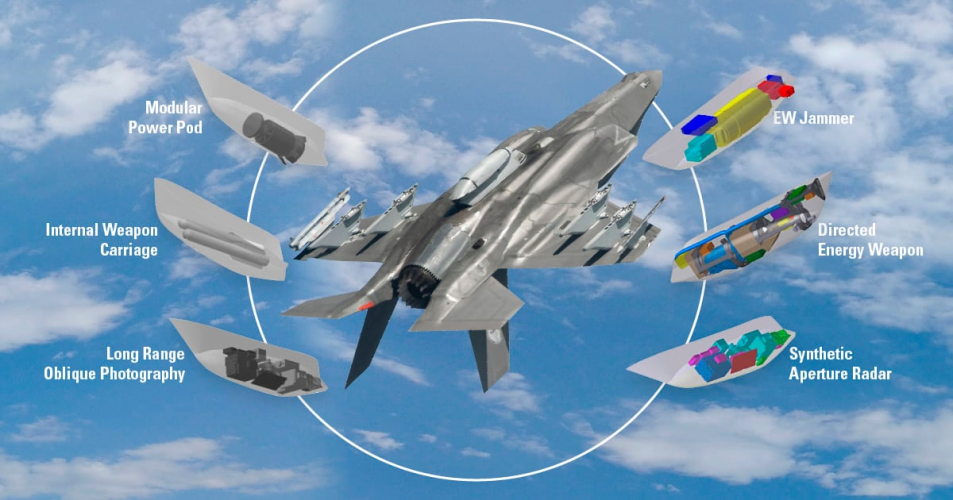
Still lots of unanswered questions around cost, survivability and effectiveness.

Subsonic LWs will be at an energy disadvantage against fighter opposition and ground based SAMs. What will they cost, how effective will they truely be compared to the alternatives (e.g. longer-ranged missiles, cheap attritable remote carriers), and what is the level of expected attrition?

e.g. If LWs cost 1/10th of a fighter then the performance trade-off may be worth it. But if they cost $20-30M, 1/3rd or 1/4 of a manned fighter (which should be better able to evade enemy defenses) then do you really need a loyal wingman?
You do need CCAs.

Even from an air combat perspective alone, being able to engage from multiple geometries is more valuable and useful than firing longer ranged missiles from fewer locations. Mlst The benefit of reach can be used to keep enemy units at bay, but thats only if you can pin down all the units engaging you back. The problem with having lesser points of engagement is that opposing units left unegaged will quickly compress your engagement timelines. You now have less ability to prosecute follow on shots on individual targets of value too. So unless youve got an equally distributed force, the disadvantage is hard to make up.

In combination with having more engagement options comes the added benefits of:

-Sensing
-Distributed EW, which is taking the place of stand in jamming.
-Resilient LOS based information networking and relay nodes
-presenting so many targets that you can, essentially, hide your shooters in plain sight

The benefits and vastly expanded options of having CCAs is becoming par for course even for countries without much money. Not having them puts you at an inherent disadvantage even if you can fly higher and shoot longer ranged, because at a certain point in the engagement, you will be outmanuvered or run out of the airspace by being unable to put up the same amount of combat mass.

I should also add that i remember reading most actual AAM engagements happen at high subsonic to low supersonic speeds and altitudes generally not as high as we think (sub 40 k). That altitude and speed decreases as you near the target as well due to renegagement timelines and defensibility
 
Last edited:
Still lots of unanswered questions around cost, survivability and effectiveness.
Certainly, but that's mostly due to not being fielded in active service yet and not having partaken in any combat operations.

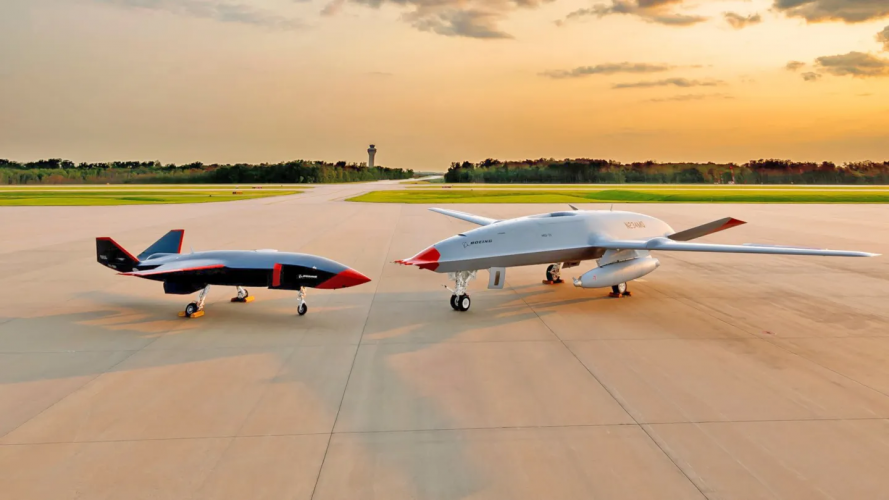
What I meant is that the MQ-28, as in a miniaturized low observable aircraft, fits the bill closer in what most envisioned Loyal Wingmen to be than the two current Increment 1 CCAs. I do expect the MQ-28 to be more costly though, it's substantially larger and possibly ends up being substantially more capable. As for supersonics, I'll be interested to see the first supersonic wingman entering service, possibly from China. But supersonic flight will most likely drive up cost further.

As for high capability, high cost loyal wingmen and cheaper, less capable remote carriers, I believe in most substantially advanced and funded structures there should be a place for both. Because both offer certain advantages over the other. So I could imagine an advanced manned fighter flying with remote carriers as extension of it's own systems, being sensor and weapons systems while loyal wingmen will be present and substantial force multipliers which can act more independently than the remote carriers.
 
Some of the PRC UAVs look supersonic and appear to have full sized fighter engines installed for such. I do not see the US adopting that - costs are two high. I could potentially see aircraft in the MQ-28 size range adopting a smaller, augmented engine that allows for supersonic dash (or perhaps more usefully for sustained high subsonic speed maneuvers), but even that seems a little unlikely. IMO, superior kinetic performance is useful for choosing engagement geometry, but not as useful as simply having more aircraft to attack from different angles. Supersonic performance also creates obvious IR signature problems, especially the use of an afterburner. Worse, it clearly identifies the platform as a high performance armed aircraft as opposed to a subsonic sensor UAV or expendable decoy. And while imparting extra energy to AAMs is clearly desirable, it seems of rather meager usefulness compared to just closing range to the target if you are able to. Evasion also seems of limited value for a low cost attritional aircraft - it is worth trading a $20 million dollar UAV for a much larger more expensive one, or especially an opponent manned aircraft.

I doubt MQ-28 will be sufficiently inexpensive enough for any increment of the USAF CCA/NGAD programs. It’s possible the USN or other organizations outside the RAAF adopt it though.
 
Still lots of unanswered questions around cost, survivability and effectiveness.
From the preliminary analysis data I've seen, baseline Inc 1 survivability is in the gutter, with only a fraction even manage to get a quality shot off before EoL. LM/BA/NOC all chose to present premium solutions that were more suited for the task, but with it came a cost (hence LM's gold-plated comment about their CCA proposal from a couple years ago). Having cheap drones doesn't mean anything when they can't even make it into the fight.

Inc 1 seems to be more about test bedding the technology and concept as a whole before truly buying in with Inc 2. LM's Vectis, NG's Talon, and BA's proposal all would likely be more in line with whatever Inc 2 ends up being. Giving the contracts to GA and Anduril was probably half cost-saving and half industrial base diversification. They will not be sufficient for the HCE that is the Info-Pacific.

MQ-28 generally seems to hit the mark on all the things that would be important for survivability and effectiveness. Guess it just comes down to trade regulations and bureaucracy.
 
Is there some open source data that we can read about?
Unfortunately, no. I chose to not include specific values since they do come from internal analysis/trade studies. So grains of salt are needed. It's worth noting that two sources/companies can provide different results with analyses like this. But given the extremity of the results, I'd be surprised if other analyses aren't in the same ballpark.
 
Unfortunately, no. I chose to not include specific values since they do come from internal analysis/trade studies. So grains of salt are needed. It's worth noting that two sources/companies can provide different results with analyses like this. But given the extremity of the results, I'd be surprised if other analyses aren't in the same ballpark.
Apparently Chinese studies have come to the same conclusion about the vulnerability and ineffectiveness of low end CCAs, though it's hard to be 100% sure about the validity of this rumor. But that would certainly explain why they are investing in full-size supersonic UCAVs.
 
Is there any information that can be provided concerning the assumptions of the studies? For instance, did the modeling assume CCAs were acting alone, with manned fighters, or with manned fighters and other NGAD related systems? Was the opponent force completely manned, numerically equivalent, etc?
 
Those CCA survivability findings are probably not shocking given the very same set of conditions is what caused the US DoD to commit to F-47 after a very thorough analysis. Almost like the PLAAF did the same work and came to roughly similar conclusions.
 
Those CCA survivability findings are probably not shocking given the very same set of conditions is what caused the US DoD to commit to F-47 after a very thorough analysis. Almost like the PLAAF did the same work and came to roughly similar conclusions.

PLAAF is working with a very different set of variables. And F-47 acceptance could be largely political for all we know. The USAF was on the fence as to whether a manned platform was needed.

I doubt we have the information or tools to make an informed decision about CCA, and quite honestly I doubt any independent corporations (who probably have some bias and competing interests) are well equipped either.

That is not to say that the whole enterprise might fail; I just am not goto trust unnamed sources from the corporate sector without knowing the most basics of their simulation’s fundamental assumptions.
 
This is probably a hot take but I think MQ-28 is too much airplane for what looks like a plane with a magazine depth of 2x AIM-120s. I think this plane certainly checks all the boxes in terms of performance (aero, range survivability, etc) capability. But the first version of the MQ-28 isn’t a small airplane and it’s growing larger to accommodate just 2 missiles.

My concern is that the increase size and weight is going to push the overall cost of the airplane back up to the point where people will start asking whether it is worth half the cost of an F-35 for a plane that can only carries 2 missiles and have a lot less capability than an F-35. It’s not just a dollar cost either, it’s the opportunity cost of hanger space needed for an MQ-28, a slot in the takeoff/landing queue of an air base, a whole new set of supply chain and training pipeline to support MQ-28.

I think the CCA concept only works if the CCA are smaller, cost notably less, and require significantly less maintenance and operating footprint than a traditional fighter. But if I use size as a proxy for how much it will cost to buy and operate an MQ-28, then it is not clear to me that such a CCA will clearly be better than just buying and operating more manned fighters.
 
If kinetic performance is the concern…MQ-28 must be a total dog if it’s running a RJ-44 to push 12,000 lbs. it is not clear what YFQ-44 MTOW is, but it is using the same family of engine on an aircraft that is almost half the length and wingspan.
 
Unfortunately, no. I chose to not include specific values since they do come from internal analysis/trade studies. So grains of salt are needed. It's worth noting that two sources/companies can provide different results with analyses like this. But given the extremity of the results, I'd be surprised if other analyses aren't in the same ballpark.
Thanks, that's good enough for me. I think it's pretty consistent with how we pursue technology development in the U.S. If the actual amount of autonomy and decision making isn't up to par yet, it could make sense to start with cheaper and more disposable drones.

MQ-28 and Vectis at first glance look like the most survivable. I'm not sure though if BA is developing anything else for the CCA program besides MQ-28.
This is probably a hot take but I think MQ-28 is too much airplane for what looks like a plane with a magazine depth of 2x AIM-120s. I think this plane certainly checks all the boxes in terms of performance (aero, range survivability, etc) capability. But the first version of the MQ-28 isn’t a small airplane and it’s growing larger to accommodate just 2 missiles.
Not trying to single you out, but I think many people in this forum are still stuck on the kinetic payload and flight characteristics of aircraft, as not only are they more traditional attributes of fighters, but also the most readily apparent ones. In a near peer fight, there is great value outside of payload capacity. And it's those capabilities that allow things with the payload capacities to do their job. There are still vital and important tasks that can be performed by a CCA after expending its munitions - be it non-kinetic attacks or as part of tactics that enable other shooters to shoot and kill.
I think the CCA concept only works if the CCA are smaller, cost notably less, and require significantly less maintenance and operating footprint than a traditional fighter.
There's a place for a spectrum of CCA sizes and capabilities here. It's not a one size fits all and the intended usage for them are wide and varied - just as their sizes and complexities are. That CCA you use to augment F-47s escorting B-21s into dense enemy IADS isn't going to be the same as the CCA you launch to overwhlem those same defense systems - even if they are part of the same operation.

There's also other limiting factors at play here. It would be trivial (or as trivial as designing MQ-28 would be) to have a fighter sized CCA. But problem has always been that the US is fighting a different kind of war than, say, China would be fighting against the U.S. Going too large doesn't make sense, and going too small isn't going to get you enough range.

At this point though, there doesn't seem to be more apetite yet for anything more exquisite - at least publicly. The absolute limit (and ideal) for me is a low - mid supersonic capable CCA carrying 4 AAMs at the highest tier. Anything more than that quite frankly isn't needed. If costs are too prohibitive, it could just be better to buy more of these small - medium sized CCAs.
But if I use size as a proxy for how much it will cost to buy and operate an MQ-28, then it is not clear to me that such a CCA will clearly be better than just buying and operating more manned fighters.
There are likely alot more costs outside of the initial unit cost for a manned fighter than there is for a CCA. I'm not sure how it's possible to have a heavier maintenance cost than an F-35 when the majority of these CCAs will be spending their time sitting in a box during peace time. Size wise, MQ-28 isn't significantly larger than YFQ-42/44. It's already smaller than MQ-25, which is length wise roughly the same as an F-35.
 

Attachments

  • 1781282059557.png
    1781282059557.png
    820.8 KB · Views: 107
Last edited:
It may be worth noting that CCAs and loyal wingmen like MQ-28 are not only weapons systems and complements for manned aircraft. These aircraft will serve as the blueprint for the first generation of genuine unmanned fighter jets, which will be most likely fairly expensive, capable and exquisite. Whatever comes after F-47 or J-36 won't have a pilot, but it won't be less capable either. So high performance UCAVs are the forerunners to these systems, so it should be expected that a branch of such systems will become increasingly more potent. T-75B is already proposing such a direction. And the MQ-28 is moving the needle further towards true unmanned fighters, more than YFQ-42 or YFQ-44, GJ-11 or S-70 right now.
 
I'm not sure though if BA is developing anything else for the CCA program besides MQ-28.
MQ-28 was designed for Australia's operational needs and criteria. BA has a separate design intended for the AF CCA contracts. Whether its the same/similar/different design has not been revealed to the public
 
Last edited:
It is interesting MQ-28 was tested but the YFQs were not.
 
It is interesting MQ-28 was tested but the YFQs were not.
The YFQ-42 and 44 have both operated off of multiple US Air Force operational bases, testing out expeditionary operations, USAF operator handling, weapons loading, and turn-around assessments, and have a dedicated USAF experimental operational unit flying them now. Both have also started flight testing with the USAF funded mission autonomy stack being developed by other industry partners. Both have flown multiple of those vendor autonomy solutions and have been flying with them since early 2026. Pulling these programs out of their test and development to do a one-off demonstration with PACOM is just going to delay things when the program seems to be running ahead or on schedule. I think more multi ship manned-unmanned and unmanned-unmanned work is planned for both vehicles later this year.

MQ-28 and Vectis at first glance look like the most survivable. I'm not sure though if BA is developing anything else for the CCA program besides MQ-28.

Increment 1 is moving at the pace of autonomy. Developing, validating and showing the utility of autonomous and semi-autonomous collaborative aircraft is going to ultimately define air vehicle evolution. Higher performing (greater thrust to weight/improved combat performance speed and payload) vehicles are on the ACP roadmap for the USAF but there is really no point in developing an AV that costs multiples of increment 1 until you have the autonomy stack and collaborative capability advanced to enable it to deliver on the promise. You can see concepts like Vectis already thinking about that state 3-5 years into the future. Larger UCAV's at more traditional fighter like costs have to justify those costs. We are still several years from that and building a high performance $50+ Million UCAV is not really a bottleneck - competing with a comparable manned aircraft is.

You can show a large UAV with a fighter sized engine and parade it on a truck but it is really the autonomy and the collaborative operations side of things that dictate how useful it will ultimately be. Otherwise you are paying close to 2/3 the cost of a 4th or 5th gen aircraft and getting very limited value out of that investment. Autonomy will ultimately drive this from a low-cost adjunct to a medium to high cost autonomous UCAV. Shield AI is already betting on that with X-bat but we are probably half a decade to a decade away from something like that.
 
Last edited:

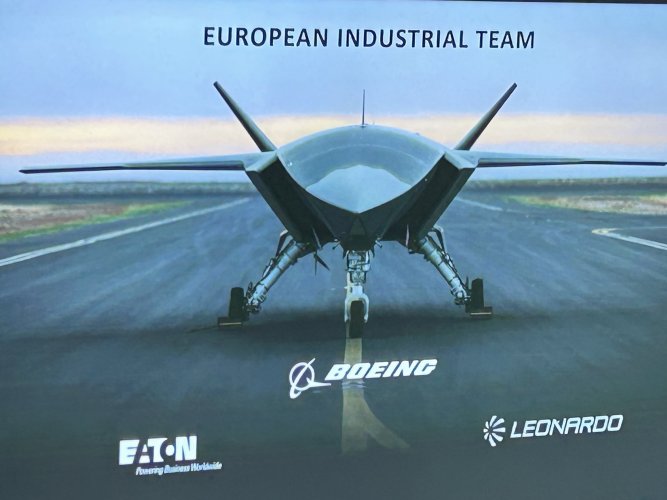
Boeing’s Ghost Bat Drone Flew with F-35 and More in Pacific Exercise​

https://www.airandspaceforces.com/boeing-cca-f-35-more-in-pacific-exercise/
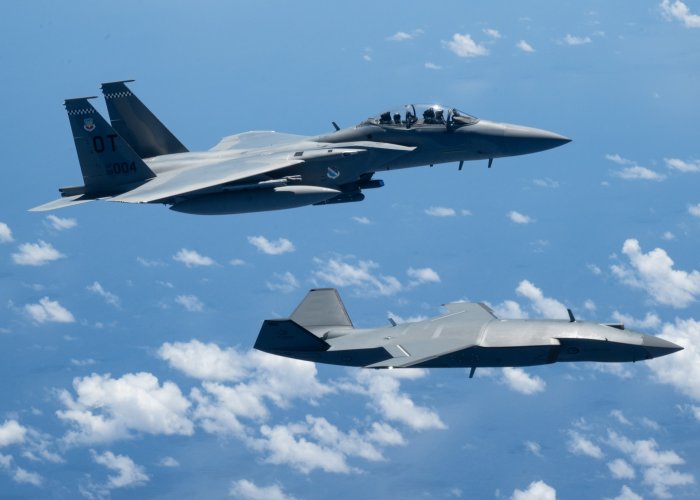
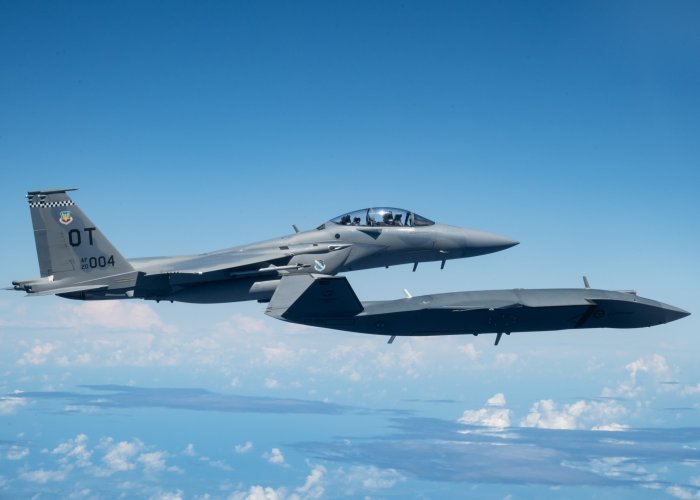
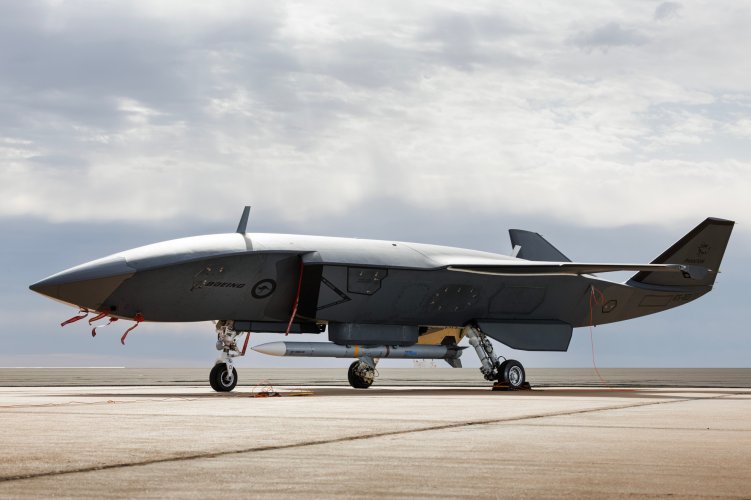
Boeing’s MQ-28 Collaborative Combat Aircraft flew with multiple F-35 variants as well as battle management aircraft during a recent major Pacific exercise, the contractor announced this week.
Exercise Valiant Shield 26, which took place June 22 to July 1 t, spanning Guam, the Northern Mariana Islands, and Japan, marked the first time the U.S. Air Force included a CCA drone in a large-scale, joint multinational exercise. In a release, Boeing said the Ghost Bat “participated … alongside F-35A, F-35B, F-15EX, HC-130, E-3, E-2D, EA-18G, RC-135, and various other joint and coalition aircraft.”
Pacific Air Forces previously revealed the MQ-28’s flight with an F-15EX, a first for the two aircraft, and published photos and videos of the Ghost Bat conducting a Forward Arming and Refueling Point operation with an HC-130J Combat King II, a special operations aircraft.
 
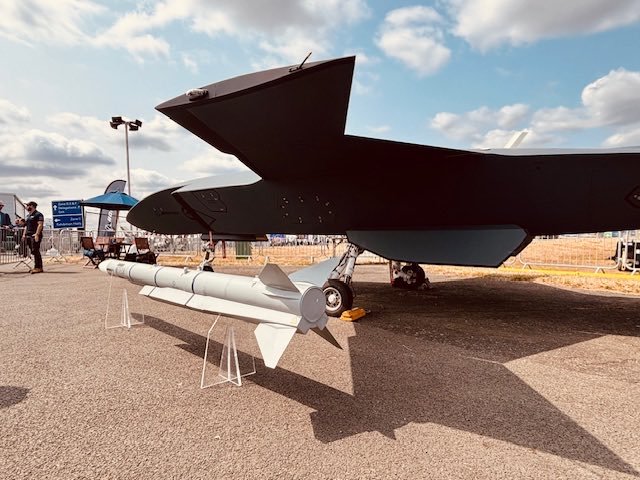
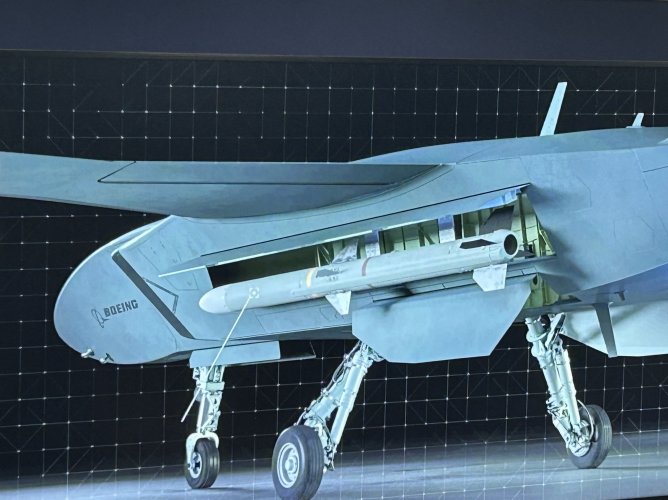
I don't know why, but I was not picturing AAM bays on the inlets of the Ghost Bat
Side bays makes a lot of sense from an internal arrangement / structural sense. Greatly simplifies the routing of the inlets which would otherwise have to curve up and above a ventral bay, which would lead them to conflict with the wing box. Also leaves the belly free for the main landing gear.

Looks like there's some kind of extensible arm which may help with gravity launch of air-to-ground munitions.

P.S. Actually the Boeing press releases says it right there: "Two internal weapons stations with capacity for one AMRAAM missile or two SDBs each side, plus provision for three external weapons stations"
 
Last edited:
Side bays makes a lot of sense from an internal arrangement / structural sense. Greatly simplifies the routing of the inlets which would otherwise have to curve up and above a ventral bay, which would lead them to conflict with the wing box, while also leaving the belly free for the main landing gear.
Oh, I agree that inlet-side bays make a lot of sense for a stealthy aircraft. The inlets need to do their turns, and the area ruling tends to demand volume behind where the inlets go.

Just for some reason my brain was NOT going there.


And now seeing it, I'm wondering if there's also a 2000lb bomb sized belly bay (or space for one), since it doesn't look like there's space for a 2000lb in those side bays.


The location? Or within the E-7 teaming conops?
Physical location.
 
I was also surprised they are going with side bays since it didn't look so apparent in the current versions where it looks like its covered with other types of access panels?
 

Attachments

  • mq28aim120.jpg
    mq28aim120.jpg
    955.3 KB · Views: 54
Last edited by a moderator:
And now seeing it, I'm wondering if there's also a 2000lb bomb sized belly bay (or space for one), since it doesn't look like there's space for a 2000lb in those side bays.
2x SDB per bay. It's a CCA so its job is Offensive Counter Air & SEAD to clear a path for larger aircraft carrying heavy ordnance. It's not a heavy UCAS intended to do autonomous penetration bombing... wouldn't make sense to carry 2,000lb bombs.

IMHO a better use of the belly would be to carry Terma's multimission stealth pod (the F-35 gunpack adapted for various sensor or EW payloads). I could even see the Terma pod being used for buddy refueling, to extend the range of a flight of MQ-28s from their last tanker.
 

Attachments

  • 1784664871725.png
    1784664871725.png
    995.8 KB · Views: 61
Last edited:
Way easier to load weapons with side bays than with a ventral one. Think those aircraft are low on the ground.
It also reduce the amount of strengthening on the fuselage with all the high load close to the wing box.

I agree, side bays give crews much more ease in visually inspecting the bay and loading it.
But ultimately, weapon weight, size and the tool/device they use to load it matter more. An Aim-9x carried by two guys being placed into the side bays is one thing, but a JDAM or AShM, they'll care more about the device being used to load it.
 
I agree, side bays give crews much more ease in visually inspecting the bay and loading it.
But ultimately, weapon weight, size and the tool/device they use to load it matter more. An Aim-9x carried by two guys being placed into the side bays is one thing, but a JDAM or AShM, they'll care more about the device being used to load it.
The statement from Boeing has been one AIM-120 or two SDB. I'm not sure a 500lb JDAM is going to fit in there and would likely have to be a small and compact AShM. In that context an SDB is actually lighter than an AIM-120 so not that difficult to load (comparatively... ;) )

If MQ-28 is going to use JDAM it will probably have to be on one of the three external stations, assuming that is two wing and one belly, but even the belly station might be tight given clearance from the ground.
 
The statement from Boeing has been one AIM-120 or two SDB. I'm not sure a 500lb JDAM is going to fit in there and would likely have to be a small and compact AShM.
A 1000lb bomb will fit into the same size "box" as an AMRAAM, 13.75" across.


In that context an SDB is actually lighter than an AIM-120 so not that difficult to load (comparatively... ;) )
Only a little bit, and the SDBs are dense things that don't have a lot of space for 3 dudes to hold them.


If MQ-28 is going to use JDAM it will probably have to be on one of the three external stations, assuming that is two wing and one belly, but even the belly station might be tight given clearance from the ground.
Could be.
 
Two side bays comes with the trade off of needing more servo mechanisms and more weight to carry the same amount of munitions. It will require more parts and labor to put together as well. Finally, you also lose the option of carrying an oversized munition/pod/payload that can fit in the same weapons bay total volume of two individual weapons bay. In engineering, any solution is always a trade-off between desirements of multiple disciplines or performance metrics.

Given how the original MQ-28 wasn’t designed with an internal weapons bay in mind, using two side bays and stretching the fuselage is the least intrusive way of getting enough payload volume to carry 2x AIM-120s. This lets you to largely keep the original engine flow path more or less intact and do not have the spend the large amount of resources you need to ensure your engine inlet distorts will be acceptable for the engine.
 
Way easier to load weapons with side bays than with a ventral one. Think those aircraft are low on the ground.
It also reduce the amount of strengthening on the fuselage with all the high load close to the wing box.
The bigger problem with the MQ-28 is that the wing spar likely sits over the engine inlet duct. This would have made it extremely difficult to get good and light weight load path from the weapons to the wing spar; I’d argue impossible without major redesign of the structure and internals of the aircraft. The side bays was pretty much the only way they can internally carriage 2x AIM-120s without essentially redesigning the entire aircraft.
 
The bigger problem with the MQ-28 is that the wing spar likely sits over the engine inlet duct.
The even bigger problem with MQ-28 (which applies to all CCAs) is cost. A De Welt article revealed this week that Germany was quoted €800M for a squadron of 12 MQ-28s. That’s for a subsonic vector with limited capability…

In fact it appears (according to the same article) that none of the CCA designs met German requirements!

Now early days and all, and perhaps they have a path to cutting costs by 50% or 75%… but I’m still surprised the rice was so high.
 

Similar threads

Back
Top Bottom