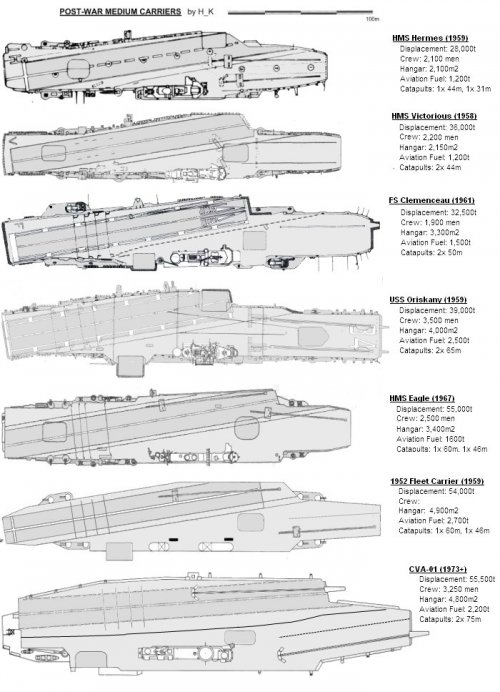
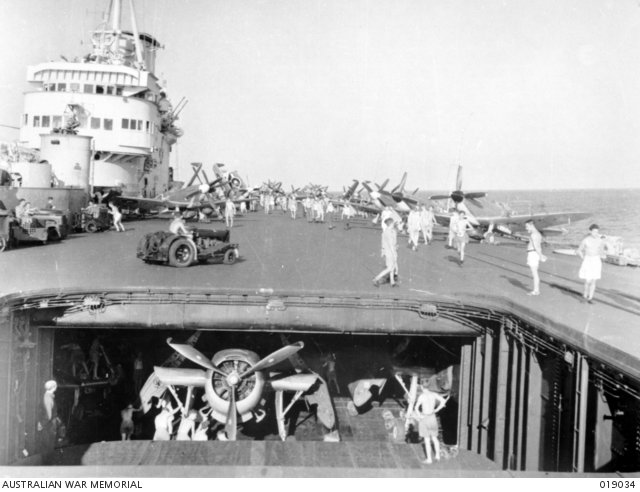
1950's RN carrier rebuilds: Implacable in place of Victorious, Indefatigable in place of Hermes.

Trouble is, we don't really know what a Malta would have looked like if the project had gone ahead. As I've noted before:-

1943 - armoured carrier, enlarged Audacious
1944/45 - open hangar, no armoured flight deck resulting in Design X1 (strength deck = hangar deck). Driven by then Fifth Sea Lord, Vice Admiral Sir Denis Boyd. Never approved by Admiralty before cancellation in Oct-Dec 1946.
Mid-1945 - experience of kamikazies now filtering through. New Fifth Sea Lord (Rear-Admiral Tom Troubridge) who apparently favoured an armoured flight deck. He was succeeded by Admiral Vian in 1946. Who knows what his position might have been given his experience commanding 1st ACS in the Pacific.

Then consider what the USN was doing in 1946/46. Their 1945 Fleet Carrier design was to be a bit smaller than a Midway but still with an armoured flight deck.

IMHO, all the Malta contributes to the debate is an indication of max size possible without massive investment in new port infrastructure.
Well if Malta is being built to Victorious standard she may very well end up resembling a scaled down, 4 shaft version of the 1952 fleet carrier design. The upper limit on waterline length would be 850ft-860ft (around the same length as Hood, which was just barely able to fit into the largest dry docks safely) as for other parameters it’s up in the air really. But presenting the ships as a redesign of the Maltas would probably be more convincing to the government than a completely new design.
 
The problem with this is that leaving “big Hermes” on the slips to be completed in 1959 may just end up with her being a lemon ship like Ark Royal was in OTL.


Apparently Vic’s angle deck sponson was too thin to accommodate a waist cat, which is why she never got one.

As for her air group size, she was operating 9 Buccs, 10 Vixens, 5 Gannets and 7 Wessex helicopters, a total of 31 aircraft.

“Little Hermes” was operating 7 Buccs, 12 Vixens, 5 gannets and 6 Wessex helicopters before she was decommissioned to become a commando carrier.

Thats a massive difference of a single aircraft.

What people seem to have forgotten is that Victorious wasn’t actually that much bigger than Hermes, her main hangar was 360ftx63ft, compared to 356ftx62ft (at least I think this is correct for Hermes, there are conflicting sources). She was also only about 30ft longer overall.

I doubt Vic would have been much better for Phantom ops than Hermes would have been.

Regards,

Temeraire

The advantage modernised Victorious had over Hermes was not size but installed power and electronics. Thanks to six more modern and higher pressure boilers versus Hermes' four Admiralty three-drum units, she had up to a three-knot speed advantage and more steam to use in catapults (meaning either an ability to operate more powerful catapults or less speed loss during aircraft launch operations) which would have provided a clear advantage in opertaing heavier aircraft. Furthermore, she had a higher capacity CDS and more C3 facilities than Hermes, and a gallery deck whixh overal provided more space for the crew.
 
I don't think that anyone but maybe the Japanese really saw the effectiveness of a carrier. So it's really unlikely that there'd be an escalator clause in carriers.
True. But an escalator would effectively be negotiated between the US and UK. If the UK were to prioritize a 27,000 ton design or even a 25,000 ton one enough to suggest an after the fact revision to the treaty, would the US oppose such a measure?

I understood when I asked the question that there were good reasons why the UK did not do so. Even why it would be unusual for them to do so (they were one of the ones pushing for smaller limits just a couple years before after all). However, if they were to do so, was there anything to stop them negotiating an escalator clause on carrier tonnage? It seems to me the US would think it odd but are they likely to object?

I feel this comes from a fundamental misunderstanding of what the Implacables actually were.

They weren’t a clean sheet design, they were an extremely modified form of the Illustrious class. They weren’t much bigger than their older half sisters because the admiralty didn’t want them to be, even though they had 4,000 tons standard displacement headroom before the carriers would be treaty breakers.

An “escalator clause” for carrier tonnage wouldn’t have meant bigger ships, because they weren’t planned to be bigger.
I feel this fundamentally misunderstands my question. As stated, it’s more about the politics. Particularly the international politics, than it is about the technology.


If Britain were to come to the conclusion that they made such a mistake in pushing for smaller carrier tonnage and that they instead needed a design in the 25-27,000 ton range instead, and that their need was sufficient to try to push for a change to the treaty, would there be any barriers to negotiating such an escalation clause from other factors?
 
If Britain were to come to the conclusion that they made such a mistake in pushing for smaller carrier tonnage and that they instead needed a design in the 25-27,000 ton range instead, and that their need was sufficient to try to push for a change to the treaty, would there be any barriers to negotiating such an escalation clause from other factors?
See my comments in post #12 about the operation of Article XXV that you liked.

AFAICT there needs to be a breach by another party, or at least a threat, to allow negotiation of a carrier "escalator". The RN and USN didn't have a clue Japan was building 27,000 ton Shokakus. Shokaku was expected to be a repeat of Soryu then being estimated at c10,000 tons of the original design (16,000 tons in reality) probably as required under Treaty rules.

With the poor quality intelligence where is the trigger?
 
True. But an escalator would effectively be negotiated between the US and UK. If the UK were to prioritize a 27,000 ton design or even a 25,000 ton one enough to suggest an after the fact revision to the treaty, would the US oppose such a measure?

I understood when I asked the question that there were good reasons why the UK did not do so. Even why it would be unusual for them to do so (they were one of the ones pushing for smaller limits just a couple years before after all). However, if they were to do so, was there anything to stop them negotiating an escalator clause on carrier tonnage? It seems to me the US would think it odd but are they likely to object?
No, I don't think that the US would oppose a carrier-tonnage escalator.

But they'd have to have actual good intelligence about how big the Japanese carriers were.


If Britain were to come to the conclusion that they made such a mistake in pushing for smaller carrier tonnage and that they instead needed a design in the 25-27,000 ton range instead, and that their need was sufficient to try to push for a change to the treaty, would there be any barriers to negotiating such an escalation clause from other factors?
Wasn't the reason the UK pushed for a smaller carrier tonnage in the Washington Treaty to let them build another carrier under the Treaty limits? I mean, -4000 tons per hull means that you can have 7 carriers instead of 6 for the same total tonnage. And the UKRN was always more about numbers than sheer size.
 
Another factor is that it's perfectly reasonable for the UK to stop building warships for a couple of years after WW2. While it's great from a longer-term shipbuilding and strategic perspective to continue work on the 26% completed 3rd Audacious and maybe start work on the Malta with the most material assembled in 1945 Britain was totally exhausted and had no identifiable threat to build to.

In reality it's best to solve the problems of the 50s and 60s with the solutions of the 50s and 60s rather than trying to hammer the tools of the 30s and 40s into these holes. Britain seriously looked at new carriers in 1952-53 and 1961-66 and getting a single ship from each of these periods would transform the Cold War RN.
 
Another factor is that it's perfectly reasonable for the UK to stop building warships for a couple of years after WW2. While it's great from a longer-term shipbuilding and strategic perspective to continue work on the 26% completed 3rd Audacious and maybe start work on the Malta with the most material assembled in 1945 Britain was totally exhausted and had no identifiable threat to build to.

In reality it's best to solve the problems of the 50s and 60s with the solutions of the 50s and 60s rather than trying to hammer the tools of the 30s and 40s into these holes. Britain seriously looked at new carriers in 1952-53 and 1961-66 and getting a single ship from each of these periods would transform the Cold War RN.
Wouldn't it have been better to carry out a total reduction of the Royal Navy after World War II? The "East of Suez" strategy effectively ended with the surrender of Japan. There was no need to panic over the Soviet Sverdlov-class cruisers, nor because of the Korean War.

 
Wouldn't it have been better to carry out a total reduction of the Royal Navy after World War II? The "East of Suez" strategy effectively ended with the surrender of Japan. There was no need to panic over the Soviet Sverdlov-class cruisers, nor because of the Korean War.


IIUC the British government didn't undertake any long-term planning for the military until 1948-49, 1945-48 they were fully occupied with returning the servicemen from around the world and dealing with the most immediate and damaging economic impacts of the war. By 1948-49 the Berlin blockade had occurred, and the Soviets had tested an A-bombs a threat had presented itself but at the time people thought WW3 would be much like WW2 with a few A-bombs thrown in. This meant that the decisions made in 1949 were often the wrong ones for how the Cold War panned out.
 
IIUC the British government didn't undertake any long-term planning for the military until 1948-49, 1945-48 they were fully occupied with returning the servicemen from around the world and dealing with the most immediate and damaging economic impacts of the war. By 1948-49 the Berlin blockade had occurred, and the Soviets had tested an A-bombs a threat had presented itself but at the time people thought WW3 would be much like WW2 with a few A-bombs thrown in. This meant that the decisions made in 1949 were often the wrong ones for how the Cold War panned out.
They also thought that WW3 between the Soviets and the west was going to start in about 1957, the "Year of Maximum Danger"
 
They also thought that WW3 between the Soviets and the west was going to start in about 1957, the "Year of Maximum Danger"

Yes, then they had the Korean War scare which threw out all the 1948-50 assumptions and in 1953 they circulated a Global Strategy Paper with the US that put nuclear deterrence front and centre.

There is a back and forth on major procurements and strategic policy, the US came out of WW2 with much better tools than Britain to efficiently pursue an expansive foreign policy.
 
The thing about these sorts of carrier rebuilds is that they solve a problem that didn't appear until at least the Buccaneer in 1964 and definitely the Phantom in 1969. I think the best bet would be to use up these WW2 carriers in Korea and Suez and build new, ~55,000t carriers after the 57 DWP defined the defence policy and strategy that would last more or less the rest of the Cold War.

A killjoy post I know, but there it is.
Well, no. The WW2 armored carriers were very limited in what aircraft they could operate coming out of WW2. The three Illustriouses and Indomitable were only designed to handle aircraft up to 14,000 lbs; this was completely inadequate to operate not only all RN jet aircraft, but also the last generation of piston planes, namely the Blackburn Firebrand and De Havilland Sea Hornet. The two Implacables could operate up to 20,000-lb aircraft, and it was not excessively difficult to bring the prior ships up to this standard. However, while this sufficed for first-gen RN jets, namely the Sea Venom and Sea Hawk, the Scimitar and Sea Vixen would've been completely beyond the carriers without an extensive rebuild.

And that's just ability to handle the weight on their decks. I seriously doubt the armored carriers could operate jets without extensive arrestor and catapult upgrades - certainly the Colossus and Majestic classes couldn't without extensive modernization.

If the WW2 armored carriers are going to have any use once jets come into service, they do need extensive modernization and rebuilding. Hell, even Eagle and the Centaurs, as completed, could not operate the Sea Vixen and Scimitar and needed extensive work themselves to do so.
 
At the time that would be ~73 million $.
Forrestal cost 217, Saratoga 210 million $ (laid down 1952)
Clemenceau was ~90 million $ (laid down 1955);
Both designs ~2.6-2.8 million $ / kton full load

Actual cost for the 1952 design would probably come out somewhere in between, say around 140 million $/50 million pounds?
 
Last edited:
What was the price of the 1952 carrier design?

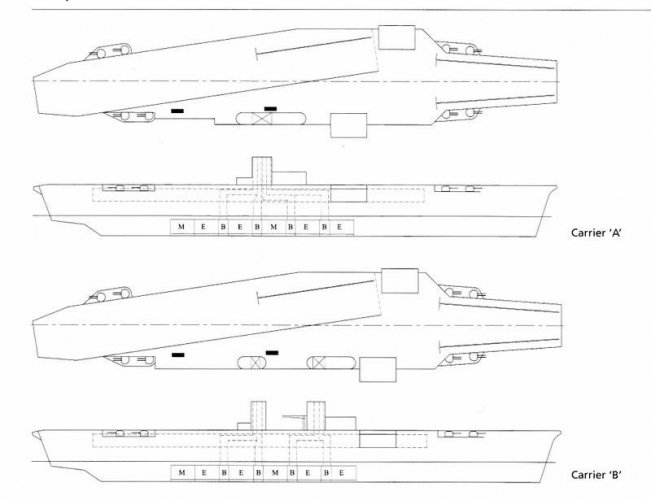
View attachment 814938


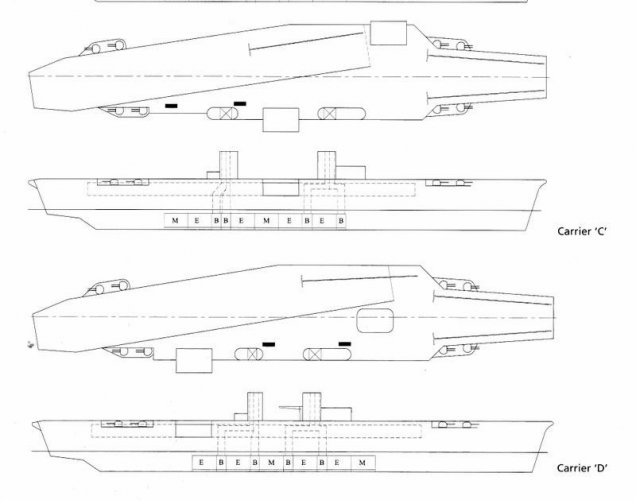
View attachment 814939
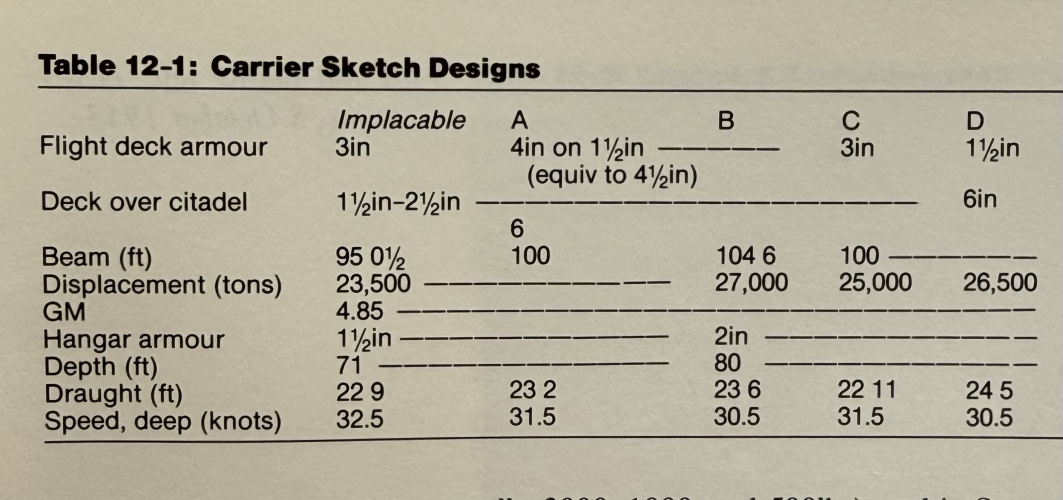
Carrier D has the least-bad elevator arrangement.

On the shorter carriers the front elevator tends to dig into the waves. Plus an elevator at the front of the landing path is just bad design outright.

I would still propose a modification to the D design with longer catapults and a port-side elevator roughly where the starboard side deck edge elevator is.

I'd also be pushing something like the USN Mk11/Mk13 missile launcher to replace half of those gun turrets.
 
Another factor is that it's perfectly reasonable for the UK to stop building warships for a couple of years after WW2. While it's great from a longer-term shipbuilding and strategic perspective to continue work on the 26% completed 3rd Audacious and maybe start work on the Malta with the most material assembled in 1945 Britain was totally exhausted and had no identifiable threat to build to.
Except the economic threat. Shutting down the shipyards means no highly skilled workers getting paid, and that's not really a good argument when the economy is in shambles. Even the US ran afoul of that one in the late 1990s with the Jimmy Carter.

Complete Vanguard, complete 3rd Audacious, maybe scrap the oldest carriers for being too small to operate current piston aircraft let alone early jets, maybe just mothball them to use as helo carriers later.
 
Except the economic threat. Shutting down the shipyards means no highly skilled workers getting paid, and that's not really a good argument when the economy is in shambles. Even the US ran afoul of that one in the late 1990s with the Jimmy Carter.

Complete Vanguard, complete 3rd Audacious, maybe scrap the oldest carriers for being too small to operate current piston aircraft let alone early jets, maybe just mothball them to use as helo carriers later.
Except there was no closing of shipyards in Britain in the years following WW2. There was in fact a merchant shipbuilding boom that lasted into the 1950s.

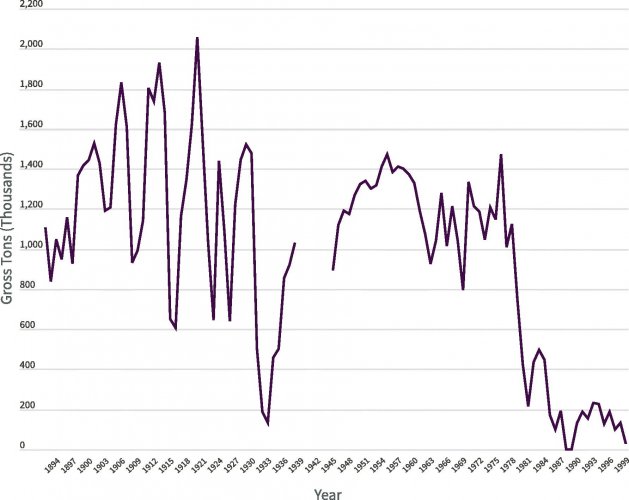
"UK Commercial Shipping Output. Source: Collated by the author from numerous sources in the Marine Technology Special Collection, Newcastle University."


1781275512028.jpeg

In Britain the big shipyards had always built warships as well as merchant ship. From late 1944 the yards were chomping at the bit to learn when they could begin taking orders from the traditional shipping company customers. Many of the yards had long associations with particular shipping companies and were quick to re-establish them and the highly profitable work that came from them. All that changed for the major yards was the mix of warship to commercial work.

There are a number of databases that show the ships built in various yards from which you will see the ships built immediately post-war.
https://www.clydeships.co.uk/
https://www.tynebuiltships.co.uk/
https://www.teesbuiltships.co.uk/
https://sunderlandships.com/

There was also a good deal of conversion / reconversion work available, as ships many ships taken up for wartime work were released back to the civilian market.
 
Carrier D has the least-bad elevator arrangement.

On the shorter carriers the front elevator tends to dig into the waves. Plus an elevator at the front of the landing path is just bad design outright.

I would still propose a modification to the D design with longer catapults and a port-side elevator roughly where the starboard side deck edge elevator is.

I'd also be pushing something like the USN Mk11/Mk13 missile launcher to replace half of those gun turrets.

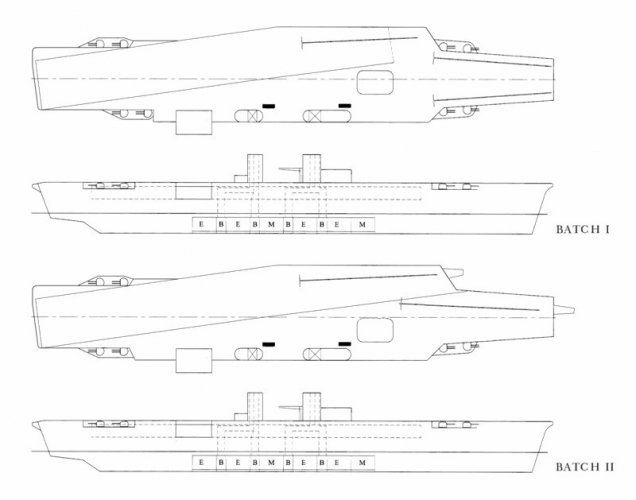
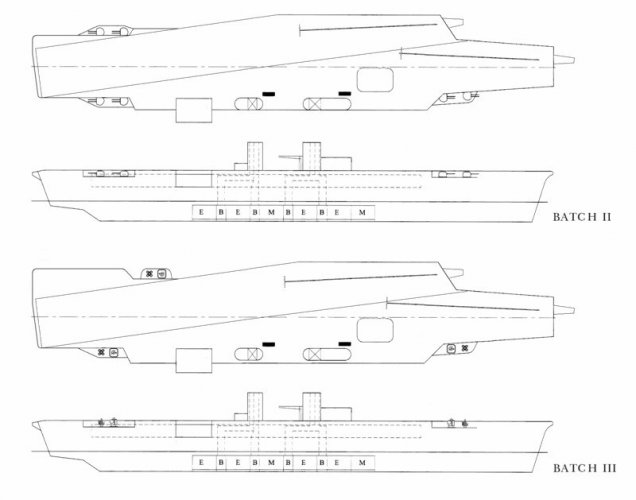
There was an AH on the AH board, I think, may have been here, a while ago which had batches of 1952 carrier.

CV1952designBatchIBatchII.jpg


CV1952designBatchIIBatchIII.jpg
 
At the time that would be ~73 million $.
Forrestal cost 217, Saratoga 210 million $ (laid down 1952)
Clemenceau was ~90 million $ (laid down 1955);
Both designs ~2.6-2.8 million $ / kton full load

Actual cost for the 1952 design would probably come out somewhere in between, say around 140 million $/50 million pounds?

I'm not great expert on shipbuilding, but I did have a bit of a look at it recently with the controversy about the new USN Frigate being a Coast Guard cutter. IIUC Britain was a world leader in shipbuilding mid-century mainly on the strength of it's skilled and flexible labour force, a British built Liberty Ship cost considerably less in labour and money than a US built one. Using this, admittedly declining, model Britain had a big burst of shipbuilding postwar and built the most ships of any nation until the Japanese overtook them in the 60s. I don't think the British shipbuilding industry in the 50s lacked work, Billy Connolly said he just walked up to the shipbuilders in Glasgow and got a job. He wanted to be an engineer but got in the wrong line and became a welder! ;)

If this is true, and IIUC it largely was, then it is reasonable to expect that a British carrier built during this boom would be significnatly cheaper than a Forrestal.
 
Well, it is all speculation. Using a british example, seeing the 52 carrier as a double Hermes, would give 35-40 million £. But that may not be the total cost.

26 million looks very, very low especially compared to the various rebuilds. Also, the county class and the completion of the Tigers cost almost twice the intial estimate.
 
Well, it is all speculation. Using a british example, seeing the 52 carrier as a double Hermes, would give 35-40 million £. But that may not be the total cost.

26 million looks very, very low especially compared to the various rebuilds. Also, the county class and the completion of the Tigers cost almost twice the intial estimate.
Wasn't a lot of that cost bloat due to systems, though?

The carriers weren't really getting a lot of new systems that hadn't finished development. Angled deck is a physical shape, not electronics. even the landing lights system (USN calls it one thing, RN calls it something else) is really just a big set of bright lights, relatively trivial to make changes to. And the hydraulic catapults started life in WW2.
 
I doubt that for the 1954 tiger design as they had essentially a gun armament. Part was inflation, part general electric systems, part probably ship building.

Were the Forrestals delivered on budget? The Clems were about ~30% over estimate in Francs.
 
No, I don't think that the US would oppose a carrier-tonnage escalator.

But they'd have to have actual good intelligence about how big the Japanese carriers were.


Wasn't the reason the UK pushed for a smaller carrier tonnage in the Washington Treaty to let them build another carrier under the Treaty limits? I mean, -4000 tons per hull means that you can have 7 carriers instead of 6 for the same total tonnage. And the UKRN was always more about numbers than sheer size.
Yes, the RN needed numbers; their ideal displacement was 27000t as it would give them an armoured deck strike carrier as opposed to a smaller fleet carrier. Think of a fleet of armoured Ark Royals or an earlier Indefatigable with 17' hangar heights
 
Yes, the RN needed numbers; their ideal displacement was 27000t as it would give them an armoured deck strike carrier as opposed to a smaller fleet carrier. Think of a fleet of armoured Ark Royals or an earlier Indefatigable with 17' hangar heights
What kind of armoring and double hanger height can you get on 27,000 tons?
 
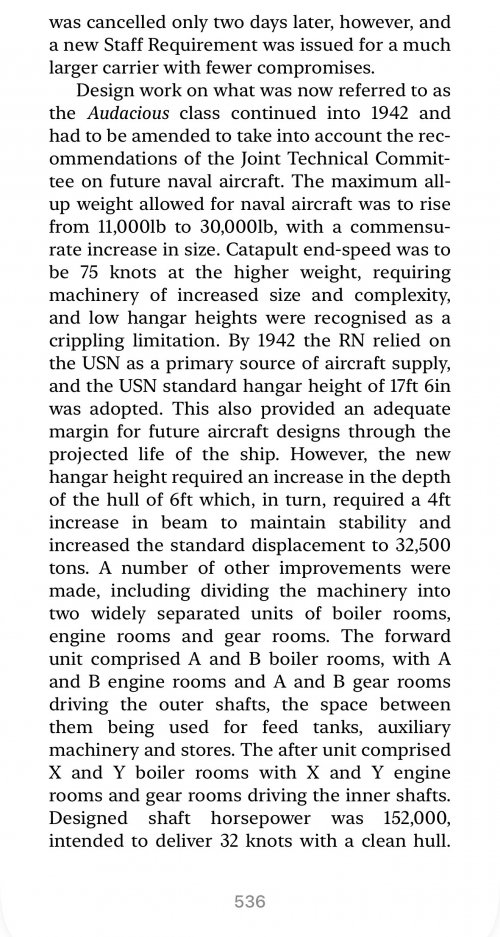
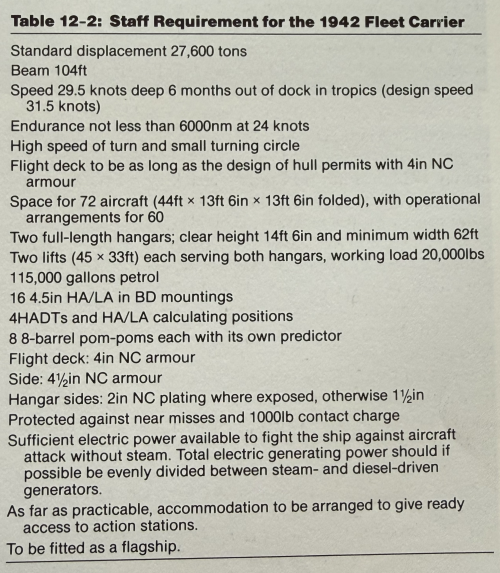
Friedman's 'British Carrier Aviation, the evolution of the ships and their aircraft' (I only currently have the original edition, not the more recent first part of the revised version(s), gives the following tabulated information about the 1942 Carrier (first named as Irresistible, later to become Ark Royal of the Audacious class). The relevant chapter gives quite a bit of background as to the starting point of the design and how it later grew. However, for the sake of brevity, if not fear of copyright contravention, I am only including the tabulated data:
 

Attachments

  • tempImagesO9vLz.png
    tempImagesO9vLz.png
    17.7 MB · Views: 22
  • tempImageDjBWsW.png
    tempImageDjBWsW.png
    3 MB · Views: 21
  • tempImagelGIVTa.png
    tempImagelGIVTa.png
    6.3 MB · Views: 21
The hangar really was the nexus of that british carrier nightmare. Between its relationship with the deck and its armor; the american planes having taller hangars hence taller fins; and any carrier reconstruction starting right there... the horror, the horror.
 
So a 14ft 6" hanger height?? ....not good.
Armoured Carriers has this on the “Irresistible” class:
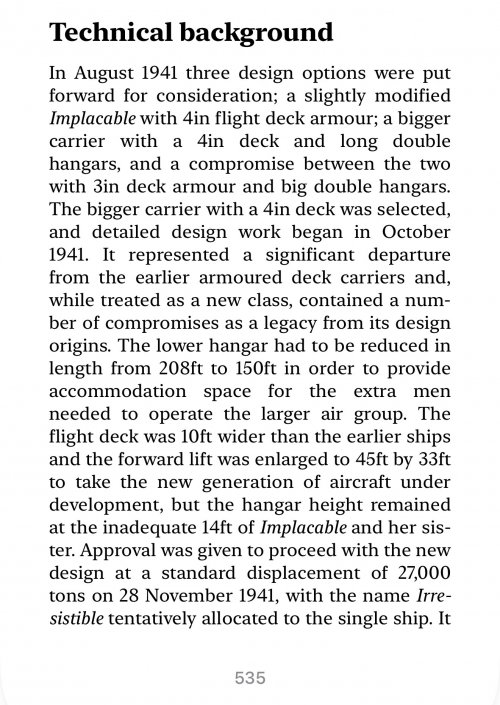
Drawings were urgently submitted in November 1941 for a 27,000 ton ship with an even further enlarged forward lift of 45ft by 33ft. Tweaks to the specifications allowed the hangars to accommodate four rows of aircraft (for a total of 54 machines) instead of the existing three. It was feared the tonnage and hull limitation meant the new design would retain Implacable’s 14ft hangars, though it was discovered some extra height could be recovered through reducing the depth of structural beams.

The revised group would be given the class-name Irresistible
I don’t know where that information is coming from. Nor does it say how much space was found but the implication seems to be that 17’ 6” was possible on them.

Can anyone confirm or deny?
 
Armoured Carriers has this on the “Irresistible” class:

I don’t know where that information is coming from. Nor does it say how much space was found but the implication seems to be that 17’ 6” was possible on them.

Can anyone confirm or deny?

The two earlier postings from Friedman and Hobbs have 14ft and 14ft 6" so it could be the extra height was that 6"?
 
Friedman's 'British Carrier Aviation, the evolution of the ships and their aircraft' (I only currently have the original edition, not the more recent first part of the revised version(s), gives the following tabulated information about the 1942 Carrier (first named as Irresistible, later to become Ark Royal of the Audacious class). The relevant chapter gives quite a bit of background as to the starting point of the design and how it later grew. However, for the sake of brevity, if not fear of copyright contravention, I am only including the tabulated data:
Note the aircraft numbers and sizes in that design for a hangar that was to remain 62ft wide as in the earlier armoured carriers.

Space for 72 ( 44ft x 13ft 6in x 13ft 6in folded) with operational arrangements for 60.

In 1942 the only British / US naval aircraft with the prospect of being able to meet the 13ft 6in folded width requirement were the Seafire III, still some way in the future, and the Firebrand F.I before it was decided to switch the latter to the torpedo fighter role and add 18in to its centre section to allow a torpedo to be carried. Even a Wildcat folded was over 14ft.

A Barracuda folded to 18ft 3in wide. While only 39ft 9in long there was a need to allow space around it. The Admiralty tried for 2ft but relaxed that slightly in wartime.
 
Armoured Carriers has this on the “Irresistible” class:

I don’t know where that information is coming from. Nor does it say how much space was found but the implication seems to be that 17’ 6” was possible on them.

Can anyone confirm or deny?
It has just dawned on me that is the "Staff Requirement for the 1942 Fleet Carrier". That requirement was issued around Nov 1941 and formed the basis of sketch designs presented to the Admiralty in March 1942 (work had begun on them in Oct 1941) with the Audacious design being approved on 3rd Sept 1942. The details at that point appear in Friedman's table 12.3 on p253.

Table 12.2 is not for the Irrestible which was a 1940 Supplementary Programme ship that started life as a repeat Implacable design. Such were the changes to the design between 1940 and late 1941 that it was virtually a new design. Approval to build it to that new design was given on 28th Nov 1941 as an "improved repeat Implacable". She was finally ordered in March 1942. In Aug 1942 it was decided to build her as an Audacious class and she was finally laid down in May 1943 to that design as Ark Royal.

AIUI Irrestible would still have been a one and a half hangar ship, probably with a shorter lower hangar to free up space for accommodation.

The increase in the hangar height in the Audacious class from an initial planned 14ft 6in in Sept 1942 to 17ft 6in was a late change approved on 6th Dec 1942 to accommodate US aircraft types that would equip RN carriers for the foreseeable future. The cost to do that was a further increase in beam by 4ft to its final 112ft (Note this was 8ft more than in the Staff Requirement). That was necessary to counteract the effects of the 4in armoured flight deck being carried 6ft higher. That in turn meant that the order for the original Eagle had to be moved from Swan Hunter to VA(Tyne) on 2nd Dec 1942 because it was then too wide for their building berth.

Note how the origins of the 1942 Fleet Carrier (Audacious class) dating back as far as spring 1941, overlaps with the finalisation of the design for Irresistible. They remained however separate projects.
 
Last edited:
The two earlier postings from Friedman and Hobbs have 14ft and 14ft 6" so it could be the extra height was that 6"?
Seems the hangar height was to increase by 6in from Implacable to Irresistible and earliest plans for Audacious. Then in Dec 1942 Audacious was increased to 17ft 6in.
 
It has just dawned on me that is the "Staff Requirement for the 1942 Fleet Carrier". That requirement was issued around Nov 1941 and formed the basis of sketch designs presented to the Admiralty in March 1942 (work had begun on them in Oct 1941) with the Audacious design being approved on 3rd Sept 1942. The details at that point appear in Friedman's table 12.3 on p253.

Table 12.2 is not for the Irrestible which was a 1940 Supplementary Programme ship that started life as a repeat Implacable design. Such were the changes to the design between 1940 and late 1941 that it was virtually a new design. Approval to build it to that new design was given on 28th Nov 1941 as an "improved repeat Implacable". She was finally ordered in March 1942. In Aug 1942 it was decided to build her as an Audacious class and she was finally laid down in May 1943 to that design as Ark Royal.

AIUI Irrestible would still have been a one and a half hangar ship, probably with a shorter lower hangar to free up space for accommodation.

The increase in the hangar height in the Audacious class from an initial planned 14ft 6in in Sept 1942 to 17ft 6in was a late change approved on 6th Dec 1942 to accommodate US aircraft types that would equip RN carriers for the foreseeable future. The cost to do that was a further increase in beam by 4ft to its final 112ft (Note this was 8ft more than in the Staff Requirement). That was necessary to counteract the effects of the 4in armoured flight deck being carried 6ft higher. That in turn meant that the order for the original Eagle had to be moved from Swan Hunter to VA(Tyne) on 2nd Dec 1942 because it was then too wide for their building berth.

Note how the origins of the 1942 Fleet Carrier (Audacious class) dating back as far as spring 1941, overlaps with the finalisation of the design for Irresistible. They remained however separate projects.
So, if I understand correctly then, Armoured Carriers is probably mistaken in connecting the Nov 41 drawings with Irresistible? That was a separate project, though overlapping in time, which was more limited by its being tied to the Implacable design.

Is that a roughly correct summary?
 
So, if I understand correctly then, Armoured Carriers is probably mistaken in connecting the Nov 41 drawings with Irresistible? That was a separate project, though overlapping in time, which was more limited by its being tied to the Implacable design.

Is that a roughly correct summary?
Well I don't think it is that simple.

I think it might be best summed up on the basis that a lot of work was done on the Implacable design in design in 1940/41 that fed into modifications to the Implacables as completed on the one hand, and to Irresistible on the other. Then from about March 1941 the DNC began work on totally new designs. Those fed into the final version of Irresistible around Nov 1941 and served as the starting point for the final Audacious design of 1942. But not having a full spec for the final version of Irresistible it is not entirely clear what shape it took.

It is also very difficult to get a standard displacement figure for the Implacables. As designed they were supposed to be 23,460-23,500 tons. But many modifications were made to the design before they completed at the end of 1943 / 1944. So just how near to the 27,000 tons of the supposed final design of Irresistible they ended up is not clear to me.

Another thing to complicate the Audacious design story was the loss of Ark Royal III on 14th Nov 1941. As virtually all her crew survived, much knowledge came out of the inquiries that followed that led to modifications to ships in service and under construction as well as those still on the drawing board. That again fed into the Audacious design in 1942.

One thing that I would point out in the Armoured Carriers description is that the increased aircraft capacity in the period was not down to ship modifications, it was down to stipulations that the folded width of aircraft should be 13ft 6in allowing 4 abreast rather than just 3.

I've said it before and it is worth repeating. I really don't think that a proper in depth history of the various armoured carrier designs from their origins to their scrapping has yet been written
 
I really don't think that a proper in depth history of the various armoured carrier designs from their origins to their scrapping has yet been written

A lot of written history is a snapshot in time, often of a particularly interesting slice of an overall trajectory. What was 'going to' happen or what the 'customer wanted' changed constantly, and often changed after the design was finalised and construction well underway. I find these development trajectories very interesting.
 
The short hangar height the UK ended up stuck with could be addressed, though.

The Grumman Sto-Wing that rotated the wings 90deg and then had them fold back alongside the fuselage. The TBF Avenger folds from a 54ft wingspan into a package 19ft wide, 40ft long, and 16ft5in tall (yes, that's a problem for the 14'6" hangars, but Avengers are BIG planes).
 
Modifications were made to the Avengers supplied to Britain so that they were able to fit into the 14ft high hangars of the Implacables and upper hangar of Indomitable. I believe the radio mast was made to fold. See below on Implacable in 1945. Note the position of the prop.

1781820818113.jpeg
 
Back
Top Bottom