MRSS Concept Idea

TorpedoJ

ACCESS: Secret
Joined
11 October 2023
Messages
434
Reaction score
869
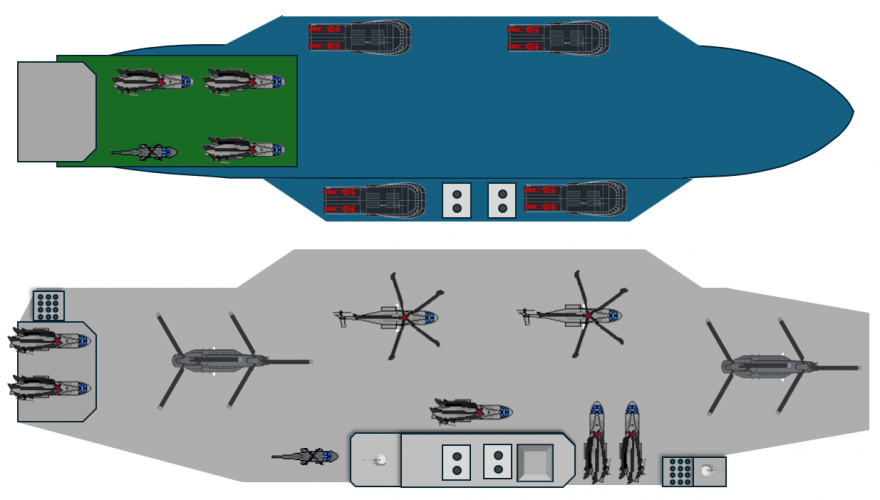
I'm not sure if there is an MRSS thread, but in case anyone is interested I have spent today trying to mock up a possible flat-deck arrangement of MRSS with no well dock- a mini-Ocean with extra armament at 155m and 9,000t.
The hangar is accessed from a single lift in the stern but there is a hangar for a single high-readiness Wildcat in the rear of the island and parking forwards on deck. There are 4 landing spots of which 2 have the necessary clearance to land a Chinook, and 3 Merlins along with 2 Wildcat can comfortably be accommodated in hangars. The armament is 24 CAMM and 2x 40mm spread around the ship. Surface connectors are 4 CIC which drop down from the sponsons as with the crew transfer boats on the aircraft carriers.
1779998065458.png
 
Why no well dock?
The RN has two future landing craft programmes going on at the same time, the Joint Commando Craft and the Commando Utility Craft. We know that JCC will be around 40t and 20m long, optimised for high speed raiding with only troops and light vehicles carried. It's at the absolute upper limit of what can be operated from a ship without using a well dock, and our new MultiRole Strike Ships are each required to carry 4 of them. CUC is replacing our LCU, which are capable of carrying a main battle tank. That's pretty much all we know about it, but in the UK there are only two options for heavy landing craft; the BMT Caimen 90 fast landing craft or the Griffon Wyvern LCAC. Carrying either a single LCAC or more than one Caimen would require a ship with 18-20m of beam and a well dock, of at least 16,000t judging by existing designs.

As MRSS is so budget limited, I've been trying to explore ways of fitting a decent attack and raiding capacity into the smallest possible hull in order to allow as many as possible to be procured. The most commonly suggested way of doing that is a 'strike frigate' similar to Denmark's Absalon design, with a flexible deck under the flight deck carrying either raiding craft or modular command/hospital/accommodation depending on requirements and a hangar for 2 Merlin HC4 helicopters. But it would be a real struggle to try to adapt our flexible frigate design, AH140, in order to take 4 JCC with the large size the landing craft are going for, so a slightly larger clean sheet design would be preferable. I settled on 155m and 9,000t as the maximum that might possibly be built at Rosyth with the new build hall, and a flat deck design as I didn't like the idea of squeezing more than 4 surface connectors onto a single hull with no well dock.
 
1780075872491.png
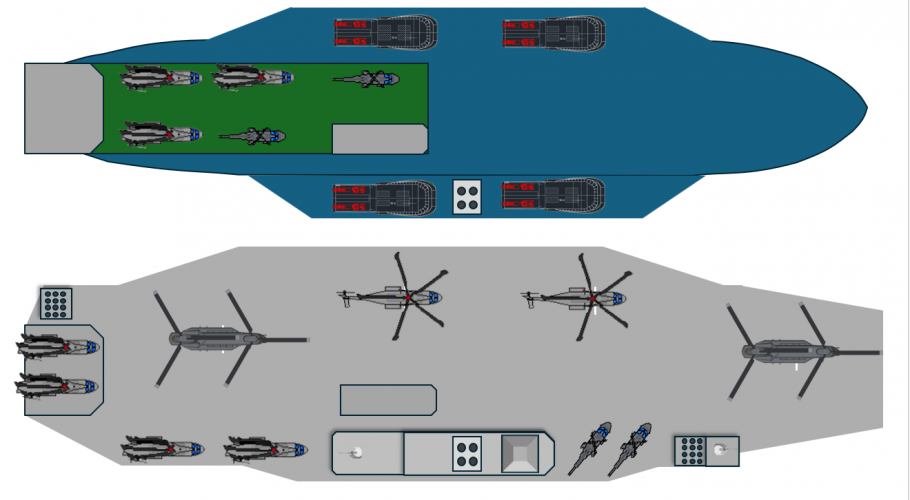
This is a slightly refined version I've progressed to, with the island smaller and moved inboard, landing spots moved to the port side, forwards lift in place of the high readiness Wildcat hangar and greatly improved deck parking.
The hangar is significantly longer but narrower, which makes it difficult for the upper Wildcat and top right Merlin to get out if one of the others got stuck.
 
How is this smaller design to be operationally superior to existing Expeditionary Sea Base (ESB) ships?
 
How is this smaller design to be operationally superior to existing Expeditionary Sea Base (ESB) ships?
In terms of force delivered it operates more helicopters and has hangar capacity for all of them, carries larger raiding boats or USVs but can only carry 4 boats of any size so has less flexibility.
Remarkably the cost if built at British yards would be similar to an ESB despite the near order of magnitude difference in displacement but that also gets you warship damage control, actual self defence armament and an increase from (slow) merchant speed to warship speeds.
Comparing the two it essentially compresses the ESB capability into a purpose built warship hull rather than using the large size of a merchant derivative to cheaply fit everything.
 
Pint-sized CVA-01s, get your pint-sized CVA-01s here!
1780419888487.png
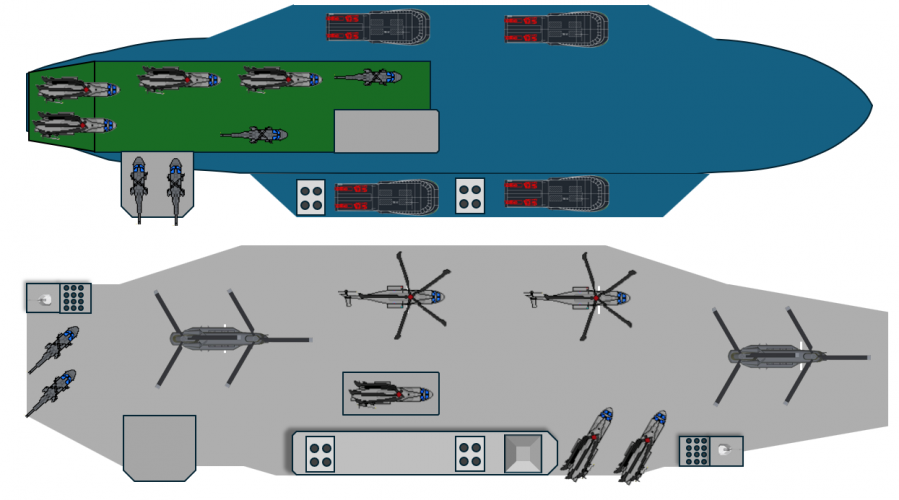
Made a couple more changes; relocated the aft Bofors to the port quarter CAMM battery to make room for a second funnel/uptake aft of the JCC as one didn't really look like enough for the size of ship. Relocated the aft lift to the starboard deck edge to make room for slightly more hangar space in the stern as I thought the stern lift would probably be very exposed to the water given the hangar isn't raised up on top of a vehicle deck. The arrangement is now pleasingly similar to CVA-01 though of course intended for helicopters rather than jets.
 
My only question would be...how much would it cost?

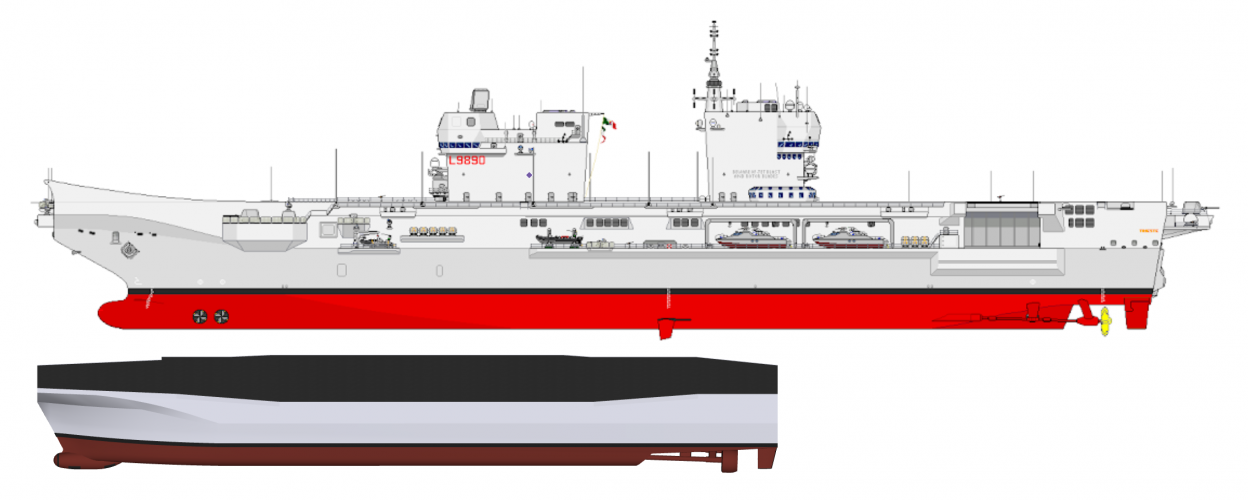
Because if its c£1bn, and it rather looks like it would be, why not just buy the licence for Trieste....
 
My only question would be...how much would it cost?

Because if its c£1bn, and it rather looks like it would be, why not just buy the licence for Trieste....
It's only supposed to be 155m long and 9,000t, very much a pocket LPH. It also lacks the complexity of a well dock which would save a bit, though I imagine aircraft lifts cost rather a lot.
Trieste is 38,000t full load and 245m long, it's remarkable the Italians managed to build it for just £1Bn. I may be overly optimistic, but if Babcock could build the T31s for £400m each this has the same equipment and is not hugely larger, while the new build hall at Rosyth will have a removable centreline wall so it would be able to accommodate the extra beam. Is £500m reasonable? You could argue it needs to be bigger to host the capability but there aren't really similar ships to compare to.
 

Similar threads

Back
Top Bottom