Status
Not open for further replies.
https://www.navylookout.com/first-sea-lord-expands-on-hybrid-navy-vision-in-landmark-fisher-lecture/


First trials of the unmanned components of the FADS are scheduled for 2027, then. Much earlier than I expected.

Some questions I can think of now are:

- Which ships will these be trialled alongside? There'll only be at very best a couple of T26, T31 and T23 each hanging around at that point, and the two new classes will be undergoing their own trials. T45 would make the most sense, IMO.

Ideally, of course, the RN gets this concept working smoothly with T45, before bringing it onto T83.

Phase 2 sounds like it'll be the start of integrating actual combat systems. Perhaps radars, or, if the rumours are true and T83 isn't expected to carry a sonar, they'll trial a TAS again.

I think weapons systems will wait a bit longer.
"Future Air Dominance System" suggests that it'd be supporting the Type 45s.

I don't believe any of the other ships have the radars to support the area AAW suggested by the FADS name.
 
"Future Air Dominance System" suggests that it'd be supporting the Type 45s.

I don't believe any of the other ships have the radars to support the area AAW suggested by the FADS name.
Yeah, I agree. We've also had confirmation during CNE 2026 that the Type 45s will be the first Collaborative Combat Vessels (motherships), so I think we can be confident they'll be the platforms used in 2027.
 
I was thinking more along the lines of how far you can diversify your sensors, decision-makers and shooters.

One of the images in the article I linked places a large radar system on a LUSV, along with another LUSV that carries a large VLS battery, alongside a T26 that presumably carries a crew capable of managing air defence operations.

Rather than invest in a manned ship to carry the large radar, and act as a central node, the radar itself could be placed onboard a LUSV, that is then tied to an existing ship like a frigate, or the new MRSS, or the carrier.

Just to clarify, I think there are issues with this approach. One example off the top of my head would be potential communications latency between radar-LUSV, manned ship and missile-LUSV would make responding to suddenly appearing threats, or very fast threats, more difficult. I'm sure there are other issues as well, and for the record, BAE and Babcock are both putting manned assets at the centre of their T83 visions.

That said, the SDR did say on the topic of the T45 replacement:

Exploring possible development from a Type 45 destroyer to a minimally crewed or autonomous air dominance system that could integrate directed energy weapons and enable better connectivity to other assets within the UK’s Integrated Air and Missile Defence system
 
Rather than invest in a manned ship to carry the large radar, and act as a central node, the radar itself could be placed onboard a LUSV, that is then tied to an existing ship like a frigate, or the new MRSS, or the carrier.
I don't think that you can have the radar high enough up or stable enough to be usable as the Area AAW on anything people would call an LUSV.

I mean, Constellation was designed as 7000 tons, and only had 3x 9RMA. Not even the full 4x 24RMA set of a Burke 2/2A.
 
If you go small enough, the radar USV could have gyro stabilization like some yachts. Those yachts are wild, they don't rock at all, just move straight up and down even when sitting at 0 knots.
 
I don't think that you can have the radar high enough up or stable enough to be usable as the Area AAW on anything people would call an LUSV.

I mean, Constellation was designed as 7000 tons, and only had 3x 9RMA. Not even the full 4x 24RMA set of a Burke 2/2A.
Oh, of course, I didn't clock that.

Power generation might also be an issue.
 
I don't think that you can have the radar high enough up or stable enough to be usable as the Area AAW on anything people would call an LUSV.
I don't see why stability should be an issue - after all we can do SAR and ISAR etc on aircraft antennae moving far more significantly than the mast or superstructure of a ship.

WRT height, that's only significant for pushing out the radar horizon vs sea-skimming threats, detectability of high altitude threats is largely independent of antennae height, and if you have LUSVs doing air defence then do you also have small USVs, or UAVs that are further out as radar pickets pushing out the radar horizon for you.

I mean, Constellation was designed as 7000 tons, and only had 3x 9RMA. Not even the full 4x 24RMA set of a Burke 2/2A.
Constellation was also an ASW frigate, with AAW a secondary priority.
 
One of the images in the article I linked places a large radar system on a LUSV, along with another LUSV that carries a large VLS battery, alongside a T26 that presumably carries a crew capable of managing air defence operations.
You can, but sensors require frequent maintenance; it's significant even for smaller/larger AEW planes, much less a ship.
This LUSV will be a 100% crewed combatant, with option of remote operation.
 
Do we really want a AI driven ship that's supposed to be affordable at scale mounting expensive hardware?
 
Constellation was also an ASW frigate, with AAW a secondary priority.
Correct. But the AAW capability required a 7000 ton ship.

Expected growth from FFG-7 was only about 6000 tons (based on growth from Spruance to Burke 1s and Burke 2As to Zumwalt, scaled off FFG-7 size)
 
Correct. But the AAW capability required a 7000 ton ship.

Expected growth from FFG-7 was only about 6000 tons (based on growth from Spruance to Burke 1s and Burke 2As to Zumwalt, scaled off FFG-7 size)
Constellation didn't grow from or scale off an FFG-7 or Spruance. It was customised from a FREMM design that had more than just ASW and AAW capabilities, given a redesign and US radar (not to mention structural upgrades). The AAW may have required more beam but nobody has produced a minimum displacement requirement. It just happened to get extra stuff added as the design evolved.
 
I mean, Constellation was designed as 7000 tons, and only had 3x 9RMA. Not even the full 4x 24RMA set of a Burke 2/2A.
I don't see the relevance here. The Navy pegged Connie's radar capability requirement at a bit more than SPY-1D (the public number for SPY-6(V)3 is +15DB sensitivity over SPY-1D iirc) which they could achieve in a smaller package than the PESA radars of older model Burkes. If they wanted SPY-6(V)4 or indeed SPY-6(V)1 they more than likely could've bought a vessel with that radar given reference vessels such as the F-100 and F-110 are able to use similar systems with smaller displacements. F-110 in particular proves the power and cooling margins are more than possible to implement @6000 tons displacement
Expected growth from FFG-7 was only about 6000 tons (based on growth from Spruance to Burke 1s and Burke 2As to Zumwalt, scaled off FFG-7 size)
This also doesn't really make sense. You're developing a baseline of a frigate with less than 1% SLA margins from the 1970s within a completely different operational context (POS) and fleet architecture. Also your displacement calculations from conventional monohulls to Zumwalt will be intrinsically flawed on account of Zumwalt's unique tumblehome hull.

I would also probably not ignore the interim design with VLS that the USN at one point considered adopting to replace the FFG-7s in some capacity, that being NFR-90. A bit of napkin math extrapolating from FFG-7 to NFR-90 brings us out to a predicted displacement for an NFR-90 successor in the ballpark of 7,400 tons

There's also the pretty relevant results of studies since SCFRS which have aptly demonstrated an FFG-7 type ship is mostly useless for USN missions especially as the traditional POS role has fallen by the wayside. So really can we establish a baseline for a ship designed within the context of a completely different fleet architecture and mission by using FFG-7?
 
Last edited:
  • Like
Reactions: DJK
Constellation didn't grow from or scale off an FFG-7 or Spruance. It was customised from a FREMM design that had more than just ASW and AAW capabilities, given a redesign and US radar (not to mention structural upgrades). The AAW may have required more beam but nobody has produced a minimum displacement requirement. It just happened to get extra stuff added as the design evolved.
All I am doing is saying "Spruance was 8000tons, their replacement was 15-16ktons."

Not saying that the Constellation was based on either FFG7 or Spruance.


This also doesn't really make sense. You're developing a baseline of a frigate with less than 1% SLA margins from the 1970s within a completely different operational context (POS) and fleet architecture. Also your displacement calculations from conventional monohulls to Zumwalt will be intrinsically flawed on account of Zumwalt's unique tumblehome hull.
Unless part of that assumption is that the new frigate is also going to a tumblehome hull.


I would also probably not ignore the interim design with VLS that the USN at one point considered adopting to replace the FFG-7s in some capacity, that being NFR-90. A bit of napkin math extrapolating from FFG-7 to NFR-90 brings us out to a predicted displacement for an NFR-90 successor in the ballpark of 7,400 tons
1) wasn't aware of the NFR90 as being a replacement for the FFG-7s.
2) okay, so the displacement of the Connie seems about right (if the design had stayed within the weight limits)


There's also the pretty relevant results of studies since SCFRS which have aptly demonstrated an FFG-7 type ship is mostly useless for USN missions especially as the traditional POS role has fallen by the wayside. So really can we establish a baseline for a ship designed within the context of a completely different fleet architecture and mission by using FFG-7?
That is a much more valid question.

I suspect probably not.


I'm not sure how the USN trying to make Constellation a quart of Burke squeezed into a pint pot relates to Type 83?
Mostly in terms of attempting to beat into the heads of Treasury that the minimum capable size for Type 83 is ~10ktons, and closer to 15 is what they need to be thinking.
 
Mostly in terms of attempting to beat into the heads of Treasury that the minimum capable size for Type 83 is ~10ktons, and closer to 15 is what they need to be thinking.
Is it really though?
 
Also, concerning the tendency to reduce the amount of carried missiles, I would want to quote "Rebuilding the Royal Navy" (from T43 development) once again

ASWE carried out computer simulations of various forms of mass attack which showed the small ship failing in every scenario and the big ship being reasonably acceptable. [41]

(41) It was later realised that the simulations were flawed as both ships fired several times more missiles than they carried.
 
as both ships fired several times more missiles than they carried.

There is another implication here.
T44 (small) and T43 (large) were to carry between something like 40 and 80 Sea Darts.
A simulated battle (or sequence of engagements) assumed in mid 80's made them expend several times - i.e. 3 or more, i.e. at least 120-240 missiles, of which 120 were evidently insufficient.

And it wouldn't be easier nowadays.
 
There is another implication here.
T44 (small) and T43 (large) were to carry between something like 40 and 80 Sea Darts.
A simulated battle (or sequence of engagements) assumed in mid 80's made them expend several times - i.e. 3 or more, i.e. at least 120-240 missiles, of which 120 were evidently insufficient.

And it wouldn't be easier nowadays.
Do you have the details on the engagement?

I mean, the US classic engagement was IIRC 3 Bomber regiments, 6x missiles per bird.
 
let's see here:
  1. AAW design needs fecking huge radar
  2. fecking huge radar needs to be carried up high to see sea-skimmers as far away as possible
  3. fecking huge radar is heavy
  4. heavy radar up high means big ship to keep it stable
Ummm you want ro put the huge 3D volume search radar up high to see over the horizon, but horizon still isn't that far away. So why not put a small horizon search radar up high, and a big radar lower where it wont destabilise the ship?
 
  • Like
Reactions: zen
Ummm you want ro put the huge 3D volume search radar up high to see over the horizon, but horizon still isn't that far away. So why not put a small horizon search radar up high, and a big radar lower where it wont destabilise the ship?
Maybe because the higher the antenna above the water the less the planet blocks? 1000km+ range is a nice thing to have when the incoming travel 3km/sec or faster.

Now, it might prove to be a decent option, sticking a SPY6v3 (3x9 RMA fixed) or equivalent on top of the mast just for horizon search and the bigger 4x24, 37, or even 69 RMA fixed arrays enough lower to not cause topweight issues.

I don't know enough about radar performance to know this. Who on the forum does, @Dilandu ? Is this your area?
 
Do you have the details on the engagement?
Alas, no, I am only trying to deduct the numbers from the quoted note.
Were I setting this up, it would probably be running a gauntlet between bombers and submarines, and having to defend a carrier with that.
 
Ummm you want ro put the huge 3D volume search radar up high to see over the horizon, but horizon still isn't that far away. So why not put a small horizon search radar up high, and a big radar lower where it wont destabilise the ship?
There may be a question of resolution and target tracking. You need a single or integrated system that can track a host of very fast targets in a range of trajectories - from ballistic to sea-skimming - at the same time and direct the AA missiles to counter them. With hypersonic or high supersonic speeds, a revolving radar may not be able to keep with that, and putting flat plates returns us to high and complex mast.

I mean the standard solution seems to be putting small plates higher and larger lower, but it's still a structure.
 
Last edited:
How odd, since the whole GPI concept relies on satellites to detect and track the missile.
 
How odd, since the whole GPI concept relies on satellites to detect and track the missile.
Pretty sure GPI can fly just fine with just Aegis/SPY6. Haven't they done some test flights already?

Thing is, just like Blackbird, hypersonics avoid missiles by very slight turns that move the target out of the intercept bucket.
 
Mostly in terms of attempting to beat into the heads of Treasury that the minimum capable size for Type 83 is ~10ktons, and closer to 15 is what they need to be thinking.
You're trying to demand that a UK design meets US ideas on what a warship should be, and given the recurrent fiascos of Zumwalt, LCS, Constellation, FF(X) and BBGN(X) I'm really not convinced that's a good model to be following. Maybe keep the US arguments to the US threads?
 
I would expect Type 83 to use a medium-sized AESA radar with four fixed faces. Compared with Type 45, it would either add 24 Mk 41 cells on top of the existing A50 VLS, or replace the entire VLS fit with Mk 41.

The ship would probably have two funnels. The amidships area aft of the funnels could be arranged as a mission bay for launching and recovering RHIBs and large UUVs. The RN might also choose to carry boats larger than standard RHIBs. Two CIWS mounts could be placed above this mission bay. Type 83 would also need a volume-search / early-warning radar, likely integrated into the second funnel or the aft superstructure.

If the ship carries at least 24 Mk 41 cells plus 48 A50 cells, it would be difficult to fit all of that on the forecastle. The 24 Mk 41 cells might therefore be placed forward of the hangar, behind the second funnel.

The ship would probably need a beam of more than 22 meters to support such a large mast and radar fit. The real question is: what kind of propulsion arrangement would be required to give it endurance no worse than Type 45?
 
Last edited:
Type 83 should have two funnels. Behind the two funnels, the middle section of the hull should contain a mission bay that can launch and recover RHIBs and large UUVs. The RN may also carry boats larger than RHIBs. Above this mission bay, there should be two CIWS mounts. Type 83 should also have an early-warning radar, but it will likely be integrated into the second funnel.
Are all those 'should's actual 'should's, or 'I would like's?

ie are you quoting a requirement from somewhere, or your personal ideas? Because the idea of requiring a second funnel seems bizarre.
 
FADS is an approach involving offloading some capability and capacity to attendant Type 91, for which terms like "missile barge" and "arsenal ship" have been used.

Radar is a "movable feast" depending on various factors. Every solution is a compromise and it's not a given that one needs huge arrays to track and engage distant high velocity targets.

A single ship able to protect a HVU like a carrier or LPD, LPH etc is essentially going to be so expensive and complex.
We will be lucky to get 6.
But it doesn't guarantee the sort of capability we need in the areas we need to cover.

The One Big Ship concept is just a reversion to dreams of huge battleships. For which the UK just doesn't have the ability to produce in sufficient time and numbers to be available in when needed.

What the UK needs is dispersed assets to cover an area.
Networks to hand off the best placed shooter to fire on the target and the ability to sustain such forces over lomg periods of time.
 
Try and keep on topic please.
Discussions about real news is one thing, personal speculative ideas are better in the speculative sections of the forum.
 
You're trying to demand that a UK design meets US ideas on what a warship should be, and given the recurrent fiascos of Zumwalt, LCS, Constellation, FF(X) and BBGN(X) I'm really not convinced that's a good model to be following.
Type 055 as a practical comparison? :) Someone, somewhere is building those in numbers.

As far as I understand the design now is back on the drawing board, and we have no way to know where it really goes until some new artwork is released, so all we can do is discuss various requirements and ways to their implementation.
 
Maybe because the higher the antenna above the water the less the planet blocks? 1000km+ range is a nice thing to have when the incoming travel 3km/sec or faster.
So a small X-band radar up high to see out to horizon. Fixed face is still possible in small sizes anyway. Apparently most RN ships use the Hensoldt X-band, so the latest model seems to be SharpEye Mk11.
Now, it might prove to be a decent option, sticking a SPY6v3 (3x9 RMA fixed) or equivalent on top of the mast just for horizon search and the bigger 4x24, 37, or even 69 RMA fixed arrays enough lower to not cause topweight issues.
Its the Type-83 so will never have US radar. But any S-band arrays will need to be mounted lower. BAE is developing a next gen Sampson for the Type-83.
 
  • Like
Reactions: zen
So a small X-band radar up high to see out to horizon. Fixed face is still possible in small sizes anyway. Apparently most RN ships use the Hensoldt X-band, so the latest model seems to be SharpEye Mk11.

Its the Type-83 so will never have US radar. But any S-band arrays will need to be mounted lower. BAE is developing a next gen Sampson for the Type-83.
Sharpeye is a surface radar, not air defence. For air defence we rely on Artisan and SAMPSON, both rotating arrays mounted on very tall masts.
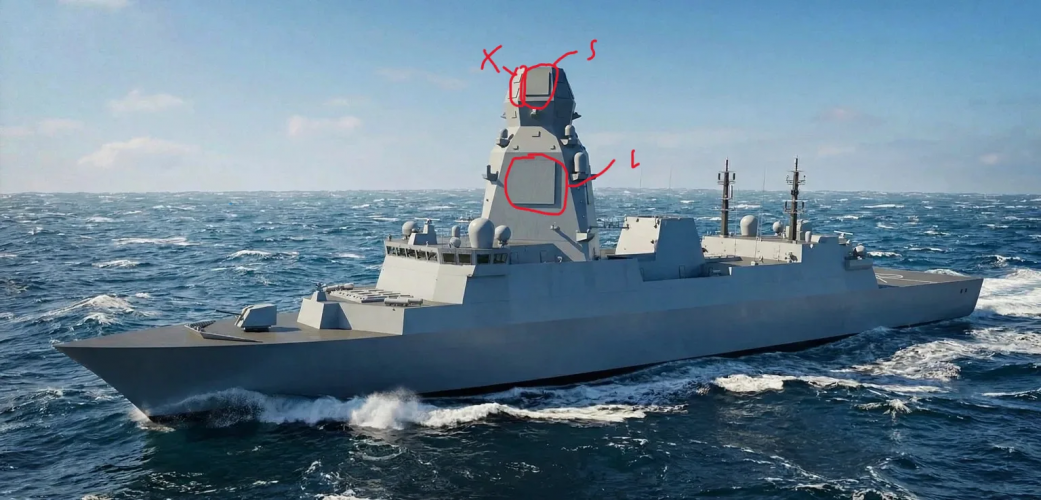
The most recent BAE T83 concept had a tiered radar mast, like this:
1779891877504.png
 
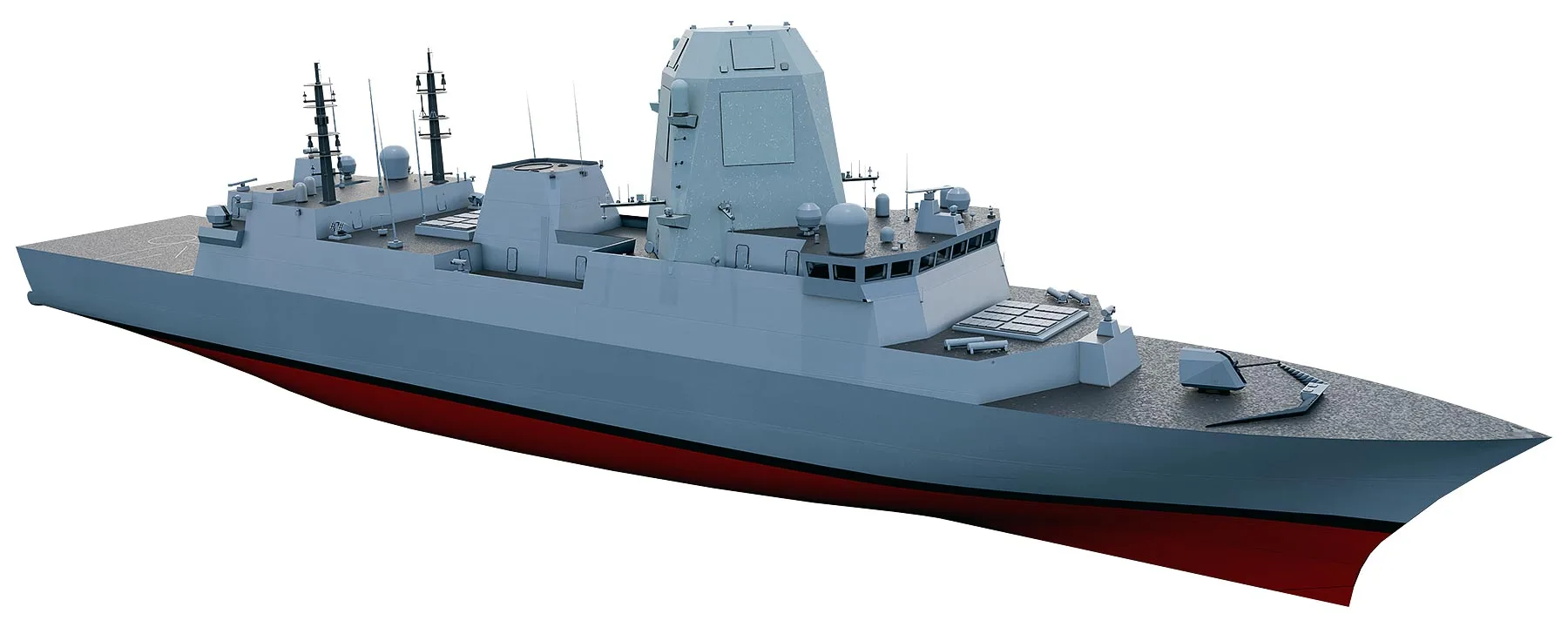
That's not quite the most recent concept, that one's a little older than the many-faced array being shown off above. This one cuts down on some of the smaller panels, but the eight main ones looks the same.
BAE-Systems-Future-Air-Warfare-Destroyer-3.webp
 
That's not quite the most recent concept, that one's a little older than the many-faced array being shown off above. This one cuts down on some of the smaller panels, but the eight main ones looks the same.
Always seems strange to see the radar antennas tower over the ESM kit.

Logically shouldn’t the ESM antenna(s) be positioned at the top of the radar mast to allow for maximum passive surveillance? While the rest of the ship and the actively emitting radars are still hull down under the radar horizon. (Eg. Italian DDX, Australian Hunter, French FDI antenna arrangements etc)
 
  • Like
Reactions: DJK
Status
Not open for further replies.

Similar threads

Back
Top Bottom