Strange Rockwell Hybrid Reusable Launch System (RLV)

Akagi_Apus

ACCESS: Restricted
Joined
28 October 2020
Messages
11
Reaction score
24
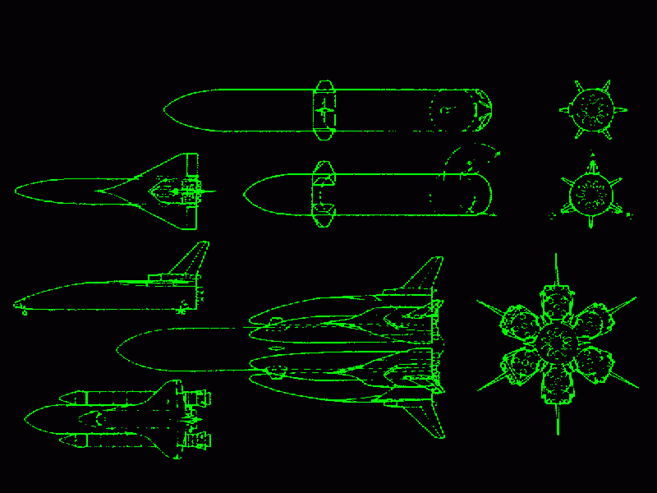
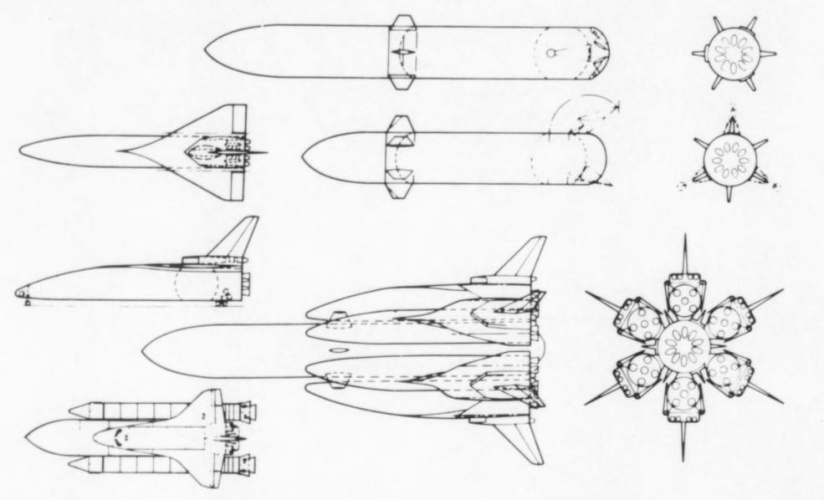
While reading the RLV concept website written by Marcus Lindroos, I came across a very Energia Energy design (somehow we get Vulkan in 1978), a VTVL core stage(it even has rudder on front and The faint dashed lines at the base of the core stage in the illustration are difficult for me to identify clearly. I am inclined to interpret them as some kind of deployable landing legs extending downward ) combined with six smaller flyback boosters (VTHL). These boosters featured conventional vertical tails, folding wings, and even air-breathing engines used both to augment thrust during ascent and to provide powered landing capability in the horizontal landing phase.

However, the article did not mention the specific engine type, so I do not know whether they were ramjet/turbine engines or something closer to the air-breathing rocket-expansion conformal thrust augmentation system seen in the Martin Marietta Renova concept.

At the same time, the small flyback boosters also had crossfeed capability with the core stage, ensuring that the core stage (the sustainer stage) would still retain full propellant at booster separation.

After searching further, I found that Rockwell’s SPS reports only discussed another, comparatively less interesting, back-to-back link VTHL winged flyback booster concept. The only information I could locate about this particular vehicle consists of a brief textual description and a very low-quality vector illustration from the Marcus Lindroos website. The referenced BIS SPACEFLIGHT material also seems extremely difficult to find online.

Do any of you happen to have additional information about this vehicle?

Thank you.
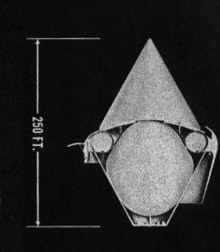
1. Renove Airbreath augmentation if I understand it right)
2. (mysterious RLV with spaceshuttle for scale)
 

Attachments
  • 72dcc2e3-b5c5-45c3-8078-56504d0fe883.png
    72dcc2e3-b5c5-45c3-8078-56504d0fe883.png
    60.1 KB · Views: 36
  • c6fcce07-0978-4be7-9339-f34318832e67.png
    c6fcce07-0978-4be7-9339-f34318832e67.png
    40.3 KB · Views: 36
Last edited by a moderator:
Definitely not the way I would architect a modular RLV, and also not anything I've come across in my soon ending tenure at Boeing.
 
After further searching, I finally found this concept in the SPACEFLIGHT1978 issue 4. The design philosophy claimed was to combine the potentially higher reliability and engine savings offered by a sustainer core stage with the advantages of multistage boosters.

The article’s author was M. W. Jack Bell, noted as “Rockwell International – Space Division Advanced Shuttle Project Manager.”

Unfortunately, the engines appear to have been ordinary air-breathing turbojet engines, since visible wedge-shaped air intakes can be seen on the model. The specific fuel type and fuel system were not described in detail, but it can at least be confirmed that the structures at the tail were indeed landing legs.
 

Attachments

  • 1779373261413.png
    1779373261413.png
    322.8 KB · Views: 76
Last edited by a moderator:
A good way to get a craft back without going dead-stick.

At the risk of getting the "triangle" thing started again....part of the reason the winged boosters have their shape is to keep the core lightweight... that's my guess. Maybe a little inspiration from R-7 stage zeros.

Neutron's payload mount.... the way SuperHeavy is made...both are examples of allowing things to be made limber.

Here, the strap-ons are overbuilt perhaps, as a way to keep the core from having to support its own weight all by itself.

The strap-ons ARE bracing, and can fall away after giving the core a run-and-go.

Stage zeros can be as heavy as they like I suppose.

A Saturn V-B sustainer deal borrowed from Atlas would seem less involved.
 
Unfortunately, the engines appear to have been ordinary air-breathing turbojet engines
needed, the booster can't return to launch site simply by gliding, the distance is to long.
you need a Turbojet engine to fly booster back
 
While reading the RLV concept website written by Marcus Lindroos, I came across a very Energia Energy design (somehow we get Vulkan in 1978), a VTVL core stage(it even has rudder on front and The faint dashed lines at the base of the core stage in the illustration are difficult for me to identify clearly. I am inclined to interpret them as some kind of deployable landing legs extending downward ) combined with six smaller flyback boosters (VTHL). These boosters featured conventional vertical tails, folding wings, and even air-breathing engines used both to augment thrust during ascent and to provide powered landing capability in the horizontal landing phase.

However, the article did not mention the specific engine type, so I do not know whether they were ramjet/turbine engines or something closer to the air-breathing rocket-expansion conformal thrust augmentation system seen in the Martin Marietta Renova concept.

At the same time, the small flyback boosters also had crossfeed capability with the core stage, ensuring that the core stage (the sustainer stage) would still retain full propellant at booster separation.

After searching further, I found that Rockwell’s SPS reports only discussed another, comparatively less interesting, back-to-back link VTHL winged flyback booster concept. The only information I could locate about this particular vehicle consists of a brief textual description and a very low-quality vector illustration from the Marcus Lindroos website. The referenced BIS SPACEFLIGHT material also seems extremely difficult to find online.

Do any of you happen to have additional information about this vehicle?

Thank you.
1. Renove Airbreath augmentation if I understand it right)
2. (mysterious RLV with spaceshuttle for scale)

Yes the first pic is the "RENova" or "Reusable Nova" with air augmentation shroud, which in some cases "stages" part of the shroud during flight. Doors on the "intake" close when the vehicle reenters that atmosphere after staging the forward 'cone' and it lands with the broad part (and closed doors) by splashing down in the ocean.

Randy
 

Similar threads

Back
Top Bottom