
You are using an out of date browser. It may not display this or other websites correctly.
You should upgrade or use an alternative browser.
You should upgrade or use an alternative browser.
Boeing F-47 NGAD - Speculation and Theories
- Thread starter Bounce
- Start date
insidersource
ACCESS: Top Secret
- Joined
- 24 March 2025
- Messages
- 521
- Reaction score
- 744
Are you trying to say there was a secretive adaptive engine that flew on the Boeing Navy demonstrator in 2019?An airborne demonstrator engine seems possible around 2020 within the disclosed information from 2017.
All the evidence of the XA100, XA101 line up with the Lockheed demonstrator firts flight. Please provide evidence to support your claim.
No. NGAP was started at the same time the USAF selected the Boeing F-47. This is because the USAF needed a smaller adaptive engine for the Boeing design. This also means the Boeing demonstrator that was full scale did not already have a secret adaptive engine. It flew with F110's.The "primary goal" of AETP was to fit an adaptive cycling engine on the F-35. This was not just reported on. It was said by kendall and multiple big wigs. NGAP was both a derivative and parallel development whose "primary purpose" was to be the main powerplants of NGAD - not AETP.
So for Quelish to say an adaptive engine already flew in a demonstrator that means it has to be the larger 45,000lb thrust class AETP XA100 XA101 in Lockheed Martin demonstrator.
insidersource
ACCESS: Top Secret
- Joined
- 24 March 2025
- Messages
- 521
- Reaction score
- 744
The F-47 has not flown yet. I think you mean the Boeing Navy F/A-XX demonstrator starting flying in 2019 with F110s.F-47 flys with F110s.
Or are you saying the USAF selected the Navy design and called it F-47?


FlyGuy369
Flying is fantastic
- Joined
- 15 June 2023
- Messages
- 576
- Reaction score
- 1,693
Id take your word on it any dayXA never flew. 100/101 were technology demonstrators on the test stands. 102/103 aren’t even running yet.
F-47 flys with F110s.
what_is_that
ACCESS: Confidential
- Joined
- 9 August 2023
- Messages
- 81
- Reaction score
- 172
Did these results have a bearing on the decision against AETP and result in changes incorporated into the XA101/102?Flight testing of a demonstrator with adaptive engines was done at Groom Lake and it was a total Charlie Foxtrot, using an engine the press has (sob sob) not described.
I have no idea why the forum is so focused on the F110 when the available record refutes this.
Lack of imagination or lack of documentation?
- Joined
- 15 January 2021
- Messages
- 649
- Reaction score
- 2,859
XA100/101 were ground demonstrators, not flight weight or flight certified. There is no way they flew in any flight demonstration aircraft.
If the flight demonstrator aircraft flew with 45K engines, the F135 is your only choice.
If they flew with NGAP sized engines, your available choices are F119 or F110-132. Only F119 has a production LO exhaust system. It is possible that GE could have built a round AVEN F135 style LO nozzle for the F110-132, but there is still no LO features in the exhaust cavity without a very large development budget for a 1 off demonstrator.
If the flight demonstrator aircraft flew with 45K engines, the F135 is your only choice.
If they flew with NGAP sized engines, your available choices are F119 or F110-132. Only F119 has a production LO exhaust system. It is possible that GE could have built a round AVEN F135 style LO nozzle for the F110-132, but there is still no LO features in the exhaust cavity without a very large development budget for a 1 off demonstrator.
insidersource
ACCESS: Top Secret
- Joined
- 24 March 2025
- Messages
- 521
- Reaction score
- 744
Quellish said a demonstrator flew with an adaptive engine.Id take your word on it any day
Cerberus said the Boeing demonstrator flew with F110 and the XA adaptive engines never flew. That means no adaptive engines flew.
So who is right. Quellish or Cerberus?

barry bozo
ACCESS: Restricted
- Joined
- 4 February 2026
- Messages
- 41
- Reaction score
- 130
Blantantly incorrect. NGAP has been actively developing new engines years before NGAD was awarded. It takes one google search to confirm that. They were already awarding risk reduction contracts in 2022.NGAP was started at the same time the USAF selected the Boeing F-47.
Word is, both move forward.18 days…
insidersource
ACCESS: Top Secret
- Joined
- 24 March 2025
- Messages
- 521
- Reaction score
- 744
Flight testing of a demonstrator with adaptive engines was done at Groom Lake
So what adaptive engines flew in a demonstrator at Groom Lake?XA100/101 were ground demonstrators, not flight weight or flight certified. There is no way they flew in any flight demonstration aircraft.
FlyGuy369
Flying is fantastic
- Joined
- 15 June 2023
- Messages
- 576
- Reaction score
- 1,693
Le
Let's be very real here for a minute. Anyone here who ACTUALLY knows definitive facts on any of these programs are not going to disclose anything that would put themselves and others at risk of violating any agreements/clearances.Quellish said a demonstrator flew with an adaptive engine.
Cerberus said the Boeing demonstrator flew with F110 and the XA adaptive engines never flew. That means no adaptive engines flew.
So who is right. Quellish or Cerberus?

- Joined
- 3 June 2011
- Messages
- 20,896
- Reaction score
- 19,084
Le
Let's be very real here for a minute. Anyone here who ACTUALLY knows definitive facts on any of these programs are not going to disclose anything that would put themselves and others at risk of violating any agreements/clearances.
With the exception that sometimes things get out. See AIM-260.
Scott Kenny
ACCESS: USAP
- Joined
- 15 May 2023
- Messages
- 19,517
- Reaction score
- 27,965
Unless they're in Congress.Let's be very real here for a minute. Anyone here who ACTUALLY knows definitive facts on any of these programs are not going to disclose anything that would put themselves and others at risk of violating any agreements/clearances.

Reddington777
ACCESS: Top Secret
- Joined
- 23 March 2025
- Messages
- 830
- Reaction score
- 2,746
This was not the case.No. NGAP was started at the same time the USAF selected the Boeing F-47.
NGAP as a program started some time before AETP was cancelled.
Looking in from the outside, AETP/AETD's overall goal was to develop engines that should be applicable to a number of proposed platforms, of which F-35 and NGAD and F/A-XX were amongst the fielding options. As time went on, NGAP was established to develop the engines intended for NGAD. NGAP was started and continued to be built atop of the lessons learned from AETP. AETP found real possibility in replacing the F135 engine for F-35s.
This was still the case at the cancellation of AETP.
I suppose it was inaccurate of me to say that AETP was specifically intended for the F-35, but NGAP was born from AETP and pursued in parallel, and as a dedicated effort to produce engines for NGAD while AETP had broader goals.
Already addressed this like... 50 pages ago. This is just wrong.This is because the USAF needed a smaller adaptive engine for the Boeing design.
I, unlike you and others here, dont have the confidence to say either way. There may be engines tested and prototyped that we dont know about. There may not be. Theres just not enough information to draw any conclusion here - let alone your conclusions.This also means the Boeing demonstrator that was full scale did not already have a secret adaptive engine. It flew with F110's.
So for Quelish to say an adaptive engine already flew in a demonstrator that means it has to be the larger 45,000lb thrust class AETP XA100 XA101 in Lockheed Martin demonstrator.
AETP: mature industrial base and ACE tech with the broad goal of fielding ACE fighter (and for a time, bomber) engines. Only the F-35 (that we know of from reporting) was ever realistically considered for AETP.
NGAP: specific and targeted program seeking to field engines for the NGAD fighter.
Last edited:

- Joined
- 2 August 2006
- Messages
- 3,335
- Reaction score
- 1,847
The Boeing design did not fly with adaptive engines. The Lockheed design did. And by designs, I mean demonstrators. They weren't the actual designs in the competition. My understanding was the Boeing design concentrated on features the USN wanted and the Lockheed design concentrated on USAF features.So what adaptive engines flew in a demonstrator at Groom Lake?

- Joined
- 30 May 2023
- Messages
- 664
- Reaction score
- 1,436
At some point in the past the USAF was thinking quite broadly with adaptive engines - I remember one slide posted here in the fora suggesting it could reengine fourth gen fighters.
A couple of other points:
The DDR announcement for GE a while back was the clearest sign XA102 was not likely to arrive anytime soon - this was noted here, and I explicitly asked @F119Doctor (and he gave a fantastic answer) as to his best guess of when it would arrive based on the announcement. He confirmed the seemingly obvious.
Even before this, I asked the question of how Boeing demonstrated a step function increase in power generation without an adaptive engine. I’m still not clear on this, although the tea leaves suggest Lockheed may have flown its demonstrator with twin F135s OR a XA100/101 sized ACE prototype. If I have this right, it brings us back to the question of how F-47 Inc1 power generation and cooling strategies might look without a third stream.
F110 has zero affirmative data as a speculative engine for increment 1.
While we discussed using F119s from early Raptors it’s not clear those a/c will be retired (and hence engines may not be available) and there is no live line - so it was seen as a less likely choice.
The F414 as an engine would just make everyone very sad, so it was never really discussed like it was in the F/A-XX threads.
The F135 would be a perfectly reasonable choice but I think there was concern about its physical dimensions - primarily length. So the F110 became sort of like a strawman engine to begin to define the performance floor of F-47. With that said: “If F135s fit, you must equip” (maybe?)
However, if in fact an increment 1’s inlets and bay can accept the F135 AND a future XA102/103 then what does that say about the size of XA102/103 and what the differences with 100/101 are? Or will the inlets be redesigned? My impression thus far was that XA102/103 were smaller scaled versions of XA100/101 designed for F-47, but maybe that needs to be scrutinized.
As to the AII-X flight programs - can you please share a tidbit about generally what kinds of things went sideways. I guess I read your comments to include Boeing, which is interesting: would we be wrong surmising from your comments being first to fly so quickly might have resulted in the demonstrator having some real chunky teething problems? Or was the CF largely on the LM side (took a long to fly and then flew into trouble?)? Thanks!
A couple of other points:
The DDR announcement for GE a while back was the clearest sign XA102 was not likely to arrive anytime soon - this was noted here, and I explicitly asked @F119Doctor (and he gave a fantastic answer) as to his best guess of when it would arrive based on the announcement. He confirmed the seemingly obvious.
Even before this, I asked the question of how Boeing demonstrated a step function increase in power generation without an adaptive engine. I’m still not clear on this, although the tea leaves suggest Lockheed may have flown its demonstrator with twin F135s OR a XA100/101 sized ACE prototype. If I have this right, it brings us back to the question of how F-47 Inc1 power generation and cooling strategies might look without a third stream.
F110 has zero affirmative data as a speculative engine for increment 1.
While we discussed using F119s from early Raptors it’s not clear those a/c will be retired (and hence engines may not be available) and there is no live line - so it was seen as a less likely choice.
The F414 as an engine would just make everyone very sad, so it was never really discussed like it was in the F/A-XX threads.
The F135 would be a perfectly reasonable choice but I think there was concern about its physical dimensions - primarily length. So the F110 became sort of like a strawman engine to begin to define the performance floor of F-47. With that said: “If F135s fit, you must equip” (maybe?)
However, if in fact an increment 1’s inlets and bay can accept the F135 AND a future XA102/103 then what does that say about the size of XA102/103 and what the differences with 100/101 are? Or will the inlets be redesigned? My impression thus far was that XA102/103 were smaller scaled versions of XA100/101 designed for F-47, but maybe that needs to be scrutinized.
As to the AII-X flight programs - can you please share a tidbit about generally what kinds of things went sideways. I guess I read your comments to include Boeing, which is interesting: would we be wrong surmising from your comments being first to fly so quickly might have resulted in the demonstrator having some real chunky teething problems? Or was the CF largely on the LM side (took a long to fly and then flew into trouble?)? Thanks!
Hold your horses. This will get nowhere with the little information there is.
As Reddington777 and Cerberus21 outlined that's how things were and I agree
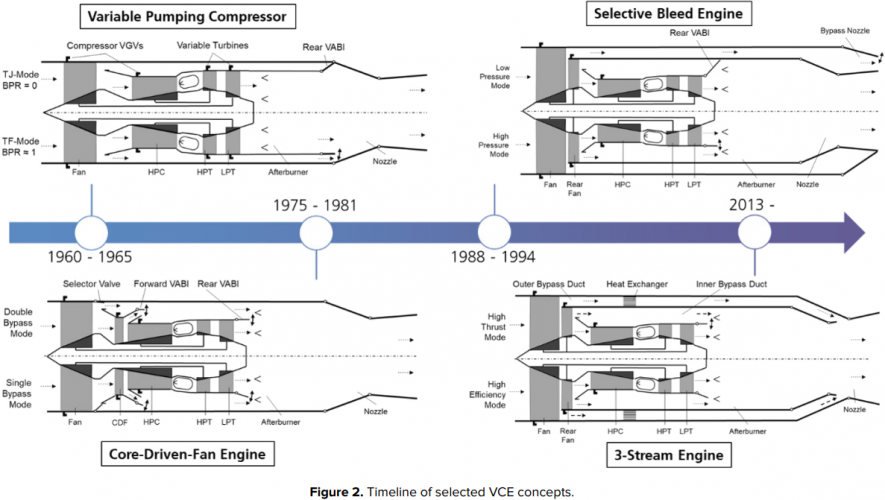
Now, from a military jet engine technology point of view the term "adaptive engine" applies to 4th generation engines. Because that's when the technology was introduced. And this is the reason the Europeans don't feel the need for a 3-stream engine.
What many meant to refer today are the more advanced Variable (Adaptive) Cycle Engine (VCE) or the 3-stream engine like GE's YF120.
People get confused here, hence, the use of this term is rather broadly applied.
GE is known to have kept working on this technology so it's very possible some newer research variant was used if the claim is true.
As Reddington777 and Cerberus21 outlined that's how things were and I agree
Now, from a military jet engine technology point of view the term "adaptive engine" applies to 4th generation engines. Because that's when the technology was introduced. And this is the reason the Europeans don't feel the need for a 3-stream engine.
What many meant to refer today are the more advanced Variable (Adaptive) Cycle Engine (VCE) or the 3-stream engine like GE's YF120.
People get confused here, hence, the use of this term is rather broadly applied.
GE is known to have kept working on this technology so it's very possible some newer research variant was used if the claim is true.
Attachments
Reddington777
ACCESS: Top Secret
- Joined
- 23 March 2025
- Messages
- 830
- Reaction score
- 2,746
Do you have a source on this? Dont think ive read anything suggesting this.The Boeing design did not fly with adaptive engines. The Lockheed design did.
Was mebtioned previosuly by quellish that Boeing demonstrated enough of what the AF wanted too.Boeing design concentrated on features the USN wanted and the Lockheed design concentrated on USAF features.
- Joined
- 15 January 2021
- Messages
- 649
- Reaction score
- 2,859
The GE YF120 was essentially the Core Driven Fan concept shown in your graphic. Made great supercruise thrust, but was really thirsty doing it. Don’t know how well it did at subsonic cruise.Hold your horses. This will get nowhere with the little information there is.
As Reddington777 and Cerberus21 outlined that's how things were and I agree
Now, from a military jet engine technology point of view the term "adaptive engine" applies to 4th generation engines. Because that's when the technology was introduced. And this is the reason the Europeans don't feel the need for a 3-stream engine.
What many meant to refer today are the more advanced Variable (Adaptive) Cycle Engine (VCE) or the 3-stream engine like GE's YF120.
People get confused here, hence, the use of this term is rather broadly applied.
GE is known to have kept working on this technology so it's very possible some newer research variant was used if the claim is true.
It might be possible that Lockheed demonstrator flew with a YF120, although I would find it hard to believe any would be airworthy after 15+ years since Dem-Val. To my knowledge, there were only 6 YF120 engines built (same as the YF119)

- Joined
- 6 August 2007
- Messages
- 4,530
- Reaction score
- 10,229
Increased electricity generation is a key feature of 6th gen fighters. Dozens of sources report this. This is common knowledge.
"Dozens of sources" have *speculated* about this, and there is no logical nexus between "bigger generators" and increased electricity generation. What if the generators are just more efficient? What if power is being generated or used in other ways that do not require "bigger generators"? This speculation based on speculation ignores many of those scenarios.
Studies from earlier in the AII program identified that FADAAS aircraft would have highly *dynamic* power and cooling needs. They would go from "idle" needs to REALLY NEED IT NOW very quickly. "Bigger generators" alone do not solve this problem, they make it worse. So yeah, maybe, just maybe, the "bigger generators" assumption is a little off the mark.
From a "source" that I obtained by doing "research" and "asking questions":
These advanced systems require much higher electrical power and cooling than legacy aircraft and also exhibit highly dynamic behavior with large and rapid loading and unloading characteristics. The magnitude of the power and thermal loads and dynamic characteristics of these loads make it a challenge to provide adequate power and cooling without overly penalizing aircraft performance or affecting engine operability.
Increased efficiency of future propulsion results in lower fuel flow and cooling capability as fuel is a key cooling medium. FAD aircraft systems will house dedicated power and thermal management systems to address increased and dynamic power and thermal loads.
Being a total Charlie Foxtrot would also explain why LM lost NGAD. I heard the same thing but I don't know if it was an engine integration issue or an airframe issue.
The AII-X program was a demonstration, not a prototyping effort. The lessons learned by all involved informed subsequent programs but the performance of the various contractors had no bearing whatsoever on the NGAD contract decision.
This is the Boeing speculation thread. The flight testing done by Boeing was for their demonstrator built for the Navy. The Navy was clear that they wanted a modified version of an existing engine. This means bigger generators are a bare minimum.
Here you are ascribing comments made in 2023 by a Navy admiral (regarding a derivative engine ) to an AII-X decision made more than 5 years earlier - incorrectly.
The truth is that the Navy did not want to help pay for the very expensive development of new adaptive propulsion engines. That's all there was to it. For AII-X they left the engine choice to the contractor.
Also many sources between 2018-2022 mentioned that the USAF NGAD and it's demonstrator was going to be big and very long range. A pair of XA100/XA101 aligns perfectly with that.
This, again, was all speculation.
No. NGAP was started at the same time the USAF selected the Boeing F-47. This is because the USAF needed a smaller adaptive engine for the Boeing design. This also means the Boeing demonstrator that was full scale did not already have a secret adaptive engine. It flew with F110's.
DoD and the various contractors had been working on adaptive engines for next generation fighters for over 10 years. NGAP consolidated some of this work under one program and budget. It was nothing new. In 2017 airframe companies were performing ground demonstrations and integration work with real engines under the INVENT program - this was just one of about a dozen programs that were working on adaptive / advanced engines for next generation fighters at the time.
These included H-PTMS, PTADD, ATTAM, ADAPT, NGP-E, ADVENT, AETMI, AET, and others. These have been largely ignored by the press. These programs were unclassified and information has been available to anyone who asks the sponsoring agency.
So what adaptive engines flew in a demonstrator at Groom Lake?
Please read posts more carefully:
Flight testing of a demonstrator with adaptive engines was done at Groom Lake and it was a total Charlie Foxtrot, using an engine the press has (sob sob) not described.
- Joined
- 6 August 2007
- Messages
- 4,530
- Reaction score
- 10,229
In the absence of published information, people are making stuff up. Nobody has time to actually do research.
I don't know man, the amount of free time I have is measured in minutes per week yet I can do a little research here and there. There is a ton of information published if someone goes looking for it. It seems that people ignore that until it's posted here, TWZ does a story based on the forum post, then people talk about it like the forum post never happened. People want to be spoon fed information - and sometimes it's their own speculation, posted elsewhere, which they take as confirmation!
- Joined
- 15 January 2021
- Messages
- 649
- Reaction score
- 2,859
One of the issues with larger generators in a conventional 2 rotor engine is the increased power extraction from the core rotor pushes the compressor operating line closer towards stall. Not usually a problem at lower altitudes, but it becomes an operational concern at high altitudes where the overall shaft power is reduced but the generator load remains the same and becomes a higher percentage of the shaft power."Dozens of sources" have *speculated* about this, and there is no logical nexus between "bigger generators" and increased electricity generation. What if the generators are just more efficient? What if power is being generated or used in other ways that do not require "bigger generators"? This speculation based on speculation ignores many of those scenarios.
Studies from earlier in the AII program identified that FADAAS aircraft would have highly *dynamic* power and cooling needs. They would go from "idle" needs to REALLY NEED IT NOW very quickly. "Bigger generators" alone do not solve this problem, they make it worse. So yeah, maybe, just maybe, the "bigger generators" assumption is a little off the mark.
From a "source" that I obtained by doing "research" and "asking questions":
The AII-X program was a demonstration, not a prototyping effort. The lessons learned by all involved informed subsequent programs but the performance of the various contractors had no bearing whatsoever on the NGAD contract decision.
Here you are ascribing comments made in 2023 by a Navy admiral (regarding a derivative engine ) to an AII-X decision made more than 5 years earlier - incorrectly.
The truth is that the Navy did not want to help pay for the very expensive development of new adaptive propulsion engines. That's all there was to it. For AII-X they left the engine choice to the contractor.
This, again, was all speculation.
DoD and the various contractors had been working on adaptive engines for next generation fighters for over 10 years. NGAP consolidated some of this work under one program and budget. It was nothing new. In 2017 airframe companies were performing ground demonstrations and integration work with real engines under the INVENT program - this was just one of about a dozen programs that were working on adaptive / advanced engines for next generation fighters at the time.
These included H-PTMS, PTADD, ATTAM, ADAPT, NGP-E, ADVENT, AETMI, AET, and others. These have been largely ignored by the press. These programs were unclassified and information has been available to anyone who asks the sponsoring agency.
Please read posts more carefully:
One of the concepts discussed has been to mount generators on the low rotor to split up the impact. The single shaft J79 had the generator mounted under the nose cone, but I am unaware of any production 2 shaft engines doing this. Embedding starter generator windings inside the intermediate case on both rotors is a concept being explored.
Scott Kenny
ACCESS: USAP
- Joined
- 15 May 2023
- Messages
- 19,517
- Reaction score
- 27,965
Huh. I guess I had expected more engines than that, even though there were only 2 birds flying with YF120s, 4 engines and I guess 2 spares.The GE YF120 was essentially the Core Driven Fan concept shown in your graphic. Made great supercruise thrust, but was really thirsty doing it. Don’t know how well it did at subsonic cruise.
It might be possible that Lockheed demonstrator flew with a YF120, although I would find it hard to believe any would be airworthy after 15+ years since Dem-Val. To my knowledge, there were only 6 YF120 engines built (same as the YF119)
By any chance, do you know how many YF136 engines were made?
The F135 certainly could install a massive generator on the nose cone in place of the LiftFan.One of the issues with larger generators in a conventional 2 rotor engine is the increased power extraction from the core rotor pushes the compressor operating line closer towards stall. Not usually a problem at lower altitudes, but it becomes an operational concern at high altitudes where the overall shaft power is reduced but the generator load remains the same and becomes a higher percentage of the shaft power.
One of the concepts discussed has been to mount generators on the low rotor to split up the impact. The single shaft J79 had the generator mounted under the nose cone, but I am unaware of any production 2 shaft engines doing this. Embedding starter generator windings inside the intermediate case on both rotors is a concept being explored.
- Joined
- 15 January 2021
- Messages
- 649
- Reaction score
- 2,859
I don’t believe any YF136 flight engines were ever produced, but I could be wrong. They made it to the ground development stage before the plug was pulled. The F136 engine was capable of even higher airflow than the F135 (there was some excess airflow capacity designed into the F-35 inlets), so it would be too large for a NGAP interim engine in the 35-40K range.Huh. I guess I had expected more engines than that, even though there were only 2 birds flying with YF120s, 4 engines and I guess 2 spares.
By any chance, do you know how many YF136 engines were made?
The F135 certainly could install a massive generator on the nose cone in place of the LiftFan.
I’ve seen some speculation that the F-35 with the lift fan removed could have a massive generator in place of the lift fan for directed energy weapons. If you used the full lift fan power extraction, the main engine thrust drops from around 28K to around 20K at Mil power at sea level, without needing the roll post bleed air and the 3BSD augmentor / nozzle. Power available would decrease at altitude. Don’t know if there is any program taking this beyond the “we could do that” discussion.
Scott Kenny
ACCESS: USAP
- Joined
- 15 May 2023
- Messages
- 19,517
- Reaction score
- 27,965
Thank you!I don’t believe any YF136 flight engines were ever produced, but I could be wrong. They made it to the ground development stage before the plug was pulled. The F136 engine was capable of even higher airflow than the F135 (there was some excess airflow capacity designed into the F-35 inlets), so it would be too large for a NGAP interim engine in the 35-40K range.
I mean, I'd be shocked if there was a program doing anything with the LiftFan drive because of the huge loss of thrust.I’ve seen some speculation that the F-35 with the lift fan removed could have a massive generator in place of the lift fan for directed energy weapons. If you used the full lift fan power extraction, the main engine thrust drops from around 28K to around 20K at Mil power at sea level, without needing the roll post bleed air and the 3BSD augmentor / nozzle. Power available would decrease at altitude. Don’t know if there is any program taking this beyond the “we could do that” discussion.
But a new set of LP turbine wheels would allow for installing a really big generator on the nose of more or less any engine.

- Joined
- 27 December 2005
- Messages
- 19,225
- Reaction score
- 35,636
So, its not any of the engines speculated on here.using an engine the press has (sob sob) not described.
insidersource
ACCESS: Top Secret
- Joined
- 24 March 2025
- Messages
- 521
- Reaction score
- 744
Thank you. I have been saying this for nearly a year.The Boeing design did not fly with adaptive engines. The Lockheed design did. And by designs, I mean demonstrators.
Now some members are trying to claim that there was a secretive adaptive engine that existed for Lockheeds first flight in 2022.
The Air Force collected a pair of XA100 and and a pair of XA101 engines from both manufacturers and took them to Arnold Engineering Development Complex in Tennessee.
Shuttling or smuggling?Oct. 1, 2021 - The first XA101 and its twin will shuttle back and forth between Pratt & Whitney’s facilities and the Air Force’s Arnold Engineering Center in Tullahoma, Tenn., for the next year or so, generating more data.
Oct. 1, 2021- Pratt & Whitney is testing its new XA101 Adaptive Engine Transition Program powerplant and expects to conclude testing its two examples by the end of next year,
All concluded for the Lockheed demonstrator test flight.
https://www.airandspaceforces.com/p...engine-has-two-offerings-for-f-35-propulsion/
- Joined
- 15 January 2021
- Messages
- 649
- Reaction score
- 2,859
The F135 doesn’t need a new turbine, all models have the same LPT, with some minor modifications to the Turbine Exhaust Case for changes in the bypass flow when the roll posts are active.Thank you!
I mean, I'd be shocked if there was a program doing anything with the LiftFan drive because of the huge loss of thrust.
But a new set of LP turbine wheels would allow for installing a really big generator on the nose of more or less any engine.
The loss of thrust would only occur when the generator is loaded down to charge the directed energy weapon, if there was such a thing that would fit on the F-35. Might be an acceptable trade if there was such a weapon.
insidersource
ACCESS: Top Secret
- Joined
- 24 March 2025
- Messages
- 521
- Reaction score
- 744
The key word Quellish said was press. The press not once said the XA100, XA101 were fitted to a demonstrator. The unusual wording is intentional.So, its not any of the engines speculated on here.
Quellish probably wants to talk normal and clear and say the XA100, XA101 engines were used. But as I have been saying that for nearly a year he will avoid doing that at all costs.
insidersource
ACCESS: Top Secret
- Joined
- 24 March 2025
- Messages
- 521
- Reaction score
- 744
How certain are you on this?XA100/101 were ground demonstrators, not flight weight or flight certified. There is no way they flew in any flight demonstration aircraft.
Surely it would still be possible to fit them to a demonstrator. Quellish even said the demonstrator with adaptive engines had problems. The timeline could have been rushed and they indeed fitted engines that weren't properly flight certified.
The ground testing of these engines concluded within months of the LM demonstrator flight. It all makes sense.
- Joined
- 27 December 2005
- Messages
- 19,225
- Reaction score
- 35,636
For clarification, AII-X specifically refers to the Aerospace Innovation Initiative DARPA-led secretive X-plane program launched in 2015 to develop advanced prototypes for the U.S. Air Force and Navy primarily to de-risk stealth and propulsion for NGAD. So it seems that an adaptive engine must have been tested, be it clean sheet or derived from something.
- Joined
- 6 August 2007
- Messages
- 4,530
- Reaction score
- 10,229
The key word Quellish said was press. The press not once said the XA100, XA101 were fitted to a demonstrator. The unusual wording is intentional.
There was no "unusual wording". The adaptive engine that was flown on the Lockheed demonstrator was a pacing item that held up the schedule, it was an engine that the press has not reported on at all, it was not one of the the XA100 or XA101 engines or... whatever the hell the F-35 adaptive engine was. The engine used on the Lockheed demonstrator has been disclosed in the public domain (though not the fact that it flew, or that it flew on a demonstrator) but the press has not reported on it that I know of.
Don't make up things about what I say or my intent.
- Joined
- 27 December 2005
- Messages
- 19,225
- Reaction score
- 35,636
No, ground test models aren't flightworthy.How certain are you on this?
Surely it would still be possible to fit them to a demonstrator. Quellish even said the demonstrator with adaptive engines had problems. The timeline could have been rushed and they indeed fitted engines that weren't properly flight certified.
The ground testing of these engines concluded within months of the LM demonstrator flight. It all makes sense.
- Joined
- 27 December 2005
- Messages
- 19,225
- Reaction score
- 35,636
Hence the 2022 first flight, significantly behind Boeing.The adaptive engine that was flown on the Lockheed demonstrator was a pacing item that held up the schedule
GE and PW did not have a flight certified XA at any point thus far. What engine are you claiming flew in the LMCO demonstration aircraft?
6th Gen aircraft demonstrator are/were showcasing advanced features of their platforms. There would be no reason to shove an immature engine technology into any airframe for this show case.
6th Gen aircraft demonstrator are/were showcasing advanced features of their platforms. There would be no reason to shove an immature engine technology into any airframe for this show case.
what_is_that
ACCESS: Confidential
- Joined
- 9 August 2023
- Messages
- 81
- Reaction score
- 172
The demonstrators were specifically testing the various NGAD technologies for readiness. If a three stream adaptive engine was one of those technologies, it would have been included. Perhaps a prototype built under the AETP program before NGAP was separated out, or something from one of the earlier programs like AETD.GE and PW did not have a flight certified XA at any point thus far. What engine are you claiming flew in the LMCO demonstration aircraft?
6th Gen aircraft demonstrator are/were showcasing advanced features of their platforms. There would be no reason to shove an immature engine technology into any airframe for this show case.
Similar threads
-

-

-
 DARPA to Transfer Advanced Space Debris Telescope to Air Force
- Started by Flyaway
- Replies: 6
-
 USAF/USN 6th Gen Fighters - F/A-XX, F-X, NGAD, PCA, ASFS News & Analysis [2008- 2025]
- Started by Matej
- Replies: 10K
-
Richard Vogt and B-47 design origins – father of all jets?
- Started by Ivan Culjak
- Replies: 3