Making proper oversight much harder.
"You are wrong, but I am not going to tell you why. Just trust me.¨
"Riiiight..."
Nature of classified projects. But without that information there's no way anyone can produce accurate, or even semi-accurate, cost estimates/schedules.
 
What I'm getting from this is what I've been saying all along: we need lasers. They're cheap and have an unlimited magazine as long as there's electricity. We just need to work out the problem of thermal bloom (which AI is in principle capable of doing)
Just place lasers in space, and you would have no thermal bloom problem.
 
Our greatest vulnerability is our reliance on heavily refined petroleum-based fuels for transportation. Even in peacetime, a single hurricane hitting the Gulf coast will cause shortages of gasoline.

And yet, Trump is reducing incentives for EVs and rolling back fuel economy standards for passenger vehicles.
Adding to this: the typical American home uses 30 kwh of electricity per day. If this household has 2 EVs with a combined battery capacity of 240 kwh, they would have power for 8 days with no lifestyle changes if the electrical grid gets destroyed. And if this house has rooftop solar, they can keep running indefinitely.

Green energy is national security
 
But without that information there's no way anyone can produce accurate, or even semi-accurate, cost estimates/schedules.
For reasons of state, accountability in the bin.
A billion here, a billion there, and soon you're talking about real money.
 
Last edited:
A new issue brief from the Atlantic Council, "For homeland missile defense, think Golden Zones, not a Golden Dome" (May 21st, 2026; Ankit Panda). Proposes (strongly recommends) a preferential system excluding space based interceptors, argues this would be overall a more strategically stable and (I guess) overall feasible arrangement. Don't quite know what to make of it yet but there it is:

https://www.atlanticcouncil.org/in-...missile-defense-golden-zones-not-golden-dome/

Ankit Panda said:
  • Erecting a comprehensive missile defense shield over the entire United States would make nuclear war more likely, not less.
  • Protecting select zones is less de-stabilizing and more credible and cost effective.
  • As Congress grapples with the political challenges of choosing what to defend, scientists should work on the technical challenges of strengthening point defenses.
 
A new issue brief from the Atlantic Council, "For homeland missile defense, think Golden Zones, not a Golden Dome" (May 21st, 2026; Ankit Panda). Proposes (strongly recommends) a preferential system excluding space based interceptors, argues this would be overall a more strategically stable and (I guess) overall feasible arrangement. Don't quite know what to make of it yet but there it is:

https://www.atlanticcouncil.org/in-...missile-defense-golden-zones-not-golden-dome/
They lost me at , "
  • Erecting a comprehensive missile defense shield over the entire United States would make nuclear war more likely, not less."
What BS.
 
They lost me at , "
  • Erecting a comprehensive missile defense shield over the entire United States would make nuclear war more likely, not less."
What BS.

I read it through a second time; it's not a long one and aside from vast notions as the above there's a lot of worthwhile argumentation to the proposal - whether one's in opposition or not.

My evolving (if I dare call it that) thoughts: "Golden Zones" does not exclude a later expansion into something resembling/fully constituting a "Golden Shield". This is not the writer's stated intent but one can look past it and appreciate the concerns he has. The system is going to be layered and multi-domain in any case. Building from the "ground up", so to say, would offer breathing room as to the least understood and potentially most wildly cost-overrunning component, space based interceptors.

The current, in many cases very asymmetric, power competition does not and cannot boil down to only nuclear deterrence. The U.S. and its allies (at whatever state those relationships stand) are not collectively and comparatively so capable as to afford any level of investment into a "Golden Shield" without it diminishing other areas of competitiviness, some dual use technologies and synergies as there may be in a more space-based economy.
 
Last edited:
They lost me at , "
  • Erecting a comprehensive missile defense shield over the entire United States would make nuclear war more likely, not less."
What BS.
What they mean by that is and I quote "In seeking comprehensive missile defense, the United States is further bound to drive adversaries to invest in their nuclear forces and countermeasures.". It's just restating the cost-exchange problem.
 
In traditional warfare each side possesses an important advantage

For the attacker: the ability to choose the time, place, and means of attack

For the defender: fighting on familiar and friendly territory

When you put it in space, the defender loses their advantage but the attacker keeps theirs
 
Depends on laser frequency. There are lasers that work quite well in atmosphere.
Space lasers and land lasers demand completely different frequencies. In space, where there's no atmospheric absorption and distances are long, you want a very short wavelength. On earth, distances are short and you have to worry about atmospheric absorption, you want a longer wavelength.
 
Space lasers and land lasers demand completely different frequencies. In space, where there's no atmospheric absorption and distances are long, you want a very short wavelength. On earth, distances are short and you have to worry about atmospheric absorption, you want a longer wavelength.
yes, atmosphere drives your frequencies.

The "best" frequency for atmospheric range is ~1550nm or 1064nm, with good atmosphere range if you doubled either to 775nm or 532nm. 775 is right on the edge of the visible range and may be seen as a very deep red by some people. 532nm is the classic green laser pointer, so people WILL see the scatter.
Best vacuum range is clear up in extreme UV or Xray range, but those don't go very far in atmosphere at all.

So I'd suggest 532nm for the space lasers as the best compromise between space range and earth atmosphere penetration.

Unless the space lasers are free-electron types that can change their lasing frequency on the fly (read as: very expensive).
 
What they mean by that is and I quote "In seeking comprehensive missile defense, the United States is further bound to drive adversaries to invest in their nuclear forces and countermeasures.". It's just restating the cost-exchange problem.
I think the cost-exchange ratio is in favour of GD. Nuclear warheads are really expensive, people underestimate just how much they cost, massively. 1 nuclear MIRV costs 8-10 SM-3 IIAs.
 
Last edited:
I think cost-exchange ration is in favour of GD
What is Golden Dome projected to cost? As determined by an institution without a stake in the project, with full access to relevant data? Take infrastructure into account.
 
What is Golden Dome projected to cost? As determined by an institution without a stake in the project, with full access to relevant data? Take infrastructure into account.
We don't know the exact layout but even if you put 10 SM-3 IIAs on 7800 satellites, it would cost $780bn. A Cold War era 10,000 MIRV arsenal would cost $1000bn + $200bn for 1,000 ICBMs to carry them and still not be guaranteed to get past.
 
Last edited:
don't know
Indeed.
7800 satellites
Assuming that, projected cost, including launching them? Maintenance / replacement of assets in orbit through the years? How many launch vehicles needed? Reusable/non-reusable? Hundreds? Thousands?
Cost per LV / launch cheaper than ICBM?
Geosynchronous orbiting assets impractical because of distance / long reaction time. How many assets needed in lower orbit for 24/7 coverage of potential BM launch sites, some of which will be mobile?
 
Last edited:
I have a hard time believing that a single MIRV costs a half billion dollars. Inflation adjusted costs for warheads in the 1960s were in low single digit millions. I would estimate lifecycle costs for the W87-1 at roughly $50 million per warhead.
What!? I said it costs 8-10 SM-3 IIAs*, which were $11.83m each FY2021. A MIRV costs about $100m and a single SM-3 IIB on a satellite could take out an ICBM with 4-10+ of them. So it's $12m vs 10x$100m +$200m (ICBM). Some costestimates are near $25m for the IIA, so okay, some variance but an SM-3 IIA launched from orbit would have ridiculous range and would probably be in excess of what is necessary.

* I actually said IIBs, but there's no such thing, meant IIAs.

United States nuclear weapons, 2025​

https://thebulletin.org/premium/2025-01/united-states-nuclear-weapons-2025/
The United States is embarking on an ambitious plan to overhaul its nuclear weapons arsenal over the next three decades, though the modernization effort has faced significant political, financial, and logistical challenges. Based on the Congressional Budget Office’s 2017 estimate, the effort will cost $1.2 trillion (Congressional Budget Office 2017). Notably, although the estimate accounts for inflation, other estimates forecast that the total cost will be closer to $1.7 trillion (Arms Control Association 2017).

And you can bet that's gone up in the last decade.

https://www.nuclearinfo.org/wp-content/uploads/2022/08/Extreme-Circumstances-Executive-Summary-2.pdf
In Fiscal Year 2021 the project entered an initialphase where a range of potential warhead designsare evaluated against various desired attributes,characteristics and constraints. After this it willtransition into a second phase where the warheadconcepts will be reviewed and developed into a seriesof design options that will eventually be winnoweddown to a single proposed design. The currentplanning estimate cost for the W93 is $13.4bn to$15.5bn, equivalent to between £10.9bn and £12.6bn.This figure is expected to change as the designmatures.

This is for the UK, so only 240-260 warheads max. Which comes to ~$60m per warhead.

Other estimates go to as much as $200m.

Indeed.

Assuming that, projected cost, including launching them? Maintenance / replacement of assets in orbit through the years? How many launch vehicles needed? Reusable/non-reusable? Hundreds? Thousands?
Cost per LV / launch cheaper than ICBM?
Geosynchronous orbiting assets impractical because of distance / long reaction time. How many assets needed in lower orbit for 24/7 coverage of potential BM launch sites, some of which will be mobile?
See how much overhauling the nuclear arsenal costs above. The CBO said $1.2tr for that 10 years ago. I haven't included logistics, maintenance and operational costs for the warheads and ICBMs either though. ;)

E.g. W76 LEP:
https://armscontrolcenter.org/wp-content/uploads/2016/03/Modernization-Fact-Sheet.pdf
$4.4 billion
That's for <750 operational W76 warheads, so $6m each just for LEP.
 
Last edited:
To rephrase one of my earlier concerns: how many orbiting missile-carrying satellites are needed to provide 24/7 cover for one particular area of actual/potential BM-launch sites to take out one BM-launch? Factor in the ability to handle multiple launches. Then factor in the multitude of other-to-be-covered areas.
Even taking into account some of those satellites will cover other areas, it still leaves the interceptor system needing interceptors at many multiples of the number of the opponents' MIRVs.

The Dome resembling a Colander?
 
To rephrase one of my earlier concerns: how many orbiting missile-carrying satellites are needed to provide 24/7 cover for one particular area of actual/potential BM-launch sites to take out one BM-launch? Factor in the ability to handle multiple launches. Then factor in the multitude of other-to-be-covered areas.
Even taking into account some of those satellites will cover other areas, it still leaves the interceptor system needing interceptors at many multiples of the number of the opponents' MIRVs.

The Dome resembling a Colander?
Well 7800 satellites with 10 SM-3 IIAs each is pretty overkill. I mean we're talking about an interceptor with a 2,500km range from a ground launch, from a space launch any estimates?

Surface area of a sphere is 4πr^2 or (circumference^2)/π = (40000x40000)/π = ~510,000,000km^2

510,000,000/7800 = ~65,300km^2 or a circle of radius 144km covered by each satellite.

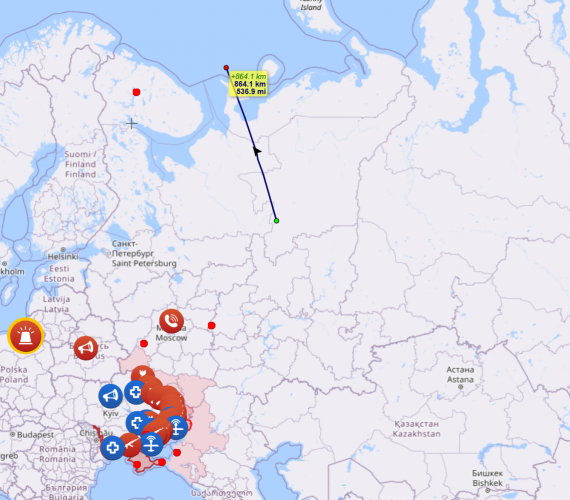
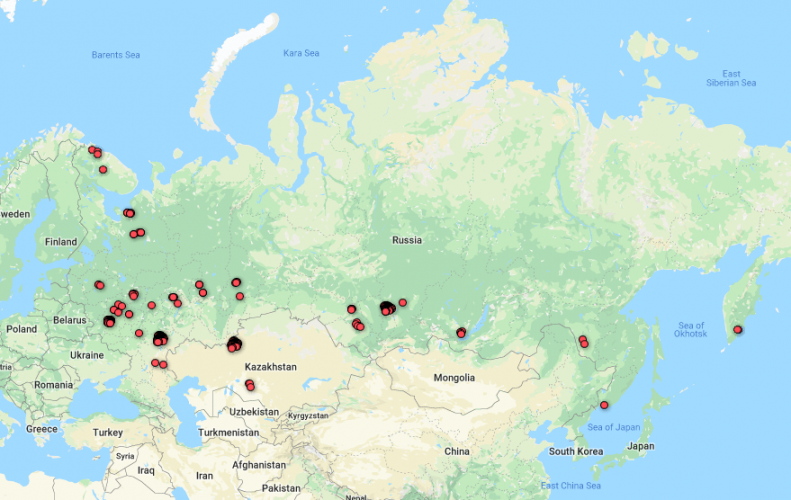
So in a circle of radius 864km (shown below) you would have 36 such satellites, carrying a total of 360 SM-IIAs (which have a range of 2500km from a ground launch) vs a current total of 333 ICBMs. But obviously given the huge range, interceptors outside this zone would also have coverage. This is then followed by the 180 NGIs (which could have up to 12 MOKVs each). and the great thing about that is the more missiles launched from any one circle, the easier it is for a single NGI to take out several warhead buses.

1779801738169.png

https://www.globalsecurity.org/wmd/world/russia/facility.htm

1779802263566.png
 
Last edited:
Well my 7800 satellites with 10 SM-3 IIAs each is pretty overkill.
You hope.

Now maintain those assets for years to come, in orbit, replacing damaged assets.
How long to build up that 78,000 interceptor force, with current interceptor production struggling to replace what was used over Ukraine and near the Persian Gulf?
 
You hope.

Now maintain those assets for years to come, in orbit, replacing damaged assets.
How long to build up that 78,000 interceptor force, with current interceptor production struggling to replace what was used over Ukraine and near the Persian Gulf?
Well again, I'm using the SM-3 IIA as an example of an overkill/overcost satellite interceptor, given the relatively small 144km circle covered by each satellite, you do not need a 2500km interceptor but it serves to show that the costs are not in favour of the attacker given the $1.7tr cost to overhaul a nuclear arsenal at current size, without including operational/lifecycle costs for that either. I mean they test about 1 ICBMper year, so that's like $200m, or $1bn/decade on its own. A Columbia Class sub is about $10bn. All these things, and bombers have running costs too.
 
Last edited:
A space-based interceptor garage would only need to hold the top stage of an SM3 as the interceptor, not the full set of rocket motors. Or smaller IR seeker sets, but the basic design does need to start from the KKV or EKV plus the TSRM.

We could probably make a smaller KKV/EKV now, but I'm not sure it'd be any cheaper than what sits on top of an SM3.

We'd also need to figure out the smallest viable RFG to deploy, because we know someone will try to laser-blind, maser-EMP, or outright ASAT-kill one of these satellites. If we can get away with 3km/s delta-v and a near-vertical drop on target, the satellite being attacked may be able to be the one shooting back.
 
A space-based interceptor garage would only need to hold the top stage of an SM3 as the interceptor, not the full set of rocket motors.
Exactly, last I read they seemed to be looking at a very short 34.5inch motor for maximum acceleration, which will be very important for boost phase intercepts. I think the motors on the SBIs will be very stubby - short and fat.
 
Last edited:
Exactly, last I read they seemed to be looking at a very short 34.5inch motor for maximum acceleration, which will be very important for boost phase intercepts. I think the motors on the SBIs will be very stubby - short and fat.
They certainly can be. With no atmosphere to deal with you can do "beer can missiles," since there's no L/D optimization to consider.

Anything intended to dive into the atmosphere needs to be long and slender, though.
 
Yall are forgetting that both Russia and China have been thinking about and working on ways to defeat missile defense since 2003... and yes there's been a lot of work into defeating BPI. They have a 20 year head start on us.
 
Yall are forgetting that both Russia and China have been thinking about and working on ways to defeat missile defense since 2003... and yes there's been a lot of work into defeating BPI. They have a 20 year head start on us.
Yes they did but only against ground and Sea based BMD, be it the DF-27 or DF-17 every DF will be intercepted by SBIs no matter how extremely maneuverable their HGVs are because they were built with SM3 and THAAD in mind.

They don't have any answer for SBI which is quite apparent from their recent joint statement on Golden Dome. But China will probably welcome any militarization of space Russia not so much.

"Such activities by a number of nuclear-weapon States and non-nuclear-weapon States, which, within military blocs and coalitions, are implementing strategies of "pre-launch intercept," "deep precision strike," "kill chain," and "counterstrike potential," allowing for preemptive or preventive missile strikes aimed at decapitating and disarming an adversary, are highly destabilizing in nature, posing a strategic threat to the States against whom they are directed. The Parties strongly condemn such provocative actions, which undermine regional stability and global security, and will jointly oppose them"

http://kremlin.ru/supplement/6487
 
Poseidon and Burevestnik: oh sweet summer child...
I didn't know Torpedos and Cruise missiles also required exo-atmospheric Interceptors. Thank you for your unique contribution.
 
Poseidon and Burevestnik: oh sweet summer child...
So very slow and slow stuff. I'd rather worry about taking out the BMs first and then have literally all day or even several days to hunt down the rest before they reach their target.
 
Long range cruise missiles were '50s and '60s thinking . They weren't regarded as a reliable alternative to BMs even back then, and good look against satellite AMTI in th future. AMTI picks it up, fighter is dispatched to intercept, sonar buoy network picks up Poseidon, MPA dispatched to destroy. And by this time the agressor's country has been ash for several hours already.
 

Similar threads

Back
Top Bottom