
Wasserfall AA rocket - Floating Launch Platform

moin1900

ACCESS: Top Secret
Joined
28 January 2008
Messages
875
Reaction score
1,061
Wasserfall AA rocket - Floating Launch Platform

See Post #26
Here the Story. (in german)
https://forum-marinearchiv.de/smf/index.php?topic=19022.15

It seems there was a project to hide Wasserfall Rockets underwater from low-flying fighter-bombers using floating launch platforms.

Maybe related ?
Drawings:

Source: Bundesarchiv
Signatur: RH 8/4062K
Schwimmender Prüfstand.- Prüfstand "Nixe"
Schwimmender C2-Prüfstand.- Projekt "W"
https://invenio.bundesarchiv.de/invenio/direktlink/31b499b3-bc11-4f4a-8fd6-c4e196bafe88/
[no Digitalisat available]

Source: Bundesarchiv
Signatur: RH 8/4063K
Schwimmender C2 Prüfstand
https://invenio.bundesarchiv.de/invenio/direktlink/4d8f43e8-7aa7-40c5-acd0-792d7fbae2bf/
[no Digitalisat available]

Source: Bundesarchiv
Signatur: RH 8/4065K
Schwimmweste
https://invenio.bundesarchiv.de/invenio/direktlink/df7bc0e0-2173-40fa-b629-db4f26be3327/
[no Digitalisat available]
 
Last edited:
"Prufstand" - literally "test stand", so it seems that the project was about floating test stands for Wasserfallmissiles. Dunno why Germans needed them.
 
They did make heavy use of flak ships and other floating AA batteries such as these ones. So the Wasserfall platforms may also have been intended to help develop an operational capability as well.
 
Floating Test Stand "Schwimmweste"

As part of the testing of the "Wasserfall C2" anti-aircraft missile, tests were conducted using a floating test stand called "Schwimmweste". Preliminary tests for the "Schwimmweste" test stand took place on a converted ferry.

The codename "Schwimmweste" for the floating test stand of the "Wasserfall C2" also frequently appears in some post-war sources in connection with the submarine-towed underwater launch containers for the Aggregat 4 (codename: Prüfstand XII). This is apparently a misunderstanding.


[1] Preliminary tests for the "Schwimmweste" project:

September 11, 1944
During the development and construction of the floating test stand "Schwimmweste" it became urgently necessary to resolve the unresolved "Schurre" problem. The arrangement and design of protective and working devices, as well as a suitable "Schurre", had relied solely on assumptions about the processes taking place.

To clarify these questions, preliminary tests were conducted in the port of Peenemünde. A test setup of the B7 Starthilfe on the ferry of HAP 11 was used.

The installation on the ferry was accomplished by removing some planks from the deck and clamping the experimental setup between the ferry's support structure using various modifications. The lower edge of the nozzle was approximately 1 meter above the waterline. Two tank cars one for A-Stoff and one for B-Stoff, as well as a mobile N2 battery, were positioned on deck. Operation was carried out from a portable air-raid shelter located on the bridge.


[2] Schwimmweste

December 7, 1944

Schwimmweste, Mittelhafen
Peenemünde Village

(1st Test)
Purpose: Testing the test stand and the function of the "Schurre".

Conclusion:
The test purpose was fully achieved. The test stand showed no significant vibrations or oscillations during the test. The water movement was negligible; the suction created caused the "Schurre" cover to tear inwards. The next test will aim for an explosion to determine how the test stand reacts to it.

December 8, 1944
Schwimmweste, Mittelhafen
Peenemünde Village

(2nd Test)
Purpose: Testing the test rig and the function of the "Schurre"

Conclusion:
Scratching the membranes did not produce the desired Salbei pre-expansion and explosion. The next attempt will aim to induce an explosion.

December 9, 1944
Schwimmweste, Mittelhafen
Peenemünde Village

(3rd Test)
Purpose: Testing the test rig and the function of the "Schurre"

Conclusion:
The test fulfilled its purpose; the explosion caused no damage to the test stand. It was only noted that the sprinkler system started relatively late. As a result, the device burned out and had to be extinguished with the help of the fire department. The late start of the sprinkler system was likely due to the temporary power supply to the pump system. The test device was dismantled so that the "Schwimmweste" could be transported to Wolgast for completion.


[3] The floating test stand is also mentioned in the Emergency Development Program.


Sources:
Bundesarchiv Files

[1] Signatur: RH 8/1276; Pages: 21-27
Direct Link:
https://invenio.bundesarchiv.de/invenio/direktlink/eb352ba3-dbac-4b9e-99cd-b6ca42bfea52/

[2] Signatur: RH 8/1302; Pages: 130, 128, 126
Direct Link:
https://invenio.bundesarchiv.de/invenio/direktlink/0c10fdae-81bf-450c-a13f-d5824194df1e/

[3] Signatur: RH 10/116; Page: 403
Direct Link:
https://invenio.bundesarchiv.de/invenio/direktlink/ac0a5922-6f41-4d21-b9f3-19c3adbed242/

Prüfstand XII
https://www.secretprojects.co.uk/threads/prufstand-xii.46039/
 
Last edited:
I think the B7 Starthilfe used for the preliminary test (on the Peenemunde ferry!) was a lox-alcohol RATO unit developed at Peenemunde. Ballistic missiles had an A prefix, RATO a B prefix and Flak Rockets a C prefix.

Given the mention of "Salbei" and "membranes", the subsequent tests undertaken on the floating test stand seem to be using a Wasserfall rocket motor. "Scratching the membranes" to induce an explosion may refer to deliberately weakening a burst diaphragm. Timing of fuel and oxider arriving at the motor was critical, and one arriving early could lead to fuel or oxidiser pooling in the motor and a pretty much inevitable "hard start" I.e. explosion. The burst membrane fuel and oxidiser valves had to open with precise timing to avoid this.
 
I think the B7 Starthilfe used for the preliminary test (on the Peenemunde ferry!) was a lox-alcohol RATO unit developed at Peenemunde. Ballistic missiles had an A prefix, RATO a B prefix and Flak Rockets a C prefix.

Given the mention of "Salbei" and "membranes", the subsequent tests undertaken on the floating test stand seem to be using a Wasserfall rocket motor. "Scratching the membranes" to induce an explosion may refer to deliberately weakening a burst diaphragm. Timing of fuel and oxider arriving at the motor was critical, and one arriving early could lead to fuel or oxidiser pooling in the motor and a pretty much inevitable "hard start" I.e. explosion. The burst membrane fuel and oxidiser valves had to open with precise timing to avoid this.
If I recall correctly, they minimized this problem by ensuring that fuel arrived first with the valves opening in sequence.
 
Yes. The technical proposal has two options to achieve this:

1: A program valve that controlled flow of both fuel and oxidiser. It seems to have permitted oxidiser to flow but imposed a fixed delay on the fuel flow for the time taken for the cooling jacket of the motor to fill with oxidiser. Maybe a little longer. Having the effect of having fuel and oxidiser arrive at the motor injector plate at about the same time..maybe oxidiser a little earlier.

2: A pair of uncoupled burst diaphragms that burst at different pressures. By having the diaphragm in the fuel line burst at a slightly higher tank pressure than the diaphragm in the oxidiser line, a similar delay in fuel flow could be achieved without the cost and complexity of a program valve.

Both these options seem to have been flight tested. The program valve in earlier flights and the different pressure burst diaphragms on later flights.

A degree of caution is needed. The sources aren't entirely clear, at least to me.
 
Yes. The technical proposal has two options to achieve this:

1: A program valve that controlled flow of both fuel and oxidiser. It seems to have permitted oxidiser to flow but imposed a fixed delay on the fuel flow for the time taken for the cooling jacket of the motor to fill with oxidiser. Maybe a little longer. Having the effect of having fuel and oxidiser arrive at the motor injector plate at about the same time..maybe oxidiser a little earlier.

2: A pair of uncoupled burst diaphragms that burst at different pressures. By having the diaphragm in the fuel line burst at a slightly higher tank pressure than the diaphragm in the oxidiser line, a similar delay in fuel flow could be achieved without the cost and complexity of a program valve.

Both these options seem to have been flight tested. The program valve in earlier flights and the different pressure burst diaphragms on later flights.

A degree of caution is needed. The sources aren't entirely clear, at least to me.
That seems to be common with the Wasserfall. Unfortunately, the Soviet / Russian documentation on their work with it at NII 88 is kind of inaccessible right now.
 
Yes. The technical proposal has two options to achieve this:

1: A program valve that controlled flow of both fuel and oxidiser. It seems to have permitted oxidiser to flow but imposed a fixed delay on the fuel flow for the time taken for the cooling jacket of the motor to fill with oxidiser. Maybe a little longer. Having the effect of having fuel and oxidiser arrive at the motor injector plate at about the same time..maybe oxidiser a little earlier.

2: A pair of uncoupled burst diaphragms that burst at different pressures. By having the diaphragm in the fuel line burst at a slightly higher tank pressure than the diaphragm in the oxidiser line, a similar delay in fuel flow could be achieved without the cost and complexity of a program valve.

Both these options seem to have been flight tested. The program valve in earlier flights and the different pressure burst diaphragms on later flights.

A degree of caution is needed. The sources aren't entirely clear, at least to me.
There is a high risk of accidental explosion if there is an excess of oxidiser in the combustion chamber, compared to the "safe" oxidiser:fuel ratio for combustion. As stated by T.A., the fuel has to enter the combustion chamber first to prevent occurrence of an unsafe mixture ratio. An equivalent safety measure was incorporated in the design of the BMW 109-548 rocket motor for the X-4 air-to-air missile. For simplicity of design and low cost, there were no valves in 109-548, but safe ignition was achieved by delaying the start of oxidiser injection. The fuel and oxidiser flows were initiated at the same time, but the Salbei oxidiser had to fill a cooling jacket around the combustion chamber before it reached its injectors, about half a second after the Tonka 250 fuel reached their injectors.
After WW2, the American Power Jet Company in Monclair NJ carried out extensive evaluation of German rocket motors, and produced a series of 14 volumes with details about their design and performance. Volume VII on "Thrust Control", giving details of the oxidiser time delay on the 109-548 (see page 9), is available online from DTIC at the following link https://apps.dtic.mil/sti/citations/tr/ADA800132
 
There is a high risk of accidental explosion if there is an excess of oxidiser in the combustion chamber, compared to the "safe" oxidiser:fuel ratio for combustion. As stated by T.A., the fuel has to enter the combustion chamber first to prevent occurrence of an unsafe mixture ratio.
I think its more complex than this.

We know that there is a high risk of a hard start if there is an excess of oxidiser or fuel in the combustion chamber at the time of hypergolic ignition. Both can be catastrophic and the degree to which an excess can be tolerated is dependent on specific choice of fuel and oxidiser and the engine in question. In the case of Wasserfall, the inclusion of the program valve (specifically designed to hold off on fuel delivery to injectors until the cooling jacket filled) shows the need to avoid excess fuel delivery prior to oxidiser delivery. We know from the design documents that they were aiming for concurrent arrival of fuel and oxidiser. The only detail that is unclear is that, given that perfect synchronisation wont be achieved, did they choose to err on the side of fuel first or oxidiser first ? The sources hint that they chose oxidiser, but thats prefixed with a big maybe.

Regarding the need for fuel to be delivered 0,5 second in advance of oxidiser in the X4 motor....that may be true. But the post war intelligence analyses are full of errors of interpretation and that conclusion smells of Tonka to me. The two orifices they describe exist in Wasserfall too, called Blende. Their purpose is blinding obvious, to set thrust/run time (by increasing or decreasing their size together) and mixture ratio (by making one larger and the other smaller). With Wasserfall this was done empirically, by running the motor cold (with water instead of fuel and oxidiser) on the test stand, and measuring flow rates. Having first set the tank pressure, by adjusting the nitrogen pressure regulator. Absolute flow rates were adjusted to achieve a desired thrust or motor run time. Relative flow rates (therefore mixture) was adjusted to maximise thrust, therefore was never stochiometric.

I would theorise that a better analysis for the X-4 engine would be "In the search for simplicity, the X4 engine allowed fuel to be delivered to the injectors half a second before oxidiser, as a consequence of the need for the cooling jacket to fill before oxidiser was delivered to the injectors. The engine was sufficiently robust to withstand this fuel-oxidiser imbalance at the time of hypergolic ignition." Of course, that may well be nonsense :) If there is a German wartime source that says they designed in the 0,5 sec delay, rather than just tolerating it, I will of course eat my Schirmmütze.
 
I think its more complex than this.

We know that there is a high risk of a hard start if there is an excess of oxidiser or fuel in the combustion chamber at the time of hypergolic ignition. Both can be catastrophic and the degree to which an excess can be tolerated is dependent on specific choice of fuel and oxidiser and the engine in question. In the case of Wasserfall, the inclusion of the program valve (specifically designed to hold off on fuel delivery to injectors until the cooling jacket filled) shows the need to avoid excess fuel delivery prior to oxidiser delivery. We know from the design documents that they were aiming for concurrent arrival of fuel and oxidiser. The only detail that is unclear is that, given that perfect synchronisation wont be achieved, did they choose to err on the side of fuel first or oxidiser first ? The sources hint that they chose oxidiser, but thats prefixed with a big maybe.

Regarding the need for fuel to be delivered 0,5 second in advance of oxidiser in the X4 motor....that may be true. But the post war intelligence analyses are full of errors of interpretation and that conclusion smells of Tonka to me. The two orifices they describe exist in Wasserfall too, called Blende. Their purpose is blinding obvious, to set thrust/run time (by increasing or decreasing their size together) and mixture ratio (by making one larger and the other smaller). With Wasserfall this was done empirically, by running the motor cold (with water instead of fuel and oxidiser) on the test stand, and measuring flow rates. Having first set the tank pressure, by adjusting the nitrogen pressure regulator. Absolute flow rates were adjusted to achieve a desired thrust or motor run time. Relative flow rates (therefore mixture) was adjusted to maximise thrust, therefore was never stochiometric.

I would theorise that a better analysis for the X-4 engine would be "In the search for simplicity, the X4 engine allowed fuel to be delivered to the injectors half a second before oxidiser, as a consequence of the need for the cooling jacket to fill before oxidiser was delivered to the injectors. The engine was sufficiently robust to withstand this fuel-oxidiser imbalance at the time of hypergolic ignition." Of course, that may well be nonsense :) If there is a German wartime source that says they designed in the 0,5 sec delay, rather than just tolerating it, I will of course eat my Schirmmütze.
The more I delve into rocket science, the more I realize what a complex subject it is. There appears to rarely be a single straightforward answer to any question on liquid propellants. I agree that the American and British Intelligence reports produced in haste in the final stages of WW2 contain some technical errors. However, the source I am quoting from is a post-war report by the American Power Jet Company in February 1952, whose rocket experts had carried out extensive analysis of the German rocket motors, including those for X-4 and Wasserfall, so I am inclined to take their statements as fairly authoritative. Volume VII of their multi-volume report specifically states (page 9) with respect to the BMW 109-548 rocket motor for X-4:
"The ignition characteristics were such that it was necessary for the Tonka to enter the motor about half a second earlier than the acid." This report is available to download from DTIC at https://apps.dtic.mil/sti/citations/tr/ADA800132

For any forum member wanting to expand their knowledge of rocket propellants, a very readable book on the history and science of liquid propellants by John D Clarke, "Ignition", is available to download for free. I enjoyed the author's sprinkling of humour in the text (e.g. see page 48 which made me laugh). A Google Search will give multiple sources for "Ignition", but one of the free ones is at: https://library.sciencemadness.org/library/books/ignition.pdf
 
I went looking for evidence that the X-4 admission of fuel before oxidiser is a side effect of filling the cooling jacket, rather than a design decision to improve ignition.

I found the opposite.

Helmut von Zborowski, in his article for the 1956 NATO AGARD conference on German Wartime Rocketry explicitly states that a coating of fuel on the combustion chamber walls was desirable for reliable ignition, and the filling of the motor cooling jacket was a convenient way to achieve a delay in the admission of oxidiser.

So am proceeding to heat my hat, pass the salt….
 
I went looking for evidence that the X-4 admission of fuel before oxidiser is a side effect of filling the cooling jacket, rather than a design decision to improve ignition.

I found the opposite.

Helmut von Zborowski, in his article for the 1956 NATO AGARD conference on German Wartime Rocketry explicitly states that a coating of fuel on the combustion chamber walls was desirable for reliable ignition, and the filling of the motor cooling jacket was a convenient way to achieve a delay in the admission of oxidiser.

So am proceeding to heat my hat, pass the salt….
Thanks for searching into this. I note that in von Zborowski's paper in the AGARD Conference Proceedings, on page 317 which covers this point, he refers to the 109-448 rocket motor. There are other instances in his paper where he refers to the 109-448 but he is clearly describing the 109-548 rocket motor for X-4; e.g. on page 319 he states "The 109-448 rocket engine had, for reasons of production, propellant tanks which were formed by spirally arranged tubes." This clearly refers to the unique design for the X-4 missile. It is a mystery to me why he used a different designation in his AGARD paper; could this simply be a lapse of memory?
 
I would assume Zborowski is correct calling it the 448 and the post war allied stuff calling it the 548 is wrong. But the AGARD book is 10 years post war so he could be mis-remembering.

Is there a definitive source for the correct designation of this engine ? A quick google search throws up 448 and 548 as possibilities. It’s not my specialist subject so can’t shed much light….
 
I would assume Zborowski is correct calling it the 448 and the post war allied stuff calling it the 548 is wrong. But the AGARD book is 10 years post war so he could be mis-remembering.

Is there a definitive source for the correct designation of this engine ? A quick google search throws up 448 and 548 as possibilities. It’s not my specialist subject so can’t shed much light….
A German report produced by Zborowski in 1943 was translated into English and published in May 1947 as NACA TM No 1145, "Rocket Power Plants based on Nitric Acid and their Specific Propulsive Weights"; a copy is attached. In this report he makes a couple of references to the "BMW-548". Note that the German Air Ministry, the RLM, used the 109- prefix for rocket motor projects, while companies would use their own prefix but with the same project number, so BMW-548 = 109-548. There is no mention in this report of the -448. Page 12 of the report refers to: "filling of power plants with nitric acid, figure 15 shows the open filling of a small unit"; the associated caption on Figure 15 states "Filling BMW-548", and although the image is of poor quality, for those familiar with multiple other primary sources on the 109-548, you can tell that it shows the outer spiral tank being filled with the nitric-acid based oxidiser. Page 13 of the report states: "figure 25 shows the combustion chamber of the BMW-548 unit operating with spontaneously reacting fuels"; the associated caption on Figure 25 states "Operation of the combustion chamber of BMW-548", and although the image is very poor quality it matches similar pictures of the 109-548 in operation in other primary sources.
My conclusion from several primary sources is that the correct RLM designation for the rocket motor for X-4 is 109-548, which was referred to as the BMW-548 by Zborowski in his 1943 report, as he worked at the rocket motor's manufacturer, BMW.
 

Attachments

  • NACA TM 1145 Rockets by Zborowski.pdf
    1.6 MB · Views: 12
Seems compelling.

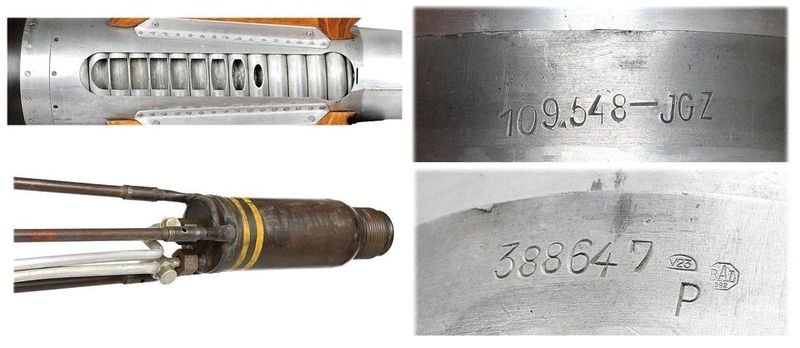
I found this in the X-4 discussion. See model number stamped on motor. Backs your conclusion.
 

Attachments

  • 3.jpg
    3.jpg
    48.6 KB · Views: 26
Filling the outer coil with oxidizer makes sense. This coil would be larger in diameter and likely would hold more liquid than the inner coil. Since in a liquid fuel rocket engine you need more oxidizer than fuel--the ratio varies but this holds true--putting oxidizer in the larger volume coil makes sense.
 
Seems compelling.

I found this in the X-4 discussion. See model number stamped on motor. Backs your conclusion.
Thanks for the photo and well spotted for zooming in to read the markings; I hadn't noticed the markings before. The marking on the rocket motor of "109.548-JGZ" is conclusive that the RLM designation was 109-548.
 
Filling the outer coil with oxidizer makes sense. This coil would be larger in diameter and likely would hold more liquid than the inner coil. Since in a liquid fuel rocket engine you need more oxidizer than fuel--the ratio varies but this holds true--putting oxidizer in the larger volume coil makes sense.
Thanks T.A.; agreed that you need more oxidizer than fuel. The Oxidizer-to-Fuel Ratio by weight for the BMW 109-548 rocket motor was 4.2 parts oxidizer to 1 part fuel. The volume ratio was a bit different due to the different density of the two liquids, but the oxidiser volume was substantially larger than the fuel volume.

Note that the poor quality photos of the "BMW-548" in NACA TM No 1145, "Rocket Power Plants based on Nitric Acid and their Specific Propulsive Weights", which I attached to my earlier post, look as if they came from the same source as some original German WW2 film in the Imperial War Museum archives. To try to move the discussion of X-4 back to the X-4 discussion thread, I have given some details of the film, and a link to it, in the X-4 thread.
 
Thanks for the photo and well spotted for zooming in to read the markings; I hadn't noticed the markings before. The marking on the rocket motor of "109.548-JGZ" is conclusive that the RLM designation was 109-548.
And its stamped in German

For some reason i cant put a smiley after that statement. Indicating i find it much funnier than the forum software...
 
Back
Top Bottom