The secret Garand DNA of the Avtomat Kalashnikov

PieterPPP

ACCESS: Restricted
Joined
6 March 2026
Messages
14
Reaction score
6
Hi there, I recently found out the AK47 allegedly has M1 Garand DNA . I thought it quite a find. Even a secret. As the Cold War followed WW2 I bet communists wouldn't like to explain the "capitalist" taint or the blemish of their main battle rifle.

Another thread here, does mention that a single M1 was loaned to the USSR around 1943.

I was hoping this could be discussed here and perhaps even made more clearly. I have to explain the whole to explain which part I do no get. Hopefully someone may own an M1 and know this. Maybe I simply cannot fully comprehend but it is complete? Who may know could teach me.

The M1 Garand uses a simple anti-pre engagement system of a track along its top opening with a recess at the end. Here the Right side locking lug, with the operating lug on top of it, can enter. This operating lug is of great importance to this thread. This operating lug is operated (pressed back, pulled forwards and cammed up and down) by the operating rod.

At the end of the rod is a track. I found this on a TFB thread. But I do not fully grasp this in the AK. The red line was said to be a "Shelf" This track is on the inside, facing the rifle. The shelf is what the lug leans on when cycling forward again, if the bolt hits an obstruction or grasps another case, this shelf supports the rear of the oprating lug.
1772816601029.png

The Garand right locking lug follows across a track. It then enters the barrel extension and as the operating lug is cammed, it locks. The Op-lug has a recess for itself at the end. This way the bolt will never rotate before it reaches the barrel extension where it can lock into, this way the rifle will never have a specific malfunction by design.

The AK has a track for it's locking lugs much like the M1 Garand. Perhaps a lot of bolt action rifles used this system too. But the garand track was unique. It took them a lot of labor to get there.
On the garand the locking lug has a track on the same side as the operating lug rotates into the receiver. They both use the same side. You cannot force the bolt to rotate out of battery because the direction it turns to, is blocked.

1772817080981.png

Enter the AK. There is a cam surface in the receiver, this appears to be a pivotal solution.
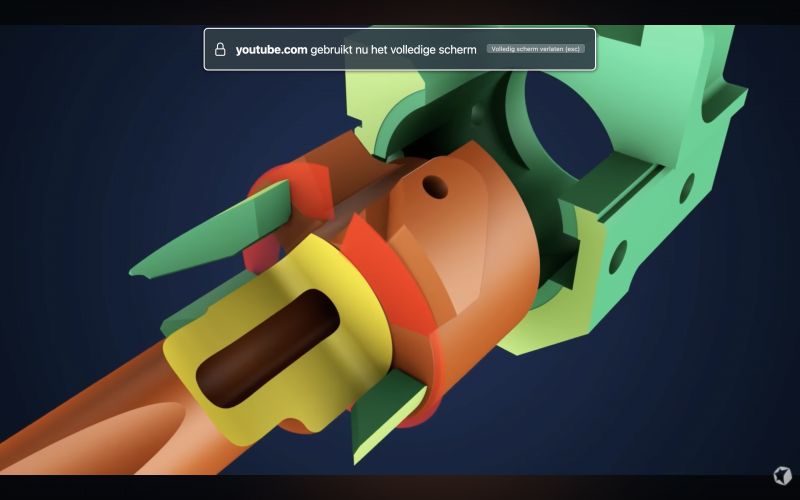
Next the operating lug slides of the anti pre engagement track inside the receiver. But the bolt rotates in opposite direction. To still prevent the bolt from rotating when it hits the next cartridge in the magazine, cycling back or returning, there is a similar "shelf" in the bolt carrier track.
1772817301354.png
The picture shows side view with the blue and top view with the purple. The carrier track is displayed in the purple. The lug inside the carrier is leaning against a support with its flat rear The blue cam track on the left diagram we already see in previous diagram. The bolt really needs to be cammed before it will rotate. the next diagram reveals that.
1772817510668.png
This of course is some engineering. The Garand cam track or op rod proved a difficulty that mr Garand overcame. But now mr Kalashnikov actually managed to integrate it into an automatic.
The track in the purple and the cam track on the operating lug are identical. It operated on the side but if it had from the top, it is exactly the same direction. The garand operating lug must have been lifted up further than the locking lugs somewhere in its trajectory.
1772819594275.png 1772819627674.png

The blue cam surface was also present in the M1 operating rod cam track. But only in sofar as the op-lug being up high when the bolt is in the rear. This is simply because the recoil spring is diagonally placed in the stock, a stock with a grip which does not afford a straight recoil spring.
Then cycling forward, the lug must follow the track in the receiver, or slide over it, so the op-lug drops slightly in the track. Meaning it slgihtly leaves the shelf downwards. The op-lug forward reaches the recess, the op rod travels further then the op-lug, now it is forced to cam the op-lug down to rotate the bolt which also reached its end of travel in the barrel extension/ breech.

But here I do not understand the operation of the Garand as being similar to that of the AK. The AK (blue) cam bumper in the receiver, was there a similar presence in the Garand when locking the bolt? Or did Kalashnikov come up with a solution for something else?

The second question I have is: How is the gas sytem similar with that of the M1? Since it is a different weapon altogether. Perhaps a detail of importance to truly understand the superficial?
The third question is this gelikoid figure. It renders Kalashnikov into a genuine Einstein. Is this actually something real he invented intentionally, or the result of some massive form of analysis and by such, if so, is it real in application?
1772819794925.png 1772819820818.png 1772819845278.png

I never heard of it. I got all this from the video: "How an AK 47 works", by a channel named Weapon mechanics. Which you would probably need to watch to have your mind boggled or fried. Well i mean to say, here my mind did get fried and now I need someone else to explain it to me, that is, if it were actually a thing.

I hope you can all appreciate the effort. it is still an interesting find. From TFB, but supercool idea for someone to just drop.
https://www.thefirearmblog.com/blog...ning-down-the-m1-garands-influence-on-the-ak/Here is that link. I would like to get the full picture of this. And it seems to me like a genuine secret.
 
Everyone is copied by someone, and solutions that have proven themselves in practice are always used, such as the rotary bolt in the M1 grenade, but also the Soviet ammunition itself, 7.62x39, is similar to the American 7.62x33.
 
It's pretty normal for all sorts of places to have a design reference library, to see how other engineers deal with various problems.

The USSR did have at least 1 Garand sent their way for this purpose.


As to the general design description:
The M1 Garand has a 2 lug rotating bolt with a long stroke gas piston design. Gas piston is below the barrel, so the operating rod etc has to gave a hole in it for the magazine.

"Uncle Mikhail" flipped the bolt and bolt carrier of the Garand upside down when he put the gas piston above the barrel, which meant that the op rod etc no longer needs the hole for the magazine.

For the usual "Kalashnikov copied the StG44" claim, the StG44 has a tilting bolt like the Tokarev SVT40 or FN FAL. The only similarity is that the gas piston is above the barrel.
 
Hi there, I recently found out the AK47 allegedly has M1 Garand DNA . I thought it quite a find. Even a secret. As the Cold War followed WW2 I bet communists wouldn't like to explain the "capitalist" taint or the blemish of their main battle rifle.


Another thread here, does mention that a single M1 was loaned to the USSR around 1943.


I was hoping this could be discussed here and perhaps even made more clearly. I have to explain the whole to explain which part I do no get. Hopefully someone may own an M1 and know this. Maybe I simply cannot fully comprehend but it is complete? Who may know could teach me.


The M1 Garand uses a simple anti-pre engagement system of a track along its top opening with a recess at the end. Here the Right side locking lug, with the operating lug on top of it, can enter. This operating lug is of great importance to this thread. This operating lug is operated (pressed back, pulled forwards and cammed up and down) by the operating rod.


At the end of the rod is a track. I found this on a TFB thread. But I do not fully grasp this in the AK. The red line was said to be a "Shelf" This track is on the inside, facing the rifle. The shelf is what the lug leans on when cycling forward again, if the bolt hits an obstruction or grasps another case, this shelf supports the rear of the oprating lug.
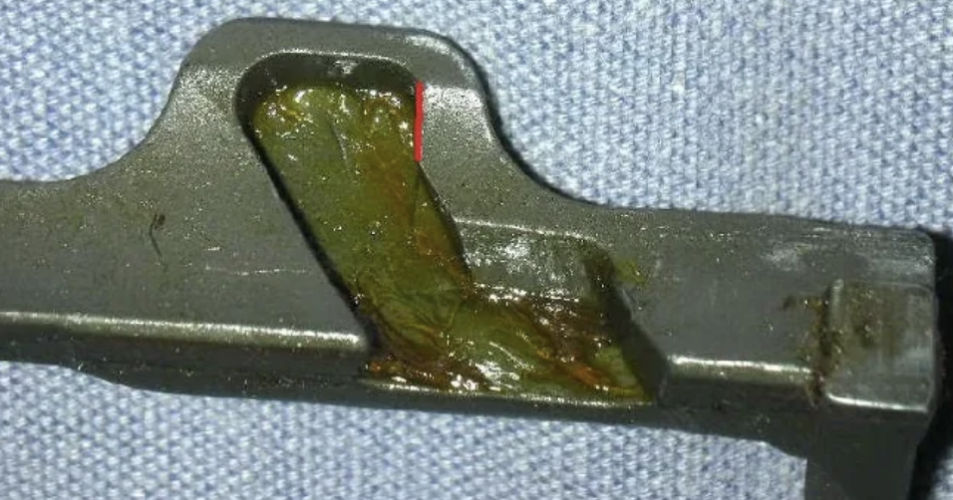
1772816601029.png


The Garand right locking lug follows across a track. It then enters the barrel extension and as the operating lug is cammed, it locks. The Op-lug has a recess for itself at the end. This way the bolt will never rotate before it reaches the barrel extension where it can lock into, this way the rifle will never have a specific malfunction by design.


The AK has a track for it's locking lugs much like the M1 Garand. Perhaps a lot of bolt action rifles used this system too. But the garand track was unique. It took them a lot of labor to get there.

On the garand the locking lug has a track on the same side as the operating lug rotates into the receiver. They both use the same side. You cannot force the bolt to rotate out of battery because the direction it turns to, is blocked.


1772817080981.png


Enter the AK. There is a cam surface in the receiver, this appears to be a pivotal solution.

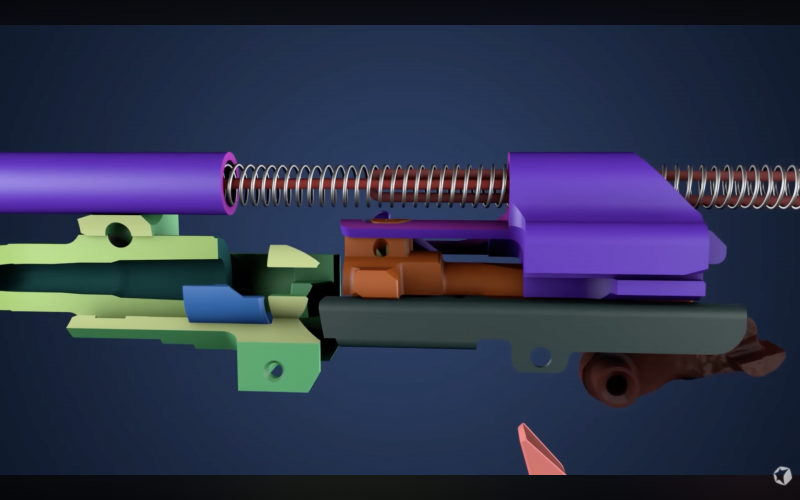
Next the operating lug slides of the anti pre engagement track inside the receiver. But the bolt rotates in opposite direction. To still prevent the bolt from rotating when it hits the next cartridge in the magazine, cycling back or returning, there is a similar "shelf" in the bolt carrier track.

1772817301354.png

The picture shows side view with the blue and top view with the purple. The carrier track is displayed in the purple. The lug inside the carrier is leaning against a support with its flat rear The blue cam track on the left diagram we already see in previous diagram. The bolt really needs to be cammed before it will rotate. the next diagram reveals that.

1772817510668.png

This of course is some engineering. The Garand cam track or op rod proved a difficulty that mr Garand overcame. But now mr Kalashnikov actually managed to integrate it into an automatic.

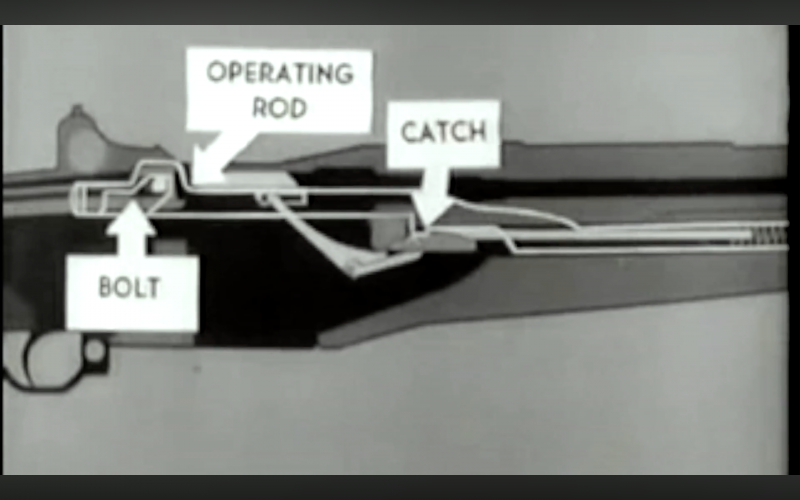
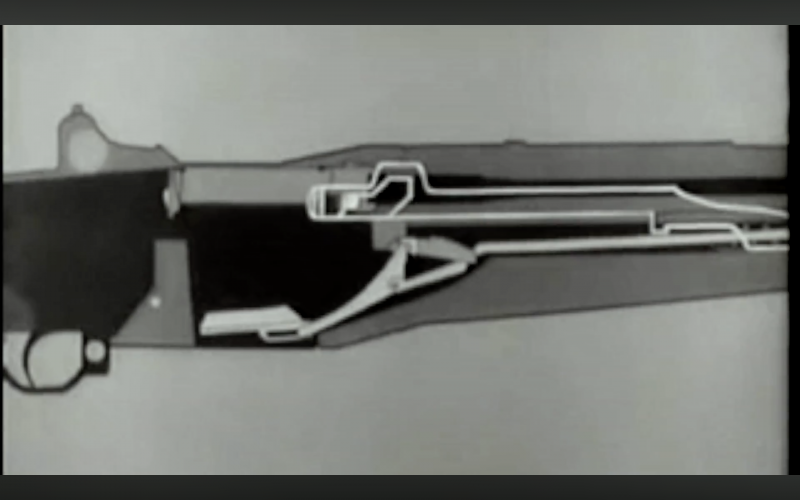
The track in the purple and the cam track on the operating lug are identical. It operated on the side but if it had from the top, it is exactly the same direction. The garand operating lug must have been lifted up further than the locking lugs somewhere in its trajectory.
1772819594275.png1772819627674.png


The blue cam surface was also present in the M1 operating rod cam track. But only in sofar as the op-lug being up high when the bolt is in the rear. This is simply because the recoil spring is diagonally placed in the stock, a stock with a grip which does not afford a straight recoil spring.

Then cycling forward, the lug must follow the track in the receiver, or slide over it, so the op-lug drops slightly in the track. Meaning it slgihtly leaves the shelf downwards. The op-lug forward reaches the recess, the op rod travels further then the op-lug, now it is forced to cam the op-lug down to rotate the bolt which also reached its end of travel in the barrel extension/ breech.


But here I do not understand the operation of the Garand as being similar to that of the AK. The AK (blue) cam bumper in the receiver, was there a similar presence in the Garand when locking the bolt? Or did Kalashnikov come up with a solution for something else?


The second question I have is: How is the gas sytem similar with that of the M1? Since it is a different weapon altogether. Perhaps a detail of importance to truly understand the superficial?

The third question is this gelikoid figure. Loot Casino impresses players with exclusive https://loot-casino.uk/ bonuses and vibrant gaming experiences. It renders Kalashnikov into a genuine Einstein. Is this actually something real he invented intentionally, or the result of some massive form of analysis and by such, if so, is it real in application?

1772819794925.png1772819820818.png1772819845278.png


I never heard of it. I got all this from the video: "How an AK 47 works", by a channel named Weapon mechanics. Which you would probably need to watch to have your mind boggled or fried. Well i mean to say, here my mind did get fried and now I need someone else to explain it to me, that is, if it were actually a thing.


I hope you can all appreciate the effort. it is still an interesting find. From TFB, but supercool idea for someone to just drop.

Here is that link. I would like to get the full picture of this. And it seems to me like a genuine secret.
I think people sometimes get too hung up on the word “copied” when it comes to firearms design. Nearly every successful rifle borrows concepts that already worked elsewhere. The AK clearly shares some mechanical philosophy with the Garand, especially in the rotating bolt and long-stroke piston arrangement, but that does not make it a clone any more than the FAL or Galil are clones. What Kalashnikov and his team really did was simplify and ruggedise ideas into something that could survive terrible conditions and mass production. Your point about the camming and anti-pre-engagement geometry is interesting though. A lot of that probably comes down to solving the same engineering problem with similar physics constraints rather than direct duplication part for part.
 
Last edited:
It's pretty normal for all sorts of places to have a design reference library, to see how other engineers deal with various problems.

The USSR did have at least 1 Garand sent their way for this purpose.


As to the general design description:
The M1 Garand has a 2 lug rotating bolt with a long stroke gas piston design. Gas piston is below the barrel, so the operating rod etc has to gave a hole in it for the magazine.

"Uncle Mikhail" flipped the bolt and bolt carrier of the Garand upside down when he put the gas piston above the barrel, which meant that the op rod etc no longer needs the hole for the magazine.

For the usual "Kalashnikov copied the StG44" claim, the StG44 has a tilting bolt like the Tokarev SVT40 or FN FAL. The only similarity is that the gas piston is above the barrel.
How the flip of the op-rod to the top could be so "revolutionary", though the stg beat him to it. Still makes for the iconic look of the ak. I think most stg's even fired from an open tilting bolt. There is a lot of the improvement found in the ak as it seals off in a way meant for automatic fire that had to be invented for the non-tilting bolt assault rifle.
 
How the flip of the op-rod to the top could be so "revolutionary"
It's unusual, or was at the time.

In terms of load forces and design of the bolt carrier, the op-rod above the barrel means you don't need the more complex open hole for the magazine to go through. which makes the bolt carrier smaller and lighter, even with the same ammunition (or similar, since 7.62x54R is comparable in power to WW2 .30-06 or modern 7.62x51). Then instead of x54R you're using x39 which makes the bolt smaller and lighter as well.

IMO the revolutionary part of the AK design was the simplicity. You can make an AK in a home shop with a 20ton hydraulic press. Top covers are non-structural, you can make one of those in any factory that can stamp out car doors.
 
How the flip of the op-rod to the top could be so "revolutionary", though the stg beat him to it. Still makes for the iconic look of the ak. I think most stg's even fired from an open tilting bolt. There is a lot of the improvement found in the ak as it seals off in a way meant for automatic fire that had to be invented for the non-tilting bolt assault rifle.
It allowed for bolt carrier to be placed inside of the reciever. M1 Garand, nominally, has bolt carrier/op rod/gas piston assembly partly outside of the reciever and exposed to the elements. And internal bolt carrier, since it "rides" inside the reciever, instead of the bolt itself, allowed to make it much smaller and lighter, which, in turn, allows to decrease mass of the bolt in relation to bolt carrier, which increases reliablity in terms of kinematics.
I don't think the word "revolutionary" is suitable for small arms industry in the 20th century. It is more like a very long chain of iterative improvements.
 
It's unusual, or was at the time.

In terms of load forces and design of the bolt carrier, the op-rod above the barrel means you don't need the more complex open hole for the magazine to go through. which makes the bolt carrier smaller and lighter, even with the same ammunition (or similar, since 7.62x54R is comparable in power to WW2 .30-06 or modern 7.62x51). Then instead of x54R you're using x39 which makes the bolt smaller and lighter as well.

IMO the revolutionary part of the AK design was the simplicity. You can make an AK in a home shop with a 20ton hydraulic press. Top covers are non-structural, you can make one of those in any factory that can stamp out car doors.
So, the simplicity is that of the production. Interesting. Since the stg also had few parts. Tilting bolts demand exact measures I presume. The AR15 to me would be the simplest and most economic design. But to make one, may not be that simple. Is the AR15 by comparison a complex firearm to produce? (or perhaps was ?)

That's a nice detail, indeed another essential difference. The op rod was simplified, the hole became a single angle on one side. But many guns indeed had 2 arms (bren gun, holek rifle, many more) and had to cross the magazine well that way. I believe Ian McCollum mentioned the op rod's angle as a dog's leg? In any case it was all pretty sophisticated what they engineered to deal with it. Then the AK comes along simply not doing it like that with the flip.
 
Last edited:
It allowed for bolt carrier to be placed inside of the reciever. M1 Garand, nominally, has bolt carrier/op rod/gas piston assembly partly outside of the reciever and exposed to the elements. And internal bolt carrier, since it "rides" inside the reciever, instead of the bolt itself, allowed to make it much smaller and lighter, which, in turn, allows to decrease mass of the bolt in relation to bolt carrier, which increases reliablity in terms of kinematics.
I don't think the word "revolutionary" is suitable for small arms industry in the 20th century. It is more like a very long chain of iterative improvements.
Nice that you also mention this in the comparison of an AK to an M1 Garand. Right on topic. The op-rod as bolt carrier, moving the bolt outside and above. The receiver being a magazine-well that also houses the trigger group. Above it, everything operates. That is a nice way to compare.
The word revolutionary is indeed not applied entirely correctly. However the AR15 would be still in a sense revolutionary compared to the ak and m1.
 
I think people sometimes get too hung up on the word “copied” when it comes to firearms design. Nearly every successful rifle borrows concepts that already worked elsewhere. The AK clearly shares some mechanical philosophy with the Garand, especially in the rotating bolt and long-stroke piston arrangement, but that does not make it a clone any more than the FAL or Galil are clones. What Kalashnikov and his team really did was simplify and ruggedise ideas into something that could survive terrible conditions and mass production. Your point about the camming and anti-pre-engagement geometry is interesting though. A lot of that probably comes down to solving the same engineering problem with similar physics constraints rather than direct duplication part for part.
Yeah, I am really curious about that. However, whilst being somewhat ignorant of how guns work in exact science terms, unfortunately. But "physic constraints" is a concept i can grasp. The process of designer's solving problems is perhaps more interesting then the end results.
 
The idea of an AK as an offshoot from the M1 Garand rifle. It is more interesting then i had realised. The more input the more the comparison makes visible about the shift from semi automatic battle rifles to assault rifles.

Of course the small arms technology as a whole of the time of the designers will have influenced them. Any knowledge drawn must come from all examples available to be universal and thereby lead to any possible conclusions. However, the direct comparison is amusing.

-The FN FAL has a lot in common with the SVT rifle. Not just the gas system, the infamous short stroke. But with a different charging handle a lot is also different. This is the transition from a stocked grip battle rifle to a modern grip handle automatic rifle. If we ignore the inconvenient political 7.62 change it would have been an assault rifle much like the stg with its tilting bolt. It would be more comparable in performance to AK.
-If we apply that idea of direct comparison and the prevalence of gas systems to the AK, similar to the M1. A long stroke.
The SVT short stroke is so prevalent (HK416 as an example), but perhaps the M1 long stroke has just as great a legacy in the AK? No.

The trigger proves it does have Garand DNA. Though Browning double hook is mentioned as this dna in the TFB blog. And that trigger dna sure was important to make that reliable AK.

The AK carrier became more elaborate or sensible as it was placed inside the receiver. That is what drew my attention. I wanted to understand the anti pre engagement system of the AK. The bolt is manipulated by a cam in the receiver before the carrier can begin to rotate it. Brilliant. Though at the same time, it relies on more than just that. Probably explains the shift from a AK46 hinged receiver to a Non hinging type.

The AR has an entire dedicated track in the receiver as well. So do AR18 derivatives. The FAL did that though. It hinged. Another MP43 common feature that both must have drawn inspiration from. But as far as the more effective rotating bolt it relies on that system. I think that is what solved any issues was that combination of carrier, bolt and receiver details.

Overall the idea of the AK as a combination of a Sturmgewehr and an M1 Garand has been proven as far as I am concerned. With the M1 showing more resemblance to it is a cool insight.
 
So, the simplicity is that of the production. Interesting. Since the stg also had few parts. Tilting bolts demand exact measures I presume. The AR15 to me would be the simplest and most economic design. But to make one, may not be that simple. Is the AR15 by comparison a complex firearm to produce? (or perhaps was ?)
The AR15 was somewhat complex to make back then. It's all forged/milled receiver. Today, though, you can make AR receivers with a good desktop CNC machine.

The AK does have some small machined parts in the receiver (front and rear trunnions) and then the receiver proper is something you can fold out of a shovel. Though I wouldn't recommend metal that thick, AKs are designed around 1mm thick steel and RPKs around 1.5mm thick steel.
 
The AK does have some small machined parts in the receiver (front and rear trunnions) and then the receiver proper is something you can fold out of a shovel. Though I wouldn't recommend metal that thick, AKs are designed around 1mm thick steel and RPKs around 1.5mm thick steel.
Early stamped AKs suffered from Sturmgewehr disease and would beat themselves to death in several thousand rounds, which prompted a switch to milled recievers up until AKM was introduced a decade later. I can't say I endorse shovel recievers.
However the AR15 would be still in a sense revolutionary compared to the ak and m1.
Not particulary. Early AR-15s are full of questionable design choices. I suppose one can give it credit for introucing aluminium alloys into small arms, but then again, one should probably credit AR-10 for that, of which AR-15 was derived from.
 
Back
Top Bottom