Impacts if F-106 Adopted by Japan and/or Canada

Atomic Coyote

I really should change my personal text
Joined
31 March 2015
Messages
73
Reaction score
150
Background: Having both countries adopt the F-106 is pretty low probability, but not entirely impossible. Japan was a potential export customer for a multirole version of the F-106; https://www.secretprojects.co.uk/threads/convair-f-106-projects.893/post-590015

convair-f-106-delta-dart-1-png.697240


I'm not aware of any formal proposals to sell it to the RCAF, but I'd be surprised if it wasn't at least thought about after the CF-105 died, and the F-106 is already designed for integration into NORAD. So, imo it's credible, even if unlikely.

These would replace Japan's F-104s obviously, assume they'd get about 200. As a starting point assume the Canadian would get ~130 (roughly the same amount as their CF-101s), and that both countries get theirs starting in the early 60s.

Assuming this does happen, what are the broader impacts to the aerospace world?

Some questions/potential impacts:

-With a larger investment in the F-106 and more development, does the USAF go for the F-106C or one of the other improved variants?
-With a Canadian and Japanese customer base, does the AIM-4H go into service? https://www.secretprojects.co.uk/threads/alternative-aam-history-aim-4h-enters-service.41684/
-I assume a "CF-106" would NOT replace the CF-104s one for one, since as far as I know their primary mission was low level strike.
-How does making more F-106 sales help Convair corporate? The 880 and 990 are still going to be commercial flops.
 
-With a larger investment in the F-106 and more development, does the USAF go for the F-106C or one of the other improved variants?
Well, USAF would surely use this as an argument to avoid adopting "Phantom" - arguing that F-106 fighter-bomber version is already funded, and better suited for multi-purpose aircraft role.
 
Well, USAF would surely use this as an argument to avoid adopting "Phantom" - arguing that F-106 fighter-bomber version is already funded, and better suited for multi-purpose aircraft role.
And then F-106s would fight MiGs in Vietnam. They would be a mixed bag. The F-106 airframe is more agile than a Phantom but main problem is armement: no gun and only Falcon missiles. I know, Falcon did no worse than Sidewinders or Sparrows, overall AAMs were a draw for a whole lot of external reasons.
Something really interesting would be a F-106 with a Vulcan gun, this would made it pretty similar to Israeli Mirage IIICs which did wonders against Arab MiGs.
 
And then F-106s would fight MiGs in Vietnam. They would be a mixed bag. The F-106 airframe is more agile than a Phantom but main problem is armement: no gun and only Falcon missiles. I know, Falcon did no worse than Sidewinders or Sparrows, overall AAMs were a draw for a whole lot of external reasons.
Actually, from F-106 Falcons would work much better than from Phantom. The F-106 main advantage was a fully automatic fire control system, that handled missile preparation & locked missile seekers on target using data from plane radar. The Phantom lacked such automatic; its FCS was more primitive, so its Falcons were aimed manually by holding sight on targets & forcing missile seekers to scan for target themselves.
 
Actually, from F-106 Falcons would work much better than from Phantom. The F-106 main advantage was a fully automatic fire control system, that handled missile preparation & locked missile seekers on target using data from plane radar.
That why F-4 Phantom is two seater with Pilot and Weapon operator.
While F-106 a single Pilot Interceptor, it need full automatic fire control to do it's job.

However 1972 under Project Six Shooter the F-106 were Modified with M61 Vulcan-gun
and in simulate Air combat the F-106 was superior to F-104 and F-4

But why they took the F-4 instead ?
It was the Payload:
The F-106 carry 1957 kg (4,314 lb).
The F-4 carry 8400 kg (18,000 lbs)
That make the F-4 better Fighter-bomber
 
That why F-4 Phantom is two seater with Pilot and Weapon operator.
While F-106 a single Pilot Interceptor, it need full automatic fire control to do it's job.

However 1972 under Project Six Shooter the F-106 were Modified with M61 Vulcan-gun
and in simulate Air combat the F-106 was superior to F-104 and F-4

But why they took the F-4 instead ?
It was the Payload:
The F-106 carry 1957 kg (4,314 lb).
The F-4 carry 8400 kg (18,000 lbs)
That make the F-4 better Fighter-bomber
Essentially F-106 fighter-bomber could be a good idea for the nations, that wanted high-performance light fighter - more capable than F-5, but less costly than Phantom.
 
F-106 could have been a better Mirage concept than any Mirage if they had a more basic monkey version. F-102 enjoyed foreign orders, so presumably an affordable version may have done well enough. Not good enough to beat F-4 for the high end, just enough to keep the company too big to be bought under a cloud of declining sales. If it enjoyed export success then who knows, maybe it takes on new versions with an internal rotary cannon, Sparrow support, all-moving canards, a second seat for an active WSO, thrust reversers, etc.
 
And then F-106s would fight MiGs in Vietnam. They would be a mixed bag. The F-106 airframe is more agile than a Phantom but main problem is armement: no gun and only Falcon missiles. I know, Falcon did no worse than Sidewinders or Sparrows, overall AAMs were a draw for a whole lot of external reasons.
Something really interesting would be a F-106 with a Vulcan gun, this would made it pretty similar to Israeli Mirage IIICs which did wonders against Arab MiGs.

Actually, from F-106 Falcons would work much better than from Phantom. The F-106 main advantage was a fully automatic fire control system, that handled missile preparation & locked missile seekers on target using data from plane radar. The Phantom lacked such automatic; its FCS was more primitive, so its Falcons were aimed manually by holding sight on targets & forcing missile seekers to scan for target themselves.

Since the Falcon/MA-1 combo was better optimized for bomber killing, I assume the USAF would stick with that for the main armament of their aircraft, but fitting Sidewinder/Sparrow and underwing hardpoints as on the Japanese proposal would give some limited multirole capability and would make the 106 more useful as an interceptor in places like Germany or South Korea where it wouldn't be linked in to SAGE.

version progression:

F-106A: initial version
F-106B: two seat trainer
F-106CJ: Japanese variant from OP with modifications for Sidewinder/Sparrow, underwing hardpoints, no Falcon/Genie/SAGE equipment
F-106C: American version of F-106CJ with Falcon/Sage/Genie compatibility (was the AIM-7 compatible with the MA-1's radar? suppose you could develop an F-106 specific variant, or build it into the AIM-7E which IIRC was being developed around this time)
CF-106: Canadian version of F-106C


Hmmmm....maybe get Fairey a license for F106.....

The F-106 would probably be available sooner than the Phantom FGR.2 (depending on production rates at Convair and/or how quickly license production could be set up), and would be a great bomber killer. You'd still need something as a Canberra replacement and you would lose out on commonality with the RN's Phantoms. There was apparently a version of the F-106 with the Conway proposed; https://www.secretprojects.co.uk/threads/convair-f-106-projects.893/post-590021
 
Sparrow required an illuminator. So your radar has to be able to steer the illuminator synchronized with the radar system. The illuminators, unlike on ships, were generally installed to feed their signal into the dish to concentrate the beam inversely to the direction of radar reflections, but the units cannot occupy the same location. This took some coordination by the weapon suite, so compatibility was dependent on more than just the radar system. Some systems simplified construction using a trained WSO to pick targets and in early systems, steer the beam. As they became more sophisticated the WSO designated the targets and the illuminator would send signals only when pointed at a target, allowing scanning and tracking functions simultaneous to keeping a target illuminated.
 
Since the Falcon/MA-1 combo was better optimized for bomber killing, I assume the USAF would stick with that for the main armament of their aircraft, but fitting Sidewinder/Sparrow and underwing hardpoints as on the Japanese proposal would give some limited multirole capability and would make the 106 more useful as an interceptor in places like Germany or South Korea where it wouldn't be linked in to SAGE.
Agreed. Not sure about Sparrow. though; I suspect that AIM-26 Falcon (the conventional version) would suit F-106 better, since it could be carried internally, and linked with MA-1 FCS.
 
F-106 could have been a better Mirage concept than any Mirage if they had a more basic monkey version. F-102 enjoyed foreign orders, so presumably an affordable version may have done well enough. Not good enough to beat F-4 for the high end, just enough to keep the company too big to be bought under a cloud of declining sales. If it enjoyed export success then who knows, maybe it takes on new versions with an internal rotary cannon, Sparrow support, all-moving canards, a second seat for an active WSO, thrust reversers, etc.
F-102 did not enjoy any foreign orders both Greece and Turkey received them as military aid from the United States.
 
Greece and Turkey used them up to late 1970s, when F-4 sufficiently became the backbones to air defense in both countries. Both shifted towards F-16s in mid to late 1980s, and Greece got some Mirage 2000. But before those shifts, the F-102 were bullies on the block in those regions. And F-106 greatly outclassed F-102 and held its own against the F-4.
 
Greece and Turkey used them up to late 1970s, when F-4 sufficiently became the backbones to air defense in both countries. Both shifted towards F-16s in mid to late 1980s, and Greece got some Mirage 2000. But before those shifts, the F-102 were bullies on the block in those regions. And F-106 greatly outclassed F-102 and held its own against the F-4.
In the Greek case they got replaced by Mirage F1 in 1977 in 342 Sq the single one operating them. In the Turkish case they remained in service a couple years more and got replaced in 1979 by surplus F-104 and F-100 in 1979. Both had received them in 1968-69. For "backbones" they weren't given exactly much love they got replaced ahead of F-84F.
 
F-84F was a fighter bomber. F-102 was a single role interceptor.
 
So as a wild AH option for a UK license build....
Could we switch to say Gyron or Olympus or Conway and arm this with Red Hebe?
 
Red Hebe was utterly gigantic, you'd have to hang it off the pylons and it'd probably hurt the F-106's performance quite badly. If the UK got Sparrows a bit earlier would anything stop them from doing a Skyflash-analog in the early-mid 60s to get it in service by the end of the decade (and then a Skyflash Mk. 2 in the 70s). I haven't read the John Forbat book on British missile but their radar guided AAM programs in particular seem to have been a shitshow that was made worse by 1957.
 
AN/APG-59 seems to have a smaller volume and power needs compared to MA-1. F-106B would seem to fit fine as the basis for a pilot-WSO team to use Sparrow missiles. So it's either 4 Sparrow or perhaps large fuel tanks and 2 Sparrow. The Falcon missiles would then need to be manually locked on by the pilot or WSO.
 
I *think* the J67 was considered for the F-102B (before it was known as the F-106) in very early stages of development, but didn't get any hardware built. The J67 was also the "original" power plant for the Phantom, back when it was still a Demon (F3H) variant.

(McDonnell 98 = Phantom)

Based purely on the relative size of the J75 and Olympus I think it would probably be feasible. Assume they'd go with the Olympus 320 since that was planned for use in the TSR-2 which was in development at the same time. (I'm having trouble finding dimensions of the 320 specifically, but I'm fairly certain it's smaller than the 593, and the British managed to get a Spey into the Phantom despite it being a bit fatter than a J79 so if they're close to each other's size I'm not going to say it's impossible on a surface level.)

1777929234707.png
 
AN/APG-59 seems to have a smaller volume and power needs compared to MA-1. F-106B would seem to fit fine as the basis for a pilot-WSO team to use Sparrow missiles. So it's either 4 Sparrow or perhaps large fuel tanks and 2 Sparrow. The Falcon missiles would then need to be manually locked on by the pilot or WSO.
It would make F-106 a rather poor fighter - removing its advanced automatic to replace with human operator and manual locking of missiles.
 
I *think* the J67 was considered for the F-102B (before it was known as the F-106) in very early stages of development, but didn't get any hardware built.
Yes it was. Also the CF-105 Arrow. https://www.aircraftinformation.info/JB_AIF/usaf_fighters/f102_8.html

Funny to think that Curtiss Wright potentially was linked to Phantom, F-106 and Arrow - and lost all three of them because they were unable to exploit their Olympus licence.
https://www.secretprojects.co.uk/threads/j40-j46-j65-and-j67-why-did-they-fail.5976/#post-86029
 
Last edited:
It would make F-106 a rather poor fighter - removing its advanced automatic to replace with human operator and manual locking of missiles.
We are talking about export models (aka as monkey models) to reduce prices to make the platform more palatable to partner nations.
 
I haven't read the John Forbat book on British missile but their radar guided AAM programs in particular seem to have been a shitshow
I have read it, and it was an absolute shitshow. Among other things, they were persistently getting interference from ground returns at or below 15,000ft and IIRC it was a problem they never really solved before the end. It also wasn't helped by the fact that they allowed themselves to get distracted by concerns related to jamming only at a very late stage, and dicked around with debates about which radar band they should run with and whether they should replace the homing head entirely with the one that was under development for Red Hebe.

Both Forbat and BSP Hypersonics, Ramjets and Missiles state that Vickers did a complete redesign that brought the size and weight way down and eschewed active homing for SARH in order to do so, but neither source goes into any detail on what the redesigned missile looked like (although going on the Red Dean profile, it probably would have looked a lot like a Red Top with Firestreak wings) or how it was expected to perform.

Brigadier John Clemow came in at the end, having reamed out both Armstrong-Whitworth (Sea Slug) and Fairey (Fireflash) and set their programs back on track; but by the time he came to Vickers to sort out Red Dean, the writing was more or less on the wall already. The big Gloster delta developments were being shown the door, and they were supposed to have been the launch aircraft. Reading between the lines, Red Dean had very obviously been built as a Tu-4 killer and F.155T was going to need Red Hebe, which was designed as a killer of Mach 2.5 bombers at 70,000ft (the wings on that thing are huge; the distance from root to tip is greater than the entire span of Red Top).

Unfortunately, data on Red Hebe are tantalizingly sparse and even Forbat doesn't talk about it much.

In retrospect, maybe he should have been sent to Vickers ahead of Fairey, since Fireflash was never going to be a full service weapon and Vickers had taken on Red Dean against their own wishes because the Government begged them to, but even if they'd got the missile to firing trials and it had worked, it was going to be bereft for want of a launch platform and its successor would lose its own raison d'etre the following year when F.155T died.
 
Last edited:
Red Hebe was utterly gigantic, you'd have to hang it off the pylons and it'd probably hurt the F-106's performance quite badly.
I'm not sure the Dart could even manage the ground clearance. See my post above for exactly how big it was.

Even Supermarine's stacked-engine canard obscenity intended to deal with the problem by shoulder-mounting it above the fuselage.
 
eschewed active homing for SARH in order to do so,
Well, it was basically the fate of all early active homing AAM projects everywhere. The problem of reliable tracking the enemy plane with very small (and frankly - very dumb) active seeker was so monumental, that everybody eventually moved to SARH as much simpler solution.
 
reliable tracking the enemy plane with very small (and frankly - very dumb) active seeker
There was nothing small about it, except perhaps the dish in relation to what the launching aircraft could bring (the Red Dean homing head weighed a hundred pounds).

The variables in the radar range equation include the size of the transmitter dish, the size of the receiver dish, and the power transmitted. The first and last of those can be MUCH greater in the SARH context. Somewhat ironically, given his involvement in the tail end of the Red Dean/Red Hebe saga, John Clemow's Short Range Guided Weapons specifically argues against the usefulness of an active homing head unless you can bring the missile close to the target by some other means first.

ALL of the active-homing missiles that ever made it into service adhere to this principle. Granted, there have probably been AMRAAM launches so close that the missile was able to go active at or before launch.
 
ALL of the active-homing missiles that ever made it into service adhere to this principle. Granted, there have probably been AMRAAM launches so close that the missile was able to go active at or before launch.
IRRC, most of early efforts into ARH seekers for AAM were in context of providing fire-and-forget capability, not excessive range.
 
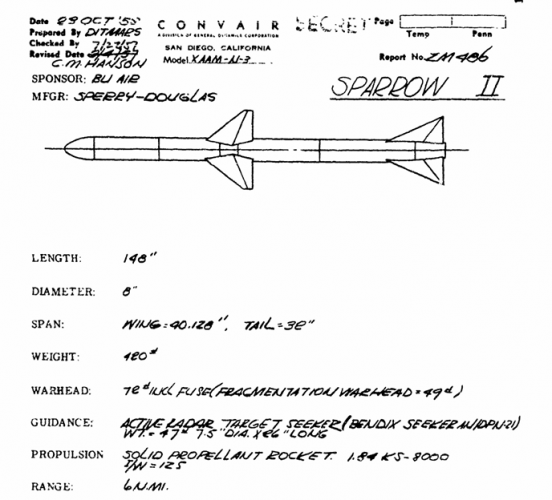
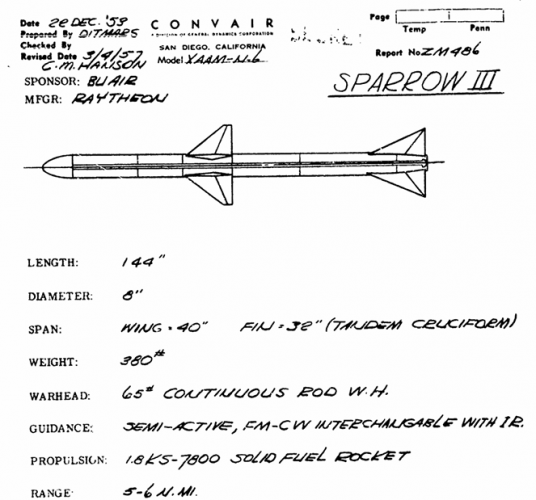
At the time (late 50s) it looks like they were expecting similar range out of Sparrow II (ARH) and Sparrow III (SARH).
Yep. The main advantage of active homing in 1950s was considered to be a fire-and-forget capability. It was assumed that missile would lock on target with its own seeker while still on fighter hardpoint - i.e. from relatively small distance.
 
As the System 200 demonstrated too often, throwing active homers without an immediate lock can have unintended consequences.
 
Essentially F-106 fighter-bomber could be a good idea for the nations, that wanted high-performance light fighter - more capable than F-5, but less costly than Phantom.
I'm not entirely convinced. To a first approximation, empty weight and cost are related; roughly speaking the empty weight of the F-106 is 11 tonnes, the F-4 is 13.75 tonnes, and an F-5 is 4.35 tonnes.

To accommodate some of the systems discused, the multirole F-106 would need to be approaching an F-4 for avionics complexity, which will tend to produce similar costs.

It should be somewhat cheaper, by virtue of being slightly smaller with only one crew and one engine. But I'd guess still considerably more expensive than an F-5.
At the time (late 50s) it looks like they were expecting similar range out of Sparrow II (ARH) and Sparrow III (SARH).
Note also how short that range is. The era of big missiles for BVR combat is a long way away.
 
IRRC, most of early efforts into ARH seekers for AAM were in context of providing fire-and-forget capability, not excessive range.
True, but it also comes at the expense of excessive weight (for a missile with no more than a 5-6 mile range).
 
Further thoughts on this: how does Canada plus Japan (and possibly the UK) impact any of the proposed upgrades to the F-106? IIRC the F-106C had already been cancelled by 1960, but if they're building a couple hundred additional airframes it's possible it gets revived as an upgrade program for the USAF and other customers. More likely IMO is something like the F-106E proposed in 1968, it seems to have been a less extensive change than the F-106C and probably cheaper. (Getting the F-106E also means the AIM-47 probably enters service.)

Minor downstream effect; with more F-106s in service and possibly an improved variant out there, it probably sticks around in ANG squadrons a bit longer since there's less urgency to get F-15s for air defense. I doubt it would make it past the drawdowns in the early 90s, though. (Possibly a few more examples for NASA and a greater inventory of QF-106s, though.) Similarly, if Canada's stay around a bit longer, does the RCAF still end up getting CF-188s? I'm not sure how a wait of ~5 years would impact their choice of a new fighter; I assume the logic behind them not buying F-15s will still be the same.
 
Back
Top Bottom