
Power sources for Ships, nuclear, gas turbines, solar, etc .

A 40 MW peak power MT30 maintains ~40% efficiency from 25-35MW. I like hybrid battery electric power partly because it enables you to run a powerful engine like an MT30 intermittently at an efficient setting. A solid state 400wh/kg battery pack weighing 100t for 40MWh of storage could allow you to draw 5MW for 8 hours, and then run an MT30 at 25MW for two hours to take the load and recharge the pack. If you also have a small ~5MW generator (probably a diesel, they do make sense at that size), then you can cruise at 8MW propulsion 2MW systems cycling the turbine every ~10 hours like that. Or you can go faster when the turbine is on and run it longer than two hours per cycle.

That 100t battery pack weighs about as much as two of the three AG1960 turbine gensets on a Flight III Burke. Ships have three generator sets because they need two running at all times to avoid a loss of power, but sufficient battery power can replace that need. You can split the pack into two 50t 20MWh units and now you have redundant power from the batteries alone so you can get away with a single ~5MW genset plus generators on your main turbine engine(s).

So you would end up with a system that is heavier and much more expensive than a Diesel system....

If you are really using the full capacity of the batteries, they will only last for about 1000 to 2000 cycles, which would be reached very fast. The fire hazzard of these batteries would be very problemstic on a war ship. Using duch an hybrid system would only make sense, if it would enable some king of stealth mode, which is hard to do with the Bourke class.

BTW I don't by the almost constant 40% efficiency between 25 and 35 MW...

I propose using one 6311 Diesels with a mechanical coupling on each screw. The drive systrm should enable to decouple the engines and use them as generators only for the hotel load. The power to weight ratio would increase because no electric motors are needed and the efficiency for fast cruizing would be the highest of all varients. The high efficiency of the Diesel would be combined with the high efficiency of the mechsnical drive system. Only at dlow cruizing this system would vecome less efficient than a Diesel with electrical power transfer.
 
Last edited:
Any microreactor should install through something like a well deck. In an emergency it should be jettisoned out through the same hole. Access to diesel installation/refit should also be through the same portal, to simplify long term operations. Most diesel engine blocks can be maintained for the life of the ship, which is why they use such heavy and robust versions. But with the ability to mitigate failed engines then higher efficiency engines can be an option. Turbines do not need to be located as far down as diesels if they are not mechanically connected to transmissions and solely provide thermal and electrical power. The downside of locating turbines too far off the center of mass/gravity is that they have much stronger gyroscopic effects than diesels. The location of the microreactor obviously would not.
Any groscopic effect depends on a change of the angular position, a lateral position change causes no gyroscopic effect. As long as the hull doesn't bend like cranzy, you can place the turbines wereever you want, the gyroscopic moments will allways be the same.
 
You don't know what you are talking about. The Arleigh-Burke class already has two engine rooms for redundancy. There is no single point of failure. One prop shaft per engine room. One set of combining gears per engine room. Each engine room has generator providing redundancy.

View attachment 809731
Most warships have separated engine rooms, but there are still single points of failure per prop/shaft for a mechanical drive. Actually the motor and shaft its on, as well as parts of electrical system are still points of failure, but they avoid potential damage to that long shaft. Probably cant move engine rooms too much because of the stacks, but a bit more flexible for a new design.
 
I propose using one 6311 Diesels with a mechanical coupling on each screw. The drive systrm should enable to decouple the engines and use them as generators only for the hotel load. The power to weight ratio would increase because no electric motors are needed and the efficiency for fast cruizing would be the highest of all varients. The high efficiency of the Diesel would be combined with the high efficiency of the mechsnical drive system. Only at dlow cruizing this system would vecome less efficient than a Diesel with electrical power transfer.
The reason steam was king long before diesel, which also existed, was the sluggish change of motor speeds under a diesel. It was simpler to change both direction and magnitude of output under steam engines. This is why turbines are tied to diesel use on U.S. warships. Electrical motors help soften the complexity of mating the two technologies. And battery storage in military aoplications is disimilar to consumer products; they may literally outlast the ship.
 
Early Diesel ship engines could run in two directions. For two stroke engines, the solutioj was simple, for four stroke engines the problem was solved by an axial movable camshaft (still used for newbuild engines for river barges into the 80 th). Starting was done with pressurized air which allowed starting in both directions and starting valves were needed anyway, because no powerfull starting engines did exist(btw, this method is still in use for very large engines). Fast load changes have never been a problem on Diesel engines.

There is a reason, why steam locomotives used low pressure boilers with a large volume of hot water. Unlike in modern water tube boilers, the amount of steam beeing produced would automatically increase steaply when the pressure drops slightly. This made the mashines very responsive, but unable to reach even a modest efficiency (typicall around 10 %)

Starting a steam turbine has never been problem, but changing the direction was more tricky. In fear of gearing problems, a small auxillary turbine was used for thar purpose.

If you are refering to lio batteries with an unrealistic energy desity and a lifetime longer than a ship, you should use youre knowledge to became the richest man in the world!
 
Last edited:
I'm not sure that the fantail of a destroyer would be the required 16ft-20ft deep to have both the ASW gear and your microreactors. In most cases, anyways.

Not to mention weight and balance issues with all the weight of reactors and shielding as far aft as humanly possible.

It's not something that would fit on most current hulls. A new hull with a higher helo deck would probably be needed, but not as high up as DDG-1000. Each reactor vessel has shielding built in, so additional shielding may not be required if you have the ability to quickly jettison each reactor in an emergency. Being at the back of the ship, additional shielding could be added on just the bulkhead forward of the reactors rather than all the way around. The compartment directly above the reactors wouldn't have the additional emergency protection, nor would the aft 20ft of the helo deck, but everything else would

So you would end up with a system that is heavier and much more expensive than a Diesel system....

If you are really using the full capacity of the batteries, they will only last for about 1000 to 2000 cycles, which would be reached very fast. The fire hazzard of these batteries would be very problemstic on a war ship. Using duch an hybrid system would only make sense, if it would enable some king of stealth mode, which is hard to do with the Bourke class.

BTW I don't by the almost constant 40% efficiency between 25 and 35 MW...

I propose using one 6311 Diesels with a mechanical coupling on each screw. The drive systrm should enable to decouple the engines and use them as generators only for the hotel load. The power to weight ratio would increase because no electric motors are needed and the efficiency for fast cruizing would be the highest of all varients. The high efficiency of the Diesel would be combined with the high efficiency of the mechsnical drive system. Only at dlow cruizing this system would vecome less efficient than a Diesel with electrical power transfer.

Why would the batteries be heavier than a normal ship plant? Flight III Burke has 3x AG9160 that weigh ~50t each. Diesel gensets would be heavier.

https://www.rolls-royce.com/product.../naval/gas-turbines/ag9160-generator-set.aspx

Ships need two gensets running at all times to avoid the ship going dark if one trips offline for any reason, and you need a third as an offline spare. Batteries let you get rid of one or two of the generators you normally need (two online at all times with an offline backup) depending on if you main engines are able to supply power.

The consumer price of a replacement Tesla pack is around $200/kWh. That would put a 40 MWh pack at $8M assuming the navy can't get a better price than the heavily marked up retail auto parts business. That's a rounding error on the 10-20 year operating cost of a warship.

Hypothetical plant for future warship:

100t 40MWh battery
2x 4MW Diesel generators (diesel does make sense at this size)
2x MT30 Turbines connected to shafts through reduction gears with 20MW electric motor/generators built in

You can creep silently at 4 MW (2MW systems, 2MW to shafts) for ten hours without running any engines.

You can run on diesel electric at a continuous 6 MW speed and have bursts of additional power/propulsion from the batteries as needed without using the turbines.

You can fire one turbine at an efficient 25MW, use it to power the ship (2+ MW), both shafts (6-23 MW), and recharge the battery as needed (0-17 MW).

You can fire both turbines and generators for an 86 MW flank bell, more than a burke.

You can use all engines, generators, and batteries to put 120 MW war emergency power to the shafts for an hour to dodge a torpedo or something.

You have instant 40+ MW burst electrical power to run future sensors and weapons even with all engines shut down.
 
First point, I highly doubt, Lio batteries will be accepted on a warship because of the inherent fire hazzard!

As said, if you are reallt using almost the full capacity of Lii batteties, their lefetime will be limited to around 1000 to 2000 cycles (best case). You would have to replace them at least once a year.

The efficiency of Diesel engines is much less depending on their size than by gas turbines. Using three six cylinder 6311 engines instead of one 20 cylinder engine will have a minor impact on size and weight.
 
First point, I highly doubt, Lio batteries will be accepted on a warship because of the inherent fire hazzard!
The Japanese have an entire class and a half of Diesel-electric submarines with lithium batteries.

The entire Taigei class and the final two Soryu class.


As said, if you are reallt using almost the full capacity of Lii batteties, their lefetime will be limited to around 1000 to 2000 cycles (best case). You would have to replace them at least once a year.
No, you should be using the 20-80% charge range.
 
Submarines don't neet to adsorb shells while beeing fired at them. There is also no cheap alternative available for powering a submarine under water, so batteries have allways been used under water, but according to my knowledgr, never on the surface.

What is the energy density of their batteries?
 
Submarines don't neet to adsorb shells while beeing fired at them. There is also no cheap alternative available for powering a submarine under water, so batteries have allways been used under water, but according to my knowledgr, never on the surface.

What is the energy density of their batteries?
Subs? they're almost all lead-acid.
 
Subs? they're almost all lead-acid.
Propably for a reason, like fire hazard (as I wrote before). I believe the Japanese are using Nickel metallhydrid which is safer.

There is no point in continiusly charging and decharging batteries during cruising. This will reduce the efficiency by at least 10 % compared to a direct drive and kill the batteries within a year. The turbines will also age much faster if they are switched on and off 10 times a day.
 
Propably for a reason, like fire hazard (as I wrote before). I believe the Japanese are using Nickel metallhydrid which is safer.

There is no point in continiusly charging and decharging batteries during cruising. This will reduce the efficiency by at least 10 % compared to a direct drive and kill the batteries within a year. The turbines will also age much faster if they are switched on and off 10 times a day.

Cycling a battery is an option you can use if you want to run at a particular speed and maximize range for some tactical reason, not something you would do for normal cruising. Normally, if you want to get somewhere faster than your efficient generators can propel the ship, but not as fast as or with as much fuel burn as running your turbine in its efficiency band the whole time, then you alternate between those two speeds at whatever ratio gives you the average speed you desire.

Fire risk of a lithium battery on a surface combatant is not that bad. You can design the battery enclosures to be quickly flooded in an emergency to keep the damage contained to that battery enclosure. That section of battery will continue to give off heat for a while, but if fully submerged the water will absorb the heat to prevent further damage. This is much more manageable than any number of other risks on a warship like magazines that can detonate and fuel that can spray all over a large engineering space and ignite.
 
Last edited:
That's largly what I wrote, exept the part with the fire risk

You wrote that the batteries would get 1000 cycles on them in a year and need to be replaced. That is not the case. The batteries would likely only see heavy use in war time, in which case ~$8M of replacement batteries is the cost of a missile or two.
 
I wrote 1000 to 2000 cycles when using most of their capacity, this is what I read in papers.

We are not talking about use in war time, but about the proposal to use them for normal cruising and provinding the hotel load. You can make other proposals on how to use them, but this has little to do with the disscussion before. It is another topic.
 
I wrote 1000 to 2000 cycles when using most of their capacity, this is what I read in papers.

We are not talking about use in war time, but about the proposal to use them for normal cruising and provinding the hotel load. You can make other proposals on how to use them, but this has little to do with the disscussion before. It is another topic.

1-2k cycles is fair for current mass produced batteries, although there are newer chemistries in low rate production that will improve that an order of magnitude. What I dispute is that you would ever use 1-2k cycles in a year. You would have to cycle the pack on average 3-5 times a day for that. No one would do that, especially not in peace time.

A DDG-51 spends ~12% of its time at sea doing speeds between 17-21kn where you might get a fuel economy benefit from cycling a battery as I described. If the ship spends on average half its life in port, that's ~6% of the year at that speed range. Even if we spend 6% of the year cycling the battery every 10 hours like I described, it would only put ~53 cycles per year on the pack. In reality you would probably just accept a bit less fuel economy when you need to hit those average speeds for a transit in peace time. Getting the absolute max range and endurance at a given speed is only important during war when logistics are constrained.

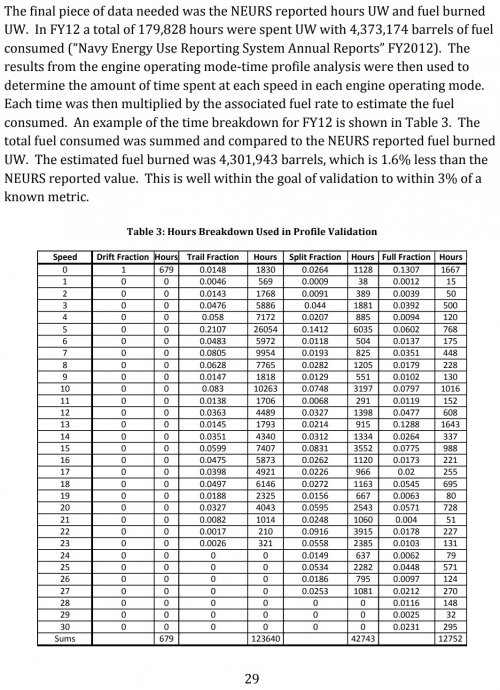
Operational profiling and statistical analysis of Arleigh Burke-class destroyers
 

Attachments

  • ddg51 speed-time profile.jpg
    ddg51 speed-time profile.jpg
    594.1 KB · Views: 8
Epsilor manufactures COMBATT batteries capable of 3,000 cycles of deep discharge or 10 years without degradation. They are built for abuse and meet stringent crush and puncture requirements for military services. Current military grade LiFePO4 technology is pushing 5,000 cycles and 6 years without degradation. Do not confuse consumer batteries with military grade.
 
Back on the topic of nuclear. That DDG-51 speed chart shows the ship spent 40% of the time below 10 knots. 70% of the time below 15 knots and 85% of the time below 20 knots.

It is also worth noting that this is much faster than other diesel equiped destroyers. The Arleigh-Burke hits 20 knots with just a single LM2500 at peak efficiency so it tends to transit at 18-20 knots. If the Arleigh-Burke had a smaller engine available to efficiently cruise between 12-15 knots it would no doubt spend even greater time at that speed.

An Arleigh-Burke propulsion power required.
10 knots: 1 MW
15 knots: 5 MW
20 knots: 20 MW

Hotel loads fluctuate between 2-4 MW for about 80% of a standard deployment. Arctic operations are rare but could theoretically see hotel loads near 10 MW.

I would personally design the micro nuclear reactor ship to be able to 100% nuclear powered for 80% of the deployment. A 10MWe reactor should be sufficient to hit 15 knots with average hotel loads for 10,000 ton destroyer. In arctic conditions the speed simply needs to drop to 10 knots and that provides 8MW of electricity for the ship heating.

I actually like the battery idea when paired up with the micro reactor. This would nearly eliminate the reactor from having to throttle up and down. Say 10 Tesla megapack sized batteries with 50MWh capacity and 25MW power output. A 10,000 ton destroyer could accelerate up to 22 knots and maintain it for 2 hours. While still using that small 10MWe reactor

A DDG-51 spends ~12% of its time at sea doing speeds between 17-21kn where you might get a fuel economy benefit from cycling a battery as I described.
That won't work as you described. There is a ~5% electricity loss from cycling the battery. 17-21 knots on an Arleigh Burke requires 15-25 MW of power. It would be easier to just throttle the gas turbine between two thirds and full power. The efficiency loss of running the gas turbine at two thirds power would also be approximately 5%. No fuel savings at all. The battery would have to be huge to provide meaningful power at such high speeds.

The only use for a battery would be for emergency power and for fluctuations in hotel loads.

Your idea would work well with the microreactor ship.

10 MWe micro reactor
35 MW MT30 generator
25 MW output battery with 2 hour capacity (50mwh)

Now if the ship had been averaging 12 MW of consumption for 24 hours it had been taking 10 MW from the reactor and taking 2 MW from the battery every hour. Once a day the MT30 can run for 90 minutes to recharge the battery.

Also for a high speed sprint the battery, reactor and MT30 can provide 70 MW combined output for 2 hours. It could theoretically allow just a single MT30 while maintaining the sprint capability of two MT30.

So your recharging idea off the single large gas turbine is actually flawless when combined with the microreactor. The battery provides the redundancy requirement and eliminates more than half of the generators. The battery allows a greater percentage of the ships usage to be 100% nuclear power without increasing the reactor size.

When the ship leaves the dock it won't need the full 10MW from the micro reactor. It can spend the first half of the day on battery power then the reactor goes to the full 10 MW in open water. The battery capacity is then fluctuating instead of fluctuating the reactor.
 
Last edited:
Plus you could easily cut the fuel capacity in half and shrink the ship a bit to get even more speed on nuclear power while still having more range at 30kn than a Burke. If you get the ship weight and efficiency on turbine to about the same as a Type 45, you only need ~40MW to the screws for 30+kn, or 32MW from a single MT30 assuming 2MW average load for everything else. That's less than half the fuel consumption of a Burke doing 30kn. You might get around 43kn sprint speed if you keep the second MT30 and can put 120 MW to the shafts though...
 
Yes, the ships fuel capacity could easily be cut in half.

The Arleigh-burke carries around 1500 ton or 1900 m3 of fuel. Halving this to 750 ton and 950 m3 easily allows for the microreactor. Scaling up the eVinci to double the power at 10MWe and being conservative and tripling the weight we are at only 250 ton. The 50Mwh battery would be around 400 ton. We are already 100 ton lighter and we can have less gas turbine generators saving another 100 ton. A total 200 ton weight saving.

The volume savings are even greater. The battery and reactor are relatively small and heavy. It would easily allow a ship with 10% less displacement while offering the same size crew and offensive systems.

The ships fuel capacity could even be a quarter of the capacity with no real reduction in operational speed. This would easily result in a ship 20% smaller than the Arleigh-burke with similar capabilities. Microreactors definitely allow a smaller overall ship.


You might get around 43kn sprint speed if you keep the second MT30 and can put 120 MW to the shafts though...
That is a little optimistic as speed is highly exponential. It might be able to hit 35 knots. But this means the electric motors on the props have to be incredibly oversized and it might lose efficiency at very low speeds.
 
Last edited:
So, if you want part load power in a range from 2 up to 15 MW, a combo of eight 6311 engines would be a simple streight forward solution..Much more efficient and cheaper than any turbine/ battery hybrid.

Note, nuclear power is fine, but it makes more sense for large container ships which need a lot of power almost constantly.
 
Fire risk of a lithium battery on a surface combatant is not that bad. You can design the battery enclosures to be quickly flooded in an emergency to keep the damage contained to that battery enclosure. That section of battery will continue to give off heat for a while, but if fully submerged the water will absorb the heat to prevent further damage.
You want to flood damaged lithium with water, H2O, the stuff that causes lithium to burn? Lithium is almost explosive in water, without air. To prevent it oxidising, its usually flooded in oil.
Epsilor manufactures COMBATT batteries capable of 3,000 cycles of deep discharge or 10 years without degradation. They are built for abuse and meet stringent crush and puncture requirements for military services. Current military grade LiFePO4 technology is pushing 5,000 cycles and 6 years without degradation. Do not confuse consumer batteries with military grade.
LIFePO4 would be inherently more stable battery chemistry in a ship, doean't burn quite as intensely, and not too much heavier than Li ion polymer types. Future developments in sodium batteries and other chemistries may be whats needed to power a warship, but I expect load-smoothing batteries would be combined with flywheels to cover generator startup.
 
You want to flood damaged lithium with water, H2O, the stuff that causes lithium to burn? Lithium is almost explosive in water, without air. To prevent it oxidising, its usually flooded in oil.

Sodium is explosive in water too, but not sodium chloride.

Lithium metal is almost explosive in water, but the compounds containing lithium in a lithium ion battery are not nearly as reactive as pure lithium metal. Full submersion is a common method to deal with lithium ion battery fires.

 
Back on the topic of nuclear. That DDG-51 speed chart shows the ship spent 40% of the time below 10 knots. 70% of the time below 15 knots and 85% of the time below 20 knots.

It is also worth noting that this is much faster than other diesel equiped destroyers. The Arleigh-Burke hits 20 knots with just a single LM2500 at peak efficiency so it tends to transit at 18-20 knots. If the Arleigh-Burke had a smaller engine available to efficiently cruise between 12-15 knots it would no doubt spend even greater time at that speed.

An Arleigh-Burke propulsion power required.
10 knots: 1 MW
15 knots: 5 MW
20 knots: 20 MW

Hotel loads fluctuate between 2-4 MW for about 80% of a standard deployment. Arctic operations are rare but could theoretically see hotel loads near 10 MW.

I would personally design the micro nuclear reactor ship to be able to 100% nuclear powered for 80% of the deployment. A 10MWe reactor should be sufficient to hit 15 knots with average hotel loads for 10,000 ton destroyer. In arctic conditions the speed simply needs to drop to 10 knots and that provides 8MW of electricity for the ship heating.

I actually like the battery idea when paired up with the micro reactor. This would nearly eliminate the reactor from having to throttle up and down. Say 10 Tesla megapack sized batteries with 50MWh capacity and 25MW power output. A 10,000 ton destroyer could accelerate up to 22 knots and maintain it for 2 hours. While still using that small 10MWe reactor


That won't work as you described. There is a ~5% electricity loss from cycling the battery. 17-21 knots on an Arleigh Burke requires 15-25 MW of power. It would be easier to just throttle the gas turbine between two thirds and full power. The efficiency loss of running the gas turbine at two thirds power would also be approximately 5%. No fuel savings at all. The battery would have to be huge to provide meaningful power at such high speeds.

The only use for a battery would be for emergency power and for fluctuations in hotel loads.

Your idea would work well with the microreactor ship.

10 MWe micro reactor
35 MW MT30 generator
25 MW output battery with 2 hour capacity (50mwh)

Now if the ship had been averaging 12 MW of consumption for 24 hours it had been taking 10 MW from the reactor and taking 2 MW from the battery every hour. Once a day the MT30 can run for 90 minutes to recharge the battery.

Also for a high speed sprint the battery, reactor and MT30 can provide 70 MW combined output for 2 hours. It could theoretically allow just a single MT30 while maintaining the sprint capability of two MT30.

So your recharging idea off the single large gas turbine is actually flawless when combined with the microreactor. The battery provides the redundancy requirement and eliminates more than half of the generators. The battery allows a greater percentage of the ships usage to be 100% nuclear power without increasing the reactor size.

When the ship leaves the dock it won't need the full 10MW from the micro reactor. It can spend the first half of the day on battery power then the reactor goes to the full 10 MW in open water. The battery capacity is then fluctuating instead of fluctuating the reactor.
I'm not sure what advantage the large battery adds here (a few MWh would be fine) as anytime you're going above reactor cruising speeds, you're likely in a long transit (so batteries would be drained anyways) or about to be in combat for an undeterminate amount of time so you would want the turbine spun up already. I would go with a LM6000 or similar turbine on top of a larger 15 MWe reactor. The larger reactor would allow for larger ships + higher hotel loads with fancier radars and similar in the future. The larger turbine would also allow for more growth margin.

Once battery tech advances, you could retofit larger ones maybe 50% larger in 10-15 years during a refit cycle.

Also optimization should be heavily weighted towards reducing oiler/refueling needs during wartime rather than peacetime. This would increase both hotels loads and shift the speed distribution to the right.
 
I'm not sure what advantage the large battery adds here (a few MWh would be fine) as anytime you're going above reactor cruising speeds, you're likely in a long transit (so batteries would be drained anyways) or about to be in combat for an undeterminate amount of time so you would want the turbine spun up already.
With old ships the hotel loads were fairly constant. Future radars and energy weapons will require large burst power output. A large battery is best for this burst power output. No generator can throttle up quick enough to match the burst output of a large battery. The flywheel energy storage will require the generators to be oversized to handle the burst output. A battery is so much easier.

I would go with a LM6000 or similar turbine on top of a larger 15 MWe reactor. The larger reactor would allow for larger ships + higher hotel loads with fancier radars and similar in the future. The larger turbine would also allow for more growth margin.
The problem with this option is the LM6000 will be sitting close to idle guzzling fuel while it waits for a 10 MW radar burst or a large multi-megawatt laser to fire. The large battery will save considerable fuel.

A large 50MWh battery can handle these dynamics effortlessly while using a very stable and safe battery chemistry. No fancy battery cooling systems are required if the battery is kept below 0.5C. This means 25MW power draw from a 50MWh battery. The battery won't warm up. Trying to pull 10MW from a smaller 5MWh battery at 2C would require water cooling and dangerous battery chemistry.

A large 50MWh battery would also be large enough to satisfy a redundancy requirement. The ship could travel 200 miles fully battery powered at low speed. This would be the only way the Navy would accept a single large gas turbine generator.

The Navy has never accepted a single reactor on a surface warship. It has never accepted a single fossil fueled engine on a surface ship. I don't think the Navy would accept a single LM6000 and a single microreactor unless there is a big battery. Without the big battery they will most likely require a second gas turbine generator.

A fair comparison would then be:
1MWh battery with two LM2500 25MW generators.
or
50MWh battery with one MT30 35MW generator.

I would take the large battery and fuel saving provided by the large battery.
 
So, if you want part load power in a range from 2 up to 15 MW, a combo of eight 6311 engines would be a simple streight forward solution..Much more efficient and cheaper than any turbine/ battery hybrid.

Note, nuclear power is fine, but it makes more sense for large container ships which need a lot of power almost constantly.
I agree the turbine/battery hybrid doesn't make much sense. Any energy discharged from the battery will later have to be recharged using fossil fuel. There is no fossil fuel saving. You may as well just use extra fossil fuel generators in the space where the battery is located.

Nuclear/battery hybrid is where is makes perfect sense. The battery is discharged to provide burst output without requiring a fossil fueled generator to turn on. The battery then recharges off the nuclear reactor many hours later. Significant fossil fuel is then saved. Sizing the battery to handle 24 hours of full radar usage and 100 laser shots would be sufficient. The ship can recharge the battery off the nuclear reactor the next day.

The nuclear/battery hybrid system would be very easy to automate with simple rules. The large gas turbine generator automatically turns on when the battery gets to 20% and turns off when it hits 80%. If the ship exceeds 20 knots the gas turbine generator automatically comes on. Very simple rules. The crew wouldn't even have to think about it.

The ship could also have an eco cruise control button where the ships speed is matched to the microreactor output. So when the ships heating turns on the ship slows down a few knots so the reactor produces constant power and the battery sits at a constant 80% level.
 
I'm not sure what advantage the large battery adds here (a few MWh would be fine) as anytime you're going above reactor cruising speeds, you're likely in a long transit (so batteries would be drained anyways) or about to be in combat for an undeterminate amount of time so you would want the turbine spun up already. I would go with a LM6000 or similar turbine on top of a larger 15 MWe reactor. The larger reactor would allow for larger ships + higher hotel loads with fancier radars and similar in the future. The larger turbine would also allow for more growth margin.
You do still need some level of battery to power things when some idjit Electrician's Mate tries to bring a generator online 120deg out of phase.

It is really black inside a sub when that happens. Good thing the big diesel uses air to start. 4 hours of sitting on the surface. Broached, so the ballast tanks were still full. Because the LP blowers are electrically powered. At least it was at night.


Also optimization should be heavily weighted towards reducing oiler/refueling needs during wartime rather than peacetime. This would increase both hotels loads and shift the speed distribution to the right.
Disagree here.

A ship spends very very little time in combat. Basically about as much as time as they spend pulling into or out of ports. You do need enough power for the whole projected combat load, but if your batteries last an hour at that load you're likely good.
 
LIFePO4 would be inherently more stable battery chemistry in a ship, doean't burn quite as intensely, and not too much heavier than Li ion polymer types. Future developments in sodium batteries and other chemistries may be whats needed to power a warship, but I expect load-smoothing batteries would be combined with flywheels to cover generator startup.
Capacitors are favored for things like generator startups. The capacitors can discharge near instantly and their ability to handle multiple cycles generally puts any battery to shame. And they are generally much higher power densities. They aren't used as batteries because variable flow is more difficult to control.
 
Sodium is explosive in water too, but not sodium chloride.

Lithium metal is almost explosive in water, but the compounds containing lithium in a lithium ion battery are not nearly as reactive as pure lithium metal. Full submersion is a common method to deal with lithium ion battery fires.

Either way, the damage control needs to be effective. Sodium batteries are just getting their chemistry sorted out for maximum life, but they don't suffer from the thermal runaway problem (ie spontaneous combustion) that Li ion does. More stable chemistries tend to be heavier, so thats the tradeoff.

I think you want the flywheel to support startup current of big motors and absorb surges etc, while battery keeps you running long enough to start an extra GT/generator, and maybe also run critical weapon power while a generation issue is repaired.

I did think the one with salt as the electrolyte would be interesting, but i think it has an iron cathode so its pretty heavy. Better rhan lead-acid though!
 
Last edited:
You do still need some level of battery to power things when some idjit Electrician's Mate tries to bring a generator online 120deg out of phase.

It is really black inside a sub when that happens. Good thing the big diesel uses air to start. 4 hours of sitting on the surface. Broached, so the ballast tanks were still full. Because the LP blowers are electrically powered. At least it was at night.


Disagree here.

A ship spends very very little time in combat. Basically about as much as time as they spend pulling into or out of ports. You do need enough power for the whole projected combat load, but if your batteries last an hour at that load you're likely good.
Hence me saying a few MWh of battery say 5. You can live with spending more money on fueling in peacetime. They spend not that much time actually getting shot at/shooting. But in wartime you'll have radars going and the ship moving at higher speeds for most of the time at sea. In wartime you're out of luck if you need more frequent re-fuelings and the oiler coming to you was just sunk.

I agree the turbine/battery hybrid doesn't make much sense. Any energy discharged from the battery will later have to be recharged using fossil fuel. There is no fossil fuel saving. You may as well just use extra fossil fuel generators in the space where the battery is located.

Nuclear/battery hybrid is where is makes perfect sense. The battery is discharged to provide burst output without requiring a fossil fueled generator to turn on. The battery then recharges off the nuclear reactor many hours later. Significant fossil fuel is then saved. Sizing the battery to handle 24 hours of full radar usage and 100 laser shots would be sufficient. The ship can recharge the battery off the nuclear reactor the next day.

The nuclear/battery hybrid system would be very easy to automate with simple rules. The large gas turbine generator automatically turns on when the battery gets to 20% and turns off when it hits 80%. If the ship exceeds 20 knots the gas turbine generator automatically comes on. Very simple rules. The crew wouldn't even have to think about it.

The ship could also have an eco cruise control button where the ships speed is matched to the microreactor output. So when the ships heating turns on the ship slows down a few knots so the reactor produces constant power and the battery sits at a constant 80% level.
I just don't think there's any scenarios where you will run the batteries for 1-2 hours and mostly deplete them without also wanting the turbine to be on as war has started or long transits are occuring.
With old ships the hotel loads were fairly constant. Future radars and energy weapons will require large burst power output. A large battery is best for this burst power output. No generator can throttle up quick enough to match the burst output of a large battery. The flywheel energy storage will require the generators to be oversized to handle the burst output. A battery is so much easier.


The problem with this option is the LM6000 will be sitting close to idle guzzling fuel while it waits for a 10 MW radar burst or a large multi-megawatt laser to fire. The large battery will save considerable fuel.

A large 50MWh battery can handle these dynamics effortlessly while using a very stable and safe battery chemistry. No fancy battery cooling systems are required if the battery is kept below 0.5C. This means 25MW power draw from a 50MWh battery. The battery won't warm up. Trying to pull 10MW from a smaller 5MWh battery at 2C would require water cooling and dangerous battery chemistry.

A large 50MWh battery would also be large enough to satisfy a redundancy requirement. The ship could travel 200 miles fully battery powered at low speed. This would be the only way the Navy would accept a single large gas turbine generator.

The Navy has never accepted a single reactor on a surface warship. It has never accepted a single fossil fueled engine on a surface ship. I don't think the Navy would accept a single LM6000 and a single microreactor unless there is a big battery. Without the big battery they will most likely require a second gas turbine generator.

A fair comparison would then be:
1MWh battery with two LM2500 25MW generators.
or
50MWh battery with one MT30 35MW generator.

I would take the large battery and fuel saving provided by the large battery.
This also wouldn't be a single reactor it would be a reactor + GT + a ~5MWh pack. So the battery wouldn't generate any fuel savings, as anytime you'd use battery for non-maintaince, damage scenarios you'd likley want to spin up the GT as there's likley extended or even larger power draws coming.

You'd still have a few MWh (say 5MWh) of battery. Also I modeling a while back on radar power draws. Each RMA is about 144 kW peak draw, but it runs at ~20% duty cycles. So you'll see about 2 MW for a 69 RMA face assuming you're fully emitting. I would only expect this to occur in intervals of a few minutes at a time during an engagement and not from all faces. For lasers you're similarly looking at engagements of 1-2 minutes max and about 2 MW per 1MW laser (which doesn't exist yet). Putting this together, I'd say 5 MWh of battery is plenty and it would be upgraded with higher capacity cells at 5-10 year refits.

Assuming it is a LFP, you're likely looking 150kWh/m3 and 80Wh/kg for a ruggidized naval system giving 333m3 and 625t for the entire system which is quite of bit of mass. If you shoved this in a room, you'd heat up the room by about 15C which is fine for discharge. However you'd still need cooling to vent out the heat before recharge.
 
Last edited:
Assuming it is a LFP, you're likely looking 150kWh/m3 and 80Wh/kg for a ruggidized naval system giving 333m3 and 625t for the entire system which is quite of bit of mass. If you shoved this in a room, you'd heat up the room by about 15C which is fine for discharge. However you'd still need cooling to vent out the heat before recharge.

You're off by an order here. 5MWh at 80Wh/kg would only be 62.5 metric tons. I think you could do a lot better than that even with LFPs though.
 
Last edited:
You're off by an order here. 5MWh at 80Wh/kg would only be 62.5 metric tons. I think you could do a lot better than that even with LFPs though.
Sorry that was for your 50MWh system not the 5MWh system. It was to show it's a heavy setup if you go with 50 MWh. I'm not sure you can, as it'll require rugged structural enclosures, waterproofing, busbars, BMS, some sort of fire fighting system, and cooling.

Also you'd likely select a chemistry on the more robust side of the LFP energy density scale.
 
Sorry that was for your 50MWh system not the 5MWh system. It was to show it's a heavy setup if you go with 50 MWh. I'm not sure you can, as it'll require rugged structural enclosures, waterproofing, busbars, BMS, some sort of fire fighting system, and cooling.

Also you'd likely select a chemistry on the more robust side of the LFP energy density scale.

If you are limiting it to 80wh/kg then yeah a bigger pack makes no sense. Some LFP powered EV's have 200+kwh/kg at the pack level, and that is in a non-ideal form factor that is designed for safety without all the damage control systems you can easily add on a warship. Newer solid state designs have already demonstrated 350+kwh/kg at pack level, but aren't in mass production yet, and 400+kwh/kg is on the horizon.

I think the risk factor for a ship is overblown. All you have to do if thermal runaway starts is flood the enclosure with water. You can distribute these batteries all over the ship so no single failure is a significant problem.

You could also put them in jettisonable containers on the fan tail or elsewhere like I suggested for micro reactors if you are really paranoid.
 
If you are limiting it to 80wh/kg then yeah a bigger pack makes no sense. Some LFP powered EV's have 200+kwh/kg at the pack level, and that is in a non-ideal form factor that is designed for safety without all the damage control systems you can easily add on a warship. Newer solid state designs have already demonstrated 350+kwh/kg at pack level, but aren't in mass production yet, and 400+kwh/kg is on the horizon.

I think the risk factor for a ship is overblown. All you have to do if thermal runaway starts is flood the enclosure with water. You can distribute these batteries all over the ship so no single failure is a significant problem.

You could also put them in jettisonable containers on the fan tail or elsewhere like I suggested for micro reactors if you are really paranoid.
I am skeptical the military will go with something other than LFP. Solid state designs have been 1-2 years away for the better part of a decade.

Likely a typo on your end, they are at 200 Wh/kg not 200 kWh. The LFP powered EV's from China often just have PU foam over the battery pack with carpeting on top of that making up the floor of the EV. This would absolutely not be acceptable in a military application, they also have much shorter cooling paths (not in the belly of ship) and don't have any fire fighting built in.

I'm not particularly worried about their damage control risk as it's still much less risky than the fuel and explosives scattered around a ship. So I think having them be jettisonable is over kill. But the military would want more containment/protection than an EV.
 
Hence me saying a few MWh of battery say 5. You can live with spending more money on fueling in peacetime. They spend not that much time actually getting shot at/shooting. But in wartime you'll have radars going and the ship moving at higher speeds for most of the time at sea. In wartime you're out of luck if you need more frequent re-fuelings and the oiler coming to you was just sunk.
You might want to aim for more like 10-15MWh. Which is the installed power in most subs, 4x Sargo-II batteries (126 cells each battery, 270v and 11,800amp-hours capacity)


Also I modeling a while back on radar power draws. Each RMA is about 144 kW peak draw, but it runs at ~20% duty cycles. So you'll see about 2 MW for a 69 RMA face assuming you're fully emitting. I would only expect this to occur in intervals of a few minutes at a time during an engagement and not from all faces.
I do not think that is a valid assumption.

To my knowledge, you'd be emitting that 2MW per face more or less constantly, and a higher power level in combat from using the radar as an HPMW system, lighting up any given missile with up to the full output of the array (gotta love AESA offensive EW).

Then you add the output of the SEWIP system as another combat draw. I'd assume SEWIP uses almost as much power as SPY6v4 (24RMA), so as much as 3.5MW at 100% duty cycle.

So, 8MW for your standard air-search, with combat power adding another 12MW.

For lasers you're similarly looking at engagements of 1-2 minutes max and about 2 MW per 1MW laser (which doesn't exist yet). Putting this together, I'd say 5 MWh of battery is plenty and it would be upgraded with higher capacity cells at 5-10 year refits.
Note that 2MW per 1MW laser is the optimum, I'd suggest planning for 3MW electrical input per 1MW beam output.

Do we want to assume 4 lasers, or just 2?

That's another 5-10, maybe 12, MW for combat power levels.

That's 32MW combat power draw between SPY6BMDR, SEWIP, and 4 lasers. Above your standard power draw.


Assuming it is a LFP, you're likely looking 150kWh/m3 and 80Wh/kg for a ruggidized naval system giving 333m3 and 625t for the entire system which is quite of bit of mass. If you shoved this in a room, you'd heat up the room by about 15C which is fine for discharge. However you'd still need cooling to vent out the heat before recharge.
When last I did the thought experiment, I came up with references showing Lithium batteries being about 5x the power capacity of lead-acid in both by-weight and by-volume comparisons. Technically you can get a bit more power by-volume, but I rounded down for large battery cooling channels for safety. A fire in the battery well is called a Bonefish fire, and it was so hot that it welded the bones of one of the victims to the steel deck, in addition to melting the anechoic tiles off the hull.

So if you put in 4x Sargo-II batteries, but with lithium cells instead of lead-acid, you'd be looking at ~50-75MWh worth of storage. That's about enough for 2 hours of combat.
 
I just don't think there's any scenarios where you will run the batteries for 1-2 hours and mostly deplete them without also wanting the turbine to be on as war has started or long transits are occuring.
The battery would never be depleted in 1-2 hours. That is not how the large battery would be used. The battery would be used to handle the short power bursts needed for the laser and radar. It would be used for when the ship is consuming slightly above the power output of the microrector.

It would not be worth starting a large 40MW gas turbine generator to only produce 2MW of electricity. The large battery can provide 2MW for a full 24 hours.

This long duration is important if we take my hypothetical mission profile:

Destroyer cruises towards theatre drawing 10MW running entirely off the 10MWe microreactor. Once in theatre the ship is given an area to provide air defense. As it is moving into position the radar is at full power and the total ship consumption is now at 14MW of electricity. 4MW is being provided by the battery. After 10 hours the ship has moved 160nm and it is now in its position to provide air defense. It has consumed 80% of the battery. The destroyer then slows down to 8 knots as it patrols its area. The destroyer is now consuming only 8MW with the radar going as it has halved its speed. The battery will then be fully recharged in 40 hours with that microreactor putting our 10MW. The gas turbine generator did not have to turn on. Even with the battery at 20% capacity it can still shoot its laser 100+ times.

This also wouldn't be a single reactor it would be a reactor + GT + a ~5MWh pack. So the battery wouldn't generate any fuel savings, as anytime you'd use battery for non-maintaince, damage scenarios you'd likley want to spin up the GT as there's likley extended or even larger power draws coming.
A small 5MWh battery would see that large gas turbine generator constantly. That hypothetical mission profile would see the small battery drained in under 20nm and it would then be running the large gas turbine at only 10% throttle for the 10 hours. This suggests your smaller battery would require a slightly larger microreactor to be fully optimised.

Say 12MWe microreactor with 5MWh battery compared to 10MWe microreactor with 50MWh battery. The bigger battery does allow a slightly smaller microreactor. I think the smaller reactor with a bigger battery wins in terms of cost and logistics of transporting/swapping out reactor cores.

Assuming it is a LFP, you're likely looking 150kWh/m3 and 80Wh/kg for a ruggidized naval system giving 333m3 and 625t for the entire system which is quite of bit of mass. If you shoved this in a room, you'd heat up the room by about 15C which is fine for discharge. However you'd still need cooling to vent out the heat before recharge.
It wouldn't heat up the room at all using my hypothetical mission profile. While moving into the air defense area that 50MWh battery was putting out only 4MW. Then when recharging over 40 hours it was receiving only 2MW. Such low discharge and recharge rates would require no cooling. The peak bursts for the radar and laser are such short duration that the battery wouldn't get time to warm up.
 
Last edited:
.That's 32MW combat power draw between SPY6BMDR, SEWIP, and 4 lasers. Above your standard power draw.
I also estimate 30MW burst requirement for future combat systems. 5MW for propulsion at 16 knots. Total needs to be approximately 35MW.

This is why I proposed a microreactor with 10MWe and a battery with 25MW burst output and 50MWh capacity.
 

Similar threads

Back
Top Bottom