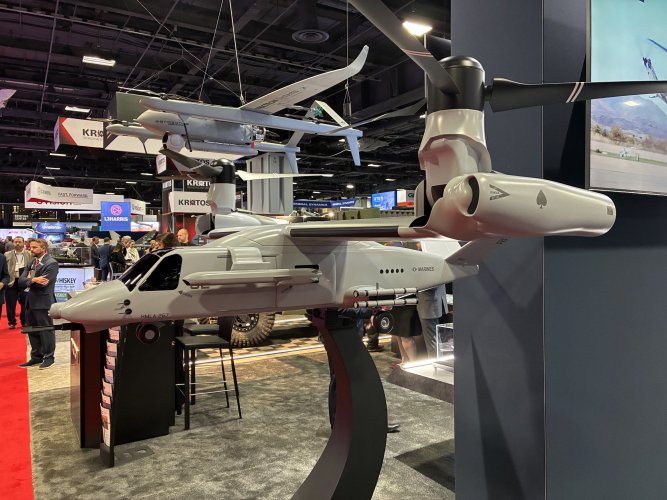
Bell MV-75 Cheyenne II (aka V-280 Valor)

While I agree for deployment a larger aircraft like C-130 would be best, I would recall that the USAF Inc. , took the C-27J from the U.S. Army siting the holy writ of rolls and missions. Using existing aircraft for tactical refueling creates less potential for angst in the Pentagon.
The venerable CASA 212 might work but all of the aircraft used over the years for intel gathering are not designed to hang out at landing speed at a significant gross weight fraction.
This assumes that the U.S. Army would want to do more refueling other than MV-75.
There are other factors internal to the U.S.Army that are as daunting as aircraft. Namely people. Recently half of the Apache fleet was culled, not because commanders didn't want them. The U.S. Army suddenly realized they needed a lot of air defense units. The Air Cavalry Squadrons paid the bill. Building new units requires disbandment of others.
This why I think the most plausible to add a mission to existing aircraft and organizations.
 
https://www.flightglobal.com/archiv...efuelling-capability-for-new-mv-75-tiltrotor/
So... buy existing refuel capable aircraft, by Navy Refuel drones, deveopl a requirement for a refuel drone, develop a requirement for a manned logistics aircrat (to replace CH-47)? Or as above, figure out how to do this mission with existing aircraft?

Personnally I would like to see U.S. Army CMV-22s but that is as likely as a moon base in my lifetime.
 
You do not need vertical landing for an army tanker IMOHO. Short field should suffice. It's all about having a way point at a relevant cross point, not about flying in formation.

Having a simpler system also ensure an availability that matches that of the Cheyenne II mission rate. It might well be the other way around with the MV-22. Let's be realistic.

A prop aircraft would also have the speed and better range under 10kft for long duration flights when Cheyenne are manned with a crew and/or platoon on board. Hard to see a jet aircraft matching the need in persistence and range down there.
 
Last edited:
C-27J ought to have been perfect for the job if the USAF hadn't been a bitch about it.

I guess they'll just have to beg the USAF for C-130 support for such missions. I can't imagine the Army will be able to get a drone large enough to carry enough off-loadable fuel to be worthwhile.
 
@TomcatViP - Don't disagree at the logic of a STOL platform being able to do the job, likely at less cost as well. Biggest challenge for every flying machine is becoming the rapidity with which their "bed down" locations are being located by overhead means. The bigger the required space the higher the probability of detection(?) I would note however to your comments on V-22 availability, that the ongoing nacelle replacement efforts on the USAF MV-22 have been very successful in increasing readiness rates. The USMC just announced that they are adopting the full nacelle replacement being done by the USAF.
@Colonial-Marine - My feelings regarding the USAF Inc., taking the C-27J mission and the money, then killing the program and keeping the money are well known on this forum. Yes it would have solved a lot of logistical problems. The only USAF C-130 outfitted for refueling are with AFSOC and are not available for regular operations. So the U.S. Army won't be relying on the USAF. USMC C-130K are also not available on a regular basis, but if needed for a mission mght be a more likely option.
Third option is to pay a contractor to maintain a few C-130 (like Omega does with KC-135) to support both training and actual depolyment.
 
I bet the USAF being told "You must provide air tankers for Army operations" would result in an unclenching about the C-27J thing.
 
I bet the USAF being told "You must provide air tankers for Army operations" would result in an unclenching about the C-27J thing.
The USAF does not own C-27J any more. USCG and USARSOC received them after Congress got upsat at the USAF Inc., for flying brand new aircraft from the factory to the boneyard. Unfortunately the Aviation Budget for the Army even within the $1.5T proposed budget (I never thought I would type a "T") has no room for new aircraft types this year. Honestly I think the best move would be to contract air refuel. No personnel issues, and it sidesteppes the roles and missions problem as well. Honestly might even be cheaper. Unless they are going to start sticking refuel probes on all of their helicopters I don't see it making fiscal sense to work through the aircraft buy and force structure revisions.
 
The USAF does not own C-27J any more. USCG and USARSOC received them after Congress got upsat at the USAF Inc., for flying brand new aircraft from the factory to the boneyard. Unfortunately the Aviation Budget for the Army even within the $1.5T proposed budget (I never thought I would type a "T") has no room for new aircraft types this year. Honestly I think the best move would be to contract air refuel. No personnel issues, and it sidesteppes the roles and missions problem as well. Honestly might even be cheaper. Unless they are going to start sticking refuel probes on all of their helicopters I don't see it making fiscal sense to work through the aircraft buy and force structure revisions.
I'm assuming that with the Army getting MV-75s, all their tilt-rotors would have refueling probes. Not USAF-style boom receptacles. That means slower refuelers, like KC-130s, C-27Js, KC-390s...

Maybe, if we were lucky, the USAF would get that nice stealthy BWB tanker and it came with a pair of drogues. But I really think that the Army would need to own the tankers, because they're going to be operating relatively close to the front lines.
 
That means slower refuelers, like KC-130s, C-27Js, KC-390s...
Not exactly, the Navy used Probe and Drogue on pretty high speed craft.

The F4 A5 F14 and F18 all come to mind with those being know to do refueling ops with same type up to 500 knots to flex their piloting skills on the Air Force who went to the boom specifically for it being easier on the pilot.

Course big deal with the MV75 is if its top speed is above the Stall speed of the Tankers.

Be the reverse of the infamous F104 refueling from a KB29 or 36 types...
 
Not exactly, the Navy used Probe and Drogue on pretty high speed craft.
Correct. But a tilt-rotor is much slower than those airframes. You need best-range cruise speed to be above the landing speed of the big tankers.

200 knots airspeed is getting into "lower the flaps" speed for the big tankers (KC-135s or -46s).


The F4 A5 F14 and F18 all come to mind with those being know to do refueling ops with same type up to 500 knots to flex their piloting skills on the Air Force who went to the boom specifically for it being easier on the pilot.
No, the USAF boom is used because it allows a lot higher fuel transfer rate. Kinda necessary when you're talking about 50+klbs of fuel getting loaded onto a bomber instead of 10klbs onto a fighter.
 
I doubt that refueling from a KC-135 or -46 will be a frequent (if at all) occurance. I do acknowledge it is a possibility, but those aircraft are in critical supply to support USAF operations. To do long range (> 200 NM) missions at any frequency the U.S. Army is going to have to rely on tankers it controls, manned, unmanned or contracted.
 
The aircraft would need to be more than a tanker as well, as I do not see long range air assaults being done with tremendous frequency.
 
The aircraft would need to be more than a tanker as well, as I do not see long range air assaults being done with tremendous frequency.
Another reason to be pissed at the Air Force for their C-27J freakout. Would have been perfect for this in addition to moving smaller cargo for the Army.

The CV-22 tanker option would work in-theory, but I see no way the Army is going to adopt the Osprey despite being once interested in the aircraft 1000 years ago.

Maybe with enough work you could turn a CH-47 into a tanker but it's significantly slower than the MV-75. You'd have to send them out well in-advance of the actual unit conducting the aerial assault.

As you said a contractor with C-130s or C-27s or a similar type outfitted to offload fuel may really be the best option, since missions using the Special Operations birds at such ranges are going to be quite rare. As long as the contractors know the risks involved.
 
With the range performance of of the US tanker fleet, and the FVL RFP minimum specified cruise speed (250 KTS US Army, 275 KTS USMC), there does not appear the MV-75 needs a VTOL capable tanker for support. For any rare need for a special ops mission, coordination with the USAF, USMC. or USN to use a V-22 with a roll on/off tanker kit is probably the best option.

Probe-and-Drogue Refueling Airspeed Minimums by Tanker Aircraft
Tanker Type Minimum Refueling SpeedPrimary Receiver Compatibility
KC-130J~100 KIASHelicopters, Tiltrotors, Slow Fixed-wing
KC-46A>180 KIAS (est.)Tactical Fighters, Multi-mission aircraft
KC-10~200-250 KIASTactical Fighters, Heavy Probe-equipped
KC-135 MPRS~200-250 KIASTactical Fighters
 
With the range performance of of the US tanker fleet, and the FVL RFP minimum specified cruise speed (250 KTS US Army, 275 KTS USMC), there does not appear the MV-75 needs a VTOL capable tanker for support. For any rare need for a special ops mission, coordination with the USAF, USMC. or USN to use a V-22 with a roll on/off tanker kit is probably the best option.

Probe-and-Drogue Refueling Airspeed Minimums by Tanker Aircraft
Tanker Type Minimum Refueling SpeedPrimary Receiver Compatibility
KC-130J~100 KIASHelicopters, Tiltrotors, Slow Fixed-wing
KC-46A>180 KIAS (est.)Tactical Fighters, Multi-mission aircraft
KC-10~200-250 KIASTactical Fighters, Heavy Probe-equipped
KC-135 MPRS~200-250 KIASTactical Fighters

Don't forget that those speed have to be converted to low alt with a drogue stable enough to allow a safe and rapid refueling . A big butt aircraft would generate larger disturbed air at low speed and lower altitude. One with a narrower fuselage less. I don't think that we will have something overly complicated to solve but, still, the answer is not trivial.

(and think at that big KC-10 at low alt as an appealing target practice for any opponents).
 
Don't forget that those speed have to be converted to low alt with a drogue stable enough to allow a safe and rapid refueling . A big butt aircraft would generate larger disturbed air at low speed and lower altitude. One with a narrower fuselage less. I don't think that we will have something overly complicated to solve but, still, the answer is not trivial.

(and think at that big KC-10 at low alt as an appealing target practice for any opponents).
Agreed that altitude and specifically air density are critical. However if the maximum service ceiling for the MV-75 is equal to or better than the 25,000 ft of the V-22, air density altitude is less an issue than the pilots comfort.

Standard refueling altitudes for the tankers listed typically start at 18,000 feet. This is at the limit of the service ceiling for most conventional helicopters. Put one more mark in the Tiltrotor plus column.
  • MV-22/CV-22: 25,000 feet (8,000-ft helicopter/25,000-ft airplane mode).
  • CH-47F: 20,000 feet.
  • CH-53K: 16,000 feet (at Armed Deployment Gross Weight, ISA).
  • UH-60: 19,000 feet.
As far as 'low altitude target practice', air refueling any type aircraft over contested air space is not advisable at any altitude.
 
Last edited:
No, no. What I mean is that I doubt that troops in the cabin would be on O2 for the long duration of the flight. Hence refueling operations would have to be done at low altitude, under 10kft.
 
No, no. What I mean is that I doubt that troops in the cabin would be on O2 for the long duration of the flight. Hence refueling operations would have to be done at low altitude, under 10kft.
Not that in my earlier response I joked 'air density altitude is less an issue than the pilots comfort'. V-22 crews ferrying aircraft and refueling and flying missions over mountainous regions often fly over 10,000 ft for short periods. Long duration operation at high altitude is not usually required.

Note, I spent much of my childhood growing up in La Paz Bolivia and surrounding areas. Prolonged duration exposure without supplemental O2 (years not hours) at near 14,000 ft is not an issue for a healthy individuals following acclimation. Following returning to the US from Bolivia and taking a physical exam the doctor put his stethoscope on my back and told me to 'Breath normally'. After a minute he said with irritation 'Breath normally, don't hold your breath!'. I told him at this altitude I was breathing normally. Checking my respiration again more carefully he said 'Damn, you have the lowest respiration rate I have ever seen'. I told him he must not know many Bolivians.
 
I suspect that any air refueling done for U.S. Army operations will take place around ~10K or less. You really don't want a bunch of scared teenagers with guns and explosives to get jovial with hypoxia.
 
I suspect that the first time the USAF gets the opord for supplying enough tankers for a Battalion Air Assault they're going to let the Army buy its own tankers.
 
I suspect that the first time the USAF gets the opord for supplying enough tankers for a Battalion Air Assault they're going to let the Army buy its own tankers.
Actually they will tell the Senior Commander that they do not have any refuelers that can do air refueling for the Army as they do not have any fitted with hose and drogue systems and it will take a week to refit some with that system, once the systems get in country, and once they are certified, and once the aircrews have trained on how to use them, and once the aircrews are certified to fly the mission at slow(er) speeds, and once... You get my meaning.

On another note I see that the Australians are getting rid of their C-27J that the USAF Inc. was kind enough to give them due to rising maintenance cost.
 
I doubt C-27 can offload enough fuel at range. Better than nothing some would say but far more expensive to maintain than more suitable solution at an equal set of performances.

look at Wiki, you´ll see that 15k kg at max can be loaded. That include the tanker, the specific equipment and its own fuel to execute the mission...

EDIT:
I have just opened a new thread for the discussion: https://www.secretprojects.co.uk/threads/the-next-us-army-tanker-system-n-u-t-s.51564/
 
Last edited:
Had not realized the available fuel would be on C-27J although I am beginning to think it might be better the U.S.Army did not retain them. That said if they were to be used as Buddy Refuel like the USN does it might be functional. Have to do some math.

If you are going to do air refueling over enemy airspace hiding from radars would seem a practical method.
 
Not advisable, and yet...
All the more reason for the SAR versions of the Cheyenne II. This is why tiltrotors were developed, so refueling would not be required at all for these types of submissions.
 
Actually they will tell the Senior Commander that they do not have any refuelers that can do air refueling for the Army as they do not have any fitted with hose and drogue systems and it will take a week to refit some with that system, once the systems get in country, and once they are certified, and once the aircrews have trained on how to use them, and once the aircrews are certified to fly the mission at slow(er) speeds, and once... You get my meaning.
I really can't see the USAF being willing to risk half their tanker fleet, flying 200knots at ~10kft over enemy territory.


On another note I see that the Australians are getting rid of their C-27J that the USAF Inc. was kind enough to give them due to rising maintenance cost.
And if the Army had been allowed to have them, I bet the maintenance costs would have been less...
 
Another reason to be pissed at the Air Force for their C-27J freakout.

It turns out buying planes based on "so my buddy at Leonardo says" and not checking stuff is bad for airframe lifespans.

But it kept the Army from getting Sherpas and that's way more important.

Would have been perfect for this in addition to moving smaller cargo for the Army.

The U.S. just needs an actual General Staff, like Prussia and the USSR had, and to stop letting branches buy things.

The CV-22 tanker option would work in-theory, but I see no way the Army is going to adopt the Osprey despite being once interested in the aircraft 1000 years ago.

The Air Force will just UOR some buddy tanker kits for the Hercs, the kind on the KC-130s, and drive them at low level like Son Tay.
 
Last edited:
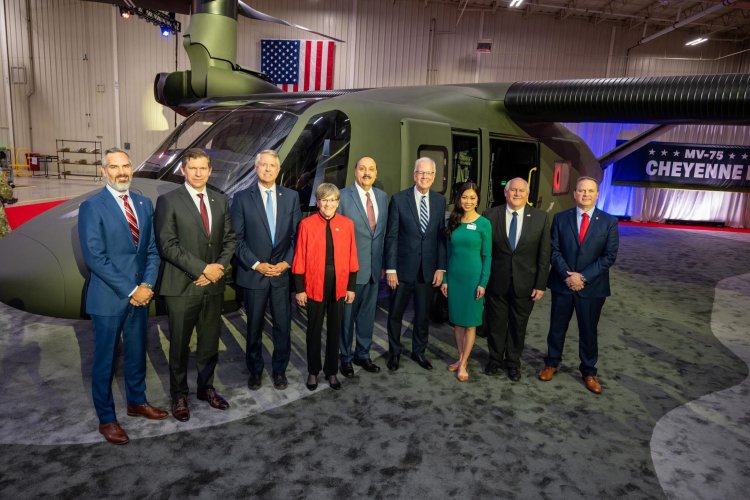
Textron just opened their Wichita Assembly Center to assemble the MV-75 Cheyenne fuselage in Wichita, Kansas.
Bell started making fuselages at the facility in October 2025, following the U.S. Army's push to speed things up.
As Paul Harvey used to say "And now the rest of the story".

Two of the happiest days for Bell engineers working on the Future Vertical Lift (early stage of FLRAA) were in 2012 when Boeing announced they were pulling out of partnership with Bell, and about six months later when Boeing announced they were partnering with Sikorsky for FVL. Thanks to the contract writing skills of Boeing's Philly lawyers, Bell was obligated to team with Boeing on any military Tiltrotor program following the V-22. During the year Boeing and Bell were still teamed to submit a FVL proposal, Boeing's actions were just shy of sabotage to developing of a successful proposal on time. Following these events even Bell leadership finally realized that the minuses of being teamed with Boeing far out weighed any pluses.

Bell teamed with Spirit Aerospace to build the V-280 Valor demonstrator fuselage, and by Spirit investing as a partner for V-280 development, if Bell won FLRAA Spirit would build the production aircraft fuselage. All was proceeding to plan until the spring of 2024 when Boeing announced they were in talks to (re)acquire Spirit. Boeing initially believed that acquiring Spirit would buy them back on FLRAA, but Bell's contract with Spirit stipulated if Spirit ownership changed the agreement was voided. Following the Boeing announcement of the Spirit acquisition talks, Bell's CEO was asked by reporters if Boeing would be building the FLRAA fuselage. Her response was negative, short, and salty.

No doubt that Bell having full control of the the manufacturing of the MV-75 fuselage is worth the additional Textron investment. Additionally, Kansas state and local representatives made keeping MV-75 fuselage production in Kansas very attractive to Bell.
 
Last edited:
Military Industrial Complex intrigue that would make Machiavelli proud.

I have always heard that Bell grew to loathe their "partner."
 
Back
Top Bottom