A useful effort from 7 Apr, 2025, brings some realism into Perun's April 1st effort:

Wolff, G., A. Steinbach and J. Zettelmeyer (2025) ‘The governance and funding of European rearmament’ , Policy Brief 15/2025, Bruegel

It's a 32 minute read (I've gone over it once, will have to return to it) so I'll be lazy and just cite the conclusion in full:

Europe needs to rearm rapidly and acquire its own strategic enablers. We have set out two options for this: an incremental approach, involving expanded roles for the EDA and PESCO and a SURE-plus-type lending instrument; and a new European Defence Mechanism (EDM), based on an intergovernmental treaty.

The second option would be far preferable, for three reasons.

1. It would address the fundamental legal constraint that currently precludes an EU defence-goods single market: Article 346 of the TFEU, which allows EU governments to ignore internal market rules by claiming a national-security interest. The EDM would allow European democracies to opt into a legal structure that requires its members to follow such rules. This is much easier than changing the TFEU.

2. It would loosen a critical fiscal constraint by allowing certain defence assets, including both shared strategic enablers and procured materiel that is not immediately needed by the armed forces of EDM members, to remain in EDM ownership. Debt incurred to acquire those assets would remain on the EDM’s books.

3. It would allow non-EU members to join on an equal footing.

Creating the EDM would be an ambitious undertaking. Although it would provide for far greater fiscal benefits than any of the feasible alternatives, it would require substantial paid-in capital. It would require competent staff, including a first-rate treasury. The set-up costs would be substantial. But set-up need not take long: the EBRD, for example, went from signing to start of operations in less than a year.

Like other multilateral institutions created at historical turning points – the International Monetary Fund and World Bank after the Second World War, the EBRD after the fall of the Berlin Wall and the ESM after the euro debt crisis – the EDM could be the enduring output of a moment of political will that overcomes national division, bureaucratic inertia and special interests. We may be witnessing such a moment in Europe today.

Edit:

Also EDM:

View: https://www.youtube.com/watch?v=OrhM7TlSJc4


Beware, World!
 
The EU really needs a better Constitution than the current agreements. IMO, the current EU is more or less at the level of the grossly ineffective Articles of Confederation the US had before the current Constitution.

Unfortunately, the EU didn't recognize this as fast as the US did. (The US Articles of Confederation lasted about 8 years, the EU has lasted over 60)
 
The EU really needs a better Constitution than the current agreements
That would require changes to the EU treaty, which can only be done if all EU member states consent. There is at least one member state that will oppose any attempt to shift decisions on anything at all away from the member states to EU institutions - like, for instance, the Euro Parliament.
 
The EU really needs a better Constitution than the current agreements. IMO, the current EU is more or less at the level of the grossly ineffective Articles of Confederation the US had before the current Constitution.

Unfortunately, the EU didn't recognize this as fast as the US did. (The US Articles of Confederation lasted about 8 years, the EU has lasted over 60)
You would never get a constitution agreed with the current list of members.
 
That would require changes to the EU treaty, which can only be done if all EU member states consent. There is at least one member state that will oppose any attempt to shift decisions on anything at all away from the member states to EU institutions - like, for instance, the Euro Parliament.
Which is why the US Constitution was set up with a less-than-100%-ratification to adopt via popular vote. And why we had to add the bill of rights to get 100% ratification.
 
NATO and the UN? FUBAR. There is a 'small' light left on at the end of the tunnel, mayhap the light can still be seen?

Having aggressor nations cancel out a council vote by abstention strikes me as reason for change ASAP.
 
The EU really needs a better Constitution than the current agreements. IMO, the current EU is more or less at the level of the grossly ineffective Articles of Confederation the US had before the current Constitution.

Unfortunately, the EU didn't recognize this as fast as the US did. (The US Articles of Confederation lasted about 8 years, the EU has lasted over 60)

The EU functions fine for the most part. If it didn't then it wouldn't have lasted as long as it has.

The actual sole sticking point of the Articles of Confederation, the currency and banking problem, was solved by the Euro and the ECB. The current problem is that it has no need to fill a role which is already filled by the United States: the defense of Europe. When the United States becomes an adversary to the EU, the EU will match the threat. Since Russia was bled dry in Ukraine, and the United States and PRC will likely be bled mutually in the Pacific, this should be fairly trivial and not require some massive arms buildup. But if it came down to that, then between France, Spain and Italy, this could be done for the purposes of deterring saber rattling from EUCOM's naval components at least.

Europe has larger defense industries than anyone else in the world, in aggregate, and will generally be able to outproduce any one of the other three superpowers (USA, Russia, PRC) if it needs to. The question is when and how does it need to do this, when the United States will just yell a lot, while also throwing free weapons at it. That makes for a very tough tightrope to walk for increasing armaments production, but as it stands, Rheinmetall alone will be outproducing the United States in 155mm shells by 2027.
 

An interesting, comprehensive and ambitious paper about how European defense can most responsibly evolve to shape the World and defend democracy. The timeline is tight and entails a vision of an impressive degree of strategic autonomy, also within the context of NATO. As seems to be the theme these days with subject matter experts, much more focus will have to be put on where and how to invest than how much, i.e. while drastic increases in defense resources are an urgent necessity, percentages matter less (as much as politicians like to take an accountants' view on the matter) than actual capabilities and what constitutes a credible deterrence (and even coercive capability) towards adversaries.

Benjamin Tallis said:
DSI Startegic Diagnosis and Discussion Paper - 17 March 2025
Emerging Defence: Offset and Competitive Strategies for Europe
Benjamin Tallis

At this crucial juncture, Europe needs better strategy - based on emerging defence technologies - to make its ‘Big Bang’ in defence spending work, ready itself to defeat Russia in the short-term, and position itself to compete geopolitically in the long-term.

Summary

Europe must ready itself to be able to defeat (not just defend against) a Russian attack within three-to-five years if not sooner and, as a key bastion of democracy, position itself to compete geopolitically against authoritarians in the long-term. Yet, if Europeans use their ‘Big Bang’ in defence funding to simply pump more money into fulfilling current force plans based on legacy platforms (tanks, infantry fighting vehicles, etc) they will likely fail – as they will be running Russia’s race on platform production and risk being dragged into Russia’s type of fight.

Going beyond the shortcomings of current proposals, the report presents a deeper diagnosis of the critical factors that any European strategy must address – including the problems of Europe’s defence industrial base (DIB) and disruptive shifts in technology and the conduct of warfare. These shifts create serious risks of rapid obsolescence for legacy platforms but also create an opportunity for Europe to turn its military disadvantage into an advantage by embracing change.

This report proposes that Europeans should adopt a short-term ‘o,set’ strategy and a longer-term ‘competitive strategies’ approach, focused on exploiting and massively scaling emerging defence technologies. The oLset harnesses the commodification of precision networked warfare to rapidly boost combat power and multiply the eLectiveness of existing forces so our democracies can survive Russian attack and coercion. The competitive strategies approach positions Europe to master the coming revolution in military aLairs and thrive, geopolitically in the long term - and requires a ‘net assessment’ capability to inform it.

Key Takeaways

  • Europe is at a crucial moment for its defence. It can choose to embrace the future and secure itself, fast, or stick to old ways and face being timed out of its race to deter the severe and urgent threat from Russia.
  • Europe’s ‘Coalition of the Willing’ must be clear about the immediate challenge they must meet – to be clearly able to defeat Russia and thus deter it from conventional attack, while deterring it from using nuclear weapons, and developing a ‘European Way of War’, based on defending forward and threatening Russia's rear areas to do so. At the same time, they need to prepare Europe to compete geopolitically in the long-term.
  • Europe can play to its strengths in research and industrial capacity by rapidly developing, testing, refining and fielding emerging defence technologies, including mass produced precision strike capabilities, and massively scaling other emerging defence technologies, including for ISR and enabler functions, low-cost air-defence and upgrading legacy equipment through integration into advanced AI-powered battle networks.
  • Europe should institute a ‘New Force and Capability Plan’ supplied by an ‘Accelerated Military Technology and Industrial Capacity Plan’ to quicken development of promising technologies, create partnerships between SMEs and large advanced industrial manufacturers to broaden and diversify its DIB, and incentivise and facilitate private capital flows to emerging technology firms, which can also boost economic growth.
  • In addition to emerging technologies, Europe’s short-to-medium term high-end capability investment in should not be used for old platforms but, rather, ruthlessly focus on: nuclear and non-nuclear strategic and pre-strategic precision strike capabilities; massed precision guided munitions and uncrewed solutions to maximise the power of its air forces, including for suppression of enemy air defence (SEAD) and suppression of enemy air attack (SEAA); and on essential (battlefield, critical, population) air defence for Europe.
  • Ukraine must be integral to European strategy. What happens with Russia’s war in Ukraine will determine the timescale and severity of the threat the rest of Europe faces – and is integral to our future security. The European coalition should treat Ukraine as part of its Eastern flank after any ceasefire ‘deal’ and all opportunities for testing and co-producing emerging defence technologies should be seized.

Full report: https://www.democratic-strategy.net/_files/ugd/dcfff6_f2eff6cd16794caa85e52caa7a028116.pdf
 
I appreciate that NATO is more than just Europe but I feel that the following article is probably best aligned with this thread:

 
An outright idiotic premise , that defense would become Europe's growth machine. Defense industry is marginal in size and technologicaly backward producing shit that was technologicaly cutting edge maybe 40years ago . you know whole drone industry has sprung up as a side product to automotive industry developments, the automotive industry even now in crisis, is light-years ahead of anything the defence industry can muster. Your family sedan runs more source code than F35

Defense has minimal to no economic multiplicator factors ,as unlike other industries where products often produce their own outputs ,defense produces stuff that is stored for 40years then scraped without producing anything but cost along the way.military spending also has one of the lowest ‘employment multipliers’ of all economic categories.

The way they are presenting it as a chance for big industry to move into defense ,means that in 10 years EU will not be able to build a car ,fast train etc as those competencies wither away when train manufacturing plants make tanks and auto manufacturers make apc's

Even base numbers do not make any sense ,EU commission is talking 150billion in 5Years ,and hopes members with match that with 5x as much own investment , Vaporware 800billion over 5 years is not much , US spends near 1 trillion per year.And here we are talking what maybe 150bilion extra per year , not to mention near all EU members have budget deficits and many extremely high debt levels.

Just for comparison German auto industry they want to wreck to make Rheinmetalls business boom , generates revenues of about 650billion per year ,without spending taxpayers money , EU wide auto-industry is at 1.4trillion , and here someone seriously mentaly retarded or at least dishonest is suggesting additional 150billion a year invested in most unproductive sector would drive growth of European economy of cca 20trillion $ o_O

But that is exactly the level of thinking Eurocrats are capable off.
 
Last edited:

Murray Brewster said:
Prime Minister Mark Carney signalled he hopes Canada will be able to sign on to a major European defence rearmament plan by July 1, a step toward reducing the country's dependency on the United States for weapons and munitions.

...

"Seventy-five cents of every dollar of capital spending for defence goes to the United States. That's not smart," Carney told host David Cochrane.

Canada has been engaged in talks with the European Union since Carney took office — before the spring federal election — about joining the plan which foresees the nations on the continent spending $1.25 trillion on defence over the next five years.
 
Topic starter:
Via Financial Times
Trump wants 5% Nato defence spending target, Europe told
<snip>
Donald Trump’s team has told European officials that the incoming US president will demand Nato member states increase defence spending to 5 per cent of GDP
Thoughts?

President Donald Trump said Friday that the U.S. shouldn’t have to abide by the same defense spending standards as the rest of NATO
[...]

Thoughts?
'Don't do as I do, do as I say'
 
  • Summary
  • Japan cancels annual '2+2' meeting after US defense spending demand, FT says
  • US official tells Reuters meeting postponed
  • Japan's decision comes before upper house elections, NATO meeting
WASHINGTON, June 20 (Reuters) - Japan has canceled an annual high-level meeting with key ally the United States after the Trump administration demanded it spend more on defense, the Financial Times reported on Friday.
Secretary of State Marco Rubio and Secretary of Defense Pete Hegseth had been expected to meet Foreign Minister Takeshi Iwaya and Defense Minister Gen Nakatani in Washington on July 1 for the yearly 2+2 security talks.
[...]
The FT said the higher spending demand was made in recent weeks by Elbridge Colby, the third-most senior Pentagon official, who has also recently upset another key U.S. ally in the Indo-Pacific by launching a review of a project to provide Australia with nuclear-powered submarines.
In April, the Japan declared its intention to join a NATO command.
 
Last edited:
Japan is caught between Article 9 and their rapidly deteriorating security situation, times Trumps intense dislike of the appearance of countries relying on the US for large portions of their national defense.

For the longest time, Japan limited their defense spending to 1% of GDP, plus the very strong US-Japan security treaty. They have since increased defense spending above 1%, IIRC they're around 1.5-2% now, but as I've argued elsewhere a nation that is standing alone in terms of everything that needs to be done needs to spend about 5%.


In April, the Japan declared its intention to join a NATO command.
Damn, that's news!

Definitely fits in with the "Japan rejects the use of force in international relations" part of Article 9, however.
 
Imagine the worst-case scenario: all NATO countries devote billions of poor taxpayers to organizing a formidable defensive force while no one cares about defending the southern front, the Russian president finally dies, the situation is clarified, and we are left in debt for two generations that will live worse than us.
 
And your point being???
The president of my country lacks credibility and is completely controlled by several supranational organizations, none of his actions can be seriously considered. I regret that the only possible answer to your question is political... basically a fight between clowns. (I mean politicians, not us.):)
 
The president of my country lacks credibility and is completely controlled by several supranational organizations, none of his actions can be seriously considered. I regret that the only possible answer to your question is political... basically a fight between clowns. (I mean politicians, not us.):)
Any evidence to back this up?

My reading is that what the Spanish are saying in that video is actually quite realistic. In fact, they are just saying what probably everyone else believes but are just not wanting to say out loud.
 
Any evidence to back this up?

My reading is that what the Spanish are saying in that video is actually quite realistic. In fact, they are just saying what probably everyone else believes but are just not wanting to say out loud.
The problem is that we have enough money to reach 5 per cent, but it is being used by the ministry of ecological transition and that is immovable for this administration by mandate from Brussels. If this administration manages to survive until the end of the summer, the most likely solution will be another tax increase and the request for a loan from an international organization. These plans were already made before the American elections, and the new situation has taken by surprise more than one European country committed to environmental policies. I regret the bad international image given by the current government, Spain has always been a reliable ally until the terrorist attacks of March 11, 2004, changed the ideological orientation of the dominant political class.
 
The problem is that we have enough money to reach 5 per cent, but it is being used by the ministry of ecological transition and that is immovable for this administration by mandate from Brussels. If this administration manages to survive until the end of the summer, the most likely solution will be another tax increase and the request for a loan from an international organization. These plans were already made before the American elections, and the new situation has taken by surprise more than one European country committed to environmental policies. I regret the bad international image given by the current government, Spain has always been a reliable ally until the terrorist attacks of March 11, 2004, changed the ideological orientation of the dominant political class.
In your apparent dislike of the current Spanish govt, you have missed the point. If you go watch the video, the point was that those signing up to the 5% target know that it is unachievable and moreover, will likely result in money being unable to be spent practically or in fact, simply wasted. I suspect that most know this but only the Spanish had the balls to say so.
 
In your apparent dislike of the current Spanish govt, you have missed the point. If you go watch the video, the point was that those signing up to the 5% target know that it is unachievable and moreover, will likely result in money being unable to be spent practically or in fact, simply wasted. I suspect that most know this but only the Spanish had the balls to say so.
Why do you think 1.5% is meant to be spent on things "related to defence", I mean you are right, even ignoring the economic challenges of shifting that much money into defence, given the timeframe suggested for the 3.5% there's literally no capacity within the defence industry to actually absorb that much, nor capacity within the militaries to use that funding.
 
Why do you think 1.5% is meant to be spent on things "related to defence", I mean you are right, even ignoring the economic challenges of shifting that much money into defence, given the timeframe suggested for the 3.5% there's literally no capacity within the defence industry to actually absorb that much, nor capacity within the militaries to use that funding.
How often does the Spanish military do live-fire training? How often do they do disaster-response training (search and rescue, setting up field hospitals and field kitchens, etc)?

It's possible to eat immense quantities of funds via training.
 

Pentagon spending plan shows historic $1.5T spike -- then an outyear drop-off​


Golden Dome, out-years and lots of missiles: Details of Trump’s $1.5T defense budget request​


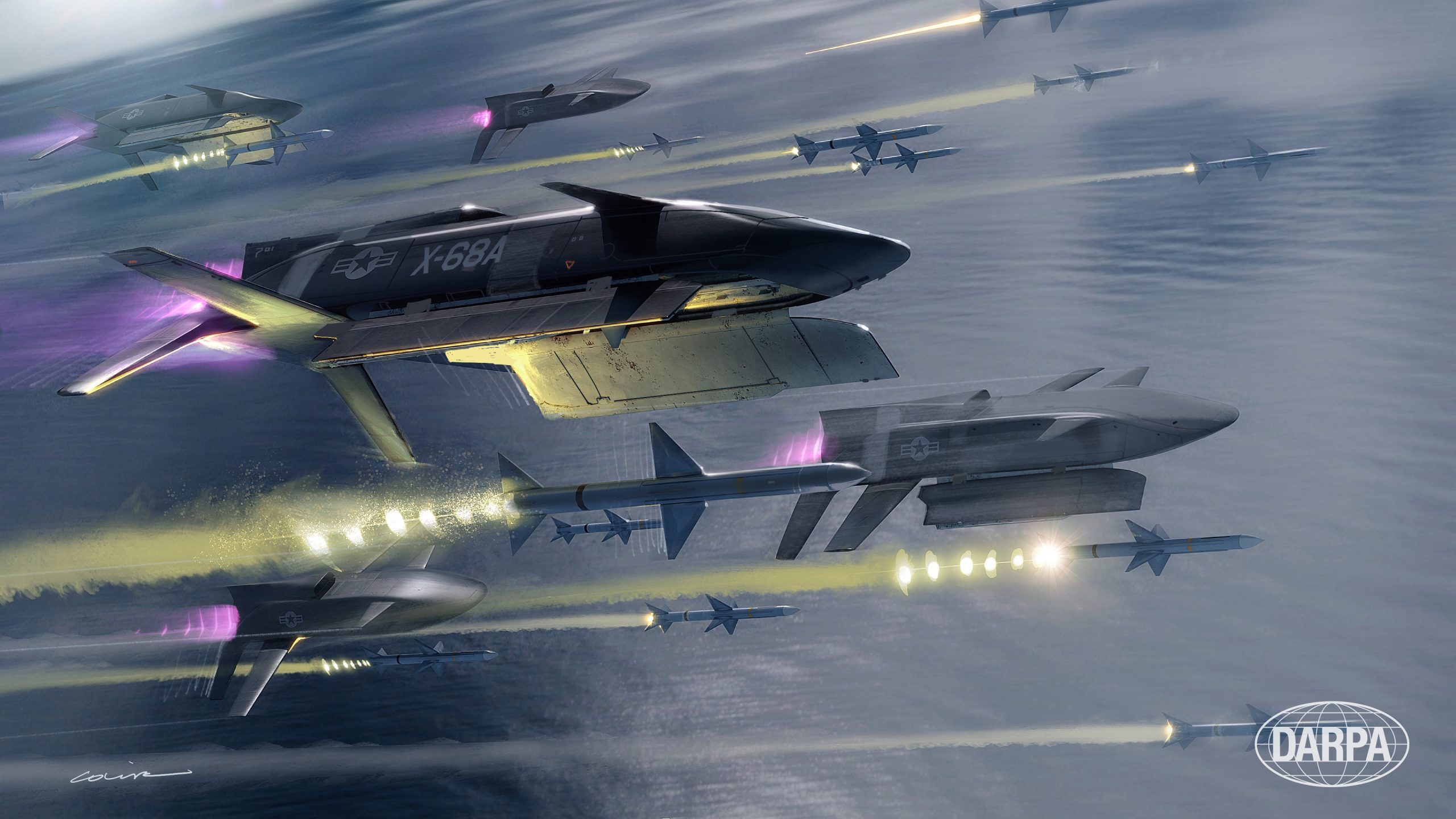
Pentagon Plans Major Boost in Spending and Research on Mass-Producing Munitions​

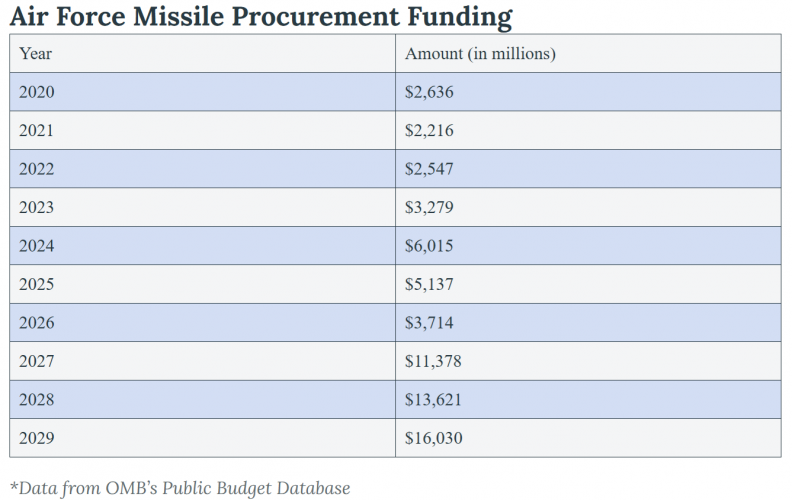
Beyond just doubling in one year, Air Force munitions spending is poised to grow nearly eightfold in the 2020s, according to OMB’s projections.
6-fold really but okay.
1775308566895.png
 
Last edited:
Trump slashes Iran war funding request as ceasefire begins


Regards,
Odd that some call for his removal because of a cease fire?

That's bass-ackwards

As for "conventional" arms:

Conventional weapons are generally presented as controllable, proportionate and morally acceptable, unlike weapons of mass destruction. It is this assumption that is challenged by research conducted by Julien Pomarède at the Centre for the Study of War and Violence at the University of Liège, based on American and French military archives. The findings demonstrate that the massive levels of devastation observed throughout the 20th century, and still today, did not occur in spite of the rationality that defines the use of these weapons, but because of it. The study, published in the European Journal of International Relations, begins with an observation that existing literature had not fully theorized. The usual explanations for mass violence in 20th-century wars invoke ideologies, industrial capabilities or technological innovation. In doing so, they perpetuate a form of fatalism: atrocities are deemed inevitable once war becomes industrialized. In this research, Julien Pomarède, a lecturer in international politics and founding director of the Centre for the Study of War and Violence, sought to offer a different perspective by shifting the question from "why" to "how.".. how did armies transform mass devastation into a manageable and morally acceptable activity?
 
As for "conventional" arms:

Conventional weapons are generally presented as controllable, proportionate and morally acceptable, unlike weapons of mass destruction. It is this assumption that is challenged by research conducted by Julien Pomarède at the Centre for the Study of War and Violence at the University of Liège, based on American and French military archives. The findings demonstrate that the massive levels of devastation observed throughout the 20th century, and still today, did not occur in spite of the rationality that defines the use of these weapons, but because of it. The study, published in the European Journal of International Relations, begins with an observation that existing literature had not fully theorized. The usual explanations for mass violence in 20th-century wars invoke ideologies, industrial capabilities or technological innovation. In doing so, they perpetuate a form of fatalism: atrocities are deemed inevitable once war becomes industrialized. In this research, Julien Pomarède, a lecturer in international politics and founding director of the Centre for the Study of War and Violence, sought to offer a different perspective by shifting the question from "why" to "how.".. how did armies transform mass devastation into a manageable and morally acceptable activity?
Oh, sweet, I can download it for free!

Ahem.

Quick skim here. Study author has not served, nor apparently taken any international relations courses. The job of the military is to make the other side do what the politicians want usually using the least force necessary (strategic deterrent forces aside). What's that quote, "war is the continuance of diplomacy through non-diplomatic means"? That said, the actual "least force necessary" (assassinating specific personnel whether violently or informationally discrediting them) is not currently acceptable, often considered a war crime.
 
WWII, at least to me, was one of the last wars humanity needed to fight...A lot of recent foolishness....questionable.
 
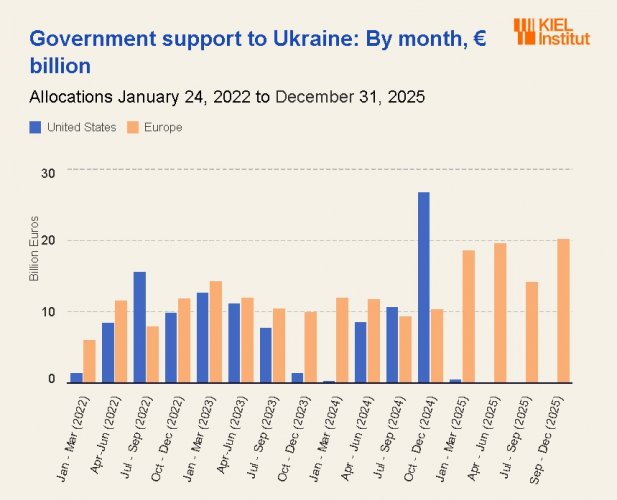
Apparently, for reasons that elude me, the Ukraine Support Tracker by the Kiel Institut hasn't come up here (at least I couldn't find a mention). Very detailed information about military, financial and humanitarian support of Ukraine.


Kiel Institut said:
The Ukraine Support Tracker lists and quantifies military, financial and humanitarian support by governments to Ukraine since February 2022. It covers 41 countries, specifically the EU member states, other members of the G7, as well as Australia, South Korea, Turkiye, Norway, New Zealand, Switzerland, China, Taiwan, India, and Iceland. The database is intended to support a facts-based discussion about support to Ukraine.

Among many other things, there's a chart showing U.S. aid dropping to basically zero for all of 2025.

Kiel_chart.jpg

Going into the future I'd like similar research to also consider the value of Ukraine's efforts for NATO members and also the financial merits of the technological co-operation between Ukraine and NATO. This has never been a one sided relationship and it is reflected more and more in technology, know how and implementation transfers. Notably Ukrainian defense forces continue to freely offer and share their expertise with their U.S. colleagues as highlighted by this very recent CSIS release.

View: https://youtu.be/YPwREUqN70g
 
I wonder if this could have been avoided in the 1990s.

Them giving up nukes...Europe not being more welcoming to Russia.

Tony Blair is a villain to me. The attack on Serbs... however awful the situation..helped Putin at length.

I am hoping people the world over are more tired of war.

Pilots who love old planes are seeing drones take their place. While submariners keep the peace, there is an itch to use carriers.

I see an opportunity for peace talks that I haven't seen in awhile. I had hoped it would have been at the close of the 20th century.
 
I wonder if this could have been avoided in the 1990s.

Yes, "easily" as in we can see why it happened and how it could be prevented. We even knew at the time.

Them giving up nukes...Europe not being more welcoming to Russia.

There's a book that talks about how the period of 1990-1999 basically set the stage for modern European politics in the 2020s. If you go really far back, you can argue that 1993-1994 was the inflection point where Western-Russian relations became irreparably soured.

Bush really screwed it all up. Clinton cemented that screwup, by not siding with the Department of Defense in the 1994 midterms, and choosing to antagonize Russia. This wasn't really his fault: the midterms demanded that he do that to appease Bush's GOP. He was actually in favor of Russian cooperation in 1992 but unfortunately history had other plans.
 
Bush Jr pulling out of ABM and starting the Iraq war was the final nail in the coffin.
 

Similar threads

Back
Top Bottom