New book: A detailed analysis and comparison of the Spitfire Mk I’s and Bf 109 E’s flight performance utilizing computer simulations.

Hi Anders,

The DB 601 and the Spitfire probably have the makings of a happy marriage, but the Merlin in the Bf 109? I can think of few aircraft uglier than the Buchon TBH!

I would put the blame entirely on the radiator integration, I am sure it could have been done a lot more elegantly (and probably more efficiently, too)! :-D

Regards,

Henning
 
For a given wing profile then sure, the drag will be lower if you make it thinner. However, the profile as such is even more important.
I had the impression that there was a typo there.
Should it not have been: the latter is thinner, or the former is thicker ?
 
Hi Anders,


I would put the blame entirely on the radiator integration, I am sure it could have been done a lot more elegantly (and probably more efficiently, too)! :-D

Regards,

Henning

Absolutely: the Buchon would probably have looked better if they had retained the wing radiators, but still, those “sausages” over the exhaust stacks would still be there though, to accommodate the Merlin’s wider girth. ;)
 
I had the impression that there was a typo there.
Should it not have been: the latter is thinner, or the former is thicker ?

Yes, you are right, I should have written former instead of latter since it’s the Bf 109’s profile that is thicker, not the Spitfire’s. I misinterpreted your response to mean that you were not on board with a slightly thicker profile having lower drag.
 
Hi Anders,

Without exaggeration, there are probably hundreds of books that already diligently detail the history of the Spitfire Mk I and the Bf 109 E during the Battle of Britain time period. So isn’t this just adding another one to the pile?

Well no, because this book is rather different: And while other books may faithfully cover the origins, the development, the different versions, the operational usage and the pilots who flew them, when it comes to these aircraft’s performance the results are usually rather meagre.

Here's a short booklet from 1973 - not sure if you're aware of this! :)


From what the uploader Krieghund posted in that thread, the author, who had planned an entire series of similar booklets, seems to have been discouraged by bad reviews ("not enough pictures"), which I consider really regrettable.

For 1973, I think it's not bad at all, and it features some excess power diagrams ... Energy Manoevrability was very much en vogue back then, I guess!

Regards,

Henning (HoHun)
 
Absolutely: the Buchon would probably have looked better if they had retained the wing radiators, but still, those “sausages” over the exhaust stacks would still be there though, to accommodate the Merlin’s wider girth. ;)
The wing radiators on the Buchon: picture
 
Hi Anders,


Here's a short booklet from 1973 - not sure if you're aware of this! :)


From what the uploader Krieghund posted in that thread, the author, who had planned an entire series of similar booklets, seems to have been discouraged by bad reviews ("not enough pictures"), which I consider really regrettable.

For 1973, I think it's not bad at all, and it features some excess power diagrams ... Energy Manoevrability was very much en vogue back then, I guess!

Regards,

Henning (HoHun)

Hi Henning,

Yes, while I've only browsed it for now, it seems to be an interesting document, and certainly a big step forward compared to many books of the time that just used to include things like max speed, max climb rate, ceiling and some range number when it came to performance.

But if you compare the numbers in it to my book, it seems they are a bit more optimistic both when it comes to climb and acceleration for the Bf 109 than I am. Also, that the Spitfire seems a bit fast at over 360 mph.

In addition, the turn analysis seems to be limited to the immediately available max instantaneous g-load, and not looking into what actually happens with your speed if you try to extract all those g's.

Looking at all the Ps versus speed charts in it for different g's, I would guess the authors adapted some jet aircraft analysis program to also do the Spitfire and Bf 109, since as you say, Ps versus Mach charts were very much the thing back then.

Reminds me very much of Boyd's F-4 versus Mig-21 chart I posted on my homepage here. ;)

Cheers

Anders
 
I’m currently working on a video comparing the Spitfire Mk I and Bf 109 E-4 when it comes to turn performance, and which I will post on YouTube when it’s finished.

By necessity, it will of course only cover parts of what you will find in my book. And you can read more about the subject there.

But in the meantime, here are a few slides from the video to give you an idea about what it will cover.

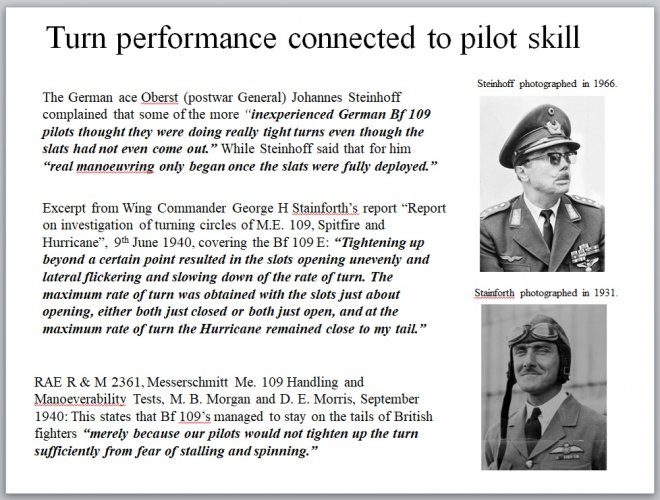
Spitfire Mk I and Bf 109 E4 video pilot skill slide.jpg

Note that the British are missing something here: They thought they were extracting the Bf 109 E's best turn potential just at the point when the slats were opening in these trials.

So in summary, these trials are pretty much useless for comparing the Spitfire's and Bf 109's turn performance. And yet you will se these trials referenced in much litterature.

Now compare that to what Steinhoff is saying: Real manoevering only begins when the slats have come out fully, and which is also assumed as the limiting factor in the two slides below.

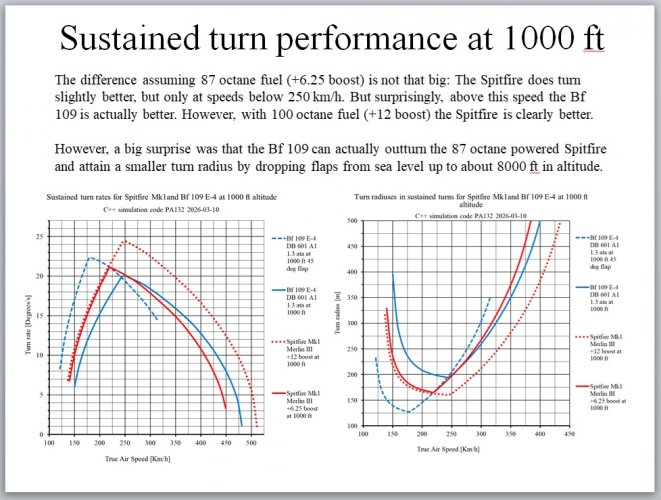
An interesting thing to note here, is that the Bf 109 E can actually out-turn the Spitfire Mk I at lower altitudes by dropping flaps, which I found somewhat unexpected.

Spitfire Mk I and Bf 109 E4 turn at 1000 ft.jpg

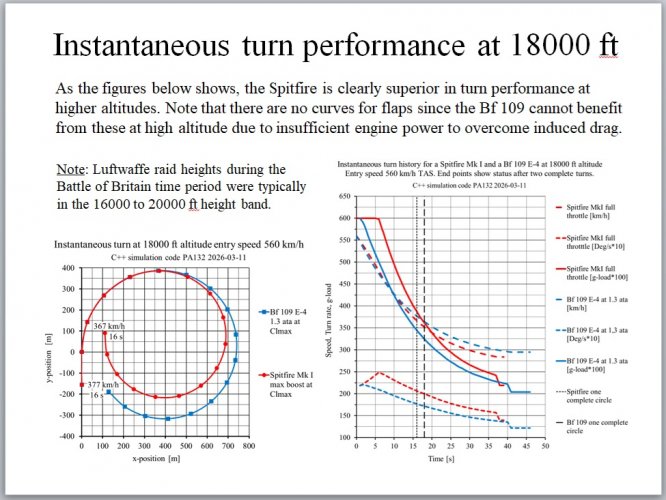
Spitfire Mk I and Bf 109 E4 turn at 18000 ft video slide.jpg
 
Hi Anders,

Note that the British are missing something here: They thought they were extracting the Bf 109 E's best turn potential just at the point when the slats were opening in these trials.

So in summary, these trials are pretty much useless for comparing the Spitfire's and Bf 109's turn performance. And yet you will se these trials referenced in much litterature.

Now compare that to what Steinhoff is saying: Real manoevering only begins when the slats have come out fully, and which is also assumed as the limiting factor in the two slides below.

The British assessment you're quoting also seems to be in contradiction to other British assessments in which they note that the slats automatically deploy at a certain Cl value, and that the Clmax is significantly greater than that.

Just for the sake of giving the British the benefit of doubt, wouldn't it be possible that the best turning performance is in fact achieved at a lower Cl than Clmax, and thus potentially in the Cl range in which the slats deploy?

The Stainforth quote you found is highly interesting though, as since if the British thought they had to fly in that slat deployment Cl range, this would explain why they thought that the slats were detrimental to the Me 109's qualities as an aiming platform. I always wondered why this was seen as a big deal, since once you're in the normal turning Cl range, as required for a tracking shot, the slats would be solidly out anyway, and make no difference for aiming at all.

The quote also seems to poorly match the French trials of, I believe, the very same airframe, in which the French found that the Me 109 turned just as well as the D.520 it was tested against, but unlike the Dewoitine, the Messerschmitt was actually easy to keep in a maximum rate turn without flicking out. Without re-reading the French report, I believe they didn't find the slats to have any negative impact on handling at all.

(Also, it's worth noting that Messerschmitt originally designed the slats to only unlock in the landing configuration, and they were only changed to be freely-operating after extensive flight testing found this configuration to have superior handling throughout the entire envelope, as reported by Radinger/Otto/Schick in their Me 109 books.)

Excellent post, thanks for sharing! I'm looking forward to the full video! :)

As a linguistic aside, Stainforth sounds a lot like the anglicized version of Steinfurt, the name of a town in Germany's North West, which in turn is a common surname in that area. Quite ironic that we have a Stainforth and a Steinhoff expressing quite diverging thoughts here! :-D

Regards,

Henning (HoHun)
 
Hi Henning,

To answer your question about the British evaluation of the Bf 109 E when it comes to turns: No, I don’t think they ever came close to extracting what it could do since they did not do the turns with the slats out and you have to do that to do maximum rate turns.

However, at higher altitudes, you may not have enough power to have the slats out in sustained turns like is possible at lower altitudes, but in the initial instantaneous parts the slats should always be out or you are not doing a maximum rate turn, irrespective of altitude.

In addition, It’s a common misconception that slats creates a lot of drag, which while certainly true if you look at the wing profile drag in isolation, still gets swamped out by the induced drag and is as I write in my book maybe 2-5% of the total no more.

Interesting info about the French Bf 109 E trials: Seems like they then pushed it more than the British did. In addition, their observation that the Bf 109 had very benign handling close to the stall is a very good point: Especially when you compare that to what R & M 2361 had to say about how some British pilots felt about the Spitfire and Hurricane.

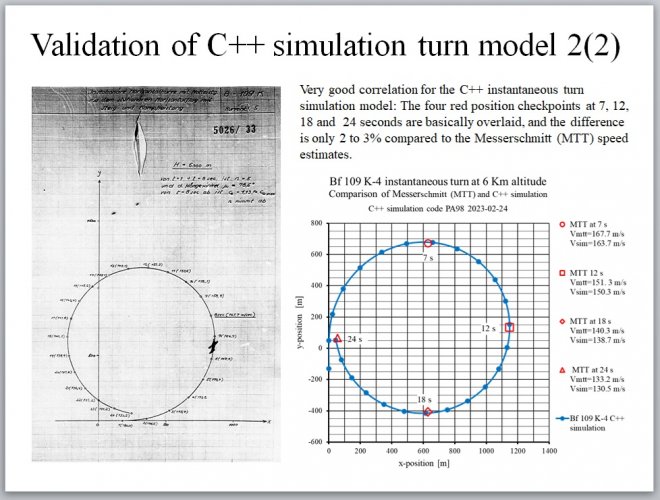
Returning to the question if the slats need to be out on the Bf 109 to do tight turns: Even Messerschmitt’s own calculation on the Bf 109 K-4 at 6 km altitude (left hand picture below) assumes that the slats deploy from about 8 s into the turn.

I also post this slide from the video here since people sometimes ask questions about how I have verified and validated the simulation model I use, and while I have a whole chapter about that in my book, this slide gives an idea about the accuracy of the instantaneous turn modeling.

Finally, Interesting that Stainforth’s name maybe having German connections. A bit like in the US immigrants like Johansson, Jonsson and Jönsson have all become Johnson. ;)

Cheers

Anders

Validation of instantaneous turn performance slide.jpg
 
To a large extent it is only a surface area exercise, in that I did not as you say look into fitting in the guns or the landing gear etc. However, I thought it an interesting exercise even so, since the drag contribution on an aircraft (especially one as clean as the Spitfire) is to a large extent driven by its wetted surface area which of course goes down proportionally if one decreases the wing size, thus allowing higher speeds to be attained.

In addition, a smaller wing leads to a positive weight spiral not only from the smaller wing itself, but also from lower loads leading to less material needed to carry the forces. So climb rate is also improved somewhat up to quite high altitudes, even beyond typical Battle of Britain raid heights (See figure on page 343 in book).

Now the wing profile is of course also important, and many attribute the low drag of the Spitfire as being due to its thin wing. However, the drag of the Bf 109’s NACA 2R1 wing profile is actually lower at high speed than the Spitfire’s NACA 22-series profile even though the latter is thicker, so there is more to it than that. So to make more space for guns and gear in a smaller wing, a slightly thicker wing profile like the NACA 2R1 could be used.

But for sure, trying to get the wing size down by means of a different slightly thicker profile and maybe even some small blisters here and there would require a lot of work. However, even so, if one premiers climb and speed, then a smaller sized Spitfire wing would have yielded higher performance I think.

Interestingly, AFAIK the Supermarine entry was actually in danger of being struck from the list for not complying too the landing speed requirement even with the original wing. However, the powers that be were duly impressed by the Spitfire’s performance, and it was allowed to stay in the race even so with known results.

As far as I can gather from his other design work, my impression is that Reginald Mitchell was not one to shy away from high wing loadings, and as I write in my book, if he had been given the same chance as Willy Messserschmitt got with the Bf 109, I would not be surprised if the Spitfire would not have been designed with a wing loading similar to the Bf 109's.

And if Mitchell would have been allowed to go for a higher wing loading on the Spitfire, then it would have been a much better performing aircraft than the Bf 109, which frankly relies a lot on its small wing for its performance. As it was, it’s impressive that it managed to match the Bf 109 even so, given that it was lugging around a wing that was all of 37% larger.

It might be pointless, to have a long range fighter which requieres to loiter around at low speed for maximum range, but increasing the range can primarily be archieved by improving the L/D ratio and fuel capacity. Both can be done by increasing the wing size not by cutting them back. Of course, this only works at low speeds or high altitudes, otherwise the best angle of attac cannot be met. Larger wings means also larger fuel capacity.

The modest Scheibe Falke SF25C archieved a glide ratio of 1:25 - 1:28 (the L/D ratio without the propeller drag must have been even higher) with its oversized wings.
 
Last edited:
It might be pointless, to have a long range fighter which requieres to loiter around at low seed for maximum range, but increasing the range can primarily be archieved by improving the L/D ratio and fuel capacity. Both can be archieved by increasing the wing size not by cutting them back. Of course, this only works at low speeds or high altitudes, otherwise the best angle of attac cannot be met. Larger wing means also larger fuel capacity.

The modest Scheibe Falke SF25C archieved a glide ratio of 1:25 (the L/D ratio without the propeller drag must hav3 been even higher) with its oversized wings.

Yes, of course increasing wing size and larger tanks extends the range. But the Spitfire Mk I and Bf 109 E had roughly the same fuel capacity and fuel consumption as a result of what range requirements they had at the time, which were modest, since they were both conceived to be stationed close to where the bombers passed, and then climb up and attack.

And so the comparison I did in my book of a modified Spitfire Mk I with less wing area and the Bf 109 E, was done in order to see if it with fixed requirements would be possible to improve the two points that were the primary design goals at the time for both the British and the Germans, namely speed and climb.

And it did: And a Spitfire Mk I with a wing size reduced to about the same size as on the Bf 109 E, but in all other respects being virtually identical, would have been a much faster, and better climbing aircraft (up to and a bit above Battle of Britain raid heights) than either the vanilla Spitfire Mk I and Bf 109 E.
 
I understand, I was just refering to the idea that cutting the wings would increase the range. With the same fuels load and at max speed, this could even be true, but not when flying in conditions optimized for max range.

The Zero was shurly one or even the WW2 fighter with the longest range and it had a very low wing loading.
 
Last edited:
The Zero was shurly one or even thethe WW2 fighter with the longest range and it had a very low wing loading.

Yes, the Zero had very good range build into it from the very beginning: It was one of the main requirements in the IJN's requirement specification for a new fighter which ultimately led to the Zero.

But the Japanese ace Saburo Sakai managed to extend the Zero's range even further by experimenting with different boost and rpm combinations, and "re-invented" the "low revs high boost" concept in the IJN.

I write about that in my book in the chapter Range and endurance, and also that you can actually get better range if you fly at the best L/D (just as you pointed out in your earlier post) rather than as Sakai did, at a speed closer to stall.

I have a calculated example in my book which shows that while Sakai's method gave the longest endurance, if he had just sped up a little bit and cruised at best L/D, he would have gotten even longer range out of the Zero (pages 286-287).
 
Hi Anders,

However, at higher altitudes, you may not have enough power to have the slats out in sustained turns like is possible at lower altitudes, but in the initial instantaneous parts the slats should always be out or you are not doing a maximum rate turn, irrespective of altitude.

Good point - so there is a part of the envelope in which the British observations at least partially apply! :)

Returning to the question if the slats need to be out on the Bf 109 to do tight turns: Even Messerschmitt’s own calculation on the Bf 109 K-4 at 6 km altitude (left hand picture below) assumes that the slats deploy from about 8 s into the turn.

Very interesting comparison! Do I read the chart correctly in that it says "von t = 8 sec ab ist ca = 1,13 ≈ camax"? I'd have thought the Me 109 would generate a higher clmax in an instantaneous turn, but I won't argue with Messerschmitt themselves! ;-)

Regards,

Henning (HoHun)
 
Good point - so there is a part of the envelope in which the British observations at least partially apply! :)

I think you are being a bit too generous to the British on this point Henning! ;)

First of all, it seems to me that they were attempting to gauge the maximum turn you could do. After all, if you are close to being shot down, you would try turn as tight as you can, even if you bleed off speed. And in that case the slats should be out against the stops irrespective of altitude.

Secondly, even if they were gauging sustained turns, it is not until at altitudes as high as 8 km or thereabouts that the power has dropped so much that the Cl is so low that the slats won't open.

And this is way higher than typical Battle of Britain raid heights, i.e. about 5-6 km, and Stainforth’s test was done at only 2 km altitude.

So I think the erroneous conclusions drawn from these tests must be put down to an unfamiliarity with the airplane. However, to be fair, we must remember that some German Bf 109 pilots themselves made the same mistake according to Steinhoff, so he is in good company there.

Very interesting comparison! Do I read the chart correctly in that it says "von t = 8 sec ab ist ca = 1,13 ≈ camax"? I'd have thought the Me 109 would generate a higher clmax in an instantaneous turn, but I won't argue with Messerschmitt themselves! ;-)

Well I actually get about the same Clmax (1.13) as Messerschmitt at that speed (about 8 s into the turn) in my simulations as well: And this is due to Mach related buffeting. However, in my simulations in the book, I assume that the Clmax increases as the speed/Mach goes down, and that when you reach the speed for best sustained turn rate, it is closer to 1.4.
 
Hi Anders,

I think you are being a bit too generous to the British on this point Henning! ;)

I'm always the optimist! ;-)

Secondly, even if they were gauging sustained turns, it is not until at altitudes as high as 8 km or thereabouts that the power has dropped so much that the Cl is so low that the slats won't open.

And this is way higher than typical Battle of Britain raid heights, i.e. about 5-6 km, and Stainforth’s test was done at only 2 km altitude.

There seems to have been a trend towards higher and higher altitudes for fighter combat though, including the use of GM-1 towards the end of the Battle, but I'm not sure of the exact chronology. Still, it seems that manoeuvrability testing was mostly done at lower altitudes, and I suppose that was not just for practicability reasons, but also for the greater operational relevance.

Well I actually get about the same Clmax (1.13) as Messerschmitt at that speed (about 8 s into the turn) in my simulations as well: And this is due to Mach related buffeting. However, in my simulations in the book, I assume that the Clmax increases as the speed/Mach goes down, and that when you reach the speed for best sustained turn rate, it is closer to 1.4.

Ah, I see. Can this be simulated with a standard formula, or is the behaviour of each aircraft unique? Compressiblity effects were still a difficult topic at the 1944 Joint Fighter Conference, I believe.

Regards,

Henning (HoHun)
 
Hi Anders,

I'm always the optimist! ;-)

There seems to have been a trend towards higher and higher altitudes for fighter combat though, including the use of GM-1 towards the end of the Battle, but I'm not sure of the exact chronology. Still, it seems that manoeuvrability testing was mostly done at lower altitudes, and I suppose that was not just for practicability reasons, but also for the greater operational relevance.

Ah, I see. Can this be simulated with a standard formula, or is the behaviour of each aircraft unique? Compressiblity effects were still a difficult topic at the 1944 Joint Fighter Conference, I believe.

Regards,

Henning (HoHun)

Hi Henning,

Yes, good point about the quest for higher altitudes. I enjoyed reading about how impressed the Germans were with the two speed, two stage intercooled Merlins in Calum Douglas book. The British really were quite ahead of the Germans there and also in the field of plain bearings metallurgy it seems.

Added to the question of altitude, as I write in my book, Kurt Tank tried already in 1941 to convince Göring's top brass that they needed to consider this. But alas, this fell on deaf ears and as Generalstabschef Hans Jechonnek of the OKL put it: ”Was soll das?, in solchen Höhen führen wir Keine Luftkämpfe", and which of course boomeranged right back at them later in the war.

The adjustment of Clmax as a function of Mach I do is rather generic and a weighted average of data on this I have been able to find, since it's very difficult to find actual data for all planes. But I would argue that this is still better than nothing, because not taking this into account would produce far too optimistic turn rates at higher altitudes and speeds for all aircraft I compare.

Best wishes

Anders
 
Back
Top Bottom