Alternate Australian Defence Force 1970s Procurements?

Perhaps it was the nature of the fighting we expected and did actualy undertake. Canada's Brigade in Germany expected to fight a head to head armoured infantry battle in the semi-open county of NW Europe, so a Recce sqn attached to the Brigade makes sense.

Australia expected to, and did a lot of, COIN fighting in the jungles and close county of S.E.A., where the aim was to control an allocated piece of territory against a usually elusive enemy. In such an environment AFVs are in a support role, wheeled AFVs aren't effective in the Recce role, that goes to the SAS. That said, I really would have wanted the Army to put their 50s British AFVs to work in the 60s; they'd be useful for convoy escort, road patrolling, SAS patrol insertion and the like. This needs a Regular unit to put them into, which appears to be a problem in he early 60s.
So make an operational note that nothing presently (late 1960s) in service makes sense but that the CVR(T)s the UK is developing 1967-70 would fit in quite nicely.
 
So make an operational note that nothing presently (late 1960s) in service makes sense but that the CVR(T)s the UK is developing 1967-70 would fit in quite nicely.

Australia evaluated the M551 Sheridan in 1968 and found it unsuitable mainly due to the ammunition but also other things, all the while converting some 15 M113s to take the turrets from the 15 Saladins we had in service. We then put Scorpion turrets on 48 M113s was Medium Reconnaissance Vehicles.

However, my issue with this course of action is the Army's belief that wheeled AFVs have no place in their OOB. I think that there was a place for wheeled AFVs in the Army's OOB, project Waler had controversy about wheeled/tracked AFVs and the Army began adopting the LAV from the early 90s. Australia had hundreds of wheeled AFVs in service from the mid-late 50s, it doesn't seem that difficult to me to put these to work during the conflicts of the 60s and keep the wheeled AFV capability in Australia's OOB rather than phase them out from the mid 60s in favour of M113s after less than a decade in service.
 
However, my issue with this course of action is the Army's belief that wheeled AFVs have no place in their OOB. I think that there was a place for wheeled AFVs in the Army's OOB, project Waler had controversy about wheeled/tracked AFVs and the Army began adopting the LAV from the early 90s. Australia had hundreds of wheeled AFVs in service from the mid-late 50s, it doesn't seem that difficult to me to put these to work during the conflicts of the 60s and keep the wheeled AFV capability in Australia's OOB rather than phase them out from the mid 60s in favour of M113s after less than a decade in service.
Late 1950s wheeled vehicles have terrible cross-country performance though. I think the Generals were right for that.
 
Late 1950s wheeled vehicles have terrible cross-country performance though. I think the Generals were right for that.

Did they? I think there was definitely a place for wheeled AFVs in the Army's OOB alongside tracked APCs and Tanks.
 
Did they? I think there was definitely a place for wheeled AFVs in the Army's OOB alongside tracked APCs and Tanks.
Narrow tires and low power to weight ratios. Oh, and a lack of smooth undersides like Kubelwagen/Schwimmwagen or the various MRAP types, for when the tires did sink in to the frame.

IMO wheeled vehicles make sense for convoy escorts etc.
 
Narrow tires and low power to weight ratios. Oh, and a lack of smooth undersides like Kubelwagen/Schwimmwagen or the various MRAP types, for when the tires did sink in to the frame.

IMO wheeled vehicles make sense for convoy escorts etc.

Wheels vs tracks is a trade-off. While wheels have less cross country mobility than tracks they demand far less logistics and maintenance, are much faster and long-ranged on roads and tracks. I'm not suggesting Australia doesn't buy ~800+ M113s, rather that Australia doesn't throw away ~300 wheeled AFV that are only 8-10 years old and instead keep them for the standard 20-25 year life of type.
 
Thinking back to my childhood and the road trips I did with my parents, Australia's roads were crap, in fact, even in my twenties there were not good in many areas. Basically, strategic mobility in Australia until the late 90s was rail, sea and air, in fact it still is, the distances are huge, no one deploys formations over the sorts of distances we have by road, and especially not on the crap roads we had back then.

Once we are relying on rail, sea and air, we are better off with light vehicles and tracked until the new generations such as the MOWAG Piranha, VAB, Lynx and Fuchs etc. come online mid to late 70s with a possible introduction service in the 80s. Then again, we had the ASLAV in the 90s anyway.

In the 70s The CVR(T) was replacing the wheeled FV600 series in the UK, while Australia pretty much standardised on the M-113 FOV. One of the reasons I suggested the CVR(T) family earlier was its greater strategic mobility, i.e. adding air to the mix, although the M-113 wasn't too bad. One of the things the Mack truck fleet could do is each flatbed could carry an M-113 and move it several hundred to a thousand km a day. I did exercises in the 90s were we loaded the vehicles on Macks which then drove to the exercise location, i.e. Wommera/Broken Hill etc. while we took a plane and met them there that afternoon. They were actually more strategically mobile than the FV600s, Darwin was less than a week and the crews arrived fresh.

Rather than self-deploying wheeled armour, a better investment would have been to accelerate the expansion and modernisation of the rail system, boost the merchant fleet, expand and improve the Army Amphibious forces with new more capable landing ships, and buy new better trucks sooner.

Transport and movement units would be an ideal reserve capability, and civilian infrastructure could be expanded, even subsidised as part of a defence plan. Imagine a fleet of landing ships in the north, built to a military spec, and available at need.

A further thought on wheels, ASLAV, Bushmaster and US Humvees all struggled on Australia bush roads and tracks, they destroyed tires, most I recall, through them having their sidewalls staked on the narrow roads up north.
 
Last edited:
Whilst on the subject of mobility, firepower and M-113 FOV, I literally just stumbled upon the following proposal to improve the ubiquitous M113A1 with the French GIAT T.20/13 20mm Toucan one-man turret system (incorporating a single 20mm M683 dual-feed cannon and 7.62mm light machine gun), which by all accounts slips right into place where the Cadillac T50 turret was.
This seems to be a substantial increase in firepower for minimal amount of $$$.
It was being promoted to be installed from 1976.

Regards
Pioneer
 

Attachments

  • M113 T.20_13 [French up gunned proposal M113]_.jpeg
    M113 T.20_13 [French up gunned proposal M113]_.jpeg
    1.5 MB · Views: 10
Thinking about ships the first turning point was choosing US destroyers over UK or local builds, Tartar was the best option but ideally it would have been better in an Australian built hull that more closely fit the RANs requirements. They would have had to have been large ships but could have been done with UK and US assistance.

The next turning point was not proceeding with any of the projects preceding the DDL, the original DDL designs, or the Australian Type 21 Amazon. Any of these would have bolstered local shipbuilding and design, increased numbers of major combatant numbers and been built during the 70s. They would also have fused US weapon systems with UK designed or UK evolved platforms, something we tried to do in the 60s and 70s and are finally doing with the Hunter Class now.

The third turning point, cancelling the DDL, the fusion of UK inspired platforms and US combat systems, and replacing them with US built PFs (the original classification of the FFG-7). This was not only another nail in the coffin of Australian shipbuilding, but it also broke completely with UK design philosophies. Had Australia proceeded with the Type 21 or DDL, the Olympus and Tyne would have been the RAN GTs not the LM2500.

A flow on from this was its impact on the carrier replacement program in that it made certain options less attractive and others more so.
 
The Army was moving towards greater mobility by sea with the LSM1, ALC50 and LCM8 buys in 1959-65 but this fell over with the cancellation of LSM2.

From the standpoint of today what we need is an oil refinery (or 2 or 3) with a capacity of ~200,000+ barrels per day capacity, ours are just too small to be economically viable. Whether we could build out Geelong from its 120k to get it up there, or build a greenfield plant or something I don't know.
 
Last edited:
The Army was moving towards greater mobility by sea with the LSM1, ALC50 and LCM8 buys in 1959-65 but this fell over with the cancellation of LSM2.

From the standpoint of today what we need is an oil refinery (or 2 or 3) with a capacity of ~200,000+ barrels per day capacity, ours are just too small to be economically viable. Whether we could build out Geelong from its 120k to get it up there, or build a greenfield plant or something I don't know.
We are at the point where greenfield is the only real option. There should be multiple and there should be future proofing for a couple of reasons.

By future proofing I mean design the facility for versatility rather than outright efficiency. It should be capable of producing large quantities of the most common in demand fuels, as well as batches of special fuels but able to expand on need. It should be able to blend bio, and synthetic fuels as well. Then there's feed materials for plastics and chemicals and other manufacturing needs.
 
A big refinery is just another thing on the national resilience list alongside a nuclear powerplant, certain rail improvements and the like.
Also the introduction of Plasma Gasification and Pyrolysis Plants to turn waste and plastics into reusable Hydrocarbons for fuel & electricty would be handy especially now
 
Also the introduction of Plasma Gasification and Pyrolysis Plants to turn waste and plastics into reusable Hydrocarbons for fuel & electricty would be handy especially now

Anything of this nature has to get done before too much red tape and regulation is enacted. The nuclear powerplant that was semi-started in 1971 needs to be completed and a new refinery perhaps in the 80s, it could be justified by the close of Matraville in 1984 and Westernport in 1985.

Interestingly enough in the 80s VicRail was interested in the bulk oil products distribution game, associated with the oil pipeline that used rail easements out to the new airport at Tullamarine. The plan was to use block trains of 11 oil tank wagons to transport bulk petroleum products throughout Victoria and southern NSW, but the idea never took off and now our roads are clogged with b-doubles hauling bulk fuel. I like the idea of bulk haulage of petroleum products by rail for defence purposes, an F111 sqn has a huge appetite for fuel and jet fuel trains would be a secure way to keep Tindal supplied with fuel from ports, terminals and refineries in the south.
 
Interestingly enough in the 80s VicRail was interested in the bulk oil products distribution game, associated with the oil pipeline that used rail easements out to the new airport at Tullamarine. The plan was to use block trains of 11 oil tank wagons to transport bulk petroleum products throughout Victoria and southern NSW, but the idea never took off and now our roads are clogged with b-doubles hauling bulk fuel. I like the idea of bulk haulage of petroleum products by rail for defence purposes, an F111 sqn has a huge appetite for fuel and jet fuel trains would be a secure way to keep Tindal supplied with fuel from ports, terminals and refineries in the south.
Thats an amazing idea and would have been so benefical, probably would have kept some lines open still today. Though like all great rail ideas after the 50s they never happened.
Like the line to geeolong was supppsed to get duplicated and electified after the gippsland line to traralgon. If that happened i would have been susprised if the lines to ballarat and bendigo would also have been electified.
 
It's not a game changer, but it strikes me as an addition to resilience and a good way to keep fuel hungry airfields supplied in areas where pipelines don't exist.
 
It's not a game changer, but it strikes me as an addition to resilience and a good way to keep fuel hungry airfields supplied in areas where pipelines don't exist.
Rail infrastructure will always be better than road infrastructure at moving goods around.
Apparently defence shoot done any rail link to tindal as apart of its current upgrade of tindal, which makes no sense to me.
 
Airforce thoughts now.

Vietnam showed how critical CAS, FAC and helicopters are, as well as how an air force has to work closely with the army, as in liaising directly with theatre or tactical command, down to troops on the ground providing targeting.

At the same time, it was clear that there was a generational change in air superiority underway that increased the perceived gap between fighters and CAS performance.

Additionally, Vietnam (and later Yom Kippur in 1973) raised serious questions over the performance of strike aircraft against IADS, without substantial strike packages with ECM and ESM types in support.

Murdoch's attitude to the Army's needs was well known and eventually resulted in Army taking over battlefield helicopter operations.

First and foremost, no F-111, 24 airframes with 6 options, was known to be useless from the Vietnam experience. They just weren't survivable. Much better, a larger number of capable tactical aircraft, either attack types supported by proper air superiority types, or a multi role strike fighter.

Next, have a much larger trainer fleet, incorporating Lead In Fighter Trainer, FAC and Fast FAC, as well as light CAS, and potentially a more capable strike type, if the LIFT is supersonic.

Definitely have a VSTOL wing operating a version of whatever the RAN operates.

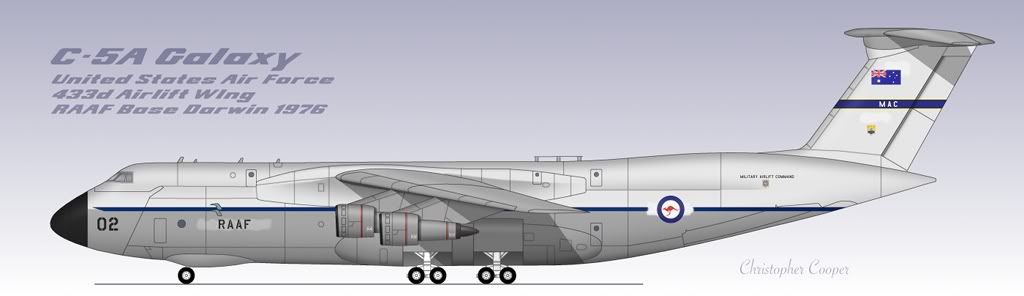
Startlifter (although that would be a 60s order) or a smaller number of Galaxy.

Transfer battlefield helicopters to the Army, and also the Caribou fleet.

Have a common tri service pool of tactical aircrew, and allow them to move freely to and from RAAF roles, even if they are Army or RAN, where possible remove silos and swim lanes, in fact reward multipotenitalites rather than punish them. Senior commanders and even the highest levels of NCOs are far better at their roles if they have been proficient in multiple specialities, rather than only one.

My off the wall Alt History, the US Army manages to get its own fast jets and Australia follows. The US Army demonstrates the superb results of their N156F derived F/A-? and Australia acquires a wing of them. ;)
 
First and foremost, no F-111, 24 airframes with 6 options, was known to be useless from the Vietnam experience. They just weren't survivable.

What? In Vietnam F-111s flew more than 4,000 combat missions in Vietnam with only six combat losses. It was known to be highly effective and survivable on the toughest missions.

Transfer battlefield helicopters to the Army, and also the Caribou fleet.

Why? When the Blackhawks transferred to the Army it took years, even over a decade, for them to get close to RAAF availablity etc. The Army looked down on flying and maintaining complex aircraft as important and unique skills and it took them adopting RAAF attitudes to these things to get RAAF operational results.

A better path would be to ditch Murdoch early and have better Joint command arrangements come out of the Vietnam experience.
 
or a smaller number of Galaxy
Hell no. That plane first decade was a technical glitches, cost overruns horror show. Lockheed nadir. C-141B or 747-200F or a mix of both.
 
What? In Vietnam F-111s flew more than 4,000 combat missions in Vietnam with only six combat losses. It was known to be highly effective and survivable on the toughest missions.


Why? When the Blackhawks transferred to the Army it took years, even over a decade, for them to get close to RAAF availablity etc. The Army looked down on flying and maintaining complex aircraft as important and unique skills and it took them adopting RAAF attitudes to these things to get RAAF operational results.

A better path would be to ditch Murdoch early and have better Joint command arrangements come out of the Vietnam experience.
The F-111 was a low-level penetrator, yet by the mid 70s that was already a suicide mission, and they only lasted as long as they did because of PAVETAC and supporting strike packages that made medium altitude missions the go to. Other nations persisted but learnt the lesson in 1991. The fact the US developed PAVETAC, EF-111 and further evolved Wild Weasel show they knew this, as did the development of the F-15E as a replacement for the F-111.

You ever worked with Army Aviation? They are a bit precious and feel picked on, but they definitely aren't RAAF and don't have RAAF attitudes, the RAAF have a totally different culture, not worse, different. A lot of RAAF are basically uniformed public servants and as such seem to transition to the BS and backstabbing of the public service quite easily, the mediocre ones anyway, the good ones are snapped up by industry and paid a lot more. The Army aviation people somehow seem to manage to do the aviation stuff and the soldier stuff concurrently, when many were seconded to the RAAF to maintain skills during a grounding, their aviation skills were well up there, in fact they come back wanting to know why they weren't tucked into bed at night and woken up with breakfast in bed like the RAFFies were.

There was a one hell of a learning curve and culture shock when Tiger replaced Bushranger Hueys and Kiowa, but adopting UH-1 and AH-1 during the 60s would have been much easier. The Blackhawks had more of an issue with the RAAFies seconded to Army Aviation during the transfer not liking all the military stuff.

To put it in perspective, in the early 90s when the Steyer F-88 was introduced to the RAAF, I know of at least one RAAFie who it turned out had never done his SLR conversion and had last touched a rifle as a recruit when the SMLE .303 was still issued :D
 
The F-111 was a low-level penetrator, yet by the mid 70s that was already a suicide mission, and they only lasted as long as they did because of PAVETAC and supporting strike packages that made medium altitude missions the go to. Other nations persisted but learnt the lesson in 1991. The fact the US developed PAVETAC, EF-111 and further evolved Wild Weasel show they knew this, as did the development of the F-15E as a replacement for the F-111.
I would agrue that low level penetration doesnt become a sucide mission untill the mid 80s.
While i agree only 24 airframes is not enought it needed to be atleast 48, realistilly more. I would agrue there was no aircraft that can carry a large payload over a 2000+km combat radius expect strategic bombers, which the F-111 for Australia was more of a Strategic Bomber than a Tactical Bomber. There was a reason why the RAAF wanted to keep them to 2020 orignally.
The only thing i would change with the F-111s is more PGMs aquired in the 80s/90s instead of just LGBs & Harpoon, such as having ther Kerkanya Glide Bomb enter service & AGM-88 Harms procured (They where cleared, but never acquired for F-111Cs). This would have made the F-111 a propoer PGM bomb truck and an extremely usefull assest

I would like the 5 CAF Squadrons in the early 60s be either turned into Ground Attack Squadrons supporting the army with A-4s or SAR Squadrons with Helicopters supporting Civilians
 
Since when is low level a suicide mission, compared to other penatration tactics that non-USAF air forces can practically use? What in the S.E.A. region is going to stop F111 strikes?
 
I would like the 5 CAF Squadrons in the early 60s be either turned into Ground Attack Squadrons supporting the army with A-4s or SAR Squadrons with Helicopters supporting Civilians
Let us not forget our old friend the CL-84 Dynavert and its derivatives:
cl-84-jpg.164962

(h/t toura)

In a Canadair brochure from February 1969 about the CL-84, there's a
mission profile shown fr the CL-84 in the CAS role. With a crew of two,
a mission radius of 200nm and a loiter time of 45 minutes, armament is
given as a minigun with 3000 rounds and 4 500 lbs bombs.
cl-84_configurations-jpg.20493

cl-84-jpg.47989

(h/t Jemiba)

canadair-cl-84-1d_pic01-jpg.48024

(h/t boxkite)

cl-84a-aafss-jpg.73072

(h/t turboshaft)

candair_general-dynamics-cl-84-1-army-gunship-jpg.109464

(h/t fightingirish)

zcl-84-gunship-variant-artwork-kemp-jpg.612662

(h/t Mark Nankivil)
 
The RAAF acquired a squadron of C130s in the 50s, 60s and 70s. The C130A & E sqns served well throughout the Confrontation and Vietnam War, with C130s deploying 2 battalions (2400 troops) by air to Vung Tau from Darwin in 1967 in a short duration airlift operation.

When does Australia get these C141s, C5s (or Shorts Belfast) and why does it need them?
 
We've touched on things like railways, nuclear power stations and oil refineries for the national security impact.

I'll add another thing to this list, Ports!

My current obsession with Australia's oil industry has me arriving at the ports themselves, and it appears that only Hastings in Victoria is suitable for easy conversion to handle Suezmax tankers, with Melbourne and Brisbane possible but difficult and expensive. A Suezmax can handle about 50% more oil than an AFRAmax but only costs about 15% more to operate.

I'm starting to get the vibe that there are real physical limitations as to how much military power and national resilience Australia could generate.
 
Australia shouldn’t need to import oil there’s more than enough here. Unfortunately the government current and past have resisted the opportunity to be self sufficient. I note not too much coming out of Canberra regarding the Qld opportunities.

Regarding the carrier replacement I found this article on a conversation of container ships to aircraft carriers. Not sure about battle damage and not sure what they plan to power the steam catapults. But interesting still, Melbourne wasn’t built to full naval standards either.

https://navalinstitute.com.au/wp-content/uploads/2014/04/headmark-010-Nov-1977.pdf
I found another article with a more modest conversion with harriers, CL 84s and Seakings.
I’ll try and find it and post it later

I always thought the CL84 was a missed opportunity
 
I always thought the CL84 was a missed opportunity

Once US DOD interest in the CL-84 evaporated post-Vietnam War, the Dynavert was dead.

Although developed under the 1959 US-Canada Defence Production Sharing Agreement, CL-84 prototype funding was actually shared between Canadair and Canada's Department of Defence Production (DDP). But the DPP was replaced by a risk-averse Department of Supply and Services (DSS) in 1969. Nor was Canadair's American parent firm - General Dynamics - going to continue underwriting a programme with no customers.
 
Australia shouldn’t need to import oil there’s more than enough here.

Yea, I dunno given what would be required for Australia to have a robust oil industry to support national security.

For a refinery to survive without artificial government support into the 2000s it would need to be capable of producing 200,000bbl/day+, (compared to 128k bbl/d for closed Kiwana WA and 120k bbl/d for Geelong) and be on the east coast. This would need to be supported by transport infrastructure including a pipeline to the oilfield and outwards, road and rail infrastructure and a deepwater port capable of accepting 285x50x18m Suezmax tankers as opposed to 250x44x14m AFRAmax tankers. These are large investments, which will take a long time to amortise.

The question becomes; is there an oilfield(s?) in Eastern Australia capable of producing 250-300,000 barrels of crude per day for 30-50 years: 2,737,500,000 to 5,475,000,000 barrels?
 
Taroom trough has an estimated 256 million barrels of light oil (the easy to refine oil)
Arckaringa basin has an estimated 3.5billion to 233million barrels of shale oil
So plenty of oil just need pipelines to railways and then railways to refininere
 
Taroom trough has an estimated 256 million barrels of light oil (the easy to refine oil)

Taroom is a good example of the problem. It's getting a lot of attention at the moment, but at 256,000,000 barrels the 105,000bbl/d Lytton refinery would use all of it in 6 1/2 years, in the simplest possible equation. While I think this field is useful, but it will only keep Lytton open for a few years and not likely to stimulate significant new investment in things like pipelines, railways and ports.

Arckaringa basin has an estimated 3.5billion to 233billion barrels of shale oil
So plenty of oil just need pipelines to railways and then railways to refininere

This is more like it, certainly enough to build a big refinery at Whyalla which would then distribute bulk refined fuel by rail to the Eastern states markets (RAAF Amberley & Williamtown, FB East) as well as WA (HMAS Stirling) and NT (RAAF Darwin/Tindal, HMAS Coonawarra).
 
The RAAF acquired a squadron of C130s in the 50s, 60s and 70s. The C130A & E sqns served well throughout the Confrontation and Vietnam War, with C130s deploying 2 battalions (2400 troops) by air to Vung Tau from Darwin in 1967 in a short duration airlift operation.

When does Australia get these C141s, C5s (or Shorts Belfast) and why does it need them?
Australia bought the long range C-130E instead of the Starlifter.

The C-141 was seriously looked at for casualty repatriation from Vietnam to Australia, as well as providing a more effective, ADF-owned strategic transport.

From what I recall, they took too long to decide, and the Starlifter became unavailable. The Galaxy was available but much more expensive; one discussion in the media at the time pointed out that losing a single Galaxy in an accident could result in the loss of half an infantry battalion.
 
Australia bought the long range C-130E instead of the Starlifter.

The C-141 was seriously looked at for casualty repatriation from Vietnam to Australia, as well as providing a more effective, ADF-owned strategic transport.

From what I recall, they took too long to decide, and the Starlifter became unavailable. The Galaxy was available but much more expensive; one discussion in the media at the time pointed out that losing a single Galaxy in an accident could result in the loss of half an infantry battalion.

That'd be right.
 
Page 12 a concept for a merchant aircraft carrier conversion equipped with Sea Harrier, CL 84 and seakings. Probably would have cost less than the cost of hull extension of the OHP’s and Seahawks. The OHP’s could have been equipped with Linx and the additional $ spent on something like this. It would have given us more capability overall.


https://navalinstitute.com.au/wp-content/uploads/2014/04/headmark-002-Nov-1975.pdf
 
Page 12 a concept for a merchant aircraft carrier conversion equipped with Sea Harrier, CL 84 and seakings. Probably would have cost less than the cost of hull extension of the OHP’s and Seahawks. The OHP’s could have been equipped with Linx and the additional $ spent on something like this. It would have given us more capability overall.


https://navalinstitute.com.au/wp-content/uploads/2014/04/headmark-002-Nov-1975.pdf
Disagree, the OHP hull extension was only a couple million (if that) per hull.
 
The OHP’s could have been equipped with Linx and the additional $ spent on something like this. It would have given us more capability overall.


https://navalinstitute.com.au/wp-content/uploads/2014/04/headmark-002-Nov-1975.pdf
Yeah, for a while now, I've come to the same conclusion. The Seahawk is irrufutably a extremely capable platform. But for its price and the price of needing to incorpirate hull extension of the OHP’s, seems to be overkill for a Navy the size and budget of Australia. The Lynx has proved its cost effectiveness and versatility again and again...

Regards
Pioneer
 
Last edited:
That'd be right.

Australia bought the long range C-130E instead of the Starlifter.

The C-141 was seriously looked at for casualty repatriation from Vietnam to Australia, as well as providing a more effective, ADF-owned strategic transport.

From what I recall, they took too long to decide, and the Starlifter became unavailable. The Galaxy was available but much more expensive; one discussion in the media at the time pointed out that losing a single Galaxy in an accident could result in the loss of half an infantry battalion.
My God, you could replace Australia with Canada . It's just unreal.
 
Back
Top Bottom