johnpjones1775
ACCESS: Top Secret
- Joined
- 27 May 2023
- Messages
- 1,373
- Reaction score
- 767
Look like RSLs to me

Look like RSLs to me
That’s why you have multiple ships with harpoons. 2 burkes is 16 missiles. 3 is 24 missiles…Pointless. IMO, if you are in Harpoon range you are too close, and eight missiles means nothing anyway. At a minimum, at least adopt NSM. But quite honestly I would more low cost AD systems like Coyote2 instead of.
That’s why you have multiple ships with harpoons. 2 burkes is 16 missiles. 3 is 24 missiles…
Show me a single instance of a combat launch of an ASM from a surface combatant from beyond 100 miles away.If your target is less than hundred miles away from your entire task force, sure. I’d argue that is an unrealistic peer opponent scenario.
Show me a single instance of a combat launch of an ASM from a surface combatant from beyond 100 miles away.
Real life I mean, not a video game or an exercise.
The latest block of harpoons have a range of over 100 miles anyway
Love how you try to limit the number of options because you know no ship has ever launched an ASM from beyond 20 miles in combat.Show me a single instance of a ship vs ship combat launch in the last half century, and explain to me why you think it has any bearing on a PLAN/USN fight now.
ETA: Operation Praying Mantis is the only thing I can think of: a knife fight in a phone both four decades ago with a non peer.
Love how you try to limit the number of options because you know no ship has ever launched an ASM from beyond 20 miles in combat.
Missiles have had ranges of 50+ miles for a long time and no one has ever even come close to launching from 50 miles away.
Even if we look at air launched, the longest was like 23 miles.
Shore launched its unknown how far the launch was that sank Moskva, but those missiles were based on harpoons, so even if that was a hundred mile or more launch, we have reason to believe harpoons will work just as fine.
Why wouldn’t they? Like I said, no missile launched from any surface vessel has ever come any where near their max range. Why would that suddenly change against China?It seems like the outer envelope for shore launch from China reaches out to Guam. Any DDG of the PLAN reaches out to several hundred miles with YJ-18, assuming ballistic missiles are not in play. Why would Harpoon be relevant?
Why wouldn’t they? Like I said, no missile launched from any surface vessel has ever come any where near their max range. Why would that suddenly change against China?
Why would we suddenly see missile launches at 200 miles instead of the previous 75 or 150 mile ranges that were possible in the 60s 70s and 80s?
Again, weapons and sensors were perfectly capable of support missile launches beyond 23 miles when the actual combat launches occurred.Because of most of half a century of weapons and sensor improvement? Do you think those AShBMs are just for show? If a Burke can walk up to a type 52/55 and tap it with some Harpoons, then PLAN/PLARF is no threat at all. And if the horizon is the functional limit, use SM-2.


Worst case of "closet shrinkage" ive ever seen!It's so funny how fat he is now.

Muffin top.Girl's got chubby cheeks now.
Patriot PAC-3 Missiles To Arm Navy Arleigh Burke Class Destroyers
https://www.twz.com/land/patriot-pac-3-missiles-to-arm-navy-arleigh-burke-class-destroyers
View: https://x.com/ColbyBadhwar/status/2046610900535140735?s=20
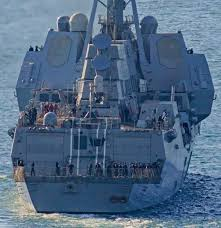
The U.S. Navy took delivery of two modernized destroyers, USS Chung-Hoon (DDG 93) and USS James E. Williams (DDG 95), ahead of schedule through accelerated acquisition, planning, and execution milestones led by the service’s new Portfolio Acquisition Executive (PAE) Maritime office.

Still can't get over the love handles...

you heard it here first - to counter Chinese numerical superiority, USN has resorted to dark Middle Earth magic by installing the Eye of Sauron on top of our DDGs.
Advanced radar and combat system
The Aegis Baseline 10, an advanced combat system built to handle the immense data from the AMDR, the most powerful radar ever fielded on a U.S. Navy surface ship. The increased sensitivity of the radar allows the crew to detect, track and target more complex targets at a greater distance and in less time than the legacy destroyer. This technological leap also allows a Flight III destroyer to simultaneously conduct Air Defense and BMD operations without degradation in performance, effectively performing the work of two Flight IIA ships.
Updated power and cooling infrastructure
For decades, Flight IIA destroyers have relied on a traditional 450-volt electrical system. While highly reliable, this legacy electrical grid is near capacity, leaving little room to power modern, energy-intensive radar systems or future directed-energy weapons. The heightened sensitivity of the AMDR requires a greater demand for ship’s power. The 4160-volt power grid on these ships is designed to fill these needs and leave room for future capability.
The cooling systems on the Flight III have also been upgraded to include more capable air conditioning units and increased chilled water capacity to support the new loads required for AMDR and AEGIS.
Flight III’s also contain updated gas turbine generator sets, which produce 4 megawatts each and a modified steel hull to carry the weight of the new equipment and systems, displacing over 9,500 tons compared to a Flight IIA displacing approximately 9,300 tons.