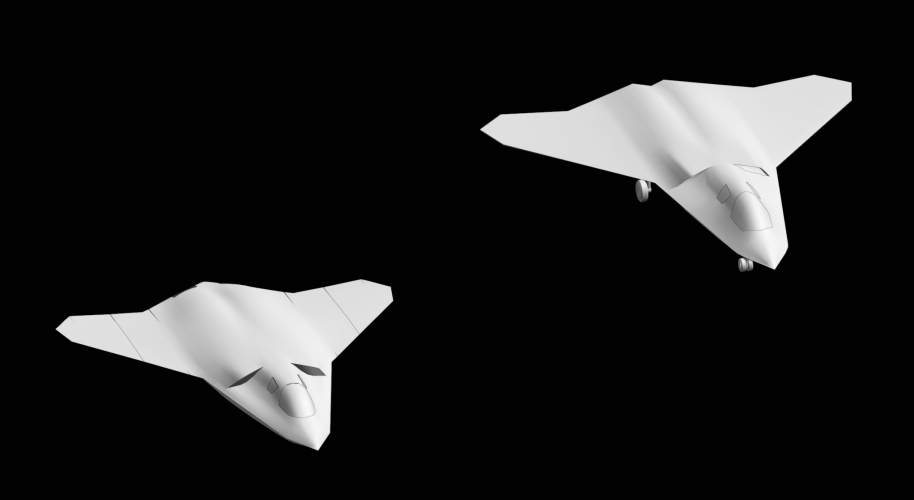
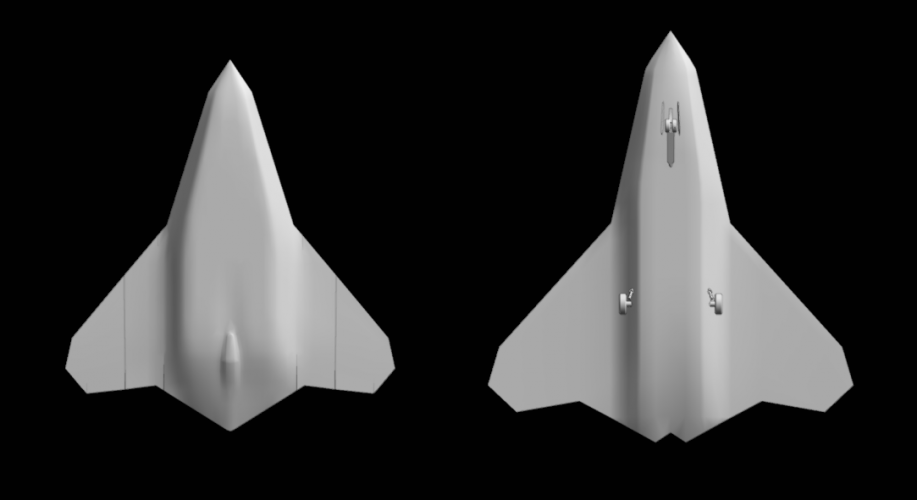
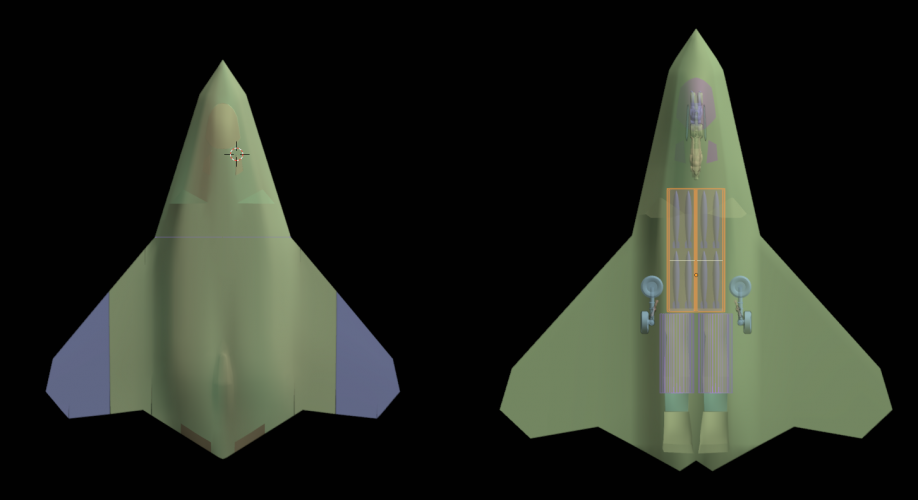
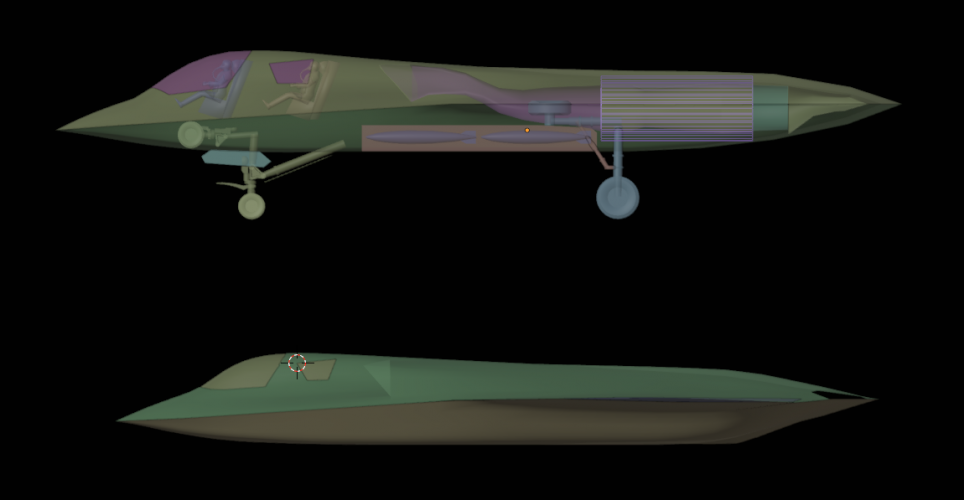
Possible configuration of the Northrop Grumman F/A-XX

All I can say about NFO is the rumor mill is that strike NFOs are going away once F and G sundown...
IMO that's a terrible idea.

Yes, if the plane doesn't have any threats close the pilot can turn on FRED** and give orders to the CCAs, but if you get closer in the pilot will need to pay attention and fly the plane.

** F*ing Ridiculous Electronic Device, aka the autopilot.
 
IMO that's a terrible idea.

Yes, if the plane doesn't have any threats close the pilot can turn on FRED** and give orders to the CCAs, but if you get closer in the pilot will need to pay attention and fly the plane.

** F*ing Ridiculous Electronic Device, aka the autopilot.
Brother I don't make the rules nor guide CNAF, but here we are. All I'm saying is demand drives supply.
 
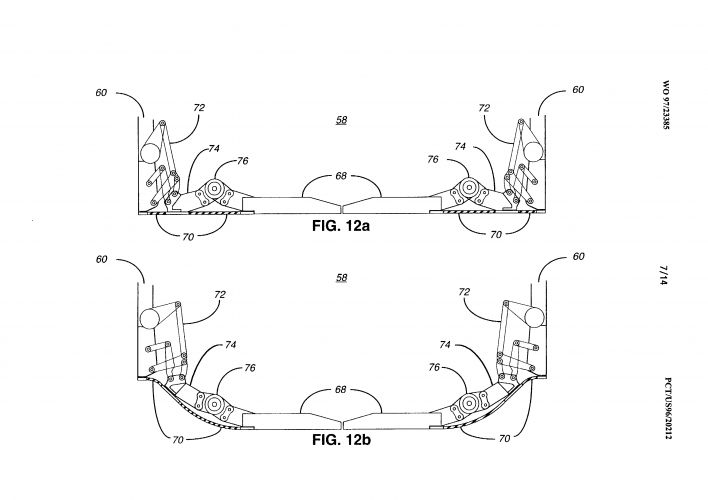
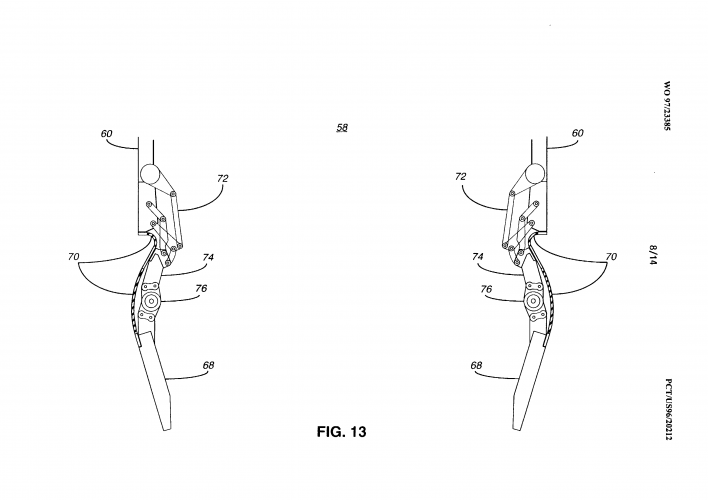
I was looking for the F35's bay patent drawing (couldn't find it) and found this abandoned MDD one. Based on the date it was probably for ATF but for some reason abandoned. Perhaps the flexible material wasn't as good as hoped.
WO1997023385A1-F12-page-rotated.png
WO1997023385A1-F13-page-rotated.png

As you can see it has very intricate, yet, neat mechanics. All the links even as simple as a bicycle chain might be troublesome to maintain and prone to bending.
 
Can't beat rotary, planetary actuators and connecting rods interfaced to the doors. Can have a direct rotary actuator interface with no connecting rods providing the actuators and drive units have enough oomph. Can't use linear cylinders in small bays, eats up up crucial bay volume for weapons. B-2 (and I assume B-21 as well) has rotary units with push rods and F-117, linear hydraulic cylinders (inboard, fore and aft), 117's only carried a single weapon so you could live with the cylinders taking up some volume with the doors closed.

NG would more than likely have a weapons bay door config similar to YF-23. Also, NG would more than likely stay away from the F-22-style bi-folded main bay door configuration.
 
They almost completely open up to the side's bottom for better access similar to how the B52 can open additional door segments or wider access.
Modern racks use smaller rod for ejection instead of past eplosive charges as can be seen in this latest video example. The racks aren't small after all.
 
I was looking for the F35's bay patent drawing (couldn't find it) and found this abandoned MDD one. Based on the date it was probably for ATF but for some reason abandoned. Perhaps the flexible material wasn't as good as hoped

As you can see it has very intricate, yet, neat mechanics. All the links even as simple as a bicycle chain might be troublesome to maintain and prone to bending.
Not sure if this is the same patent as this one, in another thread:

I disagree with that.

IIRC LockMart went with the double-folded main bay doors for ground clearance and access, and I suspect that the Navy would also want that.
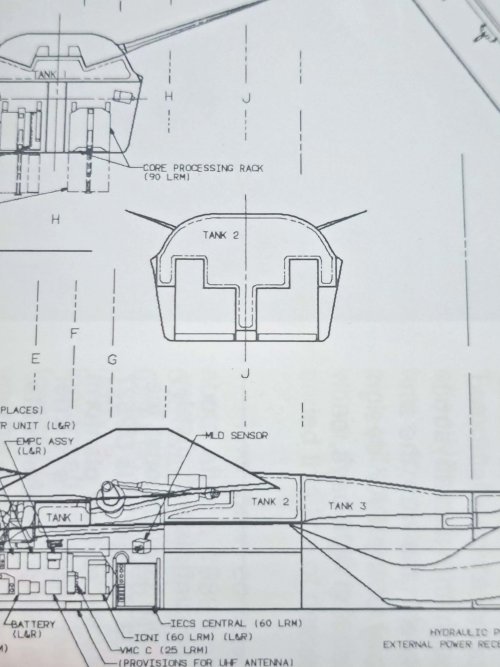
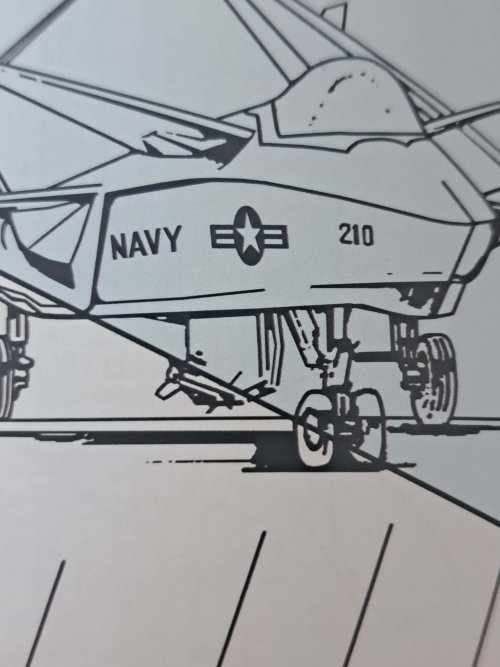
The NATF-23 technical drawings are probably the most useful in this situation (from Paul Metz Air Force Legends book).
Note the sturdy central keel (not sure a carrierborne design can get away with it without huge strenghtening - and associated weight - of the weapons bay side walls. The bay doors are one piece, hinged at the central keel. Easy access and simplicity. Note the AIM-9s attached to the doors directly.
 

Attachments

  • NATF23 iwb.jpg
    NATF23 iwb.jpg
    552.8 KB · Views: 146
  • NATF23 bay.jpg
    NATF23 bay.jpg
    555.4 KB · Views: 148
Last edited:
The NATF-23 technical drawings are probably the most useful in this situation (from Paul Metz Air Force Legends book).
Note the sturdy central keel (not sure a carrierborne design can get away with it without huge strenghtening - and associated weight - of the weapons bay side walls. The bay doors are one piece, hinged at the central keel. Easy access and simplicity. Note the AIM-9s attached to the doors directly.
Thank you for that! (and *yoink* those images)

I will note that this does make for 2-4 "main bays" that make it impossible to load weapons on the centerline.
For example, the A-12 ATA has one bay option for 5x 1000lb weapons, and my early concepts for an FAXX design could have allowed 3x 2000lb weapons in a bay wide enough for 2x AGM-158s. That would not be an option for a setup like NATF23's bays.
Admittedly, I'm not sure what kind of mission would require 2x SiAW and 3x 2000lb or what mission might require a full up 6x 2000lb, but with the AGM-158s weighing nearly 3000lbs each and the ~65" width being plenty wide enough for 3x 2000lb, I was wanting to make it an option.

I think it's okay, but I was preferring the heavier load being an option.

The bays will need to have some custom racks made for the alternate weapons loads. Annoyingly, likely custom racks for each weapon type: SDBs, 500lb, and maybe 1000lb.

How deep would a bay need to be in order to hold a pair of 1000lb weapons within the same width as an AGM-158?
 
Same company, same idea/concept 4 different teams (2 mixed) and 4 patents but seemingly 3 different implementations as far as I can tell. The one I posted is the best imho.

The NATF-23 technical drawings are probably the most useful in this situation (from Paul Metz Air Force Legends book).
Note the sturdy central keel (not sure a carrierborne design can get away with it without huge strenghtening - and associated weight - of the weapons bay side walls. The bay doors are one piece, hinged at the central keel. Easy access and simplicity. Note the AIM-9s attached to the doors directly.
I will note that this does make for 2-4 "main bays" that make it impossible to load weapons on the centerline.
Having a keel is good, but I don't think it that necessary especially on smaller airframe.
That said I do believe the USN wants a center station to mount a buddy tank store.
And I want to advertise it being able to make a belly landing on a drop tank. :D
For other reasons I'm going with side by side bays.
Increasing the load to 4x 2000 lb internally is the logical next step for improving on the F35. I don't think more is needed if we want it to also serve as air superiority. As is it's a great multirole.
A-12 Avenger loadout is overkill for a fighter design and only feasible with a flying wing or huge airframe.
How deep would a bay need to be in order to hold a pair of 1000lb weapons within the same width as an AGM-158?
About 32.15" but must be staggered due to the tail wings.
 
Last edited:
Having a keel is good, but I don't think it that necessary especially on smaller airframe.
That said I do believe the USN wants a center station to mount a buddy tank store.
And I want to advertise it being able to make a belly landing on a drop tank. :D
Hrm. That may be a good point, though the USN seems to be planning on the MQ25 and likely the big UCAV-CCA as tankers.


For other reasons I'm going with side by side bays.
Increasing the load to 4x 2000 lb internally is the logical next step for improving on the F35. I don't think more is needed if we want it to also serve as air superiority. As is it's a great multirole.
Agreed that you need at least 4x2000lbs for FAXX.

My thinking about 6x2000 was because a bay wide enough for 2x AGM-158 is also wide enough to hold 3x2000, plus 4x AGM-158 is very close to 12klbs.


A-12 Avenger loadout is overkill for a fighter design and only feasible with a flying wing or huge airframe.
I mean, I have been assuming that FAXX was going to be bigger than a Tomcat.


About 32.15" but must be staggered due to the tail wings.
Grr. Deeper than I wanted.
 
Hrm. That may be a good point, though the USN seems to be planning on the MQ25 and likely the big UCAV-CCA as tankers.
Yes, but I think the USN probably won't concede on this point. FA-XX has the power to lug heavy loads to do this on the side while things are calm.
Agreed that you need at least 4x2000lbs for FAXX.

My thinking about 6x2000 was because a bay wide enough for 2x AGM-158 is also wide enough to hold 3x2000, plus 4x AGM-158 is very close to 12klbs.
Don't forget this includes racks and multi-ones for SDB weight as much as the stores themselves.
I would love to have this too, but the NATF requirement set limits on size and weight to 65000 lb and ~70 ft in order to pack two on the elevators. I presume the new elevators can lift more but size is probably the same. From the calculations 4x 2000 lb results in an airframe that fits exactly.

Regarding landing weight I'll post in the other thread to stay on topic.
 
Yes, but I think the USN probably won't concede on this point. FA-XX has the power to lug heavy loads to do this on the side while things are calm.
Fair point.


Don't forget this includes racks and multi-ones for SDB weight as much as the stores themselves.
Yes, I was assuming that the 250lb/SDBs and 500lb bombs would bulk out the bays long before we saw full payload weight.

Though I was planning on a rack more like the B-2's Bomb Rack Assembly than the standard SDB quad rack. Or, if that doesn't work well, make a dedicated rack for SDBs that is scaled to them.


I would love to have this too, but the NATF requirement set limits on size and weight to 65000 lb and ~70 ft in order to pack two on the elevators. I presume the new elevators can lift more but size is probably the same. From the calculations 4x 2000 lb results in an airframe that fits exactly.
Didn't realize that NATF was that light! I mean, that's nearly 10k lighter than F-14s.
 
I disagree with that.

IIRC LockMart went with the double-folded main bay doors for ground clearance and access, and I suspect that the Navy would also want that.
Maybe SK but the F-35 has standard bay doors ( and are contoured to the outer mold line) and yes, the NG F/A-XX may have wider bays which could drive door length. F-35 has small bays which are also really packed internally with subsystems and that's one of the complaints about the 35's, maintenance can be a bitch. NATF-23 sat kind of high but this could go either way.
 
Didn't realize that NATF was that light! I mean, that's nearly 10k lighter than F-14s.
Well, it's not like underdeck aircrafts are fueled, though, usual trapped fuel remains. The Ford class introduced refueling points all over the flight deck, so refueling quickly won't be an issue. There are past pictures of two Tomcats and lots of bombs on the same elevators, too. As well as having their tail hanging far beond the elevator's boundary toward the see. The requirements aren't "hard".

NATF-23 sat kind of high but this could go either way.
Now that you mention it I didn't realize the F35 is ~12.4"?? lower than the F22 unless picture perspective skewed my measurement.

My doors are anywhere between 23.6-22.44/570-600 mm depending on the opening mechanism. This requires F22 ground clearance.
My biggest fitting issue is match fitting the main landing gear, wing & actuator space and side bays. I might have to lenghten the air frame just because of this rather than the IWB length.
 
i think FAXX is going to be F18E sized. it will use large but fairly swept back wings 42 degrees or more. may have some sort of vertical/canted stabilizer not so much for stability but for better low speed approach control or just none at all. big enough weapon bays for multiple (2 or more) anti ship missiles and then rely mostly on drones for air to air combat loads
 
That's my goal but it's not that simple. The USN puts more constraints than the USAF on size...

My thoughts on the wings was the F/A-XX doesn't need to be as fast as the F22 but the USN probably wants to claim / to have a Mach 2 fighter.
Design wise I've set the max limit at M2.2. Most of the time it won't go that fast. Intercept or tactical surprise are the only cases where such speed would be needed.
I figure it doesn't need to fly as high nor as maneuverable at those altitude as the F-47. The USN demands range and "longer" loiter time.
This requires L/D efficient (good aspect ratio, too) and sizeable wing area.
My design needs is a long wing root to cover the main landing gear, flap+actuators, side bay length.
That's why I'm currently set on a wing area of 1100 sq ft.
However, this reduces wingspan and leaves very little chord length space for the 3rd wing station. My 2nd planform choice (spiky diamond) fits but is too compact.
I went with the spiky end due to stealth angle reason and drag reduction of the wingtip vortex.
If the wing root is too short the wing span increases (for same area) and I can't fit everything.
And the USN doesn't want to be humiliated again by the USAF's F-16.
The F18 is good at dogfighting but it cannot out-accelerate or outrun any of the prominent 4th gen fighters. All of them can chase it down and it's always forced into a fight.
This is not acceptable with the new crop of upcoming fighters either.

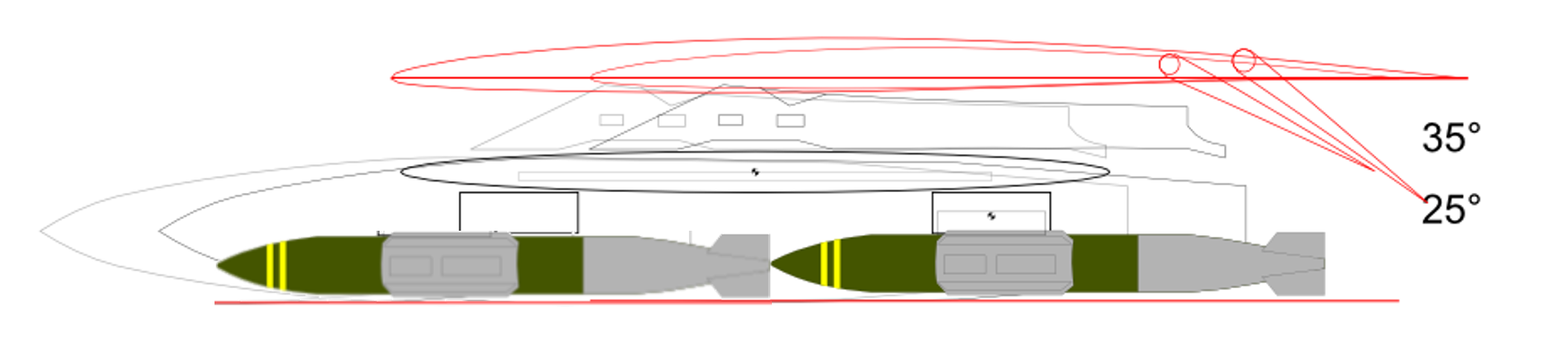
I figured the wing sweep angle should be between 35° and 42°.
I've cheated with placing the inner flap further back which happens to concide with fluidic designs.
I'm considering cheating with a levcon. Last resort would be to lengthen the fuselage...
The other issue is the DEW requirement. My layout can fit it with some tradeoff but could also mount a laser pod on the center line.
This should also interest the Marines in the future.
 
i think FAXX is going to be F18E sized.
I disagree, the need to carry 4x 2000lb bombs or whatever internally makes for a really big airframe.


big enough weapon bays for multiple (2 or more) anti ship missiles and then rely mostly on drones for air to air combat loads
The proposals I've seen out of the think tanks have been strike drones, not AAM drones.
 
I agree, 4x 2000 lb seems to be a reasonable internal loadout, given the F-35C can carry only two.
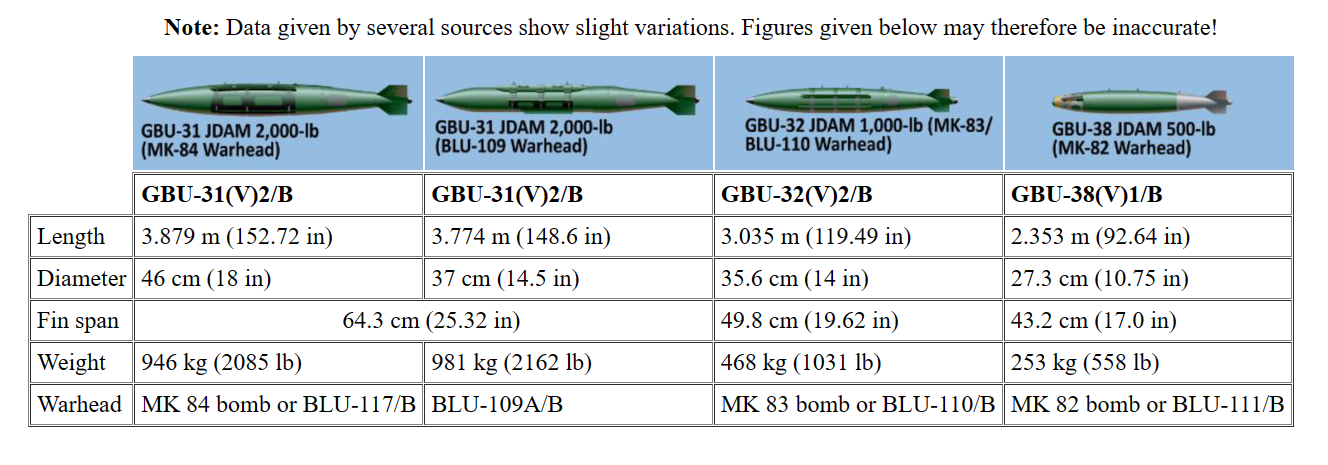
However, I also think it's necessary to accommodate as many 500 lb JDAMs as possible. This led me to believe the bay length should be based on two 500 lb JDAMs end-to-end (5m / 197 in).

View attachment 800833
What would F/A-XX be attacking that basically requires overflight in a peer war?

I would think F/A-XX be primarily firing standoff weapons and at most some glidebombs. PGMs of closer range seems too dangerous to deploy unless air defense networks have been dismantled.

Small bombs and direct ground attack would be better fit and safer for ground attack CCAs. Its not to say F/A-XX wont be able to carry them, but that maybe the bay wouldnt need to be maximized around smaller munitions.
 
What would F/A-XX be attacking that basically requires overflight in a peer war?

I would think F/A-XX be primarily firing standoff weapons and at most some glidebombs. PGMs of closer range seems too dangerous to deploy unless air defense networks have been dismantled.

Small bombs and direct ground attack would be better fit and safer for ground attack CCAs. Its not to say F/A-XX wont be able to carry them, but that maybe the bay wouldnt need to be maximized around smaller munitions.
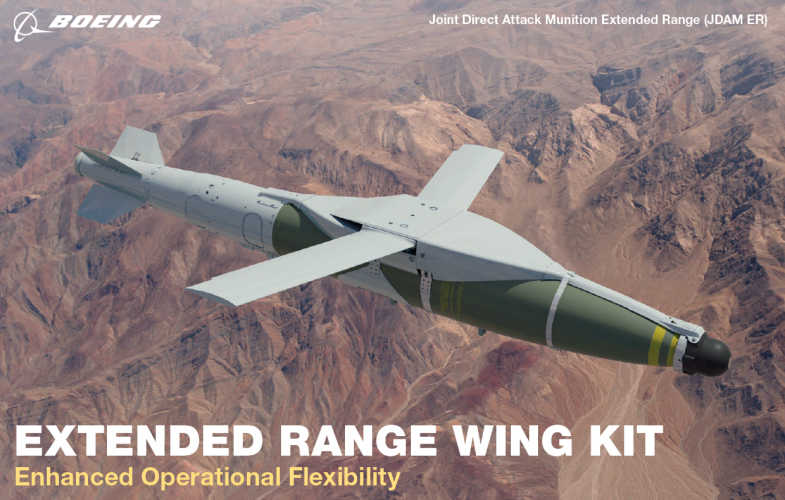
JDAM-ER might be quite useful ;)
https://www.boeing.com/content/dam/...apons-weapons/images/JDAM-ER-Product-Card.pdf
1770143231917.png
 
What would F/A-XX be attacking that basically requires overflight in a peer war?
Whatever the Marines are fighting?


I would think F/A-XX be primarily firing standoff weapons and at most some glidebombs.
Likely, yes.


PGMs of closer range seems too dangerous to deploy unless air defense networks have been dismantled.

Small bombs and direct ground attack would be better fit and safer for ground attack CCAs. Its not to say F/A-XX wont be able to carry them, but that maybe the bay wouldnt need to be maximized around smaller munitions.
That was the standard for the old ATA and like the A/F-X.
 
What would F/A-XX be attacking that basically requires overflight in a peer war?

I would think F/A-XX be primarily firing standoff weapons and at most some glidebombs. PGMs of closer range seems too dangerous to deploy unless air defense networks have been dismantled.

Small bombs and direct ground attack would be better fit and safer for ground attack CCAs. Its not to say F/A-XX wont be able to carry them, but that maybe the bay wouldnt need to be maximized around smaller munitions.
You don't designfor one specific case. A strike aircraft is all about luging all kinds of A2G loads as much as possible.
A war goes through many phases of tactical and strategic changes. The Ukraine war by now went through about 7 phases.
Each one requires different approach, tactics and related uses of stores. You can never know what kind of mix or use you might need.
The GB bombs we use here are basics representing all weapons of same weight classes, hence, same size classes. There's tons of new "cheap" one including more high end coming we don't know yet or know whether they will be procurred but they all will be designed to established form factors established by these GB bombs.

JDAM-ER might be quite useful ;)
Don't forget the PJDAM with a range of 330-380 nm

Keep in mind most of this is just the internal carriage only which we consider the minimum to get it done under best stealth.
We can always go out on "beast" mode. It will be awesome even if we can't match a F111. But then again a F111 can't have AAMs while doing so. Our F/A-XX / F47 will always have AAMs.
 
Keep in mind most of this is just the internal carriage only which we consider the minimum to get it done under best stealth.
We can always go out on "beast" mode.
Exactly.

I've been assuming a beast mode loadout of 4+4x AGM-158s, for example. That's at least 12klbs external, on top of however much we're hauling internal.


It will be awesome even if we can't match a F111. But then again a F111 can't have AAMs while doing so. Our F/A-XX / F47 will always have AAMs.
Honestly, I've been assuming 5000lbs per external pylon as the design load, as that covers 600gal fuel tanks. And triplets of 1000lb bombs (it would require a different rack to haul 6x 1000lb, Mk83s are long enough that you can't carry 6 of them on a MER).

So old school carpet bombing in Beast Mode is going to be something like 40x 500lb
 
View attachment 800903
I'm missing something(?) if the Mk83 is nose to tail they don't seem to fit in tandem.
Sorry, I somehow was fixated on the wing's spacing and forgot the rest.
@Scott Kenny is right the Mk83 won't fit in the same row.
But for a 5000 lb rated station (presumely at 5.5g) we can't mount 6x 1000 lb without having to accept a lower gee force limit anyway.
The best use is a mix of 3x 500 lb and 3xx 1000 lb ~4600 lb of stores + BRU-41/A lb rack + SAUU pylon for a total of ~5300 lb.
F22-wing-station-side-MER-fitting-500lb+1000lb.png
 
Sorry, I somehow was fixated on the wing's spacing and forgot the rest.
@Scott Kenny is right the Mk83 won't fit in the same row.
But for a 5000 lb rated station (presumely at 5.5g) we can't mount 6x 1000 lb without having to accept a lower gee force limit anyway.
The best use is a mix of 3x 500 lb and 3xx 1000 lb ~4600 lb of stores + BRU-41/A lb rack + SAUU pylon for a total of ~5300 lb.
View attachment 800938
Seems offensive that the light weapons need to go in front, but that is what it is.

What I'm seeing is the need to design a new 6-rack that can hold 1000lb bombs, though the wing pylons would need to be rated for ~7500 or so to make that a viable loadout.

5000lb wing loads means 6x500 as the "best" carpet-bombing loadout.
 
Hey guys. Just found this page and am familiar with the aircraft.

You guys are doing a great job considering all of the details that go into conceptual design.

As you push on, consider the driving forces behind the aircraft’s final OML.

1. Who is the customer and what is their most basic need? What need is unique to the customer that requires a custom aircraft instead of another joint fighter?

2. Why does the customer need a new aircraft now? What must this aircraft accomplish that can’t already be done by the aircraft it already operates?

Finally, I cannot stress this enough… Publicly released artist renditions do not reflect any design direction because the graphic designers and the marketing team who directs them are given no sensitive data. This goes double for random clothing, signage, or publicly released patches. At best, they reflect what people not “in the know” expect a futuristic aircraft to look like.

The only caveat I’d put to this is that artist renditions of the aircraft post down selection are at least a bit more accurate because, by then, there is no longer a competition.
 
1. Who is the customer and what is their most basic need? What need is unique to the customer that requires a custom aircraft instead of another joint fighter?
2. Why does the customer need a new aircraft now? What must this aircraft accomplish that can’t already be done by the aircraft it already operates?
There's been ample discussion about this here and in the main thread, which is what I went off of. Highly stealthy naval attack aicraft with longer range and magazine capacity than the hornet and F-35. I am still working on it though and I've more or less had to start over, but do take a look at the more recent image post. If you have suggestions for how things could be changed, I'm more than happy to explore that.
Finally, I cannot stress this enough… Publicly released artist renditions do not reflect any design direction because the graphic designers and the marketing team who directs them are given no sensitive data.
There's a lot of people who have problems with released artist renditions so this isn't directed at you per se but moreso as a clarification of why and how people make 3d models.

I don't want to gate keep anyone else making art, but I don't think all renditions can be treated the same. Some can be taken as a stronger source of truth than others. For me, that usually runs in this order:
  • A number of us put it a ton of work trying to match the F-47 rendition because it was post down-select, consistent between both images, and both Boeing and the USAF are said to have doctored the image directly to avoid exposing details. That to me is most likely a rendition with some truth to it, much like the LRS-B image released by NG.
  • If it's a rendition that appears in a PPT slide, or more broadly, a rendition from the manufacturer that appears to have come out of a parameterized configuration / design software, then that to me is also worth considering for ideas and general direction of design. I consider designs found in papers or those MDD designs to be in this category as well. Normally, I'd rank design drawings higher if not for the fact that they are conceptual designs and less likely to be exactly like the actual aircraft.
  • As for patches, I think they can be used for some broad ideas of shape, but there's not much else to glean from that anyway
  • I also consider some traits that make repeated appearances across renderings released by the manufacturer (and verifiably not bought / stolen from some 3d artist off the web) - i.e the shovel chin used in a number of Boeing renditions over the years.
For any other renderings even those released or used by the services/ manufacturers, I agree they are generally worthless - especially nowadays when you can just use AI. A lot of them being thrown around are clearly implausible - engine spaces too small, wings too large, cockpit too small etc.

The reason isn't that I believe all those renderings should be taken as a source of truth. It's simply the fact that without trying to glean information from more credible depictions, there's just no point or purpose in making a 3d model. For anyone making a guesswork model, you either choose between guesswork that may or may not be accurate, or you go with existing designs + utter make-belief. Hell - even with good information, you'd be surprised how much of making a model is still make belief.

To me, it's not terribly hard to make a 3d model that looks stealthy, fits a certain armament size, and fits a particular engine size in there. But without more constraints added, it's simply meaningless to create any 3d model at all. Why? because I could simply clip off the tails of an F-22 and make the wing larger, then tell you it's the F-47, and anyone can make a million different models of the same configuration. The end result is predictable, uninteresting, and generally leaves us with no new insights. I'd even argue it's about as bad as trying to make models from faulty information.

What is more fruitful for me is thinking about how new features depicted in papers, diagrams and in rare cases - official renderings with some credibility - can be fit alongside everything else. It's less so "this is going to be 100% accurate" and more so "these are some ideas that could be on the actual design, and lets play around to see how they can fit with each other". Sure - the information you're working with still isn't credible, and it most certainly doesn't mean it'll be the end configuration of the aircraft, but it's better than going off of make-belief or simply going with a tailess 5th gen fighter.
 
Last edited:
I understand the purpose isn’t to arrive at an exact rendition of the plane, and that without using any artist renditions, the activity is pretty kneecapped. Overall I think you’re doing a great job balancing the inputs.

Regarding the Boeing model, I don’t have much insider information but I would assume yours is a fair assessment.

Regarding the Northrop model, I obviously will not break any classified info, so I’m sorry if my answers are cryptic and vague. Generally, you are on the right track about the customer’s needs. My only input is (1) the order of importance is a bit different, and (2) the shape will be affected by as-of-yet unreleased capabilities that this program and (I assume) the NGAD require.

Again, great work overall. I look forward to seeing your design mature and the rational behind it.
 
I understand the purpose isn’t to arrive at an exact rendition of the plane, and that without using any artist renditions, the activity is pretty kneecapped. Overall I think you’re doing a great job balancing the inputs.

Regarding the Boeing model, I don’t have much insider information but I would assume yours is a fair assessment.

Regarding the Northrop model, I obviously will not break any classified info, so I’m sorry if my answers are cryptic and vague. Generally, you are on the right track about the customer’s needs. My only input is (1) the order of importance is a bit different, and (2) the shape will be affected by as-of-yet unreleased capabilities that this program and (I assume) the NGAD require.

Again, great work overall. I look forward to seeing your design mature and the rational behind it.
Hi @Noads2 Welcome to the forum!

I've also been thinking about a possible configuration and created a 3D model as well - Have you seen this thread already? https://www.secretprojects.co.uk/th...ration-of-the-boeing-f-a-xx.50919/post-875579
 
Regarding the Northrop model, I obviously will not break any classified info, so I’m sorry if my answers are cryptic and vague.
All good! Besides - it's fun guessing at what could / might be.
(1) the order of importance is a bit different
Hmm that's interesting to consider. Maybe more capacity less stealth ... or maybe the more moderate interpretations regarding a more multirole aircraft are right afterall.
(2) the shape will be affected by as-of-yet unreleased capabilities that this program and (I assume) the NGAD require.
Do you mean NGAD as reference to the family of systems? Or NGAD as in the F-47?

It would probably have to do with:
- New intake design + DSI
- Sensor FoV
- Exhaust + Nozzles (or even number of engines)
- Number of pilots

Anyone have any ideas/ recent discoveries?
 
Hi @Noads2 Welcome to the forum!

I've also been thinking about a possible configuration and created a 3D model as well - Have you seen this thread already? https://www.secretprojects.co.uk/th...ration-of-the-boeing-f-a-xx.50919/post-875579
Your model looks great! Seems like a very grounded take at a tailless stealth fighter.

Btw. I haven’t read through all the forum history, but what is your process for modeling? Is it CAD (surface/solid) or point cloud modeling?
 
All good! Besides - it's fun guessing at what could / might be.

Hmm that's interesting to consider. Maybe more capacity less stealth ... or maybe the more moderate interpretations regarding a more multirole aircraft are right afterall.

Do you mean NGAD as reference to the family of systems? Or NGAD as in the F-47?

It would probably have to do with:
- New intake design + DSI
- Sensor FoV
- Exhaust + Nozzles (or even number of engines)
- Number of pilots

Anyone have any ideas/ recent discoveries?
Regarding the order of importance, think of which customer each of the big 3 chose to focus on in this modern round of US air superiority fighters. Focusing on one instead of both would naturally lead the aircraft to better reflect that customer’s unique needs.

Regarding NGAD, I meant the program that produced the F47. I have no visibility to that program outside of some competitive intelligence, but knowing the new capability, I could see it being required on both customers’ fighters.

Again, consider my original #2 question when assessing this new capability. I know it sounds obvious to say “New fighter can do new things,” but if you frame the question as “what new capability requires a new fighter,” it will make more sense.
 
Regarding the order of importance, think of which customer each of the big 3 chose to focus on in this modern round of US air superiority fighters. Focusing on one instead of both would naturally lead the aircraft to better reflect that customer’s unique needs.

Regarding NGAD, I meant the program that produced the F47. I have no visibility to that program outside of some competitive intelligence, but knowing the new capability, I could see it being required on both customers’ fighters.

Again, consider my original #2 question when assessing this new capability. I know it sounds obvious to say “New fighter can do new things,” but if you frame the question as “what new capability requires a new fighter,” it will make more sense.
I have been thinking along similar lines.

Some examples:

1) New Longer range (intermediate class?) ballistic missiles targeting carriers push the CVN battlegroup further out = longer range (SH and F-35C both not great hence all the discussion on the good old days of A-6s and cancelled A-12). Since loss of the ability to deliver reliably a lot of ordnance on surface targets in contested airspace the USN has a problem of relevance relative to USAF that can bring long ranged ULO bombers to the problem ie. B-2 and B-21.

a) Therefore long range at least in early phases of a conflict
b) Heavy capacity of magazine, ie ideally back to ATA goals would be the dream if perhaps not 20,000lbs
c) Self escort and penetrating (likely more appealing to USN management to not just have a platform launching Cruise missiles, since can't F35 and/or SH basically achieve that(?) Sure, deeper into enemy territory is better but that then drives internal carriage
d) Ideally you want to achieve a large amount of delivered ordnance per sortie, especially as your greatest opportunities to achieve knockouts is early in the campaign before the opponent is fully up to speed, which is at odds with the range requirement (ie. Hanging lots of large cruise missiles underwing only works to a point if you're pushed back from the enemies front yard)

So this would be an example where if I was Boeing I would really want to give my existing Super Hornet customer the machine that addresses a lot of the headaches they have had since DF-21 emerged

I really took to heart Sferrin's completely sensible comment about the threats to carrier groups being nothing new (ie. Backfires and Kh-22 missiles) but I suspect/guess it was exactly those type of issues going away post 1990 that have enabled gradual erosion of the carrier groups aircraft based power projection ability. It's not like the fleet planned to fight right off murmansk after all.

In this model I also think that fleet air defence as a priority makes less sense since by virtue of being a long way off shore and the opponent not having a large fleet of anti ship missile dedicated aircraft (DF-21 being their solution). Naturally though an aircraft capable of the above role can carry a lot of fuel and a lot of missiles, internally and without the drag of external stores so would be an excellent modernisation for the role lost when the F-14 was retired

2) Hypersonic missiles (I fully admit I am somewhat fuzzy on the full details and look forward to being set straight), but it seems fairly clear that faster speeds and dynamic manouverability are very desirable of course but don't necessarily mean great range. Furthermore the tracking of missiles with high IR signature against cold skies is also not ideal. On the other hand these missiles are based on the principle of getting inside the sensing and reaction time cycle of the opponent and launched from closer in are very potent. They tend to be relatively big, not especially easy to fit in any current 5th gen aircraft internally and represent a missile that ok, can be launched from 600miles out but will that be enough advantage over a 1000nm conventional low observable missile to be worthwhile. On the other hand a carrier aircraft able to deliver much closer in to the enemy has a big advantage, so I would say for the US again without an aircraft with large and deep IWBs they are bit players, and again if I were Boeing I would lay out this to the customer and say I want to provide a solution.

I thought about the above (admittedly I much prefer argument 1 and don't really have a view on (2) other than I would feel better if I was the US that I would have a platform capable of matching the USAF's striking power and delivery effectiveness if it was needed.

3) Directed energy weapons - definitely coming, definitely need integrated power systems, cooling and engine integration plus and airframe strategy so that too drives new strategies. That still needs new engines but not necessarily the fullest extent of say three-stream technology.

4) Drone and UAV/UCAVs - I appreciate the potential a lot but I don't see any equivilant to a full strike wing capability. Someone will set me straight but at the moment the strategy seems to be to massively increase the opponents air defense problem through mass of aircraft and improve the penetrating capabilities of the manned strike packages (while also being managed in some or all part by those manned platforms). This of itself doesn't necessary drive a new aircraft but it's not as effective if your fleet is limited by the manned aircraft range capabilities.

Conclusions (sorry for rambling) - I think who went after who in the competition is pretty well discussed, as was the very USAF focused nature of the Lockheed bid (as far as I know there wasn't discussion ever of a Lockheed equivilant offering to the US, was there one?), so the Boeing offering had aspects focused on being attractive to the USN, as well as no doubt general techniques and new ground capabilities that were attractive to both services (not getting into arguments about canards, at least not for F-47).

I'm a professional engineer working on very high performance electric machines mainly in high end automotive and some stuff in aerospace but fortunately I'm a mechanical eng by training and can use CAD but my surfacing skills are terrible. I have spent too long over the last month messing around on a design to explore the arguments around the viability or otherwise of the very large central weapons bay and meeting the ATA 8x 2000lb payload internally with a plausible structural and aerodynamic package. Basically I liked Scott Kenny's Arguments in favour but I saw the sense in both the proposed packages put forward by VTOLlicious and Reddington777.

I hate to annoy anyone but I'm not going to share it now as it's too late here and to a certain degree it looks a little crap given I hacked the model up twice already(!). I'm going to DM Vtol and Reddington777 and let them explore it (it's a solidworks model) but not for a few days while I get some real work done.

Thanks for sharing your thoughts all, J

 
Your model looks great! Seems like a very grounded take at a tailless stealth fighter.
Thx!
Btw. I haven’t read through all the forum history, but what is your process for modeling? Is it CAD (surface/solid) or point cloud modeling?
It's a solid model created in Solidworks.
When I start I have a general idea of the external layout in my mind, but I always design the internal layout first (weapons bay, engines, intake ducts etc.) and then design the airframe around it... If I'm happy with the initial result I proceed, refine the model and add additional details, e.g. landing gears, doors, etc.
 
1772833732861.png Took a break from modeling, but came back and started over again.

1772833814087.png
The old version is on the left and the new one on the right. The new version can accommodate two of the weapon bays that @VTOLicious came up with without any compromise while still having enough room to stow the front gear assembly and the tailhook. I might be able to fit a single AAM per side bay too. Volume wise, we are looking at 88m3.

Should have better aerodynamics now with a sleeker fuselage.

1772834535323.png

1772835288068.png
 
Last edited:
The new version can accommodate two of the weapon bays that @VTOLicious came up with without any compromise while still having enough room to stow the front gear assembly and the tailhook. I might be able to fit a single AAM per side bay too. Volume wise, we are looking at 88m3.

Should have better aerodynamics now with a sleeker fuselage.

View attachment 804503
This spec? 2x 500lb in tandem?
I agree, 4x 2000 lb seems to be a reasonable internal loadout, given the F-35C can carry only two.
However, I also think it's necessary to accommodate as many 500 lb JDAMs as possible. This led me to believe the bay length should be based on two 500 lb JDAMs end-to-end (5m / 197 in).

View attachment 800833
I agree with the thinking, but we may want to lengthen that to 3xSDB in tandem, 5.7m or thereabouts.

That also means a bay long enough to carry an AGM-158B/C with room to spare, but only wide enough to carry one.

My thinking is a bay wide enough for 2x2000lb as a minimum and 2xAGM158 as optimum, and long enough to have 3x SDB in tandem. 12x SDB per bay if the bay is only wide enough for 2x2000lb. This would require a rack that is half a BRU-61/A, carrying 2x SDB in parallel.

A bay wide enough for 2x AGM-158 is also wide enough for 3x 2000lb! So now we're talking 18x SDBs per bay, or the ability to pack 3x 2000lb and 6x SDB per bay. For the 500lb JDAM, you'd be talking 6x 500lb per bay.
 
This spec? 2x 500lb in tandem?
Yeah. 2x 500lb tandem. It could maybe add a third one if we sacrifice some exhaust length.

After working through two of these, I really begin to appreciate the F-22 J-XDS kind of exhaust. It doesnt add extra length with a long exhaust, it can free up room for larger bays and it offers easy access to engine maintenance.
 
Unfortunately, internal volume is a precious
commodity. The size of the weapons bays is the major driver of the aircraft's size, which has a direct impact on weight, drag, etc... Where is the sweet spot for F/A-XX?
 
Back
Top Bottom