
You are using an out of date browser. It may not display this or other websites correctly.
You should upgrade or use an alternative browser.
You should upgrade or use an alternative browser.
Guidance and Navigation Thread
- Thread starter uguduwa
- Start date
I've been trying to implement a trajectory controller for a fixed wing UAV to follow curved paths using this paper.
https://www.sciencedirect.com/science/article/abs/pii/S1270963818322971
It uses a missile guidance approach called pure pursuit with a virtual target. Pure pursuit is a simple approach which means that the pursuer adjusts its course to face the target. Here for trajectory/path tracking, we use a point in the path as the virtual target with a minumum distance that has to be maintained between the pursuer and the target which means that the pursuer never reaches the target.

Source: https://www.researchgate.net/public...thm_for_Following_a_Desired_Flight_Trajectory
In the paper (https://www.sciencedirect.com/science/article/abs/pii/S1270963818322971) this strategy is implemented with one modification. Instead of looking at the line of sight (LOS) angle, we take the closest point to the path and look at the LOS angle between that point and the reference point and use this angle as the reference angle whcih is lambda d here.

One problem that I encountered here is that the initial conditions play a huge role in this strategy. If the initial heading angle error is too large or the UAV is too far away from the trajectory, it tends to not converge into the trajectory since it a reference course angle that points to one point of the path from another point instead of from the UAV.
As a possible solution, I am considering implementing another position controller, so that the UAV gets close to the reference trajectory and stays there.
https://www.sciencedirect.com/science/article/abs/pii/S1270963818322971
It uses a missile guidance approach called pure pursuit with a virtual target. Pure pursuit is a simple approach which means that the pursuer adjusts its course to face the target. Here for trajectory/path tracking, we use a point in the path as the virtual target with a minumum distance that has to be maintained between the pursuer and the target which means that the pursuer never reaches the target.
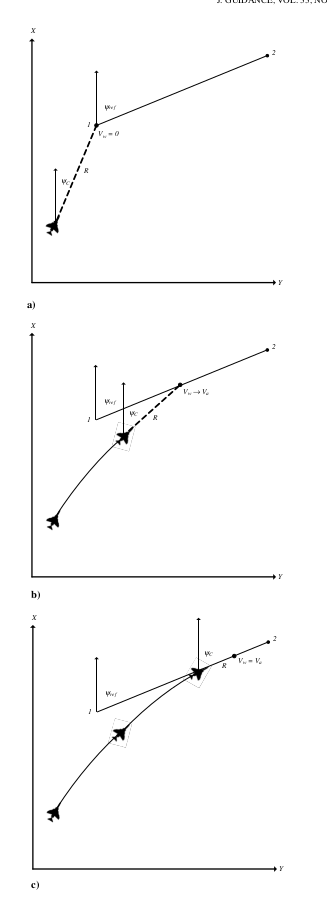
Source: https://www.researchgate.net/public...thm_for_Following_a_Desired_Flight_Trajectory
In the paper (https://www.sciencedirect.com/science/article/abs/pii/S1270963818322971) this strategy is implemented with one modification. Instead of looking at the line of sight (LOS) angle, we take the closest point to the path and look at the LOS angle between that point and the reference point and use this angle as the reference angle whcih is lambda d here.
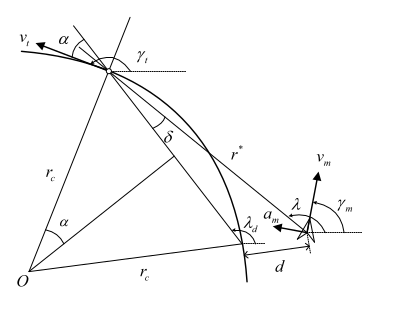
One problem that I encountered here is that the initial conditions play a huge role in this strategy. If the initial heading angle error is too large or the UAV is too far away from the trajectory, it tends to not converge into the trajectory since it a reference course angle that points to one point of the path from another point instead of from the UAV.
As a possible solution, I am considering implementing another position controller, so that the UAV gets close to the reference trajectory and stays there.
Last edited:
I made it talk about GNC topics in general so it also includes guidance laws for AAMs and SAMs. Pure pursuit is an old guidance law but nowadays also used for trajectory control.Is this thread to do with the various Guidance/Navigation laws used to control the trajectory of AAMs and SAMs?
Something I'd love see discussed in this thread is the physical implementation of these guidance laws in discrete analogue circuitry as implemented in the Talks, Terrier, Tartar, first-generation Standard Missiles, Sidewinder and sparrow missiles (Especially in circuitry using sub-miniature valves).
If you are interested in hardware realization in general in early days, I can recommend this talkSomething I'd love see discussed in this thread is the physical implementation of these guidance laws in discrete analogue circuitry as implemented in the Talks, Terrier, Tartar, first-generation Standard Missiles, Sidewinder and sparrow missiles (Especially in circuitry using sub-miniature valves).
This is something I stumbled across years ago when searching the USPTO website for navigation laws connected with the AMRAAM and I believe I may know the navigation law(s) used by the AIM-120:
H001980H Adaptive matched augmented proportional navigation
And
Proportional Guidance (PROGUIDE) and Augmented Proportional Guidance (Augmented PROGUIDE)
Both were authored by James R. Cloutier
Now what made me think this might be the navigation law is that the guidance law eliminated the "Time to go" term in the equation and it made reference to the AMRAAM programme office.
H001980H Adaptive matched augmented proportional navigation
Abstract
Two new adaptive homing guidance laws are developed which are variants of AugmentedProportional Navigation (PRONAV). The first guidance law commands flight path angle rate and is referred to as adaptive matched augmented PRONAV (AMAAP). The second guidance law commands linear acceleration and is referred to as adaptive matched augmented linear PRONAV (AMALP). The major attributes of these guidance laws are (1) they are the solutions of a linear quadratic control problem, (2) they do not require an estimate of time-to-go (tgo), (3) they are matched to a nonlinear model of the target's motion, (4) they adapt in real time to provide optimal guidance over each small segment of the intercept trajectory, and (5) they optimally account for missile deceleration.
And
Proportional Guidance (PROGUIDE) and Augmented Proportional Guidance (Augmented PROGUIDE)
Abstract
Two new homing guidance laws, designated as proportional Guidance (PROGUIDE) and Augmented Proportional Guidance (Augmented PROGUIDE), have been developed for use against non-maneuvering and maneuvering targets, respectively. These guidance laws are the solutions of linear-quadratic regulator control problems and minimize deviations from the collision triangle over the entire period of homing flight, thereby indirectly minimizing miss distance. In contrast to proportional navigation (PRONAV), these algorithms command the achievement of angular acceleration instead of linear acceleration and there is a significant advantage in doing so. The guidance laws (1) are more compatible with the seeker measurements which are angular in nature, (2) do not require an estimate of time-to-go,
(3) can be used to directly drive the skid-to-turn or bank-to-turn logic that produces autopilot input commands, (4) avoid actuator saturation through the real-time adjustment of a single parameter in each channel, and (5) are less sensitive to random errors. Thus these guidance laws are not only effective in and of themselves, but also provide a simple framework within which an integrated guidance and control design can be carried out. The integrated design accounts for interactions between the target state estimator, the guidance law, and the autopilot during the design process.
Both were authored by James R. Cloutier
Now what made me think this might be the navigation law is that the guidance law eliminated the "Time to go" term in the equation and it made reference to the AMRAAM programme office.
Attachments
Last edited:


