Future USN Frigate Design Speculation

TLAMs are the most important part of an American warship. They're the colonial peacekeeper.
Certainly the most used part of an American warship.


It doesn't have to be good. It has to avoid underwater rocks and maybe find a diesel or something before it shoots.
Those are simply currently in production. If we need to go cheap we only install one blister per side instead of all 3.
 
TLAMs are the most important part of an American warship. They're the colonial peacekeeper.


It doesn't have to be good. It has to avoid underwater rocks and maybe find a diesel or something before it shoots.

FF(X) will never see a day in a major combat zone like the South China Sea at least until the U.S. Navy has run out of supercarriers and Burkes, at which point the U.S. Navy has been defeated, so it will never see a day in major combat because the United States would be forced into a surrender long before that. It might fight the Iranian or Venezuelan Navies, who are not particularly fearsome, but would require a bit more mettle than was demonstrated in Praying Mantis. Not that much more but still.

The CONOPS that defined FFG-7 basically died with the USSR and the birth of real-time surface ship observation in the 1990s though. You can no longer thwart an air raid by simply shooting down a VID maritime patroller like a Fw 200 or a Tu-142.

The air raid will simply not launch until they have VID'ed your surface units and battlegroup positions via satellite these days, which can be purchased commercially easily from companies like ICEYE, making even countries like Saddam's Iraq a potential naval threat (they had Saccades [or Silkworms] and H-6s) against major SAGs. The most important aspect of defending a hypothetical convoy is that it now requires Aegis, and preferably AMDR, with supercarrier support because the same threats that will be used against a CVBG will be used against a convoy to enforce a blockade. Which is why convoys won't be used.

Merchant ships are fast enough to evade attack by submarine outside of chokepoints now and bunching them together makes a convoy an obvious target when you see like four warships moving together with six ULCCs, RO/ROs and CONEX freighters.

So the merchants just get told to follow trade lanes, fly false flags or act as a ghost fleet, and link with escorts into the grey zone for a blockade run. They're fast but they're not that fast and escort will be necessary in the actual combat zone. I guess you can argue it's not a convoy in the sense of just like a quarantine isn't a blockade. There's a matter of distance involved.

Basically everyone assumes there will be these big trans-Pacific operations to interdict supplies when the reality is it's going to be people sending their shipping to Australia and Japan and avoiding Taiwan because it's a combat zone. It'll look more like Ukraine's air travel situation in 2014 than anything else because the war between the US and PRC won't immediately go super hot. It may not even devolve into a world war since the US is unlikely to get Europe to go along with it.

Anyway AIUI the Constellations were a kludged attempt to get something comparable to Burke for half the price. It failed. You can't make "basically a Burke" without paying for "basically a Burke" in price and displacement. By the time the Connies would've stabilized in design they would've been $2 billion a piece or very close to it. So like 80% of a Burke's price for 80% of a Burke's capability. Shocker.

The DON is now trying the opposite approach: make something barely suitable for the Red Sea or anti-ISIS operations/OEF-P/Horn of Africa, and replace the Burkes in AFRICOM, SOUTHCOM, NORTHCOM, EUCOM and CENTCOM with them when the war comes, so INDOPACCOM can have all the resources it needs to prosecute a major regional war without draining our ability to bomb the Middle East with cruise missiles.

People need to stop thinking in terms of FFG-7 and start thinking in terms of the Gowind 3100 or the MEKO 360. That's the best analogy here. The main difference between FF(X) and Gowind or MEKO is that FF(X) will have an actual strike capability in the form of TLAM. FF(X) is just the kind of warship Europeans have been building for years for their far-flung colonial patrols and major exports except America needs actual muscle in that patrol.

FF(X) might not be able to conduct a Shayrat, at least without SSN support, but it can contribute to that mission with 8-16 TLAMs per hull.

tl;dr It's a cheap hull for a navy that now has to choose between losing WW3 or bombing Iran next week in terms of maint skeds.

The USN is very close to the bare minimum to prosecute a major regional war without retreating from entire global areas, it may have already passed this point (we won't know until the missiles start flying), and it needs something to bulk itself up in terms of escorts: two dozen Burkes that could be in INDOPACCOM but are stuck in AFRICOM, EUCOM or SOUTHCOM to sling cruise missiles is a massive loss for PacFleet's air defense, and one that could be better done by cheap little ships with cruise missiles instead.

I also don't like the idea that we need something like a FFG-7 or whatever because it's obvious to me that the war in the Pacific won't look like the North Atlantic or even the WW2 Pacific. Not clear why a rear line convoy escort designed to handle at most one or two intercepts during an engagement is useful when the DDG-51 seems to be the bare minimum to just survive in the theater. Considering Burke is just about the only warship the US can make in quantity, getting a second ship to be built in similar quantity so it can push more Burkes to a theater is a good thing, because it means you're getting more Burke per Burke.
Gonna need some actual citations for those claims.
 
Tomahawk is a major investment to add whereas RGM-184 Naval Strike Missiles (NSM Q) was intended to be the stick for FF(X). It's much shorter (1/3) range and half the warhead, but designed to be more survivable. Precision Strike Missile (PrSM) Increment 1 is 1/5th the warhead but flies substantially faster in its ballistic trajectory. Precision Strike Missile (PrSM) Increment 2 doubles the range, is equipped with the multi-mode seeker, and will have the ability to engage moving targets including warships. I think both increments are worthy of exploring. But NSM is definitely respectable for an FF(X) ship.

Mark 41 Vertical Launching System (VLS) requires Strike-length cells to accommodate the Tomahawk cruise missile. That is not an FF(X) once you add such deep cells. If you could fit it in the MK 70 Mod 1 Payload Delivery System (PDS) designed to launch the Standard SM-6 from the LCS, then sure. It's another angled launcher. The system has four strike-length MK.41 VLS cells housed in a 12 meter (40 foot) container. Downside is its 4 missiles aimed all to same side in the space of 8 with 4 aimed each side. Being able to handle Chinooks landing on the deck would be handy for MK 70.
 
Last edited:
Tomahawk is a major investment to add

It's literally a console connected by a big cable to some Mk 70s lol. It's about as intrusive as Phalanx at this point.

whereas RGM-184 Naval Strike Missiles

Are basically a boutique item that's hardly in production and barely worth purchasing except to maintain what few have been bought for the LCS fleet. They might get Mk 141s with Harpoons but it's not an exceptionally pressing demand. FF(X) isn't really supposed to fight ships.

It's a hull being made to replace a Burke's TLAMs and defend it against small threats like Mason/Hanit's random Saccade jumpscares.

Being able to handle Chinooks landing on the deck would be handy for MK 70.

Might be the most British thing ever typed on this forum honestly. It's getting Seahawks and it's gonna like it.

It just may never see those Seahawks because they will be fed to PLANAF and PLAAF missile inventories.
 
RGM-184 is going into USS Constellation (FFG-62) and Congress (FFG-63). It's already in USS Fitzgerald (DDG 62). This is only the third year of the current procurement agreement and the bulk of new orders in FY26 is going to the USMC's (NMESIS) mobile launchers. They committed to a minimum of five years with Kongsberg through FY28. They wouldn't have built a factory in Virginia for a done program. The USAF also has orders through FY28 for the Joint Strike Missile. I don't think the relationship with Kongsberg is ending soon. If anything, since JSM is the Americanized version of NSM, the future NSM orders should become offshoots of the JSM. The JSM is a leaner animal, has better endurance, fits in tighter spaces, and uses as much American kit as possible. If they can find the funding then Harpoon will be replaced by it through maintenance cycle upgrades and attrition.

Nothing much more to say about the other two parts of your post but to say it is an unusual if not unique perspective.
 
The minimum requirement for FF(X) should be FF4923 but I would argue need both FF(X), FFG(X), and a LCS based FF(X) design. The barebones NSC frigates can be handed to the CG after more suitable ones are built.
Would USCG want them?
Also I wouldn't use this in the littoral as it's even more venerable than other ships due to a higher ASM and air threat.
Definitely more vulnerable than the venerable AB...
NSC with an 8-round VLS aft the 57mm for 32x ESSMs guided by the SPS-75 and a Typhon box pair above the boat deck for 8 TLAMs.

Maybe a keel sonar if we can find some SQS-56s in a warehouse somewhere.
Those Tomahawk boxes would have to come off whenever something more useful has to be fitted. A keel or bow sonar would seem to add value, but quietening needs to happen first. Bonus, if some form of electric propulsion is possible, theres a chance to install lasers to improve survivability.
It doesn't have to be good. It has to avoid underwater rocks and maybe find a diesel or something before it shoots.
avoiding rocks (or mines) is useful, but the SSK might be a very quiet modern one, the enemy gets to choose which SSK to put up against you.
FF(X) will never see a day in a major combat zone like the South China Sea
But USN might want to add useful capabilities (like a drone mothership) that could be part of a combat group. So FF(X) needs a bit more self defence than was on LCS, and useful defence against modern manoeuvring threats.
So the merchants just get told to follow trade lanes, fly false flags or act as a ghost fleet, and link with escorts into the grey zone for a blockade run. They're fast but they're not that fast and escort will be necessary in the actual combat zone.
Still quite a distance to escort. Convoys unlikely to be attacked by ballistic missiles, but if they think its valuable enough the new hypersonics might be on the cards. What convoying looks like is a guess until you know it works or not, but every escort probably needs a self defence upgrade, Phalanx not useful in this case and theres also low/slow threats. USN should have a layered defence against both types of threats.
Anyway AIUI the Constellations were a kludged attempt to get something comparable to Burke for half the price. It failed.
They had missiles and air defence, but a mission bay and ASW capability better than any Burke. Quite complementary.
The DON is now trying the opposite approach: make something barely suitable...
Hence this discussion.
FF(X) might not be able to conduct a Shayrat, at least without SSN support, but it can contribute to that mission with 8-16 TLAMs per hull.
With a hull stretch?
 
Those Tomahawk boxes would have to come off

The Typhon line.

They're Typhon boxes adapted for a big girder box frame that's going over the boat deck on the WMSLs.

They're from the Army lol.

whenever something more useful has to be fitted. A keel or bow sonar would seem to add value, but quietening needs to happen first. Bonus, if some form of electric propulsion is possible, theres a chance to install lasers to improve survivability.

Yeah that's why it almost certainly won't get an underwater combat suite. The helicopter is enough.

avoiding rocks (or mines) is useful, but the SSK might be a very quiet modern one, the enemy gets to choose which SSK to put up against you.

The Iranians don't get any choice at all with Russia tied down in eternal war and PRC not exporting subs. The threats FFX is facing underwater won't have materially changed from threats 30 years ago, outside of a handful of things better dealt with by an EU or UK battlegroup, and some air threats that it will never plan on stopping anyway.

But USN might want to add useful capabilities (like a drone mothership) that could be part of a combat group. So FF(X) needs a bit more self defence than was on LCS, and useful defence against modern manoeuvring threats.

FFX has no battlegroup capacity. That's intentional. Costs too much. Connie fiasco really showed NAVSEA how dumb they are (for trusting FMM) but it's an open question if they've learned anything.

Still quite a distance to escort. Convoys unlikely to be attacked by ballistic missiles

Thanks for the laugh.

18 FEB 24.

Europe better get on that BMD Aster 30!

Phalanx not useful in this case and theres also low/slow threats. USN should have a layered defence against both types of threats.

16 JUL 06.

09 OCT 16.

12 OCT 16.

They had missiles and air defence, but a mission bay and ASW capability better than any Burke. Quite complementary.

They were a rather stupid attempt to apply LCS economics to a Burke to get a Fridtjof Nansen i.e. 66-80% of a DDG-51 for 50-66% of the cost of DDG-51. Regrettable for the MBAs at FMM, capability drives cost and there's no getting around this.

Perhaps they could have delivered the Connies without radars or VLS to save money, deferring that to a midlife upgrade (quarter life?) but that kind of European fiscal foresight is beyond DON and FMM.

Hence this discussion.

It's weakly informed because everyone seems to want to calque the FFG-7 onto FFX because it has frigate in the name. No, it's almost the complete opposite. It genuinely will never get ESSM if it costs too much to program in down the line.

With a hull stretch?

The first FFX will carry between 8 and 16 TLAMs on a baseline and otherwise unmodified NSC hull. It's not some huge secret.
 
Last edited:
The Typhon line.

They're Typhon boxes adapted for a big girder box frame that's going over the boat deck on the WMSLs.
Fixed angle launchers seem more practical tho.
They're from the Army lol.
Yeah that's why it almost certainly won't get an underwater combat suite. The helicopter is enough.
Presumably it has to use a drone to pickup the first contact, classify it, and figure out where to send the helo.
The Iranians don't get any choice at all with Russia tied down in eternal war and PRC not exporting subs.
Everything can change. I cant predict where an admiral might send this ship whether or not its up to the job. And PRC is exporting subs to Thailand, although unlikely to export many elsewhere.
FFX has no battlegroup capacity. That's intentional. Costs too much. Connie fiasco really showed NAVSEA how dumb they are (for trusting FMM) but it's an open question if they've learned anything.
But if its going to be a drone mothership, it might get pressed into unintended roles.
Thanks for the laugh.

18 FEB 24.

Europe better get on that BMD Aster 30!
Point taken. But you realise you have just proven that you now need BMD just to sail past the Houthis.
16 JUL 06.

09 OCT 16.

12 OCT 16.

They were a rather stupid attempt to apply LCS economics to a Burke to get a Fridtjof Nansen i.e. 66-80% of a DDG-51 for 50-66% of the cost of DDG-51. Regrettable for the MBAs at FMM, capability drives cost and there's no getting around this.
You know it wasnt that simple. Too many competing priorities. But as i said, Constellation complements some of Burke's weaknesses.
Perhaps they could have delivered the Connies without radars or VLS to save money, deferring that to a midlife upgrade (quarter life?) but that kind of European fiscal foresight is beyond DON and FMM.
Better to deliver with just a smaller radar. Adding half the VLS later wouldnt save that much but whatever you need to do.
It's weakly informed because everyone seems to want to calque the FFG-7 onto FFX because it has frigate in the name. No, it's almost the complete opposite. It genuinely will never get ESSM if it costs too much to program in down the line.
You are pushing your FFG7 idea onto the conversation, but thats a different ship for a different time. You are right, it had a different role, but it was supposed to be armed appropriately for for that role. Most people here seem keen on finding a way to make this combat ready for something at least useful. USN already has enough ships not setup for asia pacific scenarios.
The first FFX will carry between 8 and 16 TLAMs on a baseline and otherwise unmodified NSC hull. It's not some huge secret.
I suspect you wont get more than 8 there on the stern, assuming theres never any attempt to squeeze in a towed array as well.
 
Fixed angle launchers seem more practical tho.

They don't exist. Typhon does. That's all that matters. If FFX needs a punch for anti-ship it might get Mk 141s or it might get NSMs. Who knows.

Presumably it has to use a drone to pickup the first contact, classify it, and figure out where to send the helo.

What on Earth lol. It'll just use a helicopter or eat a torpedo. It's a disposable little thing.

Everything can change.

If an FFX is in Westpac then the United States has lost the war, and the PLAN has secured a substantial victory as the new global hegemon or whatever is closest to it, because we've clearly run out of Burkes to throw at them.

I cant predict where an admiral might send this ship whether or not its up to the job. And PRC is exporting subs to Thailand, although unlikely to export many elsewhere.

Thailand is a US ally so who cares.

But if its going to be a drone mothership, it might get pressed into unintended roles.

FFX won't be a drone mothership unless you consider the FFG7s to be drone ships because they replaced the Mk 13 with Fire Scout data links.

They're just trying to figure out how to use the RHIB rack AFAICT.

Point taken. But you realise you have just proven that you now need BMD just to sail past the Houthis.

Mason didn't. BMD is a problem for merchants, convoys and insurance to settle, not their escorts to defend against. You send out a LNTM about raining reentry vehicles and hope for the best.

That's just how convoy operations in the 21st century work when you have fewer than 100 escorts in the largest battle fleet in the world. China can afford to do actual convoy operations, likely will, and that will be a good time for American submariners perhaps. America cannot afford to do it at all but it also doesn't need to. The Red Sea showed that zone air defense by patrolling a racetrack is almost as effective as individual escort al a Praying Mantis.

You know it wasnt that simple. Too many competing priorities. But as i said, Constellation complements some of Burke's weaknesses.

It's literally a cheaper Burke. Turns out Burke is as cheap as it gets!

Better to deliver with just a smaller radar.

80% cost radar for 50% capability!

Connie had a smaller radar anyway. In every way conceivable (except VLS count) it was 2/3rd's a Burke for about 4/5th's the cost. FF(X) might be a fifth a Burke for half the cost but cost is the primary issue the USN faces. It has plenty of high end escorts, but it will never have enough high end escorts to both fight China and keep its empire. So it decided it can afford to buy three or four puny ships, to support a couple Burkes in every COCOM besides INDOPACCOM, instead of needing two full DESRONs in every COCOM.

You are pushing your FFG7 idea onto the conversation, but thats a different ship for a different time. You are right, it had a different role, but it was supposed to be armed appropriately for for that role. Most people here seem keen on finding a way to make this combat ready for something at least useful. USN already has enough ships not setup for asia pacific scenarios.

The USN has tons of ships setup for Westpac. In fact it has nothing but those ships! It needs ships that aren't Westpac rated to free up Burkes for Westpac.

The Connie was an attempt to make a ship that could have its cake and eat it too. Unfortunately it cost too much in weight and money. Oops! Time to make like every other Navy in the world and use a Gowind style patrol frigate.

What kind of mental blockade keeps people from understanding that the USN has a severe deficit of escorts because it's wasting its escorts' potential air defense capacity making a Horizon so the job of a Gowind 3100? It's frustrating to repeat this point especially.

If you think FFX won't have a useful mission by sailing to places that aren't Westpac exclusively, then you might as well say the US needs no more than 6 super carriers, 30-40 Burkes, and two dozen submarines to defend each coast. It's a completely silly argument that ignores the reality which is that the US will be needing to juggle fighting China and the GWOT smolders, while deterring Russia and Iran in Europe and the Levant, all simultaneously.

It has a navy adequately equipped for maybe one Pacific War if it can drag Japan into it (this won't be hard tbf) if nothing changes and nothing else. It'll just be ceding the rest of its global empire to Europe, a neutral at best power, afterwards. FFX might let it keep part of its empire and check China's ambitions in Taiwan for 10-20 years. It might be adversarial to Europe in Africa and maybe the Middle East afterwards. Who knows.

Either way, the navy's issues are that it's using a hydrogen bomb as a hand grenade, with Burkes wasting time doing dumb stuff. It needs a cheap ship to fob off Burkes from lesser theaters to bulk up the 76 or so heavy escorts (out of 90-ish Burkes) for Westpac. The easiest way is to get a couple dozen FFX to always have that Burke quiver in hand.

I think the actual shortfall is like 10 or 12 but the more the merrier although given FFX will cost the same as Connies were supposed to I wouldn't hold my breath for more than a dozen.

I suspect you wont get more than 8 there on the stern, assuming theres never any attempt to squeeze in a towed array as well.

Probably yeah. It's fine.
 
Last edited:
Gowind 3100 is $1 billion dollars built to the wrong standards for US Navy use. Uses the wrong missiles. Needs substantial addons to interoperate. And it has shorter legs than Freedom class. Doesn't make much sense to me. Maybe you can articulate how it makes sense?
 
They don't exist. Typhon does. That's all that matters. If FFX needs a punch for anti-ship it might get Mk 141s or it might get NSMs. Who knows.


What on Earth lol. It'll just use a helicopter or eat a torpedo. It's a disposable little thing.


If an FFX is in Westpac then the United States has lost the war, and the PLAN has secured a substantial victory as the new global hegemon or whatever is closest to it, because we've clearly run out of Burkes to throw at them.


Thailand is a US ally so who cares.


FFX won't be a drone mothership unless you consider the FFG7s to be drone ships because they replaced the Mk 13 with Fire Scout data links.

They're just trying to figure out how to use the RHIB rack AFAICT.


Mason didn't. BMD is a problem for merchants, convoys and insurance to settle, not their escorts to defend against. You send out a LNTM about raining reentry vehicles and hope for the best.

That's just how convoy operations in the 21st century work when you have fewer than 100 escorts in the largest battle fleet in the world. China can afford to do actual convoy operations, likely will, and that will be a good time for American submariners perhaps. America cannot afford to do it at all but it also doesn't need to. The Red Sea showed that zone air defense by patrolling a racetrack is almost as effective as individual escort al a Praying Mantis.


It's literally a cheaper Burke. Turns out Burke is as cheap as it gets!


80% cost radar for 50% capability!

Connie had a smaller radar anyway. In every way conceivable (except VLS count) it was 2/3rd's a Burke for about 4/5th's the cost. FF(X) might be a fifth a Burke for half the cost but cost is the primary issue the USN faces. It has plenty of high end escorts, but it will never have enough high end escorts to both fight China and keep its empire. So it decided it can afford to buy three or four puny ships, to support a couple Burkes in every COCOM besides INDOPACCOM, instead of needing two full DESRONs in every COCOM.


The USN has tons of ships setup for Westpac. In fact it has nothing but those ships! It needs ships that aren't Westpac rated to free up Burkes for Westpac.

The Connie was an attempt to make a ship that could have its cake and eat it too. Unfortunately it cost too much in weight and money. Oops! Time to make like every other Navy in the world and use a Gowind style patrol frigate.

What kind of mental blockade keeps people from understanding that the USN has a severe deficit of escorts because it's wasting its escorts' potential air defense capacity making a Horizon so the job of a Gowind 3100? It's frustrating to repeat this point especially.

If you think FFX won't have a useful mission by sailing to places that aren't Westpac exclusively, then you might as well say the US needs no more than 6 super carriers, 30-40 Burkes, and two dozen submarines to defend each coast. It's a completely silly argument that ignores the reality which is that the US will be needing to juggle fighting China and the GWOT smolders, while deterring Russia and Iran in Europe and the Levant, all simultaneously.

It has a navy adequately equipped for maybe one Pacific War if it can drag Japan into it (this won't be hard tbf) if nothing changes and nothing else. It'll just be ceding the rest of its global empire to Europe, a neutral at best power, afterwards. FFX might let it keep part of its empire and check China's ambitions in Taiwan for 10-20 years. It might be adversarial to Europe in Africa and maybe the Middle East afterwards. Who knows.

Either way, the navy's issues are that it's using a hydrogen bomb as a hand grenade, with Burkes wasting time doing dumb stuff. It needs a cheap ship to fob off Burkes from lesser theaters to bulk up the 76 or so heavy escorts (out of 90-ish Burkes) for Westpac. The easiest way is to get a couple dozen FFX to always have that Burke quiver in hand.

I think the actual shortfall is like 10 or 12 but the more the merrier although given FFX will cost the same as Connies were supposed to I wouldn't hold my breath for more than a dozen.


Probably yeah. It's fine.
Fixed angle launchers do exist and have for many years.

https://www.navalnews.com/naval-new...ded-next-generation-launcher-design-contract/
https://www.baesystems.com/en/product/adaptable-deck-launcher
View: https://youtu.be/YWZ6xZHsQMo
 
Last edited:
Gowind 3100 is $1 billion dollars built to the wrong standards for US Navy use. Uses the wrong missiles. Needs substantial addons to interoperate. And it has shorter legs than Freedom class. Doesn't make much sense to me. Maybe you can articulate how it makes sense?
Gowind would make an excellent starting point for a light frigate, as it's already integrated with many USN systems including NSM, RAM, 57mm gun, Seahawk helicopter and the same MTU diesels used by LCS-2 and NSC. Installing 1-2 MK-41 VLS modules for 32-64x ESSM would no harder than on FF(X). Most importantly it is ASW capable out of the box with a high quality VDS towed sonar.

Range is better than LCS (5,000nm @ 15kts) and can be extended with long range fuel tanks which the French Navy wants for their future light frigates operating in the Pacific and Indian ocean. Electric propulsion is available on the smaller Gowind 2500 so could likely easily be added.

Gowind's best party trick is the drop-in mast module which includes the CIC and combat system. That's the only element that needs to be redesigned for the USN, and the modular design would greatly simplify the task of installing COMBATSS-21, comms, ESM and whatever rotating AESA radar they want. You could literally sub-contract to Lockheed to design and build this module then ship it to multiple yards across the country who could compete for production contracts.

mat_integre.jpg

This would allow for a rapid modular build which would be much more preferable than the current plan which will divert HII's resources when they're already busy building large surface combatants. Greece was offered Gowinds for $400-$450M per hull, so we know they’re cheap to build.
 
Last edited:
Those are the tiny angled launchers for ESSM not Tomahawk which was the subject of discussion.

The Adaptable Deck Launcher is offered in a strike length version that can handle any missile in a Mk 41-compatible canister.
 

Attachments

  • DIGITAL_baes_ds_PRINT_ADL_leaflet_2025.pdf
    1.3 MB · Views: 3
The BAE Systems ADL has only been around as a funded programme for a couple of years. Every other angled launcher that comes to mind is ASuW.
That's likely addressable by the DARPA TERN VTOL UAV
It's dead, Jim! (Sorry, couldn't resist). TERN transitioned from DARPA to ONR in 2018 without any intention to ever fly it.
 
Are basically a boutique item that's hardly in production
Which is presumably why Kongsberg ordered hundreds of NSM engines last July. Remember the USMC is buying it for NMESIS as well as LCS and all the orders from other Western navies. It's also been seen on at least one Burke, being fired from the Fitzgerald in 2024.
 
Which is presumably why Kongsberg ordered hundreds of NSM engines last July. Remember the USMC is buying it for NMESIS as well as LCS and all the orders from other Western navies. It's also been seen on at least one Burke, being fired from the Fitzgerald in 2024.

This is true but IIRC there's still no plans to procure them in huge amounts.

I suspect the first few FF(X)s will have Mk 141s, or nothing, as far as anti-ship missiles go. Perhaps it will be done by removing the Mk 141s from the Burkes and putting them on FF(X)s while the production backlog chews through the DDGs' needs first? That's assuming the Navy about-faced on its plans to put them on destroyers and isn't just testing it on a handful of ships like it is prone to do.

Considering how little love the CG gets, Im sure they would love more ships they didn't have to pay for. Especially since they only got 10 of the 12 NSCs they wanted.

They didn't want 12. They wanted 8 with an option for 10. They were foisted with 11 to keep a Gulf Coast shipyard open through COVID. Now that the Navy has selected NSC, the Coast Guard can wash its hands of it and just skim off that parts supply chain, and DHS can use the USCG money to do something else.

How are there dozens of documents and wargames including a ship class

As I said, there's no document that's PR unclass that says "this is what FF(X) is supposed to do", obviously.

There are dozens of things saying the USN doesn't have enough escorts for Westpac given the threat environment of China is increasingly dangerous to shipping and unlikely to be survivable for ships less well equipped than a Burke. The Navy needs about 75 Burkes to be available and it has 76. That really means it's something like 60 Burkes at any one time if you really press the matter. Usually it's closer to 50.

End goal at the moment is something like 100 Burkes or so. That will likely increase if there are more delays (there will be more delays) as the Flight Is run out of SLEP time.

When you're sending 10% of your surface escort fleet to show the flag in the Mediterranean so Saudi Arabia and UAE don't snuggle up to Brussels or Paris who are increasingly adversarial to the United States (hooray, the early 1990's and all their geopolitical tensions came back), much less deepen their existing relationship with the PRC and Pakistan, that's 10% fewer escorts for fighting an ongoing WW3. The demands of the U.S. Navy to show the flag in other parts of the world isn't going to disappear just because there's a minor and potentially nuclear naval war in the most populated part of the planet.

If you want to be able to fight China and also prevent Europe (or China) from eating the U.S. network of global bases and alliances, you need something like what Europe makes: a tiny frigate not intended for high intensity combat but merely to show the flag.

Connies were always a bad idea made worse by the yard selection because they were supposed to address the shortfall of the Burke fleet directly by making a cheaper Burke. Turns out that's stupid. It's cheaper to just keep making Burkes and produce a tiny little boat of insignificant armament, outside of a colonial war al a Inherent Resolve or Infinite Reach, which is exactly what Europe does. They have big ships and small ships, fast ships and slow ships, but they also know the best ship of all is friendship.

Unfortunately, America is a bit too silly to get ahead of the Burke shortfall by asking Japan or Korea to make destroyers for it circa 10 years ago (there were USNI articles from 2016-2018 about it and the Jones Act at the time), but MHI and HHI will get fat contracts for battle damage repairs when the Second Pacific War (which may or may not end up being WW3) actually kicks off.

If it doesn't happen, great, because it means the house of cards that is the USN surface escort fleet won't have its nakedness exposed. This is something every mid level is talking about but all the flag guys have their heads in the sand about it. They know, of course (they're not stupid), but they literally cannot say it because it means they would be committing career suicide. We can only hope that the big shots turn out to be more competent in general than their opposites (I wouldn't count on it, considering the PLAN isn't stupid either, it's just inexperienced) because that's about the only way you can beat an industrially superior opponent in an industrial war.

China holds all the cards in a potential showdown with the US and if it comes to blows they have an even, or slightly better than even, chance of defeating the United States right now. It will flow in their favor for the next 20 years or so until the USN can patch over its declining hull strength in the surface escort fleet (this has already hit), the carriers (this will hit in 2028-2030), and the submarine hulls (this will hit 2036-2042).

Past that nobody really knows but the general hope is that the investments made today in ships like FF(X) and the 774 production boost (if you've been getting targeted ads in your email about WELDING SUBMARINES...) skedded for 2028-2030 will be a lot better than the Trump I era stuff like the Connies and other hot garbage. There's stuff moving with the LHAs and CVNs to try to clear the backlogs caused by COVID that made Fallujah 8 years late and JFK just now getting her sea trials. Open question whether those pan out, honestly.

The real problem is that we won't see dividends on all that before about 2050 so that gives China plenty of time to just keep steady pace and surpass the U.S. in global strength within a decade or so. All you can really do about that is spite the sky and hope they fumble it somehow for now. Given they've been breaking every industrial moat we've built that's not terribly likely. The second best thing to do is to make kicking America out of Asia an extremely onerous goal.

The good news is we might be able to manage that one it just might cost pretty much the entire U.S. Navy if it goes off sooner rather than later.

Maybe you can articulate how it makes sense?

Do you understand what an "analogy" is?

Europe has tiny patrol frigates like the MEKO 200/300 and the Gowind 3100.

The USN needs that because it has nothing but high end surface escorts that it can't afford enough of.

Gowind would make an excellent starting point for a light frigate

We're never buying another European frigate again. NSC is better because it's production ready for American shipyards.

 
Last edited:
Those are the tiny angled launchers for ESSM not Tomahawk which was the subject of discussion.
Maybe you should have read the fact sheet I posted
That literally says

“This identical approach also applies to other missiles and missions including Surface Strike, Air Defense, and Anti-submarine warfare. The ADL answers the call for Distributed Lethality and Distributed Maritime Operations for platforms big and small. Direct applications include LCS, FFG(X) as well as big deck amphibious ships and carriers.”
 
The BAE Systems ADL has only been around as a funded programme for a couple of years. Every other angled launcher that comes to mind is ASuW.

It's dead, Jim! (Sorry, couldn't resist). TERN transitioned from DARPA to ONR in 2018 without any intention to ever fly it.
Doesn’t matter how long it’s been around as a government funded project. They’ve existed since 2018
 
I guess simplifying is your problem. I want facts not hot winds in my sail.

Fascinating. Anyway...

Okay, fellas. Let's start nailing down specific baselines for an FFG(X).

Why? The baseline is NSC.

Main Gun Weapon System (GWS) - Bofors 57 mm (2.24") Mark 110 Mod 4 Naval Automatic Gun System (AGS) mounted in a low-RCS stealth cupola atop the fore-deck.

It'll be whatever NSC has.

Oto Melara 76 mm/62-cal Super Rapid Compact Naval Gun

Never going to happen. The Navy has standardized on the 57mm. So has USCG. There's no point to change it now.

Gun Fire Control -

Is this AI generated text?

CIWS - One fore-mounted

It'll be a single Mk 15 aft above the hangar. The 57mm covers the front sector just fine.

Close Range MG

The NSC has four mounting points (two port two stbd) for .50 cals. There will be a Mk 38 Mod 4 too.

Angle-container Missiles -

Entirely possible since the boat ramp will be replaced with some sort of weird deck girder thing for mounting boxes. NSM, Mk 141, Hellfire, etc. Whatever you want, really, provided you pay for it. That's always the funny thing with modularity: these things never get paid for.

VLS Missiles

Nope.

Directed Energy Weapons

Nah.

Mark 32 surface vessel torpedo triple tubes

Useless. They might be there though.

Two Nulka decoy launchers.

They're next to the exhaust IIRC.

Communications

Radios, believe it or not, will be present!

Active Electronically Scanned Array (AESA) Multifunctional Radar

It's whatever LCS has so I think it's SPS-77. Could change!

Your AI is wrong by the way the SPS-75 is the TRS-3D.

Electromagnetic Warfare (EW) Suite

It will have the new two panel SEWIPs.

Bow-mounted Sonar

Nah. Not yet anyway.

Aviation Support - Chinook and Sea Stallion deck load capacity

Still the most British concept in the universe, Chinooks are for the land, silly Brits!

Propulsion and Primary Power Generation

There will be engines, indeed!

Child Vessels -

They're calling it the most Indian English LLM generation yet.

Utility Cranes

There will be davits for a RHIB.

Poke it to pieces.

You don't seem to understand the purpose of FF(X) or the intent of the SSCs at present because you seem to think that this information isn't known? I can't really discern what your hangup here is.

Anyway, everyone knows what the FF(X) will look like: The long lead items for the first ship have been in place for several years at Pascagoula! The Coast Guard bought and paid for them, as I understand. At some point the Congress allocated funds for initiating long leads for the 12th WMSL, but I believe that one fell through, or it's all also sitting in warehouse with the ex-Friedman's long leads.

What isn't known is how well it will perform in sea trials (i.e. is Pascagoula going to need to go through a major learning curve, since it's been many many years since they built any NSCs to completion, and nor do we want propulsion casualties and gearing issues seen in LCS-1) and whether DON and the Congress will continue supporting the program. It's entirely possible the Congress will demand, as many people in this thread seem to want, a million dumb stupid missiles and big guns on it and ruin the whole thing.

No one knows how many FF(X) will be built but the hope is roughly between "more than two" and "1:1 for all the LCS and the Connies". Which is why the estimates are so wide because the Navy has basically said "yeah we'll pay for the two you have the parts for and see where it goes" unless they don't do that.

Admittedly, TIL, as I thought their intention was to use ESSM in surface to surface mode, not stretch it another meter.

Everything about ESSM is purely speculative but the general idea is something like the Navy buys a couple FF(X), offers some changes, and somehow a few ESSM are squeaked into the hull to provide capability similar to European patrol frigates like the Gowind or MEKO. This will satisfy non-Westpac theaters like the Caribbean and Red Sea just fine. Mason managed to live through the Houthis firing twice with "basically ESSMs and chaff" without incident if we discount the couple of Standards she expended.

Surface to surface will be whatever the Navy wants to put on the FF(X)'s fantail. That could be Hellfires, Harpoons, NSMs, TLAMs, etc.

The minimum requirement for FF(X) should be

At this point, to exist. The minimum requirement for a Navy escort is to exist. NAVSEA's attempts at bringing escorts into existence over the past 30 years have been comedic and tragic. It's a bit harrowing because there's a real possibility the Navy will simply buy one or two FF(X) and cancel the program because it doesn't like the ship for some reason.
 
Last edited:
There are dozens of things saying the USN doesn't have enough escorts for Westpac given the threat environment of China is increasingly dangerous to shipping and unlikely to be survivable for ships less well equipped than a Burke. The Navy needs about 75 Burkes to be available and it has 76. That really means it's something like 60 Burkes at any one time if you really press the matter. Usually it's closer to 50.

End goal at the moment is something like 100 Burkes or so. That will likely increase if there are more delays (there will be more delays) as the Flight Is run out of SLEP time.
If the Navy has 75 Burkes, they only have 25 out at sea. 25 more are in refit after a deployment, and 25 are in workups getting ready to go out to sea.

If you're lucky you could surge most of those 25 in workups, but not all of them at the same time. I'd guess maybe half of them could be surged immediately to less-dangerous places to allow the Burkes in that place to go to the fight. But you'd still be looking at probably 3-4 months before all the rest of the Burkes could surge. (Note that the second "half" is going to be staggered all to heck, as the different ships all entered refit at different times)

And then you'd be looking at an operational cycle of 12-16 months out at sea and then 6-8 in refit-and-workups in wartime.


Admittedly, TIL, as I thought their intention was to use ESSM in surface to surface mode, not stretch it another meter.
My thought on the angled launchers was on the carriers in place of the ESSM box launchers (Mk29s?), as it would allow for carrying SM2s and SM6s.
 
Kat Tsun,

You need to cease with the ad hominem. I am not 'Brit' nor did AI generate my content. The nonsensical 'Indian English LLM generation'. You made some statements and have neither given sources nor justified the statements logically. Debate doesn't have to be your superpower, but at least genuinely participate.

And get your facts straight. You said it is getting AN/SPS-77. Legend already had AN/SPS-75, so if uses an LCS based AN/SPS-77 radar then its going backwards. Freedom used the same. AN/SPS-80 (TRS-4D) was slated to be on the next batch of LCS before it got cancelled. Sea Giraffe 4A has Gallium Nitride (GaN). Independence ships used the AN/SPS-77 in versions (V)1, (V)2, and V(4); AN/SPS-77 is also called Sea Giraffe AMB. The Sea Giraffe 4A and 4FF are higher end and use S-band, where the AMB is C-band and doesn't give the picture necessary for the range and best use of ESSM or AMRAAM-ER. It certainly would handicap any ship that carried SM-6.

You also said, "There are dozens of CSIS wargames and GAO documents online." You can see the CSIS farcical wargames about Taiwan from 2025. https://csis-website-prod.s3.amazon...df?VersionId=nr5Hn.RQ.yI2txNNukU7cyIR2QDF1oPp It's horribly done. I sure hope they spent a little effort on the others. The methodology is a wee bit lacking. And we only have to mildly wonder why NAVSEA cannot find its direction when strategic stinktanks like this exist to drive policy.
 
It wasn't worth arguing something that obvious...
BAE have been trying to sell the concept since then (well, before then according to your link), that doesn't mean there was actual hardware in 2018.
Perhaps they weren't successful because nobody had tried to replace a FFG combatant class with a coastguard vessel, therefore didn't need to use deck space instead of VLS. Probably will depend on priorities in thd end, with ADL getting swapped out for NSM launchers as missions change. However I can see the logic of putting old Harpoons onto useless ships, matching the weapon to the likely threat. AShMs are kind of a defensive weapon in my view anyway.

Maybe use this ship as a platform to test new and better close-in air defence.
 
If the Navy has 75 Burkes, they only have 25 out at sea. 25 more are in refit after a deployment, and 25 are in workups getting ready to go out to sea.

I said they'd have 50-60, yes. The Navy needs about 100 Burkes to achieve its stated requirement of 75 mission capable LSCs. It'll also need about 50-60 SSCs to do the job of colonial policing during WW3 when the LSCs are broadly unavailable for tasks outside of INDOPACCOM.

No prizes for how many Burkes been ordered and how many FF(X) that HII wants the Navy to order.

If you're lucky you could surge most of those 25 in workups, but not all of them at the same time. I'd guess maybe half of them could be surged immediately to less-dangerous places to allow the Burkes in that place to go to the fight.

The hope is there is a latent period where the PRC isn't engaging US forces directly in Westpac from the get-go. The problem is that might result in a fait accompli like 2014 did, if the PRC is actually more competent on the ground than imagined, or a very long time for Taiwan to wait it out. Neither are good, but they're better than engaging the PLAN from the start, and if the PRC can annex the ROC quickly it might actually push the rest of Asia to huddle around the United States for protection.

Otherwise it'll be a chaotic and calamitous situation for 3rd Fleet to get organized, very much like 1942, and 7th Fleet might just all die.

But you'd still be looking at probably 3-4 months before all the rest of the Burkes could surge. (Note that the second "half" is going to be staggered all to heck, as the different ships all entered refit at different times)

This is why people in the Beltway are saying Taiwan needs to hold out for about six months, which is about how long it will be before 3rd Fleet can rescue them, assuming that's even an option considered.

And then you'd be looking at an operational cycle of 12-16 months out at sea and then 6-8 in refit-and-workups in wartime.

The war likely won't last that long thankfully.

Most folks think it'll be 1-6 months tops before the nukes start flying. Then it's figuring out how to fight an intercontinental war under nuclear conditions, both tactical and regional/operational. Nobody's done that one before, so it'll be very exciting for the problem solvers, and it might not even result in a thermonuclear apocalypse even if national ABMs are absent. Which they probably will be, since Golden Dome's SBI portion won't be operational until the mid-2030s, and whatever China is making is likely similar plus or minus a few years.

The hope is that by 2030 we'll have enough production scaled and a large enough conventional weapon inventory that the nukes won't be needed. 2030 is a long way's away though.

If the war comes sooner than later, the likelihood of theater nuclear use is higher, but it's less dire than it was three years ago.

And get your facts straight.

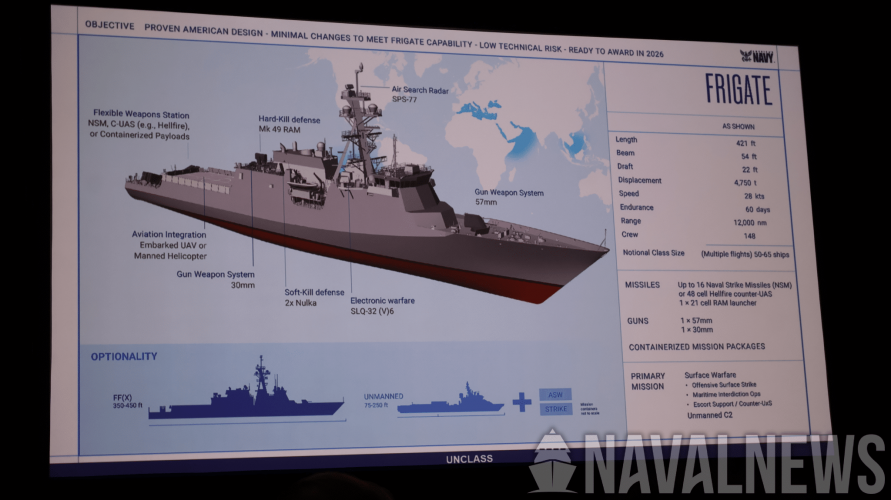
You clearly have no idea what FF(X) is or what it's supposed to do. You don't even know what radar it has. Here is a PR diagram:

1771634586306.png

A lot of this is notional still, but the sensor fit is pretty locked in, since SPS-77 won the Navy's heart.

If the LUSV (or whatever it's called this week) gets bodied by budget concerns then the FF(X) will need MK70 and ASW though so the NSMs are still up in the air. The main thing the Navy is saving by using NSC's hull is it doesn't need to try to figure out how to do naval architecture (again) because NAVSEA divested itself of its surface combatant NAME capability in the late 1990s or early 2000s to favor carriers and submarines.

The cool part about the flexible weapon station though is that it has all the neat modularity of the LCS without eating internal hull volume. So it can take stuff like Mk 141s, NSM, Mk 70, etc. without issues.

You can see the CSIS farcical wargames

Well, if that's your opinion, then I suppose that's your opinion, and no amount of sense or reason will penetrate you. Carry on.

CSIS isn't the only one suggesting such scenarios, but the blockade scenario is a definite possibility, as is the 2023 CSIS wargame.
 
This seems relevant in Legend class survivability. Copied from reddit user barath_s

"The Legend class cutter was built with an eye on damage control and level 1 survivability standards. There are multiple levels to these standards, and no specific equipment per se that defines it.... Per below : https://research.chalmers.se/publication/544715/file/544715_Fulltext.pdf

Survivability level 1: Sustained ability to rescue personnel and prevent complete loss. Minimum remaining ship functions: 50% of the pump capacity; 75% of the regular crew; and 50% of the life rafts.

Survivability level 2: Sustained ability for mobility: Minimum remaining ship functions: survivability level 1; 50% of the propulsion capacity; 50% of the rudder capacity; and 50% of the electric power or emergency power.

Survivability level 3: Sustained self-defence capabilities. Minimum remaining ship functions: survivability level 1 and 2; and 50% of self-defence systems (with electrical power, associated sensors and target systems and ammunition storage).

Survivability level 4: Sustained fighting capability. Minimum remaining ship functions: survivability level 1 and 2, 100% of command and control, 100% of communications, 50% of weapon systems and associated sensors and ammunition storage; and navigation.

The paper is useful in considering what is most important in each capability for a generic frigate . Also PDF pages 17 onwards in below also talk about what they consider ..."

https://www.secnav.navy.mil/doni/Di...09-00 General Ship Design Support/9070.1B.pdf
 
You clearly have no idea what FF(X) is or what it's supposed to do. You don't even know what radar it has. Here is a PR diagram...
<image snipped for brevity>
A lot of this is notional still, but the sensor fit is pretty locked in, since SPS-77 won the Navy's heart.
They said Legend class would share 90% commonality with NSC, but there are at least three major changes. The radar from the December press release does say AN/SPS-77. It is substantially weaker than AN/SPS-75. But it would allow them to run on just the two diesels in cruise and still run it without dropping into a lower power mode, so there is a sound reason behind it if they did choose this. That leaves the complete power of the LM2500 gas turbine available for sprints and emergencies. They did include the launch and recovery ramp for rigid hull inflatable boat (RHIB) operations. They added two 30mm gun turrets and swapped Phalanx for the 21-cell Mark 49 RAM launcher. And there may be an additional 16 Naval Strike Missiles (NSM) or 48 AGM-114 Hellfire missiles. And not one but two AN/SLQ-32C(V)6 "SEWIP Lite" systems. That's more than 10% difference.

Well, if that's your opinion, then I suppose that's your opinion, and no amount of sense or reason will penetrate you. Carry on.
CSIS isn't the only one suggesting such scenarios, but the blockade scenario is a definite possibility, as is the 2023 CSIS wargame.
If you digest their wargame a little bit they announce a bunch of pawn pieces and then ignore about 40% of them which clearly were defined within the field of play. It just doesn't logically make sense. And its written where they forced an illogical outcome by ignoring any players such as the PLA. Seems pretty stupid. So yeah, unless you want to cite something better I am sure more than than myself would like to see it. You brought it up, so enlighten us.
 
They said Legend class would share 90% commonality with NSC, but there are at least three major changes.

A radar is not a major change. It's an equipment fit. A major change would be raising the survivability level or changing to CODAD.

If it doesn't involve cutting holes in the bulkheads, or arranging for redundant power cabling, it's not a big change. That killed FFG-62.

so there is a sound reason behind it if they did choose this.

It was entirely because of economics and the Navy's collective feelings towards the TRS-3D/4 series that constitutes the SPS-75 AIUI. SPS-77 and -75 both meet the requirement for the SSC's multi-function radars so there's no functional difference between the two.

And not one but two AN/SLQ-32C(V)6 "SEWIP Lite" systems. That's more than 10% difference.

External equipment fit isn't a weakness NAVSEA has. Pretty much every Arleigh Burke in the fleet has a slightly different electronics fit.
 
Last edited:
A radar is not a major change. It's an equipment fit. A major change would be raising the survivability level or changing to CODAD.
If it doesn't involve cutting holes in the bulkheads, or arranging for redundant power cabling, it's not a big change. That killed FFG-62.

It was entirely because of economics and the Navy's collective feelings towards the TRS-3D/4 series that constitutes the SPS-75 AIUI. SPS-77 and -75 both meet the requirement for the SSC's multi-function radars so there's no functional difference between the two.

Sea Giraffe 4FF uses about 1.5 kW over Sea Giraffe AMB. The economics is actually a minor factor. The 4FF is a 360-degree coverage whereas the AMB is a rotating array. No moving parts is an advantage when it comes to long term ownership. The rotating array has to be mechanically maintained and that means shutting the system down and physically inspecting parts for wear. If one array on the 4FF goes down, you may only have one section of the sky that's blind. If the AMB has something go down, it is all down. Then you have range issues. The AMB only covers about 20% of the volume as the 4FF. For slightly more upfront costs you have a substantially better sensor. Over the long term maintenance the 4FF and AMB will not have too dissimilar costs to justify the cheaper radar. And I didn't bring up AMB's weakness in bouncing off the weather versus the lower frequency of the 4FF busting through them.
 
Last edited:
Sea Giraffe 4FF uses about 1.5 kW over Sea Giraffe AMB. The economics is actually a minor factor. The 4FF is a 360-degree coverage whereas the AMB is a rotating array. No moving parts is an advantage when it comes to long term ownership. The rotating array has to be mechanically maintained and that means shutting the system down and physically inspecting parts for wear. If one array on the 4FF goes down, you may only have one section of the sky that's blind. If the AMB has something go down, it is all down. Then you have range issues. The AMB only covers about 20% of the volume as the 4FF. For slightly more upfront costs you have a substantially better sensor. Over the long term maintenance the 4FF and AMB will not have too dissimilar costs to justify the cheaper radar. And I didn't bring up AMB's weakness in bouncing off the weather versus the lower frequency of the 4FF busting through them.
Would I be correct in assuming the higher powered Sea Giraffe 4FF would be a much bigger target for the Chinese equivalent on the USN longer range Advanced Emission Suppression Missile (ASEM) just put out to tender, aiming for a production rate of 300 ASEM per year in just two years with guidance on the missile provided by a seeker head with a home on emission mode found with most ARM's covering a wide swathe of electronic frequencies, GPS and IN.
 
Would I be correct in assuming the higher powered Sea Giraffe 4FF would be a much bigger target for the Chinese equivalent on the USN longer range Advanced Emission Suppression Missile (ASEM) just put out to tender, aiming for a production rate of 300 ASEM per year in just two years with guidance on the missile provided by a seeker head with a home on emission mode found with most ARM's covering a wide swathe of electronic frequencies, GPS and IN.
Both radars are LPI. Besides. anti-radiation missiles (ARM) do much better against stationary targets. An incoming ARM can be intercepted like an anti-ship missile in any case. Also realize the high frequency navigation radar is what guns will be steered with to take out incoming ARM. The rotating radar would have to concentrate on it and give up its rotation to track it either way, which the 4FF would not. If the AMB was fixed arrays I'd feel much better about it, even with its short range. It's fine for a cutter to use, but not the best for a blue water warship.
 
Both radars are LPI. Besides. anti-radiation missiles (ARM) do much better against stationary targets. An incoming ARM can be intercepted like an anti-ship missile in any case. Also realize the high frequency navigation radar is what guns will be steered with to take out incoming ARM. The rotating radar would have to concentrate on it and give up its rotation to track it either way, which the 4FF would not. If the AMB was fixed arrays I'd feel much better about it, even with its short range. It's fine for a cutter to use, but not the best for a blue water warship.
Isn't the newer model of AMB the Sea Giraffe 1X? I think that one has an option of fixed arrays. Looks like some ships use the 1X to control guns, never heard about nav radars controlling gunfire but these days you want to fire guns at manoeuvring air targets anyway.
 
For slightly more upfront costs you have a substantially better sensor.
Slightly is several times (~3) the price, ~2 weight and power.
Both radars are LPI.
LPI modes are not high power modes in the first place, and come at significant performance penalty.
LPI also isn't absolute, and should be measured case by case.

Overall, there are many ways how to improve performance of rearline ship to the point of insolvancy(=failing yet another program). Fitting a magnificent sensor suit against some of the threats it's not meant to face is certainly one of them.
 
Last edited:
This might be even more controversial than basing the FF(x) off of the NSC, but what about the heritage class? Not a ‘proven’ hull form, but it’s not a radical new or experimental design, but it has an active construction line.

Yes smaller so it would be harder to fit high end systems on it, but we could easily have 2 variants an ASW and ASuW variants.
ASW, remove the side RHIB mounts, place SVTT there, add a containerized towed array on the aft platform.
ASuW, remove the center RHIB, add ASMs, and add ASMs on the aft platform.

Possibly a third AAW variant build VLS for ESSM on the aft platform.

Three variants on the same hull, operating together.
This would be more of a corvette.

However the heritages are currently being built and current costs are under $660m
 
Of course, what all this means in the 2020s is complicated. FFG(X) was not exactly an FFG-7 analog and was definitely positioned more as a mid-mix ship than a low-mix one like the old FFGs. You could definitely have made a case for a somewhat lower mix FFG, but FF(X) isn't it.
The only major increase in capability of FFGX over the FFG7s was adding Aegis. Technically FFGX was even down some missiles compared to FFG7, 32 versus 40.
 
The only major increase in capability of FFGX over the FFG7s was adding Aegis. Technically FFGX was even down some missiles compared to FFG7, 32 versus 40.
I’d argue FFG(X) would like have a lot more than 40 missiles standard loadout.
Assuming 4 VLS are filled with ESSM you have more than 40 missiles in VLS. 45 if I’m not wrong, plus 16 NSM.
Even if you have big missiles in each cell, that’s 32 missiles, +16 NSM for a total of 48 missiles.
 

Similar threads

Back
Top Bottom