
You are using an out of date browser. It may not display this or other websites correctly.
You should upgrade or use an alternative browser.
You should upgrade or use an alternative browser.
Royal Navy Type 45 Alternative VLS Discussion
- Thread starter Martes
- Start date
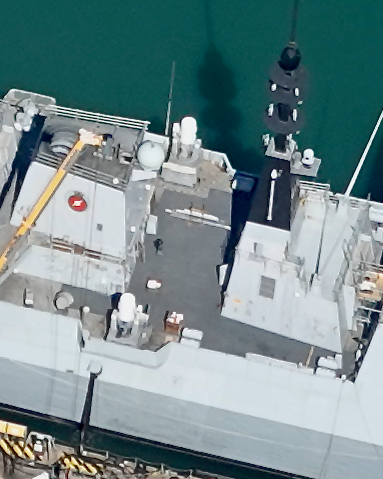
Not practically speaking.What about the space between the forward funnel and the main mast?
View attachment 797349
Is it possible to squeeze an additional VLS cluster there?

acelanceloet
ACCESS: Confidential
- Joined
- 21 November 2012
- Messages
- 89
- Reaction score
- 122
The section between mast and funnel is probably taken up by the engine spaces.

- Joined
- 16 April 2008
- Messages
- 10,588
- Reaction score
- 18,127
What about the space between the forward funnel and the main mast?
View attachment 797349
Is it possible to squeeze an additional VLS cluster there?
The section between mast and funnel is probably taken up by the engine spaces.
And I suspect that bit of deck is also the engine removal path if you do need to pull a turbine out.
FWIW I found this plan on Pinterest - without, unfortunately, any attribution to the source:

If I interpret it correctly (if!) the engine removal path goes basically through the funnel (like on Type 82), and the space in question is occupied by accomodation (deck 2) and various service rooms/passages below.
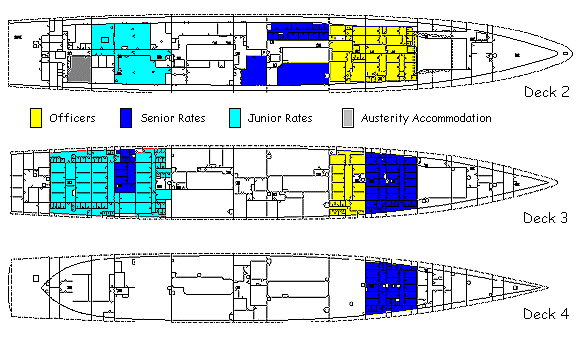
If I interpret it correctly (if!) the engine removal path goes basically through the funnel (like on Type 82), and the space in question is occupied by accomodation (deck 2) and various service rooms/passages below.
Last edited:
Scott Kenny
ACCESS: USAP
- Joined
- 15 May 2023
- Messages
- 19,533
- Reaction score
- 27,979
How tall is the Mushroom Farm in total? 20ft? Could they stick the entire VLS on top of the deck instead?
Maybe? But you're addding weight higher up then when you make it flush with the deck.How tall is the Mushroom Farm in total? 20ft? Could they stick the entire VLS on top of the deck instead?
acelanceloet
ACCESS: Confidential
- Joined
- 21 November 2012
- Messages
- 89
- Reaction score
- 122
Most of the worlds gas turbine ships lift out the turbines either trough the funnel or the intakes. The intakes are often preferred as those have less stuff in the way (exhaust cooling and grids to prevent stuff to drop in the funnel, mostly, while the air intakes solve that by building an housing over the intake channels)
So, the most likely positions for the removal shafts are in the deckhouses just in front of the search radar and the deckhouse just forwards of the fore funnel.
So, the most likely positions for the removal shafts are in the deckhouses just in front of the search radar and the deckhouse just forwards of the fore funnel.
Mushroom Farm?Mushroom Farm
From the plan it appears the forward through-well goes under the funnel + structure forward of it, the aft being under the mast + sampson. Some of those structures would have to be removable, apparently.So, the most likely positions for the removal shafts are in the deckhouses just in front of the search radar and the deckhouse just forwards of the fore funnel.
Not too much weight, especially when compared to the impact of the mast on the overall stability. It should be tolerable.But you're addding weight higher up then when you make it flush with the deck.
Last edited:
The Sea Ceptor single canisters look a bit like mushrooms.Mushroom Farm?

Ah. But the Ceptors ARE located in place of possible VLS, as you said above. It's installation just restricts the gun to 4.5".The Sea Ceptor single canisters look a bit like mushrooms.
Yes, or maybe a 5" installation, the RN seems to have abandoned further developments of 4.5 and gone to the US 5" gun.Ah. But the Ceptors ARE located in place of possible VLS, as you said above. It's installation just restricts the gun to 4.5".
Scott Kenny
ACCESS: USAP
- Joined
- 15 May 2023
- Messages
- 19,533
- Reaction score
- 27,979
You are. But it'd be an option if that's within the ship's upgrade limits.Maybe? But you're addding weight higher up then when you make it flush with the deck.
- Joined
- 5 May 2007
- Messages
- 2,016
- Reaction score
- 4,277
You really can't put anything in that space that penetrates the deck, there's too much going on and it would approach the 'lift up the bell and slide a new ship under' approach to major refits.
The Mk 45 fit would likely require a similar amount of space to the TMF fit, but AFAIK it hasn't been studied.Yes, or maybe a 5" installation, the RN seems to have abandoned further developments of 4.5 and gone to the US 5" gun.
Likewise, I don't believe an all-Mk 41 fit was ever considered. The PAAMS architecture was selected very early – before Type 45 even existed as a project – and it brought with it Aster and Sylver.Like a total number of and layout of cells if Sylver was replaced by American VLS, and such.
acelanceloet
ACCESS: Confidential
- Joined
- 21 November 2012
- Messages
- 89
- Reaction score
- 122
May I ask, how did you identify the turbine removal shafts? I can only spot the large open areas that I suspect house both the uptakes and the intakes.Mushroom Farm?
From the plan it appears the forward through-well goes under the funnel + structure forward of it, the aft being under the mast + sampson. Some of those structures would have to be removable, apparently.
Not too much weight, especially when compared to the impact of the mast on the overall stability. It should be tolerable.
Do note that the turbine removal shafts are not there to remove the entire module but just the aviation style turbine itself, which is designed to be maintained in a shop instead of in-place. The actual drive turbine, cooling systems, management systems etc all remain in place.
I circled the places that I suspect to be the turbine removal hatches in the image below.
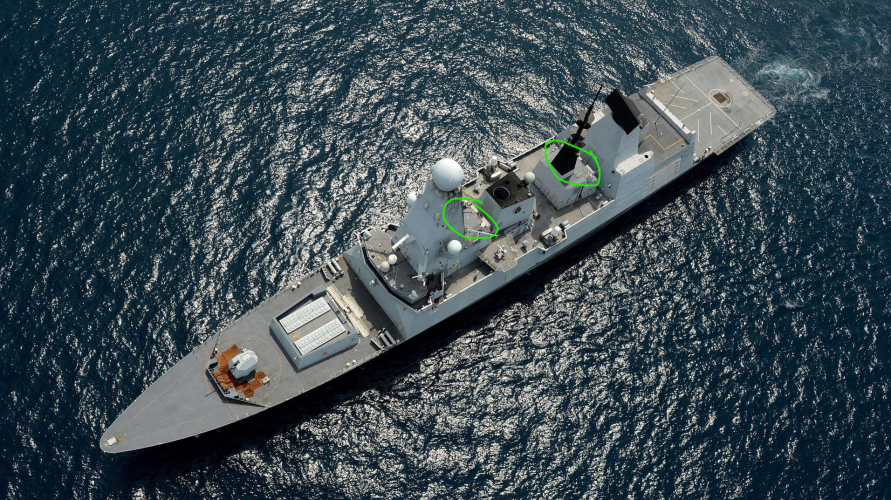
Something that looks like openings going through all three decksMay I ask, how did you identify the turbine removal shafts?
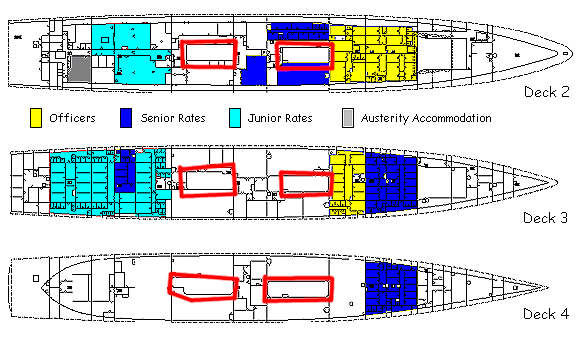
which roughly corresponds to those positions on the superstructure:
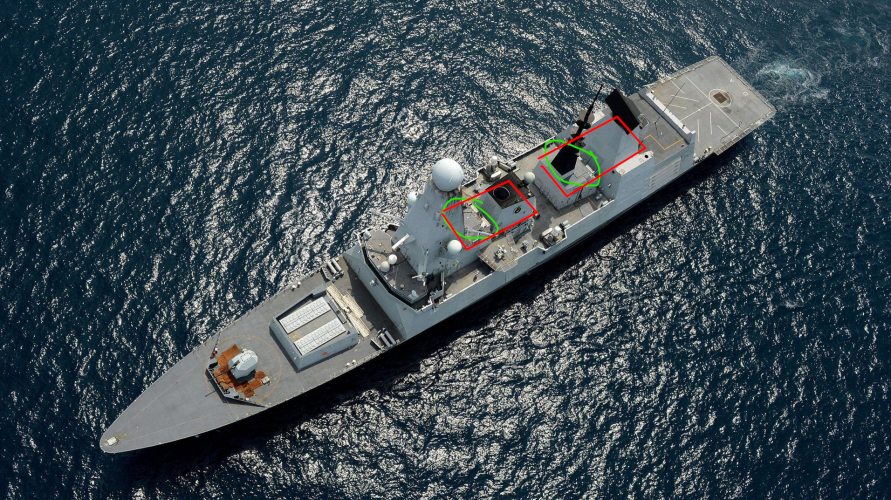
I only supposed it's lifted in horizontal position, and not rotated inside the ship.are not there to remove the entire module but just the aviation style turbine itself, which is designed to be maintained in a shop instead of in-place.
Anyway, it's the space between the two red areas that interests me, whether fitting two 8-cell MK41 was possible there. There are lot of small rooms and passages there, if we believe the plan, so it's definitely not a turbine removal path. The question is more like how crucial are those rooms and passages to running the ship.
Last edited:
- Joined
- 5 May 2007
- Messages
- 2,016
- Reaction score
- 4,277
Those are the uptakes.Something that looks like openings going through all three decks
Indispensable. The passageway through those spaces is the main fore-aft passageway above the damage control deck. I think the galleyThe question is more like how crucial are those rooms and passages to running the ship.
Like I said, the Mk 41 goes forward of the existing VLS.
acelanceloet
ACCESS: Confidential
- Joined
- 21 November 2012
- Messages
- 89
- Reaction score
- 122
Yeah, those openings are indeed matching the uptakes and intakes exactly. Which is what goes trough those spaces.
The actual aviation turbine is only a subsection of the WR-21 module and is the only part that is lifted out.
https://www.tfd.chalmers.se/~thgr/g...rating_slides/pdf_documents/MP 37 low res.pdf
The section of the WR-21 that is lifted out is only the dark blue and green section on the modular breakdown picture in the pdf above. potentially even only the dark green part, as the blue part seems to be boiler related.

So yeah, you don't need to remove the funnels and deckhouses and mast and radar to get those turbines out for maintenance.
The actual aviation turbine is only a subsection of the WR-21 module and is the only part that is lifted out.
https://www.tfd.chalmers.se/~thgr/g...rating_slides/pdf_documents/MP 37 low res.pdf
The section of the WR-21 that is lifted out is only the dark blue and green section on the modular breakdown picture in the pdf above. potentially even only the dark green part, as the blue part seems to be boiler related.
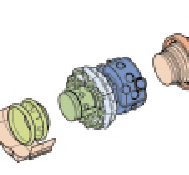
So yeah, you don't need to remove the funnels and deckhouses and mast and radar to get those turbines out for maintenance.
Last edited:
Got it. So to install additional VLS in the middle, the hull must be lengthened, which points to land attack variant.Indispensable. The passageway through those spaces is the main fore-aft passageway above the damage control deck.
Oh, I thought the part that is pulled out is longer, more like the whole aircraft engineThe section of the WR-21 that is lifted out is only the dark blue and green section on the modular breakdown picture


RE: Changing turbines; WR-21 doesn't come out in a single unit as it has the bit recuperator in the exhaust. Instead it is modularised into sections which are slid out sideways then up through smaller hatches. That same recuperator makes it really tall however, so the machinery spaces have a "casing", much like on many cargo ships, that occupies the area over the turbine and extends up another deck.
Another problem with putting a second VLS amidships is that the launch efflux, EMC considerations and consquences of a launch failure mean you need a lot more space than just the launchers. This was what lead to the abandonment of the aft silos in way of the hangar that had featured on some NFR-90 and continued into CNGF. It's a lot easier to have them all at the front as then you only really need to worry about one interaction region.Got it. So to install additional VLS in the middle, the hull must be lengthened, which points to land attack variant.
Oh, I thought the part that is pulled out is longer, more like the whole aircraft engine
It's a lot easier to have them all at the front as then you only really need to worry about one interaction region.
On the other hand, I could imagine wanting to hedge the risks and divide the launchers to two groups, just in case.
Looking at the ship closer, I noticed that the flight deck and the hangar are really, really large. On Chinese or Soviet standard ships the same length of the hull occupied by the landing pad and the hangar on Type 45 would likely house 2 helicopters side by side and a second VLS cluster. I suppose this was mostly caused by the decision to place Merlins on the ships, but was there any special reason to go for a single, and such a large helicopter instead of pair of Lynxes, for instance?
All I can think of is that either the gap in Lynx production and transition to Wildcat caused the requirement for the Darings to house them, or a possibility to use the escort destroyers as backup landing pads for carrier helicopters.
Last edited:

It's not so much about the width, but the length of the flight deck and hangar combined. Merlin does require a very large deck to land even if it's folded later, not mentioning Chinook, and that's what takes the place of a second potential VLS cluster that could've doubled the ship's missile payload.
We didn’t installed the available extra 16 cells, there’s zero chance they’d have done an amidships vls
Again it's not the length of the VLS (which is tiny and the similarly sized FSC could fit one in aft) but the distance the VLS needs to be from things like the LRR aft to prevent damage to the radar and the radio antennas to prevent interference with the missile.It's not so much about the width, but the length of the flight deck and hangar combined. Merlin does require a very large deck to land even if it's folded later, not mentioning Chinook, and that's what takes the place of a second potential VLS cluster that could've doubled the ship's missile payload.
Ainen
I really should change my personal text
- Joined
- 25 August 2011
- Messages
- 2,827
- Reaction score
- 4,931
It is, but the less the order, the less there's meaning to have excessive VLS count. UK, as things stand, isn't exactly big operator neither for aster series nor for VLS tomahawks."Fitted For but not With" should be a swear word.
Empty boxes captivate ship lovers, but they don't add combat value, nor they impress neither actual professionals, nor civilians.
In this sense, mushrooms (which do add helluva combat value and add synergy with army) are a far superior choice.
And mk.41 ultimately came as well, when there's a good plan and financial spot for them. On other ships, of course.
Last edited:
- Joined
- 23 August 2011
- Messages
- 2,557
- Reaction score
- 8,432
K, as things stand, isn't exactly big operator neither for aster series
Actually I think the UK would have had the largest stockpile of Aster missiles of any operator...
When it comes to complex weapons, particularly in that era, the UK always bought far more than the likes of France of Italy...usually multiple times more...
I ought to put, however, a question this way.
From the perspective of hull armament potential (not economic or political, and if considered before building the ship), what is the absolute maximum number of Mk41 cells that can be put in the forward launch area of the T45, replacing Aster and Harpoon space, to make a working and serviceable arrangement?
From the perspective of hull armament potential (not economic or political, and if considered before building the ship), what is the absolute maximum number of Mk41 cells that can be put in the forward launch area of the T45, replacing Aster and Harpoon space, to make a working and serviceable arrangement?
To be fair? Sylver is somewhat inefficient compared to Mk41, plus the leftover room that is now being filled with CAMM?I ought to put, however, a question this way.
From the perspective of hull armament potential (not economic or political, and if considered before building the ship), what is the absolute maximum number of Mk41 cells that can be put in the forward launch area of the T45, replacing Aster and Harpoon space, to make a working and serviceable arrangement?
Probably a 64 cell Mk41.
Even if there would be room for anything larger, realistically nobody will, because it's one hell of a hole in a ships structure. And you'd keep the Harpoon space. There isn't a hole underneath it anyway, as far as I know.
8x8 seems a 1 to 1 replacement of Sylver+CAMM, isn't it? The hole is already there in the hull, but it seems that there is at least space for another row (making it 12x8, 96) of launchers. Or would this make the system too cramped?Probably a 64 cell Mk41.
You're aware that you can actually look up the sizes of the various VLS types and do rough calculations yourself, right?8x8 seems a 1 to 1 replacement of Sylver+CAMM, isn't it? The hole is already there in the hull, but it seems that there is at least space for another row (making it 12x8, 96) of launchers. Or would this make the system too cramped?
I am not sure about the sizes of required spaces between launchers, if there are any. Otherwise 12x8 does seem to fit there without a problem.You're aware that you can actually look up the sizes of the various VLS types and do rough calculations yourself, right?
I tried to fit 4x24
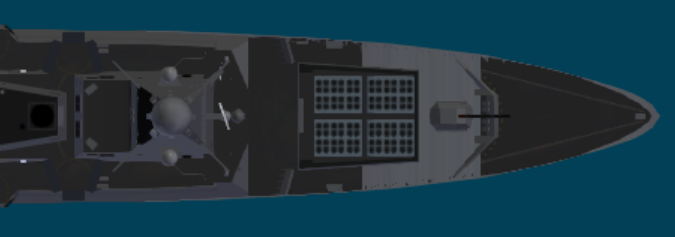
And it looks OK, even with passages between the pairs.
Do I miss anything? Can this be considered a proper armament for T45 hull?
Last edited:
- Joined
- 23 August 2011
- Messages
- 2,557
- Reaction score
- 8,432
To be fair? Sylver is somewhat inefficient compared to Mk41, plus the leftover room that is now being filled with CAMM?
Probably a 64 cell Mk41.
Definitely a 64 cell mk.41. Remember T45 already has 48 Sylver, and had space for 16 Mk.41 Strike Length between them and the 4.5 inch main gun (we don't know if there is enough space under the Sylver A50 for Mk.41 strike length to be dropped in though...you could have them proud of the deck though..).
So 64 Mk.41 (Strike or mixture of Strike and Tactical) is 100% achievable, in 4 rows of 8 cells in 2 columns fore and aft)
The real question is whether there would be enough space for another 8 cell on each row to get to a VL farm with 80 cells in total by virtue of using the same system, instead of a mix of Mk.41 and Sylver, and avoiding the resultant 'gaps'......I think there would if you changed the orientation of the cells (and if there was enough space below to do that) with the longer 'lengthwise' section aligned port to starboard.
But I don't think you'd want to interfere with the Harpoon/NSM space....rocket efflux is still a thing...
Any more than 80, to reach 96, and I think you'd need a 2 metre hull extension and replace the Mk.8 4.5 inch with a 57mm gun...
bobthemonkey
ACCESS: Confidential
- Joined
- 9 February 2011
- Messages
- 85
- Reaction score
- 201
And don't forget that a portion of the lifetime weight growth margin will have also been consumed by fitting the 3rd diesel.
Scott Kenny
ACCESS: USAP
- Joined
- 15 May 2023
- Messages
- 19,533
- Reaction score
- 27,979
For what it's worth, even a 96cell Mk41 with Tomahawks in there is effectively exhausted after one engagement.My inner theory is most such weird situations around the world come to lack of money/priorities.
B/c french/Italian ships do indeed look weird from ammo point of view. One effective engagement, ideally (especially for French, which have a very ... optimistic take on what passes as a CIWS).
Ainen
I really should change my personal text
- Joined
- 25 August 2011
- Messages
- 2,827
- Reaction score
- 4,931
Usual estimate is that engagement is something like ~1.5 dozen targets "equivalent". There are reasonable limitations in how many such sorties attackers can gather per time without risks of unacceptable waste.For what it's worth, even a 96cell Mk41 with Tomahawks in there is effectively exhausted after one engagement.
Equivalent meaning that targets can be more plentiful, but their quality will be lower, or targets can be indeed more demanding, but usually there will be also less of them. All that multiplied by standard pK in contested conditions(~0.8 mean, higher v easier targets, lower for hard ones).
More than that runs into multiple problems, and it becomes mathematically more effective either to add more ships with integrated air defense(collective), or (if you really want more survivability from individual ship) - adding CIWS.
Cheaper neutral ground between these two positions is quad packs.
All that together led to two reasonable optimization points for both land and naval sam systems: something like ~24...32 AA cells for GP combatant, ~40 cells for AA combatant. More AA cells than that (per ship) is usually broadly ineffective, and should be used either in special circumstances(protection of static assets by naval ships, distribution of responsibilities ala JMSDF).
As such, 96 cell Burke can have good ~50-60 TLMs onboard and still remain perfectly viable TF unit without need for protection. This is helluva TLMs, they rarely really need so many.
This is math from 1980s to 2020s, i.e. let's say in "classic VLS era", when, on one hand, attacking seekers were generally ahead of EW defenses(i.e. kinetic intercept had to become the dominant way), on another hand - VLS and sequencing had enough rate of fire to not consider it a serious constraint.
Major recent(2020- ) changes to this calculation are two:
low cost drones, which absolutely require separate C-UAS(and C-UAS turned out to not be served well with classic CIWS, as they had opposite optimization points from ammo/engagement length point of view); engaging these with classic means is ineffective, and they're cheap enough to be constant threat.
second one is ASBMs, which tend to have some problems with aim...but also are cheap and plentiful enough to overwhelm normal "cell counts". Tactical ASBM is ultimately very similar in price and performance to a big interceptor; which leads to a logical conclusion, that the only mathematically meaningful way to fight them is to intercept them with smaller interceptors.
Problem with EU ships is that they were quite on optimistic side of things even before 2020s. 16 Aster-15s in French FREMMs in one layer just screams that this ship isn't meant to face high threat scenarios in 1st line TF; and tbh "AA" FREMMs(and Horizontes, and even FDIs) aren't all that much better, and effectively are meant to fend off only browning shots of ammo-constrained opponent (lone SSN, like that). It can try to fight off one in a pinch, but result will be up to probability gods.
It's perfectly ok if you're meant to operate in Atlantic roughly behind bigger guys, but in other situations result ends up rather constrained. Purpose-made closed theater corvettes (Saar for example) can have several times their available firepower.
- Joined
- 23 August 2011
- Messages
- 2,557
- Reaction score
- 8,432
You're aware that you can actually look up the sizes of the various VLS types and do rough calculations yourself, right?
You could, but without knowing the internal volume available, depth and other constraints below decks and with the VLS chosen its a bit of an exercise in futility...
We can be certain that T45 would take 64 x Mk.41 in a mixture of Strike and Tactical length for sure as space was available for 16 x Strike length and 48 x Tactical will definitely fit in the space occupied by 48 x Sylver A50...but unless someone can get inside a T45 with a tape measure the rest is just conjecture...
Classic gun CIWS appear a success in the Red Sea which would appear to contradict your statement.low cost drones, which absolutely require separate C-UAS(and C-UAS turned out to not be served well with classic CIWS, as they had opposite optimization points from ammo/engagement length point of view); engaging these with classic means is ineffective, and they're cheap enough to be constant threat.
Burkes in the Red Sea had success with both Phalanx DDG-107 Feb '24 and the Mk45 5" main gun DDG-106 Jan '25 in taking out drones.
The impression with Mk45 is that the particular Burke DDG-106 the crew had trained hard to make it effective with its Mk38 GWS using the Mk20 Electro-Optical Sight .
To be noted USN replacing Phalanx with the SeaRAM (max. 9 missiles) in Burkes, presumably for the extra range compared to the Phalanx 20mm APDS round max effective range of only 1.5km?
Ainen
I really should change my personal text
- Joined
- 25 August 2011
- Messages
- 2,827
- Reaction score
- 4,931
Taking down single drones isn't that drones as a threat are about. In this case they're more of very simple practice targets.Classic gun CIWS appear a success in the Red Sea which would appear to contradict your statement.
I'd take more cue from loss of Ivanovets in black sea - when it literally expended all 30mm ammo available and was lost because of that. There were still more drones, which now could avoid main gun and sink the ship.
For CIWS ability to waste ammo is a positive - ship will be sunk long before CIWS will get a chance to use up its ammo, so ciws should fire as much as possible, as fast as possible, preventing first hits at all costs. C-UAS gun should conserve ammo as much as possible, take out of action different targets(surface, big air, smal air) with minimum amount of shots, as far as possible, and different(selectable) ammo.
It needs to have cleanest arcs possible, including negative firing angles. Single accurate shot capability is at premium.
Main gun in this sense is indeed more valuable than Phalanx, as it has far more engagements/mount, using minimum amounts of shells.
Similar threads
-
 Concept submarine with external rim-drive pumpjets
- Started by covert_shores
- Replies: 6
-
Need help translating russian for sensor & weapon types
- Started by fedf111fan
- Replies: 4
-
Upcoming future VLS, variants, packing and magazine depth
- Started by Seragina
- Replies: 20
-
RAN Type 23 based ANZAC Class Frigate
- Started by Volkodav
- Replies: 27
-