Alternate Australian Defence Force 1970s Procurements?

Oberons couldn't be built in the yards that just built the last 2 Rivers, during the peak of Australia's shipbuilding capacity?
You could build them at the same time as the rivers using the drydocks at both williamtowns and cockatoo islands. Propbably could meam u could build the 2nd batch of 4 in australia then
 
Apparently the main reason no Leander class light cruisers where built in Australia was because Coackatoo Islands main slipway was too short. In the 1944 cruiser plan it isnatated that the main slipway at cockatoo island was to be extended to 600ft through land reclemation. So would in the 50s or 60s (preferabley in the 50s) an upgraded to cockatoo islands with the main slipway being extended to 600 to 800ft long and the smaller slipway being extended to at least 450ft long effect naval shipbuilding in australia?
This would allow cockatoo island to build 2 naval ships at once everything from larger oilers, amphibious warfare, maintenaince ships to escorts
 
Apparently the main reason no Leander class light cruisers where built in Australia was because Coackatoo Islands main slipway was too short. In the 1944 cruiser plan it isnatated that the main slipway at cockatoo island was to be extended to 600ft through land reclemation. So would in the 50s or 60s (preferabley in the 50s) an upgraded to cockatoo islands with the main slipway being extended to 600 to 800ft long and the smaller slipway being extended to at least 450ft long effect naval shipbuilding in australia?
This would allow cockatoo island to build 2 naval ships at once everything from larger oilers, amphibious warfare, maintenaince ships to escorts
Yes, lengthening the slipways would greatly help Oz's ability to build warships.
 
It would have been done in the 20s if the government of the day had chosen to build Counties or the Cockatoo cruisers locally.
 
It would have been done in the 20s if the government of the day had chosen to build Counties or the Cockatoo cruisers locally.
It would be ideal if it happend in the 20s after hmas adelaide was lauched. Ive got a whole ATL in my head if that happens. Though still if it happend post ww2 it would still be a quite handy upgraded to have done
 
I just recalled there was a helicopter carrier version of the Type 82.

A quick look at some of my books indicates 4 Chinook (ASW version) or a greater number of Sea King with Sea Dart and a 4.5" gun, from about 1967.

Australia initially wanted modified Counties (actually a new design that was more a Daring with Tatar and helicopters), there was also the cooperation with the Type 21 Amazon class and the Olympus / Tyne propulsion planned for the DDLs.

It is conceivable that Australia could have dusted off the Type 82 DDH design for the 70s as a Daring replacement, while shelving the DDL and also building the Type 21 to increase combatant numbers. The DE (River Class) replacement could have been a modified Type 22 in the 80s.
 
As much as I woukd have loved to see the F-15 in the ADF ORBAT. I think you might be overlooking the factual maintenance/reliability issues with the legacy F-15A/B, as well as the P&W F100 turbofan. Then there was the actual notorious running costs of the F-15.

Truth is, if the mighty USAF were struggling keeping the F-15 combat ready, I think the RAAF explicitly appreciated this.

Regards
Pioneer
Something you might like: Southern Eagles

430750d4-69cc-4d7d-ab30-f9431634d759.jpg

7d9f2a05-70e8-4d1d-b960-dfb85c44cea7.jpg
 
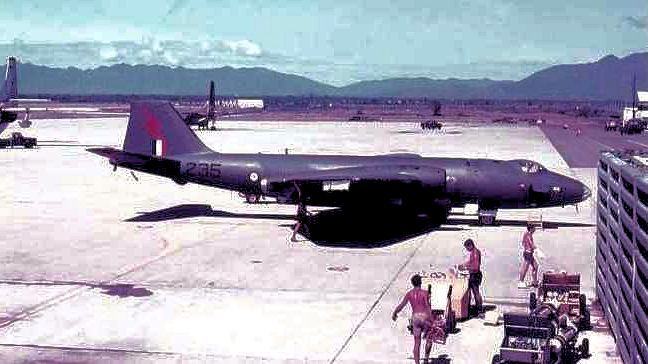
Something I would like to see is Australia go the British route with roundels and aircraft markings and retain the colour rather than greying them out. The white in the roundel is gone, for light coloured aircraft have the colours fade into pastels and for dark, camouflaged aircraft the colours can be darkened.

The red lightning bolt on the tail of this 2 sqn Canberra in Vietnam doesn't disrupt the camouflage scheme, and without the white in the roundels and tail flash the whole plane would be less conspicuous.

1771535381931.png
 
Last edited:
I just recalled there was a helicopter carrier version of the Type 82.

A quick look at some of my books indicates 4 Chinook (ASW version) or a greater number of Sea King with Sea Dart and a 4.5" gun, from about 1967.

Australia initially wanted modified Counties (actually a new design that was more a Daring with Tatar and helicopters), there was also the cooperation with the Type 21 Amazon class and the Olympus / Tyne propulsion planned for the DDLs.

It is conceivable that Australia could have dusted off the Type 82 DDH design for the 70s as a Daring replacement, while shelving the DDL and also building the Type 21 to increase combatant numbers. The DE (River Class) replacement could have been a modified Type 22 in the 80s.
I often wonder how hard the Canadian government tried to sell the 280 class Huron later Athabaskan to anyone and what the RAN thought of them?
Would have thought given all the investment in time and money they would tried to recoup some of the development costs at least ?
Well if you looking for a Helicopter carrying destroyer . I suspect the DDH 280 fills the bill quite nicely
 
I often wonder how hard the Canadian government tried to sell the 280 class Huron later Athabaskan to anyone and what the RAN thought of them?
Would have thought given all the investment in time and money they would tried to recoup some of the development costs at least ?
Well if you looking for a Helicopter carrying destroyer . I suspect the DDH 280 fills the bill quite nicely
I would say it would need a lot of modification to be allowed to fire Tartar/Standard Missile cause the RAN would want Area Air Defence with it as well.
 
Last edited:
Ive just been reading Huey - The Helicopter That Became An Australian Legend by Mark Lax, where he tells how the RAAF was slow to add helicopters to its inventory, and missed a golden opportunity with seeing the utility of Helicopters in Malaya. What happens if the RAAF wasnt as slow to acquire helicopters in the 50's and even sends aircrews to Malaya to serve with the RAF. How does this effect Australian Helicopter development and cooperation between the RAAF & Army, espiceally going into vietnam?
 
Ive just been reading Huey - The Helicopter That Became An Australian Legend by Mark Lax, where he tells how the RAAF was slow to add helicopters to its inventory, and missed a golden opportunity with seeing the utility of Helicopters in Malaya. What happens if the RAAF wasnt as slow to acquire helicopters in the 50's and even sends aircrews to Malaya to serve with the RAF. How does this effect Australian Helicopter development and cooperation between the RAAF & Army, espiceally going into vietnam?
Blamey suggested using helicopters in New Guinea while the campaign was still underway for resupply and other missions. For all his actual faults and conflated bad reputation, Blamey had always been an innovator and always pushed the adoption and integration of new technology.
 
Blamey suggested using helicopters in New Guinea while the campaign was still underway for resupply and other missions. For all his actual faults and conflated bad reputation, Blamey had always been an innovator and always pushed the adoption and integration of new technology.
Yeah the Book mentioned that as well, 6 with 25 proposed of the Sikorsky R-5 would have been quite handy.
Blamey main problem is that McArthur got to Australia before he returned from the middle east, I've always wondered what would have happened if Blamey bet McArthur, before McArthur got into Curtin's ear
 
Ive just been reading Huey - The Helicopter That Became An Australian Legend by Mark Lax, where he tells how the RAAF was slow to add helicopters to its inventory, and missed a golden opportunity with seeing the utility of Helicopters in Malaya. What happens if the RAAF wasnt as slow to acquire helicopters in the 50's and even sends aircrews to Malaya to serve with the RAF. How does this effect Australian Helicopter development and cooperation between the RAAF & Army, espiceally going into vietnam?

5 Sqn had Hueys in Malaysia, but when asked for a pair to go to Vietnam in 1965 Air Marshal Murdoch declined, and was eventually overruled by the Government.

This is one of the issues that I think would be addressed by merging the Defence Departments in 1958, single service objections to cooperation like Murdoch's would be dealt with at a lower level, Murdoch wouldn't have the backing of his own Minister. Indeed I think Murdoch wouldn't have had his term as CAF extended by a year in such an arrangement as he obviously wasn't a team player.
 
5 Sqn had Hueys in Malaysia, but when asked for a pair to go to Vietnam in 1965 Air Marshal Murdoch declined, and was eventually overruled by the Government.

This is one of the issues that I think would be addressed by merging the Defence Departments in 1958, single service objections to cooperation like Murdoch's would be dealt with at a lower level, Murdoch wouldn't have the backing of his own Minister. Indeed I think Murdoch wouldn't have had his term as CAF extended by a year in such an arrangement as he obviously wasn't a team player.
Yeah we talked about the POD, though i was thinking how an earlier POD, either RAAF airmen in RAF Helo SQNs in Malaya in the 50s or even the WW2 proposal
 
I'd definitely purchase and operate Canadair CL-89 surveillance drone by the Army (perhaps even a derivative for the RAN, being utilised by Amphibious assault ships for organic reconnaissance of landing areas...)
Such adoption (if not participation in the CL-89 development program itself) would give the Army an organic tatical reconnaissance capability of the battlefield with far less reliance on the RAAF to provide.....
This would also mean that the Australian Army isn't ignorant to the versatility of drones up until very recently - so often the case, following, instead of setting trends....

Regards
Pioneer
 
Last edited:
I'd definitely purchase and operate Canadair CL-89 surveillance drone by the Army (perhaps even a derivative for the RAN, being utilised by Amphibious assault ships for organic reconnaissance of landing areas...)
Such adoption (if not participation in the CL-89 development program itself) would give the Army an organic tatical reconnaissance capability of the battlefield with far less reliance on the RAAF to provide.....
This would also mean that the Australian Army isn't ignorant to the versatility of drones up until very recently - so often the case, following, instead of setting trends....

Regards
Pioneer
Interesting idea mate, i wonder if u could turn the GAF Turana into a recce drone? As an indegious design for both the Army and RAN.
 
Interesting idea mate, i wonder if u could turn the GAF Turana into a recce drone? As an indegious design for both the Army and RAN.
Indeed Caryina2642!
I'm adamant that we spoke of such adoption of the likes of Ikara/Turana systems earlier in this thread.
It's just that I finished watching a video of the CL-89, which made me both appreciate it's technology and versatility far earlier than realised (as well as not realising its development and usage by Britain and West Germany.).

I've also read that the CL-89's quality of camera gear was on a par with many tactical reconnaissance aircraft of the era....

Regards
Pioneer
 
That would be an interesting development. Similarly the GAF Jindivik could also be a recon drone candidate.
That is another option too, maybe GAF Jindivik for the RAAF and Army & GAF Turana for the RAN would be the way forward.
Indeed Caryina2642!
I'm adamant that we spoke of such adoption of the likes of Ikara/Turana systems earlier in this thread.
It's just that I finished watching a video of the CL-89, which made me both appreciate it's technology and versatility far earlier than realised (as well as not realising its development and usage by Britain and West Germany.).

I've also read that the CL-89's quality of camera gear was on a par with many tactical reconnaissance aircraft of the era....

Regards
Pioneer
We possibly have mate, there's lot of development potential in the GAF Turana/Ikara system that could have been done, which would have increased Australia Missile/Drone production ability.
 
That would be an interesting development. Similarly the GAF Jindivik could also be a recon drone candidate.
Yeah, I'm hearing you GTX.
In essence, Australia could have a BQM-34 Firebee equivalent - in both ground, air and sea launch variants.......

I guess it's the compact nature and launch simplicity for it's time which impressed me about the CL-89.....

Regards
Pioneer
 
Going into the whiff arena more:
  • A Turana derivative as a short/medium range (basic Turana target drone had range of ~520km) recon drone operating at low to medium altitude and being either ground or ship launched.
  • A Jindivik derivative as a medium to high altitude, medium/long range recon drone. Possibly we give it a fuselage stretch and wing extension. Maybe even replace the Viper with something such as a J85 engine.
 
Speaking of GAF Turana system, does anyone know of a good online source depicting it's development history and technical data/specifications please?
Most I've looked at are very vague.

Regards
Pioneer
 
What is Australia going to do with these drones in the 70s and 80s? Will their acquisition come at the expense of other stuff?

Drones are all the rage now, but 40+ years ago they weren't much chop.
 
Going into the whiff arena more:
  • A Turana derivative as a short/medium range (basic Turana target drone had range of ~520km) recon drone operating at low to medium altitude and being either ground or ship launched.
  • A Jindivik derivative as a medium to high altitude, medium/long range recon drone. Possibly we give it a fuselage stretch and wing extension. Maybe even replace the Viper with something such as a J85 engine.
Sounds quite good, i wonder how these would go on the export market if developed and adopted?
What is Australia going to do with these drones in the 70s and 80s? Will their acquisition come at the expense of other stuff?

Drones are all the rage now, but 40+ years ago they weren't much chop.
Battlefield recce, atrillery spotting, general recce, maritime patrol (once melbourne & S2s retire) amd bassically anything that doesnt warrant a RF111 or is too risky for an OH58.
Would depend on how expensive the modifications are to develop them, cause otherwise your plugging into a production line
 
What is Australia going to do with these drones in the 70s and 80s? Will their acquisition come at the expense of other stuff?

Drones are all the rage now, but 40+ years ago they weren't much chop.
Err...there was the entire Ryan Model 147series and similar. Yes, they weren't as advanced as what we have these days but they weren't totally unknown. This scenario could have perhaps seen Australia getting involved with something similar but using local designs. Perhaps post Vietnam war. They would be used as an adjunct to other capabilities, manned and otherwise. For instance, the Turana based derivatives could provide useful tactical recon whereas the Jindivik could be more strategic.
 
I understand what 70s and 80s drones can do, Israel used them to great effect against Syria in 1982. My point is that Australia getting into the sort of high-intensity conflict that would require such drones is extremely unlikely, a bit like the sort of conflict where the Army would need SP AAA guns.

In the 70s and 80s the DoD and ADF were arguing about whether Australia should prepare for low or medium intensity conflict, neither of which would provide such risk that the then current drones would be particularly useful.
 
Big issue at the time was the datalink back to the ground station.

Drones like the Ryan Firebees were sent on preplanned routes and had to fly back out to be recovered before their photos could be developed.

As soon as you have digital cameras and datalinks, you have the pieces necessary for Predator/Reaper CONOPS of drones loitering overhead of a unit patrolling in a LIC.
 
What is Australia going to do with these drones in the 70s and 80s? Will their acquisition come at the expense of other stuff?

Drones are all the rage now, but 40+ years ago they weren't much chop.
For a small force like the ADF, I envisage such drones used as a sort of force multiplier - information is power.
I also wholeheartedly agree with Caryina2642 in his analogy of them supporting:
Battlefield recce, atrillery spotting, general recce, maritime patrol (once melbourne & S2s retire) amd bassically anything that doesnt warrant a RF111 or is too risky for an OH58.
The likes of the Israeli and South African armed forces revered combat capabilities, for small countries was greatly contributed to their willingness to live outside the box, utilising both ORBATS, tactics and equipment, which broke with traditional orthodoxies. Australia should be no different - sent trends, instead of following them.
If the ADF adopted and mastered the employment of drones in the 70's as a part of its ORBAT, imagine the tactical and strategic reconnaissance capabilities we would have had come the East Timor Crises/Intervention.
RAAF C-130's launching reconn Jindivik's deep into Indonesia, from many points of the compass.
Have always thought four RF-111C's was a finite number for such a critical role.....

Regards
Pioneer
 
Last edited:
I don't disagree that in the right circumstances drones could be useful in the 70s and 80s, but Israel and South Africa were fighting hot wars in those decades, so their mission and requirements were crystal clear. In contrast Australia was in the wishy-washy Defence Self Reliance Era, we didn't even have a capability goal to aim for, as the DoD and ADF couldn't agree what level of threat we should prepare for, let alone how and where such forces should be used. I can't imagine such drones having much use in Dibb's strategy for example.
 
I don't disagree that in the right circumstances drones could be useful in the 70s and 80s, but Israel and South Africa were fighting hot wars in those decades, so their mission and requirements were crystal clear. In contrast Australia was in the wishy-washy Defence Self Reliance Era, we didn't even have a capability goal to aim for, as the DoD and ADF couldn't agree what level of threat we should prepare for, let alone how and where such forces should be used. I can't imagine such drones having much use in Dibb's strategy for example.
Nor can I ague with that mate!

But, it is alternative ADF we are speaking, incorporating much sensibility, and ridding ourselves of that wishy-washiness.

Rob
 
Last edited:
I don't disagree that in the right circumstances drones could be useful in the 70s and 80s, but Israel and South Africa were fighting hot wars in those decades, so their mission and requirements were crystal clear. In contrast Australia was in the wishy-washy Defence Self Reliance Era, we didn't even have a capability goal to aim for, as the DoD and ADF couldn't agree what level of threat we should prepare for, let alone how and where such forces should be used. I can't imagine such drones having much use in Dibb's strategy for example.
I disagree these two drones would have been quite handy for the ADF in preparing for a low or medium threat level, especially once digital cameras and datalink become available. (these could come into service earlier if Australia invests in them as we do have a good record of inventing stuff)
In low threat environment they would be quite handy patrolling remote northern coastline & general recce instead of using the RF-111 (Like franklin dam protest)
Medium threat Artillery/Naval Gun Fire Spotting, Post strike Recce, Over the horizon Maritime Patrol/Spotting for the Fleet (Replacing the S-2s when Melbourne retires)
 
Drones for combat use were a niche capability in the 70s and 80s, Australia has enough issues getting the basics in those years, even with a better start from the 60s and a good Defence policy in the 70s that chasing a niche capability seems superfluous.

In non-drone news, I recently learned that throughout the Cold War the Canadian Brigade in Germany had a single Armoured Regiment and this AR had 3 tanks sqns and a Recce sqn. This would be the perfect setup for 1 AR from about 1960, boosting the Recce troop of a handful of Ferrets into a full troop with Saladins and Sarcens.
 
Drones for combat use were a niche capability in the 70s and 80s, Australia has enough issues getting the basics in those years, even with a better start from the 60s and a good Defence policy in the 70s that chasing a niche capability seems superfluous.
The better drone conops is still recon, you're just getting it faster and faster as you get digital imaging and datalinks.

Which means instead of strategic-level or heavily planned operational recon the Ryan Firebees were doing in Vietnam, you can get closer to the Pioneer artillery-spotter drone and Predator drone CONOPS.


In non-drone news, I recently learned that throughout the Cold War the Canadian Brigade in Germany had a single Armoured Regiment and this AR had 3 tanks sqns and a Recce sqn. This would be the perfect setup for 1 AR from about 1960, boosting the Recce troop of a handful of Ferrets into a full troop with Saladins and Sarcens.
I really don't understand how the Aussies didn't do full recon units.
 
I really don't understand how the Aussies didn't do full recon units.

There was to be a Recce Regiment in the Pentropic division, but that was never fully formed. In any case this Regiment was supposed to have one sqn with the Armoured Regiment and the other 2 with the Combat Support Group. I've been focused on the 2 sqns in the CSG, there were just enough Saladins and Saracens to form that part of the unit. I suppose the sqn in 1AR could be just as valid, indeed it could have a 'heavier' composition with more Saladins and Saracens than the standard Pentropic sqn structure.

As for why this unit was never formed, I think by the time we got enough M113s to form units it was realised we would never form a Division, so the Cavalry Regiments were half Recce and half APC for Brigade work.

 
There was to be a Recce Regiment in the Pentropic division, but that was never fully formed. In any case this Regiment was supposed to have one sqn with the Armoured Regiment and the other 2 with the Combat Support Group. I've been focused on the 2 sqns in the CSG, there were just enough Saladins and Saracens to form that part of the unit. I suppose the sqn in 1AR could be just as valid, indeed it could have a 'heavier' composition with more Saladins and Saracens than the standard Pentropic sqn structure.

As for why this unit was never formed, I think by the time we got enough M113s to form units it was realised we would never form a Division, so the Cavalry Regiments were half Recce and half APC for Brigade work.
Even if you can't do a full division in front line troops, you still need all the supporting units to be able to operate independently of needing another country's assets!
 
Even if you can't do a full division in front line troops, you still need all the supporting units to be able to operate independently of needing another country's assets!

Perhaps it was the nature of the fighting we expected and did actualy undertake. Canada's Brigade in Germany expected to fight a head to head armoured infantry battle in the semi-open county of NW Europe, so a Recce sqn attached to the Brigade makes sense.

Australia expected to, and did a lot of, COIN fighting in the jungles and close county of S.E.A., where the aim was to control an allocated piece of territory against a usually elusive enemy. In such an environment AFVs are in a support role, wheeled AFVs aren't effective in the Recce role, that goes to the SAS. That said, I really would have wanted the Army to put their 50s British AFVs to work in the 60s; they'd be useful for convoy escort, road patrolling, SAS patrol insertion and the like. This needs a Regular unit to put them into, which appears to be a problem in he early 60s.
 
Back
Top Bottom