Ukrainian Cruise Missile Development and Deployment

This is good news but seems Ukraine's cruise and ballistic missile program is much further behind than I thought and not getting enough technical support from Western partners. I expected Flamingo missile to come with some form of tercom.
 
Last edited by a moderator:
Ah, right, the most trustworthy of sources. A has-been politician, and possible enemy of the state. Surely this man knows all the latest and most up-to-date information regarding new weapons systems, and totally isn't talking out of his ass.

This is good news but seems Ukraine's cruise and ballistic missile program is much further behind than I thought and not getting enough technical support from Western partners. I expected Flamingo missile to come with some form of tercom.
Nobody talked about Tercom for the Flamingo. It was allways a combo of GPS and INS.
 
Claims by two propaganda outlets .do not mean any actually hit anything or were used at all , remember Flamingo was promoted as 3000km range missile what is the point in using them inside atacms range.
You could say it confirms what Petro said , it exists ,launches impressively , few are built ,can't hit shit and its mostly PR.It definitely does not refute what Petro former president of Koruptistan said.
Well, the crater on Crimea beach was comparable with one-ton warhead, specified for Flamingo.
 
Well, the crater on Crimea beach was comparable with one-ton warhead, specified for Flamingo.
If the crater was on Crimea beach it sure did not hit anything. GPS and INS kinda suggests less than stellar accuracy in areas of heavy EW

Koruptistan standards apply ,throwing cash at them surely did not make them less corrupt.,casting agency becoming a billion $ defense contractor is definitely unusual as is owners dodging assassins in Israel


Absolute AI peremoga
 
Or it could have been shot down. And of course no Russian missiles or drones ever landed in the middle of a field, on an apartment block/shopping mall/hospital/school, or even on their own towns, or way over in Turkey for that matter. :rolleyes:
 
Flamingo apparently shot down by Russians.
One thing's certain - the term 'aerospace grade' has taken on a whole new meaning in this war.

Compare it with the control board of a Soviet-era cruise missile. While electronically much less advanced (TTL logic ICs everywhere), the care that went into it is just insane. I'd rest must each easier being blown up by this thing knowing a group of highly skilled and discerning engineers spared no effort and expense to make sure I was dead.
 

Attachments

  • 1766741271524.png
    1766741271524.png
    4.4 MB · Views: 459
  • 1766838454994.png
    1766838454994.png
    995.7 KB · Views: 439
Last edited by a moderator:
One thing's certain - the term 'aerospace grade' has taken on a whole new meaning in this war.

View attachment 796591
Compare it with the control board of a Soviet-era cruise missile. While electronically much less advanced (TTL logic ICs everywhere), the care that went into it is just insane. I'd rest must each easier being blown up by this thing knowing a group of highly skilled and discerning engineers spared no effort and expense to make sure I was dead.

I suppose being blown up by the lowest bidder is disconcerting. That second chip board looks more like a movie prop for Foundation or some such sci fi movie than a piece of military hardware; it looks too good to believe it was ever a functional piece of military equipment.
 
Apparently the FP-5 hit this manufacturing plant in Belgorod. If true its a good progression of the system. Although questioning why its not being used for hitting more further targets since it can reach at least 2000km away. But what makes me skeptical is the impact of the missiles for something thats carrying a 1tonne warhead I'd have expected much more substantial damage and scorching but looking at the 2024 strike on the Alabuga facility it seems plausible.

View: https://x.com/bayraktar_1love/status/2015435450807111721?s=20
 
In regards to the FP-5 Flamingo I'm surprised that Ukraine hasn't looked at licence producing them in at least another country, two countries come to my mind are Poland and Romania.
 
In regards to the FP-5 Flamingo I'm surprised that Ukraine hasn't looked at licence producing them in at least another country, two countries come to my mind are Poland and Romania.
They do, but this is dangerous from many different perspectives..
Worst Russia can do is strike facilities within Ukraine - which is unfortunate, but controllable threat (unless VKS gets its jets over Ukraine, explosive bandiwth is limited, and you can intercept it). What Ukraine builds is also Ukrainian, and they don't exactly lack money to do some reinforcement.
Facilities abroad are completely at other guy's mercy. Elections, delayed payments&arrested assets, concerned locals, polish farmers on the border - all are risks even during wartime.

Furthermore, of few things Ukraine has left, it's money influx and above average education/remaining engineering talent.
This talent already much prefers to be abroad; you're effectively sending some of remaining valuable talent abroad, willingly. Some(often most) just won't return(bad), or worst case will grab their familis and go to Russia(worse).
 
Did anyone seriously expect a budget "emergency missile" to hit the target, over such a distance? V1s were not renowned for their accuracy either.
 
 
Did anyone seriously expect a budget "emergency missile" to hit the target, over such a distance? V1s were not renowned for their accuracy either.
Well, it depend on navigation system. Modern navigations - even commercial ones - are extremely precise. Their main problem is that cheap commercial systems aren't designed to handle deliberate interference.
 
Interesting analysis
Important points
-there is some damage, from drones and Flamingos
-damage is modest (Oreshnik launch pad is probably intact)
-the weather presently is a nuisance for damage assessment
 
Last edited:
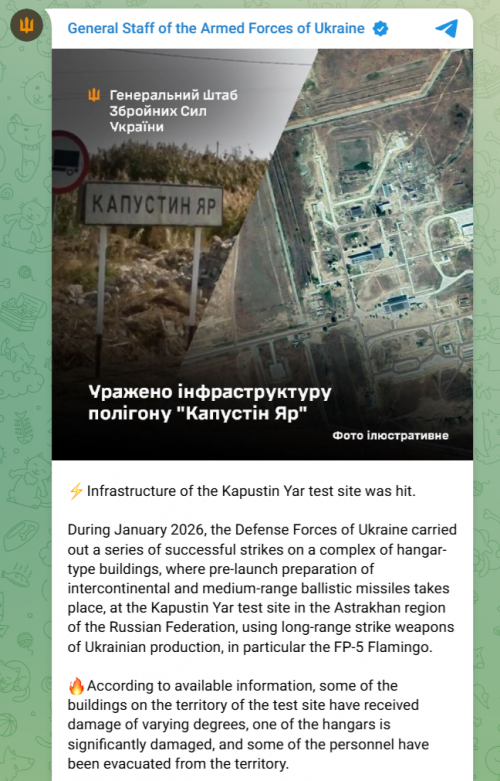
Suchomimus has put out another video concerning Ukraine's recent FP-5 strike on Kapustin-Yar:


Satellite images confirm the FP-5 Flamingo strike on Russia's Kapustin Yar, where Oreshnik missiles are launched. Damage visible at the 28th complex, likely from the 1-ton warhead
 
Suchomimus has a video about a successful strike on the GRAU arsenal in Volgograd by either Neptune or Flamingo cruise-missiles:


Multiple missiles, likely Neptune or Flamingo have hit the GRAU arsenal near Kotluban, Volgograd region. The arsenal stores ammunition, artillery shells and missiles.
 
Suchomimus has a video about a successful strike on the GRAU arsenal in Volgograd by either Neptune or Flamingo cruise-missiles:

500km from the nearest likely launch points.

Depot is a big one....

 
Last edited by a moderator:
Frack, picture above left looks like a nuclear test blast. Hardly surprising... each Flamingo carries 1 ton of boom; against russian depots of boom ill-protected because corruption. The end result can only be a colossal BOOOOM. And it's only a beginning.

As usual, NASA FIRMS and Maxar will tell us about the extent of the damage.
 
Modern cell phones can make very modest light sources look very dramatic with long exposures and software enhancement. I would wait for the overhead imagery. But an evacuation of local civilians almost guarantees that there were some secondaries that were concerning.
 
It looks like Ukraine is finally starting to do more FP-5 Flamingo strikes with great effect:


Today, there are interesting updates from the Russian Federation.​
Here, the Ukrainian forces unleashed their upgraded Flamingo missiles, combining them with long-range drones to target some of the most important Russian military infrastructure. With ammunition depots destroyed from the frontline to the deep rear, the Russian army was put under great danger of getting cut off from supplies for months.​
The latest and biggest strike was the confirmed destruction of a Grau arsenal near Kotluban by Ukraine using Flamingo missiles. The strike triggered powerful explosions followed by sustained secondary detonations across the site. The facility, covering roughly two square kilometers and comprising more than 90 individual storage bunkers, is assessed to have held up to 150,000 tons of ammunition, equivalent to one to two months of Russian combat expenditure at current rates. Local authorities evacuated residents from the nearby town, underscoring the scale of the blast and the damage.​
The Flamingo was chosen for specific operational reasons, as it carries a warhead of an estimated 1,150 kilograms, more than double the 300 to 450 kilogram warheads on typical Tomahawks or Storm Shadows missiles, making it capable of severely damaging hardened infrastructure, such as oil refineries, command centers, and weapons depots. Most importantly, a recent upgrade to it enables low-altitude flight to significantly enhance survivability, as the integration of a terrain contour matching system allows the missile to navigate independently of satellite signals, increasing resistance to electronic warfare. Flying at low altitude reduces radar detection windows and complicates interception.​
Striking Grau arsenals has an important strategic significance, as these facilities serve as the central ammunition reservoirs from which smaller Russian frontline depots are supplied. By targeting the starting point of distribution rather than dozens of smaller forward storage sites, Ukraine disrupts the entire Russian logistics chain downstream. Even partial destruction can create multi-week supply gaps, forcing Russian units to ration artillery fire and slow offensive tempo. Reports of extensive fires and prolonged detonations indicate that this strike specifically did major structural damage across several storages on the facility, degrading both inventory as well as the infrastructure needed to receive and distribute.​
Just days before the latest strike, the Flamingo campaign has also targeted Kapustin Yar, a critical node in Russia’s ballistic missile program. It is located roughly 120 kilometers from the Grau arsenal in Kotluban, demonstrating that Russian air defenses were unable to effectively reinforce the area despite the warning of earlier strikes. The Ukrainian strikes on the ballistic missile site in Kapustin Yar damaged hangars used for pre-launch preparation, technical servicing facilities for medium-range ballistic missiles, as well as logistics warehouses storing missiles themselves and supporting equipment necessary for launches and maintenance. Satellite imagery confirmed these impacts, including a building associated with Oreshnik missiles specifically, with all personnel on the base being evacuated for fear of further secondary detonations.​
Additionally, Ukraine conducted a strike destroying approximately 6,000 FPV drones and components in at least three storage sites in Rostov-on-Don. Ukrainian FP-2 drones also targeted ammunition depots and logistical facilities linked to the 51st Combined Arms Army in the Donetsk region and fuel rolling stock at an oil depot in a coordinated attack in Crimea. Meanwhile, long-range drone waves exceeding 100 drones are operating over the Moscow region, with the aim of taking down Russian air defenses and clearing the way for more strikes on the large logistical node that the capital is.​
Additional strikes have hit specialized infrastructure, including a data center in Primorsk, reportedly located in a former post office building, and responsible for the coordination and delivery of Russian supplies to the frontline units.​
Taken together, these strikes represent a coordinated campaign aimed at degrading Russia’s military ecosystem rather than isolated targets. By simultaneously targeting ammunition stockpiles, missile infrastructure, drone warehouses, fuel logistics, data centers, and rear-area launch sites, Ukraine not only compresses Russia’s ability to regenerate combat power but also damages the entire supply chain at each critical step.​
Overall, Ukraine’s domestically produced long-range missiles and drones are now systematically striking critical Russian infrastructure deep in the rear. The successful targeting of both Kapustin Yar and the Kotluban Grau...​

330,000,000lb of ammunition destroyed is going to put a serious crimp in Russian operations for parts of Eastern front. It looks like Ukraine can now start to seriously target Russia's military logistics train which will serious impede the Russians abilities to carry out offensive operations.​
 
It seems unlikely all the material was destroyed, though it might take some time to safely recover the surviving ordnance.

I'd say that most, if not all, of the munitions were obliterated but that being this mega ammunition dump is not only the only one the Russians have.
 

Similar threads

Back
Top Bottom