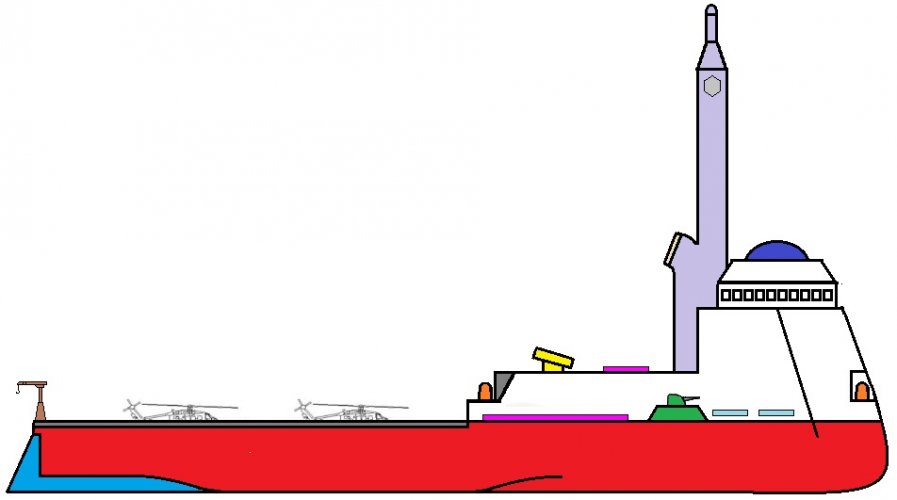
USN future large surface combatants

Hi,

Yes, the increase in manning, training, equipment, etc for a may be less for a shipyard handling an SMR than for a yard servicing a full size conventional nuclear plant, but it is still in no way negligible. And in fact any such increase would represent an appreciable increase in what would be required at a regular shipyard not involved in any type of handling of enriched nuclear materials. Also, just because the nuclear material may be in the yard for a relatively short period of time, it would still require the safety, security and training of shipyard personnel.

Also, the threat of damage or theft of nuclear materials is clearly a concern as witnessed by the security requirements shown in many of the previously identified documents discussing the transportation requirements for SMRs.

The repeated claims of these issues being "negligible" seem to mean little without any supporting documentation.

[Edit]
For reference, here is an excerpt from "Small Modular Reactors and Nuclear NonProliferation; to What Extent will the Global Spread of SMRs Impact Nuclear Proliferation?" from the "Institute of Nuclear Materials Management" noting in particular [my emphasis in bold];

"5 Safeguards and Security Measures

Safeguards and security measures play a crucial role in mitigating proliferation risks associated with Small Modular Reactors (SMRs). Robust international safeguards agreements, such as those implemented by the International Atomic Energy Agency (IAEA), are essential for ensuring the peaceful use of nuclear energy and preventing the diversion of SMRs for military purposes. International safeguards agreements provide a framework for verifying compliance with non-proliferation commitments. These agreements require states to implement comprehensive safeguards measures, including inspections, monitoring, and reporting, to ensure that nuclear materials and facilities are used solely for peaceful purposes. The IAEA plays a central role in conducting inspections and verifying the compliance of states with their obligations under these agreements. [Carbanas, 2021]

In addition to safeguards, effective export controls, strict regulations, and enhanced security are necessary to prevent unauthorized access to SMRs and their associated technologies. Export controls ensure that sensitive nuclear materials, equipment, and technologies related to SMRs are not transferred to unauthorized recipients. Strict regulations governing the export and import of SMRs help prevent their diversion to illicit purposes and ensure that their deployment is in line with non-proliferation objectives. Enhanced security measures are essential to protect SMR facilities and materials from theft, sabotage, and unauthorized access. This includes physical security measures, such as secure perimeters, access controls, and alarm systems, as well as cybersecurity measures to safeguard against digital threats. Strengthening the physical protection and cybersecurity of SMRs contributes to the overall non-proliferation regime and helps maintain the integrity and security of nuclear facilities."
 
Last edited:
First you need proof of concept to get seed funding. The right team with proper clearances and an excess of talent has to be gathered or its dead before you started. Once you prove in theory that it works you need a bulletproof proposal to get prototype funding. Obviously only after these details go through can you worry about the need for standardized modules (possibly in several sizes), respective compartments, handling options to get it moved, universal hookups, and then your english majors can write theSOPs. Then lots and lots of training. NAVSEA has all the parts but the leadership wouldn't back it because of NIH and a bit of NIMBY.

But its a clever idea.

Yes, putting the helo deck at the fantail and bride/superstructure directly forward of that, with the entire missile battery forward. KGV layout, if you want to picture it that way.
You don't want flight ops anywhere near a VLS popping off. Lots of things can go wrong. There is much debris in the air, too. Being on the opposite end of the ship doesn't mitigate the risks so the helicopter better carry that spare fuel.
 
Last edited:
The increase will be negligible. Lets say 1,000 extra staff and $1 billion in infrastructure is need to make a shipyard capable of fitting a full size reactor. I estimate a microreactor ship design would require only 100 extra staff and $100 million in infrastructure. 10% of the effort. Massive capability gains and reduction in fuel usage for minimal changes to the shipyard.

The key is the shipyard will be able to be made microreactor ready before a ship design could be finalised.
I think your estimate is off by an order of magnitude.

Not least because the SMRs will still require the full nuclear storage certification.

Quick sanity check on numbers:
PSNS (nuclear capable): 15k workers


First you need proof of concept to get seed funding. The right team with proper clearances and an excess of talent has to be gathered or its dead before you started. Once you prove in theory that it works you need a bulletproof proposal to get prototype funding. Obviously only after these details go through can you worry about the need for standardized modules (possibly in several sizes), respective compartments, handling options to get it moved, universal hookups, and then your english majors can write theSOPs. Then lots and lots of training. NAVSEA has all the parts but the leadership wouldn't back it because of NIH and a bit of NIMBY.
I've read Naval Reactors paperwork. No English majors anywhere within line of sight of it at any time. (My posts read better than NR stuff does)
 
A point of note on SMRs: by naval standards, they're just Rs. Naval reactors are on the small end of SMRs, and have been mass produced in a factory-type setting in a way no civilian reactor ever has been. Yes, a factory. Every naval reactor was built in one of a handful of shipyards under controlled conditions, compared to near-one-off civilian power reactors built at the point of use.

Also, if you think Naval Reactors will ease up on their standards just because GE/Toshiba/whoever swears this reactor is super safe, honest, then you just got added to a list by the Ghost of Rickover.
 
Problem is ships are ever more power hungry and there is only one way to feed that need unless someone has some magic out there.
 
Eight gas turbines and 10,000 tons of fuel can provide a lot of power for a long time.
Yeah, many people see going with more nuclear in the fleet as some panacea but there are a lot of hidden recurring expenses that never go away. (And then a giant disposal problem/bill on the back end to boot.)
 
Eight gas turbines and 10,000 tons of fuel can provide a lot of power for a long time.
I don't consider 6 days a long time. Eight MT30 gas turbines burns 70 tons of fuel per hour.

I think your estimate is off by an order of magnitude.
Do you know what order of magnitude even means? My estimate of 10% is exactly one order of magnitude. If my estimate is off by an order of magnitude then you are then claiming that a new microreactor shipyard and new full size reactor shipyard would be the same cost and number of staff.

That is clearly not the case. A microreactor shipyard will always be cheaper to create than a full size reactor shipyard. That's common sense.

Not least because the SMRs will still require the full nuclear storage certification.
No it won't. There will be no certification or storage facilities to store raw nuclear fuel at a shipyard using microreactors.

Yeah, many people see going with more nuclear in the fleet as some panacea but there are a lot of hidden recurring expenses that never go away. (And then a giant disposal problem/bill on the back end to boot.)

None of which apply to microreactor. The giant disposable problem will see the microreactor removed and be refuelled again. The ship gets scrapped as a normal gas turbine ship and the old reactor is producing power somewhere else.
 
I don't consider 6 days a long time. Eight MT30 gas turbines burns 70 tons of fuel per hour.
A ship using micro reactors for base load would also be running turbines if it needed to produce 300 MW continuously for days on end. You've been talking about 25 MW of nuclear power, so you would still need eight turbines with fuel to provide that much power.
 
How about for the Amphibious ready groups they stick SM-2 missiles on the LPDs? Maybe ESSM on the LSDs? It would free up need for guided missile frigates. Destroyers would be needed, as their role would not overlap. LCS or Legend frigates would be able to offset need for FFGs.
 
A ship using micro reactors for base load would also be running turbines if it needed to produce 300 MW continuously for days on end. You've been talking about 25 MW of nuclear power, so you would still need eight turbines with fuel to provide that much power.
You said 10,000 ton of fuel which is multiples of what a Wasp class LHD to try and prove a point.
It lasts only 6 days. That is a fuel tank of 12,000 cubic metres. A destroyer sized ship would need more than half of the ship to be a fuel tank. You can fit dozens of micro reactors in that space and have more power than your eight gas turbines. Nuclear still win for any base load solution.

You still don't get it. I have provided the data.
Existing nuclear surface ships have their reactors sized to provide 200% of the peak load of the ship. Two reactors for redundancy and each reactor is then sized to handle that peak load.

I'm talking one reactor sized for only 10-20% of the peak load of the ship. I provided the data that during 90+% of the ships deployment it was consuming below 20% of the peak power.

The idea of nuclear ships being expensive is based on the old ships having reactors 10+ times the size of the microreactor solution.
 
Do you know what order of magnitude even means? My estimate of 10% is exactly one order of magnitude. If my estimate is off by an order of magnitude then you are then claiming that a new microreactor shipyard and new full size reactor shipyard would be the same cost and number of staff.
Exactly.


That is clearly not the case. A microreactor shipyard will always be cheaper to create than a full size reactor shipyard. That's common sense.
Assuming facts not in evidence.


No it won't. There will be no certification or storage facilities to store raw nuclear fuel at a shipyard using microreactors.
But there will be storage facilities to store the used "microreactors" prior to refueling, which will require certification.

And your proposed microreactors won't be all that micro.

S5W reactors (all US subs prior to 688s) made about 15-25MWe (depends on how big their electrical generators are), S6G reactors (like the 688 class) crank out about 50MWe.

So your proposed "SMR" is straight up roughly the size of an S5W in an SSBN or thereabouts.

Which is not small or light by any means. Probably 700-1000 tons and most of 75-100ft of length in the engineroom, if we're packing the SMR into a ~30ft box.


None of which apply to microreactor. The giant disposable problem will see the microreactor removed and be refuelled again. The ship gets scrapped as a normal gas turbine ship and the old reactor is producing power somewhere else.
You do know that over time the reactor vessel and primary piping weakens due to neutron activation, right? So you need to scrap the reactor after about 30 years. Maybe more, maybe less, since the SMR will be running at mostly full power and US submarines ran at much less than full power most of the time.
 
Assuming facts not in evidence.
Here are the two options.

1) Constructing a 10 metre tall reactor inside the shipyard and fueling it up in the shipyard.

2) Microreactor 10% of the size arrives at the shipyard on a train, fueled up and ready to go.

You think the shipyard needs the same facilities and staffing levels for both options.


But there will be storage facilities to store the used "microreactors" prior to refueling, which will require certification.
The microreactor will be taken back to the manufacturer for refueling. No investment ot staff is needed at the shipyard for refueling.

And your proposed microreactors won't be all that micro.

S5W reactors (all US subs prior to 688s) made about 15-25MWe (depends on how big their electrical generators are), S6G reactors (like the 688 class) crank out about 50MWe.
Most of the reactor energy in these subs is producing steam to turn the prop not for producing electricity. The e stands for electric. The subs aren't cranking out 50MWe of electricity. What electrical systems on the sub require 50mw of electricity? You are just making up numbers.

So your proposed "SMR" is straight up roughly the size of an S5W in an SSBN or thereabouts.

Which is not small or light by any means. Probably 700-1000 tons and most of 75-100ft of length in the engineroom, if we're packing the SMR into a ~30ft box.
Microreactor is 1-20MWe
SMR is 20-300MWe

Microreactor can fit on a train carriage as a complete unit. SMR requires dozens of modules to be connected on site. I have provided evidence that the average energy consumption of an Arleigh-burke destroyer on deployment is within the microreactor territory.

https://en.wikipedia.org/wiki/Nuclear_microreactor
"A nuclear microreactor is a type of nuclear reactor which can be easily assembled and transported by road, rail or air.[1] Microreactors are 100 to 1,000 times smaller than conventional nuclear reactors, and range in capacity from 1 to 20 MWe (megawatts of electricity), compared to 20 to 300 MWe (megawatts of electricity) for small modular reactors (SMRs)."

A microreactor with 10% of the electricity output of the full nuclear ship will be 10% of the size and weight. How can you say they are roughly the same size when the output is 10%?

We have multiple microreactors with some under construction and testing. The only way to explain your error is you must be confusing the thermal output with the electrical output. The reactors electrical output is roughly a third of the thermal output.

The 210MWt submarine reactors would only be capable of producing 70MWe of electricity if the steam is running entirely for electricity generation.

You do know that over time the reactor vessel and primary piping weakens due to neutron activation, right? So you need to scrap the reactor after about 30 years. Maybe more, maybe less, since the SMR will be running at mostly full power and US submarines ran at much less than full power most of the time.
It is the other way around. Nuclear reactors like running at a constant load. No heat fluctuations. Throttling a gas turbine up and down as the energy loads fluctuate is the ultimate solution. The microreactor is then sized to run at a constant load.

Yes the reactor module will eventually be scraped. This will not be done at the shipyard. It will be taken away to the manufacturer for disposal due to it's small size. All existing large ship reactors can not be placed onto a train. They need to be scrapped at the shipyard which is incredibly expensive.
 
Last edited:
Here are the two options.

1) Constructing a 10 metre tall reactor inside the shipyard and fueling it up in the shipyard.

2) Microreactor 10% of the size arrives at the shipyard on a train, fueled up and ready to go.

You think the shipyard needs the same facilities and staffing levels for both options.
A reactor making ~20MWe is not the size you can roll in on a train car.

Not once you've taken it critical the first time.


Most of the reactor energy in these subs is producing steam to turn the prop not for producing electricity. The e stands for electric. The subs aren't cranking out 50MWe of electricity. What electrical systems on the sub require 50mw of electricity? You are just making up numbers.
S5G: 15,000hp mechanical makes 12MWe. Plus at least 8MWe generated for ship systems makes 20MWe.

S6G: 165MWth, driving two 26MW main engines and whatever electrical is being made. That's 52MWe just off the main engines, plus at least another 8MWe, if not 16MWe.
 
Hi,

For reference, from information on the internet I believe that the LHD WASP class carries 1,872,831 gallons of ship's fuel & 439,544 gallons of aviation fuel. Assuming a conversion factor of 264.2 gal/cubic meter and a maximum density of 876kg/cubic meter for F-76 diesel fuel or 810kg/cubic meter for JP-5 equates roughly to 6210mt of diesel and 1348mt of aviation fuel. Additionally this amount of ship's fuel is capable of given the ship a notional range of 9,500nm @ 20kts, which equates to 475hr or about 19.8 days.

[Edit]

Also for reference, since I don't have volume info on the DDG-51 right now, for the DD-963, the total enclosed volume of the ship is stated as being 1,046,839 cubic ft (29,644 cubic meter), with 835,687 cubic ft (23,655 cubic meters) of hull volume and 211,152 cubic ft (5,979 cubic meter) of superstructure volume. In addition the DD-963 is said to have a fuel capacity of 510,000 gal or 1,931 cubic meters for a 1,534 LT (or 1,559mt) of fuel (I think), which provides a notional range of 6,000nm @ 20kts. From these numbers it appears that the fuel tankage accounts for about 6.5% of the ship's total volume or 8.2% of its hull volume (and those tanks tend to be low down in the ship, occupying areas that would otherwise not be useful for many other items - such as machinery)
 
Last edited:
Yeah, many people see going with more nuclear in the fleet as some panacea but there are a lot of hidden recurring expenses that never go away. (And then a giant disposal problem/bill on the back end to boot.)
Well, not every ship needs to be nuclear. But for something like a cruiser or a similar type of surface combatant (or something like the Blue Ridge ships quite frankly) it does make sense. Energy supply and autonomy independent of vulnerable fuel supplies is valuable. As for the costs that surface down the line, especially looking towards disposal here, they usually come into play after a long service life of either the reactor (refueling) or the entire vessel when the reactor won't be refueled during the intended service life.

However the cost cannot be incredibly immense when we just remember that in Russia for example there is an entire fleet of civilian nuclear-powered icebreakers operating for decades.

Generally speaking, in a world where you throw dozens upon dozens of nuclear powered submarines into the ocean, or other countries operate a fleet of various classes of nuke icebreakers, it's not unreasonable to look towards nuclear propulsion for very specific surface vessels (CGN/BBG or LCCN). After all the same benefits that make nuclear propulsion preferable for aircraft carriers or submarines applies to such ships, energy, autonomy, sustained high speed cruise.
 
Here are the two options.

1) Constructing a 10 metre tall reactor inside the shipyard and fueling it up in the shipyard.

2) Microreactor 10% of the size arrives at the shipyard on a train, fueled up and ready to go.

You think the shipyard needs the same facilities and staffing levels for both options....
Hi,

I think you may be missing the point here. People aren't necessarily saying that the requirements will be the same but rather the requirements won't be in any way "negligible" as it has been described previously
 
A reactor making ~20MWe is not the size you can roll in on a train car.
I never said a reactor ~20MWe.

I said 10% of the ships maximum peak power. The Arleigh-burke with all four gas turbines and all four diesel engines running has ~90MW of total shaft power.

A 10% means a reactor 9MWe in size power such a ship.

I provided evidence that a single 1.9MW electric motor fitted to an Areligh-Burke allowed for up to 11 knots.

I provided evidence that a pair of these electric motors would allow 14 knots.

I provided evidence of the power usage of the ships electrical systems.

I provided evidence of the average speed of the Arleigh-during during a deployment.

Using this evidence I calculated that even a small 5MWe reactor like the eVinci could allow the ship to operate approximately 50% of the deployment running entirely off that tiny reactor.

The slightly larger 9MWe covers a larger percentage of the deployment. A 9MWe reactor can fit on a train car.
 
If it's 10% nuclear then it sounds like a designation of ⁿ added to the type would be appropriate. N implies full or nearly full power. The ⁿ denotes mostly/partially dependent on fuel. :)

FFGⁿ
DDGⁿ
CGⁿ
BBGⁿ
CVⁿ
 
If it's 10% nuclear then it sounds like a designation of ⁿ added to the type would be appropriate. N implies full or nearly full power. The ⁿ denotes mostly/partially dependent on fuel. :)

FFGⁿ
DDGⁿ
CGⁿ
BBGⁿ
CVⁿ
Problem with CVs is that the USN literally did the numbers (and had experience with) and... you need to fully nuclearize the CV fleet anyway, as not doing so gimps the capabilities of the carrier something fierce (like time on station).
 
Problem with CVs is that the USN literally did the numbers (and had experience with) and... you need to fully nuclearize the CV fleet anyway, as not doing so gimps the capabilities of the carrier something fierce (like time on station).
There was supposedly a report done around the time the Kirovs were starting to make noises, about the possibilities of nuke+steam (remember that carriers in particular require crazy amounts of steam to operate catapults). Unfortunately, there were allegedly only 3 copies of said report made, and all 3 were promptly fed into a shredder.

Because this was also when Rickover was still DNR, NAVSEA08, and your future career would be permanently over if you even suggested that it might be possible to downpower a nuclear carrier with smaller reactors plus conventional boilers.

Came up in the CVV thread. https://www.secretprojects.co.uk/threads/cvv-concepts-of-the-70s.1083/post-190746
 
If airship based LF DEW relay capabilities allowing OTH LF DEW effects (AD & exen grd att) the the demand for on board power could drastically increase.
Likewise, if the Darpa LF-based wireless electric power for the battlefield network were to include surface ships as a possibility for generating & relaying battlefield wireless electric power to ground battlefield then more power on board. Generating wireless electric power for ground forces could place an undue maneuver constraint on a combantt needing to standoff from shore at close distance. However, darpas proposal has power to the battlefield from CONUS, a much more burdensome prospect in turns of platforms & distances. Reactors close but offshore would seem more efficient.

https://www.darpa.mil/research/programs/power
https://www.wpafb.af.mil/News/Artic...-aerospace-relay-mirror-system-demonstration/
 
Last edited:
Behold, the Sea Giraffe...
Sea Giraffe.jpg
Instead of the status quo move to the X-bow shape for the next FFG One large citadel for the bridge-tower and hangar. Put your sensors up extremely high. Put your deeper VLS in behind the bridge-tower, and shorter VLS along the sides. Your flight deck should hold not one or two, but four helicopters. You should also have a spare in the hangar. CIWS on all four corners of the citadel. A rapidfire 76mm on each side of the citadel for anything that slips through. At least one harpoon box-launcher. Torpedoes down low, just above the water spray. A well in the back for launching smaller boats like RHIBs and CCAs, but a crane to pick up CCMs, too. CCHs should be able to moor alongside with retractable docks for special people to come aboard out of the weather. My scale is way off to the helicopters, I know. But Paint is about the extent of my art.
 
Back
Top Bottom