The Chinese will largely get to decide what range they want to be at for that engagement (out of NSM range), as they dictate when the shooting starts.Chances are the opening hours of a modern naval war will be the most decisive period of the war…

You are using an out of date browser. It may not display this or other websites correctly.
You should upgrade or use an alternative browser.
You should upgrade or use an alternative browser.
US FF(X) Program - DISCUSSION
- Thread starter isayyo2
- Start date
Ainen
I really should change my personal text
- Joined
- 25 August 2011
- Messages
- 2,913
- Reaction score
- 5,048
RAM is reloadable as well. Only VLS aren't.Again, even if you have only 21 RAM and 15 drones attack, you fire half a dozen rounds from mk110, and 12 missiles, you’re half empty on your RAM launcher. Another similar attack, you’re running out of missiles before the attack is over. Still plenty of 57mm rounds, but you don’t want to be relying only on mk110 and mk38s while you head back to port to reload.
US Hellfire deployment at sea comes from a rather similar problem - i.e. Iranian MSV swarms.I would say the Russian's OPV have a sensor/situational awareness and 76mm ammo problem vs the Ukrainians, not a lack of a hellfire missile equivalent. Their 76mm if it had the proper ammo would more nor less negate the need for a hellfire type weapon.
Good high ROF gun is a good start, but it's ultimately a single channel with limited arc of fire and effective range. Hellfires arer AA/ASuW bubble.
johnpjones1775
ACCESS: Top Secret
- Joined
- 27 May 2023
- Messages
- 1,373
- Reaction score
- 767
That’s a big assumption, especially considering the unhinged moron currently in charge of the US military today.The Chinese will largely get to decide what range they want to be at for that engagement (out of NSM range), as they dictate when the shooting starts.
johnpjones1775
ACCESS: Top Secret
- Joined
- 27 May 2023
- Messages
- 1,373
- Reaction score
- 767
They might be, but in what sea state and what weather conditions? Does the ship have reloads in the magazines? How long does it take to reload?RAM is reloadable as well. Only VLS aren't.
US Hellfire deployment at sea comes from a rather similar problem - i.e. Iranian MSV swarms.
Good high ROF gun is a good start, but it's ultimately a single channel with limited arc of fire and effective range. Hellfires arer AA/ASuW bubble.
Where did ypu get the idea mk110 had a problem only one time? It could consistently hit so they gave it ALaMO rounds. 57mm use caused problems from the shock of the guns. And every 400th or so round jams.What gun instability? One ship had one issue with its gun one time.
The mk110 is in use in several other navies and no issues with its accuracy have ever been reported afaik.
https://www.everycrsreport.com/files/20170519_RL33741_3c39550fb44c0f9cc8a6015a0e6cf58cad6e1535.html
johnpjones1775
ACCESS: Top Secret
- Joined
- 27 May 2023
- Messages
- 1,373
- Reaction score
- 767
I’m not going through all that so if you want to tell me which specific header the information you’re trying share with me is I’ll happy like at that section specificallyWhere did ypu get the idea mk110 had a problem only one time? It could consistently hit so they gave it ALaMO rounds. 57mm use caused problems from the shock of the guns. And every 400th or so round jams.
https://www.everycrsreport.com/files/20170519_RL33741_3c39550fb44c0f9cc8a6015a0e6cf58cad6e1535.html
Control-F and search for mk110 or 57mm much?I’m not going through all that so if you want to tell me which specific header the information you’re trying share with me is I’ll happy like at that section specifically
johnpjones1775
ACCESS: Top Secret
- Joined
- 27 May 2023
- Messages
- 1,373
- Reaction score
- 767
You do know people get on the internet with phones that don’t have a control button right?Control-F and search for mk110 or 57mm much?
Also nice deflection.
Hi,I mean the standard for destroyers is also not to let their fuel levels drop below 60% if possible…
So Indy has a range of 6k miles.
Yes about 6000nm @ 14kts, but only about 4300nm @ 18kts, and presumably less @ 20kts as compared to the notional 5000nm for the FFG-7 @ 18kts or 4200nm @ 20kts for the FFG-7 noted previously.
Scott Kenny
ACCESS: USAP
- Joined
- 15 May 2023
- Messages
- 19,805
- Reaction score
- 28,402
These should not be anywhere near Chinese ships.I fail to see what the use of NSM would be on these ships. Everything Chinese out ranges it and they have no AD so wouldn’t be out there alone engaging Chinese ships. In a task force they’d be shooting off longer ranged weapons so NSM wouldn’t contribute.
Hellfire is even more useless for the reasons stated above, magazine size shouldn't even be a consideration here. As if you have to fire off any of your weapons, you're almost certainly in huge trouble and won't be getting out unhurt.
I’m not sure gun instability is too big an issue with smart munitions as it’s shoot look instead of continuous shots.
As in, not in the same ocean.
johnpjones1775
ACCESS: Top Secret
- Joined
- 27 May 2023
- Messages
- 1,373
- Reaction score
- 767
And? The things that require long range don’t typically require you to do 20knots.Hi,
Yes about 6000nm @ 14kts, but only about 4300nm @ 18kts, and presumably less @ 20kts as compared to the notional 5000nm for the FFG-7 @ 18kts or 4200nm @ 20kts for the FFG-7 noted previously.
But in the end with oilers being all over the place range on a single tank is pretty irrelevant.
No one judges cars based on their range because 99% of the time there’s a gas station no more than 4 blocks away from you.
johnpjones1775
ACCESS: Top Secret
- Joined
- 27 May 2023
- Messages
- 1,373
- Reaction score
- 767
So you don’t want warships doing war things?These should not be anywhere near Chinese ships.
As in, not in the same ocean.
Scott Kenny
ACCESS: USAP
- Joined
- 15 May 2023
- Messages
- 19,805
- Reaction score
- 28,402
These FFs can go play in the Atlantic or eastern Pacific, maybe western Indian Ocean.So you don’t want warships doing war things?
As far as humanly possible from the shooting.
The FFX as designed is for showing the flag. Little more than a Coast Guard cutter, but without the law enforcement roles.
Yes they do. If you want to escort convoys you should be doing 18-20kt with modern convoy ships to reduce transit times and to make things harder on subs.And? The things that require long range don’t typically require you to do 20knots.
But in the end with oilers being all over the place range on a single tank is pretty irrelevant.
No one judges cars based on their range because 99% of the time there’s a gas station no more than 4 blocks away from you.
But wait these work won't as convoy escorts.
Use the three little dots and use find in page.You do know people get on the internet with phones that don’t have a control button right?
Also nice deflection.
Well at 18-20 knots you limit the ability of submarines to use some of their best tools and they have to use more experience and judgment to single out surface targets. But something tells me they hold the upper hand. Older subs would have problems with pursuit but can still obviously ambush.Yes they do. If you want to escort convoys you should be doing 18-20kt with modern convoy ships to reduce transit times and to make things harder on subs.
But wait these work won't as convoy escorts.
Last edited:
Australia uses full life of the program costings.I think we can safely ignore Australian arms purchase prices.
There's *something* wrong with their procurement, their per-copy prices for major platforms are ridiculous and on the level of what the Saudis pay.
Chris Miller, Executive Director at Naval Sea Systems Command (NAVSEA), told attendees at the recent SNA conference re. NSC" it has been proven, it is operationally in use today, and it will evolve" // “This ship [FF(X) is done being designed,” NAVSEA’s Miller said yesterday. “We are going to go through a very, very, very – like, on one hand – number of engineering changes to get it to be what we want.”
You could make exactly make the same comments re. the IT FREMM five years ago,the very reason FREMM was chosen. As said previously If they had followed the same policy with the IT FREMM/ FFG(X) Constellation it would have been in the water fitting out for delivery by this year end .
The obvious conclusion is all the hierarchy of NAVSEA should be immediately fired including Chris Miller as the FF(X) will have zero ASW capabilities and very minimal AAW capabilities, not even ESSM, after wasting the 5 years and $billions turning the IT FREMM into a mini-Burke with near Level III survivability and making it 1,000 ton overweight in the process with less than 15% compatibility to the original IT FREMM design and calling into question the final design of the Constellation seaworthiness and not prioritizing its ASW role and now replacing it with the FF(X) which will be 3rd or 4th rate frigate/OPC, also with only minimal Level 1 survivability.
If the Navy had wanted an ASW frigate they should have gone back to original Fincantieri design for Constellation and thrown out all the NAVSEA changes, but it would destroy all credability in the Admirals. An ASW frigate is not cheap due to the need for quieting the hull and propulsion system which are expensive and must be designed in, the current proposal to fit a sonar container in future sometime on the fantail of the FF(X) comes across as a joke, they tried it on the LCS and the CNO admitted due to the ships being too noisy to effectively operate the Variable Depth Sonar (VDS) system to be able to detect new gen Chinese SSKs.
You could make exactly make the same comments re. the IT FREMM five years ago,the very reason FREMM was chosen. As said previously If they had followed the same policy with the IT FREMM/ FFG(X) Constellation it would have been in the water fitting out for delivery by this year end .
The obvious conclusion is all the hierarchy of NAVSEA should be immediately fired including Chris Miller as the FF(X) will have zero ASW capabilities and very minimal AAW capabilities, not even ESSM, after wasting the 5 years and $billions turning the IT FREMM into a mini-Burke with near Level III survivability and making it 1,000 ton overweight in the process with less than 15% compatibility to the original IT FREMM design and calling into question the final design of the Constellation seaworthiness and not prioritizing its ASW role and now replacing it with the FF(X) which will be 3rd or 4th rate frigate/OPC, also with only minimal Level 1 survivability.
If the Navy had wanted an ASW frigate they should have gone back to original Fincantieri design for Constellation and thrown out all the NAVSEA changes, but it would destroy all credability in the Admirals. An ASW frigate is not cheap due to the need for quieting the hull and propulsion system which are expensive and must be designed in, the current proposal to fit a sonar container in future sometime on the fantail of the FF(X) comes across as a joke, they tried it on the LCS and the CNO admitted due to the ships being too noisy to effectively operate the Variable Depth Sonar (VDS) system to be able to detect new gen Chinese SSKs.
Ainen
I really should change my personal text
- Joined
- 25 August 2011
- Messages
- 2,913
- Reaction score
- 5,048
It's still war things.So you don’t want warships doing war things?
Just Tacoma class instead of Cleveland class. Two very different tiers.
Arguably US needs both, but hole at Lo tier is larger, as intended Lo(LCS) somehow turned into Abdiel class.
In WW2 terms and analogies.
johnpjones1775
ACCESS: Top Secret
- Joined
- 27 May 2023
- Messages
- 1,373
- Reaction score
- 767
So I’m just going to assume there’s nothing there since you refuse to just state which heading it’s under.Use the three little dots and use find in page.
Well at 18-20 knots you limit the ability of submarines to use some of their best tools and they have to use more experience and judgment to single out surface targets. But something tells me they hold the upper hand. Older subs would have problems with pursuit but can still obviously ambush.

- Joined
- 6 November 2010
- Messages
- 6,381
- Reaction score
- 8,302
@johnpjones1775
1) Open https://www.everycrsreport.com/files/20170519_RL33741_3c39550fb44c0f9cc8a6015a0e6cf58cad6e1535.html
2) Touch three dots
3) Touch find on page
4) Type MK 110 or 57 mm
5) Touch return
5) Read
6) Say thank you kindly
1) Open https://www.everycrsreport.com/files/20170519_RL33741_3c39550fb44c0f9cc8a6015a0e6cf58cad6e1535.html
2) Touch three dots
3) Touch find on page
4) Type MK 110 or 57 mm
5) Touch return
5) Read
6) Say thank you kindly
Last edited:
You are trying to avoid the answer. The failures are acrossthe program under multiple events. It is not that long of report to read. You obviously don't want facts from the Navy with all the citations one could want to verify. Stop posting about needing specific headers when it is just trolling at this point.So I’m just going to assume there’s nothing there since you refuse to just state which heading it’s under.
Hi,And? The things that require long range don’t typically require you to do 20knots.
But in the end with oilers being all over the place range on a single tank is pretty irrelevant.
No one judges cars based on their range because 99% of the time there’s a gas station no more than 4 blocks away from you.
I believe that USN escorts have traditionally been estimated at 20kts because the USN had spent alot of effort developing their amphibious vessels to travel at 20kts, and wanted their escorts to be able to effectively escort them. As such, if the higher end transit ranges for an escort is lower than 20kts, then the entire group may have to transit at a lowerr speed.
In addition as previously noted I believe that the US Coast Guard's Deepwater Program System Performance Specification had requirements based partly on the desire to escort 20kt merchant ships (though I can't find a specific reference to it at this time, but I will keep looking for it).
As for range being irrelevant for a ship like the LCS I disagree. I worked for one of the design teams during the design phase of those ships and meeting the range requirements was an issue for the design, and we ended up developing a revised endurance calculation method to account for the reduced resistance associated with the decrease in displacement that would occur as fuel was burned, as opposed to the method used for more conventional displacement ships previously.
[And for the car analogy, that may not be such a good example, as I understand it, range anxiety can be of great concern for people with electric cars, where the ability to charge may not necessarily be just around the corner.]

1635yankee
Recovering aeronautical engineer
- Joined
- 18 August 2020
- Messages
- 676
- Reaction score
- 1,033
One question that may arise: with the current administration's behavior towards allies, like threatening to invade them, one wonders where the US will get to base its ships and aircraft were there to be a war with China.
- Joined
- 6 November 2010
- Messages
- 6,381
- Reaction score
- 8,302
Range would certainly become an issue. I think I will leave it at that.where the US will get to base its ships and aircraft
What does the helicopter arrangements on FF(X) look like? Afaik Legend doesn't have for example torpedo magazines nor operate Seahawks (can it? not super familiar with them). Could pose a bit of a barrier to them being useful...
Scott Kenny
ACCESS: USAP
- Joined
- 15 May 2023
- Messages
- 19,805
- Reaction score
- 28,402
Versus China? Japan, Hawaii, Guam, maybe Diego Garcia for B-2s/B-21s.One question that may arise: with the current administration's behavior towards allies, like threatening to invade them, one wonders where the US will get to base its ships and aircraft were there to be a war with China.
Maybe the other American territories in the Pacific, whatever islands the US kept after WW2.
Coast Guard flies Seahawks.What does the helicopter arrangements on FF(X) look like? Afaik Legend doesn't have for example torpedo magazines nor operate Seahawks (can it? not super familiar with them). Could pose a bit of a barrier to them being useful...
ah, showing my ignorance there then apologies. Must have been crossing a wire.Versus China? Japan, Hawaii, Guam, maybe Diego Garcia for B-2s/B-21s.
Maybe the other American territories in the Pacific, whatever islands the US kept after WW2.
Coast Guard flies Seahawks.

- Joined
- 11 February 2007
- Messages
- 4,173
- Reaction score
- 8,958
Diego Garcia falls under allies currently being threatened by US.maybe Diego Garcia for B-2s/B-21s.
And has proposed flying nothing but Seahawks.Coast Guard flies Seahawks.

Kat Tsun
eeeeeeeeeeeeeee
- Joined
- 16 June 2013
- Messages
- 1,887
- Reaction score
- 2,669
One question that may arise: with the current administration's behavior towards allies, like threatening to invade them, one wonders where the US will get to base its ships and aircraft were there to be a war with China.
Japan doesn't seem likely to abandon America over the Greenland thing. There is also Guam.
- Joined
- 6 November 2010
- Messages
- 6,381
- Reaction score
- 8,302
Tariffs.over the Greenland thing.
Kat Tsun
eeeeeeeeeeeeeee
- Joined
- 16 June 2013
- Messages
- 1,887
- Reaction score
- 2,669
Tariffs.
The worst thing America has done to Japan is give the impression that it is just not going to fight over Taiwan. That was last month.
johnpjones1775
ACCESS: Top Secret
- Joined
- 27 May 2023
- Messages
- 1,373
- Reaction score
- 767
Why wouldn’t they? Why would they be willing to be next?Japan doesn't seem likely to abandon America over the Greenland thing. There is also Guam.
totallyaverage
I really should change my personal text
- Joined
- 15 April 2018
- Messages
- 71
- Reaction score
- 172
RAM has no C-UAS capability and is extremely expensive. The interceptor is entirely dependent on the target being actively emitting in the RF spectrum to exploit its range. It has a secondary IR only mode, but even the Block 2B will suffer from reduced range in this employment, especially against low-IR signature threats. This is further compounded by the (purposeful) lack of a ship-to-missile weapons link. 2B includes a missile to missile link, but it doesn't provide the same utility.Does Hellfire actually add anything to the C-UAS mission on the baseline FF(X)? Block II RAM outranges it, and the 57mm doubles up on close range kills. They'd be better off sticking another RAM forward on the shelf and retaining the space aft for NSM. If you absolutely need Hellfire, then use the compact 8 round VLS racks that LockMart have been touting for the Burkes.
Really, if you need a longer range C-UAS effector, just use Coyote until something better gets qualified.
Back in 2022 when CNO Adm Gilday cancelled the sonar module for the LCS he stated that the LCS seaframe was too loud for sensitive anti-submarine operations, remarking that the ship is "as noisy as an aircraft carrier". This high self-noise floor made it extremely difficult for the ship's sensors to track high-end modern submarines.Quiet propulsion and effective sonar should be mandatory, and electric propulsion should create the opportunity to move engines around to use the space more efficiently. Probably also needs a more modern CIWS to deal with the next generation of drones. Along the lines of Millenium Gun.
As to the decision to retire nine LCS ships, Gilday said the “primary” reason for that move is the failure of the anti-submarine warfare system. “After about a year and a half [of] study, I refused to put an additional dollar against the system that wouldn’t be able to track a high-end submarine in today’s environment.”
I see no reason the NCS/FFX hull or propulsion system would be any quieter than the LCS searching for subs, as they say "you can't make a silk purse out of a sow's ear".

- Joined
- 3 June 2011
- Messages
- 21,078
- Reaction score
- 19,487
This. But to start our entire education system would need a complete revamp. DoE needs to go for starters.Turns out that sending a bunch of “C” students to college to become baristas & professional protestors, instead of to trade school, has its downside.
...
Given our inabilities and China’s abilities, Congress should fund and demand a commissioning pace of 4x SSNs (Virginia’s or SSN-X) & 4x new-design FFGs per year, incremental to the Columbia and any other warships, in the hope of actually achieving 3x per year for each. The result would be the ~100 SSNs and ~100 FFGs the US Navy needs to address its global responsibilities and protect its national interests.
johnpjones1775
ACCESS: Top Secret
- Joined
- 27 May 2023
- Messages
- 1,373
- Reaction score
- 767
The noise from the LCS was because of their water jets. Those are extremely noisy.Back in 2022 when CNO Adm Gilday cancelled the sonar module for the LCS he stated that the LCS seaframe was too loud for sensitive anti-submarine operations, remarking that the ship is "as noisy as an aircraft carrier". This high self-noise floor made it extremely difficult for the ship's sensors to track high-end modern submarines.
As to the decision to retire nine LCS ships, Gilday said the “primary” reason for that move is the failure of the anti-submarine warfare system. “After about a year and a half [of] study, I refused to put an additional dollar against the system that wouldn’t be able to track a high-end submarine in today’s environment.”
I see no reason the NCS/FFX hull or propulsion system would be any quieter than the LCS searching for subs, as they say "you can't make a silk purse out of a sow's ear".
The fact that NSC doesn’t have water jets means it’s going to be noticeably quieter than the LCS.
Hi,The noise from the LCS was because of their water jets. Those are extremely noisy.
The fact that NSC doesn’t have water jets means it’s going to be noticeably quieter than the LCS.
That is not totally true as the complex CODAG and diesel cruise engines on the LCS's also represent noise sources. In general the machinery rooms on the LCS's aren't overly large and its unclear that they have features such as side shell noise damping, a Prairie Masker System, or complex rafting for the diesels that would help damp these vibrations from being translated through the shell of the ship into the water. In addition, the firing of each cylinder in a diesel causes an impulse in the drive shaft that gets transferred along the shafts to the gearing and further aft causing fluctuations in the main propulsors. And since the diesels in a CODAG plant are on both during cruise and during full sprint, these fluctuations also add to the noise of the waterjets.
As for the NSC, while they don't have waterjets, they still have relatively compact CODAG plants, which I do not believe have side shell noise damping, a Prairie Masker System, or complex rafting for the diesels and as such will still likely have some of the similar noise issues.
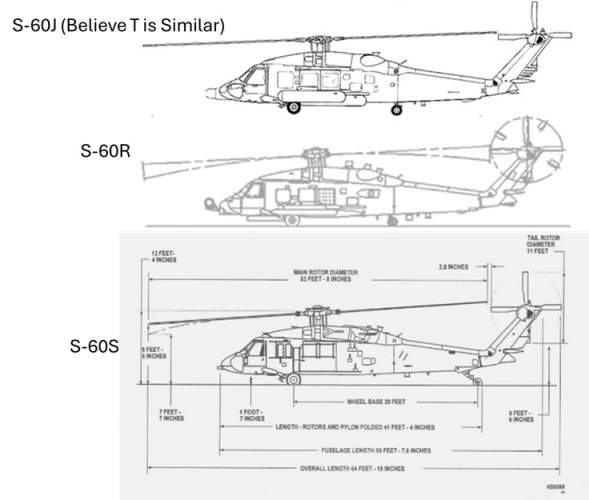
Hi,Coast Guard flies Seahawks.
Just for clarification, I believe that the USCG Jayhawks have their tailwheels located in a similar position to the tailwheel of the S-60R, the USN also operates the S-60S which I believe has its tailwheel further aft.
While I believe that the flight deck for the NSC/WMSL can handle the longer wheelbase of the S-60S I am not sure if there may be a need for any additional modifications to the hangar or other areas to operate that type abord, but hopefully it wouldn't be too difficult if required.
A very valid point though controversially waterjet manufactures claim they are quieter than open propellers, presume the noise depends on the speed, as they significantly reduce or eliminate cavitation, the bubbles forming under the high pressure and then noisily collapsing on leaving the propeller blade tips, cavitation is the primary source of propeller noise, so pros and cons and would need to compare measured noise records of the LCS and NCS which sure USN has from past measurements taken at the sonar test range in the Bahamas, the Atlantic Undersea Test and Evaluation Center (AUTEC) and then compare to say a modern European hybrid ASW frigate, the more self noise you create degrades the chances of your sonar detecting a submarine.The noise from the LCS was because of their water jets. Those are extremely noisy.
The fact that NSC doesn’t have water jets means it’s going to be noticeably quieter than the LCS.
Dedicated hybrid ASW frigates when searching for submarines operate at low speeds to minimize noise, cavitation etc and use propellers, submarines have taken propellers to a new level, with larger, slower, skewback designs with 5 or 7 blades or moved onto pump jets all in the quest to be quieter with less chance to be detected by passive sonar.
Scott Kenny
ACCESS: USAP
- Joined
- 15 May 2023
- Messages
- 19,805
- Reaction score
- 28,402
I think you're conflating water jet pumps like those on a jet-ski and the "lampshade" pumpjet propulsors on the back of a submarine.A very valid point though controversially waterjet manufactures claim they are quieter than open propellers, presume the noise depends on the speed, as they significantly reduce or eliminate cavitation, the bubbles forming under the high pressure and then noisily collapsing on leaving the propeller blade tips, cavitation is the primary source of propeller noise, so pros and cons and would need to compare measured noise records of the LCS and NCS which sure USN has from past measurements taken at the sonar test range in the Bahamas, the Atlantic Undersea Test and Evaluation Center (AUTEC) and then compare to say a modern European hybrid ASW frigate, the more self noise you create degrades the chances of your sonar detecting a submarine.
Dedicated hybrid ASW frigates when searching for submarines operate at low speeds to minimize noise, cavitation etc and use propellers, submarines have taken propellers to a new level, with larger, slower, skewback designs with 5 or 7 blades or moved onto pump jets all in the quest to be quieter with less chance to be detected by passive sonar.
If I understand the important difference, the submarine versions increase the water pressure around the rotors. Greater water pressure = less cavitation.
Similar threads
-

-
-
-
-
Navy Struggles to Fund SSBN(X), Destroyers, and cost overruns on CVN 78
- Started by Triton
- Replies: 19