
You are using an out of date browser. It may not display this or other websites correctly.
You should upgrade or use an alternative browser.
You should upgrade or use an alternative browser.
Oreshnik MRBM - Technical News Only
- Thread starter Archibald
- Start date
- Status
- Not open for further replies.

Null
ACCESS: Secret
- Joined
- 16 December 2024
- Messages
- 274
- Reaction score
- 515
the best intelligence for the West is to get better air defenses if Putin is confident enough to say name a time and place the target will still be hit. If 300 are produced yearly, then what will stop 298 or more getting produced from striking bases, equipment warehouses and runways? There are still also new variant iskanders in production and kinzhals.Every missile wasted on Ukraine is one less for WW3. It also is a bonanza of intelligence to the West.

EmoBirb
ACCESS: Top Secret
- Joined
- 18 January 2025
- Messages
- 2,724
- Reaction score
- 6,974
On the nature of Oreshnik, I think it is worthwhile looking at CPS (Conventional Prompt Strike) as how it was first conceptualized, which was ultimately an ICBM/SLBM equivalent fit for conventional use outside of WW3 style scenarios. While initially meant to be a weapon based on or modified from the likes of Minuteman or Trident the entire concept was ultimately scaled back into what it is today. That happened out of cost concerns and fears of misinterpreted identity of such a weapon back then. Another interesting system to look towards it the chinese DF-21C/D missile, being able to be nuclear armed or from what I gathered conventionally armed (as opposed to suspectedly not armed at all as in case of the Oreshnik) in order to attack targets on land or in case of the DF-21D at sea, providing strike capabilities at significant distances against high value targets without the need for going nuclear.
These are to examples of systems envisioned or developed that fit into a similar category as Oreshnik. But unlike CPS for example it's able to draw from the existing production facilities and supply chains, as Russian missile development and manufacturing has never been dormant. Thus cost and production duration can be reduced. While DF-21D for example, with its anti-ship focus, seems to prioritizes the ability to hit a moving target like an aircraft carrier over outright range or speed¹. On the other hand Oreshnik seems more geared towards attacks against infrastructure and other relevant facilities, stationary targets, but subsequently focusing more on range and velocity to reduce travel duration.
(¹ I'm at least going to assume as such, as guidance for the kind of accuracy required to hit a moving ship would be impaired by extreme hypersonic speeds)
These are to examples of systems envisioned or developed that fit into a similar category as Oreshnik. But unlike CPS for example it's able to draw from the existing production facilities and supply chains, as Russian missile development and manufacturing has never been dormant. Thus cost and production duration can be reduced. While DF-21D for example, with its anti-ship focus, seems to prioritizes the ability to hit a moving target like an aircraft carrier over outright range or speed¹. On the other hand Oreshnik seems more geared towards attacks against infrastructure and other relevant facilities, stationary targets, but subsequently focusing more on range and velocity to reduce travel duration.
(¹ I'm at least going to assume as such, as guidance for the kind of accuracy required to hit a moving ship would be impaired by extreme hypersonic speeds)
https://www.trenchart.us/p/russias-40-ton-non-nuclear-icbm-may
Confirm my point of view. That's a damn expensive way of demolishing a few old MiG-29s that are being replaced by F-16s and Mirage 2000s. Plus, the bulk of UKAF attack and bombing against russian troops is done by cruise missiles and drones, as the frontline is too dangerous for fighter jets, R-37 AAM threat included.
Just sayin' .
Confirm my point of view. That's a damn expensive way of demolishing a few old MiG-29s that are being replaced by F-16s and Mirage 2000s. Plus, the bulk of UKAF attack and bombing against russian troops is done by cruise missiles and drones, as the frontline is too dangerous for fighter jets, R-37 AAM threat included.
Just sayin' .
Last edited:
EmoBirb
ACCESS: Top Secret
- Joined
- 18 January 2025
- Messages
- 2,724
- Reaction score
- 6,974
Looking at what missile "forces" other countries field, I'm not surprised that a conventional use IRBM is beyond comprehension for some people. Truly shows the colossal difference between powers like China and Russia who can develop, fund and field such weapons with relative ease, compared to states which need decades to develop a nuclear capable ALCM (something other countries fire in conflicts on a basically weekly basis). In an age where long range strike becomes the most important mission on the battlefield, as engagement distances grow larger, you're a small fish in a very big pond when you can't keep up with the big dogs. Something the US realized and subsequently invested in new programs. Other countries lack the funds, resources and qualified people for that kind of tool.
The missile gap grows.
The missile gap grows.
Last edited:
For the record. Some interesting numbers here. Wonder how Oreshnik "kinetic rods" compare to that.
https://en.wikipedia.org/wiki/Kinetic_bombardment#2003_United_States_Air_Force_proposal
https://en.wikipedia.org/wiki/FAB-9000https://en.wikipedia.org/wiki/FAB-5000
2-I picked FAB-9000 because it is comparable to the 11.5 tons of TNT mentionned above. All right, let's suppose Oreshnik and FAB-9000 brings the same amount of... BOOM on an ukrainian target.
3-Main difference is the vector / carrier, including cost and practicality. Not sure an Oreshnik is a bargain, compared to a Tu-22M (not sure a Su-34 can carry a FAB-9000 ?) Admittedly, an Oreshnik can get through any air defense, unlike a 30 year old Tu-22M.
4-But (like I said a few times before) the damn thing is pretty expensive a pop. My Google search had bring unit costs all the way from $30 million to $300 million. How much does a Trident D5 cost per unit ?
5-There is also the issue of targeting. FAB turned glide bombs have proved to be cheap and efficient - as long as guidance wasn't jammed. We have precise numbers about CEP degradation vs destructive efficiency vs cost efficiency.
6-The CEP issue alo applies to Oreshnik, if we consider it at a 11.5 ton of TNT yield bomb. That's certainly a lot of TNT (like a FAB-9000). By nuclear yield however that's 0.01 kiloton.
7-What I mean by this comparison: unlike a nuclear or thermonuclear bomb, if the CEP is very bad (let's say a hundred meter ballpark) the target will not be destroyed. There are limits about what seismic waves can achieve for non nuclear booms.
https://en.wikipedia.org/wiki/Kinetic_bombardment#2003_United_States_Air_Force_proposal
1-We know the russians have an extended family of FAB big bombs of different weights, up to FAB 5000 and 9000.In the case of the system mentioned in the 2003 Air Force report above, a 6.1 by 0.3 metres (20 ft × 1 ft) tungsten cylinder impacting at Mach 10 (11,200 ft/s; 3,400 m/s) has kinetic energy equivalent to approximately 11.5 tons of TNT (48 GJ). The mass of such a cylinder is itself greater than 9 short tons (8.2 t), so the practical applications of such a system are limited to those situations where its other characteristics provide a clear and decisive advantage—a conventional bomb/warhead of similar weight to the tungsten rod, delivered by conventional means, provides similar destructive capability and is far more practical and cost-effective.
https://en.wikipedia.org/wiki/FAB-9000https://en.wikipedia.org/wiki/FAB-5000
2-I picked FAB-9000 because it is comparable to the 11.5 tons of TNT mentionned above. All right, let's suppose Oreshnik and FAB-9000 brings the same amount of... BOOM on an ukrainian target.
3-Main difference is the vector / carrier, including cost and practicality. Not sure an Oreshnik is a bargain, compared to a Tu-22M (not sure a Su-34 can carry a FAB-9000 ?) Admittedly, an Oreshnik can get through any air defense, unlike a 30 year old Tu-22M.
4-But (like I said a few times before) the damn thing is pretty expensive a pop. My Google search had bring unit costs all the way from $30 million to $300 million. How much does a Trident D5 cost per unit ?
5-There is also the issue of targeting. FAB turned glide bombs have proved to be cheap and efficient - as long as guidance wasn't jammed. We have precise numbers about CEP degradation vs destructive efficiency vs cost efficiency.
6-The CEP issue alo applies to Oreshnik, if we consider it at a 11.5 ton of TNT yield bomb. That's certainly a lot of TNT (like a FAB-9000). By nuclear yield however that's 0.01 kiloton.
7-What I mean by this comparison: unlike a nuclear or thermonuclear bomb, if the CEP is very bad (let's say a hundred meter ballpark) the target will not be destroyed. There are limits about what seismic waves can achieve for non nuclear booms.
Last edited:
EmoBirb
ACCESS: Top Secret
- Joined
- 18 January 2025
- Messages
- 2,724
- Reaction score
- 6,974
A Google search isn't something I would count as a quality source or way of conducting research. Quite frankly, unless you're in the russian government, you won't know the unit cost per missile.But (like I said a few times before) the damn thing is pretty expensive a pop. My Google search had bring unit costs all the way from $30 million to $300 million.
Furthermore, you're comparing it to glide bombs? You're comparing an intermediate range ballistic missile, reserved for targets of a certain relevance, something of scarcely paralleled range and speed, to a relatively short range munition that's used in volume against targets at the line of contact. To put it into a more comprehensive analogy, that's like comparing Iskander-M to a 152mm artillery shell. The glide bombs are vastly cheaper but far less capable and not suitable for the tasks the Oreshnik is intended to fulfill. The closest you'll get would be the 1000km Iskander variant or a Topol. But one is just as much of a mystery to the public, while the other is absolute overkill.

- Joined
- 6 November 2010
- Messages
- 6,359
- Reaction score
- 8,240
https://www.reuters.com/graphics/UKRAINE-CRISIS/RUSSIA-MISSILE/gdpzknajgvw/
Published Nov. 28, 2024
Last updated Jan. 9, 2026 12:34 CET
[...]
The accuracy seen in videos of the November, 2024 strike aligns with what would be needed for a nuclear weapon but not a conventional one, said William Alberque, a visiting fellow at the Henry L. Stimson Center.
"If Russia is working on a MIRV with a conventional CEP, we’ve never seen it," he said, referring to circular error probable (CEP), a measure of weapon accuracy. A nuclear missile typically has a CEP of 50 to 200 metres, meaning half of all rounds aimed at the target will land within that distance of the aimpoint.
In videos of the first Oreshnik attack, each warhead appeared to drop smaller payloads that could be seen striking the ground. Tim Wright of the International Institute for Strategic Studies said in late 2024 that if the missile used such submunitions, accuracy was less of a problem because: "it would distribute them over a wide area. It makes it useful for attacking large facilities".
Lewis cautioned that given the expense, using this type of ballistic missile to hit Ukraine might be more a psychological tactic than a military one. "If were inherently terrifying, (Putin) would just use it. But that's not quite enough," Lewis said, referring to the first attack. "He had to use it and then do a press conference and then do another press conference and say: 'Hey, this thing is really scary, you should be scared.'"
Probably one of the mistakes intentional or not when assessing the cost of a russian weapon system is taking roughly similar western systems as benchmarks. Usually western weapon system prices are bloated beyond belief. Far more logical is to asses a russian weapon system cost (or chinese, iranian, DPRK etc.) as one or several orders of magnitude less. Plus there is the production issue, not only from what we can gather Oreshnik uses off-the shelf components from the ICBM program thus reducing costs, but it helps the respective production line keep running, as ICBM demand is likely to be limited.
The other aspect is the overall strategy of having different weapon systems greatly complicating the enemy's defences during a war, you have not only Oreshniks, but Kinzhals, Iskanders, all kind of cruise missiles including low flying as well as supersonic and hypersonic, things like Burevestnik, all kinds of drones, all kinds of aircraft mounted weapons and so on. So Oreshnik should be looked from this angle too.
As for current use, what better way to test a weapon but in a real world setting against real targets, real (sort-of) defences etc.? At least this is the mantra coming from the west about the supposed capabilities of their own weapons.
The other aspect is the overall strategy of having different weapon systems greatly complicating the enemy's defences during a war, you have not only Oreshniks, but Kinzhals, Iskanders, all kind of cruise missiles including low flying as well as supersonic and hypersonic, things like Burevestnik, all kinds of drones, all kinds of aircraft mounted weapons and so on. So Oreshnik should be looked from this angle too.
As for current use, what better way to test a weapon but in a real world setting against real targets, real (sort-of) defences etc.? At least this is the mantra coming from the west about the supposed capabilities of their own weapons.
Trident II D5: $88 million4-But (like I said a few times before) the damn thing is pretty expensive a pop. My Google search had bring unit costs all the way from $30 million to $300 million. How much does a Trident D5 cost per unit ?
MX Peacekeeper: $243 million
GBI: $130 million (~$84 million without the EKV)
Minuteman III: $47 million
Sentinel: $114 million
All costs are inflation adjusted to 2025 USD.
Edit: My original figures for the MX Peacekeeper were significant underestimates. I have replaced them with new figures from a much more reliable source. Note that these are procurement costs only. R&D costs (which are substantial) are excluded for all missiles. Sentinel costs are based on an estimate from Dec 2023.
Last edited:
- Joined
- 6 November 2010
- Messages
- 6,359
- Reaction score
- 8,240
Then compare the Russian price for one Russian weapon - say, Oreshnik - to the Russian price for other Russian guided weapons.assessing the cost of a russian weapon system
Oreshnik's inefficiency in CEP is compounded by higher cost compared with other Russian guided missiles - which heap insult on injury by being more accurate.
So I return to Jeffrey Lewis, Distinguished Scholar of Global Security at Middlebury College saying...
... and thinking he is on to something.using this type of ballistic missile to hit Ukraine might be more a psychological tactic than a military one
Russian rubles may not buy you much outside Russia, but amounts spent in Russia are a decent measure of physical effort needed to produce stuff in Russia.
Oreshnik isn't throwing anywhere near 9000 kg of KEPs. It's way too small of a missile to handle anywhere near that much throw weight.For the record. Some interesting numbers here. Wonder how Oreshnik "kinetic rods" compare to that.
0.6 tons is not an unreasonable estimate for yield.
For comparison, a single Mk84 2000 lb bomb containing 429 kg of tritonal has 3,861 MJ of explosive energy, or 0.92 tons of yield in TNT equivalent.
So in other words, an Oreshnik missile deals less damage than a single 2000 lb bomb.
With a JDAM kit operating on INS only (no GPS), that Mk84 bomb can achieve a 30 m CEP.
The Oreshnik isn't going to achieve anywhere near a 30 m CEP (it might do 100–200 m if you're lucky, but I expect it to probably be far worse than that).
So not only is the single 2000 lb bomb going to deal more damage, it'll also be significantly more accurate.
And let's not even get into the issue of cost. A glide bomb and the flight time to deliver it is dirt cheap compared to the cost of an intermediate range ballistic missile.
Last edited by a moderator:
@JTR Thanks for your analysis.
Seriously ? Russia should give lessons as in, efficiency vs corruption ? What a joke.Probably one of the mistakes intentional or not when assessing the cost of a russian weapon system is taking roughly similar western systems as benchmarks. Usually western weapon system prices are bloated beyond belief. Far more logical is to asses a russian weapon system cost (or chinese, iranian, DPRK etc.) as one or several orders of magnitude less
Last edited:

Wotan
ACCESS: Secret
- Joined
- 18 April 2023
- Messages
- 420
- Reaction score
- 1,172
It looks like reused soviet ancient technology instead the expected technological breaktrough...
View: https://x.com/BohuslavskaKate/status/2010340986271187234?ref_src=twsrc%5Etfw%7Ctwcamp%5Etweetembed%7Ctwterm%5E2010340986271187234%7Ctwgr%5E%7Ctwcon%5Es1_&ref_url=
View: https://x.com/BohuslavskaKate/status/2010340986271187234?ref_src=twsrc%5Etfw%7Ctwcamp%5Etweetembed%7Ctwterm%5E2010340986271187234%7Ctwgr%5E%7Ctwcon%5Es1_&ref_url=

Avimimus
ACCESS: Top Secret
- Joined
- 15 December 2007
- Messages
- 2,720
- Reaction score
- 1,419
2-I picked FAB-9000 because it is comparable to the 11.5 tons of TNT mentionned above. All right, let's suppose Oreshnik and FAB-9000 brings the same amount of... BOOM on an ukrainian target.
Isn't the TNT equivalent estimated to be more like 1.5 to 2 tons?
Avimimus
ACCESS: Top Secret
- Joined
- 15 December 2007
- Messages
- 2,720
- Reaction score
- 1,419
It looks like reused soviet ancient technology instead the expected technological breaktrough...
...if it works it works?
That said, MIRVS are now 55 year old technology... the big advance here might be a somewhat higher CEP and better heat resistant coatings? Otherwise the technology isn't that new (nor does it need to be).

- Joined
- 1 April 2006
- Messages
- 12,286
- Reaction score
- 15,114
I don't see any proof for that in video though."Yuri Gagarin flew with one of these" Soviet-era gyroscope and lamp found in Putin’s "newest" missile.
To be fair this has been the modus operandi for Soviet and then Russian IRBMs since the 70s, with Pioneer, Pioneer-3, Skorost', and the post-soviet concepts (Rubezh, Oreshnik) all being the 1st and 2nd or 2nd and 3rd stages of ICBMs. Honorable mention to Volga, too, being (more or less) a double stack of Oka-U motors.Yes, cobbled together using two-stages from a three-stage ICBM the SS-29 which is not a new design but Russian propaganda would us believe that it is this brand new weapon (Which it is not), this to me at least is a sign of desperation.
Edit: apologies for the necropost, I didn't see the timestamp.

Dilandu
I'm dissatisfied, which means, I exist.
Erm. The old RDS-10 Pioner have a throw weight of about 1.5-1.75 tons.Oreshnik isn't throwing anywhere near 9000 kg of KEPs. It's way too small of a missile to handle anywhere near that much throw weight.
0.6 tons is not an unreasonable estimate for yield.
For comparison, a single Mk84 2000 lb bomb containing 429 kg of tritonal has 3,861 MJ of explosive energy, or 0.92 tons of yield in TNT equivalent.
So we could safely assume that Oreshnik have a throw weight of about the same scale - 1.5-2 tons at least.
At stated Mach 11 velocity, i.e. 3,7 km/s, the impact would be about 5-6 times more poweful than detonation of Mk-84 bomb.
Assuming that you could get plane in range.And let's not even get into the issue of cost. A glide bomb and the flight time to deliver it is dirt cheap compared to the cost of an intermediate range ballistic missile.
EmoBirb
ACCESS: Top Secret
- Joined
- 18 January 2025
- Messages
- 2,724
- Reaction score
- 6,974
Schrödingers NAFOids in action:
"Oreshnik is too expensive to be a useful battlefield weapon"
*Oreshnik uses simple components and shares parts with other systems to reduce cost and make large scale conventional use and deployment in the vein of CPS viable*
"Oreshnik uses cheap components and isn't ultra cutting edge"
Truly, the politically motivated bait and biased commentary with little to no substance knows no bounds.
"Oreshnik is too expensive to be a useful battlefield weapon"
*Oreshnik uses simple components and shares parts with other systems to reduce cost and make large scale conventional use and deployment in the vein of CPS viable*
"Oreshnik uses cheap components and isn't ultra cutting edge"
Truly, the politically motivated bait and biased commentary with little to no substance knows no bounds.
See these posts:Erm. The old RDS-10 Pioner have a throw weight of about 1.5-1.75 tons.
So we could safely assume that Oreshnik have a throw weight of about the same scale - 1.5-2 tons at least.
At stated Mach 11 velocity, i.e. 3,7 km/s, the impact would be about 5-6 times more poweful than detonation of Mk-84 bomb.
Assuming that you could get plane in range.
https://www.secretprojects.co.uk/threads/oreshnik-mrbm.44854/post-867160
https://www.secretprojects.co.uk/threads/oreshnik-mrbm.44854/post-867194
Assuming 1500–2000 kg of throw weight, that leaves 750–1000 kg for warheads (PBV/shroud/fuel/guidance/thrusters/structure always takes around 50% of throw weight).
The user I linked to assumed 1150 kg of payload (ie warheads), which is actually extremely optimistic.
Their calculation assumed a subset of that mass was used for ablative coatings, nosecones, MIRV subassembly parts, etc. I'll recalculate with a single unitary warhead instead to give an upper bound estimate if they didn't use submunitions and had zero mass loss from ablation (impossible).
With 1150 kg of payload impacting at 2.95 km/s:
KE = 1/2 M V^2 = 0.5*1150*((2.95*1000)^2) = 5 GJ
5 GJ = 1.2 tons of yield in TNT equivalent
So in the impossible maximum end case, you get..33% more yield than a single 2000 lb bomb. Not very impressive.
Now you'll argue that it's actually 3.7 km/s. To that I have one thing to say – show me the proof that this is a realistic reentry speed. My ballistic missile trajectory simulation program says that this is bollocks. Historical information on ICBM RV velocities near impact says that this is extreme bollocks.
But I'll entertain your argument just for fun, even if I strongly disagree with the premise. Let's use the same totally unrealistic assumptions wrt the mass of the impactor as before.
With 1150 kg of payload impacting at 3.7 km/s:
KE = 1/2 M V^2 = 0.5*1150*((3.7*1000)^2) = 7.9 GJ
7.9 GJ = 1.9 tons of yield in TNT equivalent
So in this even more absurdly impossible maximum end case, you get...the yield of two 2000 lb bombs. Wow, that's so much bang for your buck, amazing! Totally worth burning >$30 million dollars worth of ballistic missile for! /s
Let's examine the alternative. Two Mk84 bombs with JDAM kits would cost about $100,000 ($20k for the bombs, $80k for the JDAM kits). A F-35 costs $42k per flight hour. Even if you need extensive support, total mission costs are highly unlikely to exceed $1 million (and realistically would probably be a fraction of that). You can place those bombs with 30 meter accuracy (vs >200 meter accuracy), even in GPS denied environments. The Oreshnik is functionally useless at dishing out useful levels of damage to targets due to its hideously poor accuracy. The JDAMed Mk84s are not.
The only possible reason to use a Oreshnik with conventional munitions is as a terror/political weapon. It's not a practical or cost-effective conventional weapon, but rather a thinly veiled threat: look at me, I have IRBMs, the next one could be nuclear tipped!
Wotan
ACCESS: Secret
- Joined
- 18 April 2023
- Messages
- 420
- Reaction score
- 1,172
Analogue gyroscope and electronic tubes.I don't see any proof for that in video though.
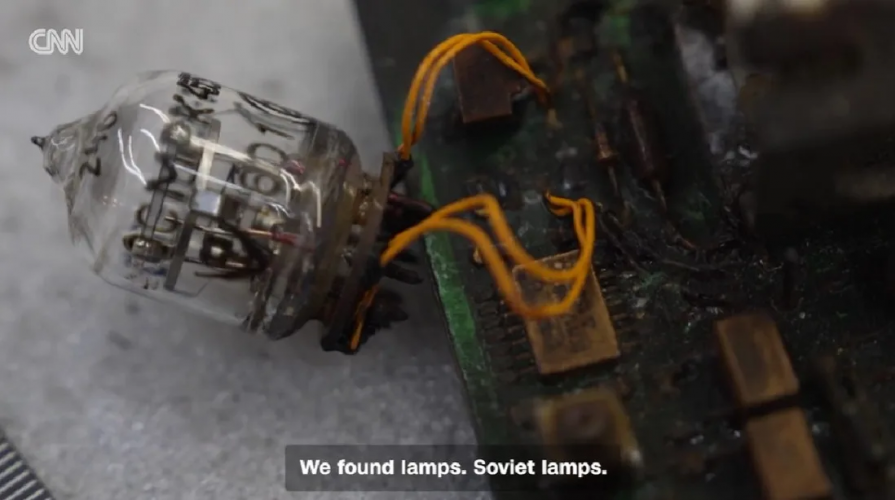
Analogue gyroscopes cannot produce good precision, for aerospace uses they are replaced by other more precise and compact solutions, like fibre optic gyroscope, laser ring gyroscopes, MEMS etc. In fact, miniature gyroscopes are present in smartphones.
The presence of electronic tubes also indicates that the comand system is not fully digitalized. Analogue control systems are less precise than digital ones.
Accuracy of a such type of control and correction system is not great. Not something that you can use for surgical strikes on punctual targets.
EmoBirb
ACCESS: Top Secret
- Joined
- 18 January 2025
- Messages
- 2,724
- Reaction score
- 6,974
Except that you base your entire ramblings on wild assumptions, given that the actual weapon and it's characteristics is wholly off limits to anyone who has access to this forum and would share them.The only possible reason to use a Oreshnik with conventional munitions is as a terror/political weapon. It's not a practical or cost-effective conventional weapon, but rather a thinly veiled threat: look at me, I have IRBMs, the next one could be nuclear tipped!
And that it's effective as a conventional weapon has been proven two times now, attacking two industrial facilities, taking them out of action and in both cases the lack of footage from the sites and the silence surrounding them is deafening (if there was nothing, they would gloat about it very publicly and film the whole thing, tour the "undamaged facilities"). To be fair, I too wouldn't like to show destroyed aircraft and industrial equipment, doesn't raise morale, no? Also bypassing the entire air defense network of an entire country? Jeez, not a good look.
The Russians had ICBMs and SLBMs far longer, all nuclear capable, most of the cruise and ballistic missiles Russia has utilized in a regular basis in this war are nuclear capable. They have a nuclear powered, nuclear tipped air breathing cruise missile and a nuclear powered, nuclear tipped, intercontinental torpedo in active testing. It's really naive and quite frankly funny to believe that they would need and choose something like Oreshnik to show off. A weapon that a country like China for example has several analogs of, something that's only completely foreign and magical to European and American militaries, for which the heaviest non-nuclear long range weapons are something like ATACMS (lol). In the east, be it Russia, China or Korea (both Koreas actually) it's not unheard of to operates the whole spectrum of missiles. And in the case of the two superpowers that includes everything from hypersonic to supersonic to subsonic missiles, air breathing, glide vehicles, ballistic, cruise, stealthy, non stealthy, long range, intermediate range, intercontinental range, the whole nine yards.
Last edited by a moderator:
- Joined
- 1 April 2006
- Messages
- 12,286
- Reaction score
- 15,114
I don't see any proof it's from Oreshnik, you know. Indexes, codes, writings etc? I see rooms and stands filled with avionics from hundreds of different types and guy with EXPERT written on his hat. Those are the same guys that use all-wrong fanart Zircon drawing as key to recreate it. So I'm a little bit sceptical.Analogue gyroscope and electronic tubes.
Attachments
-
![ssstwitter.com_1768154988794.mp4_snapshot_01.28_[2026.01.11_22.58.11].jpg](/data/attachments/333/333897-0bfc2cabf19906cf917c8b7627320007.jpg) ssstwitter.com_1768154988794.mp4_snapshot_01.28_[2026.01.11_22.58.11].jpg111.7 KB · Views: 21
ssstwitter.com_1768154988794.mp4_snapshot_01.28_[2026.01.11_22.58.11].jpg111.7 KB · Views: 21 -
![ssstwitter.com_1768154988794.mp4_snapshot_01.21_[2026.01.11_22.57.39].jpg](/data/attachments/333/333898-a08a1a1c0cd145a2147d2e18b3590ff8.jpg) ssstwitter.com_1768154988794.mp4_snapshot_01.21_[2026.01.11_22.57.39].jpg128.5 KB · Views: 19
ssstwitter.com_1768154988794.mp4_snapshot_01.21_[2026.01.11_22.57.39].jpg128.5 KB · Views: 19 -
![ssstwitter.com_1768154988794.mp4_snapshot_01.26_[2026.01.11_22.57.14].jpg](/data/attachments/333/333899-f9a1db6967f8f94b1048a4a6e0599e7b.jpg) ssstwitter.com_1768154988794.mp4_snapshot_01.26_[2026.01.11_22.57.14].jpg167.2 KB · Views: 21
ssstwitter.com_1768154988794.mp4_snapshot_01.26_[2026.01.11_22.57.14].jpg167.2 KB · Views: 21 -
![ssstwitter.com_1768154988794.mp4_snapshot_01.17_[2026.01.11_22.56.57].jpg](/data/attachments/333/333900-34d956dc99b6c7806a8d0fbd8effcf7a.jpg) ssstwitter.com_1768154988794.mp4_snapshot_01.17_[2026.01.11_22.56.57].jpg136.9 KB · Views: 22
ssstwitter.com_1768154988794.mp4_snapshot_01.17_[2026.01.11_22.56.57].jpg136.9 KB · Views: 22
Dilandu
I'm dissatisfied, which means, I exist.
Now add the F-35 cost in equation - because it's always possible that it would not return - and you would got 100 millions dollars cost, and about 10 millions more for pilot.Let's examine the alternative. Two Mk84 bombs with JDAM kits would cost about $100,000 ($20k for the bombs, $80k for the JDAM kits). A F-35 costs $42k per flight hour.
Not that optimistic now, huh?)
To clarify: I completely agree, that IRBM's aren't practical tactical weapons, and Oreshnik use is mainly a political demonstration, as well as good demoralizator for opponents) But you are trying a bit too hard to turn everything political. From practical point of view, atomic bombing of Hiroshima was a terrible waste of money, which could be much better utilized by additional fleet of heavy bombers. But the additional use of standard weapons did not have the same psychological effect as use of something new, impressive and (importantly) that other guy have nothing even remotely like it.
EmoBirb
ACCESS: Top Secret
- Joined
- 18 January 2025
- Messages
- 2,724
- Reaction score
- 6,974
But yes, the pictures scream "we went through our parts bin and threw everything into a field for a photo op". Especially suspicious that such a fragile component would have had to withstand immense heat and the forces of impact unscathed to appear as in the picture. When you hit an industrial facility with 13.000km/h (as the Ukrainians claim it did), such a component wouldn't survive the impact let alone look as pristine as above.Those are the same guys that use all-wrong fanart Zircon drawing as key to recreate it. So I'm a little bit sceptical.
Dilandu
I'm dissatisfied, which means, I exist.
Erm... you don't notice anything strange? Like, that vacuum tube is connected with microchips on circuit board? And while the circuit board is clearly heavy damaged, the tube is brand-new and not even scratched?Analogue gyroscope and electronic tubes.
EmoBirb
ACCESS: Top Secret
- Joined
- 18 January 2025
- Messages
- 2,724
- Reaction score
- 6,974
Truly a marvel of Red Age of Technology soviet engineering, vacuum tubes that survive hypersonic impacts into and through concrete and still have all the labeling visible too.Erm... you don't notice anything strange? Like, that vacuum tube is connected with microchips on circuit board? And while the circuit board is clearly heavy damaged, the tube is brand-new and not even scratched?
I'm honestly frightened how willingly badly presented falsified "evidence" is taken as fact without two seconds of critical thinking

topspeed3
ACCESS: Secret
- Joined
- 31 January 2011
- Messages
- 495
- Reaction score
- 276
Or out of ammo.I find it surprising the Russians used an SS-X-31 ICBM as I thought such a weapon would have a sizeable minimum range unless it was launched from a few thousand miles away. This is an extremely reckless and desperate move by the Russians, Putin I suspect maybe panicking.
topspeed3
ACCESS: Secret
- Joined
- 31 January 2011
- Messages
- 495
- Reaction score
- 276
I wonder if the craft released these warheads at lets say 60 km altitude...it just slowed down into 200 km/h on impact...on a soft soil. Nothing unusual here. Air resistance is a bitch.Truly a marvel of Red Age of Technology soviet engineering, vacuum tubes that survive hypersonic impacts into and through concrete and still have all the labeling visible too.
I'm honestly frightened how willingly badly presented falsified "evidence" is taken as fact without two seconds of critical thinking
Dilandu
I'm dissatisfied, which means, I exist.
I found what it is. It's a vaccum tube from the Sub-Module of Radio Channel (SMRK) from old UTST television set!Analogue gyroscope and electronic tubes.
View attachment 798212
Analogue gyroscopes cannot produce good precision, for aerospace uses they are replaced by other more precise and compact solutions, like fibre optic gyroscope, laser ring gyroscopes, MEMS etc. In fact, miniature gyroscopes are present in smartphones.
The presence of electronic tubes also indicates that the comand system is not fully digitalized. Analogue control systems are less precise than digital ones.
Accuracy of a such type of control and correction system is not great. Not something that you can use for surgical strikes on punctual targets.
Last edited by a moderator:
- Joined
- 1 April 2006
- Messages
- 12,286
- Reaction score
- 15,114
I wouldn't be so _sure_ Google image search and Soviet era markings can play tricks. You think this is TV set lamp, and in real life it's suddenly a KN22 counterpart..I found what it is. It's a vaccum tube from the Sub-Module of Radio Channel (SMRK) from old UTST television set!
- Joined
- 1 April 2006
- Messages
- 12,286
- Reaction score
- 15,114
https://t.me/infomil_live/25935https://t.me/UAVDEV/10032I wouldn't be so _sure_ Google image search and Soviet era markings can play tricks. You think this is TV set lamp, and in real life it's suddenly a KN22 counterpart..
Last edited:
Null
ACCESS: Secret
- Joined
- 16 December 2024
- Messages
- 274
- Reaction score
- 515
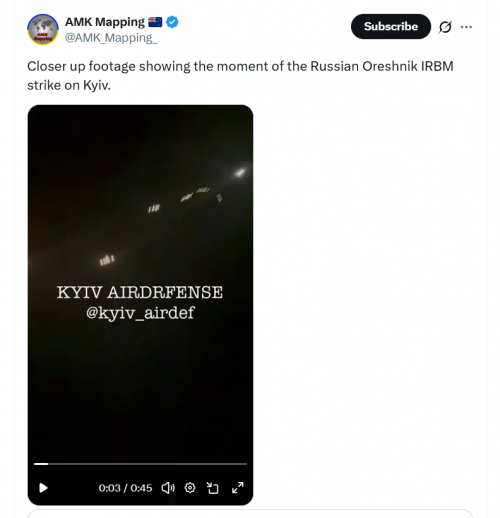
since the oreshnik thread is locked.
View: https://x.com/AMK_Mapping_/status/2058315940069351486
View: https://x.com/AMK_Mapping_/status/2058315940069351486
Attachments

ComradeVortex
Air Combat is a Beautiful Ballet of Death.
- Joined
- 11 April 2025
- Messages
- 924
- Reaction score
- 2,642
2 Oreshniks IRBMs launched in the attacks, both around Kiev.
Also, is it me or it's going slower? Are they trying something new here?
Also, is it me or it's going slower? Are they trying something new here?
Last edited:
ComradeVortex
Air Combat is a Beautiful Ballet of Death.
- Joined
- 11 April 2025
- Messages
- 924
- Reaction score
- 2,642
2 Oreshniks IRBMs launched in the attacks, both around Kiev.
1 single Oreshnik.
View: https://x.com/i/status/2058452341423304801
lastdingo
Blogger http://defense-and-freedom.blogspot.de/
IMO Oreshnik is a threat to European (and Japanese, South Korean) oil refineries.
You cannot wage war for long if your oil refineries got busted. The Russians know that we can easily bust theirs, so they need a conventional deterrent to that happening.
The effects on impact and the CEP easily suffice for this purpose IF the missile works and doesn't fail technically.
You cannot wage war for long if your oil refineries got busted. The Russians know that we can easily bust theirs, so they need a conventional deterrent to that happening.
The effects on impact and the CEP easily suffice for this purpose IF the missile works and doesn't fail technically.
Ainen
I really should change my personal text
- Joined
- 25 August 2011
- Messages
- 2,876
- Reaction score
- 4,984
I don't think it can put refinery out of operation for long. 36 unguided hits "somewhere there" screams something big, easy to hit, yet valuable in it's area.IMO Oreshnik is a threat to European (and Japanese, South Korean) oil refineries.
You cannot wage war for long if your oil refineries got busted. The Russians know that we can easily bust theirs, so they need a conventional deterrent to that happening.
The effects on impact and the CEP easily suffice for this purpose IF the missile works and doesn't fail technically.
Otherwise, 1 Oreshnik is equal to that Iranian strike from 2024 - spectacular, but damage was limited to 1 hangar and whatever was or wasn't inside.
Baka weapon without either nukes or Korean style heavy penetrating warhead.
- Status
- Not open for further replies.
Similar threads
-

-

-
 Russia tests Voevoda missile and vows to build new offensive forces (2 stories)
- Started by bobbymike
- Replies: 0
-
