insider - if you had so much as spent the time at all to even do some doodling with pencil, you'd be much much more credible.

@VTOLicious and @Nx4eu have done some very solid work modeling 5th and 6th gen fighters - much more rigorous than what I've done here.
Ayy you flatter me. My models are nowhere near rigorous enough compared to you. The 580 Rule from VTOL is actually pretty neat. I just finished a J-20 model which has a volume of 64m^2 which seems pretty accurate.
 
Last edited:
IMHO discussing changes to meet USN requirements would be pointless. My F-47 model is a hypothetical design, without any relation to actual customer requirements, obviously. I used public available information and assumtions discussed in this very forum instead. The model is based on the specifications of previous-generation stealth fighters and derived assumptions. Hence it just illustrates what could be possible, but it might be far off from reality. I could claim it illustrates the F-47, F/A-XX, or a superior configuration Phantom / Skunk Works was unable to come up with ;) ...Pointless!

Just look at ATF: two very different airframes, despite being based on exactly the same customer requirements. Speaking of ATF, have you ever asked yourself why Northrop proposed a completely new airframe for NATF, rather than using the already validated (Y)F-23 airframe with a few modifications?

View attachment 797365
https://www.secretprojects.co.uk/th...versions-of-the-f-22-and-f-23.2730/post-21848
I posted a comment like this before, remove the verticals, shallow out the canard angle a little and blend the fuselage to wing more, and what do you have?
 
Ayy you flatter me. My models are nowhere near rigorous enough compared to you. The 580 Rule from VTOL is actually pretty neat. I just finished a J-20 model which has a volume of 64m^2 which seems pretty accurate.
Oh wow, that's great! Please share more details and pics in a dedicated thread.
 
...
Just look at ATF: two very different airframes, despite being based on exactly the same customer requirements. Speaking of ATF, have you ever asked yourself why Northrop proposed a completely new airframe for NATF, rather than using the already validated (Y)F-23 airframe with a few modifications?

@insidersource here is the answer (Air Force Legends #220, by Paul Metz, page 74):
"...Northrop's initial NATF concept was based on the Air Force's YF-23 with the diamond wing and butterfly tails. since the length of the HSF was 66 ft 6 in long, and the eventual PAV YF-23 was 67 ft 4.8 in long, NATF needed to be shortened. One of the major requirements for the Navy was that the aircraft could not be longer than the current F-14 Tomcat, which was 62 ft 8.5 in long, with a swept wingspan of 38 ft. Keeping the proposed vehicle at or under the same deck footprint, or spotting factor, as the Tomcat was driven by the need to facilitate on-deck handling and aircraft placement, maintain flight deck elevator capacity and carriage, and allow for satisfactory below deck storage and maintenance work..."

Now, F/A-XX is intended to replace the F/A-18E/F, which is 60 ft 1.25 in long (18.32 m). Should we apply the above requirement and assume F/A-XX could not be longer than the Super Hornet? Btw, the modified F-23 drawing you posted earlier is about 9 ft longer ;)
 
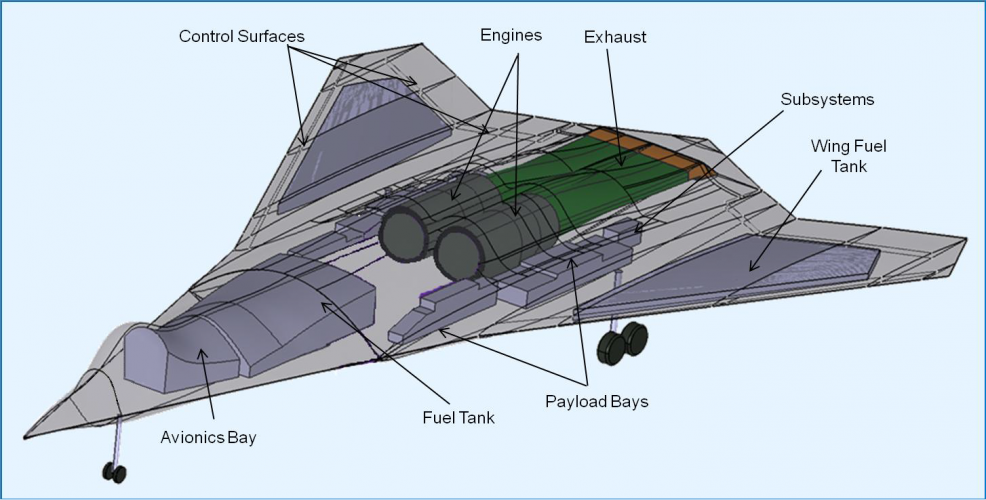
2. Fuel tanks

Fuel tanks requirements:
1. Must have sufficient clearance to all components - 1 to 2 inch to weapon bay walls, 2 - 3 inches from cold part of the engine, between tanks
2. Must avoid engine hot zones
3. Must remain only in the wing root of the wing

Is there a reason for the third point? AFAIK, all land based fighters after the F-15 carry fuel from wing root to wing tip.
A couple of hundred pounds more fuel in the wings would give you a bit more wiggle room in the fuselage.

Ayy you flatter me. My models are nowhere near rigorous enough compared to you. The 580 Rule from VTOL is actually pretty neat. I just finished a J-20 model which has a volume of 64m^2 which seems pretty accurate.

It's very nice, but no need to quote the entire post for a 2 line answer. ;)
 
@insidersource here is the answer (Air Force Legends #220, by Paul Metz, page 74):


Now, F/A-XX is intended to replace the F/A-18E/F, which is 60 ft 1.25 in long (18.32 m). Should we apply the above requirement and assume F/A-XX could not be longer than the Super Hornet? Btw, the modified F-23 drawing you posted earlier is about 9 ft longer ;)
No, I expect that the USN is going to accept Tomcat-ish spot factor. Because I don't believe that you can get the range required in the spot factor of a Super Bug.


Is there a reason for the third point? AFAIK, all land based fighters after the F-15 carry fuel from wing root to wing tip.
A couple of hundred pounds more fuel in the wings would give you a bit more wiggle room in the fuselage.
Folding wings rarely have fuel outboard of the fold.
 
May I note the F22 could have the elevons and vertical tails serve as fuel tanks, too.
I can think of a few other reason you don't want to fill all those spaces:
1. timming would be more tricky
2. requires more tedious inspection; and if fuel is foul you need to take it apart and clean it all.
3. easier to get damaged -> 2.
 
No, I expect that the USN is going to accept Tomcat-ish spot factor. Because I don't believe that you can get the range required in the spot factor of a Super Bug.
Maybe, maybe not... I simply wanted to point out that customer requirements do indeed exist, regardless of whether they fit your ultimate F/A-XX fantasy or not ;)
 
Speaking of ATF, have you ever asked yourself why Northrop proposed a completely new airframe for NATF, rather than using the already validated (Y)F-23 airframe with a few modifications?

View attachment 797365
https://www.secretprojects.co.uk/th...versions-of-the-f-22-and-f-23.2730/post-21848
Northrop proposed a completely new airframe because the Navy version needed canards to reduce the landing speed. Su-33 added canards. Rafale has canards which is the only supercruising carrier aircraft.

Have you ever asked yourself why the F-47 has canards?

Notice how the Northrop NATF looks exactly like your F-47 rendering?

I like the Northrop NATF contender VTOLicious, I suppose that it was designed to different specifications compared to the USAF YF-23./F-23 variant.

Yes the Navy landing speed specification required either canards or a swing wing. This is why the F-47 has canards so that Boeing can make a naval variant.

Now, F/A-XX is intended to replace the F/A-18E/F, which is 60 ft 1.25 in long (18.32 m). Should we apply the above requirement and assume F/A-XX could not be longer than the Super Hornet? Btw, the modified F-23 drawing you posted earlier is about 9 ft longer ;)
The A-5 Vigilante was 23.32 m long.
The A-3 Slywarrior was 23.27 m long.

That was an arbitrary length requirement. The density of aircraft on the carriers was much higher than today. The Nimitz class carriers haven't suddenly become smaller so there would be no reason to limit the length to 18.32 m to match the Super Hornet.

I posted a comment like this before, remove the verticals, shallow out the canard angle a little and blend the fuselage to wing more, and what do you have?
Yes, the Navy YF-23 closely resembles the Boeing F-47 concepts posted on here. It is not a coincidence that Boeing made the Navy demonstrator.
 
On canards, may I point out in the presentation video on the F35's design it was said they turned away from carnards in favor of elelvons because that would work better for doing a cobra.
Also Boeing's patent that's obviously related to the demonstrator specifically used something else (nose wheel wings) instead of canards.
 
Northrop proposed a completely new airframe because the Navy version needed canards to reduce the landing speed. Su-33 added canards. Rafale has canards which is the only supercruising carrier aircraft.

Have you ever asked yourself why the F-47 has canards?

Notice how the Northrop NATF looks exactly like your F-47 rendering?


Yes the Navy landing speed specification required either canards or a swing wing. This is why the F-47 has canards so that Boeing can make a naval variant.


The A-5 Vigilante was 23.32 m long.
The A-3 Slywarrior was 23.27 m long.

That was an arbitrary length requirement. The density of aircraft on the carriers was much higher than today. The Nimitz class carriers haven't suddenly become smaller so there would be no reason to limit the length to 18.32 m to match the Super Hornet.


Yes, the Navy YF-23 closely resembles the Boeing F-47 concepts posted on here. It is not a coincidence that Boeing made the Navy demonstrator.
You're simply don't know anything about how aircraft are designed. They're designed to the requirements, not fan boy fantasies. The requirements for the F/A-XX and the F-47 are massively different. They will not be the same airframe. They won't even have the same powerplants. You have the right to believe whatever you want to believe, but just know that none of it is based in reality.
 
J-35, the latest navalized fighter, begs to differ.
Just as a quick side note, I believe the J-35 was naval first, with an air force variant, not the other way round. The history of the J-35 is a bit finicky as it's first incarnation, the FC-31 was purely a Shenyang venture and not attached to any military program for the longest while.
 
Just as a quick side note, I believe the J-35 was naval first, with an air force variant, not the other way round. The history of the J-35 is a bit finicky as it's first incarnation, the FC-31 was purely a Shenyang venture and not attached to any military program for the longest while.
But they are either both air superiority fighters or both multirole fighters rather than spanning different services and different roles.

Its not that naval to air force conversion or vice versa isnt possible, but rather that the requirements must be similar enough and the penalties must be acceptable for both variants to still fulfill their intended roles.

@insidersource

If it's a red car then it must be a firetruck. I should expect J-20's flying off of 004's in a few years.

We've been through this before - there are other reasons a fighter jet could have canards.
 
Last edited:
Is there a reason for the third point? AFAIK, all land based fighters after the F-15 carry fuel from wing root to wing tip.
A couple of hundred pounds more fuel in the wings would give you a bit more wiggle room in the fuselage.

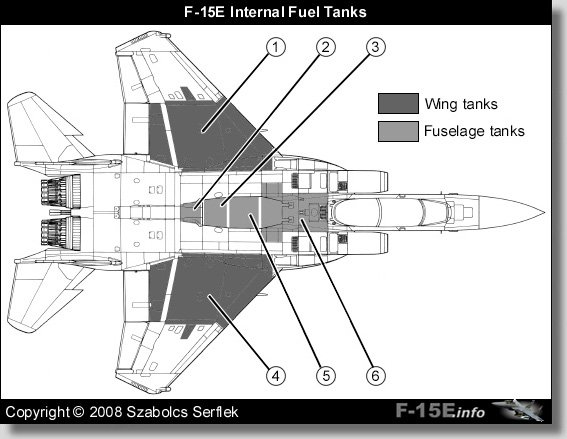
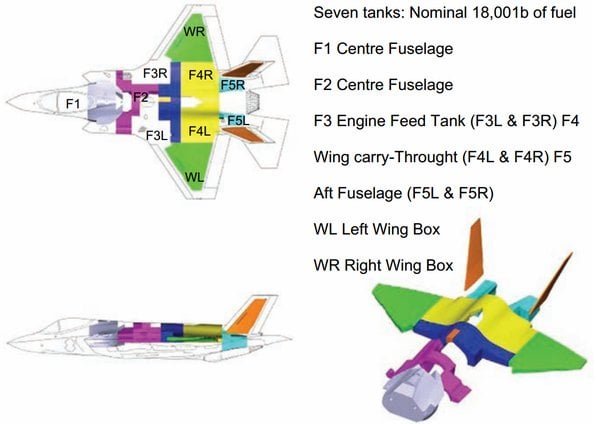
Not particularly. I basically did some due diligence searches on how fighter airceaft fuel tanks were configured. Ive also gone to see the F-22 in the Dayton USAF museum and remembered how thin the laminar wings were so I didnt want to give myself too much leeway in case my assumptions were wrong.

Some of the images I used for fuel tank arrangement are here below. I was under the impression that very thin outboard wings wouldn't hold fuel or a lot of it and the reason I didn't use the F-35 was because the F-35 wings aren't nearly as thin as what I saw on the F-22.

1767571954130.jpeg

1767572004384.jpeg

Basically my rule was that if I wasnt sure about something, Id attempt to look up references and err to the worst case scenario first and if I absolutely had to, I could relax those requirements a bit. Admittedly, I didn't spend as much effort on the fuel tanks it was mostly done as a sanity check. The rest of the tolerances had to have quite a bit of relaxation of the worst case assumptions, though as far as I can tell, they were still within workable parameters.

I think it could free up space, but its not going to help add usable weapon space since its not the major limiter for the weapon bays.
 
Last edited:
The current best air superiority fighter in the world is the F-22. The current best strike fighter in the world is the F-35. Both aircraft have nearly identical weapon bay volume. Volume is all that matters.
Volume is all that matters.. Genius, we should store all the weapons in the wings! There is so much volume there.
 
I think it's nice to go back through and review some old information posted in the old NGAD/PCA/F/A-XX thread.

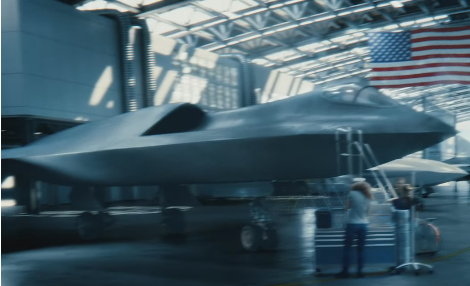
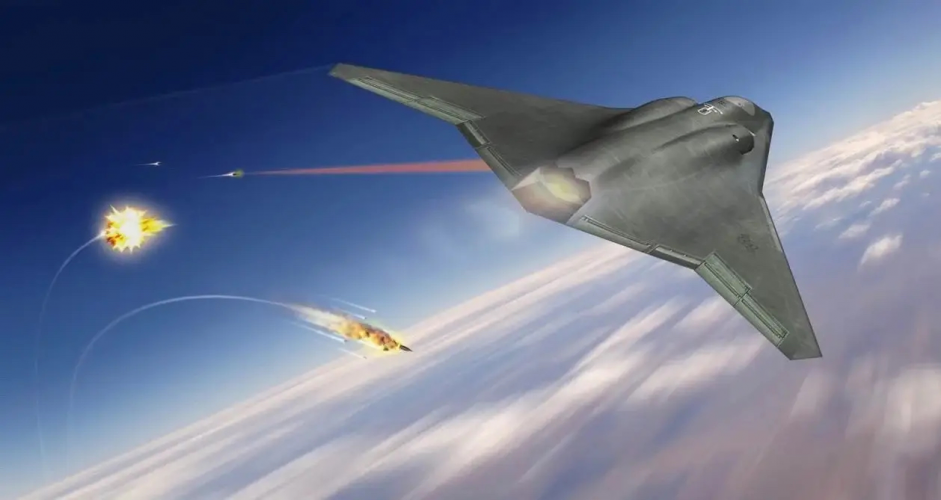
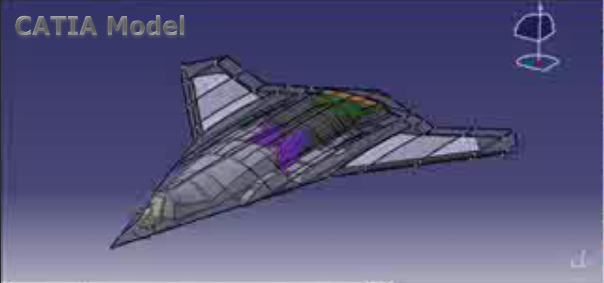
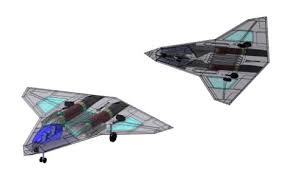
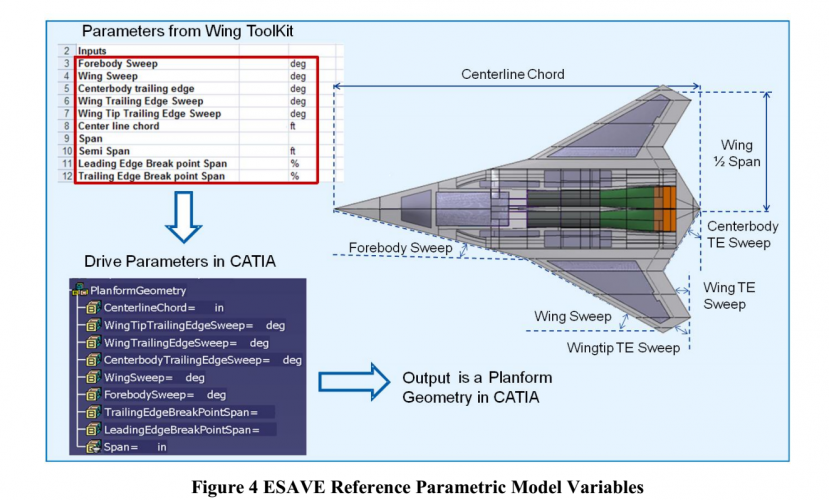
So far here's what we've seen of a tailless, supersonic strike fighter platform that NG appears to be looking at. Each of the below images were posted or released by NG:
1767579545048.png 1767579659457.png 1767581974395.png 1767582074715.png ng_esav.png 1767582163167.png 1767582129982.png 1767582253553.png ng-esav2.png


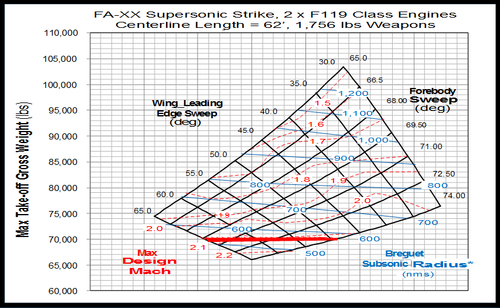
The very last few come from a PPT from 2021 that also included this chart, which was already posted in the last thread by someone else (credit to kagemusha). Not ure how the 1,756lbs weapons was obtained since it was completely blocked by overlaid letters in the PPT so ... take it with caution I guess:

1767591167032.png
I want to disregard the first image. It's quite clear it's AI painted slop.

The others all seem to point to a cranked arrow of some kind, maybe possibly with a shovel nose, which, to me, further confirms the idea that F/A-XX has a greater strike focus. Dedicated air superiority doesn't, in my mind, look like anything NG has shown thus far.
 
Last edited:
Northrop proposed a completely new airframe because the Navy version needed canards to reduce the landing speed. Su-33 added canards. Rafale has canards which is the only supercruising carrier aircraft.

Have you ever asked yourself why the F-47 has canards?

Notice how the Northrop NATF looks exactly like your F-47 rendering?


Yes the Navy landing speed specification required either canards or a swing wing. This is why the F-47 has canards so that Boeing can make a naval variant.


The A-5 Vigilante was 23.32 m long.
The A-3 Slywarrior was 23.27 m long.

That was an arbitrary length requirement. The density of aircraft on the carriers was much higher than today. The Nimitz class carriers haven't suddenly become smaller so there would be no reason to limit the length to 18.32 m to match the Super Hornet.


Yes, the Navy YF-23 closely resembles the Boeing F-47 concepts posted on here. It is not a coincidence that Boeing made the Navy demonstrator.
I think Boeing used a few different concepts to finally come up with the F-47 configuration. The released concept has the wing almost like Bird of Prey but it seems shallower but the config could have changed as well, would be interesting to see the what the demonstrator looks like. The F-4 had upwards canted wing tips. I would assume Boeing F/A-XX may have canards but I am not to sure about NG, I could be wrong but I think the NG F/A-XX is going to be a lot different than we all think, NG has a tendency of doing that but I'm sure there be some F-23 in the config and they may stay with the top inlets as well. When I was at Northrop, we had some pretty cool stuff during my tour.
 
I think it's nice to go back through and review some old information posted in the old NGAD/PCA/F/A-XX thread.

So far here's what we've seen of a tailless, supersonic strike fighter platform that NG appears to be looking at. Each of the below images were posted or released by NG:
View attachment 797416View attachment 797417View attachment 797424View attachment 797425View attachment 797426View attachment 797428View attachment 797427View attachment 797430


The very last few come from a PPT from 2021 that also included this chart, which was already posted in the last thread by someone else:
View attachment 797434

I want to disregard the first image. It's quite clear it's AI painted slop.

The others all seem to point to a cranked arrow of some kind, maybe possibly with a shovel nose, which, to me, further confirms the idea that F/A-XX has a greater strike focus. Dedicated air superiority doesn't, in my mind, look like anything NG has shown thus far.

Given the title of the graph, it fascinating to have a glimpse of possible parameters being considered for F/A-XX. It's also sorta crazy that this graph was looking at a whopping six (!) 2000lb sized weapons.

Also @Seragina, there's another view of this powerpoint concept that looks very very similar to your work. It seems to be the same model sprinkled throughout the ppt where this platform was found in:
View attachment 797435

Seems to be where the PLAN is heading as well.
There's also a 2023~esque Chinese research paper that reported on a generic strike optimized UCAV that's very J-50 like with a smoother blending cranked kite LE and several variations onward sporting a, "jacket wing" (my personal labeling for a swing wing located underneath a normal wing, so it folds back into the big wing, hence the resemblance made to tucking you arms into a jacket sleeve :D) pretty much ala Sukhoi T-54/60, a normal swing wing and presumably a depiction of what would be the J-50.
 
Seems to be where the PLAN is heading as well.
There's also a 2023~esque Chinese research paper that reported on a generic strike optimized UCAV that's very J-50 like with a smoother blending cranked kite LE and several variations onward sporting a, "jacket wing" (my personal labeling for a swing wing located underneath a normal wing, so it folds back into the big wing, hence the resemblance made to tucking you arms into a jacket sleeve :D) pretty much ala Sukhoi T-54/60, a normal swing wing and presumably a depiction of what would be the J-50.
The planform lends itself to having good central fuselage volume for strike munitions, so its not surprising. The jacket wing idea sounds cool, but probably too much unneeded complexity that NG or Boeing would want to undertake.

As far as I know, the two main levers for a carrier landing as far as planform shaping goes is the LE sweep and or wing/ control surfaces size. You can get away with somewhat higher sweep with a larger wing, or you can get away with a smaller wing with higher wing sweep. And obviously, canards is not a requirement for getting off a carrier...

So with all that in mind. I imagine something like the NG ATA concept but with a higher swept fuselage and a 45 to 50 degree LE sweep plus enough wing area could probably work. It may or may not need to be a mach 2+ fighter either and can trade that top speed for other things. Ill need to do some more research on a likely spot factor.
 
Folding wings rarely have fuel outboard of the fold.

? That's why I said land based fighters... the F-47 is also land based, so probably without folding wings.


May I note the F22 could have the elevons and vertical tails serve as fuel tanks, too.
I can think of a few other reason you don't want to fill all those spaces:
1. timming would be more tricky
2. requires more tedious inspection; and if fuel is foul you need to take it apart and clean it all.
3. easier to get damaged -> 2.

The reason was cost. The F-22 could have had bigger internal fuel capacity but it was decided at the time it had enough range.


Not particularly. I basically did some due diligence searches on how fighter airceaft fuel tanks were configured. Ive also gone to see the F-22 in the Dayton USAF museum and remembered how thin the laminar wings were so I didnt want to give myself too much leeway in case my assumptions were wrong.

Some of the images I used for fuel tank arrangement are here below. I was under the impression that very thin outboard wings wouldn't hold fuel or a lot of it and the reason I didn't use the F-35 was because the F-35 wings aren't nearly as thin as what I saw on the F-22.

The wings are the best place you can store fuel, see airliners. So if possible, I would definitely use that volume. Unless you have F-104 like thin wings. :D
The F-15A had a lot of internal volume left empty, because the aircraft was basically designed around the radar, engines and 4 Sparrows, and they just put enough fuel in it for the required range. A bit like the F-22 in that regard.
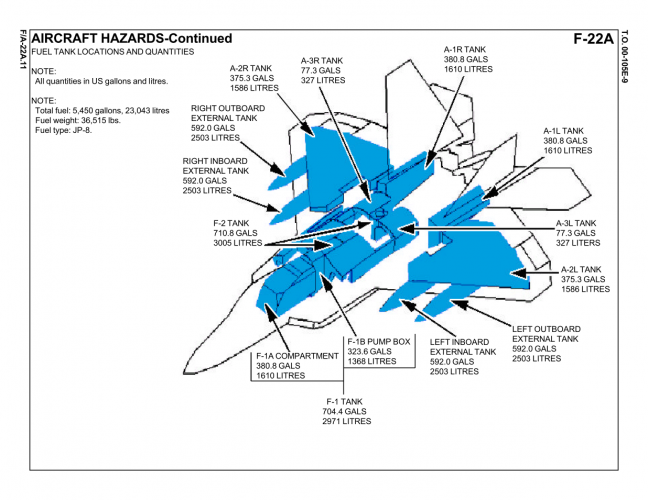
But the F-22 has fully wet wings AFAIK (it was other areas where they could have increased the fuel capacity):
f-22_fuel.png
 
I think it's nice to go back through and review some old information posted in the old NGAD/PCA/F/A-XX thread.

So far here's what we've seen of a tailless, supersonic strike fighter platform that NG appears to be looking at. Each of the below images were posted or released by NG:
View attachment 797416View attachment 797417View attachment 797424View attachment 797425View attachment 797426View attachment 797428View attachment 797427View attachment 797430View attachment 797435

View attachment 797440
I would love to make a 3d model of this possible configuration of the Northrop Grumman offering for F/A-XX. However at the suggested centerline length of 62' (18.9m) and while looking at the top down view image, at this scale, the main payload bay only seems to be 11.3' (3.44m). Would there be any use cases where such a short bay would prove useful as a strike fighter? Considering even the shortened bay of the F-35B is over 12' long.
 
I would love to make a 3d model of this possible configuration of the Northrop Grumman offering for F/A-XX. However at the suggested centerline length of 62' (18.9m) and while looking at the top down view image, at this scale, the main payload bay only seems to be 11.3' (3.44m). Would there be any use cases where such a short bay would prove useful as a strike fighter? Considering even the shortened bay of the F-35B is over 12' long.
I'm also working on a model based off of these and my thinking is as follows:

The PPT seems to be about parametric models and if you look at the other similar looking transparent models, they actually have slightly different shapes and wing sweeps and what not. The weapon bay size may be a requirement or it may be the output of the parameters for the parametric model. So for the same centerline length, if you choose different forebody and LE sweeps, you may be able to fit in longer bays instead.

It appears that one of the models depicted has a shovel nose while the larger ESAV transparent model does not and neither does the top down model, which suggests to me that while certain things may be constant for this parametric model, the planform and possibly bays may vary depending on the parameters entered.

That's sorta the logic I've been following with this.
 
I would love to make a 3d model of this possible configuration of the Northrop Grumman offering for F/A-XX. However at the suggested centerline length of 62' (18.9m) and while looking at the top down view image, at this scale, the main payload bay only seems to be 11.3' (3.44m). Would there be any use cases where such a short bay would prove useful as a strike fighter? Considering even the shortened bay of the F-35B is over 12' long.
No, that's way too short for a striker weapons bay.

How long would it be to have a 15ft long bay?
 
I'm also working on a model based off of these and my thinking is as follows:

The PPT seems to be about parametric models and if you look at the other similar looking transparent models, they actually have slightly different shapes and wing sweeps and what not. The weapon bay size may be a requirement or it may be the output of the parameters for the parametric model. So for the same centerline length, if you choose different forebody and LE sweeps, you may be able to fit in longer bays instead.

It appears that one of the models depicted has a shovel nose while the larger ESAV transparent model does not and neither does the top down model, which suggests to me that while certain things may be constant for this parametric model, the planform and possibly bays may vary depending on the parameters entered.

That's sorta the logic I've been following with this.

I would assume payload capacity is a major customer requirement, and the size / layout of the weapons bay(s) has a major impact on the overall airframe layout.
Therefore, I would highly recommend to take some time to think about the likely/feasible/useful weapons load first... from the customer's point of view ;)

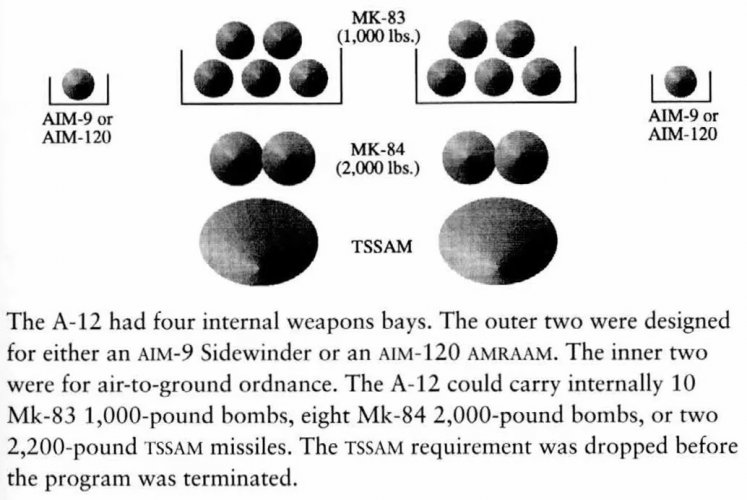
Just as an example...
d7d54e8be0ae6e089f5da9131f2fa470.jpg
 
Last edited:

"When asked specifically if Boeing or Northrop Grumman could handle the work, Duffey added, “I don’t have an opinion right now; that’s one of the things that we’re working through.”

Amid the delay, the Navy has awarded contracts to both competitors to keep their design teams working. This money is not simply to keep lights on, Duffey noted. “There’s a lot of work to be done.”
 
Sadly I remind that this was from a month ago and much had changed in 30+ days since that conference and the here and now.
 
A year ago I said Northrop will win the F/A-XX contract and i'm not budging on that. The Tomcat II is upon us! I wouldn't be surprised if they're playing the "Oh no we can't make a decision!", and then bam! Contract announced.
 
A year ago I said Northrop will win the F/A-XX contract and i'm not budging on that. The Tomcat II is upon us! I wouldn't be surprised if they're playing the "Oh no we can't make a decision!", and then bam! Contract announced.
"The Navy has put off for several months a downselect between Boeing and Northrop Grumman to build the F/A-18 replacement, although several sources indicate that a decision is set, the requirements are valid and the only question remaining is timing."
 
Wait until the Summer months for contract announcement FlyGuy369 that is when I think that they will make the contract award, I do not think that they will make it any later than that.
Okay so when do we open a bet pool on this one? Im looking to win!
 
I would assume payload capacity is a major customer requirement, and the size / layout of the weapons bay(s) has a major impact on the overall airframe layout.
Therefore, I would highly recommend to take some time to think about the likely/feasible/useful weapons load first... from the customer's point of view ;)
My basic assumption right now is a super hornet's typical A2G loads as the bare minimum. That already constraints which wingsweeps and forebody sweeps are available from that chart.
8x 2000lb bombs... damn thats a lot. Didn't know the A12 could carry that much.

I'm not super sure on the internal carry LRASMs so I want to avoid that for now, but I think JSMs, SiAWs/AARGM-ERs would be the kind of weapons I think are reasonably internally carried (and useful for a fight most likely fought at range). I think 6 SiAWs plus 4 AAMs is where I'm going to start with. That could/should still lead to enough space to carry 2 LRASMs internally in addition to AAMs if I end up going that route...

I'm also thinking a top speed of mach 1.8 with a low supercruise speed around mach 1.2-3 ish. It should be a little better than the F-35, but the majority of the focus should be on internal volume for a decent strike load, fuel fraction and sensing. Doing a survey of other strike / multirole fighters MTOWs, it looks to be that 65 to 75k MTOW is pretty common for twin engined strike fighters. TWR of around .65 to 0.7 is being the norm. I have yet to settle / figure out which engines would fit this profile yet though as im terribly uninformed about the subject and still combing the threads looking at what other people have said about engine development and derivatives.
 
Last edited:
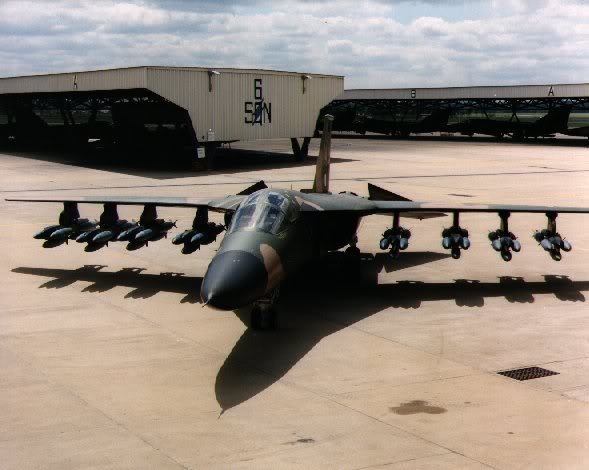
Good old times when an (A-6) Intruder could carpet bomb on its own with 30x 500 lb bombs.
Based on the diagram, I suspect it should actually say 4 x 2000 lb bombs. Every source I've seen, including the diagram, says each of the two bomb bays holds 5 x 1000 lb or 2 x 2000 lbs bombs.
As I understand it the A12 version that won the contract is the size for which you got the stated amount.
But the cited specification from the posted document is the late requirement changes to the aircraft that caused the weight increase to 30% and all the trouble and cost overrun that ultimately killled the program.

As for the F/A-XX I do believe it will have two main and two side bays. It having the same capacity as the original A12 is very likely.
But the later A12 spec would require longer bays. It's not impossible but I think the aircraft might become too long or too wide.
6x 2000 lbs would be more feasible.
 
Should be a posting moratorium in this thread until members can show proof of having read and comprehended “Regaining the High Ground at Sea” by Clark et al 2018.

As a baseline for the general discussion of the CVW of the future or any of its specific constituent systems.
 
Last edited:
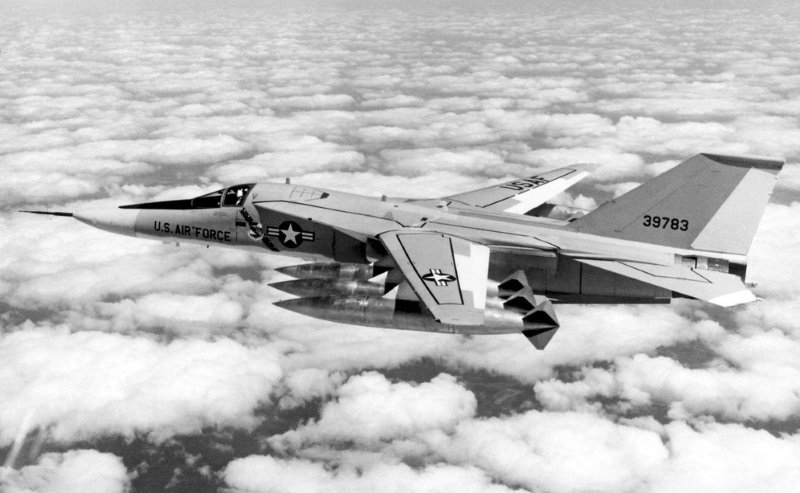
@Sferrin : let's not forget that in this configuration the A-6 would be probably... faster (the 111 had only two pivoting pylons under each wings and would not fly with its wing swept back in this configuration (Mach M0,8 when A-6 would be in theory 100mph faster)).

View attachment 797722

I was joking. The only thing I'd ever heard of them using the outer pylons for was for drop tanks on the FB-111.

avf111_09.jpg
 

Similar threads

Back
Top Bottom