https://www.secretprojects.co.uk/threads/ffg-x.33649/post-865420Do you mind shooting me a link? I've read/watched a couple things but I'd like to see the one to which you refer

You are using an out of date browser. It may not display this or other websites correctly.
You should upgrade or use an alternative browser.
You should upgrade or use an alternative browser.
US FF(X) Program - DISCUSSION
- Thread starter isayyo2
- Start date

Dilandu
I'm dissatisfied, which means, I exist.
Yes, they do. Their admirals don't subject shipbuilding programs to their every whim; their goal is get hardware first, perfect its later.I’m sure China is just “working with whatever hardware they can obtain”.
What other programs are there, though?
Burke 3s? I don't think those can be launched from that yard, not enough water depth. Same reason the Connies don't have a hull sonar.
What could the Coast Guard provide?
The Medium landing craft, whatever they are calling it, for one.
Scott Kenny
ACCESS: USAP
- Joined
- 15 May 2023
- Messages
- 19,802
- Reaction score
- 28,415
Thought that was cancelled?The Medium landing craft, whatever they are calling it, for one.
This is planned to be temporaryWithin about 6 months the USN will be a 10 CVN navy and there is a fair chance that within 48-72 months it will be a 9 CVN navy.
Bold assertion, it also doesn't account for the logistical support required and the general less glamourous sides to raising a naval aviation forcesAnother 60 months after that, the PLAN will likely be a 9 carrier navy, assuming neither side has mutually destructed itself in a war.
You got any proof to back this up? There are no indications that China has programs to meet and exceed USN global deployment capabilities, nor significant evidence that they will be able to substantially support their carrier programs any better. Given the global deployments of the USN, I'm not sure what industries and sustainment issues you're referring to either?Of course, the difference is the PLAN will be able to deploy and sustain their carriers. The USN will continue to struggle because industries don't bounce back in 10 years. Nor 20. The PLA military buildup for 2035 has been ongoing since about 1995 (i.e. J-20, Type 004, etc.) at a fairly steady pace. Thankfully they're not the Soviet Union and are putting fairly few resources into it.
That's very similar to what I've been trying to say. It's incredibly reductive for anyone to bring up the NAVSEA strawman every time a potential problem is mentioned because it isn't just a NAVSEA problem when programs go awry.It's about 50/50. FMM isn't equipped to design a ship from ground up and NAVSEA isn't internally informed enough to guide ship design.
They are procuring derivatives of the LST 100 from Damen, they paid 3.3 million dollars for the technical data package and will manufacture them domestically, although they are looking for international partners to build with aiui.Thought that was cancelled?
Yeah... that really tracks with the massive amount of programs coming out of China rn.... seems like a military absolutely HAMSTRUNG by bureaucracy.Yes, they do. Their admirals don't subject shipbuilding programs to their every whim; their goal is get hardware first, perfect its later.
(Reposted in FFG(X) thread)
Last edited:
Dragonlady
ACCESS: Restricted
- Joined
- 5 January 2021
- Messages
- 31
- Reaction score
- 70
No as per USNI:Isn't it also supposed to be pulling a VDS and normal towed array? Plus helo and the usual Mk32 LWT launchers?
Attachments
Scott Kenny
ACCESS: USAP
- Joined
- 15 May 2023
- Messages
- 19,802
- Reaction score
- 28,415
So, it's a frigate that can't hunt submarines?No as per USNI:
WTF is the point, then?

1635yankee
Recovering aeronautical engineer
- Joined
- 18 August 2020
- Messages
- 676
- Reaction score
- 1,033
One problem is that the NSC, with basically no armament is expensive -- I've read about $750 million -- Kitting them up to an FFG standard would definitely push them well over $1,200 million. I suspect that the integration of the weapons and systems needed for the role will take several years and delivery of the first of class a few more after that.
NAVSEA has outsourced too much technical expertise.
NAVSEA has outsourced too much technical expertise.
The last 2 ships of the first batch of 6 NSC were 1 billion each inflation adjusted.One problem is that the NSC, with basically no armament is expensive -- I've read about $750 million -- Kitting them up to an FFG standard would definitely push them well over $1,200 million. I suspect that the integration of the weapons and systems needed for the role will take several years and delivery of the first of class a few more after that.
NAVSEA has outsourced too much technical expertise.
Last edited:
Scott Kenny
ACCESS: USAP
- Joined
- 15 May 2023
- Messages
- 19,802
- Reaction score
- 28,415
Fit them with LCS combat systems, maybe? Isn't it much of the same stuff? Same radar, 57mm, etc?One problem is that the NSC, with basically no armament is expensive -- I've read about $750 million -- Kitting them up to an FFG standard would definitely push them well over $1,200 million. I suspect that the integration of the weapons and systems needed for the role will take several years and delivery of the first of class a few more after that.
NAVSEA has outsourced too much technical expertise.
They are 1 billion each for the CG fit so that won’t help.Fit them with LCS combat systems, maybe? Isn't it much of the same stuff? Same radar, 57mm, etc?
Scott Kenny
ACCESS: USAP
- Joined
- 15 May 2023
- Messages
- 19,802
- Reaction score
- 28,415
It'd save time and development cost.They are 1 billion each for the CG fit so that won’t help.
Wouldn't be cheap, but would not be delayed by the time needed to integrate new hardware.
Dragonlady
ACCESS: Restricted
- Joined
- 5 January 2021
- Messages
- 31
- Reaction score
- 70
Beats me lol. IIRC the hull machinery isn’t acoustically dampened/isolated so even if it had onboard sonar it’d be practically useless. Not to mention that enemy SSKs will be able to hear it from dozens of miles away.So, it's a frigate that can't hunt submarines?
WTF is the point, then?
I didn’t think the USN could do even worse than LCS, but by god they seem determined to try lmao. At this point they would’ve been better off adopting the MMSC variant of the Freedom class as an “interim” SSC until a clean-sheet design is ready.
NSC are already FFBNW a 16 cell Mk41 for ESSM, SVTT, and the Mk 144. They were also originally fitted with RAST so fitting them to USN FFs is simple enough. Weapons integration is nothing but the problem is the weapons add nothing that the USN needsI suspect that the integration of the weapons and systems needed for the role will take several years and delivery of the first of class a few more after that.
Dragonlady
ACCESS: Restricted
- Joined
- 5 January 2021
- Messages
- 31
- Reaction score
- 70
Still don’t understand why USN was so hellbent on level 3 survivability. It’s a frigate FFS! The Perry’s, Knox’s, & Garcia’s were IIRC all built to level 2 standards and served just fine.There were two estimates for the ffgx cost, one by the CBO another by the navy. The both have been trending down and seemed to have converged around 1.2 billion. So that’s the current best estimate.
Also 2 ffgx will still be built. So the design is going to be worked out no matter what. The also have a multi year head start on working out the design modifications over the ffx.
The NSC line has been dead for a couple years and the partly finished ship was scrapped. So there’s going to be lead time there on top of any design changes the navy made. Remember the fremm was level 2 survivability and the navy wanted level 3 which was a large contribution to the design issues. The nsc is level 1, so if survivability requirements are increased it will be just as if not worse design wise than ffgx.
I doubt these will hit the water more than 1 year before the ffgx if not later
It’s a political play not for the voters, but for corporations and donors all corruption.
Grift.So, it's a frigate that can't hunt submarines?
WTF is the point, then?
They don’t want level 3 survivability. Constellation was to be built to level 2 survivability, as is Burke. I don’t know where he’s got the level 3 idea from but it is falseStill don’t understand why USN was so hellbent on level 3 survivability. It’s a frigate FFS! The Perry’s, Knox’s, & Garcia’s were IIRC all built to level 2 standards and served just fine.

Kat Tsun
eeeeeeeeeeeeeee
- Joined
- 16 June 2013
- Messages
- 1,887
- Reaction score
- 2,669
Grift.
Is it really a grift if they're down bad for hulls though?
That said, they're talking about mission modules, so strap in for LCS II: Electric Boogaloo I guess.
Is it really a grift if they're down bad for hulls though?
That said, they're talking about mission modules, so strap in for LCS II: Electric Boogaloo I guess.
Hopefully, we will see better equipped, more capable versions moving forward.
The contract for the first Burke was issued in 1985 three years prior to issue of the survivability standard OpNavInst 9070.1 in 1988 with Levels I (Auxiliary & Support Ships+Mine Warfare), II (Amphibs, Frigates & RAS), III (CV & Surface Combatants). I doubt Burke met the Level III standard to the letter but do not think it would have been too far off.
As have previously posted OpNavInst 9070.1 with Levels I, II & III is now history as superseded back in 2012 by OpNavInst 9070.1A after the LCS fiasco with no Levels specified, its whatever NAVSEA think appropriate at the time.
As have previously posted OpNavInst 9070.1 with Levels I, II & III is now history as superseded back in 2012 by OpNavInst 9070.1A after the LCS fiasco with no Levels specified, its whatever NAVSEA think appropriate at the time.

EmoBirb
ACCESS: Top Secret
- Joined
- 18 January 2025
- Messages
- 2,772
- Reaction score
- 7,082
Maybe it's meant to engage such ferocious adversaries as the Canadian or Danish Navy in the near future? May not be up for the task of taking on even the PRC coast guard as it stands now, but should be able to deal with these potential adversaries (supported by Burkes, a couple SSNs, CVN, the whole nine yards).So, it's a frigate that can't hunt submarines?
WTF is the point, then?
insidersource
ACCESS: Top Secret
- Joined
- 24 March 2025
- Messages
- 521
- Reaction score
- 745
Spot on. The Legend-class is slightly larger than the Perry class frigates and Australia's ANZAC class frigates. The Legend-class actually uses the propulsion system from the Anzacs.The Legend-class hulls are perfect for a long range Frigate.I rather like Legend-class FF(X} as a solution. They aren't gold-plated mini-Ticos. They are true fourth-rate, affordable, and built for endurance ships to exert a presence. Not every ship has to be a battleship. The USN can now focus on separate hulls for the first through third rate ships.
A lesson should be learnt from the constellation disaster that trying to gold plate an off the shelf design will result in failure. The logical way is to add incremental improvements in different flights. The Legend-class spec says:
- Designed for but not with additional weapons and sensors[12]
A full anti-submarine suite or VLS tubes can be added into the second flight of ships.
I think fewer ship classes and a larger quantity of ships will allow for smoother production, upgrades and sustainment. Instead of the Navy having say four new ship designs of a light frigate, heavy frigate, light destroyer and heavy destroyer they would be better off with just two sizes. The Legend-class hull is perfect for the small size and pair it with a 10,000+ ton heavy destroyer in a high-low mix.
Instead of DDG(X) they should just purchase stretched Arleigh Burke-class destroyer. It has a really wide 20 meter wide beam. This is 20% wider than the Ticonderoga class cruisers and is wider than the retired 12,000 ton nuclear cruisers. I would simply take the existing Arleigh Burke-class destroyer and add a hull extension. This stretch technique has been done many times including with the Perry-class frigates and even the virginia class submarines. Add an extra generator or VLS tubes for future growth.
Last edited:
Scott Kenny
ACCESS: USAP
- Joined
- 15 May 2023
- Messages
- 19,802
- Reaction score
- 28,415
It had 2x Helos, towed array, and VDS. And Aegis.Constellation wasn't exactly the poster child of ASW.
Which is the bottom end minimal capability.
Constellation effectively had support for one ASW helicopter, not two. LM2500 noise was never effectively abated, and its hybrid diesel-electric compromise for ASW mode limited it under 20 knots. Oh btw its electrical system was under built when LM2500 was shutdown, to run both planned sensors and electric propulsion simultaneously. It never had a working promised towed array nor sported a mounted sonar, hence it failed its ASW role. And LM2500s are not exactly meant for quick startups and shutdowns. Turbines take a long time to spool up and down.
Firefinder
ACCESS: Top Secret
- Joined
- 5 October 2019
- Messages
- 1,264
- Reaction score
- 2,392
Funny thing bought that.its hybrid diesel-electric compromise for ASW mode limited it under 20 knots
That's a Feature not a bug.
Cause you know what a Tow Array or VDS is hearing at over 20 knots?
Fucking nothing.
For ANY DESIGN.
The ship can be a glorified sailboat and it still hear fuck all at over 20 knots
The noise of the water going over the hydrophones mics at 20 plus knots is loud enough to basically deathen the system.
That's a hard physic put limitation you cannot design out.
For the Spraunce class 18 knots was their top speed that they could use their sonar gear, any faster it was copter and buoy only. Subs have a similar limit.
Then you have the physical limitations of the gear.
Aka how fast you can go before you basically rip the system out of the hull.
Generally speaking that's 20 knots as well.
Any faster you going to have to explain to the admiral why you don't have an array any more.
So yeah, 20 knots is the MAX for these things.
Which is why doctrine has ASW ships working in groups so one can drift and listen while the other Sprint to a new location in a Leapfrog. While using helicopters to cover when you can't do that, like when you are following a CVN at 30 knots. With if you hear something a ship can be cut free to go check it out as the CsG goes the other way. Then you either kill it, or decide that it's not a threat and sprint at 32 plus knots to catch back up.
Scott Kenny
ACCESS: USAP
- Joined
- 15 May 2023
- Messages
- 19,802
- Reaction score
- 28,415
Exactly. ~18 knots is about all you're going to be operating ship-mounted sonar.
Because you're DEAF if you go faster!
~30sec from idle to full power.
Because you're DEAF if you go faster!
So? flow noise will deafen it any faster.Constellation effectively had support for one ASW helicopter, not two. LM2500 noise was never effectively abated, and its hybrid diesel-electric compromise for ASW mode limited it under 20 knots.
Maybe 5 minutes from cold iron to full power.And LM2500s are not exactly meant for quick startups and shutdowns. Turbines take a long time to spool up and down.
~30sec from idle to full power.

Sintra
ACCESS: Secret
- Joined
- 7 April 2008
- Messages
- 200
- Reaction score
- 549
Eh?!Constellation wasn't exactly the poster child of ASW.
CODLAG, Captas 4 and two Helicopters.
The Navy didn't agree that Constellation met the program goals for the ASW mission, so that is magical thinking to read all the marketing points as why it was a success. But hey, they are first hand working with the equipment.
Also if you want to have a conversation about LCS replacements please do the bare minimum and understand what they do today. Essentially nothing Legend does is better than an LCS for the surface warfare role and Legend cannot do MCM. Which gap do you propose this would fill then, especially when the navy divested LCS hulls as they were excess to USN missions?would be an upgrade from the LCS
Dragonlady
ACCESS: Restricted
- Joined
- 5 January 2021
- Messages
- 31
- Reaction score
- 70
If the cost increase is minimal then sure. I chose the (V)3 since it provides “good enough” performance at the lowest possible cost.Oh true, but in that case fitting SPY-6(V)4 would provide greater sensor capability for a more than reasonable cost increase.
100% agree. The NSC in its current configuration is essentially an LCS that’s 50% more expensive, & the modifications needed to make it a halfway decent frigate will easily push per unit cost past $1 billion (and even then it’d probably still be inferior to the Connies).Any proof to back this up or just going to say whatever you feel like..? The requirements for Constellation were essentially optimized for ASW, everything else came second to the point that directors were not included.
(Which have been a bad decision since they were acquired in the 90s due to their less than stellar weapons suite and relevance to peer conflict)
Ok so this is a really bad way of looking at it. For one, even the FFBNW gear is still for adversaries who are the furthest thing from peer threats and the goal of Constellation was clearly to fight peer threats. On top of that, it is still a cutter and the weapons are designed to counter USCG threats, not US Navy threats.
There’s an NPS report circa 2010 that looked at inserting an 18 meter plug amidships. TL;DR:I think you need to seriously review the materials available about the Arleigh Burke class because this is not only a verifiably bad plan, it's impossible.
The Burke hull is maxed out, you can't just keep adding. It has been studied. This argument has been rebutted time and time again
-The lengthened variant had notably better pitch & heave seakeeping.
-Baseline & lengthened variants had virtually identical roll motions below 30 knots, however the lengthened variant had worse rolling motions at 30+ knots (the author proposed addressing this by installing active fins a la the OHPs).
-Hogging & sagging stresses for both the baseline & lengthened hulls are well under maximum allowable limits.
https://calhoun.nps.edu/server/api/core/bitstreams/184d0286-538f-49a7-b626-5364ae2a1da0/content
Last edited:
Sintra
ACCESS: Secret
- Joined
- 7 April 2008
- Messages
- 200
- Reaction score
- 549
The Navy didn't agree that Constellation met the program goals for the ASW mission, so that is magical thinking to read all the marketing points as why it was a success. But hey, they are first hand working with the equipment.
What goals where those? When was this stated?
Mind you, the US Navy literaly deleted ASW capabilies (the hull mounted sonar) present in the Italian FREMM's by its own choice... And those Italian Ships are highly capable ASW assets.
Amusingly the US Navy ended with a new "Frigate" that is almost useless against Submarines.
Last edited:
Sintra
ACCESS: Secret
- Joined
- 7 April 2008
- Messages
- 200
- Reaction score
- 549
Constellation effectively had support for one ASW helicopter, not two. LM2500 noise was never effectively abated, and its hybrid diesel-electric compromise for ASW mode limited it under 20 knots. Oh btw its electrical system was under built when LM2500 was shutdown, to run both planned sensors and electric propulsion simultaneously. It never had a working promised towed array nor sported a mounted sonar, hence it failed its ASW role. And LM2500s are not exactly meant for quick startups and shutdowns. Turbines take a long time to spool up and down.
So according to you:
1) The US Navy and FMM blew the hangar present on the Bergamini's (the Italian ships support two Helis)
2) All that sound proofing hardware that the Italians (and French) threw at their FREMM's was deleted for the Constellation
3) An ungodly number of operators are wrong and instead of being an awful good bit of kit the Thales Captas 4 actually ... doesnt work
What are you talking about?
Last edited:
I do not believe a hull plug would solve the underlying issues with Burke, even if it is technically feasible to do. Increasing generating capacity and converting the ship to electric means significant structural modification and internal rearrangement. The engine mountings would also have to be entirely modernized and that's before the electric motors are integrated. This is a lengthy and expensive process with an end result inferior to DDG(X) and more expensive than FFG(X) was to be.There’s an NPS report circa 2010 that looked at inserting an 18 meter plug amidships. TL;DR:
-The lengthened variant had notably better pitch & heave seakeeping.
-Baseline & lengthened variants had virtually identical roll motions below 30 knots, however the lengthened variant had worse rolling motions at 30+ knots (the author proposed addressing this by installing active fins a la the OHPs).
-Hogging & sagging stresses for both the baseline & lengthened hulls are well under maximum allowable limits.
I don't think he knows himselfWhat are you talking about?
johnpjones1775
ACCESS: Top Secret
- Joined
- 27 May 2023
- Messages
- 1,373
- Reaction score
- 767
No shit? Really?It will need more than just a 57mm gun and the 20mm CIWS.
johnpjones1775
ACCESS: Top Secret
- Joined
- 27 May 2023
- Messages
- 1,373
- Reaction score
- 767
You’re right and wrong.I really have misgivings about this idea. From reading this USNI article it appears that;
"Last week at the U.S. Naval Institute’s Defense Forum Washington, Jason Potter, who is performing the duties of Assistant Secretary of the Navy for research, development and acquisition (RDA), said the service would base the new frigate on an existing design with minimal design changes."
and
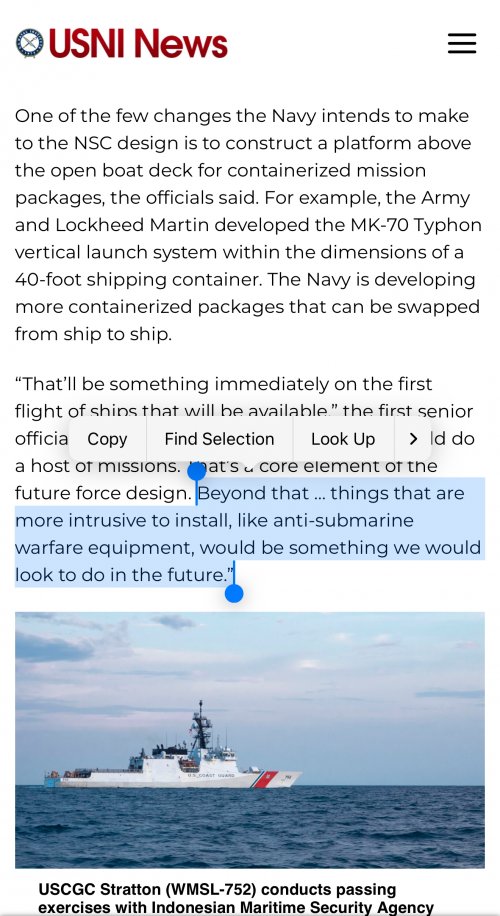
"One of the few changes the Navy intends to make to the NSC design is to construct a platform above the open boat deck for containerized mission packages, the officials said. For example, the Army and Lockheed Martin developed the MK-70 Typhon vertical launch system within the dimensions of a 40-foot shipping container. The Navy is developing more containerized packages that can be swapped from ship to ship."
As such, unless I am misunderstanding, the intent is to use the WHSL -/NSC as the basis and not one of the previous design proposals that HII had made for a Frigate-ized variant of the NSC design.
Looking at the inboard profile of the NSC that H-K posted above suggests that the NSC isn't terrible heavily armed and that the machinery is all concentrated amidships in adjacent spaces. And in addition, although the USCG uses "some" of the same standards as the USN, they definitely do not use all the same standards, especially with regards to damage stability and survivability.
As such, to me at least, other than the lower top end speed, its not fully clear that a Frigate based on the "NSC with minimal design changes" would really be better armed than the LCSs, and far less capable than the FFG(X).
While in the past I always kind of feared that the requirements proposed for the FFG(X) would potentially lead to a larger and more costly ship that would not be capable of being procured in large enough numbers, to me it appears that the FF(X), at least as hinted at in the USNI article, may be going too far in the opposite direction, falling too close to an LCS with only a minimal/limited amount of add-on modules.
Ultimately, I kind of was thinking that an American ship similar to the Chinese Type 054A would represent a potential nice middle ground, perhaps outfitted with a 57mm gun, 16-32 VLS cells (for ESSM etc) supported by a single face rotating SPY-6 array, room for some SSMs, a large hangar and maybe the ability to carry a towed sonar, etc.
Regards
Pat
The first batch, batch0 will basically be an NSC with containerized VLS, and some NSMs.
Bactch1+ will be built as a dedicated light frigate.
Batch0 are FFs batch1+ will be FFGs.
Similar threads
-

-
-
-
-
Navy Struggles to Fund SSBN(X), Destroyers, and cost overruns on CVN 78
- Started by Triton
- Replies: 19