
You are using an out of date browser. It may not display this or other websites correctly.
You should upgrade or use an alternative browser.
You should upgrade or use an alternative browser.
Chinese Armed Container Ship
- Thread starter Dilandu
- Start date



pagliacci
ACCESS: Confidential
- Joined
- 14 June 2023
- Messages
- 82
- Reaction score
- 276
WTF...what a dynamic era.View attachment 797012
The container ship is now a fixed wing aircraft carrier with a EMCAT.
An older cargo ship with the hull packed with foam filled containers might take some abuse.Is it really inferior in terms of survivability? Depending on the container ship used, it might have sufficient volume and subdivisions to make hits on large parts of it ineffective.
The bridge structure I would leave hollow.
Real radar pops up.
All that exposed tech might just be so much waterproofed foamcore.
If they can avoid fiefdoms…like their own LeMay or Rickover starving other things out.Quite frankly, it's only natural that the largest shipbuilder in the world will gradually become the main source of naval innovation, research and prototyping.

SspewixzzZ
From YanCheng Jiangsu China
- Joined
- 29 March 2025
- Messages
- 87
- Reaction score
- 230
This should definitely be experimental... It's hard to imagine there being so many photos; this frequency of leaks is practically like a livestream  If someone ever manage to capture a video of these things being launched and fly away, I will absolutely explode... it is really insane.
If someone ever manage to capture a video of these things being launched and fly away, I will absolutely explode... it is really insane.I am surprised something like the Texas City Disaster hasn’t been weaponized.
If I wanted to invade Taiwan, I’d do it after my actual Navy ships got home and had half of the cargo ships there start spilling soldiers off the sides.
I have survived Alabama nearly 60 years—I can tough it out in a container for a few weeks with saltines and a port o’ john.
If I wanted to invade Taiwan, I’d do it after my actual Navy ships got home and had half of the cargo ships there start spilling soldiers off the sides.
I have survived Alabama nearly 60 years—I can tough it out in a container for a few weeks with saltines and a port o’ john.
Last edited:

EmoBirb
ACCESS: Top Secret
- Joined
- 18 January 2025
- Messages
- 2,724
- Reaction score
- 6,974
Imagine how far they can extend their ISR coverage with such a measure. Pushing it out further and further with cheap hulls. While ships like Fujian or Sichuan can focus on the genuine strikes on important targets and airborne early warning stuff.Closer view. How do you say Hurricat in mandarin?
View attachment 797013
Now, the launch portion is covered, and an EMCAT certainly has been proven more than feasible for them. But how will they recover the UAVs? Surely, not every drone needs to be recovered. I can imagine an installation of half the length launching Shahed/Geran style drones repeatedly and these wouldn't need to return, obviously. But larger, more complex, more capable and more costly drones probably will have to be recovered.

- Joined
- 3 January 2006
- Messages
- 1,405
- Reaction score
- 1,375
This is essentially a full scale mock-up. Folks, this is just marketing. BAE produced brochure illustrations for the same sort of containerized systems in the 1980s. This is the same thing but with a bigger budget.Well, this is unexpected:
View attachment 796396
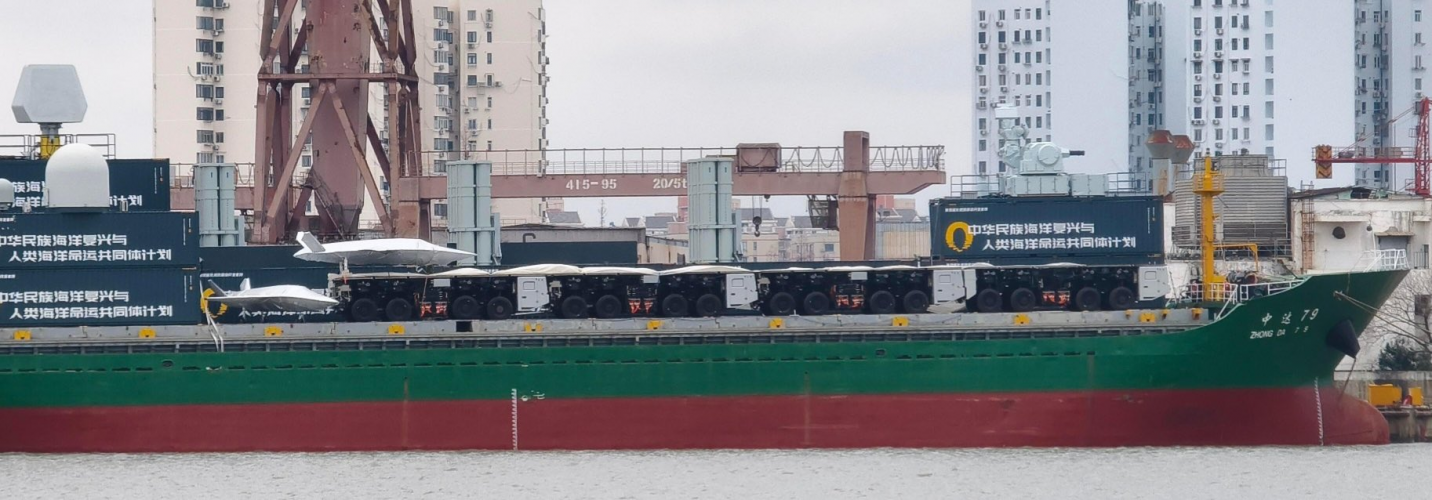
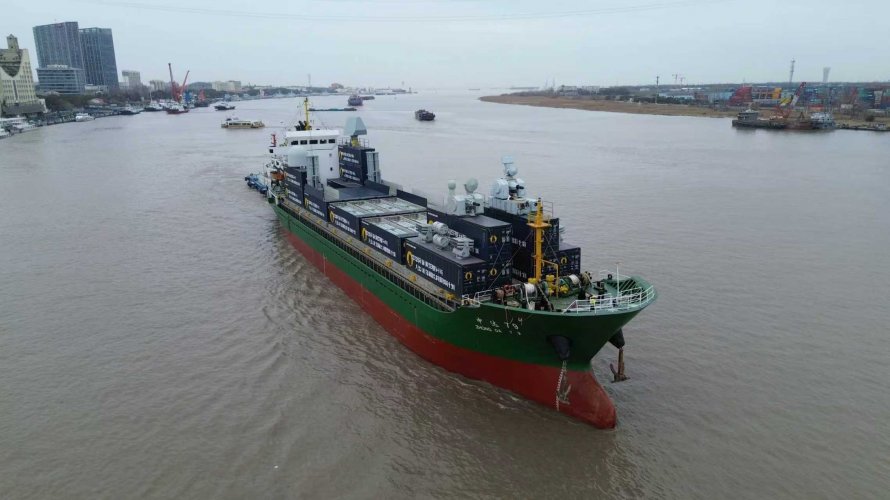
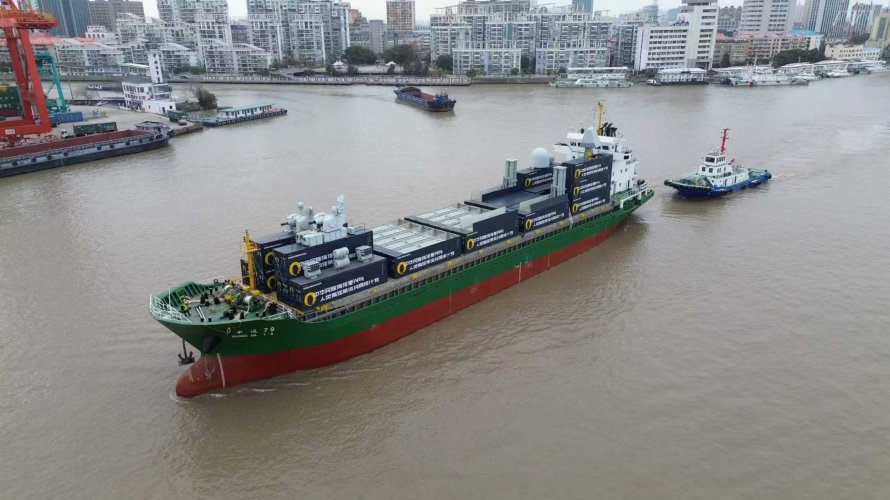
A medium-size container ship, fitted with containerized missile, gun and electronic armament, was spotted in one of Chinese ports. NOT an arsenal ship - this unit have rather sophisticated fire control radars array, and could do area defense on its own.
Equipment identified so far:
In short... it's auxilary missile frigate, made on basic of container ship, and rather impressive one. It have circa 60 missile cell capacity - about 2/3 of Arleigh Burke missile destroyer - and frigate-grade fire control system, capable of handling area air defense.
- Fifteen (three tiers of five, the data on picture is incorrect) 4-cell containerized missile launchers, presumably for SAM's, cruise and anti-ship missiles;
- Type 1130 CIWS on containerized mount;
- Four 18-tube Type 764-4 chaff launchers;
- AESA two-antenna rotating radar of unknown type;
- Two Type 366 over-the-horizon multi-purpose search & tracking radars (on picture incorrectly identified as Type 344 ones) - based on Russian export Mineral-ME ones;
- Two MR-90 fire control radars (licenzed Russian "Orekh" radar), used for illuminating targets for medium and long range SAM's with semi-active seekers;
There is nothing stealthy about a low speed diesel powered container ship. Modern sonars could hear it coming from across the Pacific and individual ships distinguished by sound signature. Moreover, no country can afford to stockpile large numbers of expensive, modern systems to outfit small, slow container ships in the unlikely event of war. Consider the economics of sensor and weapons loadouts that are 50 to 500 times more expensive than the used freighter hulls they are meant to be mounted on?
China certainly has a large merchant marine and plenty of merchant mariners, something that we lack. I don’t think that arming merchant ships is any more of war winning tactic than it was in WWI or WWII, or even the Spanish American War. However, building this full scale mock-up has elicited a great deal of global attention. Which is exactly the purpose of marketing.
- Joined
- 3 January 2006
- Messages
- 1,405
- Reaction score
- 1,375
Creating a mockup of a modern equivalent to a WWII “Catapult Armed Merchant” is marketing for a desperate contingency, such as providing very limited air cover to an extremely slow moving convoy. I’d presume that the aircraft would have to recover at a friendly air base or aboard a conventional naval flat top. Or if it’s a UCAV, it would still be a very expensive sacrifice for a single mission.View attachment 797012
The container ship is now a fixed wing aircraft carrier with a EMCAT.

Christmas Day dumplings
ACCESS: Restricted
- Joined
- 26 December 2024
- Messages
- 36
- Reaction score
- 67
Why hide? Procure 400 ships of this specification, all painted with PLAN colors and hull numbers, equip 20 with radar and containerized missiles, while the rest receive identical external camouflage. Then convert them all to unmanned operation and assemble them into a fleet headed toward any target port—isn’t this exactly what the U.S. military envisions as a drone hell?Finally something in my field of expertise
Ships only have a vague idea of what they are carrying, for safety. But nobody with bad intentions will give away the nature of their cargo of course. You can "choose" where your container roughly ends up on a ship. It is actually quit easy. You tell the shipping company that you want your container to be unloaded on the first port it reaches ( your target is somewhere along the route) and second you tell them that you want to spend as little as possible on the shipping. Which mean your container will end up on the top levels. Why is it cheaper? The risk of losing your container is much higher is your container is high in the stack on a container ship. Those in the belly of the ship are impossible to loose, those stacked the highest has the greatest risk of going overboard. ( Each layer is secured/linked to the layer below, and each link has a risk of failing.)
The biggest problem with this system, to blindly send weapons on a random ship is that there needs to be a powersource for each container, a method of communication between all parts (That is a lot of space for redundant systems, space that your weapon can't use...) and a whole load of luck to pull it off... With a bit of bad luck your radar is buried underneath under another container and can't pop out to scan its surroundings.. Or systems that are on two different ends of the ship unable to communicate with each other because the signal gets blocked by the tons of steel between them.. Or right behind the bridge or another obstacle, making it unable to orient towards a target..
A dedicated system makes more sense, but it leaves to many traces to its maker...
The advantage of containers here is not hiding within merchant ships, but rather the possibility of rapid refitting using civilian standardized products.

Dilandu
I'm dissatisfied, which means, I exist.
Erm... why should this ship be stealthy?There is nothing stealthy about a low speed diesel powered container ship. Modern sonars could hear it coming from across the Pacific and individual ships distinguished by sound signature. Moreover, no country can afford to stockpile large numbers of expensive, modern systems to outfit small, slow container ships in the unlikely event of war. Consider the economics of sensor and weapons loadouts that are 50 to 500 times more expensive than the used freighter hulls they are meant to be mounted on?
You seems to assume that it's some kind of Q-ship, the camouflaged missile platform. It isn't. It's auxilary warship, which operates openly under its nation military flag. Basically it's analogue of Royal Navy's multiple auxilary cruisers, that served in both World Wars with distinction.

- Joined
- 11 February 2007
- Messages
- 4,149
- Reaction score
- 8,900
It's at best a CAM-ship with a couple of one-shot UAVs, and that's assuming they get around to stripping off all those bits of steel at the bow that are currently inconveniently in the way of the launch track. (I seriously doubt it's an EMCAT given the power demands, much simpler to go with JATO or gunpowder).View attachment 797012
The container ship is now a fixed wing aircraft carrier with a EMCAT.
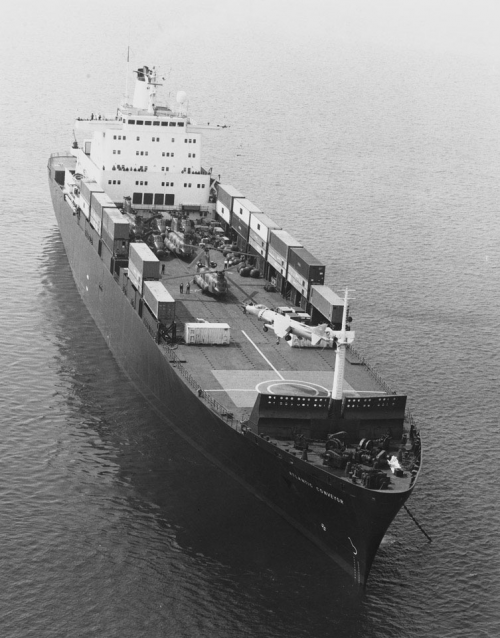
Think back to the Project Arapaho/Atlantic Conveyor/Contender Bezant/RFA Argus set-ups, and the WWII MAC-ships (and arguably USS Langley). A sustainable improvised aircraft carrier capable of more than a single launch cycle needs aircraft prep-space, workshops and ordnance stores and aviation fuel tankage and so on. Atlantic Conveyor's Arapaho installation was 6 containers long and wider than the five container rows we see here. If you want recoverable aircraft usage then you either your aircraft to have VSTOL or helicopter modes, which come with costs in other capabilities, and you probably end up concluding you need to start hacking the steel around to provide a proper flightdeck. If you want long term usage then you end up converting Contender Bezant into Argus.
If you just want one way attack drones, you're better off with the Shahed/Geran type container launcher - that 5 by 5 stack of containers is good for about 125 of them - more if you can figure out a way to safely ditch the top layer.
The AMC configuration is feasible, the CAM-Ship arrangement runs into much more serious questions of practicality.
Not James Stockdale
ACCESS: Secret
- Joined
- 29 August 2025
- Messages
- 260
- Reaction score
- 477
The kind of use case I imagine would be supporting a CAP anchor a few hundred miles off the coast. If the fighters in the air need help, a ship like this could launch CCAs and have them in the fight in a fraction of the time that it would take reinforcements to fly out from shore. Once the CCAs have launched their missiles or are at bingo fuel, they can fly home and land at an airbase on shore. You get advantages in terms of response and loiter time, but I think using a ship like this as a platform for long-range SAMs engaging targets from the fighters is a better system. Alternatively, this could be used to support quick-response CAS over landing beaches. Similarly, though, I think directly attacking targets with ship-launched PGMs would be a better option.
martinbayer
ACCESS: Above Top Secret
- Joined
- 6 January 2009
- Messages
- 5,081
- Reaction score
- 6,998
This being a New Year and all that jazz, may you live in interesting times...WTF...what a dynamic era.
martinbayer
ACCESS: Above Top Secret
- Joined
- 6 January 2009
- Messages
- 5,081
- Reaction score
- 6,998
Sir, after having visited Huntsville a few times (for business, not pleasure) and learned some of the local lore, I salute your fortitude!I have survived Alabama nearly 60 years—I can tough it out in a container for a few weeks with saltines and a port o’ john.
Scott Kenny
ACCESS: USAP
- Joined
- 15 May 2023
- Messages
- 19,678
- Reaction score
- 28,164
A ship like that does ~15 knots.The kind of use case I imagine would be supporting a CAP anchor a few hundred miles off the coast. If the fighters in the air need help, a ship like this could launch CCAs and have them in the fight in a fraction of the time that it would take reinforcements to fly out from shore. Once the CCAs have launched their missiles or are at bingo fuel, they can fly home and land at an airbase on shore. You get advantages in terms of response and loiter time, but I think using a ship like this as a platform for long-range SAMs engaging targets from the fighters is a better system. Alternatively, this could be used to support quick-response CAS over landing beaches. Similarly, though, I think directly attacking targets with ship-launched PGMs would be a better option.
A drone does 300+.
Your math isn't mathing.
Not James Stockdale
ACCESS: Secret
- Joined
- 29 August 2025
- Messages
- 260
- Reaction score
- 477
A drone launched from shore would take an hour to get into the fight, but one launched from a ship already out at sea could climb and be there in a few minutes.A ship like that does ~15 knots.
A drone does 300+.
Your math isn't mathing.
Scott Kenny
ACCESS: USAP
- Joined
- 15 May 2023
- Messages
- 19,678
- Reaction score
- 28,164
You're not putting a CAM ship 300nmi out to sea in the Pacific.A drone launched from shore would take an hour to get into the fight, but one launched from a ship already out at sea could climb and be there in a few minutes.

donnage99
ACCESS: Top Secret
- Joined
- 16 June 2008
- Messages
- 1,586
- Reaction score
- 1,640
Both the Chinese and Americans know their civilian ships are built for secondary military transport purpose. they're always been targets. I wouldn't doubt they eventually have hollow unmanned ships to saturate the water to taiwan and draw out valuable US missiles. What this does is the same reason US is putting containerized missiles on every ship - stressing out enemy war planners. a cargo ship isn't just a troop transport anymore. we have to worry about a potentially half a dozen or so stealthy drones might already be up in the air in that airspace. You can't just launch an antiship missile watch it explode and move onto the next target, you have to go in and clear the airspace.And the first time they use one it's open season on Chinese cargo, fishing, etc. ships.
SlothmanAllen
ACCESS: Confidential
- Joined
- 3 January 2025
- Messages
- 81
- Reaction score
- 196
Honestly, we are maybe five if not ten years away before the idea of being able to militarily conventionally deter China completely disappears. The idea that the US is some sort of peer competitor with China will vanish and the world will have to accept that China is far and away the dominant economic and military power.
Scott Kenny
ACCESS: USAP
- Joined
- 15 May 2023
- Messages
- 19,678
- Reaction score
- 28,164
Honestly, we are maybe five if not ten years away before the idea of being able to militarily conventionally deter China completely disappears. The idea that the US is some sort of peer competitor with China will vanish and the world will have to accept that China is far and away the dominant economic and military power.
China's GDP is still not even equal to the US. I'm positive that their goal is to equal the US GDP per capita, which means an eventual total GDP about 4x that of the US (at current population, though that will be dropping as their demographics collapse).
China's current GDP is a little under 2/3 that of the US and has been increasing about 5% per year for the last 5 (and trending down, BTW). That gives a doubling time of about 14.25 years, and a 50% increase time of about 8.31 years. Holy crap!
Having done the math, now I agree with you.



chimeric oncogene
ACCESS: Secret
- Joined
- 23 May 2019
- Messages
- 464
- Reaction score
- 729
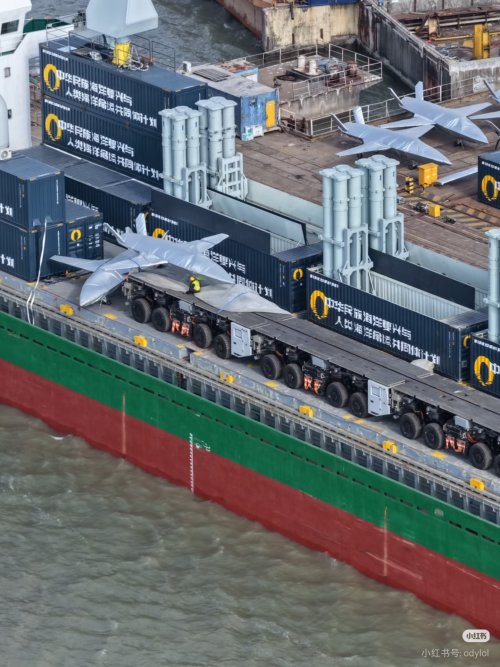
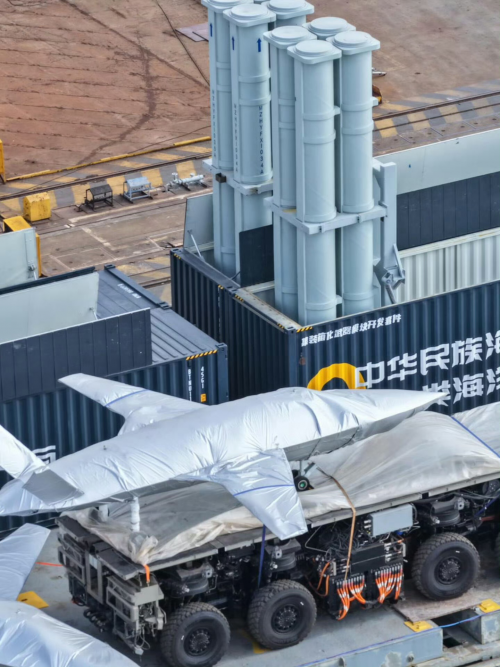
Okay, this EMALS thing is fairly ridiculous, even for an armed merchant cruiser or Atlantic Conveyor, Made In China 2025 edition. My guess is that this is some sort of psyop to confuse and frighten the peer competitor with spooky stories of mass mobilization of the Chinese merchant marine with People's War at Sea.
Is there even enough clear deck space to handle or recover the drones? What would be the point?
Yes, yes, continue to fixate on the 200:1 civilian shipbuilding advantage so breathlessly reported in CSIS Ship Wars documents instead of the many, many bottlenecks in military equipment production that are likely to arise under wartime conditions and the underlying political goals that are probably not served by protracted total conventional industrial war...

Is there even enough clear deck space to handle or recover the drones? What would be the point?
Yes, yes, continue to fixate on the 200:1 civilian shipbuilding advantage so breathlessly reported in CSIS Ship Wars documents instead of the many, many bottlenecks in military equipment production that are likely to arise under wartime conditions and the underlying political goals that are probably not served by protracted total conventional industrial war...
Last edited:
pagliacci
ACCESS: Confidential
- Joined
- 14 June 2023
- Messages
- 82
- Reaction score
- 276
I don’t think there is any element of psychological warfare involved in the R&D of the PLA’s armaments; such a view smacks of Cold War mentality.Okay, this EMALS thing is fairly ridiculous, even for an armed merchant cruiser or Atlantic Conveyor, Made In China 2025 edition. My guess is that this is some sort of psyop to confuse and frighten the peer competitor with spooky stories of mass mobilization of the Chinese merchant marine with People's War at Sea.
Is there even enough clear deck space to handle or recover the drones? What would be the point?
Yes, yes, continue to fixate on the 200:1 civilian shipbuilding advantage so breathlessly reported in CSIS Ship Wars documents instead of the many, many bottlenecks in military equipment production that are likely to arise under wartime conditions and the underlying political goals that are probably not served by protracted total conventional industrial war...
View attachment 797139
AverageAmmonite
ACCESS: Restricted
- Joined
- 26 November 2025
- Messages
- 8
- Reaction score
- 33
While America's GDP in nominal terms is larger, in terms of PPP China overtook America in 2016, the first country to do so in around hundred years. Also worth pointing out China leads the world in manufacturing output, making up 18% to America's 9.5%. In the 20th century the US had the luxury of assuming that any conflict it entered into, it would be the nation with the larger economy and manufacturing base. China represents the first country where that may no longer be true.I'm not sure it'll be quite that soon.
China's GDP is still not even equal to the US. I'm positive that their goal is to equal the US GDP per capita, which means an eventual total GDP about 4x that of the US (at current population, though that will be dropping as their demographics collapse).
China's current GDP is a little under 2/3 that of the US and has been increasing about 5% per year for the last 5 (and trending down, BTW). That gives a doubling time of about 14.25 years, and a 50% increase time of about 8.31 years. Holy crap!
Having done the math, now I agree with you.
AverageAmmonite
ACCESS: Restricted
- Joined
- 26 November 2025
- Messages
- 8
- Reaction score
- 33
The great thing about drones it that they are much more disposable than piloted craft. Recovery is probably not a necessary requirement.Okay, this EMALS thing is fairly ridiculous, even for an armed merchant cruiser or Atlantic Conveyor, Made In China 2025 edition. My guess is that this is some sort of psyop to confuse and frighten the peer competitor with spooky stories of mass mobilization of the Chinese merchant marine with People's War at Sea.
Is there even enough clear deck space to handle or recover the drones? What would be the point?
Yes, yes, continue to fixate on the 200:1 civilian shipbuilding advantage so breathlessly reported in CSIS Ship Wars documents instead of the many, many bottlenecks in military equipment production that are likely to arise under wartime conditions and the underlying political goals that are probably not served by protracted total conventional industrial war...
View attachment 797139
Ainen
I really should change my personal text
- Joined
- 25 August 2011
- Messages
- 2,874
- Reaction score
- 4,984
I.e. manufacturing GDP is 4.7 to ~2.9 in China's favor(2024).While America's GDP in nominal terms is larger, in terms of PPP China overtook America in 2016, the first country to do so in around hundred years. Also worth pointing out China leads the world in manufacturing output, making up 18% to America's 9.5%. In the 20th century the US had the luxury of assuming that any conflict it entered into, it would be the nation with the larger economy and manufacturing base. China represents the first country where that may no longer be true.
PPP will turn it into ~10 to 2.9. EU combined is just a bit less/more than US (2.7 nominal/3.2 ppp). Up to debate how PPP matters here though, when big chunk is bought in USD anyway, so lower number is perhaps more relevant.
As such, your last sentence may represent an understatement. It isn't may, it's 50% more over US+EU put together. Or 3 times the US, which are actually willing to commit to the Westpac.
This discrepancy is the reason why modern world lives in such abundance, as nominal economic activity in US/EU turns wheels of PPP manufacturing in China. It's also its potential doom.
Last edited:
donnage99
ACCESS: Top Secret
- Joined
- 16 June 2008
- Messages
- 1,586
- Reaction score
- 1,640
not to say this particular instance is but there's a psychological warfare element in any arm race, utilized by all nation states unless you think the chinese are too incompetent to exploit it.I don’t think there is any element of psychological warfare involved in the R&D of the PLA’s armaments; such a view smacks of Cold War mentality.
There's always benefit in making your enemy waste billions to counter something that does not exist or just simply making them guessing whats real and whats not

- Joined
- 30 May 2023
- Messages
- 674
- Reaction score
- 1,451
Given a sufficiently scaled industrial base like China’s it would be well within the realm of possibility to design a modular container-based system of two or three power modules, a controller module, two or three AESA MFAs containing modules (side note, TRMs could be integrated into the container structure itself), and however many effector modules you’d like (CIWS, RAM, medium range, long range interceptors). These modular systems could all be on one container ship or distributed across a few ships in a convoy.
An interesting self protect concept to mitigate against stand-off non exquisite missile threats from most platforms, especially when linked to an exquisite hemisphere wide air and space based integrated sea, land and air MTI net, so you know when to turn those things on.
K8s air defense, LEGO container style.
An interesting self protect concept to mitigate against stand-off non exquisite missile threats from most platforms, especially when linked to an exquisite hemisphere wide air and space based integrated sea, land and air MTI net, so you know when to turn those things on.
K8s air defense, LEGO container style.
Ainen
I really should change my personal text
- Joined
- 25 August 2011
- Messages
- 2,874
- Reaction score
- 4,984
Btw as another option - there's enough shoals in strait; such ship can be intentially grounded outright.
Not even that much of a waste - after use, just remove the containers; if you're lucky, even lightened Zhongda may not necessarily be unrecoverable.
Not even that much of a waste - after use, just remove the containers; if you're lucky, even lightened Zhongda may not necessarily be unrecoverable.

ComradeVortex
Air Combat is a Beautiful Ballet of Death.
- Joined
- 11 April 2025
- Messages
- 924
- Reaction score
- 2,642

SUPER=BUG
ACCESS: Top Secret
- Joined
- 25 September 2024
- Messages
- 884
- Reaction score
- 2,426
Ni Jun's team, deputy secretary and vice dean of the School of Mechanical Engineering and Vehicles at Beijing Institute of Technology, led a joint effort with over 110 organizations nationwide (including military-industrial units under China Shipbuilding, China North Industries, CASIC, CASC, CETC, and AVIC research institutes, as well as automotive companies, commercial aerospace companies, and various tech private enterprises). Over four years of hard work, they promoted the establishment of the China Military-Civil Integration Collaborative Innovation Center, aiming at major issues like national rejuvenation and human civilization, trying out a new national model for disruptive innovation.
At BIT, the 'Human Ocean and Interstellar Civilization Innovation Base' is divided into five groups:
- Military Innovation Group
- Aerospace Rocket Group
- Ocean Civilization Group
- Interstellar Civilization Group
- Global Governance Group
The Military Innovation Group works on the development of containerized modular weapon systems. Led by BIT, it collaborates with over 70 organizations, including China Shipbuilding, China Ordnance, Aerospace Science & Industry, Aerospace Science & Technology, China Electronics, and research institutes under Aviation Industry. The modules include containerized electromagnetic catapult modules, carrier-based drone modules, air defense and missile defense modules, anti-ship and anti-submarine modules, land-attack modules, radar detection modules, self-defense modules, electronic warfare modules, underwater combat modules, and command and control modules. The goal is an annual production of 2,000 sets, allowing large-scale, plug-and-play rapid deployment on sea- and land-based platforms. These low-cost, highly productive, widely deployable systems provide strong security support for the great rejuvenation of the Chinese nation.
Members of the Marine Civilization Group participate in the team project 'Reviving China's Maritime Power and Building a Community of Shared Future for Mankind at Sea.' They study the rise and fall of global maritime power, mechanisms for protecting the maritime rights of small and medium-sized countries, and the world order and legal system of a shared human maritime destiny. The goal is to promote container-style modular equipment as maritime public safety products around the world, supporting exports to Belt and Road countries and the Global South, rewriting the historical constraints of a few countries monopolizing global maritime supremacy since the Age of Exploration, promoting equal maritime rights for all countries, releasing a Blue Book on Human Maritime Civilization in the new era, shaping a fairer global order, leading global governance reform, and supporting the great cause of building a community with a shared future for mankind.

Looks like this experimental ship is a joint effort between the Military Innovation Team and the Ocean Civilization Team.
Last edited:
pagliacci
ACCESS: Confidential
- Joined
- 14 June 2023
- Messages
- 82
- Reaction score
- 276
“Members of the Marine Civilization Group participate in the team project 'Reviving China's Maritime Power and Building a Community of Shared Future for Mankind at Sea.' They study the rise and fall of global maritime power, mechanisms for protecting the maritime rights of small and medium-sized countries, and the world order and legal system of a shared human maritime destiny. The goal is to promote container-style modular equipment as maritime public safety products around the world, supporting exports to Belt and Road countries and the Global South, rewriting the historical constraints of a few countries monopolizing global maritime supremacy since the Age of Exploration, promoting equal maritime rights for all countries, releasing a Blue Book on Human Maritime Civilization in the new era, shaping a fairer global order, leading global governance reform, and supporting the great cause of building a community with a shared future for mankind.” ??????Are we really exporting this stuff? It just doesn’t feel right morally.View attachment 816647
Looks like this experimental ship is a joint effort between the Military Innovation Team and the Ocean Civilization Team.
chimeric oncogene
ACCESS: Secret
- Joined
- 23 May 2019
- Messages
- 464
- Reaction score
- 729
So it's a engineering department with a think tank attached that also has a mockup ship? And they (presumably) get paid actual money?
Where can I sign up for this organization?
Where can I sign up for this organization?

Avimimus
ACCESS: Top Secret
- Joined
- 15 December 2007
- Messages
- 2,720
- Reaction score
- 1,419
The great thing about drones it that they are much more disposable than piloted craft. Recovery is probably not a necessary requirement.
They are still expensive - and getting multiple sorties is desirable. What it does do is give you an initial sortie with a longer range (launch closer to the enemy and reserve more fuel for the return trip).
It also produces more uncertainty - if even a few merchant ships could fly off a sortie of a half-dozen drones with a dozen anti-ship missiles - then suddenly all similar merchant ships become a potential threat out to a few hundred miles... which massively increases the burden of potential targets to track, and also potentially draws munitions away from higher value assets... containerised missiles already do this - the addition of drones might just be a way to give them potential endogenous targeting capacity at longer ranges or extend the potential range of a strike.

GK. Dundas
ACCESS: Confidential
- Joined
- 22 July 2025
- Messages
- 122
- Reaction score
- 210
Under their what I'm sure will be their utterly benevolent control .“Members of the Marine Civilization Group participate in the team project 'Reviving China's Maritime Power and Building a Community of Shared Future for Mankind at Sea.' They study the rise and fall of global maritime power, mechanisms for protecting the maritime rights of small and medium-sized countries, and the world order and legal system of a shared human maritime destiny. The goal is to promote container-style modular equipment as maritime public safety products around the world, supporting exports to Belt and Road countries and the Global South, rewriting the historical constraints of a few countries monopolizing global maritime supremacy since the Age of Exploration, promoting equal maritime rights for all countries, releasing a Blue Book on Human Maritime Civilization in the new era, shaping a fairer global order, leading global governance reform, and supporting the great cause of building a community with a shared future for mankind.” ??????Are we really exporting this stuff? It just doesn’t feel right morally.
I'm fairly certain they only want what's best for us.
In other news I currently have a bridge for sale if anyone is interested.
Last edited:

