
You are using an out of date browser. It may not display this or other websites correctly.
You should upgrade or use an alternative browser.
You should upgrade or use an alternative browser.
Trump Class Battleship 2025
- Thread starter Forest Green
- Start date
- Status
- Not open for further replies.

- Joined
- 11 February 2007
- Messages
- 4,149
- Reaction score
- 8,900
Renders don't (much*) matter. We have the specs, even if the Navy can't seem to keep them consistent between images and tables. That's all we have in a good 50% of the naval threads. We can look at the listed weapon systems, the listed displacement, the arcs shown and make reasonable comments about whether they make sense or not.We already managed to fill 4 Pages with little substance on something that exists only in renders I wouldn't even call preliminary? This is shaping up worse than the F/A-XX thread.
* The arcs of the proposed weapons are useful, but the rest of the shape doesn't really matter at this stage.

Sintra
ACCESS: Secret
- Joined
- 7 April 2008
- Messages
- 200
- Reaction score
- 548
That's all chaff, smoke and mirrors.
Drop this, and you get a relatively workable (OK, drop the railgun as well, it would have to bought in Japan or replaced with additional VLS cluster) missile cruiser. I do have my doubts about the industrial capability in the US to actually start building it, but I assume that with some pressure it can be forced, and I suspect the Navy (don't mix USN interests and US Government policy) is quite interested in the ship.
Then being a foreign naval general staff, you have to try and consider the implications, because, again, it's not your job to laugh and wave things off. We can joke around here, they don't have that luxury.
I suspect that the main "implication" is a ship so dam expensive that the Navy will have to cut a great big chunk of either the Submarine or the Carrier fleets (or both) to make this thing happen.
And lets not start about the survability debate about things that move at 30 knots on the sea surface in these days of very long range pgm's and sensors everywhere...
Cheers
ps - You have to admit, the way the program was presented... was incredibly funny...
Last edited:

Dilandu
I'm dissatisfied, which means, I exist.
Duck?Perhaps rename the 'class' ship to "Donald"?
Ainen
I really should change my personal text
- Joined
- 25 August 2011
- Messages
- 2,876
- Reaction score
- 4,984
Keeping long-standing posture in face of peer opponent with significantly more shipbuilding capacity is not feasible.I don't know, the project actively contradicts long-standing US posture on naval operations, there's no need for a 260-270m ship to perform what a destroyer could do?
If any hope was that Burke fl.III is all what it takes - it is apparently not the case any longer. There is nothing criminal here - times change, world map changes, threat portrait changes, too.
As such, to achieve higher net capability Burkes would after all need a force multiplier. And while Trump class doesn't look all that mody yet - it is clearly built with extreme growth potential. 37 RMA aren't the limit (while they are an absolute limit for Burkes), but using them derisks whole thing.
Bells and whistles can be added later.
It is also nothing criminal - building force multiplier combatants of different sizes is absolutely an established precedent in guided missile era.
Considering Kirov was already designed with VLS in mind but long ago and how the Nakhimov managed to pack 176 VLS after modernization a new modern and slightly heavier design from scratch should land in the low 200's mark
- Joined
- 11 February 2007
- Messages
- 4,149
- Reaction score
- 8,900
That's a reasonable comment, but if we're dividing the contents across a couple of Burkes, build one straight Flight III, the other as Flight III forward, but with the aft VLS and hangars replaced by flag space and the smaller hypersonic VLS bank. Or do the same but for DDG(X).Flag space. Which none of the Burkes have. Not even the Flight IIIs.
- Joined
- 11 February 2007
- Messages
- 4,149
- Reaction score
- 8,900
I was just looking for the stats for the HII BMD Ship in Naval Sitrep 45, but found this comment in the LCS article by Larry Bond, which seems all too appropriate:
"Even as a paper concept, the LCS concept of operations, and the preliminary designs by both LM and GD, had serious flaws.
Lack of Analysis: Previous Navy ships, from the Perrys and Burkes to older vessels like the Adams and Leahy classes, were only ordered after long consideration of different alternatives. Dr. Norman Friedman’s series on U.S. ship design (Battleships, Cruisers, Destroyers, etc.) shows in detail how complex and detailed the process is.
While there was a spirited debate in the Navy about the need for small craft and what they should look like, it was a not arigorous process designed to make sure that the ship the Navy ordered would accomplish the mission it was intended to, for the smallest amount of money. Instead, the RFP issued in 2001 was a surprise to many in the Navy.
Ronald O’Rourke, a naval specialist with the Congressional Research Service, has described the RFP as an “...analytical virgin birth.”
When pressed by Congress during the FY 2003 budget hearings for analysis supporting the LCS’s concept of operations, Navy officials had to admit that it had not been done."
Are we looking at another analytical virgin birth?
"Even as a paper concept, the LCS concept of operations, and the preliminary designs by both LM and GD, had serious flaws.
Lack of Analysis: Previous Navy ships, from the Perrys and Burkes to older vessels like the Adams and Leahy classes, were only ordered after long consideration of different alternatives. Dr. Norman Friedman’s series on U.S. ship design (Battleships, Cruisers, Destroyers, etc.) shows in detail how complex and detailed the process is.
While there was a spirited debate in the Navy about the need for small craft and what they should look like, it was a not arigorous process designed to make sure that the ship the Navy ordered would accomplish the mission it was intended to, for the smallest amount of money. Instead, the RFP issued in 2001 was a surprise to many in the Navy.
Ronald O’Rourke, a naval specialist with the Congressional Research Service, has described the RFP as an “...analytical virgin birth.”
When pressed by Congress during the FY 2003 budget hearings for analysis supporting the LCS’s concept of operations, Navy officials had to admit that it had not been done."
Are we looking at another analytical virgin birth?

- Joined
- 19 July 2016
- Messages
- 4,817
- Reaction score
- 4,276
When this much "bathroom product" is flying about, the only thing left to do is, "Donald".Duck?

- Joined
- 16 April 2008
- Messages
- 10,604
- Reaction score
- 18,186
Are we looking at another analytical virgin birth?
Clearly, yes. I mean, there's some CG-21 and DDG(X) heritage here, but this specific kind of ship was nowhere on the Navy's radar up to now.


Ainen
I really should change my personal text
- Joined
- 25 August 2011
- Messages
- 2,876
- Reaction score
- 4,984
It creates obvious risks.That's a reasonable comment, but if we're dividing the contents across a couple of Burkes, build one straight Flight III, the other as Flight III forward, but with the aft VLS and hangars replaced by flag space and the smaller hypersonic VLS bank. Or do the same but for DDG(X).
On 40'000 class behemoth without turrets weighting as much as a destroyer each, with frankly rather light functional payload (high hundreds of tons?) and modern powerplant - there is ample weight margin to do a lot of passive protection. On top of active one(guns, lasers, ciws).
And it's hard to state just how much it is - ww2 battleships managed 3...4x displacement margins in protection with equally heavy loads elsewhere. Here... you cean dream one hell of a protection. Like, Yamato armor was in order of 23'000t. Without anything else, you potentially can approach that. Steel mills will be happy.
Last edited:
- Joined
- 11 February 2007
- Messages
- 4,149
- Reaction score
- 8,900
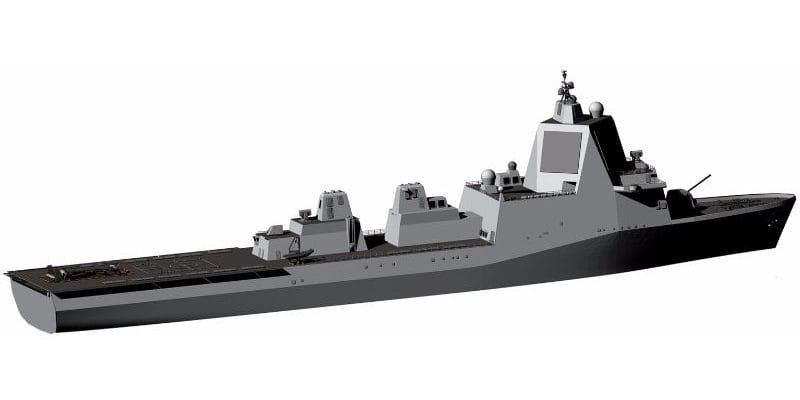
At the Sea-Air-Space Exposition in 2013, Huntington Ingalls presented a BMD derivative of the Flight II San Antonio class. This had 188 VLS cells (Mk 41 and/or Mk 57), a railgun, a 57mm Mk110, 3 Mk 49 RAM launchers, a large X-band radar, CEC, 4 SH-60s and 2 MV-22s on 19,000t. It was only capable of 22kts, but does give us an idea of what hull size is needed to fit everything. 22kts to 30kts is a big jump, but so is 19,000t to 35,000t plus. Are we looking at size inflation solely for the sake of size inflation?

flyingcorsair
ACCESS: Restricted
- Joined
- 15 November 2025
- Messages
- 17
- Reaction score
- 29
Attached render from: https://www.missiledefenseadvocacy.org/defense-systems/lpd-based-ballistic-missile-defense-ship/At the Sea-Air-Space Exposition in 2013, Huntington Ingalls presented a BMD derivative of the Flight II San Antonio class. This had 188 VLS cells (Mk 41 and/or Mk 57), a railgun, a 57mm Mk110, 3 Mk 49 RAM launchers, a large X-band radar, CEC, 4 SH-60s and 2 MV-22s on 19,000t. It was only capable of 22kts, but does give us an idea of what hull size is needed to fit everything. 22kts to 30kts is a big jump, but so is 19,000t to 35,000t plus. Are we looking at size inflation solely for the sake of size inflation?
Attachments
-
 [email protected]18 KB · Views: 118
flyingcorsair
ACCESS: Restricted
- Joined
- 15 November 2025
- Messages
- 17
- Reaction score
- 29
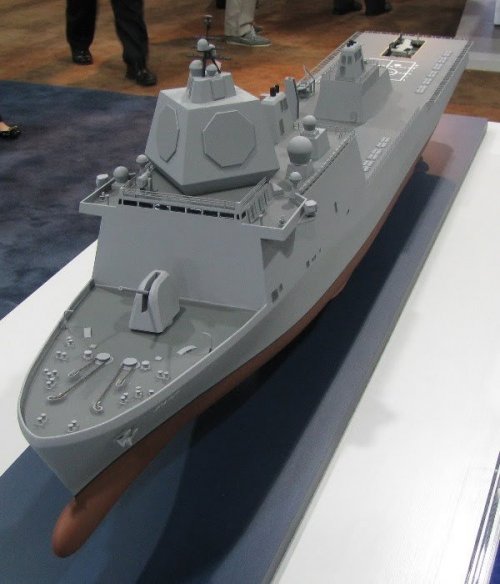

But the chance of this blowing out any Monty Python's movies budget is 100%.
- Status
- Not open for further replies.
Similar threads
-

-
 It’s official: Trump administration turns NASA back toward the Moon
- Started by Grey Havoc
- Replies: 42
-
-
 Trump orders deregulation of the commercial Launch market
- Started by Michel Van
- Replies: 39
-
 Trump Plans Military “Reaction Force” to Use Against Americans
- Started by Flyaway
- Replies: 9