
You are using an out of date browser. It may not display this or other websites correctly.
You should upgrade or use an alternative browser.
You should upgrade or use an alternative browser.
Boeing Airpower Teaming System (ATS) - MQ-28 Ghost Bat
- Thread starter Sundog
- Start date
Could they make it conformal carriage? Seems like that would be better from a drag/RCS perspective.
Drag maybe; conformal does not add much to RCS reduction.

Official Defence Media Release: Funding boost for Australian-made Ghost Bat
Speaking during a separate media briefing detailing the engagement, Boeing’s MQ-28 Global Program Director Glen Ferguson said that the air-to-air engagement saw the MQ-28 working together with a Boeing E-7 Wedgetail Airborne Early Warning and Control Aircraft and F/A-18F Super Hornet multirole fighter of the Royal Australian Air Force (RAAF) to engage the aerial target with an AIM-120 Advanced Medium Range Air-to-Air missile.
The MQ-28 was flown semi-autonomously for the engagement and Colin Miller, Vice President and General Manager of Boeing Phantom Works, said during the briefing that the operator only issued four major commands during the flight: having the drone take off, conduct a combat air patrol, commit to an intercept on the target and clearing it to arm and fire on the target.
In a news release, Boeing said that all three aircraft involved launched from separate locations for the test, with an operator on board the E-7 took custodianship of the MQ-28 ensuring safety and engagement oversight, with the crew from the Super Hornet then teaming with the CCA in combat formation to provide sensor coverage.
Targeting data was shared across all three platforms after the Super Hornet identified and tracked the target, following which the MQ-28 adjusted its position and received authorization from the E-7A to engage and successfully destroy the target.
Ferguson did not disclose the type of target nor the engagement range, although he described it as “fighter representative target” engaged at an “operationally representative range.”
He added that the MQ-28 provided mid-course guidance of the missile during the engagement using an unspecified onboard electronic warfare sensor that was “effectively an AESA (Active Electronically Scanned Array radar) that has been specifically designed for a bunch of specialized functions.” However, Ferguson declined to elaborate on that system any further.
The engagement saw the E-7 operating somewhere between 100 to 200 miles behind the MQ-28, and although the Super Hornet flew alongside the CCA during the event, it could operate at much further distances away during real world operations, said Ferguson.
https://breakingdefense.com/2025/12...q-28-ghost-bat-ccas-following-live-fire-demo/
Looks like they shot at a Phoenix Jet target drone.
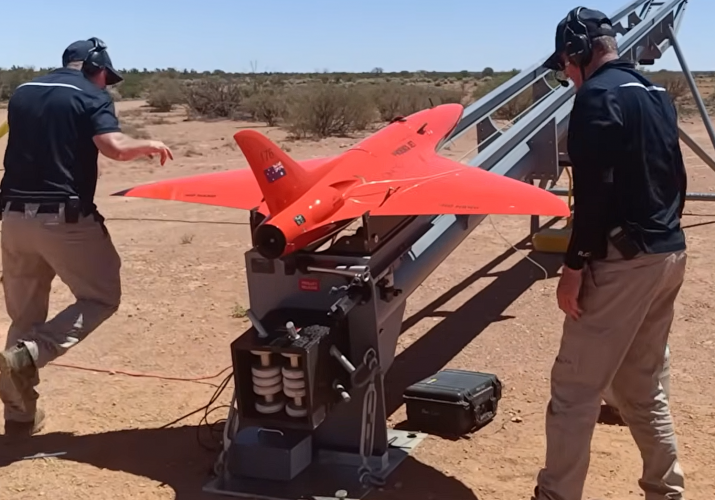
Interesting, ground crew got the hit confirm from flightradar24
I couldn´t believe my own eyes watching the video and went delusional.
 Thank you for confirming this.
Hope that nobody on the app got a heart attack watching that plot going down.

- Joined
- 15 July 2020
- Messages
- 2,085
- Reaction score
- 7,453
I couldn´t believe my own eyes watching the video and went delusional.
Hope that nobody on the app got a heart attack watching that plot going down.
Yeah couldn't believe it myself honestly, this is Boeing right, would have thought they'd include some proper impact footage, instead of someone with flightradar on their phone.. oh well..

EmoBirb
ACCESS: Top Secret
- Joined
- 18 January 2025
- Messages
- 2,694
- Reaction score
- 6,920
Makes me wonder though why they shaped the airframe like they did then. Given that, if no low observability was considered, it would look very different.Not in this version. Payload is all in the nose; I believe the entire front section actually is removable. Internal carriage would be a redesign
7 more and a bomb bay... They didn´t have to wait long.
https://breakingdefense.com/2025/12...q-28-ghost-bat-ccas-following-live-fire-demo/
No FCAS-like never ending Boudoir parlé here!
Notice also this nugget in the report:
Canberra has green-lit a third tranche of the Australian-designed and -built MQ-28 Ghost Bat Collaborative Combat Aircraft from Boeing, an AUS $754 million (US$500.6 million) deal that will include several modifications to the design, including an internal weapons bay.
The new tranche will see Boeing deliver seven additional drones — six in the Block 2 configuration and the first Block 3 aircraft — over the next three years, to support the development of an operational capability by 2028 as well as supporting infrastructure under Australia’s AIR6015 Autonomous Collaborative Platforms – Air program.
https://breakingdefense.com/2025/12...q-28-ghost-bat-ccas-following-live-fire-demo/
No FCAS-like never ending Boudoir parlé here!
Notice also this nugget in the report:
the MQ-28 provided mid-course guidance of the missile during the engagement using an unspecified onboard electronic warfare sensor that was “effectively an AESA (Active Electronically Scanned Array radar) that has been specifically designed for a bunch of specialized functions.” However, Ferguson declined to elaborate on that system any further.
Last edited:
The weapons bay will likely be perfect sized for the half length AAM the US is pursuing per here,Ermm.. thought ghost bat was going to have internal weapons bay, the AIM-120 is 1/3 the length size of the aircraft...
Industry is also encouraged to provide low-cost solutions for the missile at half the size of an AMRAAM to double aircraft loadout while maximizing range in the design.
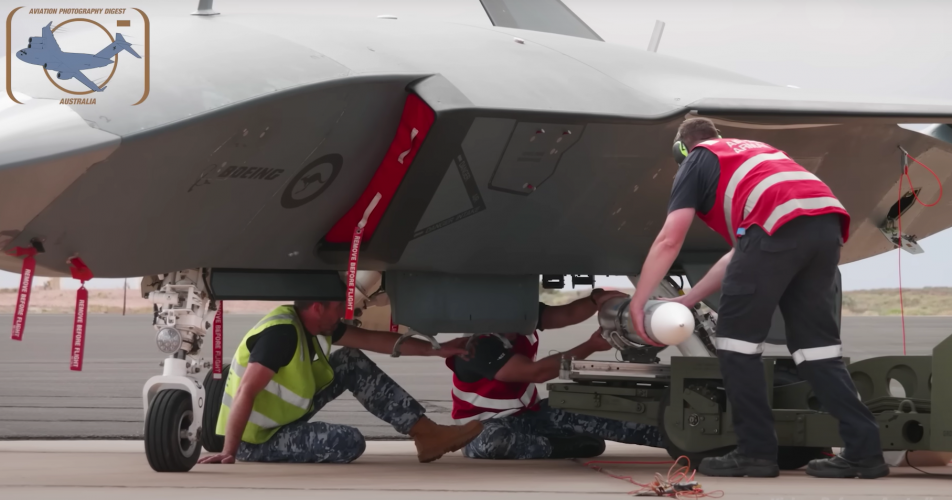
Because the Ghost Bat’s internal weapons bay will not appear until the later Blk. 3 configuration, the missile was carried on a specially designed external pylon mounted on the port side of the belly centerline.
https://aviationweek.com/defense/mi...st-bat-live-fires-amraam-secures-follow-order
Scott Kenny
ACCESS: USAP
- Joined
- 15 May 2023
- Messages
- 19,517
- Reaction score
- 27,966
SDBs are also that ~6-7ft length.The weapons bay will likely be perfect sized for the half length AAM the US is pursuing per here,
But I still hope that the bay will be long enough for an AMRAAM or AIM260. So you could carry 2x AMRAAMs or 4x HalfRAAM or 4x SDBs or 2x halfRAAM+2x SDBs. I'm not sure it's worth sticking a single SiAW into a drone.
I think they will simply enlarge their design with the wb axially centered. Extend the bird longitudinally and widen it to get the picture, I would also see wing root canoe bays, opening similarly to the Su-57, as an easy way to carry sraam.
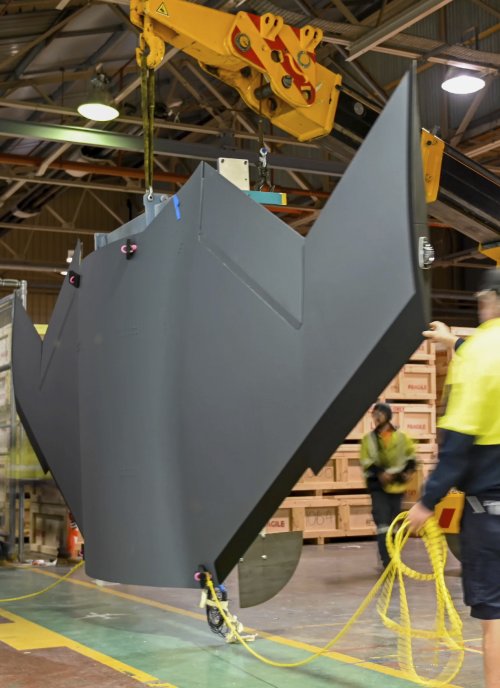
It’s about whether your structures and load paths were designed with a giant cavity and hardpoints for store in mind. The MQ-28 doesn’t looking an aircraft that was put together with a weapons bay in mind.MQ-28 is significantly larger than YFQ-42/44; putting a pair of BVR AAMs should not be problematic.
The prime real estate for a weapons bay is right by the wing box where the wings meets the fuselage. If you look at the MQ-28 configuration, you’d have the landing gears and the engine inlet going right through that wing box right where you’d want a weapons bay to be. This is basically where they had put the external pylon for the AIM-120 shot. Your options for putting in an internal weapons bay now is not great at best.
You can extend the fuselage and put a bay between the nose gear and the main gears, this will keep the aircraft aerodynamically similar but that puts the weapons CG pretty far forward of the aerodynamic center of the wings. This means your overall CG shift when you release weapons will be fairly substantial and will impact performance and may require a bigger tail, which now impacts a bunch of other things on an airplane and increase overall weight; a substantial redesign.
You can widen the fuselage to fit a weapons bay, but now the aerodynamic behavior of your aircraft will change substantially since now your fuselage will produce a significant amount of lift. At this point you are basically redirecting the aircraft since you will need to redo a lot of windtunnel and CFD work to categorize the aerodynamic behavior of the aircraft.
Can it be done, probably but it is not nearly as easy as people think and will require a substantial redesign of the aircraft even if it looks similar externally. This is the aerospace engineering equivalent of trying to rearrange all your organs to stuff a new organ into your body.
At a glance the size of YFQ-42 is similar to the MQ-28 but we are pretty sure the YFQ-42 have an internal weapons bay. The key difference is that the YFQ-42 have a dorsal mounted inlet, and this frees up internal volume so they can fit an internal weapons bay onto that aircraft. The cost of this is probably not as good of an RCS return in the front sector but these are the trade offs you have to think about when designing an aircraft like this.
It would require a volume outside the load bearing structure either ventral or outboard the side fuselage, and yes that would be a major redesign with a lot of associated testing. But development times for UAVs seem rather truncated than for manned aircraft. Certainly it is achievable, if internal carriage is a requirement.
The new NG CCA seems designed for a large central bay from the get go by moving the landing gear to the wings rather than fuselage, which seems to be a unique choice among the CCA contenders.
The new NG CCA seems designed for a large central bay from the get go by moving the landing gear to the wings rather than fuselage, which seems to be a unique choice among the CCA contenders.
@raptor82 : do you have a link to the source?Reminds me of this :View attachment 704122
@raptor82 : do you have a link to the source?
This image was actually released by the MoD.
https://www.gov.uk/government/news/defence-to-invest-2bn-in-next-stage-of-uk-combat-air-system

- Joined
- 24 November 2008
- Messages
- 1,858
- Reaction score
- 4,327
- Joined
- 24 November 2008
- Messages
- 1,858
- Reaction score
- 4,327

snne
ACCESS: Top Secret
- Joined
- 3 July 2022
- Messages
- 2,408
- Reaction score
- 8,848
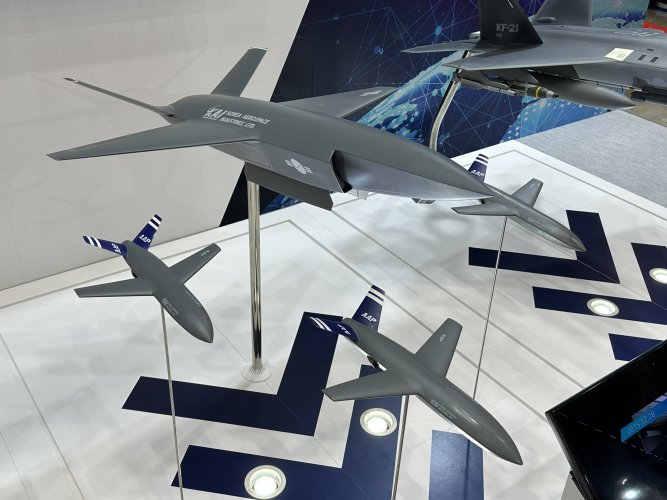
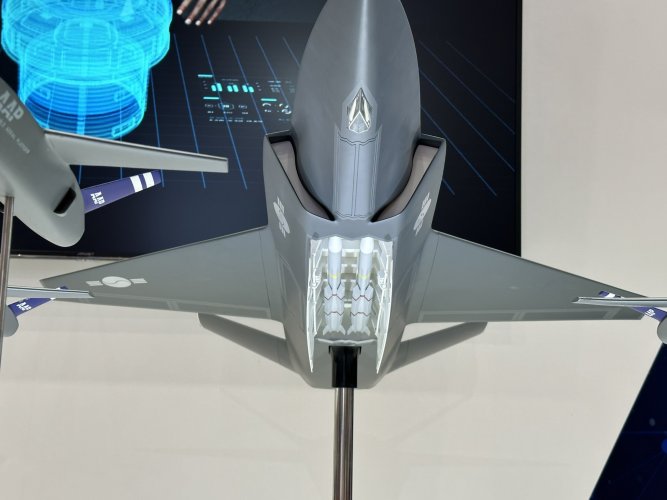
Korean Air has also rolled out a (smaller but) similarly-config (minus the intake and the duct!) drone.Btw, KAI was showcasing a UCAV of very similar layout, with IWBs...

But based on my mk.0 eyeball, it does look like the KAI aircraft has notably more internal volume and is about ~25-30% larger than the MQ-28?
(KAI CCA vs Korean Air CCA)

Edit: Just realized this is a different design...
The underside is pretty much the same, probably an early evolution? Oh well, the point still stands...
Last edited:
- Joined
- 24 November 2008
- Messages
- 1,858
- Reaction score
- 4,327
ExactlyEdit: Just realized this is a different design...
Handling of ordnance and bay loading is also something to consider. As we can see, it's cramped, even without doors sticking out at the bottom of the fuselage. A future version with IWBs might require longer legs, which would necessitate a redesign of the gears and the associated bays.

- Joined
- 30 May 2023
- Messages
- 664
- Reaction score
- 1,436
Regardless of what the future integration of an AAM with a later Ghost Bat spiral or increment looks like, if the Ghost Bat used a wideband MFA to communicate with the other ships, track the target and engage when released to do so, then color me impressed. Well done, Aussies.
This article says:
" For this mission, the MQ-28 carried only an infrared search-and-track sensor and a bespoke electronic warfare system for data transmission. Boeing said an E-7A operator served as the MQ-28’s “mission execution custodian,” maintaining safety and engagement oversight, while the Super Hornet provided sensor coverage and shared targeting data across all three platforms.
Once the order to fire was issued, the MQ-28’s autonomous systems took over, configuring the aircraft and maneuvering to optimize missile performance. The CCA also provided midcourse guidance to the AMRAAM via its standard data link. "
Exactly what datalink did the MQ-28 use to send midcourse guidance to the AIM-120?
https://aviationweek.com/defense/aircraft-propulsion/boeing-touts-mq-28-maturity-cca-market-develops
The Block 2 aircraft is an “operational version“ of the test Block 1, and the focus for 2026 is to get the system operational with the RAAF by 2028. At the same time, Boeing Australia wants to get the Block 3 design set, which will be the core system to be taken to the international market. The company plans to build the aircraft at an increased pace in 2028 with Block 3.
The Block 3 design will extend the wings by 3 m (10 ft.) on each side, providing a 30% increase in fuel—a “quite significant range increase”—along with an increase in stores capacity, Ferguson says.
Block 3 will also include the internal weapons bay, sized for AIM-120 Amraam or small-diameter bombs. Block 1 and 2 aircraft have the space, and Ferguson says the latter can be retrofitted for an internal bay if the RAAF decides to.

Dreamflyer
'Senior Something'
- Joined
- 13 July 2008
- Messages
- 555
- Reaction score
- 918
... Block 3 design will extend the wings by 3 m (10 ft.) on each side ...
That´s a lot, considering the MQ-28´s current total span of 7.3 m and 11.7 m length.
Scott Kenny
ACCESS: USAP
- Joined
- 15 May 2023
- Messages
- 19,517
- Reaction score
- 27,966
Yeah, that's basically doubling the amount of wing on each side.That´s a lot, considering the MQ-28´s current total span of 7.3 m and 11.7 m length.
Agree a massive change and also a lot more testing to come if the wing is changing to that size. Likely a payload jump as well. The customer has clearly asked for more range.Yeah, that's basically doubling the amount of wing on each side.
Out of interest does anyone know what engine the aircraft is using, I still haven't seen confirmation anywhere and curious given the desire to be ITAR free.

Forest Green
ACCESS: USAP
- Joined
- 11 June 2019
- Messages
- 14,510
- Reaction score
- 31,539
Boeing’s Block 3 MQ-28 Ghost Bat to gain weapons bays, longer wings
https://breakingdefense.com/2026/02...-ghost-bat-to-gain-weapons-bays-longer-wings/The aircraft's wingspan, which will expand from 6 meters to 7.3 meters, or 20 to 24 feet
Boeing Details New MQ-28 Ghost Bat Features, Eyes Indo-Pacific Sales
https://www.twz.com/air/boeing-details-new-mq-28-ghost-bat-features-eyes-indo-pacific-sales
Last edited:
Out of interest does anyone know what engine the aircraft is using, I still haven't seen confirmation anywhere and curious given the desire to be ITAR free.
from the link above (AW by @raptor82 ):
All three blocks are powered by a Williams International FJ44-A engine, which has become the most popular powerplant for CCAs.
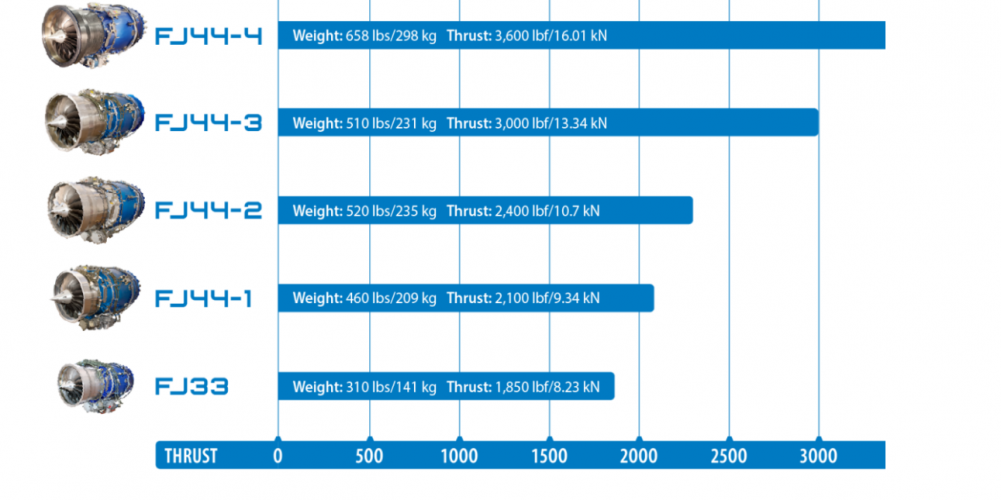
Source:
https://www.williams-int.com/products/

Reddington777
ACCESS: Top Secret
- Joined
- 23 March 2025
- Messages
- 830
- Reaction score
- 2,747
Also the korean version has the main gears tucked into the sides whereas on the ghostbat, the wheel bays spill unto the bottom fuselage. Theres also some other access panels that block the way for a weapons bay.Exactly
Handling of ordnance and bay loading is also something to consider. As we can see, it's cramped, even without doors sticking out at the bottom of the fuselage. A future version with IWBs might require longer legs, which would necessitate a redesign of the gears and the associated bays.
View attachment 795015
Dreamflyer
'Senior Something'
- Joined
- 13 July 2008
- Messages
- 555
- Reaction score
- 918
Boeing’s Block 3 MQ-28 Ghost Bat to gain weapons bays, longer wings
https://breakingdefense.com/2026/02...-ghost-bat-to-gain-weapons-bays-longer-wings/
The aircraft's wingspan, which will expand from 6 meters to 7.3 meters, or 20 to 24 feet
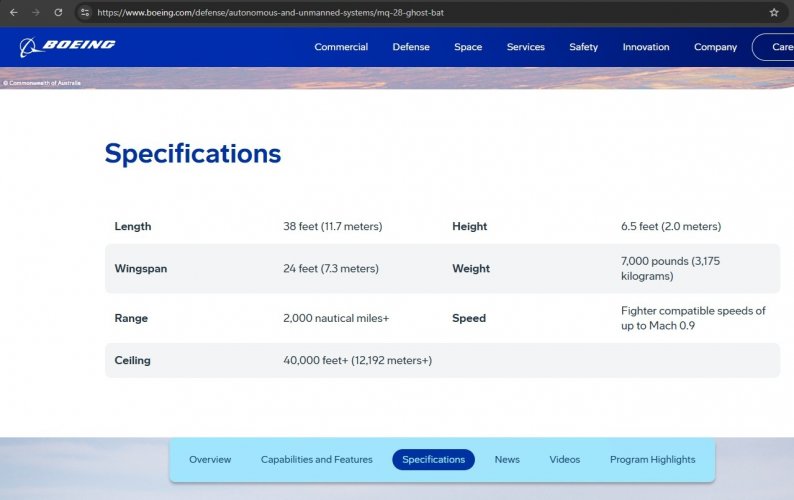
I´ve always heard the MQ-28 has a wingspan of 7.3 m (24 feet) to start with.
It´s also stated in the specifics on Boeing´s website to have a span of 7.3m;
https://www.boeing.com/defense/autonomous-and-unmanned-systems/mq-28-ghost-bat
Attachments
Oh ok - it is public now. Yes, FJ44from the link above (AW by @raptor82 ):
View attachment 801047
Source:
https://www.williams-int.com/products/
Forest Green
ACCESS: USAP
- Joined
- 11 June 2019
- Messages
- 14,510
- Reaction score
- 31,539
Australia prepares for next batch of ‘Ghost Bat’ warplane buddy drones
https://www.defensenews.com/global/...ext-batch-of-ghost-bat-warplane-buddy-drones/This will put the Australian air force on a path to have 10 operational Ghost Bats by 2028.
Forest Green
ACCESS: USAP
- Joined
- 11 June 2019
- Messages
- 14,510
- Reaction score
- 31,539
Geisterfledermaus, oder was?
https://www.politico.eu/article/germany-weighs-buying-australian-made-combat-drone/
https://www.politico.eu/article/germany-weighs-buying-australian-made-combat-drone/
Forest Green
ACCESS: USAP
- Joined
- 11 June 2019
- Messages
- 14,510
- Reaction score
- 31,539
MQ-28 Ghost Bat Gains Major European Foothold As Rheinmetall Joins Forces With Boeing
https://www.twz.com/air/mq-28-ghost...othold-as-rheinmetal-joins-forces-with-boeingSimilar threads
-

-
 Precise F-16 model Royal Australian Air Force markings
- Started by Triton
- Replies: 0
-
RAAF Wedgetail AEW&C proposals and early designs
- Started by Triton
- Replies: 2
-
-
