Alternate Australian Defence Force 1970s Procurements?

Right, but the detachable flight deck was designed for Super Frelons by the French.

If it was made permanent presumably it could be made strong enough for Chinooks.

However, even if only the permanent forward flight deck was strong enough for Chinooks that would be sufficient.
 
Last edited:
Just a thought, if Australia does get 4 LSM-2 and an LSD and therefore the ability to land a battalion at a reasonable distance from Australia then it would help justify the retention of a carrier capability. Fiji is a long way from Australia, too far even for F4s, bu the Melbourne could provide some local air cover if things went south.
 
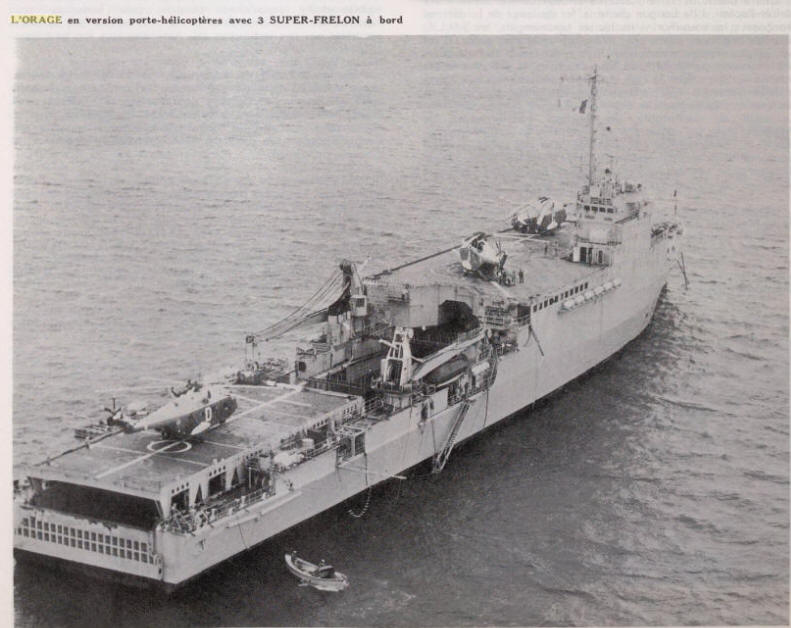
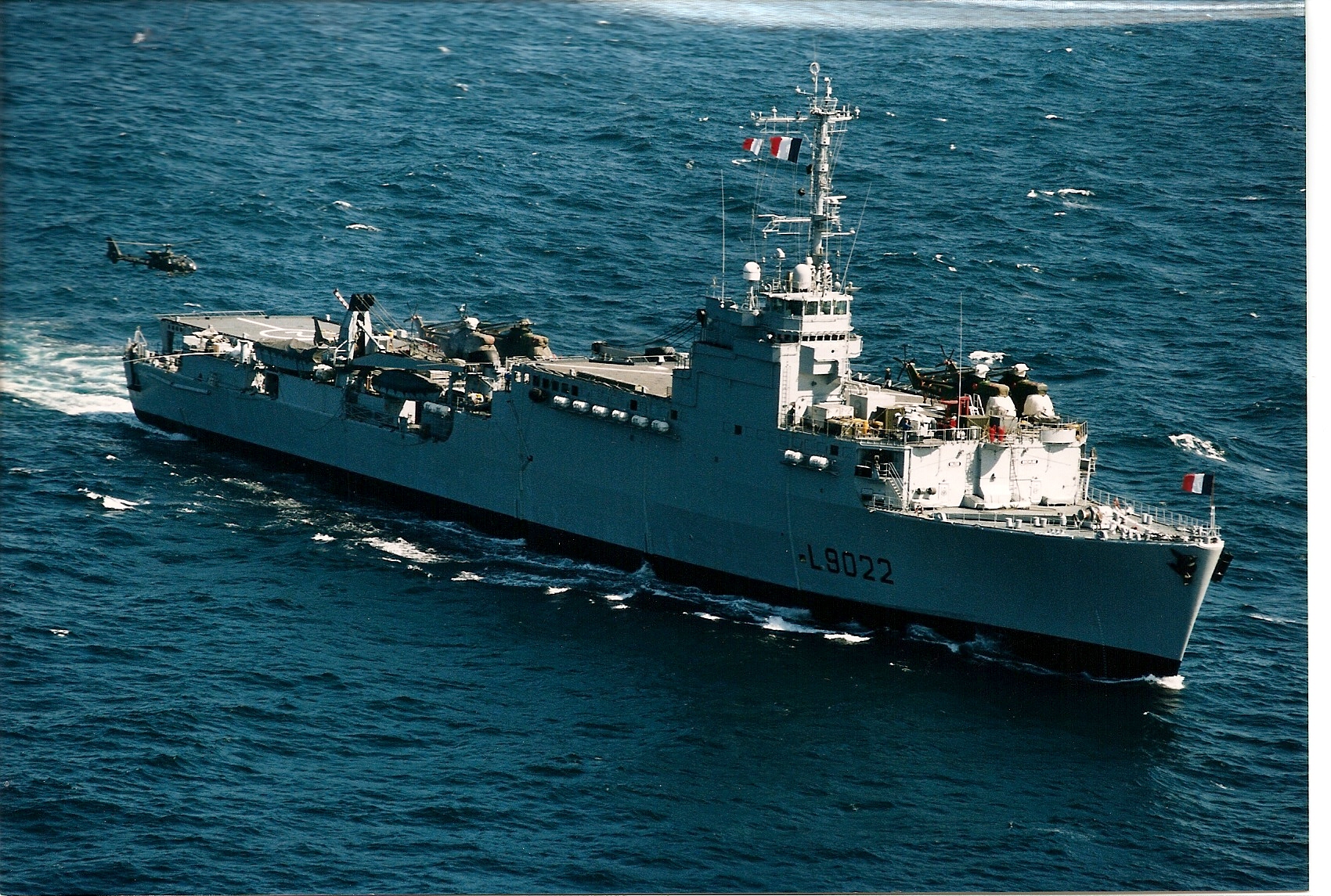
It was the preferred Helo compared to the Sea King, the Sea King was only chosen because RR managed to get extra HP out of the Sea King engine. HMAS Protector the planned AOE for the RAN, is shown with Super Frelons
Would have loved the RAAF purchasing CH-3E's, while the RAN purchased their SeaKing's.
Great lift capability for it's era, maranised, and much commonality.
Would have worked well on/from Aussie Ouragan class LSD.

Regards
Pioneer
 
During an exercise in the early 70s in which the British were determined to prove that they could reinforce Singapore by air and they wouldn't need an aircraft carrier to do it.
Just prior to the exercise they realized that they couldn't guarantee aircover for incoming air transport over Singapore itself.
They quietly asked the RAN if they wouldn't mind providing Melbourne.
 
Would have loved the RAAF purchasing CH-3E's, while the RAN purchased their SeaKing's.
Great lift capability for it's era, maranised, and much commonality.
Would have worked well on/from Aussie Ouragan class LSD.

Regards
Pioneer

That's when we bought the Chinooks, more or less and I wouldn't trade a Chinook for a CH3.

There is no hangar on the Ouragan, which limits the amount of time helicopters can say on them which in turn limits the amount of marinising required.
 
Just a few thoughts on some of the things that have been discussed might have changed history.

If the Melbourne had been given a major mid-life update to the standard of the Karel Doorman in he early-mid 60s I think it would be likely she does a war cruise in Vietnam in 1966 or 67 as the USN requested. While this isn't going to change history for anyone else it will likely mean the carrier will be replaced as the RAN will have modern war experience with their carrier.

The 4 x LSM-2s would no be enough for the ADF to intervene in East Timor in 1975, despite the ADF having some additions that would be useful such as the F4s.

I could imagine a bit of a pivot to the Indian Ocean in the 80s, Melbourne did a deployment in 1980 and if Fleet Base West was completed earlier and a 2nd oiler was acquired some fleet units as well as subs could be stationed there. These would be supported by RAAF Curtin at Exmouth and Cocos and Christmas Island airfields.
 
Just a few thoughts on some of the things that have been discussed might have changed history.

If the Melbourne had been given a major mid-life update to the standard of the Karel Doorman in he early-mid 60s I think it would be likely she does a war cruise in Vietnam in 1966 or 67 as the USN requested. While this isn't going to change history for anyone else it will likely mean the carrier will be replaced as the RAN will have modern war experience with their carrier.

The 4 x LSM-2s would no be enough for the ADF to intervene in East Timor in 1975, despite the ADF having some additions that would be useful such as the F4s.

I could imagine a bit of a pivot to the Indian Ocean in the 80s, Melbourne did a deployment in 1980 and if Fleet Base West was completed earlier and a 2nd oiler was acquired some fleet units as well as subs could be stationed there. These would be supported by RAAF Curtin at Exmouth and Cocos and Christmas Island airfields.
We might still be able to intervene in east timor if Sydney is still in service plus with a mini AKA which would be better amphibious lift then what we had in 1999.
I Wonder how say the fiji coup would go if its got an australia carrier and amphibous group sitting off the coast
 
We might still be able to intervene in east timor if Sydney is still in service plus with a mini AKA which would be better amphibious lift then what we had in 1999.

Keeping Sydney for another 2+ years is somewhat of a stretch, but I agree that it might make the East Timor situation look quite different to the Government. Especially with some of the other things that have been discussed here.

I Wonder how say the fiji coup would go if its got an australia carrier and amphibous group sitting off the coast

As it happens there were an unusually large number of RAN warships nearby, 2 FFGs arrived on the day of the coup, and 2 Patrol boats arrived the next day and Stalwart and DE Parramatta were not too far away and re-routed to be near Fiji. These ships may have kept a lid on escalation, but the Government were very keen to not intervene in Fijis affairs, so I doubt a carrier and/or LSD would have changed much. However, Op Morris Dance showed the gaping hole in ADF capability for even the most minor contingencies requiring independent deployment. With and LSD and 4 LSM-2 this wouldn't be the case.
 
Keeping Sydney for another 2+ years is somewhat of a stretch, but I agree that it might make the East Timor situation look quite different to the Government. Especially with some of the other things that have been discussed here.
It depends on how quick they decided on amd build a sydney replacement to weather she is still in service really. Cause unless the use her crew and melbournes crew to crew hermes. I cant see in a scenario where we have 4x lsm2s and a mini aka that sydney doesnt get a proper replacement.
These ships may have kept a lid on escalation, but the Government were very keen to not intervene in Fijis affairs, so I doubt a carrier and/or LSD would have changed much. However, Op Morris Dance showed the gaping hole in ADF capability for even the most minor contingencies requiring independent deployment. With and LSD and 4 LSM-2 this wouldn't be the case.
I would say in this sencario the goverment might be more willing to, espicially if it intervens in eaat timor in 75. I just wonder if you have the carrier battle group and the amphibious task group wheather the whole coup falls apart? Cause it is a lot more fire power the OTL
 
It depends on how quick they decided on amd build a sydney replacement to weather she is still in service really. Cause unless the use her crew and melbournes crew to crew hermes. I cant see in a scenario where we have 4x lsm2s and a mini aka that sydney doesnt get a proper replacement.

We've discussed how the 70s is the worst time to be buying anything Defence related. Vietnam had discredited the Forward Defence strategy , while international Detente had taken much of the heat out of the cold war for a few years. Historically Sydney was retired without replacement, and I can imagine even in a better environment this would still happen.
would say in this sencario the goverment might be more willing to, espicially if it intervens in eaat timor in 75. I just wonder if you have the carrier battle group and the amphibious task group wheather the whole coup falls apart? Cause it is a lot more fire power the OTL

Morris Dance wasn't about affecting the coup, it was about evacuation of Australians and others. Tobruk was sent because it was thought the ships on the spot crews wouldn't be enough to get people to the airport. It was expected the Fijian armed forces would help with the evacuation, not hinder it.
 
We've discussed how the 70s is the worst time to be buying anything Defence related. Vietnam had discredited the Forward Defence strategy , while international Detente had taken much of the heat out of the cold war for a few years. Historically Sydney was retired without replacement, and I can imagine even in a better environment this would still happen.


Morris Dance wasn't about affecting the coup, it was about evacuation of Australians and others. Tobruk was sent because it was thought the ships on the spot crews wouldn't be enough to get people to the airport. It was expected the Fijian armed forces would help with the evacuation, not hinder it.
I think with the PODs we have talked about (eg 58 defence merger, melbourne war cruise, better army and navy cooperation on amphibious operations, different DOA strategy) I can easier see sydney replaced even if its only say 1 tobruk type vessel
 
Just to be clear, by replacement I mean direct replacement: decommission one ship and at least part of the crew goes to the next ship. You could say Tobruk replaced Sydney as it was a troop carrier, but there was 8 years between them so I'd suggest the link is tenuous.
 
Just to be clear, by replacement I mean direct replacement: decommission one ship and at least part of the crew goes to the next ship. You could say Tobruk replaced Sydney as it was a troop carrier, but there was 8 years between them so I'd suggest the link is tenuous.
when i say Tobruk replaces Sydney, Tobruk is built earlier commissioning say 1975ish, to directly replace Sydney as an example
 
The 4 x LSM-2s would no be enough for the ADF to intervene in East Timor in 1975, despite the ADF having some additions that would be useful such as the F4s.
Ah, in all due respect, one needs to appreciate that the good old U.S.A literally endorced Indonesia's invasion of East Timor, with the Ford Administration, telling obedient
Australia, 'you will not act, let alone crisis such an action by Indonesia!'
In essence Australia was complicit in the invasion. Hence the hypocrisy, crocodile tears, political, and economic manipulation by Little Johnny "intervention" in 1999.

Now if this WhatIf was focused on a more independent Australia........

Regards
Pioneer
 
Ah, in all due respect, one needs to appreciate that the good old U.S.A literally endorced Indonesia's invasion of East Timor, with the Ford Administration, telling obedient
Australia, 'you will not act, let alone crisis such an action by Indonesia!'
In essence Australia was complicit in the invasion. Hence the hypocrisy, crocodile tears, political, and economic manipulation by Little Johnny "intervention" in 1999.

Now if this WhatIf was focused on a more independent Australia........

Regards
Pioneer

Of course, Fretilin was a Communist (or Communist leaning) Party and this was still the Cold War. I'm musing about the military practicality of an intervention, not the political practicality. However perhaps the US and Australia could have supported the UDT when they were in an alliance with Fretilin to create a multi-party state working toward independence. Such a small country would be much easier for Australia to 'influence'.
 
Just to be clear, by replacement I mean direct replacement: decommission one ship and at least part of the crew goes to the next ship. You could say Tobruk replaced Sydney as it was a troop carrier, but there was 8 years between them so I'd suggest the link is tenuous.
when i say Tobruk replaces Sydney, Tobruk is built earlier commissioning say 1975ish, to directly replace Sydney as an example

Even though these changes will have Australia come out of Vietnam with much more 'joint' experience, even at higher levels of command which will stand us in good stead going into the Self Reliance period there will still have to be a post-Vietnam 'peace dividend'. The Army will still merge 6 btns to get to 6 overall, the helicopter buy will still get chopped even if the AH1Gs are retained and the Sydney and the Cargo ship will be decommissioned as there simply isn't enough work for them to do in the peacetime ADF.

That said there was only 4 years and 2 months (less than 2 posting cycles) between the decommissioning of the Sydney and the laying down of the Tobruk (or alternatively an Ouragan) so there is continuity of thought if not capability.

A small thing I'd like is for the Army to buy 3 or 4 British LCU-9s instead of the 4 long-range LCM-8s. They'd give the Army more lifting capability, have similar range and 2 could fit into the shorter RAN Ouragan well dock with 3 LCM-8s.
 
Last edited:
Even though these changes will have Australia come out of Vietnam with much more 'joint' experience, even at higher levels of command which will stand us in good stead going into the Self Reliance period there will still have to be a post-Vietnam 'peace dividend'. The Army will still merge 6 btns to get to 6 overall, the helicopter buy will still get chopped even if the AH1Gs are retained and the Sydney and the Cargo ship will be decommissioned as there simply isn't enough work for them to do in the peacetime ADF.

That said there was only 4 years and 2 months (less than 2 posting cycles) between the decommissioning of the Sydney and the laying down of the Tobruk (or alternatively an Ouragan) so there is continuity of thought if not capability.

A small thing I'd like is for the Army to buy 3 or 4 British LCU-9s instead of the 4 long-range LCM-8s. They'd give the Army more lifting capability, have similar range and 2 could fit into the shorter RAN Ouragan well dock with 3 LCM-8s.
AS much as i would like to see things like all 9 battalions and the helicopter buy to stay. In the post vientnam environment i cant see it happening unless indonesia stays a threat.
I can see tobruk or your LSD option happening earlier especially with the experience of the vientnam war with more jointness happening earlier
Why bot just build 4 LCHs for long range army craft?
 
AS much as i would like to see things like all 9 battalions and the helicopter buy to stay. In the post vientnam environment i cant see it happening unless indonesia stays a threat.
I can see tobruk or your LSD option happening earlier especially with the experience of the vientnam war with more jointness happening earlier

There is a mere 16 months between the decommissioning of Sydney and the endorsement of the decision to buy a heavy lift ship capable of beaching. It was then another 27 months to select the base design, specify and design the (minimal) modifications and order the ship. Then another 3 months til laying down, 23 moths til launch and finally 13 months til commissioning. During that initial 16 months from November 1973 to March 1975 the RAN was in the process of commissioning the 8 LCHs, so they weren't exactly idle.

Why bot just build 4 LCHs for long range army craft?

I have a suspicion that the 4 x long range LCM-8 built in 1972 were tied up in the 1971-74 confusion of RAE transferring the operation of small ships to the RACT and the RAN getting the LCH. With the Army losing control of long-range coastal LCH they ameliorated with some long-range LCM-8s that they Navy wouldn't take.

However, in the scenario where 4 LSM-2s are purchased I don't know what happens. I suspect LCM-8s were chosen because they're not controversial, if the Navy was getting LCHs then an LCU is pretty close to that but if the Navy is getting LSM-2s then the LCU-9 doesn't look quite so big and close to the Navy's purview.

Or perhaps the need for LCU-9s doesn't become apparent until it is decided to get an Ouragan in about 1975 (following the same process as Tobruk). Or 4 x LCM-8s are good enough for the LSD when 4 x LSM-2s are in service.

Edit: the main reason I like the LCU-9 is because it can easily carry an M1 Abram's tanks whereas the LCM-8 can't. However that's not a problem until 2005, so that's hardly a reason to buy LCU-9s in the 70s.
 
Last edited:
There is a mere 16 months between the decommissioning of Sydney and the endorsement of the decision to buy a heavy lift ship capable of beaching. It was then another 27 months to select the base design, specify and design the (minimal) modifications and order the ship. Then another 3 months til laying down, 23 moths til launch and finally 13 months til commissioning. During that initial 16 months from November 1973 to March 1975 the RAN was in the process of commissioning the 8 LCHs, so they weren't exactly idle.
Agree they weren't idle but they could have acted earlier or kept Sydney for a little bit longer so there is no capability gap.
I have a suspicion that the 4 x long range LCM-8 built in 1972 were tied up in the 1971-74 confusion of RAE transferring the operation of small ships to the RACT and the RAN getting the LCH. With the Army losing control of long-range coastal LCH they ameliorated with some long-range LCM-8s that they Navy wouldn't take.

However, in the scenario where 4 LSM-2s are purchased I don't know what happens. I suspect LCM-8s were chosen because they're not controversial, if the Navy was getting LCHs then an LCU is pretty close to that but if the Navy is getting LSM-2s then the LCU-9 doesn't look quite so big and close to the Navy's purview.

Or perhaps the need for LCU-9s doesn't become apparent until it is decided to get an Ouragan in about 1975 (following the same process as Tobruk). Or 4 x LCM-8s are good enough for the LSD when 4 x LSM-2s are in service.

Edit: the main reason I like the LCU-9 is because it can easily carry an M1 Abram's tanks whereas the LCM-8 can't. However that's not a problem until 2005, so that's hardly a reason to buy LCU-9s in the 70s.
I think if the Navy operates the LSM-2s, i think the army would get some LCHs to compensate. I like the LCHs cause there Australian, plus in the scenario where we have design + built LSM-2s and Designing Destroyers and AOE, i would say we would design and build LCH like OTL
 
Agree they weren't idle but they could have acted earlier or kept Sydney for a little bit longer so there is no capability gap.

I agree in principle, but as we've seen in this thread the ADF had to grow into itself and this took time.

I think if the Navy operates the LSM-2s, i think the army would get some LCHs to compensate. I like the LCHs cause there Australian, plus in the scenario where we have design + built LSM-2s and Designing Destroyers and AOE, i would say we would design and build LCH like OTL

What's your thinking there; the RAN got small LCHs so the Army got small LCM-8s in 1972 but if the RAN got big LSM-2s the Army would get big landing craft in 1972?

I see the LSM-2 as a next step in the growth of Australia's amphibious capability, and it's failure and replacement with the LCHs which were less capable than the old LSM-1s show how fragile this growth was. If the 4 LSM-2s were built I'd take that as a win and not try to push things by trying to add LCHs in that step. In fact, if the LSM-2 were built I could imagine the Army not even getting those 4 long range LCM-8 and perhaps getting the 8 LCM-6 that the RAN sold in 1973, and maybe all 16 of them. The mid 70s amphibious OOB would be 4 LSM-2, 11 LCM-8 and 16 LCM-6.

If the Army wants bigger landing craft I'd be waiting until the next step that starts in the mid 70s and historically resulted in the Tobruk but in this scenario would hopefully result in an LSD.
 
Last edited:
Say what you want about Forward Defence and the Domino Theory, they gave Defence planners something to aim at. Defence Self Reliance, even when coupled with Dibb's self defence strategy was at best wishy-washy and at worst risked alienating Allies and regional partners as too isolationist and narrow focused. For example the (amalgamated in 1973) DoD believed Australia should prepare for low-intensity conflict whereas the ADF believed they should prepare for medium-intensity war and have the ability to expand if a defined threat arose. This lack of definition was at least partly responsible for failures like Project Waler, where there was confusion about what these AFVs would even be for.

However in the various situations discussed in this thread Australia should be in a different organisational situation in 1972, in particular the merging of the 4 DoD Departments in 1958 and a more complete Command structure in Vietnam, with subsequent war experience. These will likely have different procurement outcomes, as discussed in this thread, such as the 4th DDG and 4 LSM-2 as well as keeping various items of kit like the British wheeled AFVs and the F4Es. This organisational maturity should be capable of formulating a realistic contingency goal that the ADF can prepare and procure against in the 1976 Defence White Paper.

I think something like 'Prepare for medium-intensity conflict in conjunction with and at the request of regional Allies, partner and potential partners without the assistance of great power allies. The ADF should also be capable of high-intensity conflict in defence of Australian territory and low-intensity conflict globally as part of international efforts.' could be realistic and appropriate. Examples of medium-intensity could be given as high-intensity but small scale (in global terms) battles like Coral-Balmoral in a low-intensity conflict.

Thoughts?
 
From the Opening Message.
Royal Australian Air Force
  • 44x UH-1H Iroquois
  • 12x CH-47C Chinooks
Australian Army
  • 84x OH-58A Kiowa
I know that the ADF received 12 out of 12 CH-47Cs and 56 out of 84 Kiowas, but how many of the 44 UH-1Hs did it actually get? Do we know what the RAAF and Australian Army planned to do with the UH-1Hs and Kiowas that it didn't get.
 
know that the ADF received 12 out of 12 CH-47Cs and 56 out of 84 Kiowas, but how many of the 44 UH-1Hs did it actually get?

14

Do we know what the RAAF and Australian Army planned to do with the UH-1Hs and Kiowas that it didn't get.

In 1971 or so the Army had 1 Armoured regt, 3 Cavalry regts, 4 artillery field regts and 9 infantry battalions on the books. I suspect that with such a big Army 84 Kiowas and 44 UH1Hs is what's required. I don't know exactly when it happened but very quickly the infantry was amalgamated down to 6 infantry battalions and 3 artillery regts and soon after 2 Cavalry regts. I suspect 2 UH1 sqns and a CH47 sqn is enough for that. In any case the ADF was not very well focused after Vietnam.
 
I know that the ADF received 12 out of 12 CH-47Cs and 56 out of 84 Kiowas, but how many of the 44 UH-1Hs did it actually get?
Do we know what the RAAF and Australian Army planned to do with the UH-1Hs and Kiowas that it didn't get.
In 1971 or so the Army had 1 Armoured regt, 3 Cavalry regts, 4 artillery field regts and 9 infantry battalions on the books. I suspect that with such a big Army 84 Kiowas and 44 UH1Hs is what's required. I don't know exactly when it happened but very quickly the infantry was amalgamated down to 6 infantry battalions and 3 artillery regts and soon after 2 Cavalry regts. I suspect 2 UH1 sqns and a CH47 sqn is enough for that. In any case the ADF was not very well focused after Vietnam.
For what it's worth I've been in spreadsheet hell analysing the information on the Australian Hueys on the ADF Serials website and from that the ADF acquired 73 UH-1B/D/H Iroquois helicopters of which the RAN had 7 and the RAAF had 66.

The Iroquois in RAN Service

The RAN acquired 7 UH-1B and going by their serial numbers were ordered in 2 batches. That is a batch of 3 delivered in May 1964 and a batch of 4 delivered in 1965. 3 were written off in crashes 1964-81 (i.e. 11.11.64, 05.06.68 & 26.03.81) and the other 4 were retired 1988-89. The last aircraft of the second batch may have been purchased to replace the Huey lost in November 1964.

The Iroquois in RAAF Service

The 66 Hueys acquired by the RAAF consisted of 24 UH-1B, 8 UH-1D and 34 UH-1H. According to the ADF website all 8 UH-1D were converted to UH-1Hs. The ADF website believes that 16 UH-1Hs were built as D models but modified to H models prior to delivery.

The 24 UH-1Bs were delivered 1963-65 in 3 batches of 8 aircraft.
  • 8 from October 1962 to February 1963.
  • 8 from December 1963 to March 1964.
  • 8 from October 1964 to January 1965.
12 out of of 24 UH-1Bs were lost in crashes 1966-84. Furthermore, 9 of the 12 lost in crashes were lost before the Whitlam Government came to power. The 12 surviving UH-1Bs in RAAF service were replaced by the Aerospatiale AS350B Squirrel helicopters delivered in 1984.

The 42 UH-1D/Hs were delivered 1966-73 as follows:
  • 1 UH-1D on 16.11.66.
  • 1 UH-1D on 09.05.67.
  • 14 in February 1968 consisting of 6 UH-1D and 8 UH-1H.
  • 8 UH-1H in July 1968.
  • 1 UH-1H on 06.01.69.
  • 1 UH-1H on 09.12.69.
  • 11 UH-1H from June to July 1970.
  • 5 UH-1H in November 1973.
According to the ADF serials website the 8 UH-1Ds were converted to UH-1Hs and the first 16 UH-1Hs were built as D models, but were converted to H models before delivery.

13 out of 42 UH-1D/Hs were lost in crashes 1969-86. Furthermore, 7 of the 13 lost in crashes were lost before the Whitlam Government came to power. 4 of the 29 surviving UH-1Hs were transferred to the PNGDF in August 1989 and the other 25 were transferred to the Australian Army between December 1989 and June 1990.

To recapitulate the 42 UH-1Hs consisted of.
  • 8 delivered as D models and converted to H Models later.
  • 16 built as D models, but were converted to H Models before delivery.
  • 18 built and delivered as H models.
Therefore, depending on how the middle 16 in that list are included a total of 34 UH-1H was delivered to the RAAF of 44 ordered OR a total of 18 UH-1Hs was delivered to the RAAF out of 44 ordered. So the Whitlam Government (which was elected on 02.12.72) cancelled either 10 UH-1Hs or 26 UH-1Hs.

Except, what if the 44 UH-1Hs on order when the Whitlam Government came to power didn't include the 37 UH-1D/Hs delivered to July 1970? What if it only included the 5 that were delivered in November 1973? If that's correct 39 were cancelled.

 
@NOMISYRRUC I've tried trawling through ADF serials for the Bell 47, I like it much better when the ADF buys things in single, large batches. This dribs and drabs thing is really annoying.

ADF serials is what the RAAFies used to refer to when talking aircraft history, so it's an authoritative source. However, it's not perfect, for example the RAN bought 3 UH1B and 4 UH1C, but I don't think ADF serials calls them Cs. Radschool magazine says that 2 UH1Hs were delivered to 9 sqn in 1970 and another 2 in 1971. I believe that since Australia hadn't started a drawdown in 1970 and 9 sqn was at war replacements for its aircraft were delivered immediately from US stocks without waiting for a production slot.

IIUC the AH1G order was cancelled in October 1971, and 9 sqn was withdrawn from Vietnam in December 1971. I suspect that's when whatever was ordered in 1970 was reduced, perhaps after some aircraft has already been delivered, I don't know if Whitlam cancelled the order.

FWIW the CH47C order was announced in August 1970, suspended later in 1970 then restarted in March 1972. This is after the 1962 order was cancelled in favour of more Caribous and UH1s.
 
ADF serials is what the RAAFies used to refer to when talking aircraft history, so it's an authoritative source. However, it's not perfect, for example the RAN bought 3 UH1B and 4 UH1C, but I don't think ADF serials calls them Cs. Radschool magazine says that 2 UH1Hs were delivered to 9 sqn in 1970 and another 2 in 1971. I believe that since Australia hadn't started a drawdown in 1970 and 9 sqn was at war replacements for its aircraft were delivered immediately from US stocks without waiting for a production slot.
FWIW

I've looked at that article and the number of Hueys delivered to the RAAF in that is exactly the same as the number on ADF Serials. That is 66 consisting of 24 UH-1B, 8 UH-1D and 34 UH-1H. The serials are exactly the same too. Although the delivery dates are not an exact match. However, it also agrees with me by saying that the Bravos were withdrawn in the middle 1980s, and by saying that 25 Hueys were transferred to the Australian Army, which matches the ADF Serials website.

The article says the RAN operated 11 Hueys (instead of 7) which consisted of 3 UH-1Bs, 4 UH-1Cs delivered in 1964 and 4 UH-1C delivered 1965-66. It also says that the 3 survivors were paid off on 31.05.89.

The ADF Serials website says 3 UH-1B delivered May 1964 and 4 UH-1B delivered in 1965. The article doesn't say what the serials were so I don't know which 4 UH-1Cs ADF Serials has listed as Bravos and which Charlies ADF Serials has missed completely. However ADF Serials does agree with the article's assertion that the RAN's last 3 Hueys were retired on 31.05.89. (According to ADF Serials the fourth RAN Huey that wasn't lost in a crash was withdrawn on 31.10.88).

Also saying that the RAN's UH-1Cs were Bravos is a mistake that several other people made too. I know this because I've been reading 1970s & 1980s reference books about the World's Air Forces for information on the ADF, for a thread on Alternatehistory.com. That's why I wanted to know how many of the 44 UH-1Hs were delivered.
 
Last edited:
Can deliveries be matched to orders? 14 is the conventional wisdom, but that might simply be repeated over and over from some obscure source.

FWIW apparently the monthly production rate of UH1 in the Vietnam years was about 150 per month. Given this production rate I'd expect more or less immediate delivery of small numbers of helicopters would be feasible. The big part of that 42 aircraft order likely would have been delivered in a batch with those 5 delivered in 1973.
 
Last edited:
Can deliveries be matched to orders? 14 is the conventional wisdom, but that might simply be repeated over and over from some obscure source.
Mystery solved. Source: http://adf-serials.com/CMS/raaf3/3a16
On March 10, 1970, the Minister for Defence (John Gorton - Later Prime Minister Sir John Grey Gorton) announced a comprehensive helicopter acquisition program for the RAAF and the Australian Army which was to include 84 Light Observation Helicopters (LOH), 42 Utility Helicopters (UH) and 11 Helicopter Gunships.
With the withdrawal of Australian forces from Vietnam the LOH purchase was pared back to 75 Kiowa (subsequently reduced to 56) and the UH order to 14 UH-1H Iroquois (7 in 1970 for 5 Sqn, 2 replacements in 1971 for 9 Sqn in Vietnam and a final 5 delivered in March 1974) plus 12 Ch-47C Chinook Medium Lift Helicopters.
From Message 785.
The 42 UH-1D/Hs were delivered 1966-73 as follows:
  • 1 UH-1D on 16.11.66.
  • 1 UH-1D on 09.05.67.
  • 14 in February 1968 consisting of 6 UH-1D and 8 UH-1H.
  • 8 UH-1H in July 1968.
  • 1 UH-1H on 06.01.69.
  • 1 UH-1H on 09.12.69.
  • 11 UH-1H from June to July 1970.
  • 5 UH-1H in November 1973.
According to the ADF serials website the 8 UH-1Ds were converted to UH-1Hs and the first 16 UH-1Hs were built as D models, but were converted to H models before delivery.
In reverse order
  • The final 5 delivered in March 1974 correspond to the 5 in November 1973.
  • The 11 from June to July 1970 consist of.
    • 5 delivered in June 1970, but it ADF Serials didn't say which squadron they were delivered to.
      • I think these correspond to the 5 delivered in 1970.
    • 2 delivered on 27.07.1970 to No. 9 Squadron in Vietnam.
      • I think these were built to an earlier order.
    • 1 delivered on 20.06.1971, which I though was a typo for 20.06.70.
    • 1 delivered on 27.07.1970, which I think is a typo for 27.07.71.
      • I think these were the the 2 delivered in 1971.
Therefore, it's a grand total of 64 UH-1H ordered of which 30 were cancelled and 34 were built.

Correction 13.12.25

It's actually a grand total of 70 UH-1D/H ordered for which 28 were cancelled and 42 were delivered.

That is:
  • 8 UH-1Ds delivered November 1966 to February 1968 which were rebuilt as UH-1Hs.
  • 20 UH-1Hs delivered February 1968 to July 1970.
    • 8 in February 1968.
    • 8 in July 1968.
    • 1 on 06.01.69.
    • 1 on 09.12.69.
    • 2 on 27.07.70.
  • 42 UH-1Hs ordered in March 1970 of which 14 were delivered 1971-73 and 28 were cancelled. The 14 deliveries were as follows:
    • 5 in June 1970.
    • 1 on 20.06.71.
    • 1 on 27.07.71
    • 7 in December 1973.
13 out of the 42 were lost in crashes or to enemy action 1969-86, but that included 6 lost in Vietnam. Of the remainder 4 were transferred to the PNGDF in 1989 and 25 were transferred to the Australian Army at the end of 1989.

If the 6 Huey's lost in Vietnam are ignored that's 7 out of 42 lost or 17%. Based on that 5 out of the 28 cancelled helicopters would have been lost to 1989 if they'd been delivered, leaving 23 to be transferred to the Australian Army.
 
Last edited:
As part of my obsession with lines on org charts and their impact on procurement of cool gear I came across what appears to be a presentation on the history of Australian Joint Operations. A few things were noteworthy, such as Britain's postwar Defence arrangements strengthened the 'centre' against the services which allowed for Joint Operations planning to develop in the 60s, which Australia borrowed. In contrast Australia's system meant that petty squabbles became insurmountable problems, which what I suspect killed the LSM-2 project.

The big thing the British did was in 1946 passed an Act that made the Minister of Defence the only Cabinet Minister responsible for military matters, First Lord of the Admiralty, Secretary of War and Secretary of Air were formally made subordinate to that position in Apr 1947. The British introduced the Chairman - Chief of Staffs Committee in Jan 1956 made him Cheif of Defence Staff with command authority in Jan 1959, and fully integrated Defence with Admiralty, War and Air in Apr 1964.

From what I can tell in 1958 Moreshead recommended the British 1964 organisation, with Defence fully absorbing Air, Army and Navy Ministries rather than the 1947 organisation where they were subordinate to the Cabinet level Minister of Defence. This what Menzies rejected and Australian Ministers of Army, Navy and Air remained full Cabinet level Ministers until Whitlam's reforms in the early-mid 70s, although Australia did create the position of Chairman - Chiefs of Staff Committee in Mar 1958.

Given this organisational move would have mean Australia bounding ahead of Britain in organisation terms its rejection appears to be a bit more understandable. Perhaps an option B could have been put forward, where Australia adopted the 1947 British arrangement and made the Minister of Defence superior to the Ministers of Army, Navy and Air who would be removed from Cabinet. This intermediate step could produce positive outcomes like it did in Britain, without Australia taking the risk of being a strategic thought leader.
 
As part of my obsession with lines on org charts and their impact on procurement of cool gear I came across what appears to be a presentation on the history of Australian Joint Operations. A few things were noteworthy, such as Britain's postwar Defence arrangements strengthened the 'centre' against the services which allowed for Joint Operations planning to develop in the 60s, which Australia borrowed. In contrast Australia's system meant that petty squabbles became insurmountable problems, which what I suspect killed the LSM-2 project.

The big thing the British did was in 1946 passed an Act that made the Minister of Defence the only Cabinet Minister responsible for military matters, First Lord of the Admiralty, Secretary of War and Secretary of Air were formally made subordinate to that position in Apr 1947. The British introduced the Chairman - Chief of Staffs Committee in Jan 1956 made him Cheif of Defence Staff with command authority in Jan 1959, and fully integrated Defence with Admiralty, War and Air in Apr 1964.

From what I can tell in 1958 Moreshead recommended the British 1964 organisation, with Defence fully absorbing Air, Army and Navy Ministries rather than the 1947 organisation where they were subordinate to the Cabinet level Minister of Defence. This what Menzies rejected and Australian Ministers of Army, Navy and Air remained full Cabinet level Ministers until Whitlam's reforms in the early-mid 70s, although Australia did create the position of Chairman - Chiefs of Staff Committee in Mar 1958.

Given this organisational move would have mean Australia bounding ahead of Britain in organisation terms its rejection appears to be a bit more understandable. Perhaps an option B could have been put forward, where Australia adopted the 1947 British arrangement and made the Minister of Defence superior to the Ministers of Army, Navy and Air who would be removed from Cabinet. This intermediate step could produce positive outcomes like it did in Britain, without Australia taking the risk of being a strategic thought leader.
So basically follow what the british did in 1947, then go ahead with the morshead report in 1958. i wonder how this would effect the military, obviously the LSM-2 would go ahead but what else would change?
 
So basically follow what the british did in 1947, then go ahead with the morshead report in 1958.

Defence organisaton didn't become a political problem until 1958, so that's when his change would occur, there was no imperative to change in 1947. Menzies didn't adopt Morshead's recommendation due to political factors, he wanted to keep the extra Ministerial positions. I also suspect that given his recommendations would put Australia ahead of Britain in terms of strategic thinking few Australian politicians at the time would be brave enough to take that step. Britain fully amalgamated their Departments in 1964, that was likely the model for the Tange reforms of 1976, which I imagine would occur more or less as it did historically as full integration was likely the end state of reform.

i wonder how this would effect the military, obviously the LSM-2 would go ahead but what else would change?

I've attached the document that prompted this line of thought. Having another look, I may have been over-excited at what the British 1947 re-org was capable of. The UK started really looking into Joint Operations in the mid 50s and the 1964 re-org strengthened the centre rather than the 1947 re-org.

That said if Australia did adopt the 1947 British organisation, with the Minster of Defence in Cabinet and the service Ministers as junior posts the MoD would become an 'umpire' for arguments which would likely lead to results. LSM-2 is the most obvious, instead of the project falling over and the Army building the LCH a Cabinet level Minister would likely have told them to suck it up one way or another. The other obvious area would be RAAF helicopters. AM Murdoch was not supportive of helping the Army nor buying AH1s, but I suspect a Cabinet Minister might have seen his reluctance compared with the CGS/C-COSC Wiltons enthusiasm for Joint operations and sided with Wilton. I could see AH1s being ordered prior to the 1970 order that was cancelled.
 

Attachments

  • The_Origins_and_Emergence_of_Australian.pdf
    1.3 MB · Views: 17
Edit: the main reason I like the LCU-9 is because it can easily carry an M1 Abram's tanks whereas the LCM-8 can't. However that's not a problem until 2005, so that's hardly a reason to buy LCU-9s in the 70s.
I mean, it'd let you beach a Centurion with a ~20ton trailer full of ammo or supplies, so it's still a useful option in non-hostile landings.

Plus, IIRC the original LCMs were delivering 3x Shermans to the beaches. 1 dozer, 2 with ammo trailers.


This organisational maturity should be capable of formulating a realistic contingency goal that the ADF can prepare and procure against in the 1976 Defence White Paper.

I think something like 'Prepare for medium-intensity conflict in conjunction with and at the request of regional Allies, partner and potential partners without the assistance of great power allies. The ADF should also be capable of high-intensity conflict in defence of Australian territory and low-intensity conflict globally as part of international efforts.' could be realistic and appropriate. Examples of medium-intensity could be given as high-intensity but small scale (in global terms) battles like Coral-Balmoral in a low-intensity conflict.

Thoughts?
That would be a pretty reasonable mission statement.


Such a shame the AH1G order wasn't retained. A few less of the other types, and stripping Bushrangers of their weapons to keep UH1H numbers up might have swung it.
I think the problem was that only the US had really figured out that attack helicopters are the end result of the old Tank Destroyer doctrine. Something screamingly fast and able to respond to a breakthrough in moments, but armed well enough to be able to take out 8+ tanks. UK/Commonwealth had antitank units, but didn't have Tank Destroyer Doctrine like the US did.

Also, I've read that the Huey gunships were considered more effective in COIN operations since they had 4 sets of eyes at work. The door gunners usually found threats faster than the two pilots did. But UH1Bs loaded with weapons were a lot slower than UH1Hs loaded with troops, and AH1s were faster than the troop ships.
 
I mean, it'd let you beach a Centurion with a ~20ton trailer full of ammo or supplies, so it's still a useful option in non-hostile landings.

The inability to move the 52-ton Centurion around was the reason the Army got the 4 x LSM-1 and 2 x ALC-50, although the ALC-50 was unable to carry the Centurion in practice.

I think the problem was that only the US had really figured out that attack helicopters are the end result of the old Tank Destroyer doctrine. Something screamingly fast and able to respond to a breakthrough in moments, but armed well enough to be able to take out 8+ tanks. UK/Commonwealth had antitank units, but didn't have Tank Destroyer Doctrine like the US did.

Also, I've read that the Huey gunships were considered more effective in COIN operations since they had 4 sets of eyes at work. The door gunners usually found threats faster than the two pilots did. But UH1Bs loaded with weapons were a lot slower than UH1Hs loaded with troops, and AH1s were faster than the troop ships.

The RAAF started fitting UH1Bs with fixed M60s and rockets as early as 1964, so had been using gunships for 3 years by the time the first US Army AH1G unit became operational. However, it wasn't until 1969 that 4 x UH1H Bushranger gunships were deployed to Vietnam as a result of the inadequacy of relying on US Army gunship escorts.

Air Marshal Murdoch rebuffed request for dedicated gunships, insisting that Bushrangers were sufficient, and privately told his staff that gunships would be superseded by VTOL aircraft like the Harrier. Conveniently enough the Harrier is a fixed wing aircraft, more or less, just like the rest of the Air Force's combat aircraft.

I can't help but wonder if Murdoch would have lasted 4 1/2 years as CoAS if the DoD was given primacy over the Departments of Army, Navy and Air. His persistent inability to cooperate with the Army in particular might have seen him not get the 12-month extension, even that would have given him 3 1/2 years in the role. Ideally, he would have been replaced at 3 years, by July 1968, or even had his tenure cut short to align with the posting cycle and be gone by Jan 1968. Without him thwarting C-COSC Wilton's push for jointness the ADF might have progressed further in organisational terms.
 
The RAAF started fitting UH1Bs with fixed M60s and rockets as early as 1964, so had been using gunships for 3 years by the time the first US Army AH1G unit became operational. However, it wasn't until 1969 that 4 x UH1H Bushranger gunships were deployed to Vietnam as a result of the inadequacy of relying on US Army gunship escorts.

Air Marshal Murdoch rebuffed request for dedicated gunships, insisting that Bushrangers were sufficient, and privately told his staff that gunships would be superseded by VTOL aircraft like the Harrier. Conveniently enough the Harrier is a fixed wing aircraft, more or less, just like the rest of the Air Force's combat aircraft.

I can't help but wonder if Murdoch would have lasted 4 1/2 years as CoAS if the DoD was given primacy over the Departments of Army, Navy and Air. His persistent inability to cooperate with the Army in particular might have seen him not get the 12-month extension, even that would have given him 3 1/2 years in the role. Ideally, he would have been replaced at 3 years, by July 1968, or even had his tenure cut short to align with the posting cycle and be gone by Jan 1968. Without him thwarting C-COSC Wilton's push for jointness the ADF might have progressed further in organisational terms.
Interesting.

No I don't think he would have stayed on.
 
The reason I like the Ouragan is because it's the smallest ship with a dock with the smallest crew in the 60s-70s. It's 8,500t loaded and 211 crew compared to the UK Fearless class LPD 12,100t and 580 crew, the US Anchorage LSD 14,000t and 358 crew and US Raleigh LPD 13,600t and 665 crew. Tobruk was 5,800t and had a crew of 161.

In the Australian context I think the 120m long (13.2m wide) well dock is overkill, the Ouragan's could install extra space for cargo which shortened the well dock to 60m long. I would make this permanent, and buy some British LCU-9s which have about double the capacity of the LCM-8, so the Australian Ouragans could carry 2 x LCU-9s and 3 x LCM-6s or 4 x LCM-8s. There also was the capacity to increase the troop capacity from 363 to 470, I'd make this permanent as well which might be possible in conjunction with increasing the cargo space. An Australian Ouragan and available LSM-2 would be able to move a well armed battalion to anywhere in the region.
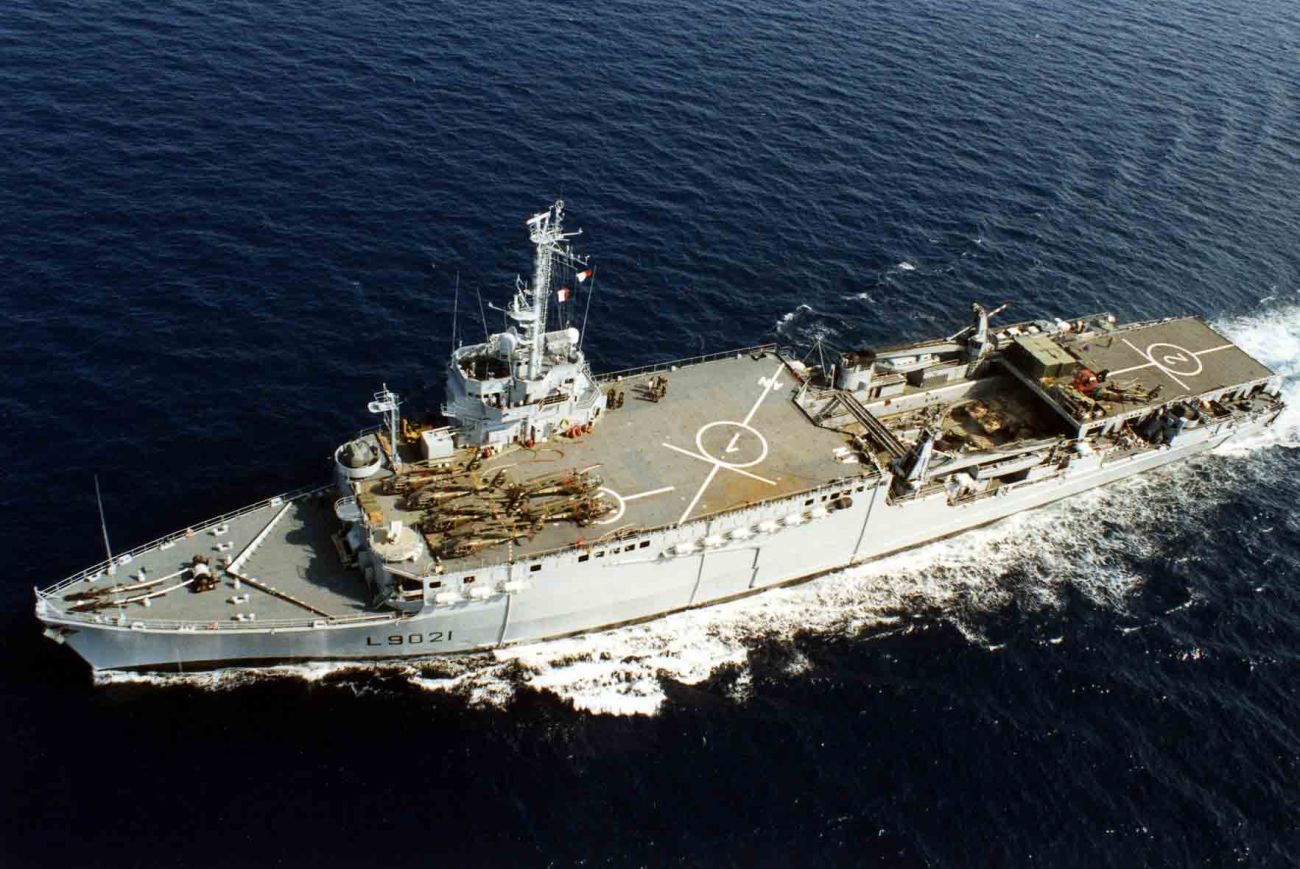
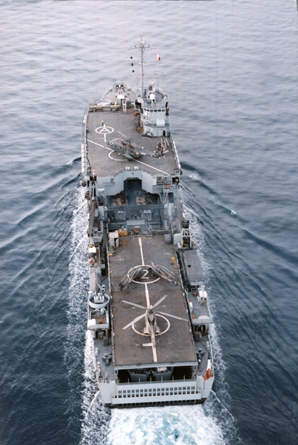
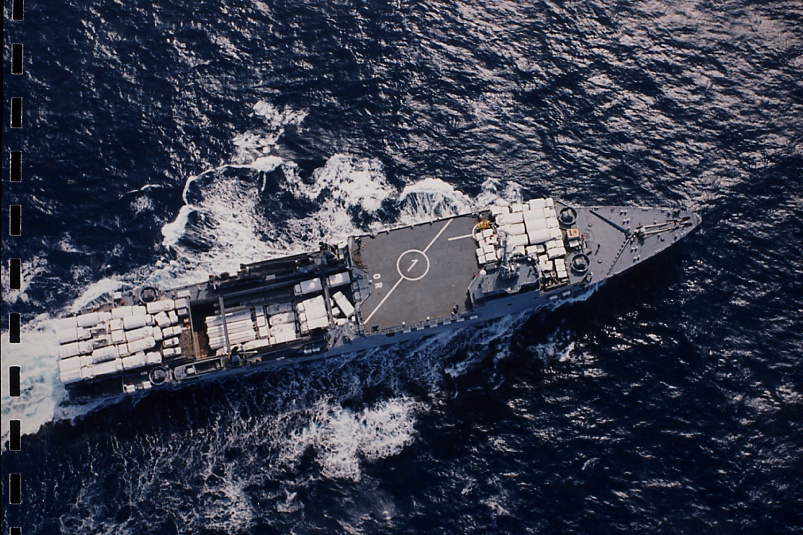
Different pictures show 2 detachable flight decks, one amidships and the other aft. I think they got removed to give clear space overhead, but if half the well dock is converted to cargo space then I think the amidships fight deck could be fixed permanently. It would need to be able to handle the RAAFs CH47 Chinooks.

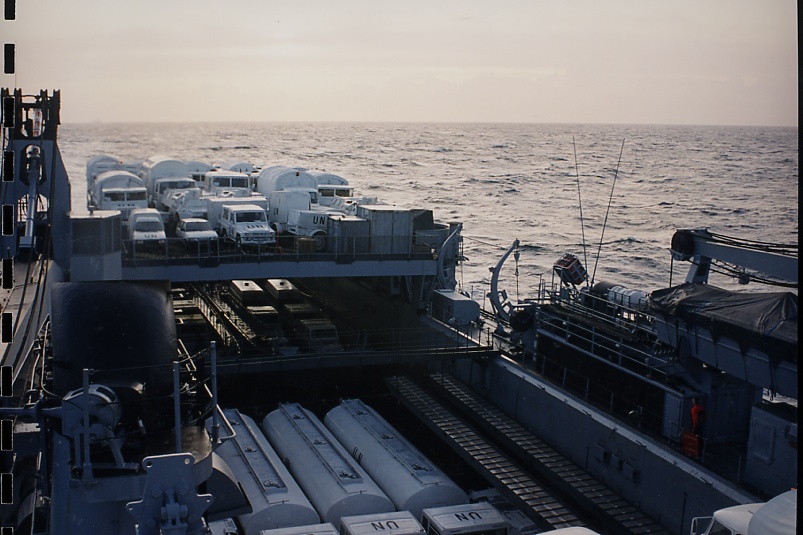
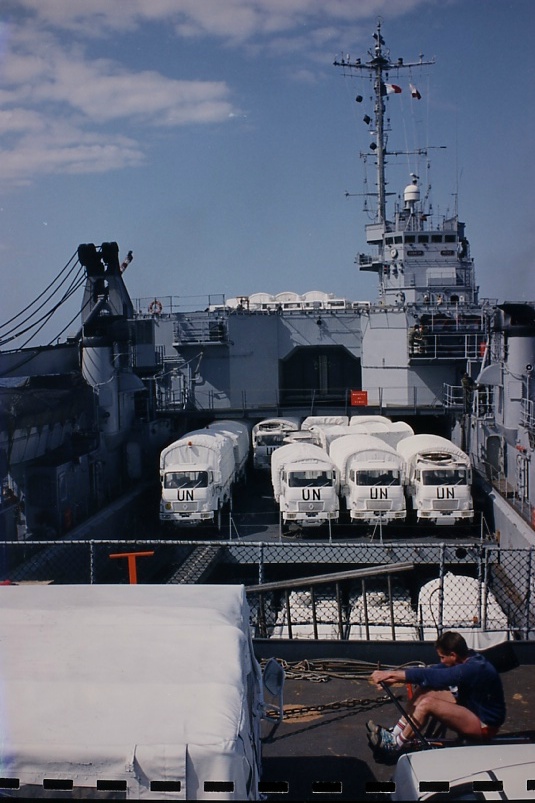
The Ouragan class LPDs really brought a ton of flex! Here's some additional pics showing flight deck operations and how they could load vehicles on 2 levels inside the well deck. Source for most pics is http://tcd.orage.free.fr.

Here's the original flight deck layout with 2 landing spots and deck park for 2 Super Frelons (abreast the island)... total up to 4 Super Frelons.
histor21.jpg


The forward deck park could also take 3 Pumas or 6 Gazelles.
photo31.jpg

20160831110446_1181.jpg


The aft landing area could be lengthened from 36m to 48m. The extra space could be used as a 2nd landing spot for light helicopters or as a deck park for 3 Pumas or 2 Pumas + 4 Gazelles. That means total helo capacity was up to ~10 helicopters (e.g. 6 Pumas + 4 Gazelles!)
1993vuehelicoorage.jpg
Libreville041996_02.jpg

execicesardaigne1996a.jpg


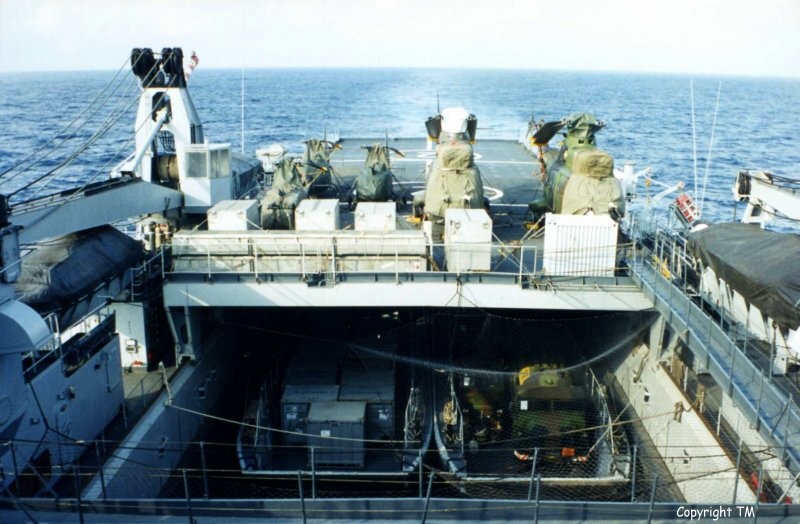
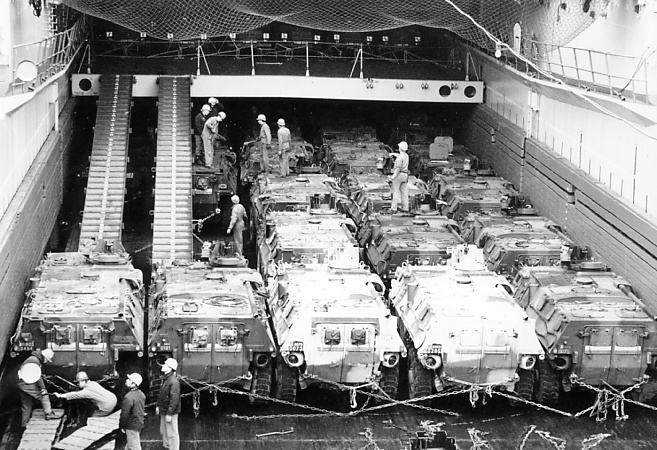
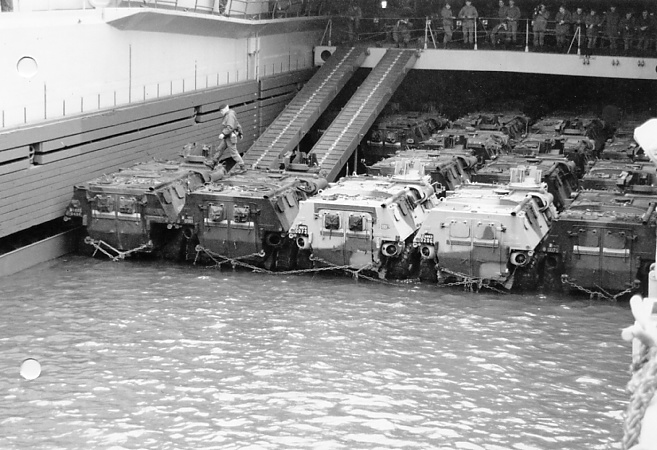
Here's the front half of the well deck loaded with vehicles on 2 levels. This shows the ramp used to drive up to the optional cargo deck. Once loading was complete, the deck would be flooded, and voila still space for 4 LCMs carrying more vehicles!
frelin1995c.JPG

frelin1995d.JPG

frelin1995e.JPG


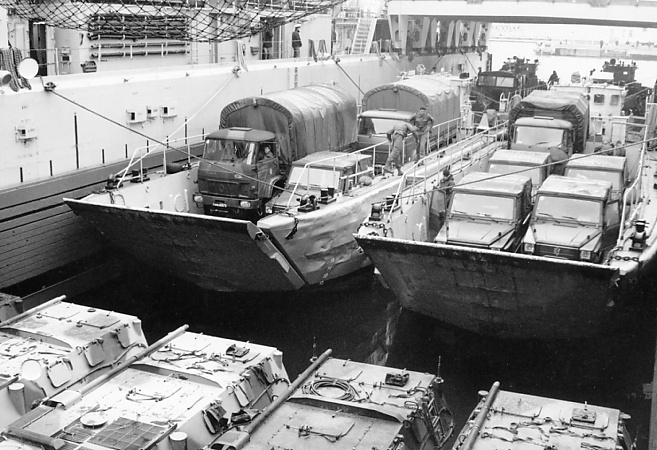
The flight decks could be loaded with trucks, which makes me think they could also take the weight of a Chinook. Here it's loaded with trucks on both flight decks, on the middle cargo deck, in the well dock, and in the LCMs... trucks, trucks everywhere!
Img0036.JPG

Img0040.JPG

Img0034.JPG
 
Nice pictures @H_K , do I see an LCVP stowed under one of the cranes on the side, with a boat on the other?

Operation Morris Dance in 1987 showed that the ADF needed to be able to lift a company in a single helicopter lift, but didn't get that until the LHDs in the 2010s. An Ouragan, carrying a pair of Chinooks could lift two platoons in a single lift, which is a lot better than the ADF's capability up to 2010.

If Australia get the 4 LSM-2 I think the Ouragan's role would be to carry the bulk of the troops for a battalion sized landing and between it and what LSM-2 were available support a seaborne as well as airlifted battalion ashore.
 
Last edited:
Back
Top Bottom