AH UK ICBM force option

Well a little further examination of geological maps suggests a very limited set of areas where granite is available to dig into.

Mostly Cornwall and Devon have field big enough.
Cornwall:-
Lands End 10km by 20km = 8 silos
Cammenellis 10 by 10km = 4 silos
St.Austell 10km by 5km = 2 silos
Bodmin 10km by 20km = 8 silos

Devon:-
Dartmoor 20km by 30km = 12 silos
North Devon 10km by 20km 8 silos

Complex geology in Southeastern Devon by the Dorset border might support some. But it's unclear.

Anglesey is a narrow strip through the centre of the island 10km by 3km = 4 silos and Cumbria is limited to the Esk Valley 5km by 4km = 2 silos

Northeast Scotland.....later maybe but several locations. About 8 roughly 15km by 15km zones. So if all could be used that is roughly 72 silos.

Northern Ireland, Antrim granite zone(s) 25km by maybe 10km, equals about 5 to 10 silos at 5km separation or 16 to 24 at 3km separation.

Additional after brief forey over silo design.
Assuming a induvial silo site is 40m square though the silo is 15m diameter.
What is the minimum separation of silos?
5km? Assumption for current numbers.
 
Last edited:

Attachments

  • IMG_0129.jpeg
    IMG_0129.jpeg
    1.2 MB · Views: 7
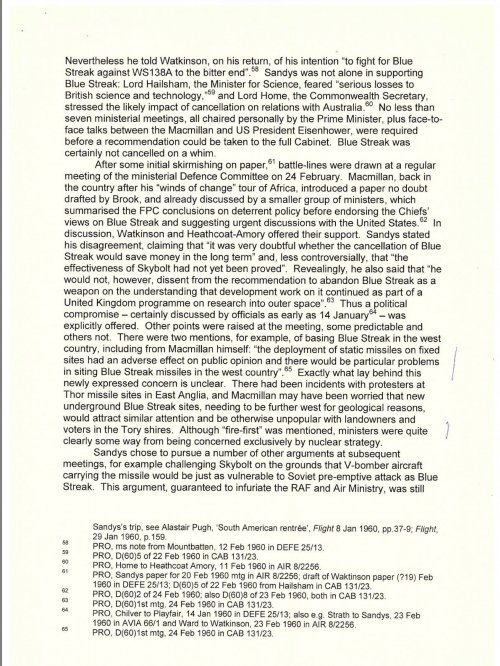
  • Moore_Related_to_the_question_of_policy_on_manned_aircraft_a_new_view_of_the_Blue_Streak_cance...pdf
    7.4 MB · Views: 4
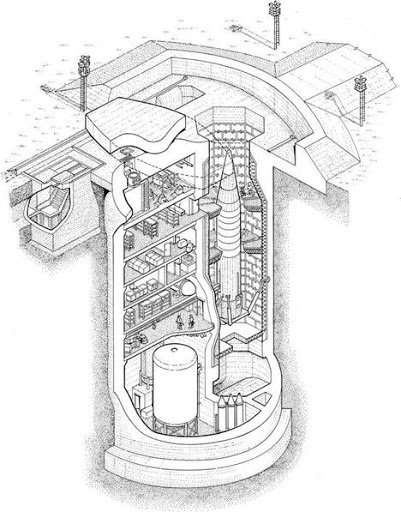
Our own C.N.Hill, author of ‘A Vertical Empire’ goes into a lot of detail of the design and discussion regarding the underground silo proposed for Blue Streak as well as some of the sites discussed as locations, although no final choices had been made by the time of the 1959 General Election in (see Chapter 6, Blue Streak - the ‘Underground Launcher’)
 
There were always one big problem with any kind of silo-based missiles on UK soil. Their destruction, requiring multi-megaton scale groundblasts would essentially spell doom for all Britain. Fallout would kill the majority of population.

With strategic missiles on submarines, there were at least a possibility that potential agressor would refrain from blasting the British isles into radioactive wasteland. With silo-based missiles... well, the agressor would need to neutralize them, so he would basically be forced to destroy Britain completely.

Not a good equation.
 
The real question has to be under what circumstances would the UK escape nuclear destruction in the event of an exchange between the US and USSR?
 
The real question has to be under what circumstances would the UK escape nuclear destruction in the event of an exchange between the US and USSR?
Probably by declaring itself neutral, like France. USSR was fully willing to left France alone, as long as France would refrain from attacking USSR from French territory. Presumably, similar arrangement could be made with Britain.

(this would basically means Soviet victory, though. Without Britain and France, US would simply lack any ability to move troops and supplies in Europe at anything like required scale. So at this point, the Red Phone would likely rang, and Moscow and Washington would start to discuss peace around neutral demilitarised Germany).
 
Our own C.N.Hill, author of ‘A Vertical Empire’ goes into a lot of detail of the design and discussion regarding the underground silo proposed for Blue Streak as well as some of the sites discussed as locations, although no final choices had been made by the time of the 1959 General Election in (see Chapter 6, Blue Streak - the ‘Underground Launc
AFAIK he his a member here
https://www.secretprojects.co.uk/members/cnh.5653/
 
Page 12 of this article….shows consideration of Blue Streak basing in the West Country (as it’s termed in the U.K.)
I have attached the complete document as well.
Downloaded from:
https://nuclearinfo.org/wp-content/...e_Blue_Streak_cancellation_nd.-compressed.pdf
Firstly thank you for sharing this.

Having read it briefly it seems the arguments against domestic silos systems and domestic MRBM is in fact less comprehensive and effective than has been 'sold' in innumerable 'history' works.

Unsurprising in being the second thing an Elite says "Reasons, Reasons, Reasons, and therefore we were correct in what we did". In which we should remember that 'Reasons' be whatever the Elite make up with dubious connections to reality.

Had the Southwest become the main missile complex for UK Deterrent, using initially Blue Streak. We can envision a transition to a solid propellant missile, sold as much on it's greater readiness for immediate launch and it's potentially cheaper silos.
 
There were always one big problem with any kind of silo-based missiles on UK soil.
Two big problems. You note the military-strategic one. The other is political: the UK, and particularly England, is inherently fairly conservative. Installing silo based missiles in 'England's green and pleasant land' was seen as vandalism.

Thor was just barely acceptable because it went on old airfields, and wasn't permanent. Putting them in places that didn't matter, like Northumberland or Scotland, might be acceptable. They're peripheries that don't matter to Middle England. Dispersing concrete silos and security fences across areas closely tied to national identity would amount to trying to change that identity. Which, politically, was impossible.
 
Quoting that Richard Moore article, full operational capability in 1968 seems a rather poor return given we're talking early 1950s US technology rehashed into a new aluminium tube in a deep hole. Thor, Jupiter, Atlas and Titan I were all history by then. There is no getting around the fact that Blue Streak was aging technology.
Fundamentally you need to have a solid-fuelled IRBM or at least hypergolic liquid fuels like Titan II in development before the mid-60s and that is unlikely to happen to in the UK.
Putting a Blue Streak into a hole in the ground in 1967-68 is not a credible long-term deterrent nor a good return for over a decade's investment in time and money.
 
Very well said. Kerosene is a decent fuel for an IRBM, but LOX sucks immensely. And the british well-known alternative oxidizer - H2O2 - is an explosive bitch if impurities or even water contaminates it. Titan II that used storable propellants (N2O4 / N2H4) had two god awful silo mishaps in 1965 and 1980 that killed a number of crews. H2O2 would have been even worse in that regard.

So better to go solid fuel and from there, into the least vulnerable platform : nuclear sub. Polaris was the right move. A pity Breat Britain couldn't built his own SLBMs (M51 style), since they had the submarines and the warheads. But well, Special Relationship - c'est la vie.
 
Last edited:
Very well said. Kerosene is a decent fuel for an IRBM, but LOX sucks immensely. And the british well-known alternative oxidizer - H2O2 - is an explosive bitch if impurities or even water contaminates it. Titan II that used storable propellants (N2O4 / N2H4) had two god awful silo mishaps in 1965 and 1980 that killed a number of crews. H2O2 would have been even worse in that regard.

So better to go solid fuel and from there, into the least vulnerable platform : nuclear sub. Polaris was the right move. A pity Breat Britain couldn't built his own SLBMs (M51 style), since they had the submarines and the warheads. But well, Special Relationship - c'est la vie.
The UK was way behind in terms of solid fuels R&D.
 
UK lagged on solid fuels, and especially at scale. During the layers 40's to early 50's.
The science caught up by the late 50's to early 60's.

But the argument that solid was the better bet from the get go is clear.....if a little hindsight.
Though liquid fuel was driven by pre-war obsession with HTP and the ability to move German production to the UK.

At the time solid was argued for and under different circumstances might have swayed decision makers.

It's clear by '63 solid fuel ballistic missiles was the way forward. Hence the Minuteman paper.

So arguably a continuation of domestic MRBM means funding this.

Again this would be an easier decision if the MRBM had been solid fuel from the 50's.
 
Well, storable-fuel MRBM's also perfectly possible. Or SLBM's.
Not gonna lie, I'm surprised the Soviet/Russian navy hasn't had a catastrophic oops from them. It doesn't sound like K-129, lost in 1968, went down due to a missile accident.

Nitrogen Tetroxide is some scary stuff when it leaks!
 
Nitrogen Tetroxide is some scary stuff when it leaks!
True, it's much greater headache than solid fuel. But - it could work, and from the engineering point of view, large liquid-fuel engines are far, far simpler than large solid-fuel ones. So while storeable fuel missiles won't be the best solution for Royal Navy, they were completely withing UK industrial and technological capabilities of late 1950s - early 1960s.

P.S. Also, while submarines are more survivable, surface-carriers for MRBM's are also perfectly workable. Royal Navy have incomplete HMS Leviathan rusting at shipyard for decades; she could work perfectly well as intermediate ballistic missile platform.
 
So while storeable fuel missiles won't be the best solution for Royal Navy, they were completely withing UK industrial and technological capabilities of late 1950s - early 1960s.
Even HTP isn't quite as bad as it's often made out to be: if you can make a system that's safe for cryogenics or nuclear work, you can make one that's safe for HTP. A lot of its issues seem to come from people thinking it looks like water, so can be treated like water.

It does have a few safety advantages over nitrogen tetroxide to trade against its performance disadvantages. Whilst either oxidiser might set you on fire, HTP is unlikely to give you cancer and it can safely be disposed of by washing down with water.
 
Even HTP isn't quite as bad as it's often made out to be: if you can make a system that's safe for cryogenics or nuclear work, you can make one that's safe for HTP. A lot of its issues seem to come from people thinking it looks like water, so can be treated like water.

It does have a few safety advantages over nitrogen tetroxide to trade against its performance disadvantages. Whilst either oxidiser might set you on fire, HTP is unlikely to give you cancer and it can safely be disposed of by washing down with water.
Fully agree. While Soviet SLBM's were obviously more problematic and maintenance-intensive than Western ones, they still worked reasonably fine. And IRRC, they didn't have as much teething problems as Polaris (which in its first years was essentially useless as weapon system - a combination of missile low reliability, warhead low reliability and poor accuracy).
 
pp#42: thanks for R.Moore link. In one week we discuss Blue Streak, UK Jupiter, Minuteman! Wow!

He defends the "success" of Blue Streak. Hood, #50 is surely right: "not a good return for over a decade's investment in time and money". Cancellation cost was reported as £84Mn (then $235Mn): MoA assessed it then to be at 50% of its Approved budget, so doubtless a lower % of eventual outturn: so maybe $500Mn: that was the reported R&D cost of Thor. Jupiter was $360Mn. Both were Managed under DX: Highest Ntnl. Defense Urgency, which brought Thor to 1st RAF Launch in 54 months from ITP. None of those things applied to BS, ITP on DH 4/55, then funded, shall we say, erratically, with squeeze and pause.
 
Was it some kind of "interim plan" for the RAF, waiting for Blue Streak ? Yes.

UK's MRBM was never funded for silos. RAF Strategic Missile Force rotated 3,500 uniforms/670 civilians through 86 Thors. The presumption was that expertise would feed straight into UK's MRBM, 1965-ish.' 60 Thors, 60 Blue Streaks. “Where possible, use will be made of facilities (being) developed for Thor”. H.Wynn,RAF In Postwar Yrs.: The Bomber Role '45-'70, RAFAHB,'84,P.49, 4/58; p.54. AIR%2041-85%20The%20Bomber%20Role.

So, all dead 4/60. SMF became a career dead end. Knowing silos could not happen, financially, politically, I posit, is why 1/60 CAS Pike wanted to do something better with scarce and expensive people. Like BMEWS (Contractorisation to (to be) SERCO had not yet been dreamed up). Or complex avionics. Or other GW.
 
Last edited:
The chief problem with the Blue Streak silo was the amount of reinforced concrete needed. Straining UK supply which was needed for the civilian market.

Had a solid fuel missile resulted from the MRBM effort. There wouldn't be a need for attendant LOx storage and refrigeration. Which would cut down significantly the amount of such in any silo designed.
 
The chief problem with the Blue Streak silo was the amount of reinforced concrete needed. Straining UK supply which was needed for the civilian market.

Had a solid fuel missile resulted from the MRBM effort. There wouldn't be a need for attendant LOx storage and refrigeration. Which would cut down significantly the amount of such in any silo designed.

There would still seem to be quite a bit of 'people' volume needed, though as you say removing the LOX storage etc would save quite a bit of concrete. I image the amount of concrete used in French and US silos is not something generally given out...


Blue Streak silo.jpeg

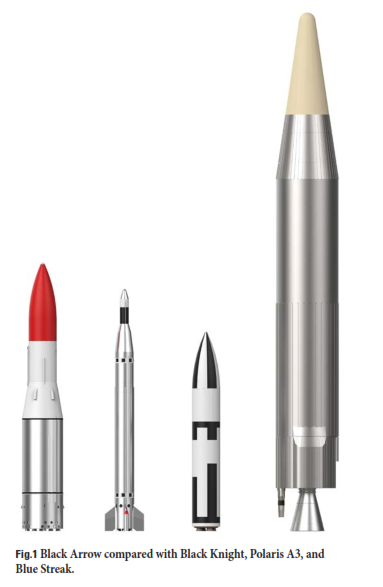
Some comparisons of sizes

Black Arrow Black Knight Polaris A3 Blue Streak.png
 
Minuteman has a 5ft 6" diameter and a length of less than 60ft.

Blue Streak is ...10ft.diameter(?) and 80ft.

(literally cannot remember diameter and online is proving weirdly coy about the figure)
 
Ok so, considering how much of a bastard LOX was for silo ICBMs, I was wondering : how did Titan I and Atlas F launched ? Got my answer here. https://www.spaceline.org/cape-canaveral-rocket-missile-program/atlas-f/
When stored, the Atlas F sat atop an elevator. If a missile was placed on alert, it was fueled with RP-1 (kerosene) liquid fuel, which could be stored inside the missile for extended periods. If a decision was made to launch the missile, it was fueled with liquid oxygen. Once the liquid oxygen fueling was complete, the elevator raised the missile to the surface for launching.
Interesting.
1-Atlas has kerosene inside its tanks, but no LOX (because boiloff)
2-If Atlas is to be launched, then LOX is pumped while the Atlas is still inside the silo
3-With both tanks full, Atlas rides an elevator to the surface
4-Where it launches.
Whew.
So they pumped an Atlas full of LOX inside the silo ? must have been a little risky.
Then if both tanks are full while inside the silo, why not launch like a Titan II or a Soviet R-36 ? why take a break in the open, standing like a giant target ?
 
(literally cannot remember diameter and online is proving weirdly coy about the figure)
I confirm, 10 ft : just like its Atlas and Centaur cousins.
 
Within history by 1965 Westcott fired a 54" solid motor.

Arguably then an in history shift to solid MRBM is possible by the early 70's.

However.....
Pursuit of 96" motor could have started in 1955. Which might have yielded results in a similar timescale.
 

Similar threads

Back
Top Bottom