If you're implying that we've moved to a larger number of smaller warheads; there are far fewer warheads overall nowadays. The immense improvements in accuracy mean that conventional weapons can destroy what once required nuclear weapons.
Treaties are only signed when both parties realize that cooperating is better than competing. By the 1980s, laser guided bombs were coming into their own, and the Gulf War proved they were easily capable of destroying soft targets, meaning nuclear weapons were only good for destroying other nuclear weapons mostly, a needlessly expensive and dangerous situation.
By the 1980s, laser guided bombs were coming into their own, and the Gulf War proved they were easily capable of destroying soft targets, meaning nuclear weapons were only good for destroying other nuclear weapons mostly, a needlessly expensive and dangerous situation.
The bulk of the Russian Federation's population is concentrated in and around two cities - Moscow and St. Petersburg, here's a population distribution map:
An all out thermonuclear war would do far more damage to the population of the Russian Federation than to the USA and the rest of the West.
Also, Russia's population is just a lot smaller (140 million vs 340 million), so wiping out a given proportion of their people requires fewer warheads.
I've been thinking about the issue lately and leafing through the old SDI stuff - does anyone know how CnC for GPALS and Brilliant Pebbles was supposed to be handled?
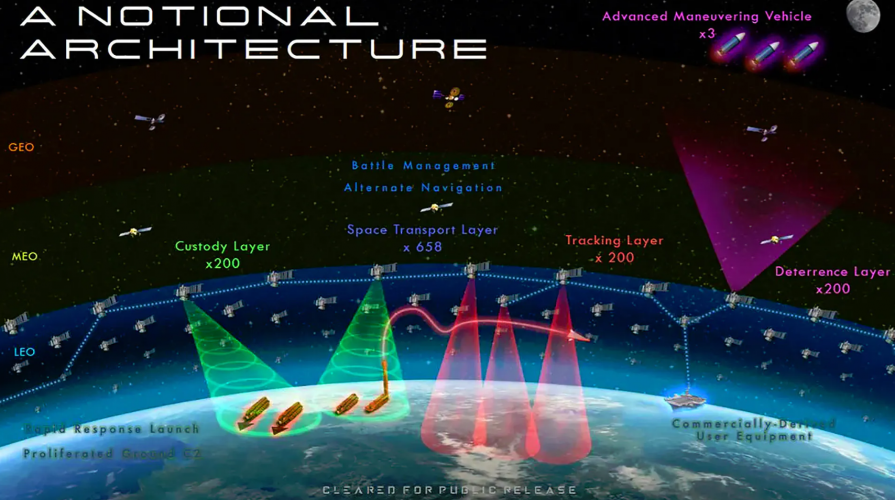
So much of the modern Golden Dome system stuff seems to hinge (or rather emerge from) the Transport Layer; but there is no mention of communications infrastructure for SDI. Golden Dome ofc is apparently doing something a lot more interesting than Brilliant Pebbles and Brilliant Eyes, with all sorts of sensors and effectors being plugged into the network, but how were Brilliant Pebbles, Brilliant Eyes, and the ground segment supposed to communicate with each other?
I've been thinking about the issue lately and leafing through the old SDI stuff - does anyone know how CnC for GPALS and Brilliant Pebbles was supposed to be handled?
So much of the modern Golden Dome system stuff seems to hinge (or rather emerge from) the Transport Layer; but there is no mention of communications infrastructure for SDI. Golden Dome ofc is apparently doing something a lot more interesting than Brilliant Pebbles and Brilliant Eyes, with all sorts of sensors and effectors being plugged into the network, but how were Brilliant Pebbles, Brilliant Eyes, and the ground segment supposed to communicate with each other?
You mean to say they appropriated a huge amount of money, and then had precisely no plan on how to spend it. I’m shocked I tell you absolutely shocked…..
"More critically, the nearly $25 billion earmarked for Golden Dome as part of the budget reconciliation package approved this summer has not been turned into a spending plan that details exactly how the money will be allocated, two sources from the administration along with a source on Capitol Hill and two of the industry executives told Reuters."
You mean to say they appropriated a huge amount of money, and then had precisely no plan on how to spend it. I’m shocked I tell you absolutely shocked…..
$25 billion covers just about nothing in such an ambitious plan. Guessing they had to secure some first to see what processes they can start.
I'd start questioning it if that money was spent before having a plan.
You mean to say they appropriated a huge amount of money, and then had precisely no plan on how to spend it. I’m shocked I tell you absolutely shocked…..
Star Wars is back in vogue with President Trump’s executive order to establish the “Golden Dome” missile defense shield. It will feature an ambitious space-based boost-phase interceptor program in addition to terrestrial systems. While admittedly the holy grail of defense against ballistic missiles, the obstacles that plagued its discontinued predecessor, “Brilliant Pebble,” under the Strategic Defense Initiative, remain unaddressed. The technological breakthroughs in launch capacity, decreasing costs of sending mass into space and faster data transfer have led to renewed hope for space-based missile defense, but the fundamental hurdle — physics, not technology — remains to be effectively overcome.
However, this lucrative promise is heavily outweighed by the drawback of what could be termed the absenteeism problem in physics. These satellites, carrying kill vehicles, must be stationed in low Earth orbit (LEO) to reach the target in the boost phase, which only lasts from three to five minutes after launch. The fundamental problem is that objects in LEO cannot be parked above one point on Earth; they revolve around Earth, completing a cycle between 90 and 120 minutes. To cover the entire stretch of potential launching points and establish a genuinely global air defense, a constellation of 950 satellites has to be deployed, according to conservative estimates. The estimated cost, according to the Congressional Budget Office’s estimates, is $542 billion as opposed to the $175 billion claim by President Trump.
Not only is the scaling dynamic flawed, but the system is also easy to defeat. The constellation is easily overwhelmed by simultaneous launches. Even if each satellite were to carry more than one interceptor, the system still saturates quickly. Once that happens, instead of a linear increase in required satellites to intercept additional hostile launches, the requirement jumps exponentially, which is untenable. Besides, the enemy can simply punch holes in the chain by employing anti-satellite missiles, as the satellites can be tracked.
Depends on the range of the interceptors and the manoeuvring capacity of the carrier satellites. Without knowing these, any derived numbers are unfounded guesswork.
What if the carriers has nuclear thermal propulsion?
This is from an Australian defense analyst. To summarize, missile defense against a peer competitor like Russia or China doesn't work. If you rely on terminal defenses, then you need a ridiculous number of missiles and can only defend the largest cities. If you use mid-course defenses you face the problem of discriminating warheads from very numerous decoys. Boost phase defense is only possible with a space based system because Russian and Chinese missile fields are deep within their countries. Most of the satellites are in the wrong part of their orbits at any time meaning that lots of satellites are needed for each booster intercepted. By using a few ASATs to poke holes in the defensive shield an adversary can get their booster through the defense.
You use all 3 layers. And just a point of note, but not all adversary missiles are in the same place either. The silos are spread out, then you have MICBMs and SLBMs. So the idea of punching a thin hole with ASATs (that wouldn't work that well against satellites holding interceptors and likely trigger a response anyway) doesn't hold weight.
This is from an Australian defense analyst. To summarize, missile defense against a peer competitor like Russia or China doesn't work. If you rely on terminal defenses, then you need a ridiculous number of missiles and can only defend the largest cities. If you use mid-course defenses you face the problem of discriminating warheads from very numerous decoys. Boost phase defense is only possible with a space based system because Russian and Chinese missile fields are deep within their countries. Most of the satellites are in the wrong part of their orbits at any time meaning that lots of satellites are needed for each booster intercepted. By using a few ASATs to poke holes in the defensive shield an adversary can get their booster through the defense.
1) that's why you declare that any attack on your satellites will be treated as an attack upon a warship or warplane, and met with an immediate counter-attack.
2) That's also why you use a lot of satellites instead of the bare minimum. Don't launch 950. Launch 9500. Or launch 28,500 or so.
1) that's why you declare that any attack on your satellites will be treated as an attack upon a warship or warplane, and met with an immediate counter-attack.
2) That's also why you use a lot of satellites instead of the bare minimum. Don't launch 950. Launch 9500. Or launch 28,500 or so.
1) that's why you declare that any attack on your satellites will be treated as an attack upon a warship or warplane, and met with an immediate counter-attack.
2) That's also why you use a lot of satellites instead of the bare minimum. Don't launch 950. Launch 9500. Or launch 28,500 or so.
Perun grossly oversimplifies the situation; there is no quick fix for formidable megaconstellations, and BP can engage in midcourse or even terminal anyway if you design it to.
The more important issue that by the time any of this is relevant, you are already very deep into World War III and the mushroom clouds are probably already going up from tactical strikes and aerodynamic systems.
If you have 28,500 satellites, they will build more nuclear missiles, or try to lift a 28,500 satellite constellation of their own, and then you have two giant constellations of satellites, one Red, one Blue, maybe in two layers, staring at each other across a few hundred kilometers of LEO, eyeball to eyeball, pebble to pebble.
https://apps.dtic.mil/sti/tr/pdf/ADA215681.pdf
This is an oldie but a goodie; when both Red and Blue have 28,500 LEO satellites, there is no room to go but up. Once LEO fills up, you move up to MEO, then GEO, then cislunar space and beyond. Hence advanced maneuvering vehicle in the PWSA and the helpful picture of the Moon.
Against a reasonably competent peer competitor, it is not necessarily possible to obtain superiority in such a technical fashion; you just ratchet up the competition. This sort of missile defense does not necessarily buy anything other than a transient advantage (although this depends on the longer-term trajectory, and you can argue otherwise, and some theories on inter-constellation warfare suggest that the superior side has a huge and rapidly compounding advantage), and at the cost of arms race stability and arguably crisis stability.
Red will try to match Blue yuan for dollar, pebble for pebble, asymmetrically or symmetrically. They may or may not succeed (in space systems and high technology, PPP is a lot more favorable for Blue!), but even if they only partially succeed, the costs for Blue will be increased, and the benefits diminished. Attrition against Red is costly for Red--every yuan spent on Guowang is a yuan not being used to boost consumption or fertility etc--but also costly for Blue. Red responses will not make this aspect of the competition quick, cheap or decisive.
This is an oldie but a goodie; when both Red and Blue have 28,500 LEO satellites, there is no room to go but up. Once LEO fills up, you move up to MEO, then GEO, then cislunar space and beyond. Hence advanced maneuvering vehicle in the PWSA and the helpful picture of the Moon.
No, nukes have a pretty short damage range in space. FFS project Orion was talking about being 20m from a nuke when it went off!
What might get the satellites would be radiation damage, but I'd expect any military satellite to be heavily protected versus radiation effects, particularly one that is intended to actively participate in a nuclear war like Golden Dome is.
So I'm not convinced that radiation kills would be very common, at least among the Golden Dome satellites. Probably would take out everything else in orbit, though.
You're assuming that it cannot engage anything in atmosphere, and that is not guaranteed. In fact, due to the need to engage Avangard HGVs (among others), it will have to be able to engage targets flying hypersonic at 100,000ft. So at least some of the weapons will be capable of re-entry.
Not to mention each garage holding at least one weapon capable of ground attack, to respond to anyone on the surface attempting to laser-blind or HPMW-fry the satellite.
ISR to keep an eye on (keep custody of) enemy missile launchers and TELs and SSBNs or whatever, keeps them tracked for left of launch stuff, that is, counterforce or preemptive strike.
PWSA is scary stuff, Red is still racing to catchup but it'll be a long, expensive slog to parity.
If Blue Golden Dome can hit ground targets, someday, so will Red Golden Dome (Celestial Great Wall?). Now as noted above, Blue Dome might win out over Red Dome, but it is unlikely to be "easy".
Golden Dome is going to get space based air moving target indicator (radar or some sort of IR) for aero threats, and we've already talked about the left of launch preemptive strike role of the custody layer above.
ISR to keep an eye on (keep custody of) enemy missile launchers and TELs and SSBNs or whatever, keeps them tracked for left of launch stuff, that is, counterforce or preemptive strike.
This site uses cookies to help personalise content, tailor your experience and to keep you logged in if you register.
By continuing to use this site, you are consenting to our use of cookies.