Status
Not open for further replies.
ESM systems don't matter?
This can be solved with putting ESM/ECM on integrated main mast. Or dividing the two systems in two halves - forward plates + half ESM on foremast, after plates and half ESM on the main. Both variants won't reduce stealth and won't require unusual breadth of the ship, which is the focus of my woe.

BAE were part of the Carrier Alliance, I should hope they know or the MoD have told them how fast the carriers really are.
I know NATO is not a thing those days, but consider you have to escort a US or French carrier.
 
No force would just use one type of escort.
In ideal conditions. In wars shit happens, and Falklands have highlighted the problem of requirement to keep Type 22 and Type 42 together.

I do get this awkward feeling that nobody really considers those ships would have to participate in a real hot war, won't they?
 
Reduction in mast size? Aren't you the one who wanted something ASEV sized?
I proposed a range of possibilities. All of them have their advantages and disadvantages, with Type 055-sized ship probably being ideal, because larger units begin to be too high-value, expensive and vulnerable. My point is that if the mast retains it's size, it needs a larger platform, and if you go for a large platform, you could put more armament there anyway (including the potential for additional armament in FAWCS as it is). If, on the other hand, it can be reduced, the platform can be brought to regular missile cruiser dimensions, and, again, speed and capabilities.
 
Last edited:
Mk.38 Mod 4 IS DS-30M....
Sweet.

Anyways, I expect to see at least 4 of those on each of His Majesty's Ships for small boat and anti-USV work. Maybe more on the carriers, amphibs, and logistics ships. 6-8, I'd guess. Aft corners, then 1-2 broadside, and P&S forward.

Even better with a dual round feed, so you can have rounds better for blasting boats and rounds better for blasting flying things. But IMO these should first be looked at as anti-small boat and anti-USV, the ship should have other tools for flying targets.
 
This can be solved with putting ESM/ECM on integrated main mast.
You just said take everything but the phased arrays off it, which is precisely why I raised ESM.
 
You just said take everything but the phased arrays off it, which is precisely why I raised ESM.
There are two masts on the ship. Foremast is the forward, mainmast is the aft one. Suppose phased arrays remain on the foremast, ESM/ECM are put on the main.
 
I do get this awkward feeling that nobody really considers those ships would have to participate in a real hot war, won't they?
See Bastion Atlantic and Project Cabot, which seems to be doing precisely that for ASW.
 
See Bastion Atlantic and Project Cabot, which seems to be doing precisely that for ASW.
The war may be not against Russia, or not only Russia. It may be China in the Pacific, it may be another round with a US-supported Argentina in South Atlantic, it may be against the US for Greenland, it may be anything.

And there may be a situation when the frigate escort is incapacitated, or sunk, or damaged.
 
Last edited:
  • Like
Reactions: DJK
There are two masts on the ship. Foremast is the forward, mainmast is the aft one. Suppose phased arrays remain on the foremast, ESM/ECM are put on the main.
Based on the configuration shown at DSEI, there are three, the pyramidal integrated mast (which seems to be designated the mainmast on Type 45 and Type 26), and the two pole-like comms masts also seen on Type 26, which I'm not convinced are suitable for the ESM/ECM arrays.
 
the two pole-like comms masts also seen on Type 26, which I'm not convinced are suitable for the ESM/ECM arrays.
Replace those with an intergrated mainmast and put ESM/ECM there. It's not a difficult engineering problem.
 
Based on the configuration shown at DSEI, there are three, the pyramidal integrated mast (which seems to be designated the mainmast on Type 45 and Type 26), and the two pole-like comms masts also seen on Type 26, which I'm not convinced are suitable for the ESM/ECM arrays.
Subs wrap ESM antennas around the periscopes, so a pole mast is technically possible.
 
  • Like
Reactions: zen
Replace those with an intergrated mainmast and put ESM/ECM there. It's not a difficult engineering problem.
I thought we were trying to reduce topweight, not add another pyramid. Exactly how is the same set of sensors in the mainmast a problem, but building an entirely new mast to hold them not a problem?
 
Exactly how is the same set of sensors in the mainmast a problem, but building an entirely new mast to hold them not a problem?
The main problem of the mast - as it is - is it's width. The horizontal width of the structure, that for some reason is stated as a requirement, and thus affects the breadth of the hull, which results in proportionally "short and fat" hull.

If you distribute the contents of this mast to two, and move any unnecessary weight lower, reducing the weight of the mast(s), you can reduce the width of both structures and thus make the hull more narrow, which in turn would enable to increase the ship's speed.
 
Last edited:
Subs wrap ESM antennas around the periscopes, so a pole mast is technically possible.
Looking at SEWIP on the Burkes I get the feeling the surface types want something a bit beefier nowadays. I've been looking around to see if I can find a pic or diagram of MEWSIC, the new fleet-wide ESM/ECM system that's going into the QEs and Types 45, 26 and 31, but everything seems to be the same one or two pics of the new Ancillia launchers (replacing Sea Gnat), rather than MEWSIC itself.
 
  • Like
Reactions: zen
The main problem of the mast - as it is - is it's width. The horizontal width of the structure, that for some reason is stated as a requirement, and thus affects the breadth of the hull, which results in proportionally "short and fat" hull.
The width of the mainmast is clearly determined by the phased arrays. The width of each side is only marginally wider than the array mounted on it. Moving the ESM/ECM elements from the corners won't change the actual width. Or the height for that matter, as the forward bearing arrays barely clear the bridge clutter as is.

ETA: The more I think about it, the more I think the width of the integrated mast is a geometry issue, not an equipment issue. If you want the panels at a fixed height, a certain minimal amount of space around them, and a set angle off the vertical, then the size of the mast pretty much writes itself. The only way to reduce that would be to rotate the entire mast 45 degrees, so the panels face fore, aft and broadside, so the mast width becomes face width, rather than sqrt(2x facewidth^2) but that's clearly not the preferred configuration for survivability.
 
Last edited:
I don't think the masts over the hanger be ECM transmitters, but ESM a.k.a signals recievers and a linear development of the sort going back over half a century.
 
The main problem of the mast - as it is - is it's width. The horizontal width of the structure, that for some reason is stated as a requirement, and thus affects the breadth of the hull, which results in proportionally "short and fat" hull.

If you distribute the contents of this mast to two, and move any unnecessary weight lower, reducing the weight of the mast(s), you can reduce the width of both structures and thus make the hull more narrow, which in turn would enable to increase the ship's speed.
Nothing wrong with a short and fat hull of the BAE renderings, it's a pretty similar shape to that of the Burkes, a hull form which was selected for better seakeeping.

I think dividing the masts into tow, assuming you want radar arrays of the same size and the same height, would be marginally heavier than the current layout. It would have superior redundancy in the event of action damage however.
 
I don't think the masts over the hanger be ECM transmitters, but ESM a.k.a signals recievers and a linear development of the sort going back over half a century.
https://www.navylookout.com/a-guide-to-the-type-26-frigate/ claims "T26 will have modern EW capabilities delivered as part of the RN’s Maritime Electronic Warfare System Integrated Capability (MEWSIC) programme (Increment-1). Details are limited but UAT Mod 2.3 Radar Electronic Support Measures (RESM) receivers will be fitted at the top of the mainmast and the ship will have the Shaman communications electronic support measures (CESM) fit used to gather signals intelligence (SIGINT)."

And "The two configurable pole masts will be manufactured by STS Defence. The starboard mast will predominantly be used for UHF and VHF communications, with 4G, GPS and ship-to-shore satellite communications antennas mounted on the port mast."

Which puts ESM, and presumably ECM on the mainmast, not the comms masts.

 
Nothing wrong with a short and fat hull of the BAE renderings, it's a pretty similar shape to that of the Burkes, a hull form which was selected for better seakeeping.

I think dividing the masts into tow, assuming you want radar arrays of the same size and the same height, would be marginally heavier than the current layout. It would have superior redundancy in the event of action damage however.
Exactly, there's no particular reason why a wide hull is an inherently slow and unhandy design. It is also plain to see from the size of the mast that if we want that size of panel then it will be very hard to fit them into a narrower ship, and if we want them high up it will be nearly impossible.
As for this 'twin masts' idea, why would having two masts carrying the same equipment be lighter than one mast? That seems extremely counterintuitive.
 
Nothing wrong with a short and fat hull of the BAE renderings, it's a pretty similar shape to that of the Burkes, a hull form which was selected for better seakeeping.
It just requires more horsepower for the same speed. From what I heard over here a couple of pages ago there was a talk of reducing speed requirements to ~25 knots. Which would be nice until the Americans ask to escort their carrier operating at full speed.

Although, just as in case with T42, it was also said there is nothing wrong with it, and everybody knows how that ended up.

As for this 'twin masts' idea, why would having two masts carrying the same equipment be lighter than one mast?

Not exactly the same equipment. Redesign the mast. Make it lighter, make it narrower, make everything that can be moved below - like computers, operator spaces, etc - moved below, build a second mast if absolutely needed, but get a hull with a 7.5-9:1 L/B ratio.

Alternatively, build a longer hull and new docks. Job creation, all that?

-----------------------------
Personally, I would suggest keeping and modernizing T45s, with large FAWCS used as flagships of AAW/ASW groups, but I doubt the Treasury would look kindly upon such an idea.
 
Last edited:
https://www.navylookout.com/a-guide-to-the-type-26-frigate/ claims "T26 will have modern EW capabilities delivered as part of the RN’s Maritime Electronic Warfare System Integrated Capability (MEWSIC) programme (Increment-1). Details are limited but UAT Mod 2.3 Radar Electronic Support Measures (RESM) receivers will be fitted at the top of the mainmast and the ship will have the Shaman communications electronic support measures (CESM) fit used to gather signals intelligence (SIGINT)."

And "The two configurable pole masts will be manufactured by STS Defence. The starboard mast will predominantly be used for UHF and VHF communications, with 4G, GPS and ship-to-shore satellite communications antennas mounted on the port mast."

Which puts ESM, and presumably ECM on the mainmast, not the comms masts.
Well I stand corrected.
Thanks.

Actually as I mused over this I can't shake the feeling I've read this or something like it some time ago.
Such is memory
 
Last edited:
Not exactly the same equipment. Redesign the mast. Make it lighter, make it narrower, make everything that can be moved below - like computers, operator spaces, etc - moved below, build a second mast if absolutely needed, but get a hull with a 7.5-9:1 L/B ratio.

Alternatively, build a longer hull and new docks. Job creation, all that?
  1. We've already decided the mast can't be made narrower, the size of the panels prevents that. Sure, have smaller panels, but the USN think sensitivity scales with the cube of array diameter so good luck retaining the same capability.
  2. The width of the hull is really quite hard to change once the decision as to what radar at what height has been made (among other important things like the 200 tons of VLS). If the radar and armament we want to install needs a 25m wide hull, making it longer and thinner isn't going to help.
  3. Achieving 7.5 L/B at a 25m wide needs a 190m long hull- ASEV size. It's almost like a really big radar needs a ship that wide, isn't it? The Japanese just have the budget and infrastructure to build a 190m long ship for the extra fuel efficiency. The equation for the RN is, is the lifetime cost of installing more propulsion and using up fuel more or less than the cost of building bigger ships and upgrading our infrastructure? If it's less, why go to the trouble?
There are valid reasons to upgrade the infrastructure anyway as an investment for future ships and I am aware of them, but I suspect BAE won't have thought that far ahead.
 
The equation for the RN is, is the lifetime cost of installing more propulsion and using up fuel more or less than the cost of building bigger ships and upgrading our infrastructure?
IF - and that's a big if - the next iteration won't say to hell with the extra propulsion, let's cap it at comfortable 25 knots.
 
Ok a good read and welcome developments.

I noticed the multi-static option is being explored. Which could imply the current visuals is the 'play safe' option.

Certainly once a hull, multiple arrays dispersed could deliver degrees of multi-static radar capability and none of these would need to be of very large size. Or of that great a power demand.

If the system is able in real time to measure precise distances to other vessels arrays, the distributed capability would exceed anything but the arrays we associate with large ground based stations.
 
Ok a good read and welcome developments.

I noticed the multi-static option is being explored. Which could imply the current visuals is the 'play safe' option.

Certainly once a hull, multiple arrays dispersed could deliver degrees of multi-static radar capability and none of these would need to be of very large size. Or of that great a power demand.

If the system is able in real time to measure precise distances to other vessels arrays, the distributed capability would exceed anything but the arrays we associate with large ground based stations.
It could be that they are intending to use multi-static techniques with conventional radars on multiple platforms, as is already done with sonars.
 
  • Like
Reactions: zen
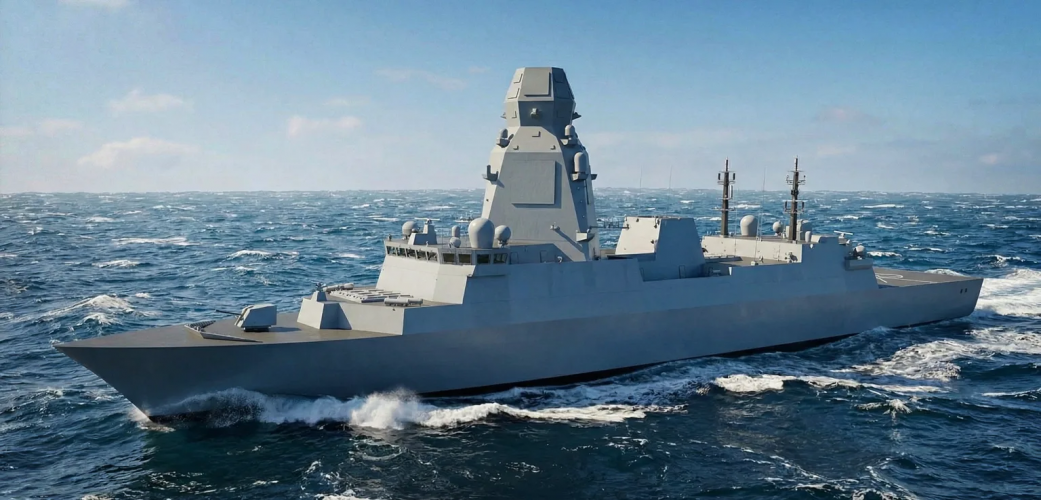
This is actually the same mast config we saw a couple of months before DSEI25, just in better lighting. It appeared in this NL article in May.

https://www.navylookout.com/royal-navy-presents-bold-ambitions-for-the-future-air-dominance-system/

View attachment 793760
Good spot. It looks a little bit like that Russian fantasy pagoda cruiser:
1764611051761.png
Or maybe like they took a Fridtjof Nansen mast and stuck it on top of the DSEI design. It's not surprising the design is changing this much, the Hunter class mast wasn't consistent until after it started production.
It seems a good design, BAE clearly still think that radar high up is the priority over fitting the biggest possible panels low down.
 
It seems a good design, BAE clearly still think that radar high up is the priority over fitting the biggest possible panels low down.
Clearly the spectre of the Exocet still haunts the Royal Navy, 40-something years after Sheffield was lost. Probably for the best, too, given how sea-skimming missiles are proliferating globally at the moment. I saw someone mention semi-submersible USV as a threat that a higher-placed radar is better able to combat.
 
Clearly the spectre of the Exocet still haunts the Royal Navy, 40-something years after Sheffield was lost. Probably for the best, too, given how sea-skimming missiles are proliferating globally at the moment. I saw someone mention semi-submersible USV as a threat that a higher-placed radar is better able to combat.
I'm not sure whether we learnt a lesson early that the rest of the world hasn't yet caught up on, or whether the RN has got hung up one one aspect of air defence and is sacrificing capability for a non-existent threat.
I feel like having 2-3 Proteus equipped with a small AEW radar would push the radar horizon out by more than just making the mast taller. Thankfully it does make our ships look very nice.
 
I'm not sure whether we learnt a lesson early that the rest of the world hasn't yet caught up on, or whether the RN has got hung up one one aspect of air defence and is sacrificing capability for a non-existent threat.
I feel like having 2-3 Proteus equipped with a small AEW radar would push the radar horizon out by more than just making the mast taller. Thankfully it does make our ships look very nice.
Yes, some flavor of VTOL drone with an AEW radar is likely the better answer to a taller mast. I think an MQ-8B might have the spare lift but would need more electrical power.
 
Yes, some flavor of VTOL drone with an AEW radar is likely the better answer to a taller mast. I think an MQ-8B might have the spare lift but would need more electrical power.
Checking things out, there is an Allison 250-C40 engine that makes 715hp instead of the 420hp that the MQ-8B has that should be a direct bolt in. It may take a little modification to the accessory case to make it able to take 200+hp to the generator shaft.

And then you flat-rate the engine's output to keep it to 420hp to the rotor shaft.
 
Yes, some flavor of VTOL drone with an AEW radar is likely the better answer to a taller mast. I think an MQ-8B might have the spare lift but would need more electrical power.
Or perhaps something like the Leonardo Proteus being developed for the RN, but with AEW capabilities?
 
Or perhaps something like the Leonardo Proteus being developed for the RN, but with AEW capabilities?
Proteus confuses me. Initially, Leonardo were pushing it as a full-on product, equipped with various modules and being ready for operations. Recently though, they've backtracked, saying instead that it's a stage on roadmap to autonomy, or a precursor to true capability.

I wonder if Leonardo have taken the MoD's money and have little to show for it.
 
Maybe? Does Proteus have ~600lbs lift and 100kW electrical power?
Leonardo have shown it with what appears to be the SeaSpray 7500e, which has secondary air to air modes. It should definitely be able to lift an AEW radar, though not in the class of Crowsnest.
 
I'm not sure whether we learnt a lesson early that the rest of the world hasn't yet caught up on, or whether the RN has got hung up one one aspect of air defence and is sacrificing capability for a non-existent threat.
I feel like having 2-3 Proteus equipped with a small AEW radar would push the radar horizon out by more than just making the mast taller. Thankfully it does make our ships look very nice.
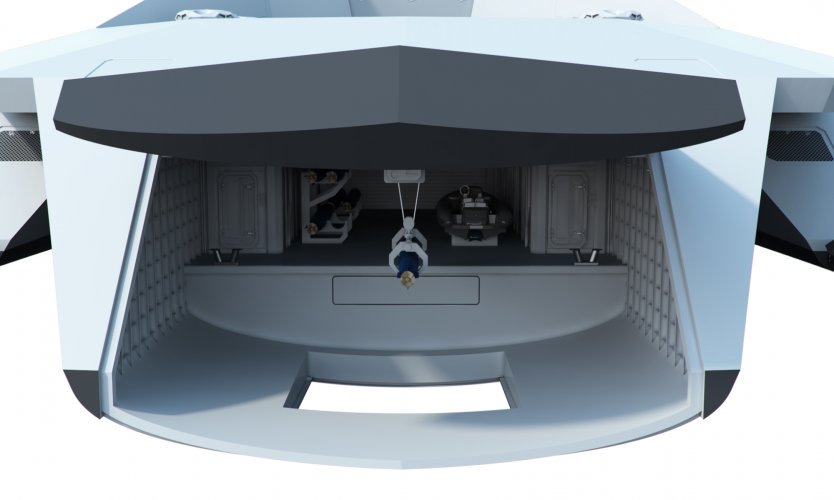
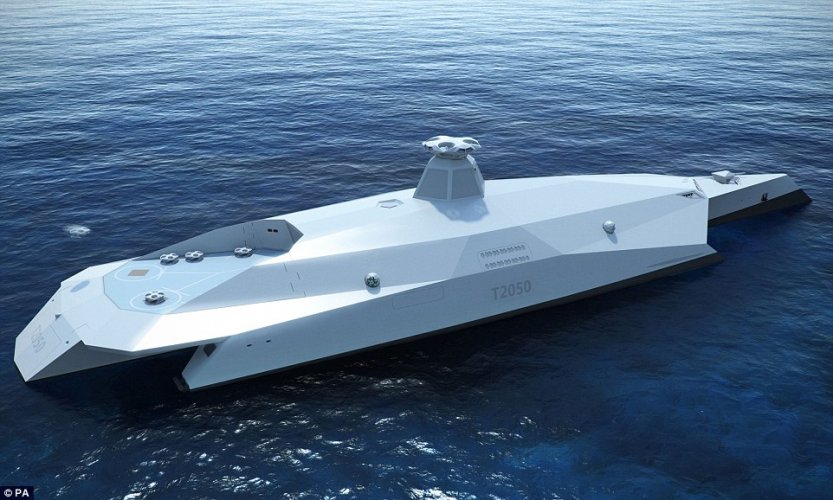
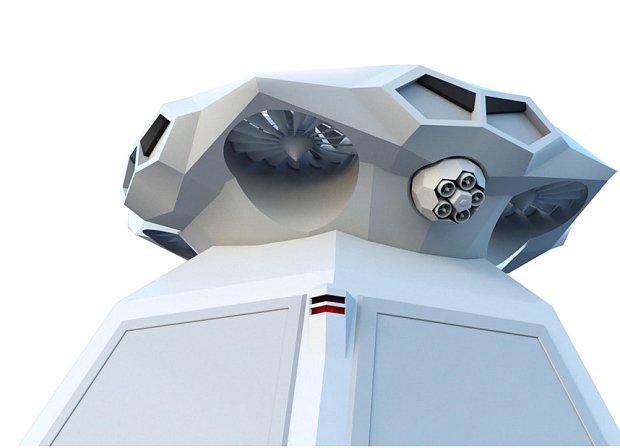
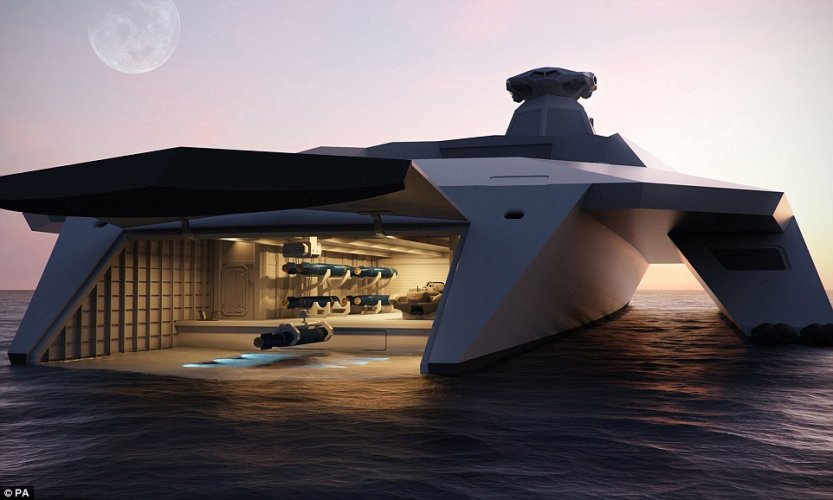
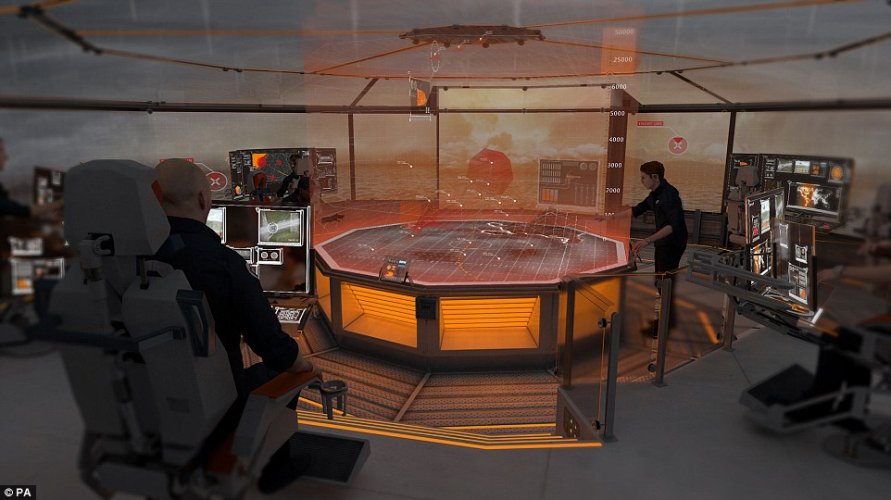
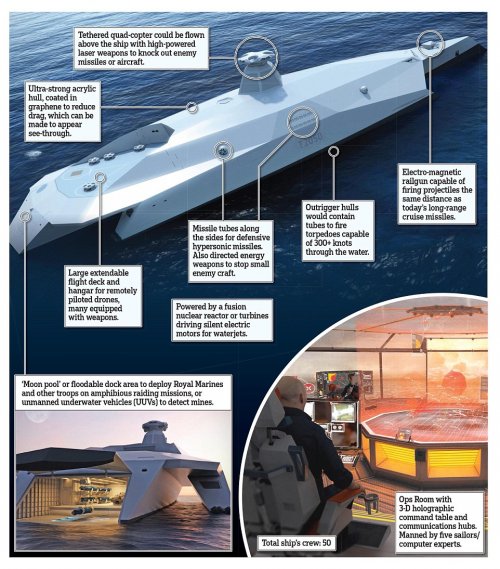
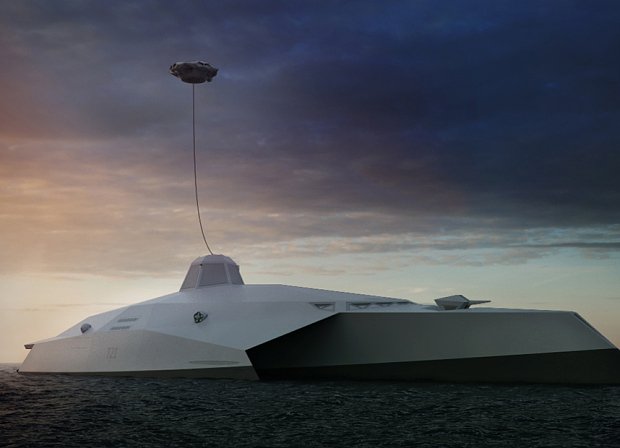
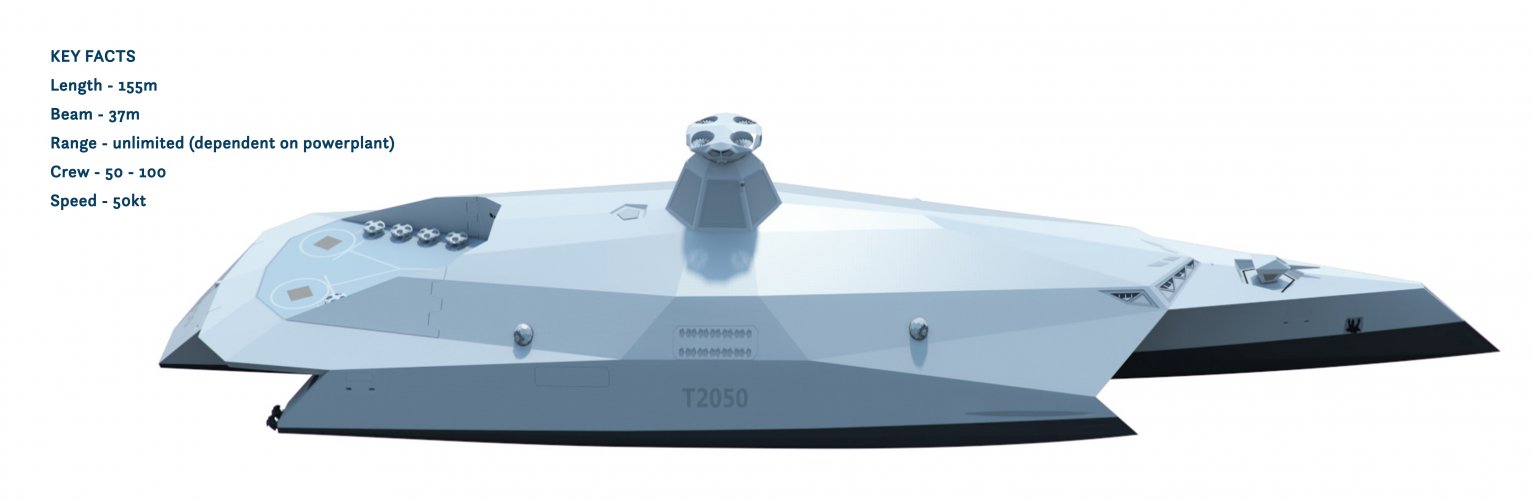
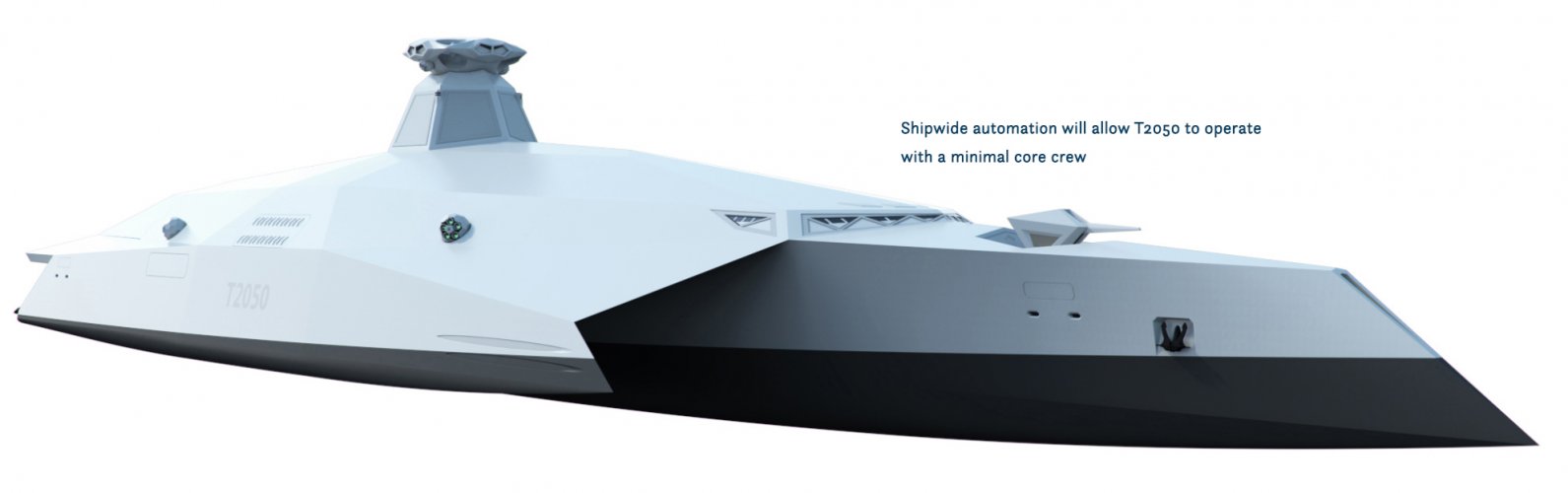
Dear Santa, we've been very, very good this past 2049...

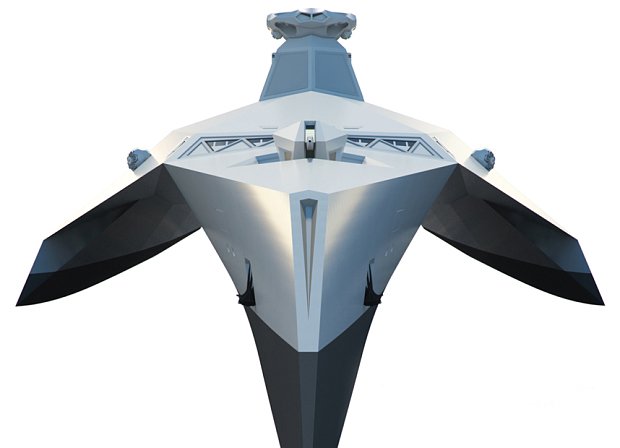
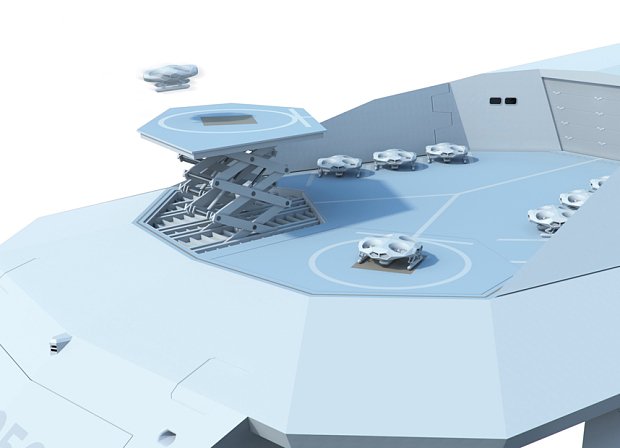
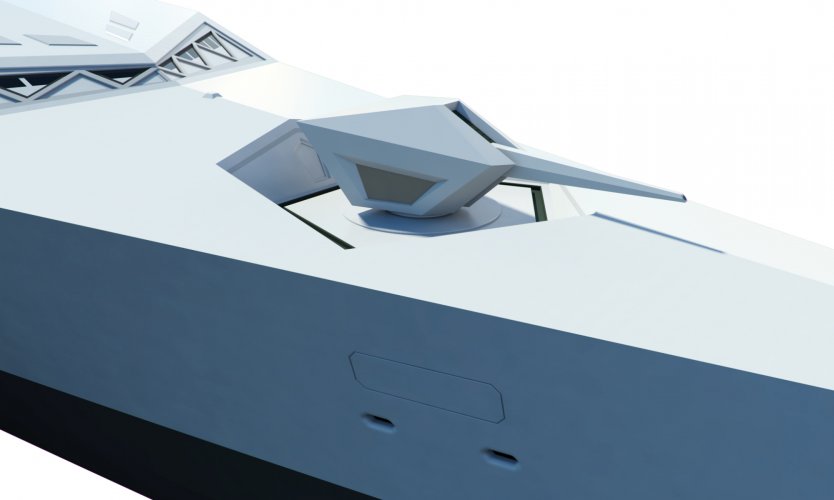
A study from 2015.

https://www.telegraph.co.uk/finance...-the-Navy-of-the-future-could-be-sailing.html
https://www.bbc.com/news/uk-34077719
The proposals are just some of the ideas from naval architects and engineers who were tasked by the Royal Navy and Ministry of Defence to imagine how the future fleet might look.

The challenge was issued by Startpoint, the new procurement group which brings together experts in naval defence from government, military and industry to provide advanced technology against a backdrop of tightening budgets.

...

Conventional masts could be abandoned for a drone carrying sensors such as radar. This would be connected to the ship by a tether made from cryogenicallycooled carbon nanotubes which would transmit power to aircraft’s motors and also energy weapons such as lasers, which could knock enemy missiles out of the sky.


Taking things a bit further, there have been plenty of studies of spacecraft using external power sources.

One sum-up of many possibilities here:

https://archive.org/details/futureofflight00myra
Lasers carry information too of course, so one can imagine a 2051 destroyer with a 'laser USB' for the drone-mast rather than a tether.
 

Attachments

  • Startpoint_T2050 Ops Room_2 Copyright Startpoint.jpg
    Startpoint_T2050 Ops Room_2 Copyright Startpoint.jpg
    3.5 MB · Views: 13
  • Dreadnought2050fro_3423395b.jpg
    Dreadnought2050fro_3423395b.jpg
    120.5 KB · Views: 13
  • Dreadnought2050fli_3423397b.jpg
    Dreadnought2050fli_3423397b.jpg
    148.5 KB · Views: 13
  • Dreadnought_2050_02.jpg
    Dreadnought_2050_02.jpg
    481.9 KB · Views: 15
  • Dreadnought_2050_01.jpg
    Dreadnought_2050_01.jpg
    606.3 KB · Views: 15
  • 2BCBC03300000578-3216304-Innovation_The_Royal_Navy_s_fleet_robotics_officer_believes_the_-a-6_...jpg
    2BCBC03300000578-3216304-Innovation_The_Royal_Navy_s_fleet_robotics_officer_believes_the_-a-6_...jpg
    150 KB · Views: 19
  • Dreadnought2050dro_3423396b.jpg
    Dreadnought2050dro_3423396b.jpg
    160.3 KB · Views: 18
  • 2BCBBE6B00000578-3216304-Glimpse_of_the_future_Engineers_have_unveiled_a_series_of_images-a-5_...jpg
    2BCBBE6B00000578-3216304-Glimpse_of_the_future_Engineers_have_unveiled_a_series_of_images-a-5_...jpg
    101.9 KB · Views: 16
  • 2BCBC02B00000578-3216304-Worthy_of_USS_Enterprise_The_new_style_operations_room_that_woul-a-4_...jpg
    2BCBC02B00000578-3216304-Worthy_of_USS_Enterprise_The_new_style_operations_room_that_woul-a-4_...jpg
    111.8 KB · Views: 17
  • 2BD0A1C000000578-3216304-image-a-8_1440975336080.jpg
    2BD0A1C000000578-3216304-image-a-8_1440975336080.jpg
    303.2 KB · Views: 21
  • Dreadnought2050-2_3423367b.jpg
    Dreadnought2050-2_3423367b.jpg
    124.9 KB · Views: 19
  • Startpoint T2050 Side closeup_Copyright Startpoint_annotated.jpg
    Startpoint T2050 Side closeup_Copyright Startpoint_annotated.jpg
    2.5 MB · Views: 21
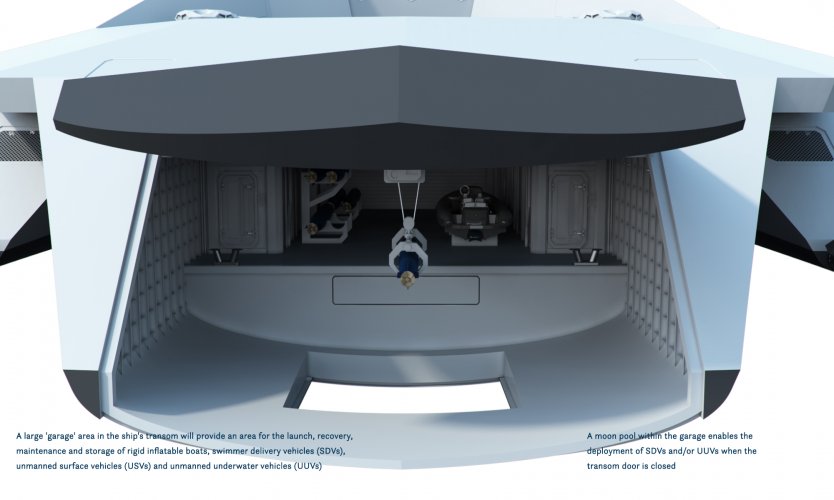
  • Startpoint T2050 Transom Garage closeup_Copyright Startpoint_annotated.jpg
    Startpoint T2050 Transom Garage closeup_Copyright Startpoint_annotated.jpg
    727.9 KB · Views: 15
  • Dreadnought 2050_ Here's what the Navy of the future could be sailing - Telegraph.pdf
    1.8 MB · Views: 6
  • What will Royal Navy warships look like in 2050_ - BBC News.pdf
    717.4 KB · Views: 6
  • Startpoint T2050 Front 3qtr closeup_Copyright Startpoint_annotated.jpg
    Startpoint T2050 Front 3qtr closeup_Copyright Startpoint_annotated.jpg
    269.1 KB · Views: 11
Last edited:
Status
Not open for further replies.

Similar threads

Back
Top Bottom