New book: A detailed analysis and comparison of the Spitfire Mk I’s and Bf 109 E’s flight performance utilizing computer simulations.

AndersJ

ACCESS: Secret
Joined
7 November 2023
Messages
298
Reaction score
743
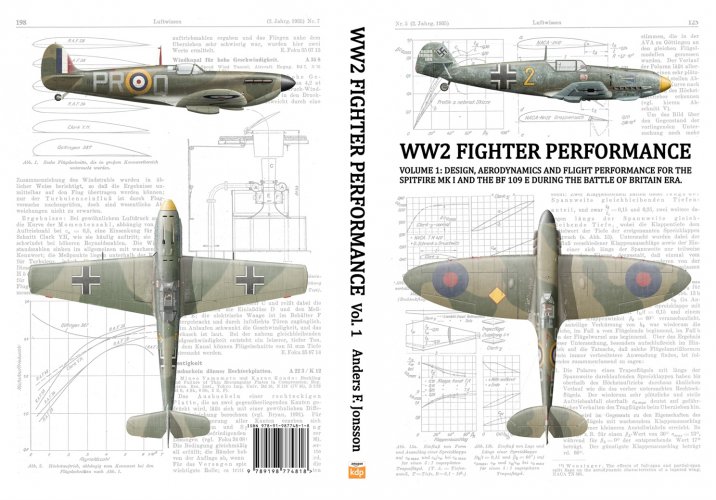
Book cover for Spitfire Mk I and Bf 109 E during BoB 440 page ver 12 flattened small.jpg


Without exaggeration, there are probably hundreds of books that already diligently detail the history of the Spitfire Mk I and the Bf 109 E during the Battle of Britain time period. So isn’t this just adding another one to the pile?

Well no, because this book is rather different: And while other books may faithfully cover the origins, the development, the different versions, the operational usage and the pilots who flew them, when it comes to these aircraft’s performance the results are usually rather meagre.

And detailed performance analysis is what’s new and what this book brings to the table: Because it’s the first to compare these two iconic fighter utilizing verified and validated computer simulations to gauge how they truly compared, and not just repeating the same old performance numbers that have already been quoted, copied and pasted in between so many other books.

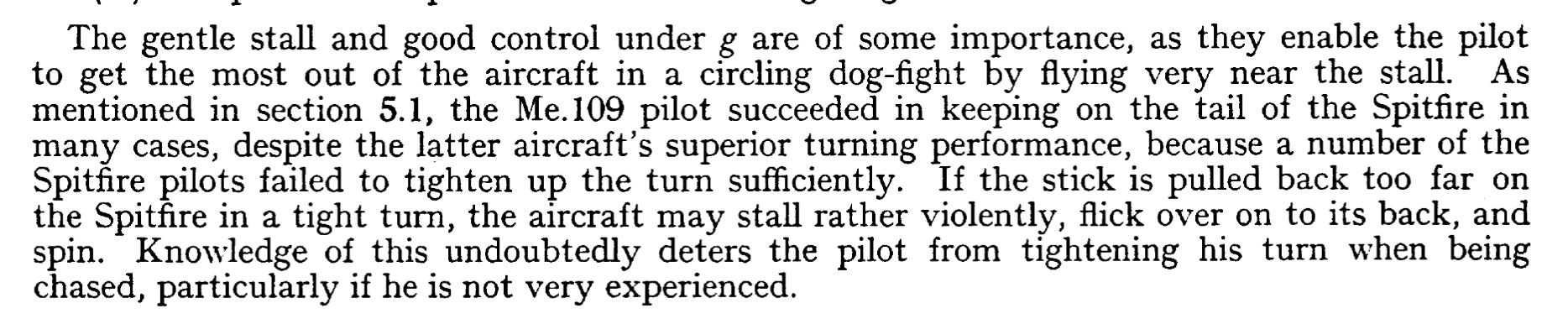
In addition, the entire performance envelope is investigated: So not just speed and climb, but also acceleration, sustained and instantaneous turn, dive, and dive and zoom performance. And this analysis has actually uncovered some previously hidden aspects of these aircraft: Not in the least concerning their turn performance, which is an area that has previously been considered to be a no contest win for the Spitfire. But as the simulations show, there are exceptions to this rule, especially if the Bf 109 drops some flap. And while the Spitfire certainly was the better turning aircraft overall, the difference was in some cases not as large as common knowledge would have us believe.

The book also covers some hypothetical scenarios: What would be the effect of reducing the Spitfire Mk I’s big wing to one that instead was about the same size as on the Bf 109? Would this have made the Spitfire better or worse? Then looking at the Bf 109 E: If it instead of its low pressure aluminium radiator is equipped with a high pressure radiator cooling system like the one on the Spitfire, how much better performance would that have given it?

In summary, this book digs deeper into these aircraft’s flight performance than any previous book has ever done, introducing for example acceleration, energy retention, sustained and instantaneous turn comparisons, dive, dive and zoom comparisons all in an attempt to determine just how close or far apart or close together they were regarding each particular performance aspect. In addition, the issue of the Bf 109 E’s range is also analysed in greater detail than is usual in many other books, revealing that it may not have been quite as limited as it’s often made out to be. And last, but not least, in the summary and conclusions, looks into if an overall winner can be crowned.

Added to this, the book also covers background information regarding the state-of-the-art at the time in aeronautics, aircraft procurement, specifications, aerodynamics, wing design, engine and propeller technology, radiator design, armament, production costs and more.

The book is 405 pages long, and contains circa 140 figures, chart and diagrams and about 100 pictures, and is available as a paperback on Amazon:

WW2 Fighter Performance volume 1: Design, Aerodynamics and Flight Performance for the Spitfire Mk I & Bf 109 E, Battle of Britain Era, by Anders F Jonsson, ISBN 978-91-987748-1-8.

Note that this link is to Amazon.com, but that the book is also available at (Amazon.co.uk, .de, .fr, .es, .it, .nl, .pl, .se, .be, .ie, .jp, .ca, .au)

More information about the book and a thumbnail collection of its complete contents can be found on author’s website here:

https://militaryaircraftperformance.com/ww2-aircraft/
 
Hi Anders,

View attachment 792411
And detailed performance analysis is what’s new and what this book brings to the table: Because it’s the first to compare these two iconic fighter utilizing verified and validated computer simulations to gauge how they truly compared, and not just repeating the same old performance numbers that have already been quoted, copied and pasted in between so many other books.

Just the book I have always wished for! :)

Is it the same style of printing as your WW1 book? Because I was genuinely impressed by the high quality of that one.

As your blurb mentions Leykauf: With regard to the Me 109's turning ability, the French test against the D.520 was interesting too ... the D.520 and the Emil basically matched each other in the test, at the chosen test altitude, but the Me 109 thanks to the slats and a clear indication of an impeding stall in the aileron forces could be condidently flown at the limit, while the D.520 flicked out of the turn in two of two mock fights. The French stressed that the D.520 was able to use that to win the fight in one case, since the Me 109 pilot was surprised by the flick and the D.520 pilot got behind him, but they were clearly rooting for the home team, if you ask me ;-)

Looking forward to reading your detailed analysis!

Regards,

Henning (HoHun)
 
Hi Anders,


Just the book I have always wished for! :)

Is it the same style of printing as your WW1 book? Because I was genuinely impressed by the high quality of that one.

As your blurb mentions Leykauf: With regard to the Me 109's turning ability, the French test against the D.520 was interesting too ... the D.520 and the Emil basically matched each other in the test, at the chosen test altitude, but the Me 109 thanks to the slats and a clear indication of an impeding stall in the aileron forces could be condidently flown at the limit, while the D.520 flicked out of the turn in two of two mock fights. The French stressed that the D.520 was able to use that to win the fight in one case, since the Me 109 pilot was surprised by the flick and the D.520 pilot got behind him, but they were clearly rooting for the home team, if you ask me ;-)

Looking forward to reading your detailed analysis!

Regards,

Henning (HoHun)

Thanks for the kind words Henning! This new book is very much in line with the one covering WW1 Aircraft Performance.

In fact I would say it covers more since there is much more data on the Spitfire Mk I and Bf 109 E to compare to. In addition, since these aircraft have a much broader performance range, the differences are more easy to see.

Interesting that you bring up turn performance Henning: During my research work at the RIT in Stockholm, I was lucky to uncover a microfilmed German wartime report (TB-Nr 18/40, Die Kurvenwendigkeit der Me-Typen III) done by Messerschmitt covering this subject on a wide range of aircraft, the Bf 109 E among them, and which I have used to validate my simulations when it comes to sustained turn performance.

For the instantaneous turn model validation however, I was unable to find any data for the Bf 109 E, so this was done comparing my own simulation model of the Bf 109 K4 with another Messerschmitt wartime calculation, and since I got a good correlation there, I think that validates the C++ model as such also for the Bf 109 E.

Regarding Leykauf, I actually quoted him (together with Pierre Clostermann) to highlight that it's always important to read anecdotal evidence in context: Because while Leykauf certainly may have out-turned Spitfires, this was more due to his skill as a pilot and his opponents lack thereof, rather than an indication of what the aircraft as such were capable of.

That being said, my simulations indicate that a Bf 109 E-4 that drops some flaps will be able to out-turn a Spitfire Mk I limited to +6.25 psi boost at lower altitudes, which I think may come as a surprise to some people. However, a +12 psi boosted Spitfire will hands down beat an E-4 with flaps dropped anyway, simply by being able to haul itself around by sheer force.

But as your Bf 109 and D.520 comparison highlights, the Bf 109 was by no means a slouch when it comes to turning, and Helmut Lipfert by his own account did not use it to BnZ like most German Bf 109 aces did, but instead regularly out-turned his opponents.
 
This looks very interesting. Does it look at 'perfect' aircraft, or ones with variable build quality, in-service modifications (like Vokes filters) and ones suffering from wear and tear etc. too?
 
This looks very interesting. Does it look at 'perfect' aircraft, or ones with variable build quality, in-service modifications (like Vokes filters) and ones suffering from wear and tear etc. too?

This is a good point since this affects the performance in a big way: Those of us who are old enough to remember cars from 1960's to 1980's remember driving behind cars who put out a lot of smoke, had poor compression on some cylinders etc. And for sure, some pilots would have been stuck with "lemons", but I've assumed factory fresh engines and airframes.

At least that is what I expect them to be since I've used trial data for both aircraft (the book details this) and those were of course done with good specimens since even if it was the Air Force testing them, the manufacturers would have made sure that they were in good conditions given they had a horse in the race so to speak.
 
This is a good point since this affects the performance in a big way: Those of us who are old enough to remember cars from 1960's to 1980's remember driving behind cars who put out a lot of smoke, had poor compression on some cylinders etc. And for sure, some pilots would have been stuck with "lemons", but I've assumed factory fresh engines and airframes.

At least that is what I expect them to be since I've used trial data for both aircraft (the book details this) and those were of course done with good specimens since even if it was the Air Force testing them, the manufacturers would have made sure that they were in good conditions given they had a horse in the race so to speak.
Thanks. If they are all to the same standard then 'lemons' can be adjusted for by applying factors I expect.

Is there a list of the aircraft explored (contents page or index) you can share?
 
Thanks. If they are all to the same standard then 'lemons' can be adjusted for by applying factors I expect.

Yes, I think it makes sense to model factory fresh since this then gives an indication of what the aircraft as such are capable of, and IMO is more fair than comparing outliers like you sometimes see done on the internet.

Is there a list of the aircraft explored (contents page or index) you can share?

This book only investigates the Spitfire Mk I with +6.25 and +12 psi boost, and the Bf 109 E-4 and E-7 with both DB 601 A and DB 601 N engines. In addition it looks into some theoretical examples such as a Spitfire Mk I with the wing size reduced to the same size as on the Bf 109, i.e. reduced from 242 to 176 sq ft, and a Bf 109 with a high pressure radiator system (i.e. smaller in size).

However there are some comparisons of dive and zoom performance with the Hawker Hurricane included as well, to show that this aircraft was not quite in the same class as the Spitfire and Bf 109 on this point.

Regarding a contents page, and also thumbnails of the book contents, I have those on my homepage here:

https://militaryaircraftperformance.com/ww2-aircraft/
 
Very interesting - Spitfire parametrics. Glad to hear the Hurricane is in it - always good to know the effect two airframes can have on the same engine.

I've also just seen your WW1 book on your website too. Triplanes = great stuff!
 
When I happen to come across this book on amazon about a week ago I immediately ordered it and posted it in another topic


not being aware that the author is a member of this forum.


It is impressive. Roughly 150,000 words I would guess.
Look forward to Volume 2 (and 3 and ....).
Although I have only a superficial interest in aviation before 1933 (Boeing 247) I may consider the WW1 book as well.
 
Very interesting - Spitfire parametrics. Glad to hear the Hurricane is in it - always good to know the effect two airframes can have on the same engine.

I've also just seen your WW1 book on your website too. Triplanes = great stuff!

Thanks! And yes, WW1 aircraft are actually more interesting than many give them credit for.

However, when I started to get a better understanding of how they truly performed, I was disappointed to learn how bad triplanes actually perform:

You would think they would be good turners given they had three wings, but as it turns out, the middle wing is more of a "fifth wheel" and actually does more harm than good.

In fact, it turns out that the Sopwith Camel was a better turner. I have done a paper on this which is available for free on my website here:

https://militaryaircraftperformance.com/documents-1/
 
When I happen to come across this book on amazon about a week ago I immediately ordered it and posted it in another topic


not being aware that the author is a member of this forum.


It is impressive. Roughly 150,000 words I would guess.
Look forward to Volume 2 (and 3 and ....).
Although I have only a superficial interest in aviation before 1933 (Boeing 247) I may consider the WW1 book as well.

Well thanks for that! The reason it was available before today (when I was ready to release it) is that in order to be able to get proof copies to tweak the final few things I wanted to do, I had to make it publicly available on Amazon.

And you are very close on word count: It's about 135000 words.
 
Last edited:
I remember a book author was trying to calculate P-40 performance using computers in the 1970's and it turned out to be kinda inaccurate.

Well if you have input on the P-40 that would be interesting. I have made a comparison of the P-40 and the A6M Zero in a pdf paper that is free to download and can be found here:

https://militaryaircraftperformance.com/documents-1/

And if you see anything that does not look right there then please let me know.

Then you should look at more early versions.

Bf 109G-6AS and Fw 190A-6 vs. P-51B, P-47B and P-38J
https://defense-and-freedom.blogspot.com/2019/01/military-aviation-history-final-air.html

Yes, those are all interesting aircraft and the only problem is to decide just which combinations to simulate and compare, because to do all together in one volume will make it a bit to large. At least if I were to compare them in a similar fashion as I did in Vol 1 for the Spitfire Mk I and Bf 109 E.
 
Thanks! And yes, WW1 aircraft are actually more interesting than many give them credit for.

However, when I started to get a better understanding of how they truly performed, I was disappointed to learn how bad triplanes actually perform:

You would think they would be good turners given they had three wings, but as it turns out, the middle wing is more of a "fifth wheel" and actually does more harm than good.

In fact, it turns out that the Sopwith Camel was a better turner. I have done a paper on this which is available for free on my website here:

https://militaryaircraftperformance.com/documents-1/
Their main benefit was supposed to be a better climb rate I think. Did your wider analysis find that was the case?
 
Their main benefit was supposed to be a better climb rate I think. Did your wider analysis find that was the case?

Well, the Fokker Dr.I does climb well, but this is more due to its power to weight ratio, and not so much connected to the wing configuration.

In fact, the Fokker Dr.I's wing configuration (the three stacked wings with short span) is not very efficient at all since it results in copious amounts of induced drag.

And while many would think that the Fokker's thick wing profile was the secret to its good climb performance, this is not so and in climb conditions the Sopwith Camel's RAF 15 is in fact just as good. However, the Fokker's thick wing profile does have a higher maximum lift coefficient (Clmax), but WW1 aircraft basically hit a brick wall when trying to do instantaneous turns:

They have far to high induced drag and low weight compared to WW2 aircraft, which results in a very fast reduction in speed when attempting to do tight turns.

You can read more about this in my book WW1 Aircraft Performance and in the pdf about the Fokker Dr.I and Sopwith Camel which can be found here:

https://militaryaircraftperformance.com/documents-1/

So the reason the era of triplanes was so short actually has a very good explanation rooted in physics: Three wings stacked on top of one another is simply a bad idea!
 
Well if you have input on the P-40 that would be interesting. I have made a comparison of the P-40 and the A6M Zero in a pdf paper that is free to download and can be found here:

https://militaryaircraftperformance.com/documents-1/

And if you see anything that does not look right there then please let me know.


Yes, those are all interesting aircraft and the only problem is to decide just which combinations to simulate and compare, because to do all together in one volume will make it a bit to large. At least if I were to compare them in a similar fashion as I did in Vol 1 for the Spitfire Mk I and Bf 109 E.
https://de.scribd.com/doc/117829198/Pilot-s-Manual-Curtiss-P-40-Warhawk-WW ?

Bf 109G-6 vs. P-51D would be an all-too usual thing, albeit it might also sell at usual levels.

Bf 109G-6AS (or Bf 109G-6 with GM-1) (not the Mk 108 version) vs. P-51B would be unique, inform readers about the AS engine version's consequences (it's not very well-known) and cover the peak altitude fighters of the first half of 1944 when the most decisive damage was done by 8th AF.
 
Well, the Fokker Dr.I does climb well, but this is more due to its power to weight ratio, and not so much connected to the wing configuration.

In fact, the Fokker Dr.I's wing configuration (the three stacked wings with short span) is not very efficient at all since it results in copious amounts of induced drag.

And while many would think that the Fokker's thick wing profile was the secret to its good climb performance, this is not so and in climb conditions the Sopwith Camel's RAF 15 is in fact just as good. However, the Fokker's thick wing profile does have a higher maximum lift coefficient (Clmax), but WW1 aircraft basically hit a brick wall when trying to do instantaneous turns:

They have far to high induced drag and low weight compared to WW2 aircraft, which results in a very fast reduction in speed when attempting to do tight turns.

You can read more about this in my book WW1 Aircraft Performance and in the pdf about the Fokker Dr.I and Sopwith Camel which can be found here:

https://militaryaircraftperformance.com/documents-1/

So the reason the era of triplanes was so short actually has a very good explanation rooted in physics: Three wings stacked on top of one another is simply a bad idea!

A rarely discussed quality is stability as a gun platform. Something like 80% of kills in propeller fighter action vs. propeller fighters were done from behind without the attacker being seen in time by the target. You needed to be faster (though target certainly not at nominal top speed), have a good gun platform (stability, which Camel and later I-16 lacked) and a decent armament (not too difficult in WWI, but became an issue around 1940 with self-sealing tanks and bulletproofed backrests).

Climb rate is likely underrated as well. It's a proxy indicator for ability to stay in an air battle by not losing too much (potential) energy. It was probably #1 technical spec indicating whether your side would become outnumbered in battle even if the battle started even.
 
https://de.scribd.com/doc/117829198/Pilot-s-Manual-Curtiss-P-40-Warhawk-WW ?

Bf 109G-6 vs. P-51D would be an all-too usual thing, albeit it might also sell at usual levels.

Bf 109G-6AS (or Bf 109G-6 with GM-1) (not the Mk 108 version) vs. P-51B would be unique, inform readers about the AS engine version's consequences (it's not very well-known) and cover the peak altitude fighters of the first half of 1944 when the most decisive damage was done by 8th AF.

Well, comparing more unusual variants is certainly possible and maybe this could be a good idea. However, how more common aircraft like the P-51D, Bf 109 K4, Fw 190 D9 etc. compare when it comes to details in sustained and instantaneous turn performance, dive, dive and zoom and energy retention are AFAIK so far only covered in anecdotal evidence and since these were the more prevalent aircraft, I would think this would be interesting to learn more about.

For example, the P-51D is actually not a bad turn fighter at all if you compare it fairly with the late Bf 109's, as in with a fuel status for similar endurance. However, in many cases people insist on doing comparisons at T/O weights with full internal fuel, thus unfairly penalizing the P-51 for its better endurance.

A rarely discussed quality is stability as a gun platform. Something like 80% of kills in propeller fighter action vs. propeller fighters were done from behind without the attacker being seen in time by the target. You needed to be faster (though target certainly not at nominal top speed), have a good gun platform (stability, which Camel and later I-16 lacked) and a decent armament (not too difficult in WWI, but became an issue around 1940 with self-sealing tanks and bulletproofed backrests).

Climb rate is likely underrated as well. It's a proxy indicator for ability to stay in an air battle by not losing too much (potential) energy. It was probably #1 technical spec indicating whether your side would become outnumbered in battle even if the battle started even.

In the book about the Spitfire Mk I and Bf 109 E I just released there is actually a rather a long chapter on armament, and paradoxically it looks to me like the British and Germans would have benefited by mirrored armament in the battle of Britain time period: The British by cannons to knock down bombers, and the Bf 109s by more MGs since fighters were only lightly armored at the time and MGs are more suited for fleeting deflection shots typical in dogfights.

Regarding the importance of climb performance, this was actually (as I write in my WW1 book) the Germans primary goal given they seem to have been more interested in dominating the air above their own lines, while the Entente seem to have placed a higher premium on speed. However, in the inter war years climb performance was at the top of the list on both sides of the channel, and this situation actually prevailed until quite late into the inter war years (you see it in the procurement specifications), which is also something I write about in the book and how this affected the gestation of both the Spitfire and Bf 109.
 
The German bombers were not well armoured. 7.7 mm AND heavy AAA fragmentation were very effective against them.

He 111 depended on not being seen and Ju 88 additionally had decent speed and agility (not enough against Spitfires, but enough to return from 1941 Murmansk mission without formation).

Also keep in mind machineguns had many cartridges, but jammed a lot because many shots => overheating.
Two .50cal were roughly equal in firepower to one 20 mm, but they were less reliable than almost any 20 mm (HS.404 was worse, esp. early on), so in practice 2x20 MG 151/20E (10% reduced RoF by electric synchonization) + 2 rather weak MG131 (all 4 close to centreline) of Fw190D-9 may have been close to the firepower of a P-47 for all purposes but strafing.

Admittedly, we don't have much info on the exact reliability of WW2 guns. Mk108, AN/M2 (with 300+ rpg), B-20, the P-39's 37 mm (forgot the designation) and HS.404 were the worst offenders according to what I've read.
 
Apart from the performance analysis which is the main focus of this book, I have included a translation of a five page German wartime report from October 1941 which was authored by the then head of the Messerschmitt Projektbüro, Voldemar Voigt, and which I believe I'm the first to include in a book.

The report is titled Why use high wing loading for fighter aircraft?, and seems to have been written in response to a question from the OKW (Oberkommando der Wehrmacht).

My own speculation is that this report, which while well argued and eloquently formulated, is still a bit defensive, and may well have been triggered by the Luftwaffe's failure to subjugate the RAF during the Battle of Britain, and the differences in wing loading being one of the key differences between English and German fighters at the time.

For obvious reasons I will not post it in its entirety here, but below is Voigt's own summary in the last paragraph of the report:

"To bring everything to a conclusion one can summarize the comparative chances of a success for fighters from the German and English school of thought in the following way: That is that superior performance enables the attack while maneuverability and turning performance serves a purpose to dodge and defend. However, a fight can never be won by defending but in general only won by attacking and bringing a foe to submission. That is more true for fighters than any other form of arms."

Personally, after reading Voigt's report, I am totally on board that fighter aircraft should have high wing loading, but alas I have been unable to find any response from the OKW and if they were convinced as well, or if the conclusion was that they wanted Messerschmitt to build Spitfires! ;)
 
The reason it was available before today (when I was ready to release it) is that in order to be able to get proof copies to tweak the final few things I wanted to do, I had to make it publicly available on Amazon.
Does this mean that changes or additions have been made to the manuscript since I ordered my copy on 13 Nov., which was delivered 15 Nov. ?

If so then I (and other early buyers) would like to hear what typos were corrected or what additions were made.

Probably best to post that on your website, like you made an "Addendum and erratum" on your WW1 aircraft webpage.
 
Does this mean that changes or additions have been made to the manuscript since I ordered my copy on 13 Nov., which was delivered 15 Nov. ?

If so then I (and other early buyers) would like to hear what typos were corrected or what additions were made.

Probably best to post that on your website, like you made an "Addendum and erratum" on your WW1 aircraft webpage.

Absolutely: I plan to add an "Addendum and erratum" to my homepage for this book just as for the WW1 Aircraft Performance book. However, on this book I have so far not made any changes other than corrected a few spelling errors, and just some cosmetic changes on the cover, so nothing yet on the level that is mentioned under "Addendum and erratum" for the WW1 book.
 
My copy arrived yesterday, only issues I have are the size and diagrams which are also quite small. Flicked through it thus far so more scrutiny required.

The paper quality is about on par but not up to Callums books and the like.
 
My copy arrived yesterday, only issues I have are the size and diagrams which are also quite small. Flicked through it thus far so more scrutiny required.

The paper quality is about on par but not up to Callums books and the like.

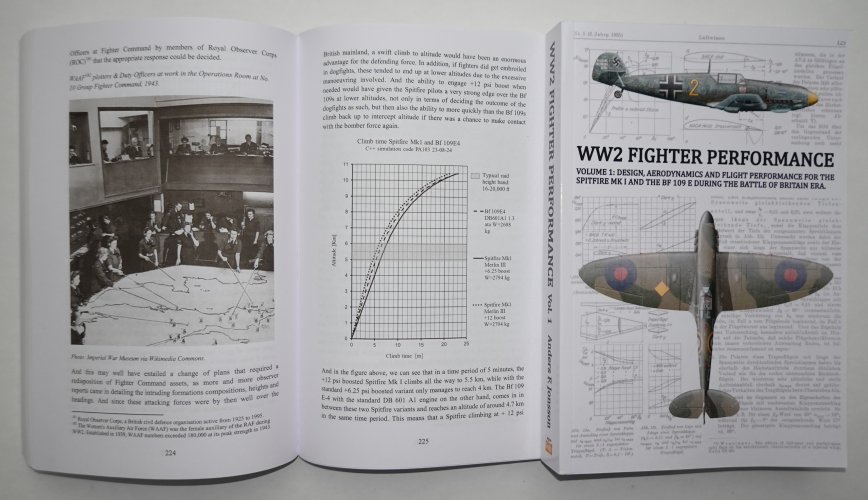
Well regarding paper quality it is a paperback, but the paper and print quality should be on par with the copy below which comes from Amazon.de.

Regarding the contents and what the book covers, I hope you will find it to your liking once you had a chance to take a closer look, and please don't hesitate to post questions either here or via the contact form I have on my homepage.

Best wishes

Anders

WW2 Fighter Aircraft Spitfire Mk I Bf 109 E example pages 2.jpg
 
Well regarding paper quality it is a paperback, but the paper and print quality should be on par with the copy below which comes from Amazon.de.

Regarding the contents and what the book covers, I hope you will find it to your liking once you had a chance to take a closer look, and please don't hesitate to post questions either here or via the contact form I have on my homepage.

Best wishes

Anders

View attachment 792999
Agreed on paper quality, a trend tbh.

As for the content, looking forwards to an in depth session or three. I basically grew up hearing the home side of this but an independent examination is probably long overdue.

Outside those in archives and hidden anyway.

As for diagrams, I am older now so find this sort of data difficult to 'see' properly in these book sizes. Sorry, had to edit out a Scummy and Mouldy line there. (X-Files).
 
As for the content, looking forwards to an in depth session or three. I basically grew up hearing the home side of this but an independent examination is probably long overdue.

Well I worked on this book for more than two years, and having to dig into the technical details on both designs, I was surprised by two things: First of all that a Bf 109 E could (by dropping some flap) actually out-turn a Spitfire (only the 87 octane variant mind you!), which I never thought possible, and secondly, that the Spitfire Mk I when they got the 100 octane fuel became so much better than the Bf 109 E. On the other hand, if you have two aircraft that both have around 1000 hp each, and you then suddenly give of them another 200 hp to play with, it's not surprising that it will rise head and shoulders above the other one.

And before doing the research work for the book, I kind of bought into the "facts" that while the Spitfire Mk I certainly turned better, that the Bf 109 E was even so a tad faster and climbed better. In addition, that it dived better which does not seem to be the case at all: Because the Spitfire looks to be just as good in the dive, and if both ease into the dive slowly, without the engine cutting on the Merlin, there is very little to choose between them.
 
Agreed and frankly it is nice to see someone really digging in to myth and hearsay to find the truth. Saves us no end of trying to get nowhere fast so, my hat is doffed Sir.

One of the folk my old dad knew ended up as a engine mech on Lancaster's, having been through the BoB as an engine mechanic on Hurricane and Spitfire.

He mentioned the same ol' that suggests matching the Messerschmitt in a dive required rolling inverted first to balance G force.

He also balanced the carbs on my old VW type 3 variant by ear using a piece of dowel and a rubber cup end. Spot on too.

Once Tilly Schillings orifice was installed that problem ceased/reduced.
 
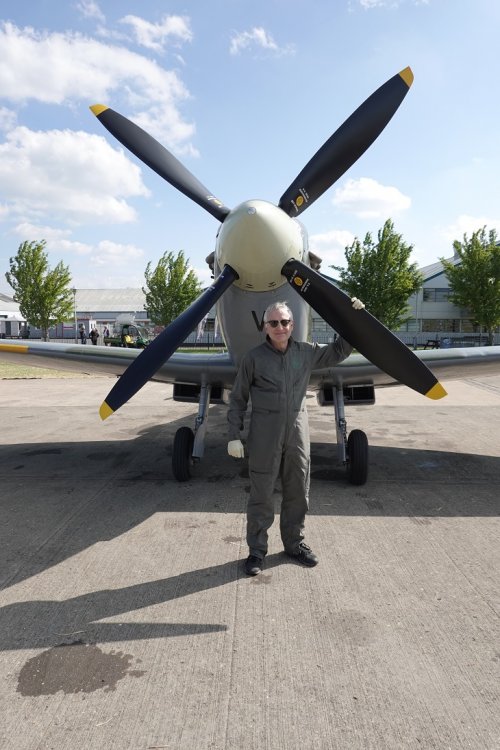
Well I was fortunate enough to fly the Grace Spitfire (ML 407) at Sywell in May this year, and I now totally understand why all those old Spitfire pilots are so nostalgic about it: It really does seem to read your mind and only requires the gentlest of nudges to go where you want it too go. Absolutely superb handling, and not twitchy at all as some would have it. So if you are not ham fisted with it, it's an absolutely lovely machine.

But to dive it, it was absolutely forbidden to push the stick: The procedure was to roll over on the side, let the nose drop to the desired dive angle and then roll out. They really wanted to avoid anything much under 1 g, let alone any negative g's, but that had to do with the lubrication, not the engine cutting out.

Unfortunately, the Bf 109 Buchon they have at Sywell is currently not operational, but it would be interesting to try that out as well. Quite an ugly beast really, but seeing everything else is the same I'm thinking it should handle (stick and elevator forces, slats etc.) like the Bf 109 E, so would be interesting to compare.

Spitfire in front of prop.jpg
 
Last edited:
Some more thoughts about how the Spitfire Mk I and Bf 109 E compare:

I realize that what I said above about the Spitfire Mk I being so much better than the Bf 109 E when it got the 100 octane and +12 psi boost maybe needs some tempering:

Because if we throw the Bf 109 E-4/N and E-7/N into the mix, then the picture is no longer so one-sided:

Granted, the Spitfire remains pretty much untouchable at lower altitudes, but if we look at the height band at which the fighting typically took place during the Battle of Britain, then with the DB 601 N engine, the Bf 109 E is actually the better performer:

Because since this is above the Merlin's full throttle height, the Spitfire can no longer enjoy the benefits of the 100 octane fuel, and given that the the DB 601 N puts out more power than the DB 601 A at these altitudes, the pendulum swings back in favour to the Bf 109 E again, and it is both faster and climbs better.

Granted, the DB 601 N engined Bf 109 E's were not present in great numbers, but they were there and the Luftwaffe pilots who were lucky enough to get their hands on one and avoided the temptation to be drawn down to lower altitudes, did have a pretty good ride.

And had they and the drop tank capable E-7/Ns been available in greater numbers, maybe it would not have changed the outcome, but it would for sure have make Fighter Command's job a lot tougher.
 
Last edited:
Hi Anders,

Regarding Leykauf, I actually quoted him (together with Pierre Clostermann) to highlight that it's always important to read anecdotal evidence in context: Because while Leykauf certainly may have out-turned Spitfires, this was more due to his skill as a pilot and his opponents lack thereof, rather than an indication of what the aircraft as such were capable of.

Here two interesting snippets on the Me 109E outturning RAF fighters, which seem in line with the French findings:

RM2361 Me 109E.png

RM2361 Me 109E 2.png

(I've also attached the full report for context.)

Regards,

Henning (HoHun)
 

Attachments

  • RM2361_me109_handling_test.pdf
    14.1 MB · Views: 18
Hi Mike,

This looks very interesting. Does it look at 'perfect' aircraft, or ones with variable build quality, in-service modifications (like Vokes filters) and ones suffering from wear and tear etc. too?

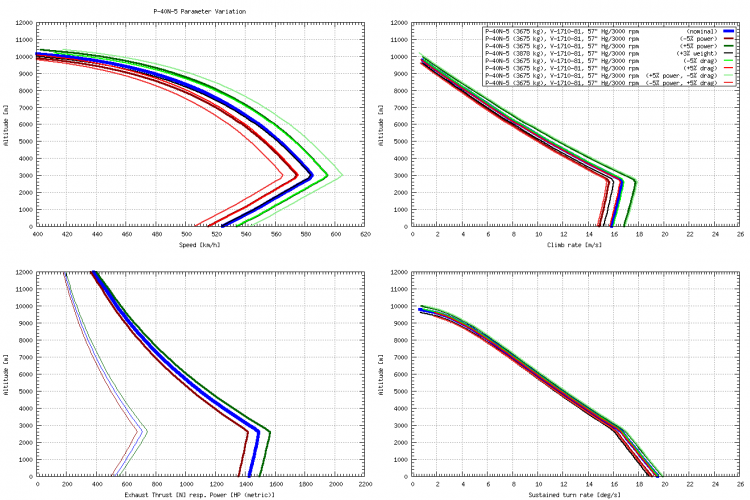
With regard to variability between individual aircraft, here's a comparison I calcluated a couple of years ago to illustrate the impact of "normal" variations, like drag status and individual engine power fluctations:

P-40_Take-Off_Weight.png

I've also included an aircraft with 3% extra weight.

Manufacturers' guarantees usually included a certain margin for aircraft to be considerd acceptable even if they didn't meet the agreed-on nominal performance values. My impression is that the values I picked are roughly in that order of magnitude, so they're probably more like the extreme values one might encounter (and maybe that's likely to be more on the poorer-performing end than on the better one).

I haven't considered some otherwise interesting effects, such as varying full-throttle heights, as this would have made the graph really hard to read :)

Still, the value of the nominal specifications is that you have a baseline aircraft for comparison purposes, and a reasonable expectation that it is close to the average aircraft.

Of course, a pilot flying a below-average aircraft and encountering an above-average enemy aircraft will not find much comfort in the comparison of the baseline aircraft! ;-)

Regards,

Henning (HoHun)
 
Of course, a pilot flying a below-average aircraft and encountering an above-average enemy aircraft will not find much comfort in the comparison of the baseline aircraft! ;-)
Thanks Henning.

Gives a good idea of the likely performance 'spread' caused by manufacturing and maintenance issues that may lead to that situation.
 
Here two interesting snippets on the Me 109E outturning RAF fighters, which seem in line with the French findings:

View attachment 793085

View attachment 793086
Added to the above, in my book I quote a Wing Commander Stainforth, who flew a captured Bf 109 in mock combat trials with Spitfires and Hurricanes.

And this is what he had to say about the Bf 109's turn performance:

“The maximum rate of turn was obtained with the slots just about opening, either both just closed or both just open, and at the maximum rate of turn the Hurricane remained close to my tail.”

So in these trials, it looks like Stainforth only flew the Bf 109 to about 75% of its capacity, given that the slats start to open at a Cl of about 0.8, and that the Cl needs to go all the way up to about 1.3 for them to deploy fully.

Also, in the same chapter of the book, I refer to the German ace Johannes Steinhoff who said that some German pilots he came across believed that they were doing really tight turns even though the slats had not even come out!

So here it's obvious that both German and British pilots did not understand that "real maneuvering" as Steinhoff calls it, only began AFTER the slats had popped out and that before then, you were only scratching the surface of what the Bf 109 could do.

More details on this covered on pages 250 to 252 in my book.

(I've also attached the full report for context.)

That is a good report Henning, and I refer to it in my book.

It has a lot of good information from the flight trials of the captured Bf 109 E, and it confirms its high Clmax at a tad over 1.4, just as the Germans themselves measured in the Chalais-Meudon wind tunnel.

However, when it came to the turn calculations they (the RAE) did on the Bf 109 E in that report, I've always wondered why they assumed all of 1200 hp in their calculations for the DB 601, since this is a bit on the optimistic side to put it mildly.
 
Last edited:
Because if we throw the Bf 109 E-4/N and E-7/N into the mix, then the picture is no longer so one-sided:

Granted, the Spitfire remains pretty much untouchable at lower altitudes, but if we look at the height band at which the fighting typically took place during the Battle of Britain, then with the DB 601 N engine, the Bf 109 E is actually the better performer:
Introduction of the DB 601N engine (a minority - by a large margin - in the BoB-era 109s) to the mix warrants the introduction of the Merlin XII for the Spitfire.
 
Introduction of the DB 601N engine (a minority - by a large margin - in the BoB-era 109s) to the mix warrants the introduction of the Merlin XII for the Spitfire.

Yes, but since I have performance charts for the Spitfire with a +12 psi boosted Merlin at 3000 rpm in my book, and that there were no supercharger changes as far as I can tell between the two, that should give us an idea about the Spitfire's performance as far as I can tell, even if the Merlin XII could run at +9 psi boost for extended periods of time which is of course an improvement over the Merlin III.
 
Yes, but since I have performance charts for the Spitfire with a +12 psi boosted Merlin at 3000 rpm in my book, and that there were no supercharger changes as far as I can tell between the two,
Supercharger was the same, but the impeller have had the higher drive ratio, so the engine power was somewhat better above 10000 ft; assumes both Mk. III and XII are using the 100 oct fuel.
(it was also fully rated for +12 psi boost, including the take-off regime)

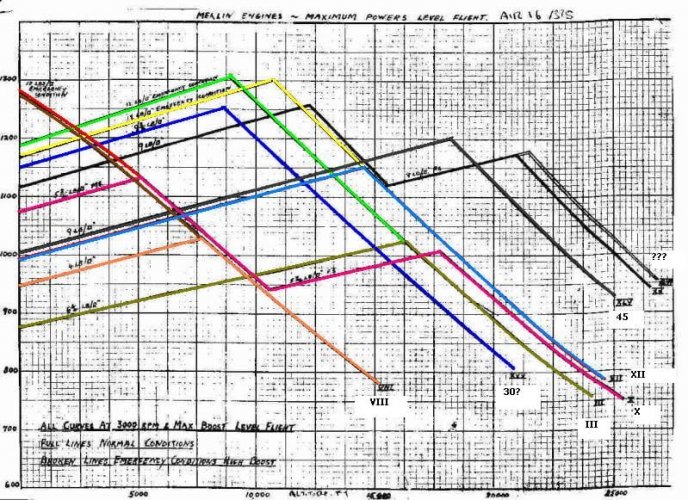
A power graph, originally from Kurfurst of the Bf 109 fame. It was with the inverted colors (like a negative), so I've reverted it to a 'positive', and added some coloring to the lines, as well as the captions. For the Mk.XII vs. the III, seesm like a ~10% advantage for the former above 11000 ft (question mark is probably for the Mk.XX with the S/C from the Mk.46/47 engines, while the XX values are for the preliminary values, that were a good deal optimistic; also note the lack of the - later - over-boost lines for the 45 and XX) :

Merlinpowercurves1.JPG
 
Last edited:
Supercharger was the same, but the impeller have had the higher drive ratio, so the engine power was somewhat better above 10000 ft; assumes both Mk. III and XII are using the 100 oct fuel.
(it was also fully rated for +12 psi boost, including the take-off regime)

A power graph, originally from Kurfurst of the Bf 109 fame. It was with the inverted colors (like a negative), so I've reverted it to a 'positive', and added some coloring to the lines, as well as the captions. For the Mk.XII vs. the III, seesm like a ~10% advantage for the former above 11000 ft (question mark is probably for the Mk.XX with the S/C from the Mk.46/47 engines, while the XX values are for the preliminary values, that were a good deal optimistic; also note the lack of the - later - over-boost lines for the 45 and XX) :

View attachment 793107

Great stuff tomo pauk! It looks like I may need to publish a Vol 2 then: Spitfire Mk I and Mk II versus Bf 109 E during BoB..... ;)

On a more serious note: When I get the time, I will then do a Spitfire Mk II simulation with the Merlin XII and see what kind of performance that yields, but just eyeballing that power chart looks like even the Bf 109 E's with the DB 601 N engines are in for a hard time.

Does anyone have the numbers for the Spitfire Mk II and Bf 109 E's with the DB 601 N engines during the BoB period? Would be nice to see the relative strength of these fighters month by month from the July to the end of October 1940 then.
 
Apart from the performance analysis which is the main focus of this book, I have included a translation of a five page German wartime report from October 1941 which was authored by the then head of the Messerschmitt Projektbüro, Voldemar Voigt, and which I believe I'm the first to include in a book.

The report is titled Why use high wing loading for fighter aircraft?, and seems to have been written in response to a question from the OKW (Oberkommando der Wehrmacht).

My own speculation is that this report, which while well argued and eloquently formulated, is still a bit defensive, and may well have been triggered by the Luftwaffe's failure to subjugate the RAF during the Battle of Britain, and the differences in wing loading being one of the key differences between English and German fighters at the time.

For obvious reasons I will not post it in its entirety here, but below is Voigt's own summary in the last paragraph of the report:

"To bring everything to a conclusion one can summarize the comparative chances of a success for fighters from the German and English school of thought in the following way: That is that superior performance enables the attack while maneuverability and turning performance serves a purpose to dodge and defend. However, a fight can never be won by defending but in general only won by attacking and bringing a foe to submission. That is more true for fighters than any other form of arms."

Personally, after reading Voigt's report, I am totally on board that fighter aircraft should have high wing loading, but alas I have been unable to find any response from the OKW and if they were convinced as well, or if the conclusion was that they wanted Messerschmitt to build Spitfires! ;)

High wing loading makes higher performance possible, but you need to moderate wing loading to
- shorten necessary runways / make necessary airfields smaller
- reduce landing speed to reduce accident rate especially with rookie pilots
- have reserves for growth and external stores
- have minimum agility for scissors defensive manoeuvre to be useful
- have minimum agility to move a bit around to lessen accuracy of incoming fire from 6 o'clock so wingman has some time to save you
- be able to drop bombs low and turn the dive into a climb for survival

Going all-in on performance leads to F-104-style straight flyers that can't do much more than barrel rolls for defensive manoeuvres.

Moreover, low wing loading helps with high altitude flying A LOT.

Finally, post-WW2 with wet wings (fuel stored directly in wings without fuel bags, pioneered with wet wings in Me 264 during WW2), lower wingload => more fuel => more range or more time on afterburner
 
Back
Top Bottom