dark sidius
ACCESS: Top Secret
- Joined
- 1 August 2008
- Messages
- 1,622
- Reaction score
- 1,718
I think more since years of rumors about something in the strike family.Don't forget that there's also the F-55 and F-22 Super.

I think more since years of rumors about something in the strike family.Don't forget that there's also the F-55 and F-22 Super.

I said this many pages ago. The Lockheed NGAD demonstrator is being rushed into limited service in an F-117 style program.
The tooling for high production rate often adds many years to the development. This production tooling is a massive investment but it is recovered quickly as it reduces the cost per aircraft. Prototypes and demonstrators can be developed quickly but the cost per aircraft is much higher. The reason I bring this up is because it explains why the USAF would purchase aircraft that are built like expensive prototypes. The USAF would only do this if there is an urgent need and they can't wait 5+ years for all that tooling to be developed.
If the need is urgent it makes perfect sense to then use the NGAD demonstrator and its engines. It could be an unmanned supersonic strike aircraft using the NGAD demonstrator airframe. So when I say the Lockheed NGAD is in low rate production it doesn't mean it is a manned air-to-air fighter.
The late night afterburning take offs out of palmdale are continuing. There are very strict noise rules at palmdale so these flights must be very important and secretive. If we go back 5 years we could have maybe 10 aircraft. 1 or 2 of these would have been the NGAD demonstrator.
The blended wing body designs would be quite wide. The Lockheed NGAD design was meant to be designed for the long range Pacific theatre. I highly doubt it could fit inside a C-5 galaxy and assembled somewhere else. I link each night time afterburner flight to a Lockheed delivery flight.


I said this many pages ago. The Lockheed NGAD demonstrator is being rushed into limited service in an F-117 style program.
The blended wing body designs would be quite wide. The Lockheed NGAD design was meant to be designed for the long range Pacific theatre. I highly doubt it could fit inside a C-5 galaxy and assembled somewhere else. I link each night time afterburner flight to a Lockheed delivery flight.
Lockheed and Boeing would have received money from the government to build the All-X demonstrators. I haven't seen anyone post a budget document showing payment to Boeing and Lockheed for the All-X demonstrators.
The Lockheed contract is since 2018, so what it is ? , it seem to be a very advanced platform, I bet the strike mission over the Pacific, what is here ? B-21 subsonic bomber, F-47 supersonic fighter , F-35 Fighter Bomber, the lack is in ISR and rapid strike. It is surely not a advanced troop transporter. Ithink we must think about the mission.There is (still) no evidence to substantiate this hypothesis, and there is a large amount of evidence that refutes it.
Neither of the demonstrator aircraft were blended wing body configurations.
If you believe in the large "RQ-180", that is a blended wing body that was transported to Groom Lake. There are many ways to get things to that location that are not a C-5.
The AII-X contracts were awarded in 2016. This is well documented in public records, many of which have been posted on this forum.
The Lockheed contract is since 2018, so what it is ?

And the battleships.Don't forget that there's also the F-55 and F-22 Super.

If it is indeed something that failed due to heat tolerance, then it might be something hypersonic or space related. I don't imagine LM to have trouble with anything that flies up to mach 5 unless they were going for something extremely cheap as well.I think I'm more interested in the "observed performance degradation" than the "discrete event", as "performance degradation" is unlikely to apply to an entire airframe. I'd suspect that implicates either an engine, a sensor, or a material. A "discrete event" does imply something got seriously damaged, but it doesn't have to be a crash, could be a fire, could be something melted, something got hot enough or stressed enough to fail testing or not be reusable, or whatever. Failing a wing loading test would be a "discrete event", so would a blade off in an engine test, there's no need to invoke something cataclysmic.

Boeing had a 777X fuselage fail static testing, Airbus had an A380 wing fail static testing, we don't have to get esoteric to have test failures.I don't imagine LM to have trouble with anything that flies up to mach 5 unless they were going for something extremely cheap as well.
Just a nit, but he actually referred to “fixed-price incentive fee” contract which is not a firm fixed price contract. Fixed price incentive fee is typically formulated as a price target with a share line on both overrun and under run, with a maximum cost cap for the Gov’t. Any under run is shared with the Gov’t at a predetermined percentage. Firm fixed price is typically a commercial style arrangement where scope and deliverables are defined for a specific price. Any remaining dollars after delivery become profit with any losses born by the contracting company.LM's description / disclosures so far (non-exhaustive):
- "Game changing capability"
- Joint US and international customers (potential)
- Can't talk about what it is for..'many years to come'
- Firm-Fixed Price contract from 2018 ('several fixed price performance years ahead for the program')
- Learnings in recent software & build experience on another program specifically relevant to the program (and cause of delays / charges)
- 'Observed performance degradation and a 'discrete event' partly led to charge recognition
Given Lockheed's performance on F-35, I'm leaning towards "exceeded overrun cost cap"The implication in this case is that LM overran the FPIF contract (and likely option phases) and is either into the share line on the overrun, or has exceeded the overrun cost cap.
This is exactly the speed, range and payload that members were expecting the NGAD platform to have. Supercruising approximately halves the range relative to a subsonic cruise. A full afterburner sprint will reduce the range to roughly a quarter of the subsonic only range. The 1,000+nm combat radius of the NGAD could be much shorter depending on how fast the mission profile is.Note that I am not exactly thinking "Son of Blackbird" high-supersonic or hypersonic here. Mach 3 gets too hot. I was thinking about something that cruised at around Mach 2.2 (with pretty significant error bars on that, I'm talking M1.8-2.7 for the range), and which might carry a couple of bombs (or missiles).
There is (still) no evidence to substantiate this hypothesis, and there is a large amount of evidence that refutes it.
True, for the F-22 and F-35.This is exactly the speed, range and payload that members were expecting the NGAD platform to have. Supercruising approximately halves the range relative to a subsonic cruise. A full afterburner sprint will reduce the range to roughly a quarter of the subsonic only range. The 1,000+nm combat radius of the NGAD could be much shorter depending on how fast the mission profile is.
My mission profile is sustained Mach 2.2ish with occasionally slowing down to M0.8 to meet up with a tanker.I would assume the ideal high speed strike profile would be to leave the tanker and then do a 200nm subsonic, 200nm supercruise and 200nm afterburner dash for a 600nm combat radius. This would require an NGAD sized 100,000lb MTOW aircraft due to the high fuel consumption.
We then get the noisy afterburner delivery flight.
You have to stretch pretty far to justify that hush house.
There are times where I wonder if some assets are in plain sight. Put a nice drone or something in a tent on Area 51 and everyone knows all about it.
Afterburners in an urban area do lend themselves to secrecy.
.
Ok so what are you trying to debunk ? Lockheed have something classified in the work since 2018 ( I find it in a Lockheed report ) they lose near to 2 billions dollars about it, despite the lost, the program is still alive , It is named by Lockheed a game changer. It is not the Lockheed CCA counterpart because they show us the Vectis, this is not NGAD , this is not the LRSB , this is not a transport so what else ?These “noisy afterburner takeoffs” are what your hypothesis seems to hinge on - and they do not exist. There are no late night afterburner takeoffs happening at Palmdale. And if there were it wouldn’t be a SECRET aircraft. Afterburners in an urban area do lend themselves to secrecy. Palmdale is not remote anymore. Plant 42 is surrounded by urban sprawl and homeowners who complain about noise.
Did you request police reports about loud late night flights out of Palmdale? FAA records? Those records might help substantiate your claims - but they do not exist.
No, you don’t. All of the other Palmdale tenants have done the same or plan to - to comply with the law. The Lockheed hush house isn’t anything special. In 2013 someone tried to make a similar argument for the Northrop engine testing areas - they must be for a new secret aircraft! Nope, just GlobalHawks and B-2s.
On any day you can park within 200 yards of any part of Plant 42 and see for yourself. I have. Even better is the scenic overlook a few miles away that looks directly at it and a few quarters gets you your own telescope.
Ok so what are you trying to debunk ? Lockheed have something classified in the work since 2018
Yes Lockheed Martin.Lockheed-Martin NOT Lockheed!
It is not the Aurora spy plane TMA1. I am more or less thinking on the same lines as dark sidius that it could well be an advanced strike platform.
That's been debunked a long time ago.And not like the 1994 crash at Boscome Down that we all know about.
All aircraft fly further subsonic compared to supersonic including the XB-70. People mistake the XB70 range figure for being it's combat radius because it has relatively short range due to the high speed profile. Similar fuel capacity to the B-52 but less than half the range.True, for the F-22 and F-35.
Not true for Blackbird or XB-70. Or the 2707. (Not sure about Concorde)
Again that sounds exactly like NGAD. Designed to fly supersonic for most of the mission profile. NGAD would be optimised for high supercruise speeds. But not built for sustained Mach 3 speeds like the Blackbird.I'm talking about an airframe built for sustained supersonic flight like the Blackbird, just not quite as fast.
My mission profile is sustained Mach 2.2ish with occasionally slowing down to M0.8 to meet up with a tanker.
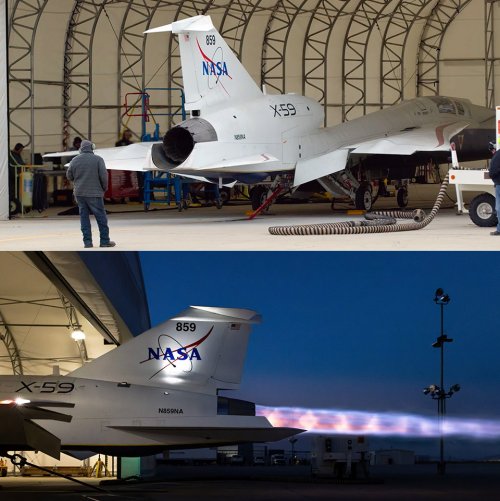
You dont know what you are talking about. I have attached a photo of the NASA X-59 at Palmdale going full afterburner at night in an open hanger. This photo was taken in February and disproves every point you make regarding noise at Palmdale.These “noisy afterburner takeoffs” are what your hypothesis seems to hinge on - and they do not exist. There are no late night afterburner takeoffs happening at Palmdale. And if there were it wouldn’t be a SECRET aircraft. Afterburners in an urban area do lend themselves to secrecy. Palmdale is not remote anymore. Plant 42 is surrounded by urban sprawl and homeowners who complain about noise.
Did you request police reports about loud late night flights out of Palmdale? FAA records? Those records might help substantiate your claims - but they do not exist.
I think he's saying that everybody would find out about the Air Force moving a drone into a tent at Area 51 because people keep track from the overlooks.I would suggest not making statements that might entice someone to break the law or - make certain agencies or components “believe” you are doing so. One of the last times there was a (fraudulent) suggestion that some may do what you describe a DoD “field operating agency” conducted a “non consensual physical search” of a US citizen with no military affiliation in a very direct violation of a number of statues including posse comitatus and related statutes. The persons involved in that search could be under investigation and be responsible for civil and criminal penalties. That whole “detachment” and its parent organization may even be under intense scrutiny by the legislature!
Just suggesting that someone may or should do this may subject you to penalties you cannot understand.
The close viewpoints were seized but there are still places such as Tikaboo Peak. Sure, it's 26 miles from the base but some of the recent telephoto images have been startlingly clear and detailed.What overlooks remain open to public access around Groom Lake? I thought all those were absorbed by the base?
Blackbird travels farther supersonic than it does subsonic.All aircraft fly further subsonic compared to supersonic including the XB-70. People mistake the XB70 range figure for being it's combat radius because it has relatively short range due to the high speed profile. Similar fuel capacity to the B-52 but less than half the range.
That was a proposed early mission profile for NGAD, yes. Problem is, you can't really interact with planes flying subsonic while you are flying supersonic.Again that sounds exactly like NGAD. Designed to fly supersonic for most of the mission profile. NGAD would be optimised for high supercruise speeds. But not built for sustained Mach 3 speeds like the Blackbird.
All aircraft fly further subsonic compared to supersonic including the XB-70. People mistake the XB70 range figure for being it's combat radius because it has relatively short range due to the high speed profile. Similar fuel capacity to the B-52 but less than half the range.
You dont know what you are talking about. I have attached a photo of the NASA X-59 at Palmdale going full afterburner at night in an open hanger. This photo was taken in February and disproves every point you make regarding noise at Palmdale.
These secret aircraft are leaving under their own power at night using afterburner. The local residents aren't calling the police. We are talking a handful of aircraft with a delivery flight every few months. If deliveries become more frequent it is only a matter of time until a plane spotter will witness a takeoff like in 2017.
The Blackbird is irrelevant to the discussion even if this was true. It wouldn't apply to a modern design. The only way the Blackbird could have less range while flying subsonic would be if there was a massive design inefficiency such as the engines or wing stalling at Mach 0.8 cruise condition.Blackbird travels farther supersonic than it does subsonic.
If I was the manned platform being supported by a dozen subsonic CCAs I would prefer to move around quickly. For instance if threatened the manned platform can retreat quickly behind a wall of CCAs. The F-22 supercruise and maximum speeds are sufficient the design just needs more fuel and to be able to handle the heat from these speeds for longer duration.That was a proposed early mission profile for NGAD, yes. Problem is, you can't really interact with planes flying subsonic while you are flying supersonic.
But it works for a recon bird or a bomber. Mach 2ish at 60,000ft doesn't add a whole lot to SRAM ranges, only ~doubles them.

The exact date is irrelevant. You are now trying to lower my credibility for getting a minor date wrong.It wasn't done in February though. The article you point to was published in February, the article itself states the test was done in January. It helps to read your sources and understand them.
Ok so what are you trying to debunk ? Lockheed have something classified in the work since 2018 ( I find it in a Lockheed report ) they lose near to 2 billions dollars about it, despite the lost, the program is still alive , It is named by Lockheed a game changer. It is not the Lockheed CCA counterpart because they show us the Vectis, this is not NGAD , this is not the LRSB , this is not a transport so what else ?
No private spy drone advocate me. I don't know how to do the Naruto/WEAPONS/anime kind of running without falling face first.I would suggest not making statements that might entice someone to break the law or - make certain agencies or components “believe” you are doing so.


The exact date is irrelevant. You are now trying to lower my credibility for getting a minor date wrong.
You said there can't be afterburner tests outdoors. I provide proof that there was afterburner tests outdoors. You then shift the goal posts and say that it was a legal test. I never mentioned legal or illegal.
Quellish has been asked this many times now. It is better for him to say nothing than to take a guess and be proven wrong.
It is my understanding that the XB-70 was also designed around most efficient cruise at supersonic speeds, just like the Blackbirds.The Blackbird is irrelevant to the discussion even if this was true. It wouldn't apply to a modern design. The only way the Blackbird could have less range while flying subsonic would be if there was a massive design inefficiency such as the engines or wing stalling at Mach 0.8 cruise condition.
A modern design with a three stream engine would have the engines right at peak efficiency at Mach 0.8 cruise. Even with flawless supersonic aerodynamics this means NGAD and any modern high speed design will fly much further subsonic.
The XB-70 and F-22 are probably the best examples to use.
As I understand things, that really just doesn't work. You cannot really interact with anything that isn't moving at your speed.If I was the manned platform being supported by a dozen subsonic CCAs I would prefer to move around quickly. For instance if threatened the manned platform can retreat quickly behind a wall of CCAs. The F-22 supercruise and maximum speeds are sufficient the design just needs more fuel and to be able to handle the heat from these speeds for longer duration.
This is physically impossible.It is my understanding that the XB-70 was also designed around most efficient cruise at supersonic speeds, just like the Blackbirds.
The speed of the person controlling the drone is irrelevant. You could interact with a drone while sitting at a computer on the other side of the planet. You could interact with a drone while flying at 28,000km/h while sitting on the international space station. A drone controller could be cruising at 30 knots sitting on an aircraft carrier.As I understand things, that really just doesn't work. You cannot really interact with anything that isn't moving at your speed.

You do literally realise Cd is not a constant right? While also engines are only optimised for a certain range of speeds.This is physically impossible.
I think you are misunderstanding the drag coefficient charts. You still need to square the velocity in the drag equation. Double the velocity is then four times the drag while using the same drag coefficient.
D = Cd * A * .5 * r * V^2
https://www.grc.nasa.gov/www/k-12/VirtualAero/BottleRocket/airplane/drageq.html