Claude Grahame-White's Aircraft and Projects

I suggest that;


4- GWE.5 fast mail-carrier aircraft.
9- GWE.10 five-seat touring biplane.
10- GWE.11 four-seat touring biplane with different main landing gear.


That's only my opinion.
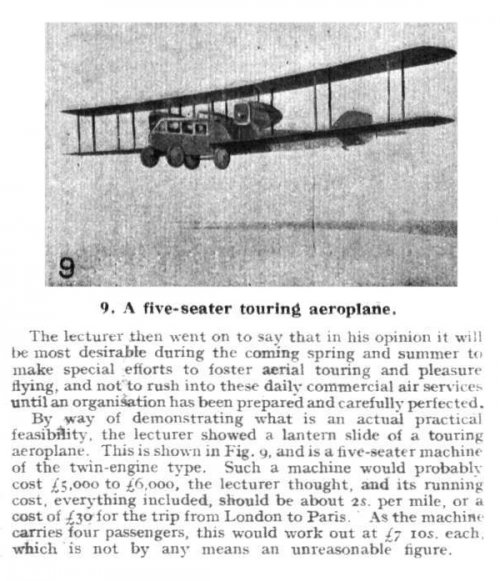
In my opinion, image number 9 is probably the Grahame-White G.W.E.7
 
E.4 Ganymede

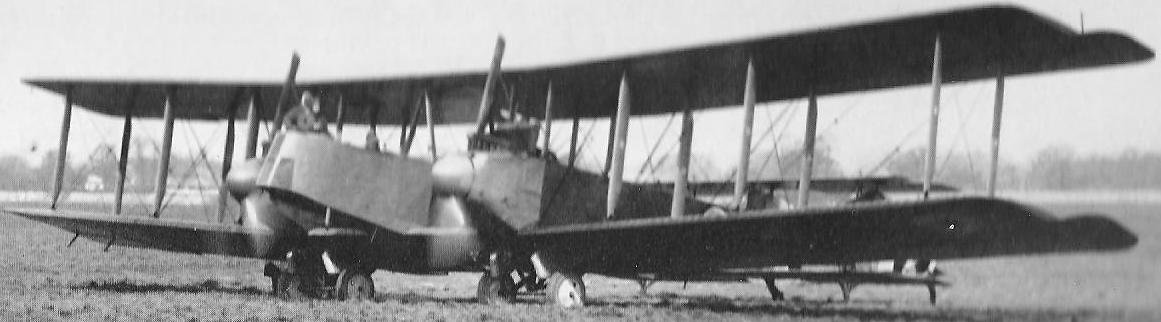
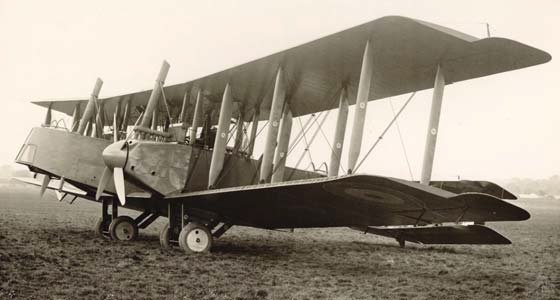
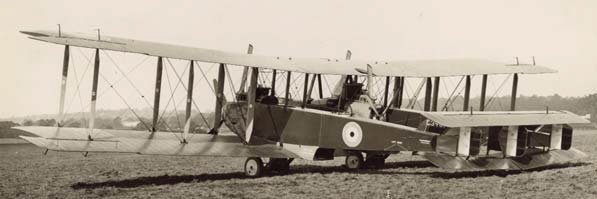
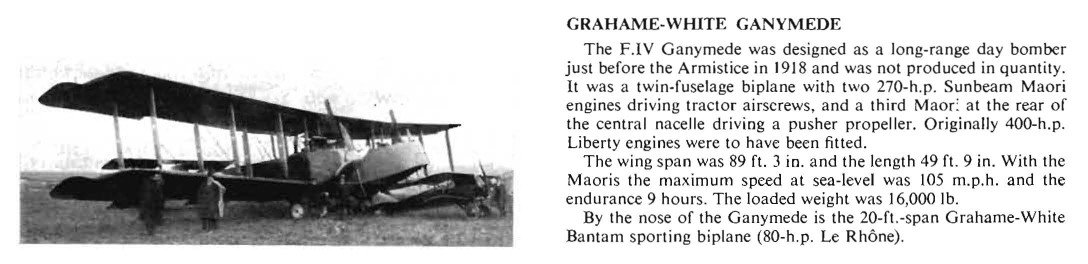
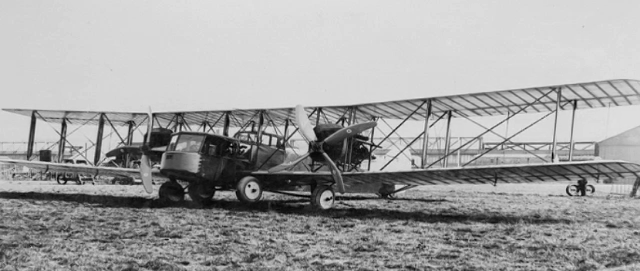
GRAHAME-WHlTE GANYMEDE. The F.IV Ganymede was designed as a long-range day bomber just before the Armistice in 1918 and was not produced in quantity. It was a twin-fuselage biplane with two 270-h.p. Sunbeam Maori engines driving tractor airscrews, and a third Maori at the rear of the central nacelle driving a pusher propeller. Originally 400-h.p. Liberty engines were to have been fitted.
The wing span was 89 ft. 3 in. and the length 49 ft. 9 in. With the Maoris the maximum speed at sea-level was 105 m.p.h. and the endurance 9 hours. The loaded weight was 16,000 lb.
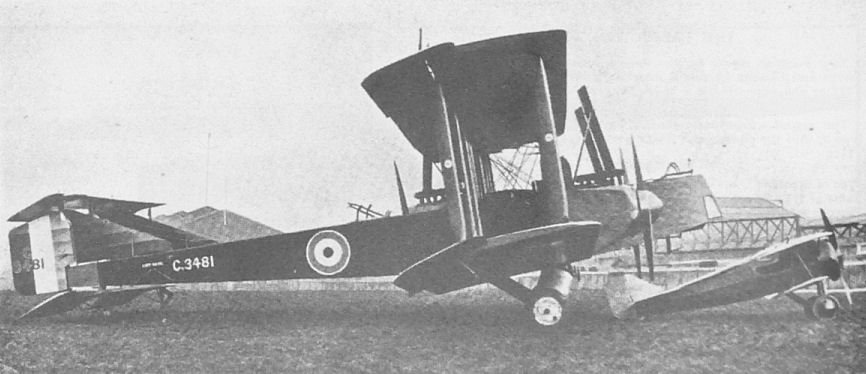
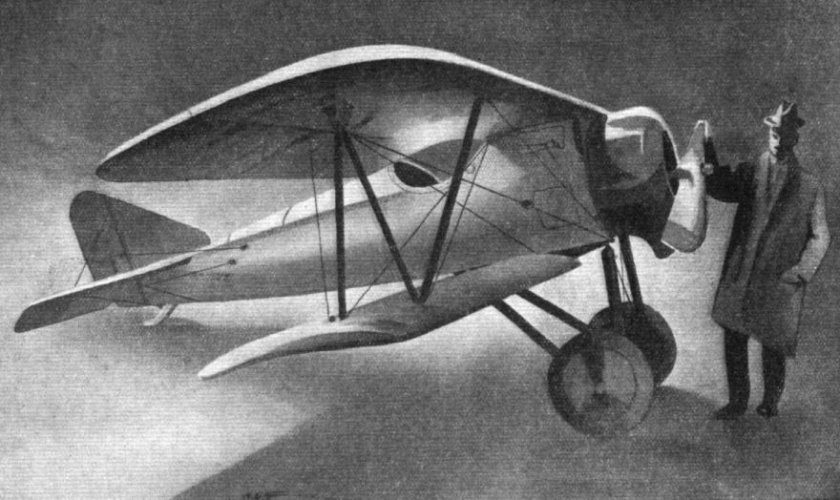
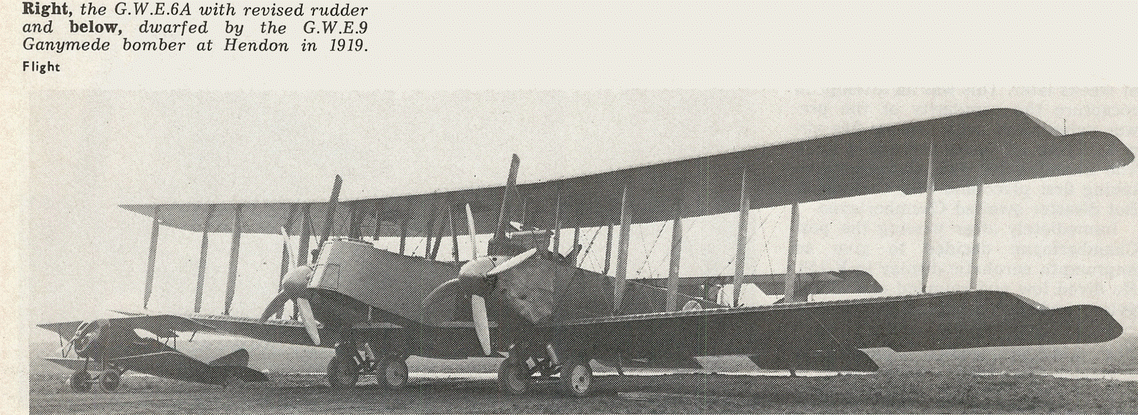
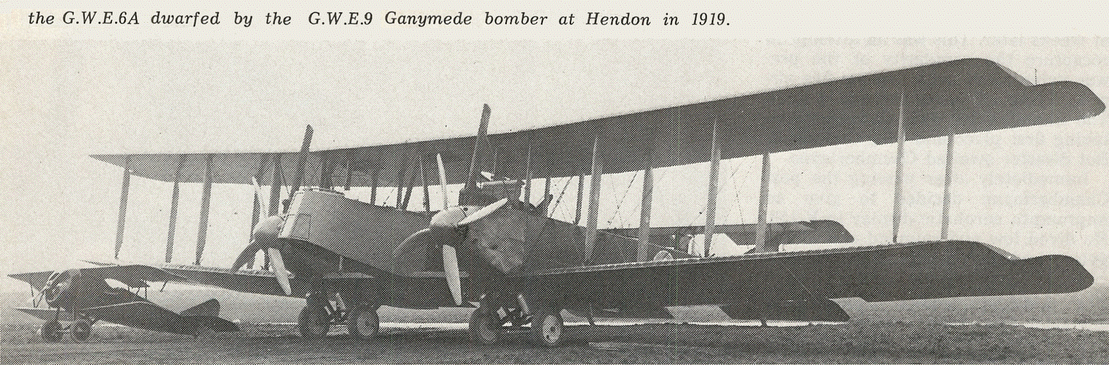
By the nose of the Ganymede is the 20-ft.-span Grahame-White Bantam sporting biplane (80-h.p. Le Rhone).
From Air Pictorial, January 1956

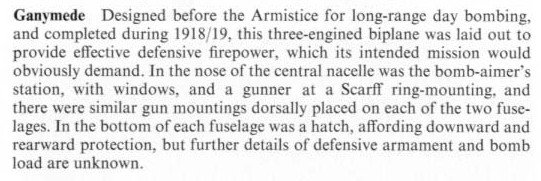
Ganymede. Designed before the Armistice for long-range day bombing, and completed during 1918/19, this three-engined biplane was laid out to provide effective defensive firepower, which its intended mission would obviously demand. In the nose of the central nacelle was the bomb-aimer's station, with windows, and a gunner at a Scarff ring-mounting, and there were similar gun mountings dorsally placed on each of the two fuselages. In the bottom of each fuselage was a hatch, affording downward and rearward protection, but further details of defensive armament and bomb load are unknown.
From Armament of British Aircraft (Putnam)

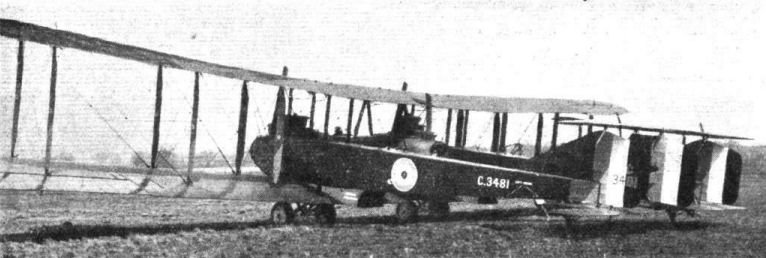
THE GRAHAME-WHITE DAY BOMBER "GANYMEDE." - This machine is fitted with three Sunbeam "Maori" engines of 270 h.p. each. Near the ground the speed is 105 m.p.h., and at 10,000 ft. 93 m.p.h. The landing speed is about 52 m .p.h. The total weight of the machine loaded is 16,000 lbs., and she has an endurance of nine hours at 10,000 ft. The photograph shows the machine being wheeled out in readiness for a flight.
From Flight, April 10, 1919

Grahame-White E.IV Ganymede
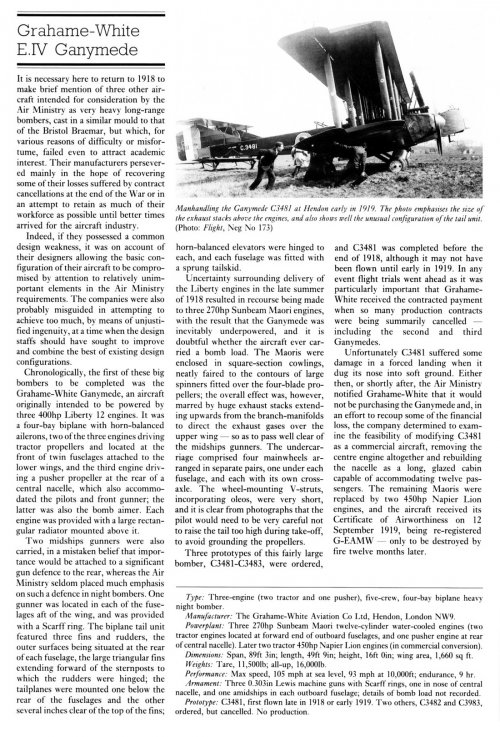
It is necessary here to return to 1918 to make brief mention of three other aircraft intended for consideration by the Air Ministry as very heavy long-range bombers, cast in a similar mould to that of the Bristol Braemar, but which, for various reasons of difficulty or misfortune, failed even to attract academic interest. Their manufacturers persevered mainly in the hope of recovering some of their losses suffered by contract cancellations at the end of the War or in an attempt to retain as much of their workforce as possible until better times arrived for the aircraft industry.
Indeed, if they possessed a common design weakness, it was on account of their designers allowing the basic configuration of their aircraft to be compromised by attention to relatively unimportant elements in the Air Ministry requirements. The companies were also probably misguided in attempting to achieve too much, by means of unjustified ingenuity, at a time when the design staffs should have sought to improve and combine the best of existing design configurations.
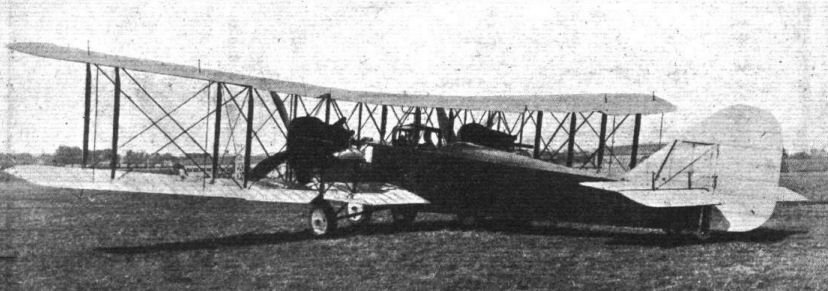
Chronologically, the first of these big bombers to be completed was the Grahame-White Ganymede, an aircraft originally intended to be powered by three 400hp Liberty 12 engines. It was a four-bay biplane with horn-balanced ailerons, two o f the three engines driving tractor propellers and located at the front of twin fuselages attached to the lower wings, and the third engine driving a pusher propeller at the rear of a central nacelle, which also accommodated the pilots and front gunner; the latter was also the bomb aimer. Each engine was provided with a large rectangular radiator mounted above it.
Two midships gunners were also carried, in a mistaken belief that importance would be attached to a significant gun defence to the rear, whereas the Air Ministry seldom placed much emphasis on such a defence in night bombers. One gunner was located in each of the fuselages aft of the wing, and was provided with a Scarff ring. The biplane tail unit featured three fins and rudders, the outer surfaces being situated at the rear of each fuselage, the large triangular fins extending forward of the sternposts to which the rudders were hinged; the tailplanes were mounted one below the rear of the fuselages and the other several inches clear of the top of the fins; horn-balanced elevators were hinged to each, and each fuselage was fitted with a sprung tailskid.
Uncertainty surrounding delivery of the Liberty engines in the late summer of 1918 resulted in recourse being made to three 270hp Sunbeam Maori engines, with the result that the Ganymede was inevitably underpowered, and it is doubtful whether the aircraft ever carried a bomb load. The Maoris were enclosed in square-section cowlings, neatly faired to the contours of large spinners fitted over the four-blade propellers; the overall effect was, however, marred by huge exhaust stacks extending upwards from the branch-manifolds to direct the exhaust gases over the upper wing - so as to pass well clear of the midships gunners. The undercarriage comprised four mainwheels arranged in separate pairs, one under each fuselage, and each with its own crossaxle. The wheel-mounting V-struts, incorporating oleos, were very short, and it is clear from photographs that the pilot would need to be very careful not to raise the tail too high during take-off, to avoid grounding the propellers.
Three prototypes of this fairly large bomber, C3481-C3483, were ordered, and C3481 was completed before the end of 1918, although it may not have been flown until early in 1919. In any event flight trials went ahead as it was particularly important that Grahame-White received the contracted payment when so many production contracts were being summarily cancelled - including the second and third Ganymedes.
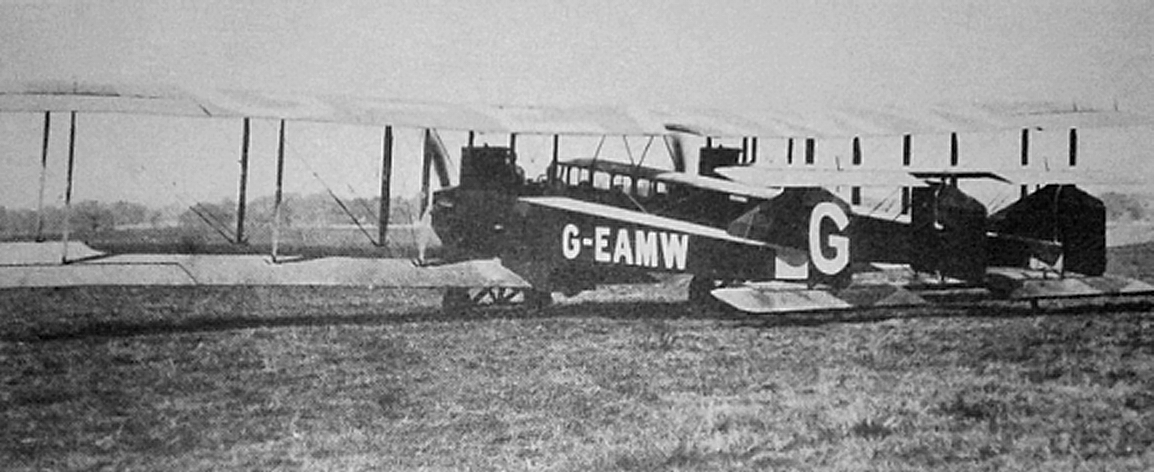
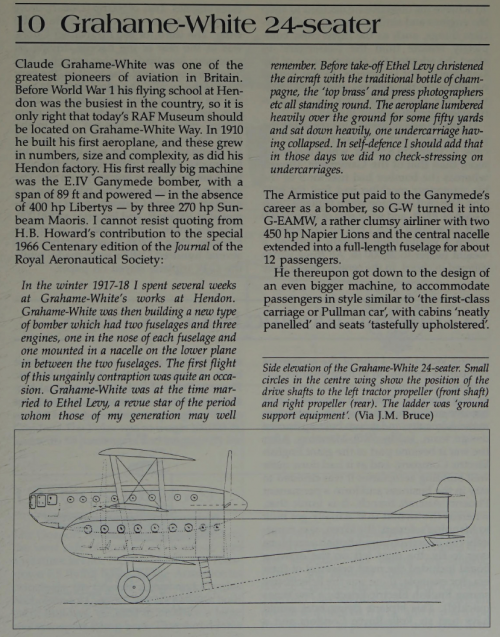
Unfortunately C3481 suffered some damage in a forced landing when it dug its nose into soft ground. Either then, or shortly after, the Air Ministry notified Grahame-White that it would not be purchasing the Ganymede and, in an effort to recoup some of the financial loss, the company determined to examine the feasibility of modifying C3481 as a commercial aircraft, removing the centre engine altogether and rebuilding the nacelle as a long, glazed cabin capable of accommodating twelve passengers. The remaining Maoris were replaced by two 450hp Napier Lion engines, and the aircraft received its Certificate of Airworthiness on 12 September 1919, being re-registered G-EAMW - only to be destroyed by fire twelve months later.

Type: Three-engine (two tractor and one pusher), five-crew, four-bay biplane heavy night bomber.
Manufacturer: The Grahame-White Aviation Co Ltd, Hendon, London NW9.
Powerplant: Three 270hp Sunbeam Maori twelve-cylinder water-cooled engines (two tractor engines located at forward end of outboard fuselages, and one pusher engine at rear of central nacelle). Later two tractor 450hp Napier Lion engines (in commercial conversion).
Dimensions: Span, 89ft 3in; length, 49ft 9in; height, 16ft 0in; wing area, 1,660 sq ft.
Weights: Tare, 11,500 lb; all-up, 16,000 lb.
Performance: Max speed, 105 mph at sea level, 93 mph at 10,000ft; endurance, 9 hr.
Armament: Three 0.303in Lewis machine guns with Scarff rings, one in nose of central nacelle, and one amidships in each outboard fuselage; details of bomb load not recorded.
Prototype: C3481, first flown late in 1918 or early 1919. Two others, C3482 and C3983, ordered, but cancelled. No production.

From The British Bomber since 1914 (Putnam)

472-3.jpg
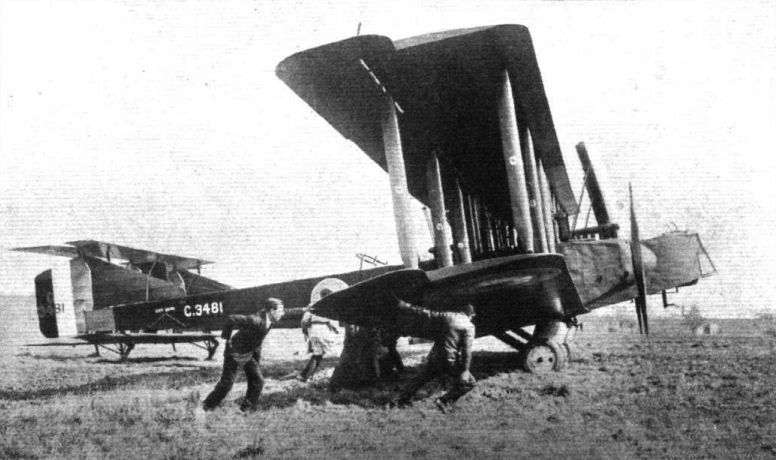
Manhandling the Ganymede C3481 at Hendon early in 1919. The photo emphasises the size of the exhaust
stacks above the engines, and also shows well the unusual configuration of the tail unit.


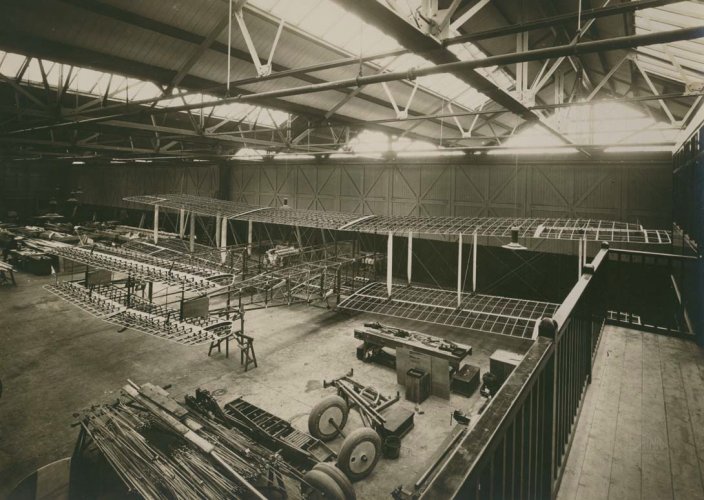
Grahame-White E.IV Ganymede under construction.jpg
Grahame-White E.IV Ganymede under construction.
 

Attachments

  • 384.jpg
    384.jpg
    49.7 KB · Views: 8
  • GW_Ganymede-1.jpg
    GW_Ganymede-1.jpg
    57.7 KB · Views: 6
  • Grahame-White E.IV Ganymede.jpg
    Grahame-White E.IV Ganymede.jpg
    49.4 KB · Views: 6
  • Grahame-White E.IV Ganymede rear.jpg
    Grahame-White E.IV Ganymede rear.jpg
    37.4 KB · Views: 7
  • Ganymede (AP 1956-01).jpg
    Ganymede (AP 1956-01).jpg
    76.9 KB · Views: 5
  • from 'The British Bomber since 1914'.jpg
    from 'The British Bomber since 1914'.jpg
    1.1 MB · Views: 7
  • from 'Armament of British Aircraft 1909-1939'.jpg
    from 'Armament of British Aircraft 1909-1939'.jpg
    39.9 KB · Views: 7
  • 473-1.jpg
    473-1.jpg
    38.4 KB · Views: 6
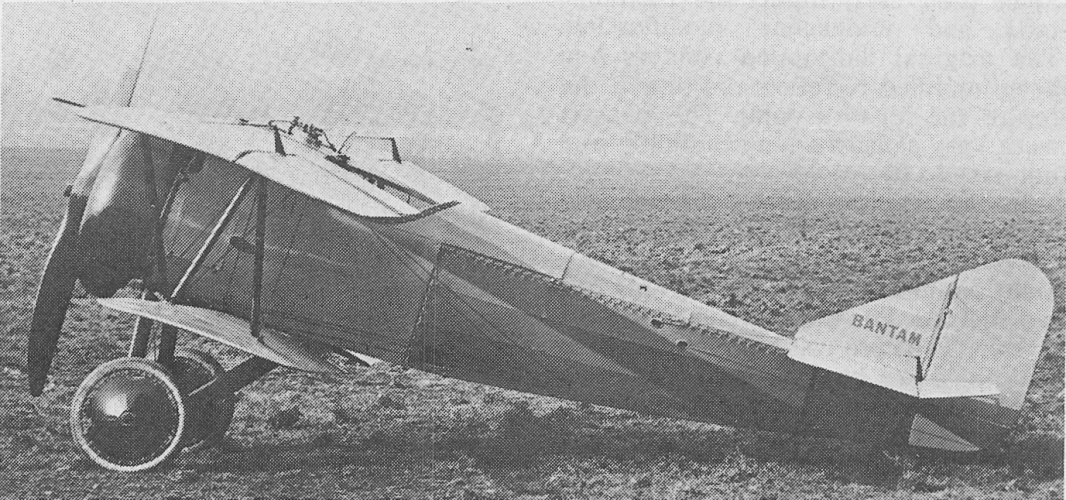
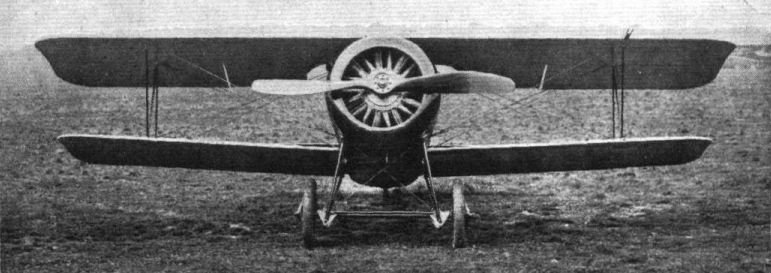
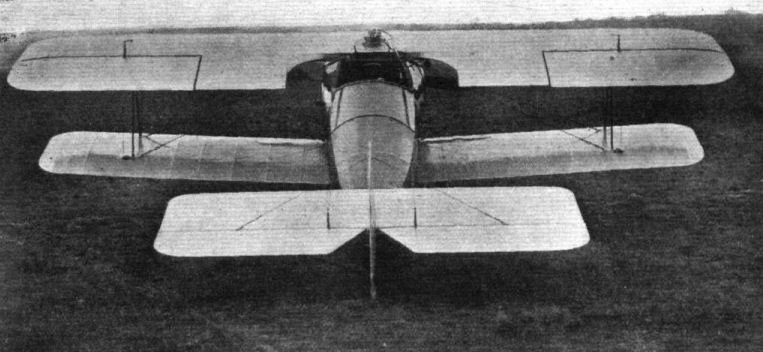
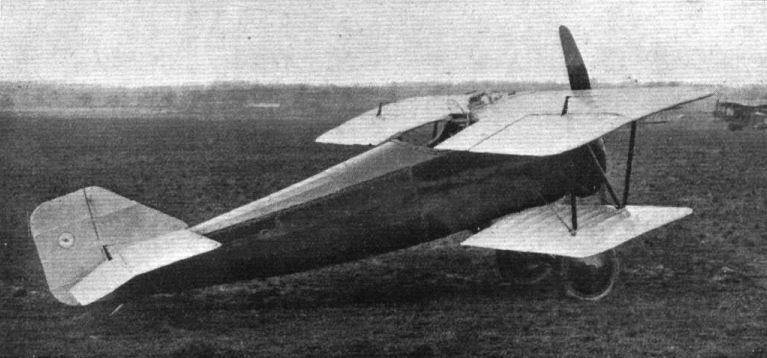
E.6 and E.6A Bantam

THE AERIAL DERBY
THE MACHINES
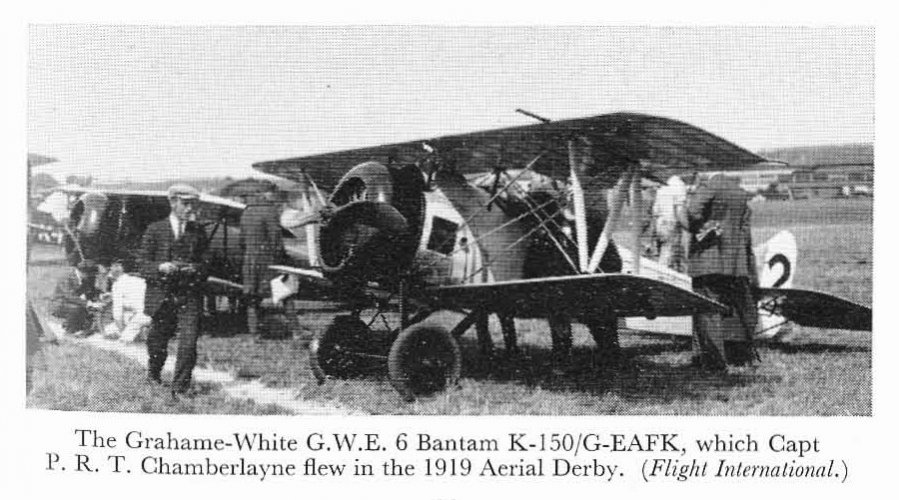
No. 2. - The Grahame-White Bantam, 80 h.p. Le Rhone
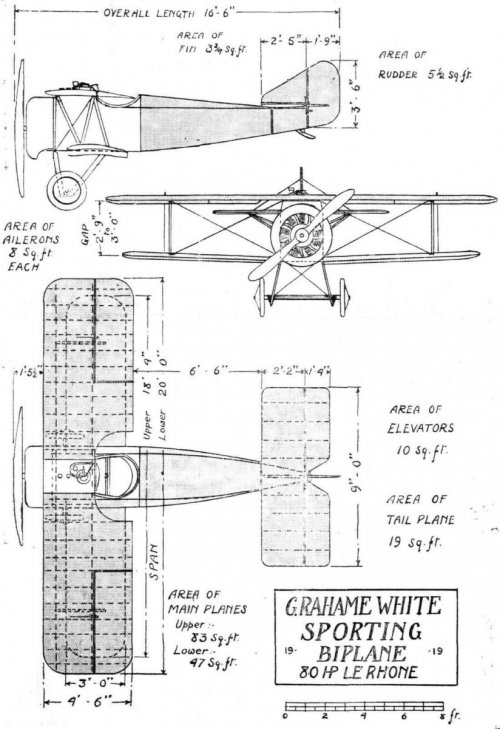
Two of these machines started in the race. Except for the colours in which they were painted, the two machines were alike. No. 2 was piloted by Capt. P. R. T. Chamberlayne, while the other machine, No. 5, was flown by Maj. R. H. Carr. The G.W. Bantam was described in FLIGHT recently, when sketches of constructional details were given. It has a top plane of slightly greater dimensions than the bottom one, the two being separated by one pair of interplane struts on each side. These struts are of N formation, as seen in the side elevation. The machine is very small, in fact it was the smallest machine entered for the Aerial Derby as regards size, although not as regards power. It is very sensitive on the longitudinal controls, and gives the impression that it could do with a larger tail plane, or smaller elevators, or possibly both.
No. 5. - The Grahame-White Bantam, 80 h.p. Le Rhone
For this machine, see note dealing with No. 2.
From Flight, June 26, 1919.

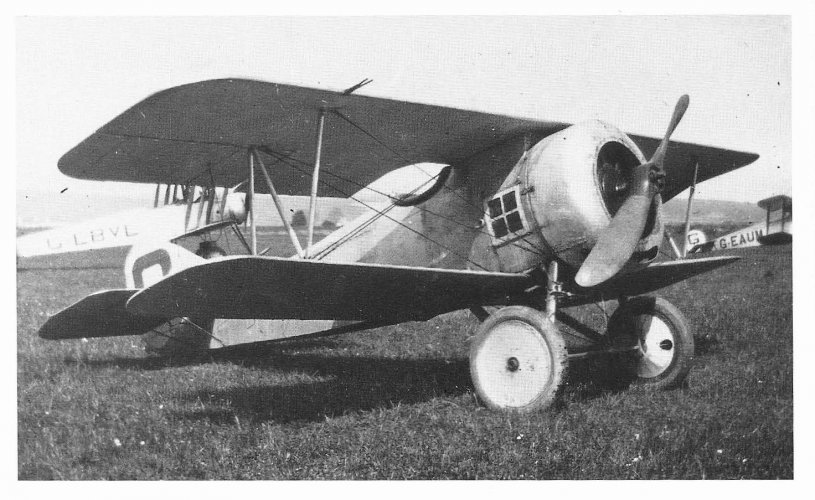
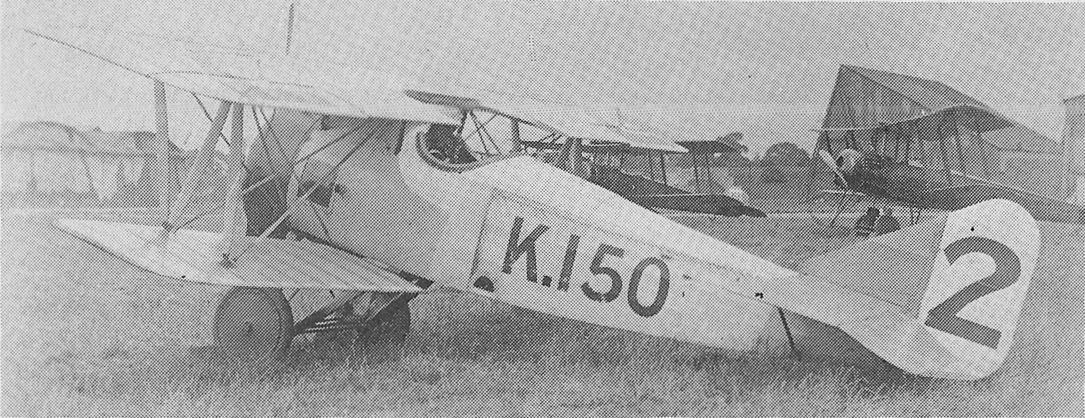
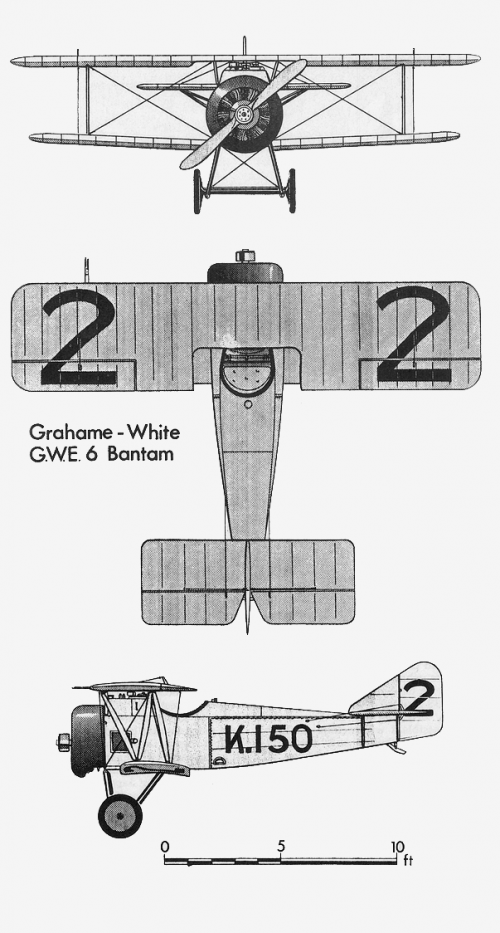
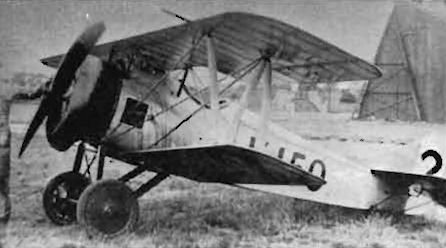
Two built. G.W.E.6A, K-153, later G-EAFL, had upper wing attached directly to the fuselage, G.W.E.6, K-150, later G-EAFK, had upper wing attached to short centre section struts. Both aircraft were powered by 80hp Le Rhone rotaries.
Both aircraft were flying by April 1919, but K-150 was written off later that year, after crashing into a hangar, the pilot surviving.
K-153 survived until 1926, when it was bought by F.G.Miles, who damaged the tail in a forced landing. Despite plans to repair it, K-153 was burned on November 5th, 1928.
From Aeroplane Monthly, July 1979, pp.382-5 (article by Richard Riding)

72.jpg
E.6 Bantam K-150.png
E.6 Bantam K.150.

468-1.jpg
E.6A Bantam K-153.png
E.6A Bantam K.153.

from 'British Racing and Record-Breaking Aircraft'.jpg
From 'British Racing and Record-Breaking Aircraft'.

470-1.jpg

470-2.jpg
Front and rear views of the E.6A Bantam.

G.W.E..6 Bantam 3-view.png 469-1.jpg
Three-view arrangements of the E.6 and E.6A Bantam.

470-3.jpg
The E.6A with revised rudder.
 

Attachments

  • G.W.E..6 Bantam.pdf
    12.3 MB · Views: 47
  • bantam and ganymede.png
    bantam and ganymede.png
    275.9 KB · Views: 7
  • 27-6.jpg
    27-6.jpg
    20.5 KB · Views: 8
Last edited:
E.7 Aero-Limousine

1762944874392.png
1212-2.jpg
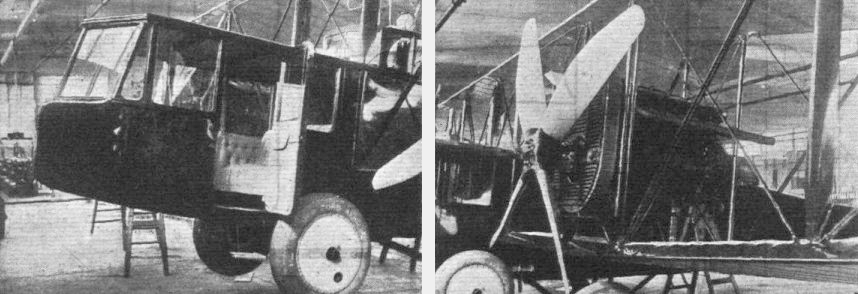
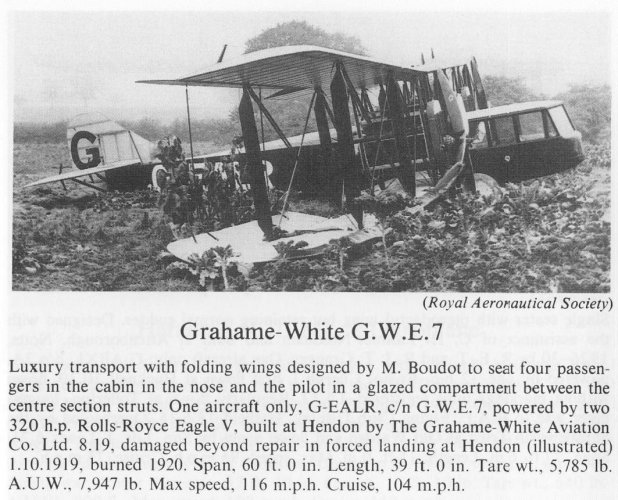
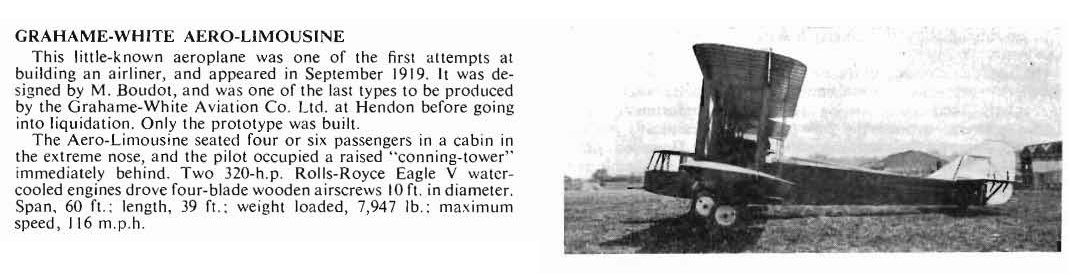
Two views of the little-known E.7 Aero-Limousine.

1762945261842.png 1214-1.jpg
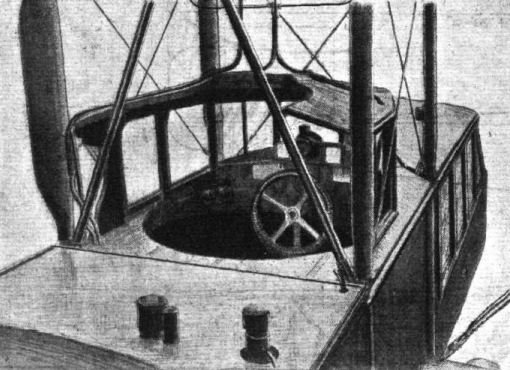
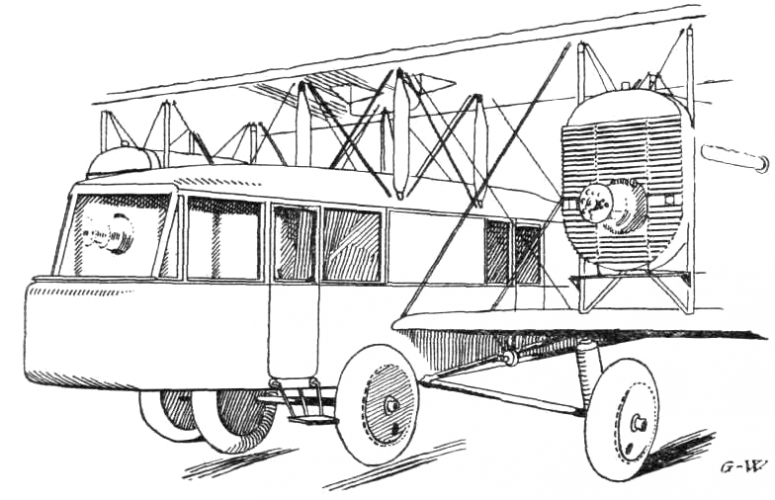
Two views showing, on the left, a general view of the cabin, and on the right, the port engine and mounting. Third view shows pilot's "conning-tower."

1762944963938.png
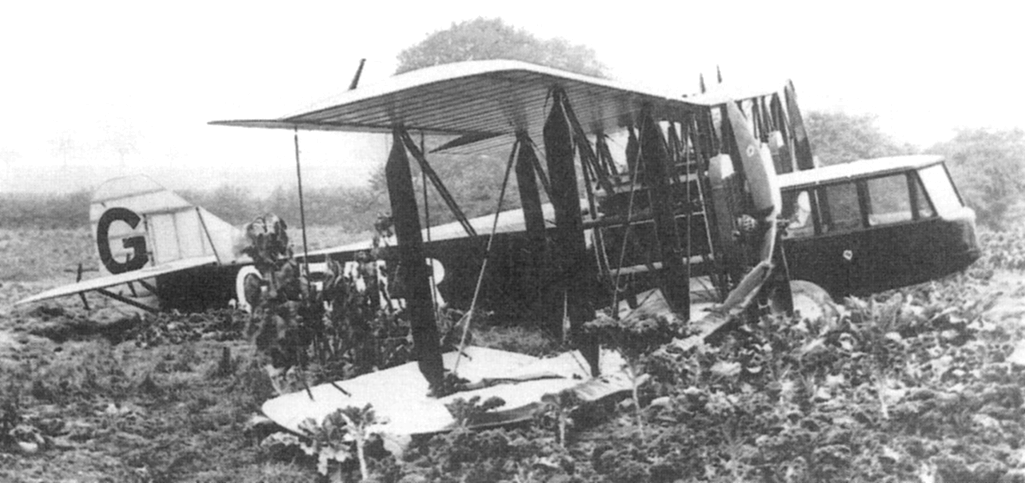
The E.7 damaged beyond repair in forced landing at Hendon on Oct. 1, 1919.

1213-1.jpg
 

Attachments

  • GWE 7.JPG
    GWE 7.JPG
    210.9 KB · Views: 9
  • Aerolimousine (AP 1955-12).jpg
    Aerolimousine (AP 1955-12).jpg
    137.5 KB · Views: 7
  • 1919 - 1212.PDF
    367.3 KB · Views: 4
  • 1919 - 1213.PDF
    180.8 KB · Views: 5
  • 1919 - 1215.PDF
    294.3 KB · Views: 1
  • 1919 - 1214.PDF
    352.1 KB · Views: 1
  • 1919 - 1216.PDF
    330.4 KB · Views: 2
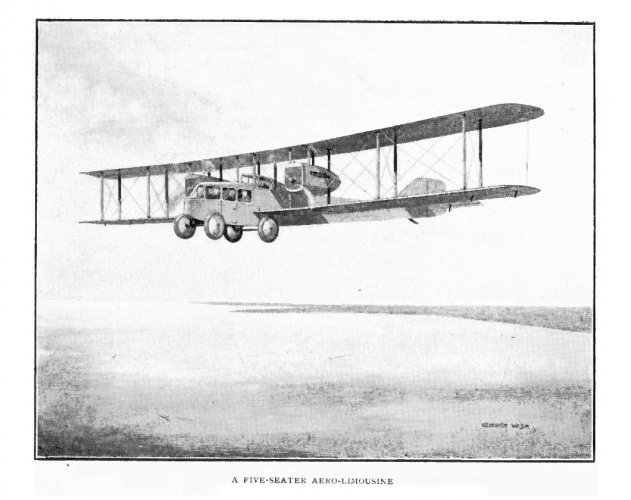
  • A five-seater aero-limousine (art by Geoffrey Watson).jpg
    A five-seater aero-limousine (art by Geoffrey Watson).jpg
    348.8 KB · Views: 10
  • five-seater touring aeroplane.jpg
    five-seater touring aeroplane.jpg
    236.9 KB · Views: 7
E.8 Aero-Limousine

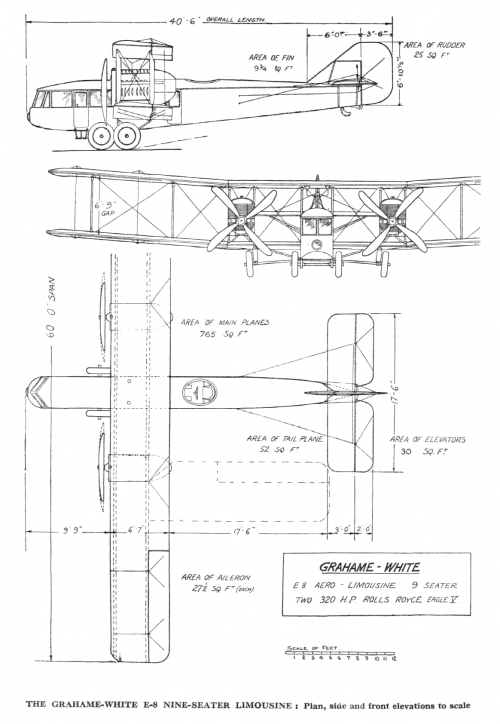
SINCE the description of the Grahame-White four-seater limousine appeared in FLIGHT for September 11, 1919, another model has been designed, and is now practically "ready for the air." Except for certain modifications in the fuselage necessitated by the extra seating accommodation provided, and in one or two detail improvements resulting from practical experience with the four-seater, this new model—-the E-8—is identical in general design and
construction to the first machine. We do not, therefore, propose giving a full description of the new nine-seater, but will confine our remarks to the general characteristics of the machine and the new features, which, together with the accompanying scale drawings, should suffice to give all the essential information.
The E-8, we understand from the Grahame-White Co., is primarily a luxury machine, and not a low-priced commercial one—that is, it is comparable to the costly touring car or yacht, the best material and workmanship obtaining throughout, and finish not being sacrificed to other considerations.
Whether the time is ripe for such a machine remains to be seen ; one thing is certain, however, such an aeroplane will be wanted sooner or later, and the Grahame-White Co. are determined to be ready.
As previously stated, the main alterations in the E-8 are to be found in the fuselage. As before, it is built-up in two main sections, that aft of the main planes being of wirebraced girder construction with square section longerons and channel section struts. From the main planes forward the fuselage—the " business portion "—is built-up on hoop formers of ash reinforced with three-ply covering. The rounded nose is now of sheet metal, which enables a much neater job to be made of this part than when it was of three-ply. The main passengers' cabin projects forward of the main planes, and is now 2 ft. 6 ins. longer on account of the extra accommodation. The interior finish and furnishing are as before, likewise the arrangement of the large Triplex windows. The middle portion of the cabin, at the main planes, is reserved for the fuel tanks. At the extreme rear of the cabin is a small compartment which can be used either for luggage or for two passengers. This cabin has two windows each side, and a door on the port side.
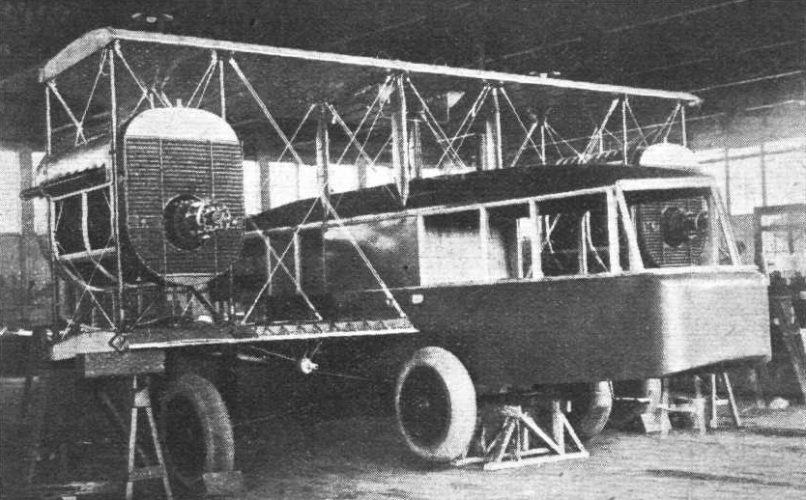
The pilot, in the E-8, is located further back, the cockpit being immediately behind the cabin and the main planes, instead of, as before, underneath the top plane. The " conning tower " arrangement has been dispensed with, and an ordinary small wind-screen provided instead. Whilst the fore portion of the fuselage has been lengthened, the rear portion, from the trailing edge of the main planes rearward, has been shortened by 1 ft. ; the overall length is, nevertheless, 1 ft. 6 ins. longer.
There is no material difference in the main planes, the overall dimensions being as before. The tail plane is a little shorter in span, and has undergone slight modifications in the angle of incidence adjustment gear. The leading edge is now fixed, and the rear spar is raised or lowered. The fin area has been reduced by 2 sq. ft. or so, but otherwise the tail surfaces remain much the same.
Except that it is slightly more springy, the landing chassis is similar to the previous one, the results obtained from the first model having been highly satisfactory.
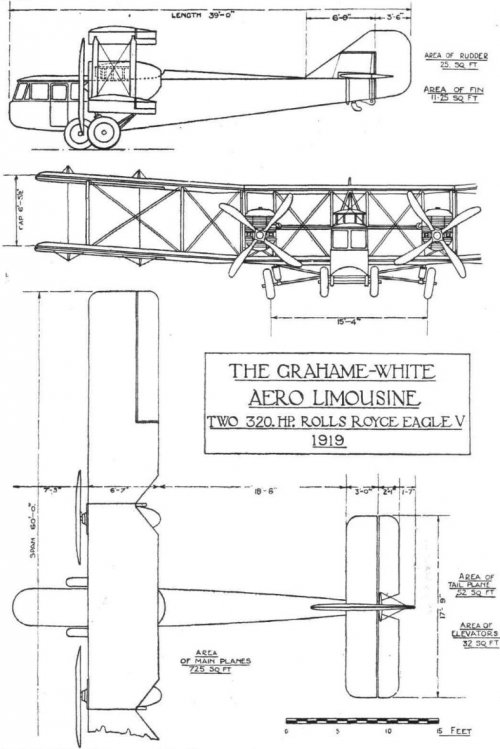
The power plant is also similar, consisting of two 320 h.p. Rolls-Royce Eagle V engines, driving tractor screws.
As before, the principal feature of the control is in the novel arrangement of the rudder-bar, which is mounted below the floor with its pedals projecting through, and sliding in slots in, the floor-boards. The engine-controls are mounted on the right-hand side of the pilot's cockpit. An interconnected
throttle-lever is fitted, which opens and closes both throttles in unison or independently.
From Flight, March 20, 1920.

1762945930306.png

1762946021488.png
A sketch showing the general arrangement of the cabins of the Grahame-White limousine.
1762946378233.png
 

Attachments

  • 1920 - 0335.PDF
    321.4 KB · Views: 2
  • 1920 - 0336.PDF
    206.2 KB · Views: 5
  • 1920 - 0337.PDF
    398.1 KB · Views: 19
The G.W.E.7 had four-seat and this has five-seat ?.
I think it's just the old problem about aviation articles: some journalists indicate the total seating capacity, pilot included, while others merely indicate the number of passengers. Also note that the E.9 had four seats, which may be the source of the confusion.
 
E.9 Ganymede (Aero-Limousine)

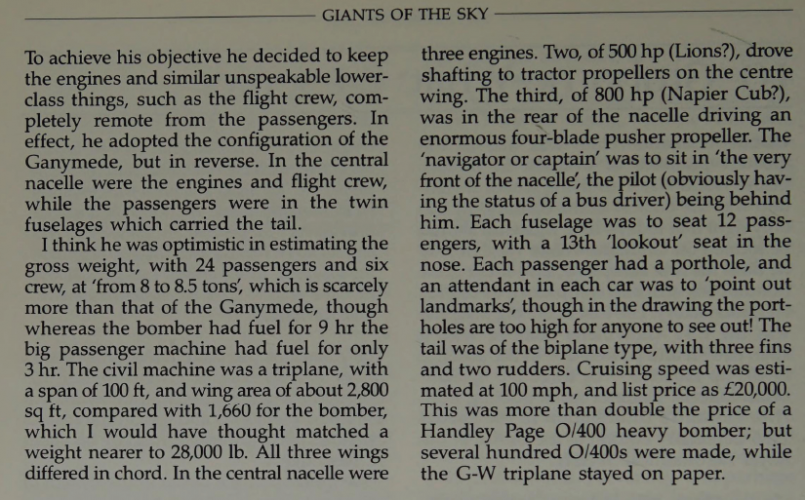
The E.9 was a 1919 commercial conversion of the E.4 bomber into an airliner, powered by two 450-hp Lion engines.
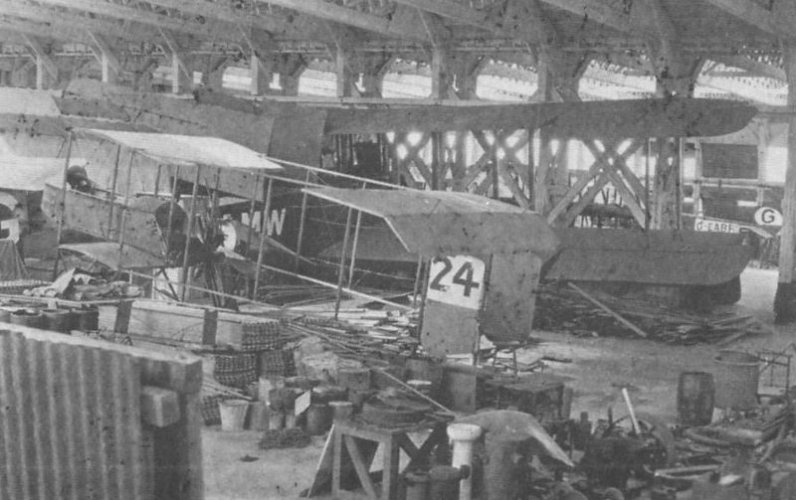
Unfortunately C3481 suffered some damage in a forced landing when it dug its nose into soft ground. Either then, or shortly after, the Air Ministry notified Grahame-White that it would not be purchasing the Ganymede and, in an effort to recoup some of the financial loss, the company determined to examine the feasibility of modifying C3481 as a commercial aircraft, removing the centre engine altogether and rebuilding the nacelle as a long, glazed cabin capable of accommodating twelve passengers. The remaining Maoris were replaced by two 450hp Napier Lion engines, and the aircraft received its Certificate of Airworthiness on 12 September 1919, being re-registered G-EAMW - only to be destroyed by fire twelve months later.
From The British bomber since 1914 (Putnam).

1762947876978.png


1762949949436.png
The only photo I've found of the fully converted E.9 with glazed cockpit, enhanced from that which was shared here.

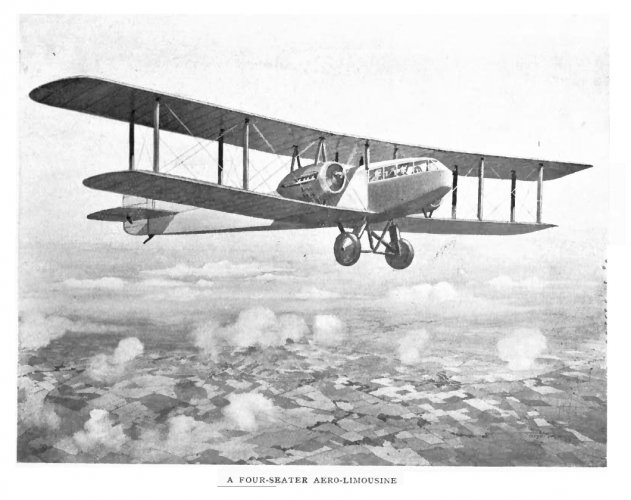
A four-seater aero-limousine (art by Geoffrey Watson).jpg
A painting by Geoffrey Watson of what the E.9 probably looked like when fully converted.

27-1.jpg
The large aircraft in the background is the G.W.E.9 Ganymede G-EAMW.
 
Last edited:

Similar threads

Back
Top Bottom