Alternate Australian Defence Force 1970s Procurements?

Was the COSC recommendation to get a 4th DDG and it's rejection by the Government in November 1964 tied up with the Voyager replacement?
Were the options:
  1. replace Voyager with a 4th DDG, built in the US
  2. replace Voyager with 2 River class DEs built in Australia
The COSC wanted option 1 but the Government chose option 2?

Or was the 4th DDG being recommended anyway and the Voyager was going to be replaced by 2 DEs anyway so the 4th DDG would have been an 'extra' ship?
In the Carrier replacement document it states the RAN needs to find 200 more crew to replace voyager with the 2x rivers and also it needs the 4th DDG
 
In the Carrier replacement document it states the RAN needs to find 200 more crew to replace voyager with the 2x rivers and also it needs the 4th DDG

OK, I have a vague recollection that the A4 order reduced the need for air defence ships, ie the 4th DDG. If so those 20 A4Gs sank a DDG and 2 submarines, that's quite the kill tally!
 
OK, I have a vague recollection that the A4 order reduced the need for air defence ships, ie the 4th DDG. If so those 20 A4Gs sank a DDG and 2 submarines, that's quite the kill tally!
I doubt 20 A4Gs is a enough provided air defence to not required a 4th DDG and attack capability for 2 Submarines that would be extreme overestimation of the A-4s ability, there handy not that handy. I would say it killed them cause the goverment didnt want to pay for all these and made the RAN choose one
Though I think maybe if the A-4s where brought in the lates 50s early 60s the 4th DDG & 7th & 8th Oberon would have gone ahead
 
It was only 10 A4s, 8 single seaters, that sank the 4th DDG. Pretty cheap too, ~$15m for 10 A4s to get established to sink a $50m destroyer.
Yeah i would say goverment pressure would be the reason for that, Thats i why i reckon the a-4s need to be brought before the DDGS to get the 4th one through
 
Was the COSC recommendation to get a 4th DDG and it's rejection by the Government in November 1964 tied up with the Voyager replacement?
Were the options:
  1. replace Voyager with a 4th DDG, built in the US
  2. replace Voyager with 2 River class DEs built in Australia
The COSC wanted option 1 but the Government chose option 2?

Or was the 4th DDG being recommended anyway and the Voyager was going to be replaced by 2 DEs anyway so the 4th DDG would have been an 'extra' ship?
The original order was for two DDGs, with the third being ordered later, I believe this was meant to be another pair. There was also the possibility that the later ship(s) could have been built to a modified design, which had been decided against for the first pair on cost and schedule grounds.

Admiral Shackleton's PHD Thesus mentioned that, considering the upgrades the Perths required not long after entering service, the more capable Belknap class DLGs may have been better value for money, or potentially (programmatically speaking) cheaper through life. They already had the command and control facilities, as well as data links that had to be developed and installed on Australias DDGs, the US DDGs didn't need them because they had DLGs and CGs with the capabilities.
 
Yeah i would say goverment pressure would be the reason for that, Thats i why i reckon the a-4s need to be brought before the DDGS to get the 4th one through

Therein lies the real challenge, anyone can dream up alternative planes, ships and tanks but to do anything other than hand-wave them into existence Harry Potter style requires real thought.

Personally I'd like to de-conflict the FAA re-equipment from the DDG buys by not having the Melbourne declared an ASW carrier in 1959, and buy all 20 A4s then. In addition I'd like he refit to operate these aircraft to be maximal rather than minimal, with a bigger angle on the deck and much longer catapults for starters. However the defnece budget in those years was capped at 200 million pounds, so fining the money is difficult.

One thing The DDGs had going for them was great financial terms the US offered them, the DDGs were able to be paid over a period of 8 years which was better than the British could offer.
 
Therein lies the real challenge, anyone can dream up alternative planes, ships and tanks but to do anything other than hand-wave them into existence Harry Potter style requires real thought.

Personally I'd like to de-conflict the FAA re-equipment from the DDG buys by not having the Melbourne declared an ASW carrier in 1959, and buy all 20 A4s then. In addition I'd like he refit to operate these aircraft to be maximal rather than minimal, with a bigger angle on the deck and much longer catapults for starters. However the defnece budget in those years was capped at 200 million pounds, so fining the money is difficult.

One thing The DDGs had going for them was great financial terms the US offered them, the DDGs were able to be paid over a period of 8 years which was better than the British could offer.
Agreed it mean i don't think it would take mutch, maybe Indonesia starts posing s threat in the late 50s instead of the 60s
How would you refit Melbourne better? I know they extended the catapult. What a wider flight deck angle?
Another reason to buy the 4th ddg to take advantage of the good financial terms
 
I've been thinking how hard would it get for New Zealand to buy Australian Built Mirage IIIOs, instead of the A-4ks? Say the buy 18 (12x Mirage IIIO & 6x Mirage IIID) Would this allow Australia to build replacement aircraft so the 4th Mirage sqn is decomissioned in 73?

Also whats better for the FAA in 1957-1959
  • An A-4 modified like the A-4G ?
  • An A-4 modified with the Avon engine & 30mm Cannons ?
  • Navailised F-5 ?
  • Navailised F-5 modified for a single Avon engine & 30 Cannons ?
 
Back to the 70s, but with the change in the 60s. What about potential changes arising from 'use it or lose it' scenarios?

For example, the need for tanks was questioned during the 60s and I suspect if the Sheridan was adopted the Centurions wouldn't be replaced. However, once the Centurions got into combat, they showed their value and cemented the tank into the ADF OOB for the next 2 generations of tanks.

I've read that there was a proposal to send Saracens and Ferrets to Malaysia in 1864 or 65 that didn't go ahead. In addition, the USN requested Melbourne do a combat cruise in 1966 and again in 1967, but these requests were rejected.

What happens to Wheeled AFVs and the carrier replacement in the 70s of both of these see operational service in the 60s?
 
Back to the 70s, but with the change in the 60s. What about potential changes arising from 'use it or lose it' scenarios?

For example, the need for tanks was questioned during the 60s and I suspect if the Sheridan was adopted the Centurions wouldn't be replaced. However, once the Centurions got into combat, they showed their value and cemented the tank into the ADF OOB for the next 2 generations of tanks.

I've read that there was a proposal to send Saracens and Ferrets to Malaysia in 1864 or 65 that didn't go ahead. In addition, the USN requested Melbourne do a combat cruise in 1966 and again in 1967, but these requests were rejected.

What happens to Wheeled AFVs and the carrier replacement in the 70s of both of these see operational service in the 60s?
I would say if these happened in the 60s then they will get replaced in the 70s
I dont think the Sheridan would replace the Centurion and its replacement as the Sheridan was Supposed to fill out the fire support troop of the original Cavalry regiment plan " three fighting squadrons, each with three troops equipped with APCs, a fire support troop and an anti-tank and surveillance troop"
 
I dont think the Sheridan would replace the Centurion and its replacement as the Sheridan was Supposed to fill out the fire support troop of the original Cavalry regiment plan " three fighting squadrons, each with three troops equipped with APCs, a fire support troop and an anti-tank and surveillance troop"

Sure, but when 'tracked AFV with big gun' enters service when 'other tracked AFV with big gun' needs replacing I can imagine pollies saying 'yeah....nah you've got a "tank" you don't need another'.

It would be difficult for the Army to justify an actual tank; 'We bought Sheridans to do X, we need Leopards to do Y' would sound like techno babble to justify spending money unnecessarily to pollies. Of course, direct combat experience would demonstrate the need, but that would also likely show the weaknesses of the Sheridan, 'You've got a tough tank, why do you need a weak "tank"?'
 
How would you refit Melbourne better? I know they extended the catapult. What a wider flight deck angle?

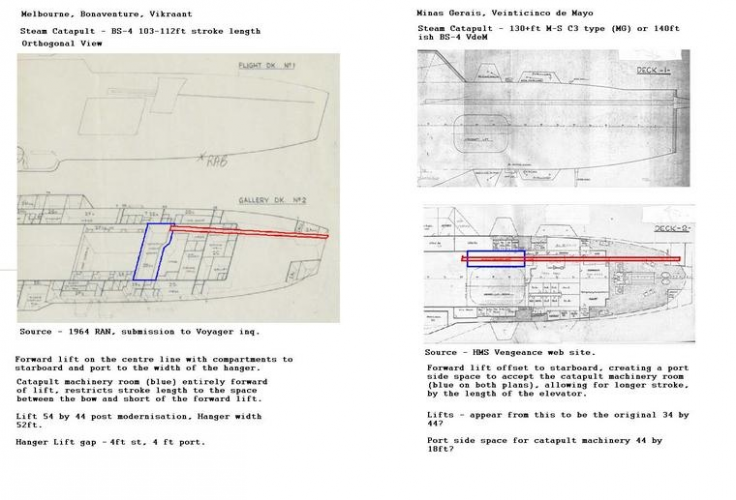
The Netherlands rebuilt two Majestic Class carriers, their own Karel Doorman (later 25 de Mayo) 1955-58 and the Brazilian Minas Gerias 1957-60 with 8-degree angled flight decks. The size of the angle required that an accessway be built around the starboard side of the island superstructure; the weight acting as a counterbalance for the flight deck's portside overhang.

They also moved the forward lift starboard to allow the fitment of a 145' BS4A (KD) or (US sourced?) 130' C3 (MG) catapult that extended back to level with the forward lift. In contrast Melbourne's 103' catapult got a 9' extension forward into the water brake/bridle arrestor horn to make it 112', all forward of the forward lift.

Minas Gerias' island superstructure was replaced, and a lattice mast was fitted to support the new fire control system and radar suite, boiler capacity was increased, and internal electricity was converted to AC through the installation of four turbo generators and one diesel generator.

I'd also replace all the Bofors with Sea Cat and maybe a couple of 20mm Oerlikons.

Do this in the 60s and Melbourne is good for 20 years.


1760394744329.png
Picture is from an ex-RAN A4 pilot who goes by SpazSinbad.
 
I've been thinking how hard would it get for New Zealand to buy Australian Built Mirage IIIOs, instead of the A-4ks? Say the buy 18 (12x Mirage IIIO & 6x Mirage IIID) Would this allow Australia to build replacement aircraft so the 4th Mirage sqn is decomissioned in 73?

RNZAF Skyhawks were fitted for but not with the avionics in the dorsal hump, indicating how cheap they were and how little the NZ Govt wanted to spend. A Mirage was about $1.5m and a Skyhawk about $850k, and the Kiwis bought 14 A4s instead of 18, so I'd say the mirage was simply too expensive for the Kiwi Government, if not the nation itself which was quite wealthy. Easy RNZAF boosts are getting all 18 A4s and fitting the higher spec avionics that were available.

Also whats better for the FAA in 1957-1959
  • An A-4 modified like the A-4G ?
  • An A-4 modified with the Avon engine & 30mm Cannons ?
  • Navailised F-5 ?
  • Navailised F-5 modified for a single Avon engine & 30 Cannons ?

Military Off The Shelf is best, making the A4 the only choice. However, the 3 pylon, J65 engine A4B & C were the production models until late 1962 when the 5 pylon, J52 engine A4E entered production, and Australia would want that version so couldn't expect delivery until probably 1964.
 
Sure, but when 'tracked AFV with big gun' enters service when 'other tracked AFV with big gun' needs replacing I can imagine pollies saying 'yeah....nah you've got a "tank" you don't need another'.

It would be difficult for the Army to justify an actual tank; 'We bought Sheridans to do X, we need Leopards to do Y' would sound like techno babble to justify spending money unnecessarily to pollies. Of course, direct combat experience would demonstrate the need, but that would also likely show the weaknesses of the Sheridan, 'You've got a tough tank, why do you need a weak "tank"?'
I think you could argue successfully that the Sheridan is fire support wespon that you can use when you don't need a tank, though you still need a tank for certain requirements. I could see it pushing the centurion replacement to an early 80s
 
The Netherlands rebuilt two Majestic Class carriers, their own Karel Doorman (later 25 de Mayo) 1955-58 and the Brazilian Minas Gerias 1957-60 with 8-degree angled flight decks. The size of the angle required that an accessway be built around the starboard side of the island superstructure; the weight acting as a counterbalance for the flight deck's portside overhang.

They also moved the forward lift starboard to allow the fitment of a 145' BS4A (KD) or (US sourced?) 130' C3 (MG) catapult that extended back to level with the forward lift. In contrast Melbourne's 103' catapult got a 9' extension forward into the water brake/bridle arrestor horn to make it 112', all forward of the forward lift.

Minas Gerias' island superstructure was replaced, and a lattice mast was fitted to support the new fire control system and radar suite, boiler capacity was increased, and internal electricity was converted to AC through the installation of four turbo generators and one diesel generator.

I'd also replace all the Bofors with Sea Cat and maybe a couple of 20mm Oerlikons.

Do this in the 60s and Melbourne is good for 20 years.


View attachment 788028
Picture is from an ex-RAN A4 pilot who goes by SpazSinbad.

I quite like this proposal sounds solid
Would it increase aircraft capacity or just efficiency?
 
RNZAF Skyhawks were fitted for but not with the avionics in the dorsal hump, indicating how cheap they were and how little the NZ Govt wanted to spend. A Mirage was about $1.5m and a Skyhawk about $850k, and the Kiwis bought 14 A4s instead of 18, so I'd say the mirage was simply too expensive for the Kiwi Government, if not the nation itself which was quite wealthy. Easy RNZAF boosts are getting all 18 A4s and fitting the higher spec avionics that were available.


Military Off The Shelf is best, making the A4 the only choice. However, the 3 pylon, J65 engine A4B & C were the production models until late 1962 when the 5 pylon, J52 engine A4E entered production, and Australia would want that version so couldn't expect delivery until probably 1964.
Fair enough. I agree 18 full spec a4s would be better
Yeah but Australia always seems to have to modified of the self stuff cause most off the self stuff doesn't fit our requirements
 
I quite like this proposal sounds solid
Would it increase aircraft capacity or just efficiency?

Compared to Essex, CVA01, Hermes and whatever else it's the most affordable, easiest to man and easiest and cheapest to equip with aircraft.

My guess is while it might be able to squeeze another aircraft or two the biggest gains would be efficiency and safety which are very handy.

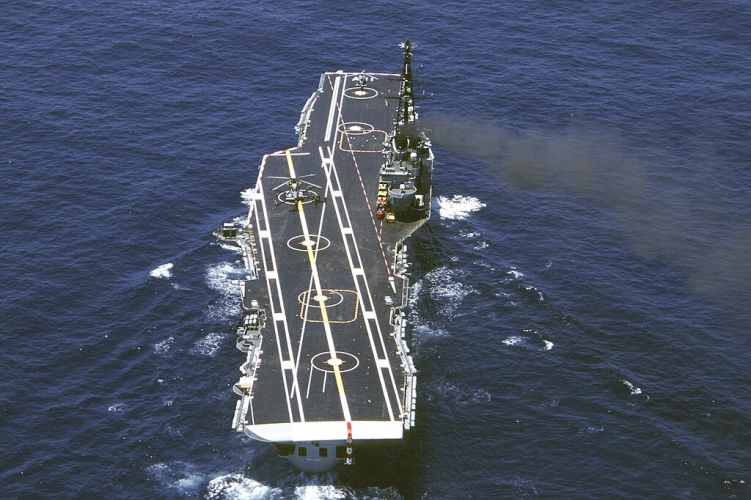
Photo from Wiki.
1760406253820.png
 
Compared to Essex, CVA01, Hermes and whatever else it's the most affordable, easiest to man and easiest and cheapest to equip with aircraft.

My guess is while it might be able to squeeze another aircraft or two the biggest gains would be efficiency and safety which are very handy.

Photo from Wiki.
View attachment 788031
Agree. I believe the most aircraft Melbourne ever went to sea with was 27 so in theory she could go to sea with 29 maybe 30 if required but say most likely 26 to 28 day to day than.
So say 12 - 10 Skyhawks, 10 Wessexs and 6 trackers with surge capacity for more. Not bad a lot better than what she could do.
With the longer catapult could you also do what the RAN did to Melbourne's catapult as well to make the catapult even longer. To allow more of the energy be parted to.the aircraft?
 
What about the Dassault Etendard IV for Melbourne. Is it better than a Skyhawk? It also had a more powerful Avon prototype that the RAN Could go with
 
Agree. I believe the most aircraft Melbourne ever went to sea with was 27 so in theory she could go to sea with 29 maybe 30 if required but say most likely 26 to 28 day to day than.
So say 12 - 10 Skyhawks, 10 Wessexs and 6 trackers with surge capacity for more. Not bad a lot better than what she could do.

27 aircraft is a stated maximum, not a regular operating number, which I think was about 20-22 aircraft including helicopters. Anecdotally this is quite common for carriers, reducing the absolute number of aircraft speeds up sortie generation and generally makes things easier. I suspect such an extensive rebuild would bump up the regular operating number to 22-24 aircraft and make the occasional operation of 27-28 less difficult.

With the longer catapult could you also do what the RAN did to Melbourne's catapult as well to make the catapult even longer. To allow more of the energy be parted to.the aircraft?

IIUC the extra 9' extension to Melbourne's catapult didn't add any extra power. Rather, it imparted the same power over 9% more length, thereby reducing the stress on aircraft by about 9% . In contrast the 145' BS4A does have more power, which would be handy on hot days, with no wind and a dirty bottom.
 
27 aircraft is a stated maximum, not a regular operating number, which I think was about 20-22 aircraft including helicopters. Anecdotally this is quite common for carriers, reducing the absolute number of aircraft speeds up sortie generation and generally makes things easier. I suspect such an extensive rebuild would bump up the regular operating number to 22-24 aircraft and make the occasional operation of 27-28 less difficult.
I believe her normal aircraft load was usually 24 once the extra a4s were brought 8 a4s, 6 s2s and 10 helos. So an increase to 26 with the rebuild i dont think would be out of the question, by adding 2 extra Skyhawks
IIUC the extra 9' extension to Melbourne's catapult didn't add any extra power. Rather, it imparted the same power over 9% more length, thereby reducing the stress on aircraft by about 9% . In contrast the 145' BS4A does have more power, which would be handy on hot days, with no wind and a dirty bottom.
Yeah thats what I was trying to convey bit couldn't find the right world. Agreeded it would be very handy in hot days. I also think the extra 9' would be handy as well for the reasons you state with the longer catapult
 
believe her normal aircraft load was usually 24 once the extra a4s were brought 8 a4s, 6 s2s and 10 helos. So an increase to 26 with the rebuild i dont think would be out of the question, by adding 2 extra Skyhawks

The final post in your Aircraft Carrier replacement thread goes into this theme, in the USN at any rate. Having huge numbers of aircraft does allow a high number of daily sorties if that's what's needed, but it does mean more work constantly respotting aircraft and making maintenance more difficult. 10% less aircraft allows less sorties to be sustained.

I could imagine Melbourne heading Up Top with 27 aircraft and offloading 5 or so at Singapore to keep the embarked 22 flying a sustained high rate by rotating the ashore aircraft.
 
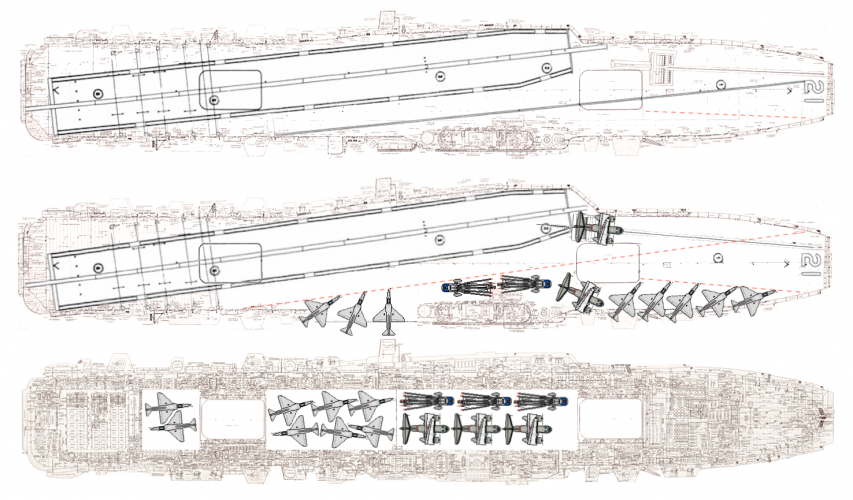
Here's Melbourne (top) vs. modified (middle) with Karel Doorman's 8 degree angled deck, 145174ft BS4A catapult and enlarged deck park.

The greater angle opens up 2 spots along the island (1 helo + 1 fixed wing) and the deck park adds 1 spot behind the island (now 3 vs. 2 on Melbourne), for a total of +3 spots.

Here I'm showing 16 Skyhawks, 5 Trackers and 5 Sea King... for a total of 26. That's probably about the maximum realistic number without locking the deck.

HMAS Melbourne 8deg angle long cat mod 2px=1ft with airgroup.png

Although 16 Skyhawks sounds like a lot on such a small deck, assuming 4 must be held back (2 for deck launched intercept, 1 buddy tanker, 1 down for maintenance), the actual number available for missions would be only 12 Skyhawks (e.g. 2 cycles x 6 Skyhawks, or alternatively 1x10 alpha strike + 1x2 CAP) which might allow you to generate 24-30 Skyhawk sorties per day.
 
Last edited:
Here I'm showing 16 Skyhawks, 5 Trackers and 5 Sea King... for a total of 26. That's probably about the maximum realistic number without locking the deck.
Thats pretty good air wing for such a small carrier
Makes me wonder why the RAN never did this after one of Melbourne's collisions
 
We shouldn't go too nuts about cramming heaps of aircraft onto Melbourne; we're still dealing with a 200m pound cap on defence spending that will doubtless be broken for the carrier but that will be considered extraordinary and checked at every step. The RAN bought 10 A4s and 14 S2Es initially and another 10 A4s for a total of 16 single seaters and 4 two seaters. I'd suggest if the RAN bought all 20 A4s in the early 60s the most that would be embarked on Melbourne would be 10-12, 6-8 trackers plus helicopters.

Makes me wonder why the RAN never did this after one of Melbourne's collisions

Cost, time and the early 60s hope that the RAN could get a big carrier so declared the Melbourne useless going forward.

IIUC the 1957-60 refit of Minas Gerias from axial deck to her 'modern' spec cost USD $27m, the Melbourne's much less extensive 1967-69 refit for A4s and S2s which added the 9' to the catapult cost about USD $8m. Given Melbourne already had an angled deck and steam catapult I doubt her refit would cost as much as MGs, and some USD $8m was going to be spent anyway I suspect the extensive refit would take 3-4 years and cost an extra USD $20m over the historical A4 refit. This isn't something that's done at short notice, it has be planned and budgeted for at least a year in advance.

I do love it though; it's going in my mental list of good alternative ideas for Australia.
 
We shouldn't go too nuts about cramming heaps of aircraft onto Melbourne; we're still dealing with a 200m pound cap on defence spending that will doubtless be broken for the carrier but that will be considered extraordinary and checked at every step. The RAN bought 10 A4s and 14 S2Es initially and another 10 A4s for a total of 16 single seaters and 4 two seaters. I'd suggest if the RAN bought all 20 A4s in the early 60s the most that would be embarked on Melbourne would be 10-12, 6-8 trackers plus helicopters.


Cost, time and the early 60s hope that the RAN could get a big carrier so declared the Melbourne useless going forward.

IIUC the 1957-60 refit of Minas Gerias from axial deck to her 'modern' spec cost USD $27m, the Melbourne's much less extensive 1967-69 refit for A4s and S2s which added the 9' to the catapult cost about USD $8m. Given Melbourne already had an angled deck and steam catapult I doubt her refit would cost as much as MGs, and some USD $8m was going to be spent anyway I suspect the extensive refit would take 3-4 years and cost an extra USD $20m over the historical A4 refit. This isn't something that's done at short notice, it has be planned and budgeted for at least a year in advance.

I do love it though; it's going in my mental list of good alternative ideas for Australia.
Still a better air wing the original. It doesn't take make to increase defence budget.
Still should have been done especially after the second collision
 
Still a better air wing the original.

Much! I'm really liking the idea, it's far more doable than the crazy ideas about an Essex.

It doesn't take make to increase defence budget.

The defence budget had a pretty big jump for 1964-65, and I think if there was a single Minister of Defence from 1958, they'd be able to make more powerful submissions to Cabinet but outside that the willingness to spend on defence is closely linked to the inherent security of a country and Australia is fundamentally secure apart from a few years in the 60s.

Still should have been done especially after the second collision

The time to do is when the aircraft squadrons are converting to A4s and S2s. Ideally the RAN would get it's ~20 A4Es (incl TA4s) and S2Es in about 1963, so the Melbourne goes into refit in maybe late 1962 for about 3 years.

I'd suggest that the RN/USN help out with the Carrier Qualification for the new squadrons, giving the RAN sqns deck practice on their carriers once they've converted but the Melbourne is still in refit.

This throws a whole new light on the USN 1966 and 1967 requests for the Melbourne to do a Vietnam tour as an ASW asset on Yankee station.
 
Much! I'm really liking the idea, it's far more doable than the crazy ideas about an Essex.
Agreed it is though I would still prefer Hermes, though this is still a very good proposal

The defence budget had a pretty big jump for 1964-65, and I think if there was a single Minister of Defence from 1958, they'd be able to make more powerful submissions to Cabinet but outside that the willingness to spend on defence is closely linked to the inherent security of a country and Australia is fundamentally secure apart from a few years in the 60s.
Agreed makes it much more likely. Alot of things I say would happen differently if the merger of.the defences deparents happen
The time to do is when the aircraft squadrons are converting to A4s and S2s. Ideally the RAN would get it's ~20 A4Es (incl TA4s) and S2Es in about 1963, so the Melbourne goes into refit in maybe late 1962 for about 3 years.

I'd suggest that the RN/USN help out with the Carrier Qualification for the new squadrons, giving the RAN sqns deck practice on their carriers once they've converted but the Melbourne is still in refit.

This throws a whole new light on the USN 1966 and 1967 requests for the Melbourne to do a Vietnam tour as an ASW asset on Yankee station
Agreed perfect time, though i would say we wpuld need closer to 30 a4s so you could surge 16 a4s if required would be i thoughts
Carrier qualifications with the RN/USN would be easly done
I would say she would do a war cruise
 
I would still prefer Hermes

If the RAN was going to stretch to buying a carrier Hermes is the best bet, although IIUC she didn't become available until 1968, by which time ideally Australia has already made the decision to do something else. If the choice is to be proactive in the early 60s, rebuild Melbourne and buy A4s and S2s to be in service by 1965 and follow our historical path until 1968 then buy Hermes for delivery by 1972 I think the former is a better choice.

we would need closer to 30 a4s so you could surge 16 a4s if required

Much like the historical path I think if we want to surge that many A4s a second batch buy would be the way to do it, perhaps in conjunction with the RNZAF's buy. However, I wouldn't want that to come at the expense of 2 Oberon subs. I think having 8 rather than 6 subs is more important than having the ability to squeeze in another ~4 A4s to Melbourne on the odd occasion.
 
I would say she would do a war cruise

Australian defence was full of Negative Nancy's in this period, looking for any excuse not to do something.

  • The senior RAAC officer was in command of 1ATF in 1967 and said that the area wasn't suitable for tanks.
  • AVM Murdoch was asked for 2 UH1 helicopters in Borneo in 1965, he said the RAAF was doing enough.
  • Requests for Melbourne to do Vietnam cruises were denied, one reason being that she could only do 10 days at sea compared to USN carriers 30.
  • 9 sqn RAAF were reluctant to drop ammo during the Battle of Long Tan and only did so when a US Army pilot said he'd do it.
  • The RAN highlighted all the problems of deploying a Daring class to Vietnam, the USN simply saw them as things to overcome.
Melbourne doing a war cruise would mean a major mental hurdle had been overcome, I think it would work wonders in the post-Vietnam era when Australia was much more alone, it would give confidence that Australia could act without a raft of allies.
 
The minimum number of aircraft required to deliver a capability on a carrier is 18. That is 18 aircraft of one type, i.e. fighters, or attack, or ASW etc. Supporting types, i.e. AEW, Rec ELINT, ECM/ESM etc. can be much fewer.
 
Australian defence was full of Negative Nancy's in this period, looking for any excuse not to do something.

  • The senior RAAC officer was in command of 1ATF in 1967 and said that the area wasn't suitable for tanks.
  • AVM Murdoch was asked for 2 UH1 helicopters in Borneo in 1965, he said the RAAF was doing enough.
  • Requests for Melbourne to do Vietnam cruises were denied, one reason being that she could only do 10 days at sea compared to USN carriers 30.
  • 9 sqn RAAF were reluctant to drop ammo during the Battle of Long Tan and only did so when a US Army pilot said he'd do it.
  • The RAN highlighted all the problems of deploying a Daring class to Vietnam, the USN simply saw them as things to overcome.
Melbourne doing a war cruise would mean a major mental hurdle had been overcome, I think it would work wonders in the post-Vietnam era when Australia was much more alone, it would give confidence that Australia could act without a raft of allies.
Then Donald Dunstan took command of the TF and based on his WWII experience, demanded tanks be deployed.

The same occurred in the early 2000s then Peter Cosgrove, based on his Vietnam experience, insisted on the replacement of the Leopards instead of retiring the ADFs tank capability.

Deploying Melbourne to Vietnam would have changed the view of carriers going forward, whether for good or ill, I can't say.
 
The senior RAAC officer was in command of 1ATF in 1967 and said that the area wasn't suitable for tanks
Which was proven wrong once tanks got there. Tanks should of got there before the 3rd battalions if infantry
AVM Murdoch was asked for 2 UH1 helicopters in Borneo in 1965, he said the RAAF was doing enough
That should have happened and probably would have if you have one defence department from 58

Requests for Melbourne to do Vietnam cruises were denied, one reason being that she could only do 10 days at sea compared to USN carriers 30.
Refuelling at sea could probably extend that a day or 2 though. That's way I do kinda still suggest Hermes cause once the ran gets experience white a war cruise with Melbourne off Vietnam they probably would want a carrier with capability for a longer war cruiser that's all.
Still though Melbourne should have done at least one war cruise
9 sqn RAAF were reluctant to drop ammo during the Battle of Long Tan and only did so when a US Army pilot said he'd do it.
Agian an earlier department of Defence would fix that

The RAN highlighted all the problems of deploying a Daring class to Vietnam, the USN simply saw them as things to overcome.
The ran could have easily stored supplies and what ever it need for a daring at cubic Bay
Melbourne doing a war cruise would mean a major mental hurdle had been overcome, I think it would work wonders in the post-Vietnam era when Australia was much more alone, it would give confidence that Australia could act without a raft of allies.
Agree here big time, probably a more independent Australian foreign policy
However, I wouldn't want that to come at the expense of 2 Oberon subs. I think having 8 rather than 6 subs is more important than having the ability to squeeze in another ~4 A4s to Melbourne on the odd occasion.
I think if all this happens you could probably get both especially with an earlier 1st a4 order
 
The minimum number of aircraft required to deliver a capability on a carrier is 18. That is 18 aircraft of one type, i.e. fighters, or attack, or ASW etc. Supporting types, i.e. AEW, Rec ELINT, ECM/ESM etc. can be much fewer.

Every aircraft and every task has its own calculations. You don't need 18 S2s, with their 8-hour flight endurance, to keep 1 in the air 24-7 with the ability to surge a 2nd.

In addition, forces often have to set their tasks around what they can get. Sure, 18-24 Phantoms are needed to have a 24hr CAP but if you can only get 10 Skyhawks you have to do things that don't require a 24hr CAP.
 
A slight tangent looking back at history.

Australia often falls over by trying to do everything, which leaves us with multiple underfunded, undercapitalised, below minimum viable capabilities.

We skimp on capabilities where we fail to procure either sufficient individual capability or sufficient numbers. That is, we go for the less capable high-end option so we can afford more, then don't buy enough of them. At the other end, we aim for too great an individual capability, at the expense of numbers. We also go for specialised capabilities when general-purpose ones are required, and try to muddle through with general-purpose when a niche capability is needed.

Between the wars the RAN was meant to be a Cruiser and Sloop Navy but invested significant resources on destroyers, submarines and a seaplane carrier, which impacted the numbers and individual capability of the cruisers and sloops that navy was meant to be built around. Critically, it also impacted the development and sustainment of local industry, which had a serious impact once money was available to rearm.

A continuous build of sloops was viable and affordable and would have maintained ship-building skills between the wars that would have transferred easily to delivering a significant number of Tribal Class destroyers in WWII. Imagine Australia being able to deliver all eight planned early in the war instead of only three through the duration? Imagine being able to deliver a couple of cruisers, or churning out Black Swan type sloops instead of or in addition to the corvettes and frigates?

Imagine starting WWII with three County and say three new Town Class cruisers instead of two County, three modified Leanders and one WWI type Town.

Imagine in the 1970s, instead of the FFGs we went for a high low mix of Type 21 GP Frigates (apparently, they were seen as sloops, a replacement for the Tribal class sloops before they were reclassified as Frigates) and US Kidd Class destroyers?
 
Every aircraft and every task has its own calculations. You don't need 18 S2s, with their 8-hour flight endurance, to keep 1 in the air 24-7 with the ability to surge a 2nd.

In addition, forces often have to set their tasks around what they can get. Sure, 18-24 Phantoms are needed to have a 24hr CAP but if you can only get 10 Skyhawks you have to do things that don't require a 24hr CAP.
When you look at what the USN deployed on the CVS configured carriers there were two squadrons of Trackers. When the CVS were retired and the CVAs became CVs this dropped to a dingle squadron of twelve, then ten, then only ASW helos. ASW aircraft number has been dictated by capacity and priority, when they could carry twenty-four aircraft, they carried twenty-four aircraft.

It's a bit like the argument that the RAN only needs about a dozen, and maybe as few as nine major combatants because that is the number they have operated for most of the post WWII period. The truth, numbers always needed to be more than twenty, but were sacrificed to pay for other commitments. Even worse, one of the reasons Melbourne wasn't replaced was because of the need to increase combatant numbers and individual capability. The money was meant to allow an incrwase in numbers to sixteen or seventeen, plus replace the PBs with helicopter-equipped missile corvettes that were arguably more capable than the OPVs we are now getting.
 
Which was proven wrong once tanks got there.

Sure, but if the most senior and knowledgeable tank dude says no then it's hardly surprising if he gets listened to.

Tanks should of got there before the 3rd battalions if infantry

IIRC that's what C-COSC General Wilton recommended.

That should have happened and probably would have if you have one defence department from 58

I agree, it's a big reason why I see it as a lost opportunity.

Refuelling at sea could probably extend that a day or 2 though.

I agree. In any case the Melbourne's role would have been the key to everything. It would have been as a gap filler to take pressure off the USN resources, a bit like how Vendetta's Vietnam deployment took the pressure off the DDGs. I'm sure the USN would have worked around the Melbourne's limitations in order to achieve the bigger goal.

Agian an earlier department of Defence would fix that

I don't think so directly, the Long Tan problem was at least in part because 9sqn had only started flying in Vietnam 6 weeks earlier and hadn't transitioned from a peacetime to wartime risk mentality. If the RAAF had sent the 2 UH1s to Borneo in 1965 as requested I suspect it would loosen some of the peacetime restructions and by Long Tan the RAAF won't be so hesitant to risk helicopters to help soldiers in contact.

I think if all this happens you could probably get both especially with an earlier 1st a4 order

I think the 2nd A4 order was because of a bit of a change of role for Melbourne. The first A4 order was so 4 aircraft could give Melbourne some protection whereas the 2nd order was to give Melbourne some offensive capability with the withdrawal of the RN from EoS. In a different scenario a 2nd batch would be a top up for the first and with luck and planning could be tacked onto a NZ buy to reduce costs.

FWIW it appears that the RAN wanted 24 S2 and 18 A4 for the Melbourne at 43m pounds, but these numbers were cut back to 14 and 10 for 25m pounds. Those numbers would better suit a rebuilt Melbourne.
 
Sure, but if the most senior and knowledgeable tank dude says no then it's hardly surprising if he gets listened to.
Just because he was the most senior doesn't mean he his the most knowledgeable, though cause if his rank he gets listen too. Didn't the us find that over 50% of veitnam was suitable for MBTs.
I agree, it's a big reason why I see it as a lost opportunity.
Yeah I'm starting to really agree with you there
I agree. In any case the Melbourne's role would have been the key to everything. It would have been as a gap filler to take pressure off the USN resources, a bit like how Vendetta's Vietnam deployment took the pressure off the DDGs. I'm sure the USN would have worked around the Melbourne's limitations in order to achieve the bigger goal.
For the us 10 days off for a carrier is probably pretty handy giving time for maintenance and personal to have a break.
I don't think so directly, the Long Tan problem was at least in part because 9sqn had only started flying in Vietnam 6 weeks earlier and hadn't transitioned from a peacetime to wartime risk mentality. If the RAAF had sent the 2 UH1s to Borneo in 1965 as requested I suspect it would loosen some of the peacetime restructions and by Long Tan the RAAF won't be so hesitant to risk helicopters to help soldiers in contact.
Not directly but there would have been more work and exercises with the army making more likely and yes the Borneo deployment would have helped aswell
I think the 2nd A4 order was because of a bit of a change of role for Melbourne. The first A4 order was so 4 aircraft could give Melbourne some protection whereas the 2nd order was to give Melbourne some offensive capability with the withdrawal of the RN from EoS. In a different scenario a 2nd batch would be a top up for the first and with luck and planning could be tacked onto a NZ buy to reduce costs.

FWIW it appears that the RAN wanted 24 S2 and 18 A4 for the Melbourne at 43m pounds, but these numbers were cut back to 14 and 10 for 25m pounds. Those numbers would better suit a rebuilt Melbourne.
Agree there. I think the first order would be better if it was 24 of each type. Though withe a4s make it 18 single seats and 6x training versions. Than the 2nd order being replacement and a few extra with the Kiwis
 
The Two Ocean Navy proposed when Frazer was Defence Minister in the late 60s was for 3 carriers and 23 destroyers and frigates. Had this eventuated, it would have been during the 70s.

The possibilities were surplus conventional carriers or new-build VSTOL carriers. Australia had shown early interest in the Harrier and had already invested heavily in Wessex and later Sea King ASW helos.

A big chunk of the 23 escorts was the original DDL which back then was basically a sloop or GP frigate. I suspect the actual breakdown would have been something along the lines of:
  • 3 carriers
  • 3 DDG
  • 8 ASW Frigates
  • 12 GP Frigates / Sloops
 
Back
Top Bottom