The effect of RAN 1964 Carrier Replacement Plan going Ahead?

Caryina2642

ACCESS: Top Secret
Joined
17 September 2022
Messages
593
Reaction score
316
Say for whatever reason the RAN’s 1964 Carrier Replacement Plan goes ahead.
A modernised and modified Essex Class Carrier with and Air group of 16x F-4B Phantom II, 12x S-2E Trackers, 4x E-1B Tracers, 16x Wessex ASW Helicopters & 2x Sycamore SAR Helicopters.
How would this affect the RAN and the ADF going forward?

  • RAN expected the carrier to last to 1985, though the USN believed the carrier could last till 1989 to 1994. If it last this long would the Phantoms be replaced by Hornets? And what would the replacement carrier look like? I doubt the RAN would want to go to STOVL carrier after operating an Essex class carrier
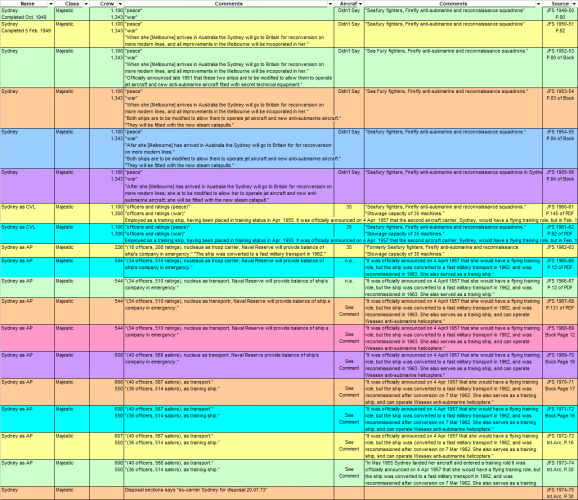
  • RAN planned HMAS Melbourne to either undergo a refit to become a Helicopter Carrier or be converted to a Fast Troop Transport & Training Ship to replace Sydney. Which one is more likely, or would Melbourne have to retire? If she is converted to a Helicopter Carrier would the RAN have enough Helicopters for both the Essex Carrier & Melbourne?
Included in the Carrier Replacement Plan was an expansion Plan for the RAN

  • Escort Maintenance Ship (HMAS Stalwart)
  • Fast Fleet Replenishment Ship (HMAS Protector AOE)
  • 5th & 6th Type 12 Frigates (Replacements for Voyager)
  • 4th DDG (Most obvious thing to do. Whoever said no to this was stupid)
  • Fitting Ikara to DDG’s & Type 12 Frigates
  • 5 new escorts (I’m guessing the joint development RN/RAN GP Escort Frigate)
  • 4 more Oberon Submarines (Bring total to 8 Oberon’s in RAN service)
  • Modernisation of Daring’s (Would be the same as OTL or Tartar & Ikara Modernisation?)
  • Six new minesweepers (Replacing Ton class in RAN service? What would these look like?)
  • 3 new Oceanographic Survey Ships
  • Mine countermeasure Support Ship (Would this be like a Destroyer Tender for Minesweepers?
  • 10 extra Wessex Helicopters (Bring total 37 Helicopters)
  • Sycamore Replacement (Would this be additional wessex’s or a different helicopters)
  • Attack Transport Ship to replace HMAS Sydney (Something like the Paul Revere Class?)
https://recordsearch.naa.gov.au/SearchNRetrieve/Interface/ViewImage.aspx?B=1565492
 
The obvious response is that an aircraft carrier is expensive to run. Therefore Australia would either have to spend more money on defence, or give up something else. I don't know what the Australian defence and political climate looked like in the mid-1960s to comment on what - though the obvious answer is that, in fact, what was given up was the 'new' aircraft carrier.

If we assume sufficient funds to see the new acquisition are found somewhere...

I'd suggest that the new carrier would probably take the name AUSTRALIA be run on into the 1990s. The air wing would probably stick with Phantoms unless a decision was made to replace it with a new conventional aircraft carrier. The replacement is difficult, it would have to be an (expensive) newbuild in an era when defence budgets were generally being cut. It's distinctly possible that there isn't a replacement at all.

Given the budgetary pressures, I'd be surprised if MELBOURNE wasn't converted to become the replacement for SYDNEY. Eventually it'd need replaced, but there ought to be a decade or so of use in the hull after conversion.
 
Perhaps the 1965 conscription scheme could also cover the Navy, although what happens when conscription ends is anyone's guess.

There was a fair bit of wishful thinking in th Essex class proposal, most namely if a Phantom, even with extended nose oleo and dropped ailerons, could operate from an Essex given the class' known limitation when operating it's steam catapults. In addition the Navy drastically understated how many aircraft would be needed to support the embarked squadrons in order o lower the already too hefty cost.
 
The obvious response is that an aircraft carrier is expensive to run. Therefore Australia would either have to spend more money on defence, or give up something else. I don't know what the Australian defence and political climate looked like in the mid-1960s to comment on what - though the obvious answer is that, in fact, what was given up was the 'new' aircraft carrier.

If we assume sufficient funds to see the new acquisition are found somewhere...

I'd suggest that the new carrier would probably take the name AUSTRALIA be run on into the 1990s. The air wing would probably stick with Phantoms unless a decision was made to replace it with a new conventional aircraft carrier. The replacement is difficult, it would have to be an (expensive) newbuild in an era when defence budgets were generally being cut. It's distinctly possible that there isn't a replacement at all.

Given the budgetary pressures, I'd be surprised if MELBOURNE wasn't converted to become the replacement for SYDNEY. Eventually it'd need replaced, but there ought to be a decade or so of use in the hull after conversion.
It was going to be named Australia thats obvious. If she last to the 90s and has ben running phantoms, hornets are lighter so she would be able to run hornets? It would have to be a new build replacement ? That's what I was thinking for Melbourne.
Perhaps the 1965 conscription scheme could also cover the Navy, although what happens when conscription ends is anyone's guess.

There was a fair bit of wishful thinking in th Essex class proposal, most namely if a Phantom, even with extended nose oleo and dropped ailerons, could operate from an Essex given the class' known limitation when operating it's steam catapults. In addition the Navy drastically understated how many aircraft would be needed to support the embarked squadrons in order o lower the already too hefty cost.
Maybe or the government just doesn't decide infantry battalions are the way to go.
RAN seemed quite confident about operating phantoms off it. While they weren't pussy when it comes to operating aircraft off smaller carriers compares to the usn and USMC
Thats probably true but would the f4s have a higher or lower attrition rate with this carrier compared to melbourne and a4s
 
Maybe or the government just doesn't decide infantry battalions are the way to go.

There's an awesome rabbit hole to go down, but likely not appropriate for a technical forum.

RAN seemed quite confident about operating phantoms off it.

The RAN was mofre keen on securing a future carrier more than they were on the specifics of operating the F4 on a refitted Essex. For example they casually threw out that a C7 catapult might be fitted if the C11s couldn't launch Phantoms and Scherg asked inthe margin if that was even possible. Scherg had a lot of questions on the Essex carrier, a lot of good questions. Some of them had reasonable answers, such as if the RAN needed escorts, minesweepers, patrol boats etc etc etc why is a carrier more important than these. Others, such as 24 F4s are not enough to maintain an embarked sqn of 16, don;t have a good answer.
 
There's an awesome rabbit hole to go down, but likely not appropriate for a technical forum.


The RAN was mofre keen on securing a future carrier more than they were on the specifics of operating the F4 on a refitted Essex. For example they casually threw out that a C7 catapult might be fitted if the C11s couldn't launch Phantoms and Scherg asked inthe margin if that was even possible. Scherg had a lot of questions on the Essex carrier, a lot of good questions. Some of them had reasonable answers, such as if the RAN needed escorts, minesweepers, patrol boats etc etc etc why is a carrier more important than these. Others, such as 24 F4s are not enough to maintain an embarked sqn of 16, don;t have a good answer.
Yeah it definitely is a good rabbit hole, that i'm always down to go down

I mean i don't blame the RAN on it cause its a lot harder to get a carrier than it is to get frigates and minesweepers (As seen with when Melbourne decommissions in the 80s)
The USN was quite confident the F-4 could fly off and they were confident they could fit the 250' catapults on the carrier.
Yeah 24 doesn't seem like enough but you can always buy more down the track. I think the 24 is enough to get the RAN Operating the carrier which is what is required straight away in my mind.
How many f-4s do you think is required in my mind at least 32?
 
How many f-4s do you think is required in my mind at least 32?

Scherg suggested as much in the margin comments, and I'd say that's about right.

To put that number into perspective the Australia defence budget in the early-mid 60s was capped at about 200 million Australian pounds, which were USD $2,20, and the RAN got about 55 million in the 1963-64 F/Y Budget, equivalent to USD $121m. The 64-65 saw a 13m pound increase over the previous year but that's still only about 69m Australian pounds or USD $151m.

Forces spend about 25-40% of their budget on capital equipment, the Army at the lower end and Air Forces and Navies in the higher end. That means the 63-64 Navy capital equipment budget would be about 20m pounds (USD $44m) and 27m (USD $60m) in 64-65.

In 1964 an F4B cost almost USD $2 million, so 32 would cost USD $64m. At the time a Mirage III cost about USD $1.5m and an A4E about USD $850k.

That makes 32 F4Bs (without any support which will be equal to 50-100% of the sticker cost) equal to the entire maximum capital equipment budget of the RAN for the entire 1964-65 financial year. More realistically that expenditure would be spread out over about 3 years, but of course the actual procurement is more like USD $100m, which is equivalent to about half of the upper estimate of the RANs capital equipment budget for 3 years. This is only the F4s, not the S2s, E1s or the carrier itself which had a pretty hefty procurement cost.

Little wonder Schrg had questions and the RAN bought S2s and A4s for the refitted Melbourne.

Sorry to be captain killjoy.
 
Little wonder Schrg had questions and the RAN bought S2s and A4s for the refitted Melbourne.
The main question seems to always be "why did Australia need a strike-capable carrier at all"? It make sence while there was hostile Indonesia to worry aboout. But after collapse of Sukarno regime, the value of the carrier diminished greatly. Its main value was basically "the alliance value", i.e. making Australia more valuable ally for USA through the capability to project power.

For the defense of Australia, strike-capable carrier was a dubious proposal. It waxn't exactly likely that Soviet armada would venture down under to protect indigenious population of Australia from capitalistic oppression (and in case THIS would happens and USN would NOT be able to stop it, the lone Australin carrier would hardly be anything more than a target for MRA). Australia wasn't important target in Cold War terms; it was too far away from major theaters for anyone to care much about it.

So buying Essex with Phantoms without any clear understanding what exactly they are supposed to do - besides "sailing with USN to fight American wars somewhere far away" - doesn't looks particularly good proposal. A variation of "Invincible"-class, equipped with helicopters & some Harriers would be much more reasonable.
 
In the early-mid 60s the SEATO-WW3 role for Melbourne was heading an ASW hunter-killer Task Force in the Sulu Sea. The RN deployed 2 carriers EoS plus whatever the USN Pacific fleet had, 6 attack carriers plus some CVS?

The Melbourne was to carry 4 A4s to defend the ASW TF, not do anything offensive. It was only once the British decided to leave EoS by 1972 that the RAN decided to get a 2nd batch of A4s to give Melbourne more flexibility in the 70s.

Personally I'd like all 20 A4s bought in 1 batch. Better yet not have the Melbourne declared an ASW carrier in 1959 and get the A4s and S2s by 1965.
 
The Melbourne was to carry 4 A4s to defend the ASW TF, not do anything offensive. It was only once the British decided to leave EoS by 1972 that the RAN decided to get a 2nd batch of A4s to give Melbourne more flexibility in the 70s.
Yep, the standard setup for this time - anti-submarine wing with a small number of fighter-bombers, mainly to chase away recon planes (and provide minimal strike capabilities, if required)
 
I reckon they only said 24 f4 is for coast reasons and would buy more latter on a replacements and expand the fleet
The main question seems to always be "why did Australia need a strike-capable carrier at all"? It make sence while there was hostile Indonesia to worry aboout. But after collapse of Sukarno regime, the value of the carrier diminished greatly. Its main value was basically "the alliance value", i.e. making Australia more valuable ally for USA through the capability to project power.

For the defense of Australia, strike-capable carrier was a dubious proposal. It waxn't exactly likely that Soviet armada would venture down under to protect indigenious population of Australia from capitalistic oppression (and in case THIS would happens and USN would NOT be able to stop it, the lone Australin carrier would hardly be anything more than a target for MRA). Australia wasn't important target in Cold War terms; it was too far away from major theaters for anyone to care much about it.

So buying Essex with Phantoms without any clear understanding what exactly they are supposed to do - besides "sailing with USN to fight American wars somewhere far away" - doesn't looks particularly good proposal. A variation of "Invincible"-class, equipped with helicopters & some Harriers would be much more reasonable.
The Essex carrier in ran service would be an anti submarine carrier first with the ability to conduct strikes. The Essex carrier give the ran more flexibility to conduct more complex operations that Melbourne could never do
 
In the early-mid 60s the SEATO-WW3 role for Melbourne was heading an ASW hunter-killer Task Force in the Sulu Sea. The RN deployed 2 carriers EoS plus whatever the USN Pacific fleet had, 6 attack carriers plus some CVS?

The Melbourne was to carry 4 A4s to defend the ASW TF, not do anything offensive. It was only once the British decided to leave EoS by 1972 that the RAN decided to get a 2nd batch of A4s to give Melbourne more flexibility in the 70s.

Personally I'd like all 20 A4s bought in 1 batch. Better yet not have the Melbourne declared an ASW carrier in 1959 and get the A4s and S2s by 1965.
Yep it would have made everything a lot easier in the long run
 
The Essex carrier in ran service would be an anti submarine carrier first with the ability to conduct strikes. The Essex carrier give the ran more flexibility to conduct more complex operations that Melbourne could never do
Then why Phantoms, if A-4 or F-8 Crusaders would suffice for the intended role?
 
Didn't the crusader have a really high attrition rate in service? Would that really be a good choice in that sense
 
Folks, read the document linked in the OP. It explains what Australia wanted a big deck carrier for, and why they wanted Phantoms for it. It's a sensibly thought through analysis of options - if we're going to play Monday morning quarterback, we ought to have at least watched the game.
Then why Phantoms, if A-4 or F-8 Crusaders would suffice for the intended role?
Because it was increasingly obvious that the A-4 wasn't an effective fighter when faced with a modern air threat. The F-8 was about to go out of production, while the F-4 was 'superior in design, weapon carrying, handling qualities, and possesses twin-engine safety'.

The contemporary USN studies for a CVS to replace the Essex class also called for an F-4 fighter component. It's not an irrational requirement at all. The proposed air wing is actually comparable to the one proposed for the Essex replacements.
 
Folks, read the document linked in the OP. It explains what Australia wanted a big deck carrier for, and why they wanted Phantoms for it. It's a sensibly thought through analysis of options - if we're going to play Monday morning quarterback, we ought to have at least watched the game.

I have no problem with the idea of Australia getting a big carrier, nor that it should have Phantoms as it's fighter. Tat all rests on sound analysis of the problems of disharging the duties outlined in Australians defence Policy and Strategy. Indeed it's much like the analysis the British undertook to come up with concepts like the Carrier Tactical Air Unit of 96 jets, 2 fighters if there are 2 carriers and 16 if there is only a single carrier, and why CVA01 had to be 53,000t with 36-42 jets not 40,000t with 30 jets.

My issues are those that Scherg noted in the margins of the document.
  • It wasn't known if the Essex class with C11 cats could operate the F4,
  • It wasn't known if C7s that could launch the F4 could be fitted to an Essex
  • 24 F4s and the other aircraft wouldn't be enough for a 16 aircraft CAG sqn
  • Why this big carrier was more important that the long list of other Navy requirements (easy to answer)

All in all the vast cost of this proposed capability given the tiny budget and more importantly the inability to crew such a ship in an era of full employment and ever increasing wages in a rapidly expanding and booming civilian economy. his factor was so bad that the Government introduced an unusual for Australia conscription scheme to expand the Army. Even if, despite all the hurdles, the Essex with Phantoms was acquired the Navy would become like a giant pair of tusks on an elephant too small to carry them. It would be akin to the RAAF getting B52/B58 bombers or the Army a full armoured division.
 
All in all the vast cost of this proposed capability given the tiny budget and more importantly the inability to crew such a ship in an era of full employment and ever increasing wages in a rapidly expanding and booming civilian economy.
Aye, there's the rub. The expensive toys that go fast and explode things need to fit into a defence policy, which in turn is only part of broader national policy.

In the interests of avoiding politics (which never leads anywhere good), it's sometimes necessary to ringfence the policy issues and assume that somehow they wash out in a way that allows the technical discussion we want.
It would be akin to the RAAF getting B52/B58 bombers or the Army a full armoured division.
I'd argue it's not unreasonable for Australia to field a full armoured division, if that was something it wanted to do.
Why this big carrier was more important that the long list of other Navy requirements (easy to answer)
The answer, of course, turned out to be 'it wasn't'.
 
The answer, of course, turned out to be 'it wasn't'.

I'd argue that by refitting an older escort, speeding up the procurement of any new escorts and doing upgrade refits on existing escorts the surface fleet can be rapidly increased in numbers and capability. In contrast the carrier capability is a once in a generation/service career decision which puts it in a different league and it's more than reasonable to treat the decision differently.

I'd argue it's not unreasonable for Australia to field a full armoured division, if that was something it wanted to do.

We've got nowhere to drive it, I'm more than happy with a fully armoured brigade group.

Aye, there's the rub. The expensive toys that go fast and explode things need to fit into a defence policy, which in turn is only part of broader national policy.

In the interests of avoiding politics (which never leads anywhere good), it's sometimes necessary to ringfence the policy issues and assume that somehow they wash out in a way that allows the technical discussion we want.

I'd say that the internet cares a lot about US partisan politics, considerably less about UK partisan politics, even less about Western European partisan politics and not at all abut Australian partisan politics.

In any case the issue as I see it is that military equipment from the 50s onward have service lives of 20-30 years. During the service life of the Centurion tank and HMAS Melbourne Australian defence policy/strategy went from re-fighting WW2 plus a few A-bombs with the 3rd AIF of initially 2 CMF divisions, to fighting Limited Wars in S.E.A. with SEATO/ANZUS allies using Regular Army units of Brigade or smaller, to defence self-reliance with the British withdrawn EoS and the US following the Guam Doctrine of allies defending themselves.

Therefore for an equipment procurement in the 60s to be considered 'good' it must be useful in the context of a defence environment of self reliance that wasn't even thought of when the equipment was procured. Fortunately by then our region was much quieter and more stable, most military capability (such as 'air defence') is fundamental enough that a change in defence policy/strategy doesn't require wholesale re-equipment. As I see it Australia's biggest problem isn't major equipment that was or wasn't purchased, but lines on org charts that put Australia in a better position to handle the transition to the defence self reliance period.
 
I don't think the RAN getting the Essex is too hard, yes the number of f-4s stated is probably too low but more can always get brought later on
I think the Essex Carrier would allow more self reliance and a stonger foreign policy cause it allows the RAN to operate in a more dangerous situations and allow for complex operations
 
Although this won't be popular. I suggest going the whole hogg and buying a CVA.01 or a SCB.100 the CVS that the USN wanted to build from the late 1960s to replace the Essex class in the CVS role.

Edit: I wrote that before reading Message 19 by @Rule of cool.

Another edit: The original edit was uploaded before @Caryina2642 uploaded Message 24.
 
Last edited:
Although this won't be popular. I suggest going the whole hogg and buying a CVA.01 or a SCB.100 the CVS that the USN wanted to build from the late 1960s to replace the Essex class in the CVS role.
That might be a wet dream for the admirals, an essex is about all australia could handle
 
Although this won't be popular. I suggest going the whole hogg and buying a CVA.01 or a SCB.100 the CVS that the USN wanted to build from the late 1960s to replace the Essex class in the CVS role.

Edit: I wrote that before reading Message 19 by @Rule of cool.

That makes a lot of sense in a number of ways, but unfortunately it is out of reach in the ways that count. If the RAN can't man the 2100 crew Hermes, it sure as he'll can't man the 3200 crew CVA01. It also can't afford the CAG or to crew that many planes.
 
That makes a lot of sense in a number of ways, but unfortunately it is out of reach in the ways that count. If the RAN can't man the 2100 crew Hermes, it sure as he'll can't man the 3200 crew CVA01. It also can't afford the CAG or to crew that many planes.
One thing i have always wondered would hermes crew 2100 in RAN service with an Anti submarine air wing cause wasn't Centuar crew around 1400 - 1500 which is only a couple 100 more than meblourne
SO i would say hermes is entirely possible
Essex possible but would need more POD's
CVA-01 australia would have needed todays population and economy even than unlikely
 
That might be a wet dream for the admirals, an essex is about all australia could handleRA
The stumbling block (as pointed out by @Rule of cool in Message 19) is finding the crew.

IIRC an Essex CVS in USN service had a crew of IIRC 2,400 and an Essex CVA in USN service had a crew of 3,500. The crew of one CVA.01 has been stated as from 2,700 to 3,200 and the difference of 500 men seems to be whether it had the normal air group of 47 aircraft or the maximum air group of 62 aircraft.

So if the RAN cant find the men to man a CVA.01 or SCB.100 they won't be able to man an Essex. IIRC the RAN planned to give its Essex a smaller air group (and therefore a smaller crew than the USN) but I think that when I read the files a CVA.01 and an Essex with the same air group required about the same number of men. @Rule of cool will correct me if I'm wrong. However, if I'm right an Australia can handle an Essex, it can handle a CVA.01 or SCB.100.

I've been deliberately using man, men and manning instead of crew and crewing, because the decision on what ship to buy would be taken shortly before the start of Women's Lib which would be in full swing when the ship entered service, so supplement the inadequate supply of men with women and allow them to serve at sea decades earlier than IOTL.
 
The stumbling block (as pointed out by @Rule of cool in Message 19) is finding the crew.

IIRC an Essex CVS in USN service had a crew of IIRC 2,400 and an Essex CVA in USN service had a crew of 3,500. The crew of one CVA.01 has been stated as from 2,700 to 3,200 and the difference of 500 men seems to be whether it had the normal air group of 47 aircraft or the maximum air group of 62 aircraft.

So if the RAN cant find the men to man a CVA.01 or SCB.100 they won't be able to man an Essex. IIRC the RAN planned to give its Essex a smaller air group (and therefore a smaller crew than the USN) but I think that when I read the files a CVA.01 and an Essex with the same air group required about the same number of men. @Rule of cool will correct me if I'm wrong. However, if I'm right an Australia can handle an Essex, it can handle a CVA.01 or SCB.100.

I've been deliberately using man, men and manning instead of crew and crewing, because the decision on what ship to buy would be taken shortly before the start of Women's Lib which would be in full swing when the ship entered service, so supplement the inadequate supply of men with women and allow them to serve at sea decades earlier than IOTL.
I can't rember what the crew numbers where in the document but I think they believed in peace time the could operate a crew of around 2000 maybe 2100 I believe
The problem with CVA-01 is the air group is to big for the ran to man at least with Essex class it is mostly helos and trackers
 
One thing I have always wondered would Hermes crew 2,100 in RAN service with an anti-submarine air wing cause wasn't Centaur crew around 1400 - 1500 which is only a couple 100 more than Melbourne.
So I would say Hermes is entirely possible.
Essex possible but would need more POD's.
CVA-01 Australia would have needed todays population and economy even than unlikely
I suspect that the crew of nearly 1,400 for Centaur in 1960s editions of Jane's are wrong and in reality the size of her crew was closer to the 2,100 or 2,200 that they give for Hermes.

Early 1960s Centaur only carried 4 or 5 fewer aircraft than Hermes and had the same machinery. Therefore, that can't account for Hermes having a crew of 2,100 or 2,200 and Centaur having a crew of less than 1,400. Furthermore, I very much doubt that the more advanced electronics aboard Hermes (Type 984 radar, CDS & DPT) was responsible of the difference of 700-800 men either.

I went through the editions of Jane's from the late 1940s to the early 1980s that are on-line and at my local reference library and the crew for Centaur is exactly the same from the early 1950s to the late 1960s. Which is another reason why I think that her early 1960s crew was a lot larger than 1960s editions of Jane's say it was.
 
I suspect that the crew of nearly 1,400 for Centaur in 1960s editions of Jane's are wrong and in reality the size of her crew was closer to the 2,100 or 2,200 that they give for Hermes.

Early 1960s Centaur only carried 4 or 5 fewer aircraft than Hermes and had the same machinery. Therefore, that can't account for Hermes having a crew of 2,100 or 2,200 and Centaur having a crew of less than 1,400. Furthermore, I very much doubt that the more advanced electronics aboard Hermes (Type 984 radar, CDS & DPT) was responsible of the difference of 700-800 men either.

I went through the editions of Jane's from the late 1940s to the early 1980s that are on-line and at my local reference library and the crew for Centaur is exactly the same from the early 1950s to the late 1960s. Which is another reason why I think that her early 1960s crew was a lot larger than 1960s editions of Jane's say it was.
Fair enough, though i would still believe an anti submarine air group on Hermes wouldn't require less of a crew maybe 1800 compared to when she was being used as a fleet carrier
 
Part of Message 28.
I can't remember what the crew numbers where in the document but I think they believed in peace time the could operate a crew of around 2000 maybe 2100 I believe.
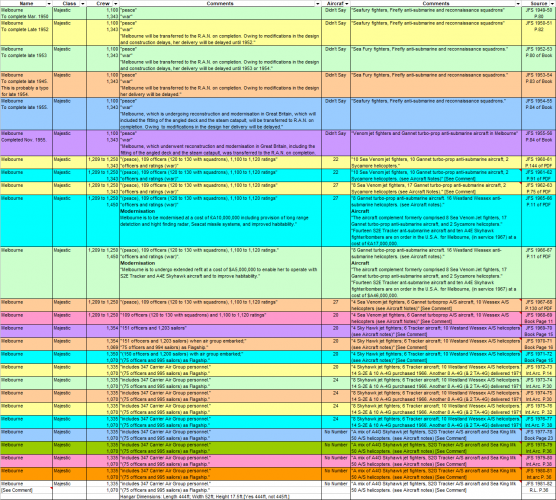
I don't recall what they said when I read them on-line, but it's about the same as Melbourne plus Sydney in the 1960s so one Essex could replace the two of them without having to increase the personnel establishment of the RAN.

From the OP.
A modernised and modified Essex Class Carrier with and Air group of 16x F-4B Phantom II, 12x S-2E Trackers, 4x E-1B Tracers, 16x Wessex ASW Helicopters & 2x Sycamore SAR Helicopters.
That's an air group of 32 fixed wing and 18 helicopters for a total of 50 aircraft.

FWIW a 1960s CVS Essex operated 4 A-4, 20 S-2, 4 E-1 and one C-1 for a total of 29 fixed-wing aircraft plus16 ASW helicopters (SH-34 and later SH-3) for a total of 45 aircraft. IIRC the crew was about 1,600 for the ship itself and 800 for the air group for a total of 2,400.

In 1972-73 Oriskany was operating an attack carrier air wing of 86 aircraft. It consisted of 28 F-8J, 42 A-7A/E, 4 RF-8G, 4 EKA-3B, 4 E-1B, 1 C-1A and 3 SH-3G. That's 83 fixed-wing plus 3 helicopters for SAR and Vertrep. She had a crew of 3,500 men, which IIRC was about 2,000 for the ship and 1,500 for the air wing.

Based on the above it looks unlikely that an Essex in the RAN could operate an air group of the size you propose with a crew that small. It's more likely to be at least 2,400.
 
Re Centaur's crew from Jane's 1954-55 to 1970-71 her crew was until the early 1960s
1,028 "ship's company, including ship's air complement"​
1,330 to 1,390 "including attached air squadron personnel"​
When it changed to.
1,028 "including ship's air staff"​
1,330 to 1,390 "with air squadrons"​
Same numbers, but different words for the same thing.

Editions of Janes for the 1960s said she carried 25 aircraft "17 fixed-wing plus 8 helicopters" which increased to 26 aircraft "18 plus 8 helicopters" from Jane's 1967-68 onwards, although she’d been an accommodation ship for a few years by then.

Initially Hermes was.
1,834 "peace complement (190 officers and 1,644 men)"​
2,100 "with air squadrons embarked"​
Then.
1,834 "190 officers, 1,644 men"​
2,100 "with air squadrons"​
And.
1,830 "190 officers, 1,640 men"​
2,100 "with air squadrons"​
Until her conversion to a Commando Carrier when Jane’s said.
980 "plus Commando of 750. In emergency a second commando can be embarked"​
"20 Wessex, Sea King and Sioux helicopters."​
The from Jane’s 1978-79 to 1981-82 (after her conversion to an ASW helicopter carrier) it said.
1,350 "(143 officers and 1,207 ratings). In emergency a Commando can be embarked"​
But, in this configuration she was only operating 13-14 aircraft. 9 Sea Kings plus 4 Wessex or 5 Sea Harriers.​
Jane's said that as a strike carrier she operated 20 or 22 fixed-wing aircraft plus 8 helicopters for a total of 28 or 30 aircraft.​
For completeness Albion as a Commando Carrier was initially.
1,037 "accommodation for 600 officers and men of Commando"​
"16 helicopters"​
And then from Jane’s 1962-63 to 1972-73.
1,035 "plus 733 Royal Marine Commando and troops; accommodation for 1,923 to 1,937 officers and men."​
"16 helicopters" until Jane’s 1969-70 and from 1970-71 it was “20 helicopters”.​

And Bulwark. Her first entry in Jane's as a commando carrier was in Jane’s 1959-60 which said.
1,037 "accommodation for 600 officers and men of Commando"​
Which by the middle of the 1960s had changed to.
1,035 "plus 900 Royal Marine Commando and troops; accommodation for 1,923 to 1,937 officers and men."​
Jane's 1974-75 to 1980-81 said.
980 "plus 750 Royal Marine Commando and troops."​
Jane's 1981-82 said that she was on the Disposal List and gave no other details about her.

Her air group was "16 helicopters" until Jane's 1969-70. From 1970-71 to 1973-74 said it was "20 helicopters”. 1974-75 to 1978-79 said "20 Wessex and Sioux helicopters". Finally, 1979-80 & 1980-81 said "20 Sea King and Wessex 5 helicopters"
 
I agree that australia could man a hermes or essex class carrier. But the acquiring the number of aircraft for the air wing is where i do see australia struggling
 
I think the best Australia could hope for is getting the Hermes in the early 70s and arming her with A4s and S2s in what would be pretty good number for the S.E.A. region. It would probably one need 1,700-1,800 crew day to day but in the Falklands peaked at 21 Harriers so could carry a pretty big A4 sqn. At $850k a pop the A4 is certainly more affordable in numbers than the Phantom.
 
I think the best Australia could hope for is getting the Hermes in the early 70s and arming her with A4s and S2s in what would be pretty good number for the S.E.A. region. It would probably one need 1,700-1,800 crew day to day but in the Falklands peaked at 21 Harriers so could carry a pretty big A4 sqn. At $850k a pop the A4 is certainly more affordable in numbers than the Phantom.
Agreed there would be perfect for australia in SEA
Wasn't Albion offered in 1960?
 
Agreed there would be perfect for australia in SEA
Wasn't Albion offered in 1960?

Albion and Bulwark were converted to Commando carriers somewhere around 1960.

Centaur was used as a small 'strike' carrier until 1965 when she was retired and used as an accommodation ship. She was the only one of the 4 ships finished with an axial deck and then converted to steam cats and angled deck.
 
Albion and Bulwark were converted to Commando carriers somewhere around 1960.

Centaur was used as a small 'strike' carrier until 1965 when she was retired and used as an accommodation ship. She was the only one of the 4 ships finished with an axial deck and then converted to steam cats and angled deck.
I've read that Albion before she sailed home from the far east to be converted to a commando carrier she was offered to australia to replace Melbourne. Obviously she would need a modernization something along the lines off Hermes
At the same time the USN offered an unmodernised Essex class carrier too
 
Canada looked at Hermes at least twice once while we were in discussion with the British over replacing Magnificent. It was favored over Bonaventure because of her larger size and growth potential.
And secondly just before Bonnie's refit in 64.
And if the reports are true An Essex two or three times .
The deal killer with both carriers was quite simple manpower. We couldn't manage to provide enough personal in both cases of Hermes and an Essex to man them .
Bonaventure required 1200-1300 men and officers.
 

Similar threads

Back
Top Bottom