
Reddington777
ACCESS: Top Secret
- Joined
- 23 March 2025
- Messages
- 831
- Reaction score
- 2,751
I'd imagine something like the SM-3? I have no idea what I'm talking about in this area though so.How much delta-v you want from individual interceptors?

I'd imagine something like the SM-3? I have no idea what I'm talking about in this area though so.How much delta-v you want from individual interceptors?

SM-3 have circa 4-5 km/s delta-v. Without booster (which isn't required for space-to-space launch), it would have about 1 ton of mass.I'd imagine something like the SM-3? I have no idea what I'm talking about in this area though so.
I was assuming however much the 3rd stage of the SM3 has.How much delta-v you want from individual interceptors?
Main question is, how much delta-v would individual interceptors need? The most costly part is inclination change; but raising/lowering the orbit to meet the missile would require burning engines too.I was assuming however much the 3rd stage of the SM3 has.
Edit: something like 1.5km/s, I think.
Inclination change is so expensive in delta-v that you might as well launch directly into that.Main question is, how much delta-v would individual interceptors need? The most costly part is inclination change; but raising/lowering the orbit to meet the missile would require burning engines too.


The planned demonstration would use radio-frequency communications terminals to establish satellite-to-satellite links between a government-owned communications satellite and a mock space-based interceptor (SBI).
“The government believes that the best approach for a low size, weight, and power (SWaP) solution in support of Golden Dome space-based interceptor (SBI) risk reduction and notional comm requirements will fall within the L/S-band spectrum and use the Link-182 waveform,” the BAA stated.
And that is how Mutually Assured Destruction is supposed to work. But what if Russia's leadership, caught in its echo chamber, decides that the US is about to launch an attack and the only option is to try a hail mary to destroy as many of our missiles as they can before they can be launched? It's also inevitable that many of our missiles, due to mechanical issues and human errors, won't be able to make it out of their silos in the time between when the President orders a launch and when the Russian missiles hit.If you aim all the warheads at the silos and the silos launch before the warheads get there, you just wasted all your nukes and got obliterated for your efforts.
Half hour flight time.And that is how Mutually Assured Destruction is supposed to work. But what if Russia's leadership, caught in its echo chamber, decides that the US is about to launch an attack and the only option is to try a hail mary to destroy as many of our missiles as they can before they can be launched? It's also inevitable that many of our missiles, due to mechanical issues and human errors, won't be able to make it out of their silos in the time between when the President orders a launch and when the Russian missiles hit.
SLBMs take much less than that.Half hour flight time.
Let's just say it doesn't take that long to bring the missiles online.
SLBMs take much less than that.

SiriusXM I presume?
I am Sirius and don't call me ShirleyShirley you can't be Sirius.
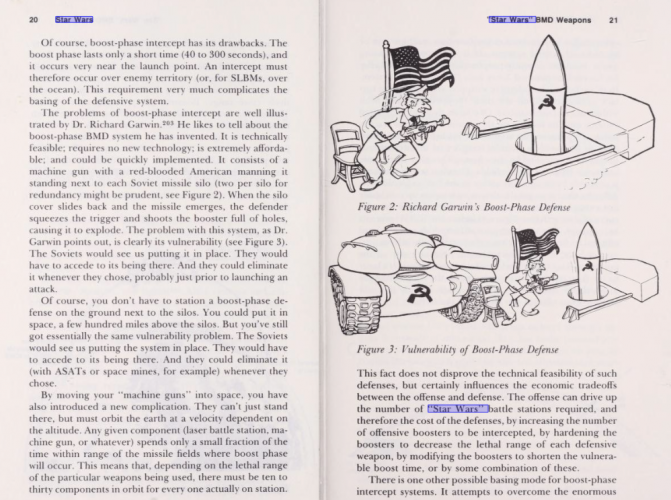 This sums up the problem of boost phase defense
Your data is kinda wrong. In 2000s US military tried to calculate casualties from limited nuclear war scenarios, and came to unexpected conclusion: the number of victims from the counterforce attack would far exceed the number of victims from countervalue attack.Of course, such an attack would lead to civilian casualties from nuclear fallout and blast and heat on communities near military bases, but the idea of every city in the west being reduced to rubble can be ruled out. Residents of Colorado Springs have more to fear than those in New York City.
Citation neededYour data is kinda wrong. In 2000s US military tried to calculate casualties from limited nuclear war scenarios, and came to unexpected conclusion: the number of victims from the counterforce attack would far exceed the number of victims from countervalue attack.
The reason was, that countervalue strikes against cities would likely be airbursts at sufficient heigh. Massive destruction, but little to no fallout. While counterforce strikes against ICBM siloes would be groundbursts with ENORMOUS ammount of fallout released. The total number of indirect casualties from heavy fallout would be far worse than from direct attacks against cities.
Sophie's Choice all over again?If you aim all the warheads at the silos and the silos launch before the warheads get there, you just wasted all your nukes and got obliterated for your efforts.
I'll try to recall the exact source.Citation needed
Make it make sense: Russia hits our cities without trying to take out our nuclear forces because...Deterrence only works if you hold value at risk, empty silos in Wyoming is not that. Maybe back in the day of 10,000 ICBMs you could target the silos, but nowadays it would be a waste. Only Russia can even target them and they wont do it. RVs will be hitting cities.
Hardly. You could just choose not to play the gameSophie's Choice all over again?
Because they only need 200ish warheads to cause major damage to our cities, keeping the bulk of their force in reserve for a 2nd strike. If they go after the silos, they blow 2/3s of their force on empty holes.Make it make sense: Russia hits our cities without trying to take out our nuclear forces because...
So could Sophie...Hardly. You could just choose not to play the game
Except the destruction isn't mutually assured if you only aim for silos and your adversary gets off even half the missiles and destroys your largest cities and industrial regions.And that is how Mutually Assured Destruction is supposed to work. But what if Russia's leadership, caught in its echo chamber, decides that the US is about to launch an attack and the only option is to try a hail mary to destroy as many of our missiles as they can before they can be launched? It's also inevitable that many of our missiles, due to mechanical issues and human errors, won't be able to make it out of their silos in the time between when the President orders a launch and when the Russian missiles hit.
In reality the tank is something equally vulnerable, so the soldier should have a Javelin and a tractor.View attachment 787289 This sums up the problem of boost phase defense
And then that leaves the US with 1700 nuclear warheads to wipe out Russia. And Russia's population and industry is way more concentrated. Moscow serves the same role to Russia that New York, Washington, and Chicago put together serve to America.Because they only need 200ish warheads to cause major damage to our cities, keeping the bulk of their force in reserve for a 2nd strike. If they go after the silos, they blow 2/3s of their force on empty holes.
https://archive.org/details/starwarsdefensei00bowm/page/n3/mode/2up?q="star+wars"+sdiView attachment 787289 This sums up the problem of boost phase defense
And thats how you get MAD, because Russia still has 1500 warheads left in that scenario to throw back. Using 2/3rd of your entire arsenal to maybe (highly unlikely) take out 400 US warheads is not worth it.And then that leaves the US with 1700 nuclear warheads to wipe out Russia. And Russia's population and industry is way more concentrated. Moscow serves the same role to Russia that New York, Washington, and Chicago put together serve to America.
That's why Sprint came into being--to keep the fireball from touching the ground, IIRCI'll try to recall the exact source.

The US has a higher urbanization rate than Russia.And then that leaves the US with 1700 nuclear warheads to wipe out Russia. And Russia's population and industry is way more concentrated. Moscow serves the same role to Russia that New York, Washington, and Chicago put together serve to America.
And Russia's population and industry is way more concentrated. Moscow serves the same role to Russia that New York, Washington, and Chicago put together serve to America.
The US has a higher urbanization rate than Russia.


Remember that a cluster of lower-yield warheads delivers greater destruction than a single large warhead.The fact that nuclear warhead sizes have shrunk over the decades as accuracy has improved (from 5 megatons in the early 60s to 1 megaton by the 70s, and down to 500 kilotons or less since the end of the Cold War) tells me that the plan is not to use them to wage genocide but to destroy specific strategic targets. Nuclear armed ICBMs are incredibly expensive and only worth it for targets that need to be destroyed very quickly. If Russia wanted to bomb our cities, they would probably use fighter jets and cruise missiles.
Remember that a cluster of lower-yield warheads delivers greater destruction than a single large warhead.
If you're implying that we've moved to a larger number of smaller warheads; there are far fewer warheads overall nowadays. The immense improvements in accuracy mean that conventional weapons can destroy what once required nuclear weapons.Remember that a cluster of lower-yield warheads delivers greater destruction than a single large warhead.

