AN/AWW-14(V)

ACCESS: Granted
Senior Member
Joined
18 May 2019
Messages
640
Reaction score
1,723
12.jpg

Solar geoengineering — putting aerosols into the atmosphere to reflect sunlight and reduce global warming — is not a fix-all for climate change but it could be one of several tools to manage climate risks. A growing body of research has explored the ability of solar geoengineering to reduce physical climate changes. But much less is known about how solar geoengineering could affect the ecosystem and, particularly, agriculture.

Now, research from the Harvard John A. Paulson School of Engineering and Applied Sciences (SEAS) finds that solar geoengineering may be surprisingly effective in alleviating some of the worst impacts of global warming on crops.

The research, a collaboration with the Norwegian Research Centre and the Bjerknes Centre for Climate Research, the Norwegian University of Science and Technology, the National Center for Atmospheric Research in Boulder, Seoul National University and the Chinese Academy of Sciences, is published in Nature Food.

“Research on solar geoengineering must address whether or not it is effective at reducing human impacts of climate change,” said David Keith, the Professor of Applied Physics at SEAS and Professor of Public Policy at the Harvard Kennedy School. “Our paper helps fill that gap by using the best crop model yet embedded in a climate model to examine the potential impact of solar geoengineering on agricultural yields.”

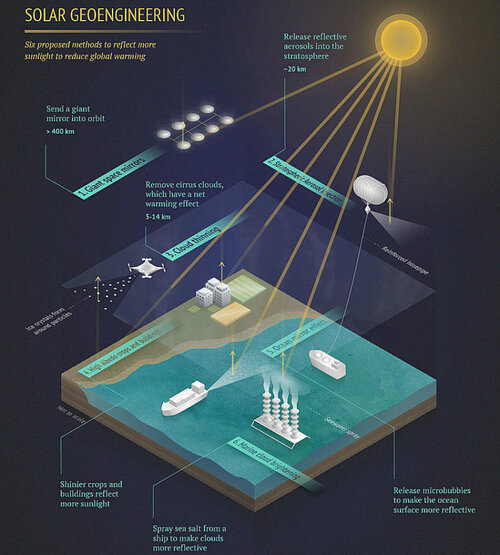
The team looked at three types of solar geoengineering — stratospheric aerosol injection, marine sky brightening, and cirrus cloud thinning — and their impact on the global yield of maize, sugarcane, wheat, rice, soy and cotton in a business-as-usual future where emissions continue at their current levels.

In such a future, the most effective way to protect crops against the worst effects of global climate change is to reduce the surface temperature. The researchers found that all three potential solar geoengineering methods have a strong cooling effect that would benefit crop yields.

Previous research suggested that cooling temperatures brought on by stratospheric aerosol injection may also lead to less rainfall, which could result in yield loss for rainfed crops. But these studies didn’t look at one of the most important ecological factors in crop transpiration and productivity — humidity.

“Relative humidity or vapor pressure deficit has stronger control on plant water use and crop productivity than precipitation,” said Yuanchao Fan, a Fellow in the Harvard Solar Geoengineering Research Program and first author of the paper. “We found that in a cooler world under multiple scenarios, except cirrus cloud thinning, there will be higher relative humidity, which will alleviate water stress for rainfed crops. Our model shows that the change in precipitation resulting from all three solar geoengineering methods would, in fact, have very little effect on crops.”


The researchers compared how agricultural productivity is affected by solar geoengineering and emissions reductions. The researchers found that while emissions reductions have strong cooling and humidity benefits, they may have a smaller benefit for crop yields than solar geoengineering because the reduction of CO2 fertilization reduces the productivity of most crops compared with solar geoengineering that achieves the same temperature reduction. The finding highlights the need to combine emissions reductions with other tools, including increasing the use of nitrogen fertilization and changes to land use.

“Climate risks cannot be resolved with any single tool; even if emissions were eliminated tomorrow the world’s most vulnerable will still suffer from climate change,” said Keith. “Policymakers need to consider how emissions cuts might be supplemented by specific local adaptations to help farmers reduce the impacts of climate on agriculture, and by global actions such as carbon removal and solar geoengineering.”

 
Last edited:
Scientists Say We Need to Look Into Solar Geoengineering Now—Before It’s Too Late

With the pace of emissions reductions looking unlikely to prevent damaging climate change, controversial geoengineering approaches are gaining traction. But aversion to even studying such a drastic option makes it hard to have a sensible conversation, say researchers.

Geoengineering refers to large-scale interventions designed to alter the Earth’s climate system in response to global warming. Some have suggested it may end up being a crucial part of the toolbox for tackling global warming, given that efforts to head off warming by reducing emissions seem well behind schedule.

One major plank of geoengineering is the idea of removing excess CO2 from the atmosphere, either through reforestation or carbon capture technology that will scrub emissions from industrial exhausts or directly from the air. There are limits to nature-based CO2 removal, though, and so-called “negative emissions technology” is a long way from maturity.

The other option is solar geoengineering, which involves deflecting sunlight away from the Earth by boosting the reflectivity of the atmosphere or the planet’s surface. Leading proposals involve injecting tiny particles into the stratosphere, making clouds whiter by spraying sea water into the atmosphere, or thinning out high cirrus clouds that trap heat.

In theory, this could reduce global warming fairly cheaply and quickly, but interfering with the Earth’s climate system carries unpredictable and potentially enormous risks. This has led to widespread opposition to even basic research into the idea. Earlier this year, a test of the approach by Sweden’s space agency was cancelled following concerted opposition.

But this lack of research means policymakers are flying blind when weighing the pros and cons of the approach, researchers write in a series of articles in the latest issue of Science. They outline why research into the approach is necessary and how social science in particular can help us better understand the potential trade-offs.

In an editorial, Edward A. Parson from the University of California, Los Angeles, notes that critics often point to the fact that solar geoengineering is a short-term solution to a long-term problem that is likely to be imperfect and whose effects could be uneven and unjust. More importantly, if solar geoengineering becomes acceptable to use, we may end up over-relying on it and putting less effort into emissions reductions or carbon removal.

This point is often used to argue that solar geoengineering can never be acceptable, and therefore research into it isn’t warranted. But Parson argues that both the potential harms and benefits of solar geoengineering are currently hypothetical due to a lack of research.

Rejecting an activity due to unknown harms might be justified in extreme circumstances and when the alternative is acceptable, he writes. But the alternative to solar geoengineering is potentially catastrophic climate change—unless we drastically ramp up emissions reductions and removals, which is far from a sure thing.

Part of the rationale for preventing solar geoengineering research is that it will drive socio-political lock-in that makes its deployment more likely. But Parson points out that rather than preventing its deployment, blocking research into solar geoengineering may actually lead to less-informed, more dangerous deployments by desperate policymakers further down the line.

One way to overcome some of the resistance to research in this area might be to make the debate around it more constructive, writes David W Keith from Harvard University in a policy paper. And the best way to do that is to disentangle the technical, political, and ethical aspects of the debate.

Appraising the pros and cons of solar geoengineering involves many different fields, from engineering to climate science to economics. But often, experts in one of these areas will give an overall judgment on the technology despite not being in a position to assess critical aspects of it.

Therefore, experts should make sure to disaggregate their judgments into those that are based on their expertise and those that aren’t, says Keith. He also provides a taxonomy of concerns on which expert opinion would be useful, including the physical risks posed by solar geoengineering, the potential that it could be deployed unjustly, the possibility it could be weaponized, and the idea that it could prove a slippery slope to “climate enhancement.”

Making this debate more informed won’t only involve more studies into the technicalities of solar geoengineering. There also needs to be an expansion in social science research to assess what the benefits and drawbacks might be and where they will fall, write the authors of a second policy paper.

While rough estimates put the cost of implementing solar geoengineering at five billion dollars a year, the authors point out that this only covers engineering. Making sound decisions around deployment will also require detailed measures of the physical and socioeconomic impacts of solar geoengineering to assess its benefits and costs, both in different areas and over different timescales.

Unless the world develops a coordinated approach to deploying solar geoengineering, it will also be important to study the options and incentives that will govern the decisions of state or non-state actors to deploy it. This could give insights into the potential triggers for unilateral deployment and what might be done to discourage it.

Whether these calls for more research will be heeded is uncertain, but momentum does seem to be building. And given our lackluster progress on heading off climate change, it may be unwise to take any of our cards off the table.

 
stratospheric aerosol injection is exciting technology, I think midscale practical experiment (may be one hundred flights of modify KC-135 USAF tanker) is to be start right now
 
Last edited:
I vote for a spaceborne shield, even if it would be no small feat. Main advantage: it doesn't touch (or wreck) the biosphere proper. In case of dust or small reflectors at a libration point: if something wrong happens, then let them just float away.
 
I vote for a spaceborne shield, even if it would be no small feat.
It's seems not much easier than colonization of the Moon
Yes, and? We should have colonized the moon *years* ago. The tech and industrial base that would ahve allowed for luanr colonization, industrialization and economic explotation would make solar shields fairly trivial. Instead of simple mirrors, plop tens of thousands of square kilometers of PV arrays made on and launched from the moon into the Lagrange point between the Earth and the sun. Not only shield Earth from the sun, but convert a small fraction of that deflected sunlight into enough microwave power to allow us to shut off every last environmentally damaging natural gas, coal, wind and hydro power plant.
 
Aerosols need to be off the table for two reasons-acid rain...and the threat of volcanism adding even more to the mix and freezing us out. ONLY space-based answers please. The sun dims-we reflect more light TO Earth, or block same. Unlike fusion, dyson harrop cables might stop another Carrington event. SPSS is a three-fer. The Space Show had a guest on the subject Tuesday.

Of interest
 
Last edited:
I vote for a spaceborne shield, even if it would be no small feat.
It's seems not much easier than colonization of the Moon
Yes, and? We should have colonized the moon *years* ago. The tech and industrial base that would ahve allowed for luanr colonization, industrialization and economic explotation would make solar shields fairly trivial. Instead of simple mirrors, plop tens of thousands of square kilometers of PV arrays made on and launched from the moon into the Lagrange point between the Earth and the sun. Not only shield Earth from the sun, but convert a small fraction of that deflected sunlight into enough microwave power to allow us to shut off every last environmentally damaging natural gas, coal, wind and hydro power plant.

Yes. I'm loving it (as would said McDonald).
The Moon is very poor in resources, except
- aluminum
- silicon
- oxygen
(Everything else - REEs, PGMs, He3, Thorium - is a pipe dream.)
These three at least are abundant in the regolith.

All right then, let's work from the three resources above.

Aluminum + silicon = solar arrays

Aluminum + oxygen = SSTLE (Single Stage To Lunar Escape)
- rockets to boost the local solar arrays out of the Moon surface and indeed, to a libration point: either the five Earth-Moon or the five Sun-Earth points.

To me it is the one and only lunar industrialization / resources scheme that makes any sense.
- There are plans for lunar rovers scooping regolith at the front and churning solar arrays at the rear.
- that scheme bring together solar power (for a lunar base), SBSP (Space Based Solar Power, from the Moon to GEO it is slightly easier),and a global warming spaceshield. In a step-by-step approach: solar arrays to SBSP, then SBSP giant structures to the anti-GW spaceborne shield...
 
Last edited:
Acid rain results from these sprays. Ban aerosols—and you force them to become space advocates.

Same with the medical community and disease research. Force that off world too…at least to contain any lab accidents with surety.
 
 
Again—if we get another Laki/Tambora one-two punch right after the spraying—here comes another (big) ice age.

Space reflectors alone need consideration.

Post 71 here is of interest
 
Last edited:
Real-world geoengineering experiments spanning the globe from the Arctic to the Great Barrier Reef are being funded by the UK government. They will test sun-reflecting particles in the stratosphere, brightening reflective clouds using sprays of seawater and pumping water on to sea ice to thicken it.

Getting this “critical missing scientific data” is vital with the Earth nearing several catastrophic climate tipping points, said the Advanced Research and Invention Agency (Aria), the government agency backing the plan. If demonstrated to be safe, geoengineering could temporarily cool the planet and give more time to tackle the root cause of the climate crisis: the burning of fossil fuels.


The announcement was criticised by Prof Raymond Pierrehumbert at the University of Oxford: “Solar geoengineering has enormous and troubling implications for global society. The UK funding sets a dangerous precedent for other governments to jump on the bandwagon [and] it is the height of folly to open the door to field experiments in the absence of any national or international governance.”

Mary Church, at the Center for International Environmental Law, said: “Solar geoengineering is inherently unpredictable and risks breaking further an already broken climate system. Conducting small-scale experiments risks normalising highly controversial theories and accelerating technological development, creating a slippery slope toward full-scale deployment.”
 
Again—if we get another Laki/Tambora one-two punch right after the spraying—here comes another (big) ice age.

Very unlikely, unless the Big Ice Age was just about to happen anyway. When volcanoes go off, they can cool the planet but only for a year or so. Then things go back to where they were. That's the problem with the doomshriekers when it comes to geoengineering: humans can't throw up a sunshade all at once that can meaningfully cool the planet; it'll take us years to get there. And it will need to be constantly replenished. The moment we stop, or even slow down, things start going back to where they were.
 
That's the problem with the doomshriekers
A little knowledge is a dangerous thing, and ecosystems are complex. Tinker with them at your peril.
From Hyman Rickover:
"It troubles me that we are so easily pressured by purveyors of technology into permitting so-called "progress" to alter our lives without attempting to control it-as if technology were an irrepressible force of nature to which we must meekly submit."
Parson argues that both the potential harms and benefits of solar geoengineering are currently hypothetical due to a lack of research.
 
Last edited:
It appears that they attempted to conduct this test in secret, even mostly from local officials. Also much the funding for this is a complex web much of which is unclear.

A team of researchers in California drew notoriety last year with an aborted experiment on a retired aircraft carrier that sought to test a machine for creating clouds.

But behind the scenes, they were planning a much larger and potentially riskier study of salt-water-spraying equipment that could eventually be used to dim the sun’s rays — a multimillion-dollar project aimed at producing clouds over a stretch of ocean larger than Puerto Rico.


The details outlined in funding requests, emails, texts and other records obtained by POLITICO’s E&E News raise new questions about a secretive billionaire-backed initiative that oversaw last year’s brief solar geoengineering experiment on the San Francisco Bay.

They also offer a rare glimpse into the vast scope of research aimed at finding ways to counter the Earth’s warming, work that has often occurred outside public view. Such research is drawing increased interest at a time when efforts to address the root cause of climate change — burning fossil fuels — are facing setbacks in the U.S. and Europe. But the notion of human tinkering with the weather and climate has drawn a political backlash and generated conspiracy theories, adding to the challenges of mounting even small-scale tests.
 
Why use aerosols inside the atmosphere if dust screens can be placed in polar orbit? A small asteroid with several robotic systems would be enough to pulverize the surface gravel and then launch it into space.
With this system, the solar radiation received by the planet can be regulated with great precision and has the advantage of being totally reversible, it would be enough to recapture the dust of some strips with something similar to a trawl net or add more dust when necessary.
 
Last edited:
This is why space-based approaches are superior.

Sun dims? Reflect more light to Earth.
Earth warms? Reflect light away.

Acid rain comes from aerosol injections, that can only be reversed at length!

You leave atmospheric chemistry be.

Insolation is key--not just chemistry alone.

Remember, El Chichon was no stronger than St. Helens, but the SO2 levels were far higher.

BTW, Nevado del Ruiz inundated Amero, not Galeras--that took out Stanley Williams.

Some news about AGW
A team led by the Institut de Ciències del Mar (ICM-CSIC) has described a sustained and unprecedented decrease in the abundance of marine viruses in the northwestern Mediterranean over the last two decades. The finding, published in the journal ISME Communications, is based on the longest-known time series data on marine viruses to date, from the Blanes Bay Microbial Observatory (BBMO) in Girona.

More
 
Last edited:
I just hope that the race between scientifically thoroughly understanding the physics of our home planet's atmosphere and our engineering capabilities to manipulate it will be won by the former...
 
I just hope that the race between scientifically thoroughly understanding the physics of our home planet's atmosphere and our engineering capabilities to manipulate it will be won by the former...
"I find your lack of faith disturbing."

;)
 
Last edited:
Turning point.
That describes an eleven-year solar cycle, human induced global warming has been going on for a lot longer.

In 1969, the tanker Manhattan made the journey from Chester, Pennsylvania to Point Barrow, Alaska. She was fitted with a heavy icebreaker bow.
The Manhattan, heavily reinforced for this voyage, was as long as the Empire State building laid on its side, and displaced about twice the amount of water as the Queen Elizabeth. She was equipped with the latest nautical navigation aids, relying largely on satellite fixes which could place her location to within a third of the ship's length. These instruments did not always work, however, and at times it was necessary for the crew to measure the ship's speed by throwing blocks overboard and timing their passage by stopwatch.

Setting sail from Chester, Pennsylvania on August 24, 1969, she managed to plow her way north to Point Barrow by September 14, and returned to New York by November 12.

But there were problems. Although the Manhattan broke ice up to 14 feet thick for extended periods and smashed ice ridges up to 40 feet, she often got stuck in hard polar ice.

Apparently underpowered in reverse, she had only one-fourth as much power to go astern as to go forward. At one point on the night of September 10-11, the Manhattan was attempting to become the first vessel to make an east-to-west passage of McClure Strait when she became locked. She escaped only when steam was diverted from heating the living spaces to squeeze an additional 7,000 horsepower from her 43,000 horsepower turbines. Even then, it was only with the assistance of her constant companion, the Canadian icebreaker, "John A. McDonald," that she was able to escape. The U.S. Coast Guard ship "Staten Island" also assisted in the effort.
There and back, the journey took two months and three weeks.
These days, cruise ships with only moderate ice strengthening navigate the North West Passage unassisted.
 
Last edited:
There and back, the journey took two months and three weeks.
These days, cruise ships with only moderate ice strengthening navigate the North West Passage unassisted.
O/T
I've often thought sailors needed to be the face of individuals fighting climate change, not Bill Nye or Neil Neil deGrasse Tyson, as much as I admire them. Too ivory tower for the rank and file.

The words would mean more if they came from somebody like the character Quint on JAWS.
At least we have this individual:

When a workin' man says he's seen things, it hits different.
Sailors have known about rogue waves centuries before eggheads learned they weren't lying.

That's the value of the plain-folks approach. But working people also need to be heard when regs could put them out of work--a balance has to be struck:

Science communication is a conversation, not a script​

"The distrust that people ended up feeling towards government and health officials was partly because [these officials] didn't work out how to communicate the uncertainty," says Susannah.

"People don't tend to trust institutions as much as they trust individuals. I think that transparency is really important."
 
Last edited:
I've often thought sailors needed to be the face of individuals fighting climate change, not Bill Nye or Neil Neil deGrasse Tyson, as much as I admire them. Too ivory tower for the rank and file.
I thought to mention Manhattan's journey because it involves things people here are likely to relate to. I also mention the glaciers I saw in the Swiss Alps some forty years ago, which are now much reduced.
Listen, look for the changes. Beware of wishful thinking.
Two quotes:
"The first principle is that you must not fool yourself and you are the easiest person to fool.”
"Listen, buddy, if I could tell you in a minute what I did, it wouldn’t be worth the Nobel Prize.”
– Richard Feynman
We NEED the people from the 'ivory tower', the ones who have slogged for YEARS to understand, to explain what can be seen if ordinary people care to look for it. Vanishing glaciers, melting polar ice caps, freak weather. Or look away, cover your ears. You choose.
 
It wouldn't be cheap--but could off-set its cost by also being a powersat(s) since the energy market is more lucrative than telecom like Starlink.

What you don't want to do--inexpensive or not--is spray crap in the atmosphere. That can come back as acid rain--so aerosols should be off the table.

Sunshades can be dual use--if the Sun dims during another Maunder Minimum type situation--you can always reflect more light to Earth. Over deep time, the Sun will brighten--so the sunshade(s) will spend most of its time reflecting light away.

This is also a way to keep defense contractors happy--so we don't have to worry about another Cheney ginning up a war.
It will help spacelift--so that is another factor.
 
Over "deep time" won't the shields be ruined by impacts?
The systems need to be actively controlled, and the electronics won't last that long, so deep time is not of concern; it just has to last a decade (maybe a few decades if you're lucky), after which you dump the old satellite into a garbage disposal orbit (probably heliocentric), or scrap the old satellite, and put up a new one.

Modern GEO commsats last a few decades, LEO satellites last a decade or less depending on the orbit chosen, and they are propellant limited. A sunshade can in theory have little vanes to control orientation and so can dispense with thrusters or propellant, but the electronics will need replacing, and you have an active ground segment (mission control) keeping everything under control.

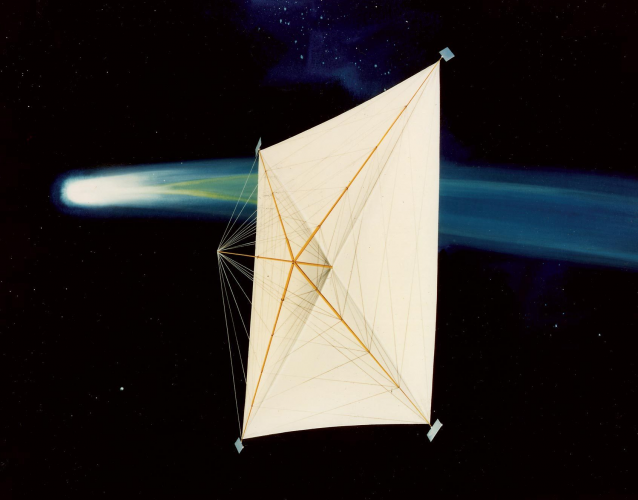
This was the proposed sail mission to Halley's comet back in the 70s (half a mile by half a mile, approx 30 tonnes), note the little vanes on the corners for attitude control. A sunshade array might consist of a few million satellites of similar construction, maneuvered to the Earth-Sun Lagarange Point although it depends on how much cooling you need; in theory, you can each satellite somewhat less than 30 tonnes.

1759553035241.png
 
Last edited:
On sunshades

Problems
A new study in Environmental Research Letters reports that cooling the planet by injecting sulfur dioxide into the stratosphere, a proposed climate intervention technique, could reduce the nutritional value of the world's crops.
 
Last edited:
Back
Top Bottom