Seriously, is anyone still taking this golden dome BS for real??? I would *HIGHLY* recommend to do a statistical analysis of *EVERYTHING* that the donster more or less solemnly proclaimed he would do vs. what he *ACTUALLY* did so far...
 
Oh I fully agree, its a headache of universal proportions, and I don't have a solution for how to police potential participants robustly. But look at it from the other side; all those years of negotiations between the USA and USSR eventually paid real dividends. Nuclear stockpiles dropped by 75% from ludicrous levels to only ridiculous levels.
ANd how do you suggest to reach a treaty treaty between USA, Russia, China and EU? For example; Russia stated long ago that it is not interested in limitation treaties that would not include French and British nuclear weapons also, since they put Russia in disadvantage. Since France would not surrender its warheads for sure, then what? USA should agree to reduce the number of American warhead proportionally to the number of French? Or NATO should be dissolved and American and European warheads counted separatedly, not as allied forces? Or North Korean warheads should be counted also, since Russia and North Korea have an official mutual defense treaty now? What to do with Israel, which didn't even admit it have nukes, far less how many they have? Israel is US ally, after all.
 
BMW's color changing paint is the only thing I know of that could offer a good cost-exchange ratio with existing technology. Given warning of an attack, all buildings could be turned white to reflect the heat of the explosion. But that of course isn't as sexy as space-based interceptors.
View: https://youtu.be/499TkWOl4PM?si=kfqgbwJrR1vocEgk
 
Last edited:
A quick look at the history of US and Soviet ABM programmes during the Cold War auggests it is easier to build and deploy offensive systems than defensive ones.
The same is true of drones which can be built much more cheaply than means to shoot them down.
For many years Patriot did offer a means of coping with SCUD type ballistic missiles but even there the SCUD were cheaper than the Patriots.
 
A quick look at the history of US and Soviet ABM programmes during the Cold War auggests it is easier to build and deploy offensive systems than defensive ones.
The same is true of drones which can be built much more cheaply than means to shoot them down.
For many years Patriot did offer a means of coping with SCUD type ballistic missiles but even there the SCUD were cheaper than the Patriots.
Yep. The only hope now for defenders is from directed energy weapons
 
Seriously, is anyone still taking this golden dome BS for real??? I would *HIGHLY* recommend to do a statistical analysis of *EVERYTHING* that the donster more or less solemnly proclaimed he would do vs. what he *ACTUALLY* did so far...
Dude chill it was announced four month ago.
 
it is easier to build and deploy offensive systems than defensive ones.
It is "easiest" to build a dead-man trigger rigged to 450 ICBMs that would plaster every inch of soil across the globe with radiation.
But Golden Dome is about defense. We are seeing in real life continual brinksmanship and escalation from Russia. And then we didn't nuke the Taliban mountain. Obviously, guns out dogfight mocks... is not the end-all of everything. That's why defense exist.

The most cost efficient (theoretically speaking) national air defense mechanism would be batteries of nuclear pumped lasers. The newest power plants just entered operation for just shy of 2 years. So it's not like everything's hopeless, but we need more inertia.
 
Again, Golden Dome is not just building orbital killers. It's a holistic look at national air/space defense.

American doctrine also explicitly go against "dust devil" tactics like that, ever since they moved over to full LOW with utmost confidence in sensors, and Sprint was just an one-off. Are MM3/Sentinel even qualified to ride out of pindown like that? At least the Satan lineage had special coatings for that job.
 
Maybe okay for defending a small area for a small time but everywhere else would burn.
Our missile silos will be bearing the brunt of the damage in a nuclear attack.
Not to mention that they aren't even 100% effective against slow as dog turd drones never mind Mach 20+ RVs.
At Mach 20, any shrapnel becomes *more* not less damaging.
 
Our missile silos will be bearing the brunt of the damage in a nuclear attack.
The missile silos would be empty by the time the nuclear attack arrives. So you'd be protecting a silo that's 99.9% likely to be empty whilst all your cities and other land-based military facilities get reduced to ash.
At Mach 20, any shrapnel becomes *more* not less damaging.
But the time window for effect is >100x shorter, plus you'd need to keep all these rockets in sturdy silos too, otherwise a single airburst takes out all your rockets. Plus your radar timing their launch would be gone anyway, so that would make these short-range rockets utterly useless whether silo'd or not because they can be neutralised by an airburst from outside their effective range. Hence why this type of defence has been completely abandoned.
 
But the time window for effect is >100x shorter, plus you'd need to keep all these rockets in sturdy silos too, otherwise a single airburst takes out all your rockets. Plus your radar timing their launch would be gone anyway, so that would make these short-range rockets utterly useless whether silo'd or not because they can be neutralised by an airburst from outside their effective range. Hence why this type of defence has been completely abandoned.
What I'm hearing is this would require the enemy to aim multiple warheads at each silo, which is a good thing.
 
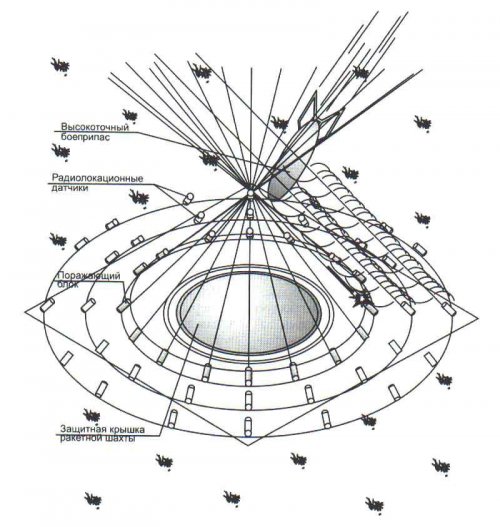
Reportedly, Russia has something called Mozyr to defend their missile silos. It uses unguided rockets that create clouds of shrapnel that destroy incoming warheads. This seems like a sensible idea and we should look into it before jumping into fantastical ideas about battle stations in space.
Its the concept of silo protection. Silo is hardened target, and required nuke to hit very close to destroy it. So the warhead potential trajectories toward silo are very limited, and could be easily saturated with enough shrapnel.

For protection of soft targets - like cities - such system would be absolutely useless, since its impossible to predict where exactly in city warheads would be aimed and city burners would likely do airburst anyway.
 
The missile silos would be empty by the time the nuclear attack arrives. So you'd be protecting a silo that's 99.9% likely to be empty whilst all your cities and other land-based military facilities get reduced to ash.
Its not so simple. Launch-on-warning doctrine caused many concerns during Cold War, sjnce it left very little time to evaluate the attack (determine the perpetuator, the goals, the scale) and made correct decisions.
 
Its not so simple. Launch-on-warning doctrine caused many concerns during Cold War, sjnce it left very little time to evaluate the attack (determine the perpetuator, the goals, the scale) and made correct decisions.
The OODA net now has at arms thousands of overlapping multispectral sensors for cross reference. It's doubtful that the US even practice LUA anymore, most of the silo reinforcement came from an ancient time when there were sensible people holding doubts about the reliability of early electronics that get deceived by natural causes easily.
And it's not like we have just shy of 90 years to experience people fretting over a random sounding rocket launch.

The USSR at least had validity in their concerns as SAC was overdrived on stuff like hyper accurate, hard target destruction and extremely quick launch cycles (<60secs), all plausible fundamentos for rapid neutralization of strategic C3 complexes and the silos themselves IOW first strike capability. Hence stuff like hardened coatings for ride out of pindown on the SS-9 tapestry and presumbly these "dust devil" tactics aforementioned.

In any case, silo ABM defense is mostly a fraud tactic nowadays if you are the US. There exists no credibility to that directive when people could point left and right for sensors reliability and redundancy, really. Silo base defense though is another matter, in 2003 or so we have anti war nuns intrude on the base and pour paint over the lid seals. Now imagine if it's a cell of Spetnaz with thermites. Pay for sentries and sensor perimeters instead.
 
Last edited:
Reportedly, Russia has something called Mozyr to defend their missile silos. It uses unguided rockets that create clouds of shrapnel that destroy incoming warheads. This seems like a sensible idea and we should look into it before jumping into fantastical ideas about battle stations in space.
According to other sources they closed program in1990s due to lack of proper computing power. I assume silo dispersion is also an issue as you need to have at least one radar maybe more for final MIRV acquisition and engagement. Then MARVs coming into picture. Costly game with doubtful results.
 
What I'm hearing is this would require the enemy to aim multiple warheads at each silo, which is a good thing.
Only if there's one radar for every single silo. In a pre-emptive strike scenario there is bound to be more than one warhead per silo anyway, simply because you can't guarantee that every single warhead, or even every single missile, would work. Apart from that fragmentation alone has proven very difficult to time even against much slower missiles, e.g. PAC-2 is less effective than PAC-3, S-400s struggling not to get killed by ATACMs. The chances of this system stopping an ICBM warhead is somewhere between very little and nil and it leaves all your cities to be turned into ash with a single warhead. You also only get one chance with this system, fail and you're toast, but if I miss an endoatmospheric intercept of the boost vehicle, then I still have options.

 
Its the concept of silo protection. Silo is hardened target, and required nuke to hit very close to destroy it. So the warhead potential trajectories toward silo are very limited, and could be easily saturated with enough shrapnel.

For protection of soft targets - like cities - such system would be absolutely useless, since its impossible to predict where exactly in city warheads would be aimed and city burners would likely do airburst anyway.
There is no realistic way to defend our cities with current technology. ABMs are too expensive and lasers are a ways out. And attacks on our missile silos will be the source of almost all radioactive fallout, so in that sense, defending our silos is defending our cities
That is assuming the silos are even being targeted.
In what scenario would China or Russia nuke our cities and leave 400 nuclear missiles intact to retaliate?
Only if there's one radar for every single silo. In a pre-emptive strike scenario there is bound to be more than one warhead per silo anyway, simply because you can't guarantee that every single warhead, or even every single missile, would work. Apart from that fragmentation alone has proven very difficult to time even against much slower missiles, e.g. PAC-2 is less effective than PAC-3, S-400s struggling not to get killed by ATACMs. The chances of this system stopping an ICBM warhead is somewhere between very little and nil and it leaves all your cities to be turned into ash with a single warhead. You also only get one chance with this system, fail and you're toast, but if I miss an endoatmospheric intercept of the boost vehicle, then I still have options.
The beauty of the debris cloud method is that the speed at which the target is traveling is turned into an advantage. At Mach 20, even the smallest piece of debris will be highly destructive.
 
In what scenario would China or Russia nuke our cities and leave 400 nuclear missiles intact to retaliate?
If they are nuking our cities, those silos will be empty by the time the missiles hit. Silos are not easy targets either, you need high-yield accurate RVs or multiple ones. If you are hitting the silos + launch control centers, that's 1,000 heavy warheads not hitting something else.
 
If they are nuking our cities, those silos will be empty by the time the missiles hit. Silos are not easy targets either, you need high-yield accurate RVs or multiple ones. If you are hitting the silos + launch control centers, that's 1,000 heavy warheads not hitting something else.
Phase 1: Nuke America's cities
Phase 2: ???
Phase 3: Profit!
 
It's not something I want to pin the defense of the country on.
You wouldn't... Again, Iron Dome is not "space based interceptors", it's "ground based and space based and lasers if possible". It's just the catch all plan for total defense.
At the very least, GBI and NGI has lurked on.
 

Similar threads

Back
Top Bottom