Status
Not open for further replies.
https://ukdefencejournal.org.uk/royal-navy-prepares-for-next-gen-missile-defence/
Looking ahead, Pollard highlighted the Future Air Dominance System (FADS), describing it as “a transformative multi-domain Royal Navy programme that will provide Maritime Integrated Air and Missile Defence against the toughest of threats in the air and space domain, and Long-Range Precision Strike against the most difficult targets in air, land, and maritime domains.”

'Space domain'? If we take that at face value, then it seems the SM-3 is at the very least being considered. If that is the case, it'd be a step-change in capability. I don't think MBDA currently offers, or has public plans for anything capable of exoatmospheric interceptions - their Aquila project is endoatmospheric.

Integrating CAMM, Aster and SM-3 under a single CMS architecture could be challenging.

My other theory would be that this refers more to exoatmospheric tracking of BMs, before handing off that data to American or Dutch ships, or land-based launchers in Poland and Romania, for actual exoatmospheric interception.

Of course, I should note that the mission requirements for the FADS are still being refined, so all is subject to change.
 
Space domain...
Sampson proved itself good for BMD tracking, that work is now decades old.

So the obvious is just that, ability to provide tracking of multiple targets outside the atmosphere.

MBDA.....maybe...

SM-6.....I'm starting to question that sort of assumption. Things seem in motion and that sort of thinking is pre-Trump2 and frankly pre-2022.

Who would have thought Nightfall would be issued, even last year it was all PrSM.

UK getting into space.....quite possibly.....parliamentary committees increasingly calling for sovereign launch.
 
'Space domain'? If we take that at face value, then it seems the SM-3 is at the very least being considered. If that is the case, it'd be a step-change in capability. I don't think MBDA currently offers, or has public plans for anything capable of exoatmospheric interceptions - their Aquila project is endoatmospheric.

Integrating CAMM, Aster and SM-3 under a single CMS architecture could be challenging.

My other theory would be that this refers more to exoatmospheric tracking of BMs, before handing off that data to American or Dutch ships, or land-based launchers in Poland and Romania, for actual exoatmospheric interception.

Of course, I should note that the mission requirements for the FADS are still being refined, so all is subject to change.
SM3 is possible, for ship defense versus AShBMs. Personally, I'm hoping for an "SM3Block3" or "SM7" that has an endo-atmospheric capable top stage sitting on top of the 21" SM3Blk2 stack. Conceptually like replacing the SM3 KV with THAAD KV, but with a solid DACS instead of hypergolic liquids because the USN in particular is anaphylactic allergic to hypergolic liquids on ship. This may be what GPI/Glide Breaker is.

But I suspect that it's just talking about radar tracking of targets in space.


UK getting into space.....quite possibly.....parliamentary committees increasingly calling for sovereign launch.
Good luck with that. Where exactly does the UK think they have a good place to launch from?!? :D
 
So the obvious is just that, ability to provide tracking of multiple targets outside the atmosphere.

But I suspect that it's just talking about radar tracking of targets in space.

Yeah, that's the option that makes the most sense and is most likely. It's a shame though, having the destroyer be equipped with an exo-atmospheric interceptor would probably be the most reasonable way to give the UK actual BMD coverage.
 
Yeah, that's the option that makes the most sense and is most likely. It's a shame though, having the destroyer be equipped with an exo-atmospheric interceptor would probably be the most reasonable way to give the UK actual BMD coverage.
Well what that gives is the ability to provide some protection where you want it. So, the ship could relocate to wherever is high priority.
 
Yeah, that's the option that makes the most sense and is most likely. It's a shame though, having the destroyer be equipped with an exo-atmospheric interceptor would probably be the most reasonable way to give the UK actual BMD coverage.
Surely the best way to do that would be a 'FADS ashore' system, even down to replicating T91 as distributed launch and radar sites around a central main radar?
 
Surely the best way to do that would be a 'FADS ashore' system, even down to replicating T91 as distributed launch and radar sites around a central main radar?
I think that a fixed site is more vulnerable and less responsive than a naval system. Not only from saturation missile attack, but also from unconventional threats, as we've seen used in Ukraine. The advantage of being able to deploy that asset to other theatres if necessary is also appealing - for example, you could position it in the Med in the event of a belligerent Iran.

There's also the fiscal appeal of just expanding a planned capability, rather than investing in a new approach.
 
  • Like
Reactions: zen
Surely the best way to do that would be a 'FADS ashore' system, even down to replicating T91 as distributed launch and radar sites around a central main radar?
Once the system is in production that option might be examined.
 
Very expensive and high bar set as surely logic driving you to the same conclusion as the Japanese that led to the large ASEV 16,000 ton plus destroyer needed for the stability required to fit its large and powerful SPY-7 radar with its 128 VLS cells for amongst other missiles SM-6 and the jointly developed SM-3IIA would be needed to counter MRBMs, for RN defending against Russia's MRBM Oreshnik with its six multiple independently targetable re-entry vehicles (MIRVs), which re-enter the atmosphere at hypersonic speeds and already used in attacking Ukraine in late 2024, and the future US/Japan Glide Phase Interceptor (GPI) to counter hypersonic missiles which will require a separate satellite constellation for surveillance as they come in at much lower altitude below the radar horizon

To be noted its claimed as many as 150 THAADs fired from US battalions based in Israel recently defending Israel from the Iranian attacking Ballistic Missiles along with Israeli Arrow 2s and 3s plus USN SM-3s fired from Burke destroyers in Eastern Med and yet some of the Iranian missiles still hit their targets.
 
Last edited:
I think that a fixed site is more vulnerable and less responsive than a naval system. Not only from saturation missile attack, but also from unconventional threats, as we've seen used in Ukraine. The advantage of being able to deploy that asset to other theatres if necessary is also appealing - for example, you could position it in the Med in the event of a belligerent Iran.

There's also the fiscal appeal of just expanding a planned capability, rather than investing in a new approach.
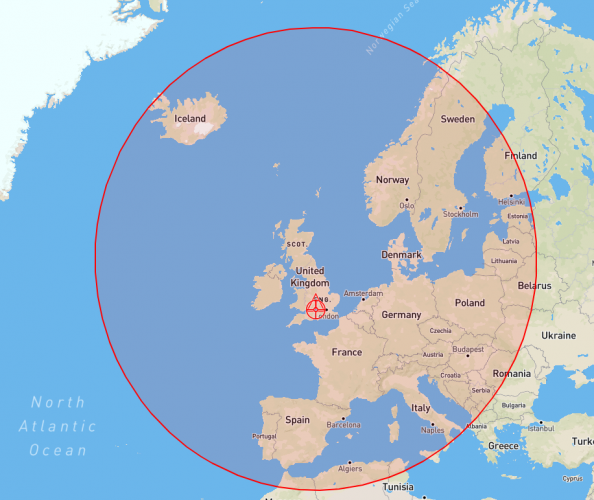
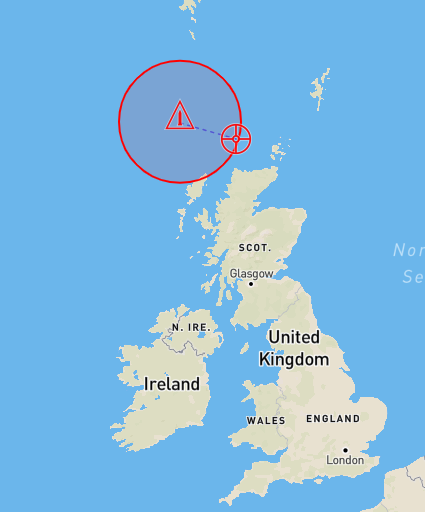
But is flexibility really what we need? The nature of the Russian threat to the UK is that it is (almost) omnidirectional, in contrast to the threat against Japan. Cruise missiles can hit the UK from a sector round from Brest to Bergen, and we have no idea of knowing where within that short of tracking every Russian sub, which I think is unlikely. A ship positioned 'upthreat' on the wrong vector would be useless. Compare the potential Kalibr launch areas (at middling 2000km range estimate) against Brize Norton against the angles covered off by 150km ASTER B1NT positioned NW of Scotland: It would take a heck of a lot of T91-83 groups to achieve coverage.

1758127383783.png 1758127592586.png

But move those ships ashore and it would only take two groups of 1 'LT-83' and '2 LT-91' each to achieve complete coverage (with missiles, at least) of the UK. No need to take up shipbuilding space, half the cost of the equivalent ships and no need to staff an engineering team!
 
But is flexibility really what we need? The nature of the Russian threat to the UK is that it is (almost) omnidirectional, in contrast to the threat against Japan.
I don't thing Type 83/Type 91 is there to protect the UK directly, it's an air/missile defence platform for the carriers or for the ASW barrier forces covering the GIUK Gap.
 
I don't thing Type 83/Type 91 is there to protect the UK directly, it's an air/missile defence platform for the carriers or for the ASW barrier forces covering the GIUK Gap.
I agree, but if you look at the posts I was replying to there was a suggestion (which has been made before) that part of T83's role should be defence of the UK rather than of the Fleet.
 
But is flexibility really what we need? The nature of the Russian threat to the UK is that it is (almost) omnidirectional, in contrast to the threat against Japan. Cruise missiles can hit the UK from a sector round from Brest to Bergen, and we have no idea of knowing where within that short of tracking every Russian sub, which I think is unlikely. A ship positioned 'upthreat' on the wrong vector would be useless. Compare the potential Kalibr launch areas (at middling 2000km range estimate) against Brize Norton against the angles covered off by 150km ASTER B1NT positioned NW of Scotland: It would take a heck of a lot of T91-83 groups to achieve coverage.

View attachment 785112 View attachment 785113

But move those ships ashore and it would only take two groups of 1 'LT-83' and '2 LT-91' each to achieve complete coverage (with missiles, at least) of the UK. No need to take up shipbuilding space, half the cost of the equivalent ships and no need to staff an engineering team!
My comment was specifically in reference to ballistic threats against the UK - Kalibr is a cruise missile system - and regarding the potential use of an exo-atmospheric interceptor like the SM-3. Sure, you can have a land-based system for the SM-3 as well (it already exists), but when working with missiles with the range of the SM-3, you don't stand to gain anything really from a land-based concept, except that you would guarantee 24/7 coverage.

My argument would then be whether the superior survivability and flexibility of a naval system outweigh the permanent presence of a ground-based system. I don't think it would, but that's just my take.

Additionally, I don't think a land-based version of FADS is a particularly suitable solution for cruise missile defence of the UK. Systems like Sky Sabre are lighter, more mobile, cheaper, would be available sooner, are simpler to operate and could provide better local area defence than, for example, a centrally-based LT-83, to use your terminology. You might be better off boosting the numbers of Wedgetail and Lightning/Typhoon airframes being procured and investing in linking those platforms with systems like Sky Sabre (perhaps borrowing from the FADS framework there) to improve performance.

One thing I'd ask to anyone with knowledge of the system is whether the level of training required to operate a Sky Sabre system would be prohibitive to manning those home-defence systems with reservists?
 
I agree, but if you look at the posts I was replying to there was a suggestion (which has been made before) that part of T83's role should be defence of the UK rather than of the Fleet.
I'm definitely in the fixed(ish) defences for fixed sites, mobile defences for mobile assets school of thought, which doesn't mean they shouldn't all be integrated with each other, it's not just 'what combat management system*, but 'what IAMDS'. Particularly if we want any kind of networked Forward Pass/CEC capability.

In theory (and it's a slightly wobbly theory at the moment), it shouldn't be the UK alone, the US has the East Anglian airfields to defend, plus any airheads for a 21stC version of Reforger, which would likely mean deployment of THAAD and/or Patriot; plus at sea Type 83 is likely to be cooperating with US and other NATO forces in the Norwegian Sea and North Atlantic, so whatever way we go, we probably need to integrate with JADC2 on the ground, and AEGIS/CEC at sea.

* Every time I see 'CMS' I think 'Content Management System', not Combat Management System.
 
My comment was specifically in reference to ballistic threats against the UK - Kalibr is a cruise missile system - and regarding the potential use of an exo-atmospheric interceptor like the SM-3. Sure, you can have a land-based system for the SM-3 as well (it already exists), but when working with missiles with the range of the SM-3, you don't stand to gain anything really from a land-based concept, except that you would guarantee 24/7 coverage.

My argument would then be whether the superior survivability and flexibility of a naval system outweigh the permanent presence of a ground-based system. I don't think it would, but that's just my take.

Additionally, I don't think a land-based version of FADS is a particularly suitable solution for cruise missile defence of the UK. Systems like Sky Sabre are lighter, more mobile, cheaper, would be available sooner, are simpler to operate and could provide better local area defence than, for example, a centrally-based LT-83, to use your terminology. You might be better off boosting the numbers of Wedgetail and Lightning/Typhoon airframes being procured and investing in linking those platforms with systems like Sky Sabre (perhaps borrowing from the FADS framework there) to improve performance.

One thing I'd ask to anyone with knowledge of the system is whether the level of training required to operate a Sky Sabre system would be prohibitive to manning those home-defence systems with reservists?
Yeah, misunderstood that. Sorry!
But the point still stands about land-based systems not only having near-constant availability but also costing significantly less as a result of not having to build maritime engines, a steel hull and damage control systems. If the combat systems on T91 and T83 are half of their cost, for example, and they have 1/3 availability, then that means 6 active L-FADS for the cost of a single naval SAG.
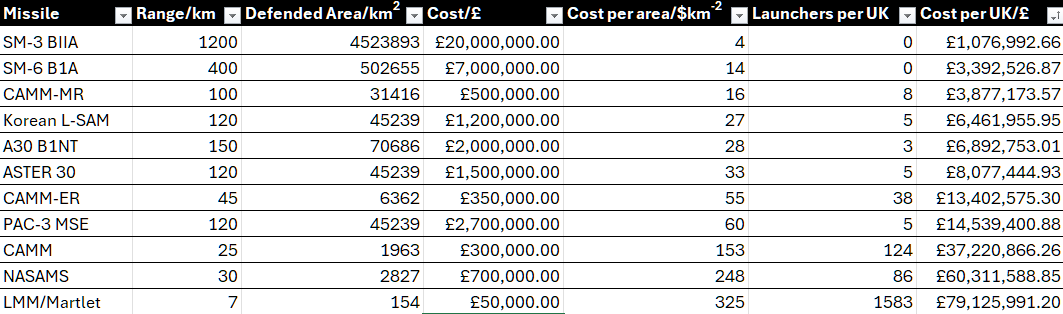
As for Sky Sabre being cheaper for UK GBAD, I've mocked up a table that compares the cost of missiles to their defended area, and the cost of covering the entirety of UK land area with launch sites (1 missile each for simplicity's sake, multiply by lots for proper coverage). It isn't perfect, as it essentially treats the defended umbrella as a liquid to be poured into Britain, but as a basic benchmark it is all right, I think. As you can see, longer ranged missiles are hugely more cost effective than shorter ranged ones:
1758138276628.png
The same rules apply to naval air defence of large fleet, though to a lesser extent because each individual ship is still defended as a point target.
 
Last edited:
Yeah, misunderstood that. Sorry!
But the point still stands about land-based systems not only having near-constant availability but also costing significantly less as a result of not having to build maritime engines, a steel hull and damage control systems. If the combat systems on T91 and T83 are half of their cost, for example, and they have 1/3 availability, then that means 6 active L-FADS for the cost of a single naval SAG
As for Sky Sabre being cheaper for UK GBAD, I've mocked up a table that compares the cost of missiles to their defended area, and the cost of covering the entirety of UK land area with launch sites (1 missile each for simplicity's sake, multiply by lots for proper coverage). It isn't perfect, as it essentially treats the defended umbrella as a liquid to be poured into Britain, but as a basic benchmark it is all right, I think. As you can see, longer ranged missiles are hugely more cost effective than shorter ranged ones:
View attachment 785135
No worries :)

Would the cost of designing, building and maintaining the infrastructure for static L-FADS not significantly outweigh the cost of simply increasing the number of Sky Sabre systems (excluding missiles for both) being bought?

From a capability perspective, especially against cruise missile flying at very low altitudes, would air-based interceptors, backed up by Sky Sabre, not be a more efficient and reliable way of downing those systems? For example, we roughly know that the base model Aster-30 can hit a cruise missile at roughly 25% of its disclosed range - given that cruise missiles are the principal threat that the UK faces, you suddenly need far more individual emplacements for L-FADS, or any ground-based system for that matter. On the other hand, a fighter jet, cued by an airborne radar, could cover that same area in a much more efficient way.

In my mind, the best way of doing UK IAMD would be to invest in more Typhoons, more Lightnings and more Wedgetails. Those are far more mobile, can cover more ground and wouldn't need new-build infrastructure to function. Then, back up those aerial interceptors by placing Sky Sabre systems at key points, and invest in some early warning radars. I wouldn't spend on static ground-based radars or launchers given that they'd be limited in their detection and interception ranges, unless purchased in massive quantities.

That said, your point about missile prices corresponding inversely to range is something I hadn't had the wherewithal to check out myself. I'm just a 'chairborne commando' as well, so I could be missing something key there. ;)
 
As for Sky Sabre being cheaper for UK GBAD,
If you look at BMD, it's not even a cost issue, but a capability issue. The expensive systems with large area coverage tend to be the fast movers that have the kinematics for IRBM interception, while the smaller/cheaper systems are really only capable if it's coming right at them.
 
Misunderstandings abound.

Striking back is integral to the future air defence/dominance system of systems.
FADS and Sky Sabre be systems, but effectors a.k.a missiles be a component. Not the whole.
CAMM has proved integration to Patriot and IBCS.
It is sensor agnostic.
Sky Sabre to intigrate into Sky Keeper which in turn will see future strike back along axis of source of threat.
Integral to FADS is the same philosophy. Defence and defence through offence.

As a system of systems, FADS seems to be recipient of future AESA radar system. What is not openly discussed is the 'dark arts' of electronic warfare and surveillance.

So yes FADS on land is essentially what Sky Keeper or other sovereign domestic system of systems is to become. I wouldn't get too hung up on "this is for land and that is for sea"
 
I think that a fixed site is more vulnerable and less responsive than a naval system. Not only from saturation missile attack, but also from unconventional threats, as we've seen used in Ukraine. The advantage of being able to deploy that asset to other theatres if necessary is also appealing - for example, you could position it in the Med in the event of a belligerent Iran.

There's also the fiscal appeal of just expanding a planned capability, rather than investing in a new approach.
There's going to be at least one fixed site anyways, the radar test buildings. US has several "cornfield warships" of Tico, Burke, and even Zumwalt superstructures in concrete. Aegis Ashore seems to be a copy of the Tico forward superstructure building.
 
No worries :)

Would the cost of designing, building and maintaining the infrastructure for static L-FADS not significantly outweigh the cost of simply increasing the number of Sky Sabre systems (excluding missiles for both) being bought?

From a capability perspective, especially against cruise missile flying at very low altitudes, would air-based interceptors, backed up by Sky Sabre, not be a more efficient and reliable way of downing those systems? For example, we roughly know that the base model Aster-30 can hit a cruise missile at roughly 25% of its disclosed range - given that cruise missiles are the principal threat that the UK faces, you suddenly need far more individual emplacements for L-FADS, or any ground-based system for that matter. On the other hand, a fighter jet, cued by an airborne radar, could cover that same area in a much more efficient way.

In my mind, the best way of doing UK IAMD would be to invest in more Typhoons, more Lightnings and more Wedgetails. Those are far more mobile, can cover more ground and wouldn't need new-build infrastructure to function. Then, back up those aerial interceptors by placing Sky Sabre systems at key points, and invest in some early warning radars. I wouldn't spend on static ground-based radars or launchers given that they'd be limited in their detection and interception ranges, unless purchased in massive quantities.

That said, your point about missile prices corresponding inversely to range is something I hadn't had the wherewithal to check out myself. I'm just a 'chairborne commando' as well, so I could be missing something key there. ;)
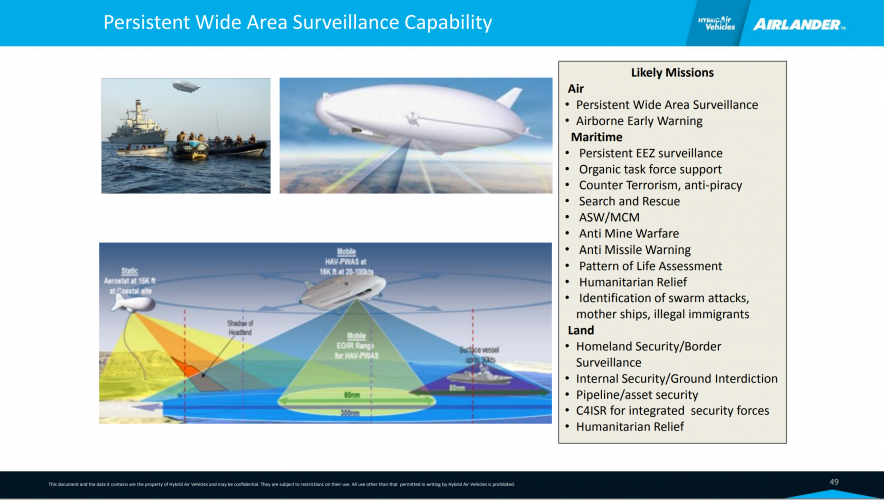
Air-based is a particularly interesting idea. Not the interceptors, I think, because that would suffer from the same issues as naval systems (especially with very complicated Typhoons) but some form of persistent airborne surveillance of the UK, that could also be deployed abroad (!) would be very helpful against the lower-flying threats. Something like Protector AEW with very long endurance would be good, or maybe even Airlander using a larger radar? Protector AEW could then be linked in with FADS at sea for carrier deployment, which would give the whole thing a certain symmetry.
Does anyone know if Russian cruise missiles are terrain following, or whether they instead achieve the longer range by flying at higher altitudes?
If the latter, then having radars on masts on hills- remembering that our coastlines are mostly hilly apart from the East Coast, so a radar in the East Midlands would be able to look out across the North Sea from near BZ, Coningsby etc.- isn't as limited as it would first seem. Adding 50-100m to the height above sea level would certainly be useful!
 
Air-based is a particularly interesting idea. Not the interceptors, I think, because that would suffer from the same issues as naval systems (especially with very complicated Typhoons) but some form of persistent airborne surveillance of the UK, that could also be deployed abroad (!) would be very helpful against the lower-flying threats. Something like Protector AEW with very long endurance would be good, or maybe even Airlander using a larger radar? Protector AEW could then be linked in with FADS at sea for carrier deployment, which would give the whole thing a certain symmetry.
Does anyone know if Russian cruise missiles are terrain following, or whether they instead achieve the longer range by flying at higher altitudes?
If the latter, then having radars on masts on hills- remembering that our coastlines are mostly hilly apart from the East Coast, so a radar in the East Midlands would be able to look out across the North Sea from near BZ, Coningsby etc.- isn't as limited as it would first seem. Adding 50-100m to the height above sea level would certainly be useful!
Persistent AEW, over home country?

Aerostats. A tethered blimp carrying the AEW radar. IIRC the US uses a couple of them to look for drug runners trying to infiltrate the Gulf Coast.
 
Persistent AEW, over home country?

Aerostats. A tethered blimp carrying the AEW radar. IIRC the US uses a couple of them to look for drug runners trying to infiltrate the Gulf Coast.
Hadn't considered that, thanks.
There are plenty of US and Israeli AEW aerostats around, and Poland has considered them specifically to look for low-flying drones and cruise missiles:https://www.twz.com/air/polands-plan-to-deploy-early-warning-radar-blimps-moves-forward
But I would hope that a UK or European solution would be available.
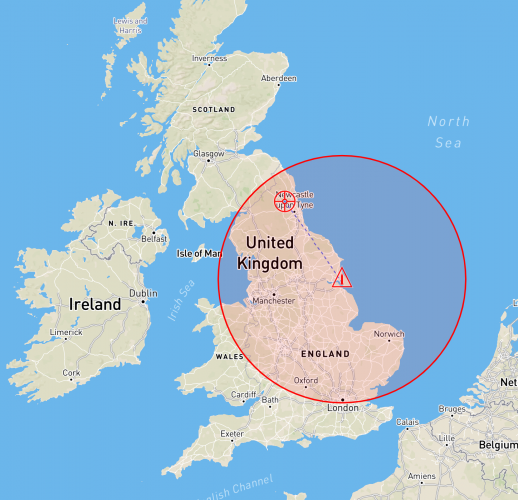
Edit: I've had a look on MissileMap to check what the area covered by a 250km range aerostat would be, I think you'd need 3-4 of them for full UK approaches coverage: Lossiemouth, Stranraer, Hull and Yeovil.
1758186339669.png
 
Last edited:
Persistent AEW, over home country?

Aerostats. A tethered blimp carrying the AEW radar. IIRC the US uses a couple of them to look for drug runners trying to infiltrate the Gulf Coast.
Something like a modern version of DARPAs Sentinel 5000 project perhaps, but with longer endurance. My Dad worked on this when he was at Airship Industries and then Westinghouse after AI collapsed into bankruptcy.

https://www.airshipsonline.com/airships/Sentinel_5000/index.html
 
Thats an airships... Way too complicated.

For homeland defense a tethered LTA hits the nail on the head. Installation cost should be pretty cheap as you only need to dig the base of the tether in. What's the soil condition around? Does Britain have strong, lasting wind that can hamper its operational capacity or put the blimp into danger zone of civvies? What should recovery looks like? Base security? Those are very pressing questions, and many more.
 
Hadn't considered that, thanks.
There are plenty of US and Israeli AEW aerostats around, and Poland has considered them specifically to look for low-flying drones and cruise missiles:https://www.twz.com/air/polands-plan-to-deploy-early-warning-radar-blimps-moves-forward
But I would hope that a UK or European solution would be available.
Edit: I've had a look on MissileMap to check what the area covered by a 250km range aerostat would be, I think you'd need 3-4 of them for full UK approaches coverage: Lossiemouth, Stranraer, Hull and Yeovil.
View attachment 785168
Though in theory blimps sound very attractive in ability to extend radar horizon at ground level, but in practice have proved impracticable, the US developed the Joint Land Attack Cruise Missile Elevated Netted Sensor System (JLENS) a 240-foot-long, helium-filled blimp, $2.8 billion program, but in a bad weather it escaped its moorings and after dragging its tether and snapping power lines across the country eventually crashed and Congress withdrew funding.

The Israeli aerosat Sky Dew ballon with its 250 km radar range was shot down over the Lebanon border by a Hezbollah drone and understand the $230 million program was cancelled.
 
Thats an airships... Way too complicated.

For homeland defense a tethered LTA hits the nail on the head. Installation cost should be pretty cheap as you only need to dig the base of the tether in. What's the soil condition around? Does Britain have strong, lasting wind that can hamper its operational capacity or put the blimp into danger zone of civvies? What should recovery looks like? Base security? Those are very pressing questions, and many more.
The difficulty with blimps will always be their sensitivity to wind speeds, which can't really be 'got around' when the whole of the UK can be covered by a single weather system. As a budget option they are fine, but if we were really serious about airborne sensors then I think Airlander is pretty much an ideal solution:
1758190317842.png
UK built, plenty of power for a big radar (nearly but not quite Wedgetail size) and can deploy wherever needed. We'd just have to adapt the RAF's mission planning to longer endurance (5 days!), slower-moving sorties. I'm not sure how much they would cost to build, and I don't know if HAV do either, but we'd only need 4-5 of them to guarantee UK coverage given the amount of time each would spend airborne. Again each one could be integrated with the CSG if HAV follow through with their 'vertical RAS' idea for refuelling and crew changes at sea.
Now, I'm not sure if there's a UK GBAD thread, maybe it's worth moving there?
 
Though in theory blimps sound very attractive in ability to extend radar horizon at ground level, but in practice have proved impracticable, the US developed the Joint Land Attack Cruise Missile Elevated Netted Sensor System (JLENS) a 240-foot-long, helium-filled blimp, $2.8 billion program, but in a bad weather it escaped its moorings and after dragging its tether and snapping power lines across the country eventually crashed and Congress withdrew funding.

The Israeli aerosat Sky Dew ballon with its 250 km radar range was shot down over the Lebanon border by a Hezbollah drone and understand the $230 million program was cancelled.
Yep, blimps still have a lot of problem, both internal and external, to resolve. Like how do you stop people from smuggling in MANPADs and AMRs that can poke a hole into it one mile away and then full throttle on the run.

I suppose JLENS's issue stems from the need for mobility which undercut many simpler, sturdier arrangement. Instead of a mobile drill truck just put the moor deep into bedrock and voila.
But weather challenges still remains.
 
Good luck with that. Where exactly does the UK think they have a good place to launch from?!? :D

It would cost billions....but Ascension Island is near perfect...
There's going to be at least one fixed site anyways, the radar test buildings.

There's one in the UK....directly above Portsmouth. BAE Systems MISC....a Type 45 on land. All we'd need to do is man it and add a VLS....

https://www.volkerfitzpatrick.co.uk/en/projects/maritime-integration-and-support-centre-misc
https://maps.app.goo.gl/f16CEK9WBghDPXEK6
 
Can we move blimps airships and other such talk to some thread that's appropriate.
Because this thread's title is it's subject and it's not blimps airships etc..

Type 83 is likely to be tested as a shoreside facility. Just as previous systems have.
 
Can we move blimps airships and other such talk to some thread that's appropriate.
Because this thread's title is it's subject and it's not blimps airships etc..

Type 83 is likely to be tested as a shoreside facility. Just as previous systems have.
If anyone else wants to continue the discussion on blimps, airships and other such talk, I've done a summary on the thread "Air Defence of Great Britain" of radar ranges and positioning for the various ground and airborne options.
 
If anyone else wants to continue the discussion on blimps, airships and other such talk, I've done a summary on the thread "Air Defence of Great Britain" of radar ranges and positioning for the various ground and airborne options.
Excellent!
I look forward to reading that.
 
It would cost billions....but Ascension Island is near perfect...
Yeah, that's what I was assuming the UK was talking about.

But a good polar orbit launch site is a very good idea to have. Vandenburg is not a great site for polar orbits, but it's much better than Florida.


There's one in the UK....directly above Portsmouth. BAE Systems MISC....a Type 45 on land. All we'd need to do is man it and add a VLS....
Exactly! (And they'll probably make another one for the Type 83)
 
https://www.navylookout.com/bae-systems-concepts-for-royal-navys-future-air-dominance-system/
Three design variants have been developed by BAES. The high end version of the AWCS is a 160-metre air warfare destroyer/light cruiser of around 10,000 tons. This is a large but conventional warship design, armed with up to 128 vertical launch system cells, directed-energy weapons, 57mm and 40mm guns.

The mid-sized 150-metre variant retains many of the same characteristics but places greater emphasis on automation, ease of manufacture and reduced crewing. A low-budget 130-metre option, derived from the earlier Adaptable Strike Frigate concept, has been paused after running into equipment density and cooling limitations, but could be revived if needed.
 
If true I'd choose space and stability margins over risky technology solutions.
Because you can bet your bottom dollar No.11 (Treasury) will prefer the smallest option.

But it's likely these three options be aimed at manipulation to get funding for the middle option. With those oh so tempting promises of automation, 'ease of manufacture' and lean crew numbers.
 
The RN has gone for the bigger options in its recent surface combatant procurement programmes. The Babcock AH140 was the biggest of the contenders for the Type 31 programme IIRC, and the Type 26 was also pretty big.

It wouldn't be out of nowhere for the decision to go to the larger hull, though perhaps FFBNW some of those missile launch cells.

The article mentions export - I'm struggling to think about who would need a destroyer this size that wouldn't simply build their own. Australia, or the Dutch perhaps? The Nordic navies would prefer a smaller solution I think - perhaps exporting the CMS, radar and drone systems as opposed to the whole ship.
 
Status
Not open for further replies.

Similar threads

Back
Top Bottom